Infographics Powered by SAS:: Data Visualization
Techniques for Business Reporting 1st Edition
Travis Murphy pdf download
https://textbookfull.com/product/infographics-powered-by-sas-
data-visualization-techniques-for-business-reporting-1st-edition-
travis-murphy/
Download more ebook from https://textbookfull.com
We believe these products will be a great fit for you. Click
the link to download now, or visit textbookfull.com
to discover even more!
Infographics Powered by SAS:: Data Visualization
Techniques for Business Reporting 1st Edition Travis
Murphy
https://textbookfull.com/product/infographics-powered-by-sas-
data-visualization-techniques-for-business-reporting-1st-edition-
travis-murphy/
Coulson and Richardson’s Chemical Engineering, Fourth
Edition: Volume 3A: Chemical and Biochemical Reactors
and Reaction Engineering R. Ravi
https://textbookfull.com/product/coulson-and-richardsons-
chemical-engineering-fourth-edition-volume-3a-chemical-and-
biochemical-reactors-and-reaction-engineering-r-ravi/
Matplotlib for Python Developers Effective techniques
for data visualization with Python 2nd Edition Yim
https://textbookfull.com/product/matplotlib-for-python-
developers-effective-techniques-for-data-visualization-with-
python-2nd-edition-yim/
Taken by Pirates 1st Edition Haley Travis
https://textbookfull.com/product/taken-by-pirates-1st-edition-
haley-travis/
Essential Methods for Planning Practitioners : Skills
and Techniques for Data Analysis, Visualization, and
Communication 1st Edition Laxmi Ramasubramanian
https://textbookfull.com/product/essential-methods-for-planning-
practitioners-skills-and-techniques-for-data-analysis-
visualization-and-communication-1st-edition-laxmi-
ramasubramanian/
Mastering the SAS DS2 Procedure Advanced Data Wrangling
Techniques Second Edition Mark Jordan
https://textbookfull.com/product/mastering-the-sas-ds2-procedure-
advanced-data-wrangling-techniques-second-edition-mark-jordan/
Data Visualization for People of All Ages (AK Peters
Visualization Series) 1st Edition Nancy Organ
https://textbookfull.com/product/data-visualization-for-people-
of-all-ages-ak-peters-visualization-series-1st-edition-nancy-
organ/
Interactive Data Visualization for the Web Murray
https://textbookfull.com/product/interactive-data-visualization-
for-the-web-murray/
Jumpstart Tableau A Step By Step Guide to Better Data
Visualization 1st Edition Arshad Khan
https://textbookfull.com/product/jumpstart-tableau-a-step-by-
step-guide-to-better-data-visualization-1st-edition-arshad-khan/
Recommended / Playlists / History / Topics / Tutorials / Settings / Support / Get the App / Sign Out
© 2018 Safari. Terms of Service / Privacy Policy
NEXT
Infographics Powered by SAS®: Data Visuali… ⏭
🔎


 Infographics Powered by SAS
Find answers on the fly, or master something new. Subscribe today. See pricing options.
Recommended / Playlists / History / Topics / Tutorials / Settings / Support / Get the App / Sign Out
© 2018 Safari. Terms of Service / Privacy Policy
Contents
About This Book
About the Author
Acknowledgments
Part 1: Concepts
Chapter 1: Getting Started
Introduction
Infographics Today
The Goal
Chapter 2: Visual Tour of Infographics
Overview
Audience
Power of Infographics
Origins of Infographics
Types of Infographics
Artistic Infographics
Business Infographics
Information Fragments: A Common Subcategory
SAS Sees the Value in Infographics
Chapter 3: Art versus Science
Overview
Audience
Artistic Freedom versus Communication
Traditional Personas
Traditional Outputs
Spreadsheets
Dashboards
Reports
Email
Presentations
Infographics
Flexible Tools
Chapter 4: Changing Technology Landscape
Overview
Audience
Technology
Market Trends for Data Visualization
API Economy and the Age of Analytics
Technology Improvements Continue to Drive Innovation
Chapter 5: General Considerations for Designing Infographics
Overview
Audience
Analytics for Everyone
Data Visualization 101: The Basics
Data Accuracy
Storytelling
Foundations of Visual Perception
Elements of an Infographic
Quantitative: Data-Driven Elements
Subjective: Creative Elements
Designing an Infographic
Designing for Audience
Designing for the Non-designer
Top-Ten Infographic Elements
Infographic Toolkit
Chapter 6: Data to Insight
Overview
Audience
The Challenge: From Data to Insight
Exploring the Requirements Continuum
Exploring the Roles Continuum
Chapter 7: The Platform – a Business Engine
Overview
Audience
SAS and the Analytics Lifecycle
Data: Fuel for Decisions
Discovery: Make Data-Driven Decisions
Deployment: Drive the Business Where It Happens
Part 2: SAS Tools and Worked Examples
Chapter 8: The Tools: Software Used in this Book
Overview
Audience
Tools Overview
SAS Add-In for Microsoft Office
Capability Overview
Typical Use Cases
Tools Used
SAS Visual Analytics
Capability Overview
SAS Visual Analytics Capabilities
Typical Use Cases
Tools Used
SAS Code
Design Intent
Typical Use Cases
Tools Used
SAS Studio
Capability Overview
Typical Use Cases
Tools Used
Chapter 9: Worked Examples
Overview
Audience
Sample Files
Creative Content
Tools
Ready, Set, Go!
Chapter 10: Example 1: SAS and Microsoft PowerPoint
Overview
Audience
Sample Files
Getting Started with SAS and Microsoft Office
Step Zero: Start with a Mockup Design
Step 1: Open the Template in PowerPoint
Step 2: Connecting to SAS Visual Analytics
Step 3: Deciding What Content to Leverage from SAS
Report 1: The Sales Performance Dashboard
Report 2: Ad Hoc Analysis on Sales Performance
Step 4: Unifying the Content Elements
Step 5: Adding Elements to the Microsoft PowerPoint Document
From the Sales Dashboard: Report 1 Elements
From the Data Exploration: Report 2 Element
Step 6: The Final Touches
Step 7: Share the Infographic
Why Use this Approach?
Examples Gallery
Chapter 11: Example 2: SAS and Microsoft Excel
Overview
Audience
Sample Files
Enhance with Analytics
Step Zero: Create a Strawman Design for the Infographic
Step 1: Using SAS and Microsoft Excel
Step 2: Working with SAS Visual Analytics Report and Microsoft Excel
Step 2a: Insert the Heatmap
Step 2b: Insert the Word Cloud
Step 3: Add the Key Values from SAS Visual Analytics
Step 4: Using a SAS Stored Process inside Microsoft Excel
Step 5: Tell SAS Where to Put the SAS Stored Process Output
Step 6: Move the SAS Stored Process Output to the Desired Location in the Infographic
Using SAS Code Directly inside Microsoft Excel
Step 7: The Final Touches
Step 8: Share the Infographic
Examples Gallery
Chapter 12: Example 3: SAS Visual Analytics Infographic Inspired Dashboards
Overview
Audience
Sample Files
Step 1: Start with Your Idea and Rough Design
Step 2: Explore Your Data
Step 3: Build the Basic Infographic
Sales Performance: Set Up Our Basic Infographic
Top Container
Middle Container
Bottom Container
Step 4: Add some Approachable Analytics
Geo Maps: Bringing Data to Life
Add Some Advanced Analytics
Add Analytics Objects to Examples
Step 5: Add External Graphics
Add Custom Data-Driven Content
Step 5a: Adding the Data-Driven Content: Example using the Condegram
Step 5b: Adding Data-Driven Content: Third-Party Graphic
Step 6: Add Interactivity
Step 6a: Setting Automatic Actions
Step 6b: Adding an Additional Data-Driven Content Object
Step 7: Share the Infographic
Examples Gallery
Chapter 13: Example 4: SAS Code to Create Infographics
Overview
Audience
Sample Files
Using SAS Code for Data Visualization
Example 4.1: Custom Business Infographic Poster
Step 1: Design
Step 2: Required Elements
Step 3: Walking through the Code
Step 4: Run Time
Example 4.2: Social Media Tiles
Step 1: Design
Step 2: Required Elements
Step 3: Walking through the Code
Step 4: Run Time
Examples Gallery
Chapter 14: Where to Go from Here?
Overview
Audience
Which Approach Do I Choose?
Pathways and Training Resources
Free Video Library
"Ask the Experts" Series
SAS YouTube Channel
Future Trends
Open
Motion Infographics
Massive Data
Real-Time Infographics
Age of Automation
Crowd Sourcing / Data for Good
Hyper-Personalization
Evolution of Personal Productivity
Closing Comment
Bibliography
Appendix A: The Data – Why this Data? (Sample Data)
Data Overview
Data Location
Data Enrichment
Geographic Data Items
Other Data Items
Index
PREV
Infographics Powered by SAS®: Data Visuali…
⏮
NEXT
About This Book ⏭
🔎


 Infographics Powered by SAS
Find answers on the fly, or master something new. Subscribe today. See pricing options.
Recommended / Playlists / History / Topics / Tutorials / Settings / Support / Get the App / Sign Out
© 2018 Safari. Terms of Service / Privacy Policy
Chapter 1
Getting Started
Introduction
Infographics Today
The Goal
INTRODUCTION
“A picture is worth a thousand words”. This overused phrase is almost mundane these days. However, it is truer
than ever in history. A picture is worth a billion words might be a better representation of what is today's reality.
There are many reasons why this is the case, and we will explore this further in the chapters ahead.
The world is at a point where the attention span of a consumer is only about eight seconds (McSpadden, 2015). If
something doesn't grab their attention, chances are they will move on. Not only will they move on, but most of the
time they won't come back. This has created a shift in the massive growth of infographics to quickly show data-
driven visuals for immediate impact. According to Just and Ludtke (2010), there is a reason for this growth in
infographics:
“Now you can circumvent written language to a large extent. A lot of printed words are there to describe things that
occur spatially. In many cases a picture is worth a thousand words. Now we can generate these pictures and
graphics and we can convey them to other people very easily. I think it's inevitable that visual media are going to
become more important in conveying ideas and not just about raging fires.”
Marcel Just, Center for Cognitive Brain Imaging at Carnegie Mellon University, 2010.
As the quote implies, and as many instinctive and logical proof points show, visualization is a more effective way of
getting a reaction from the audience. It is proven that data presented visually is more easily processed by the brain
than looking at the tabular format or words alone (Dale, 1969).
Business analysts need to adapt to this shift in the audience's attention span and combine visuals with the massive
amount of available data. We need to combine creative infographics with big data to take advantage of the
opportunities that the data presents. The boardroom, just like the classroom, has a much shorter attention span for
consuming information and reaching the “Aha” moment as fast as possible. The emergence and growth of many
data visualization tools have placed infographics and data visualization at the forefront when considering business
intelligence solutions.
INFOGRAPHICS TODAY
All infographics have their place, and when used correctly, they can have a great impact on the intended audience.
The infographics outlined in this book combine artistic elements (such as clip art and background images) with
data-driven content from the corporate data warehouse or the big data platform. Traditionally, the infographic
creator/author needed to spend a large amount of time with tools such as Microsoft Excel or certain programming
languages to develop and craft the correct data to support the right visualization. This is not the case anymore.
What has changed is the vast increase in data: the volume, the variety, and the velocity. The Internet of Things and
surrounding applications guarantee the continued growth in data assets. The importance of data visualization will be
the difference between noticing a pattern or missing a pattern altogether. To add to this, business analysts need to
do what they did in multiple pages in a dashboard now in eight seconds to capture the audience. Business analysts
must provide insight and create a reason for the audience to click through to more detailed information. This is
where the infographic comes in.
One only caveat is that pictures and visualizations themselves should not impede the message or the clarity of the
information being communicated. I know from personal experience, working on many data warehouse projects, that
all stakeholders, whether executive or line manager, need to be guided on a path, a repeatable path, to the insight
that is being communicated from the data platform. SAS has been a leader in data visualization for more than 40
years. Over the years, SAS tools have improved so as to be more approachable for more people within an
organization.
Today, analysts do not have to write code to get great visualization from the data. They don't have to spend hours
using scripts and spreadsheets to craft the data into a usable format. The analyst can start to be more creative on
the visual layer and to place better visualization in their infographics. This book is not focused on the theory of
design for infographics. I will leave that to the graphic designers, data journalists, and visual artists of the world.
This book focuses on the SAS analytic engine and associated software to make extremely powerful tools available
to the business analyst to better create infographics.
THE GOAL
Of course, there are other tools that are very well-suited for a graphic artist, and they too have a barrier to entry with
many years of education required to become proficient. On the flipside, our aim is to create a business-ready
environment to take some of the benefits of the infographics to the enterprise stakeholders or the c-level executive
in the boardroom. Today more than ever before, organizations must continue to innovate in methods and
approaches on how we capture the attention of our business stakeholders. This book shows you that you have an
option, right now, with your current SAS investment.
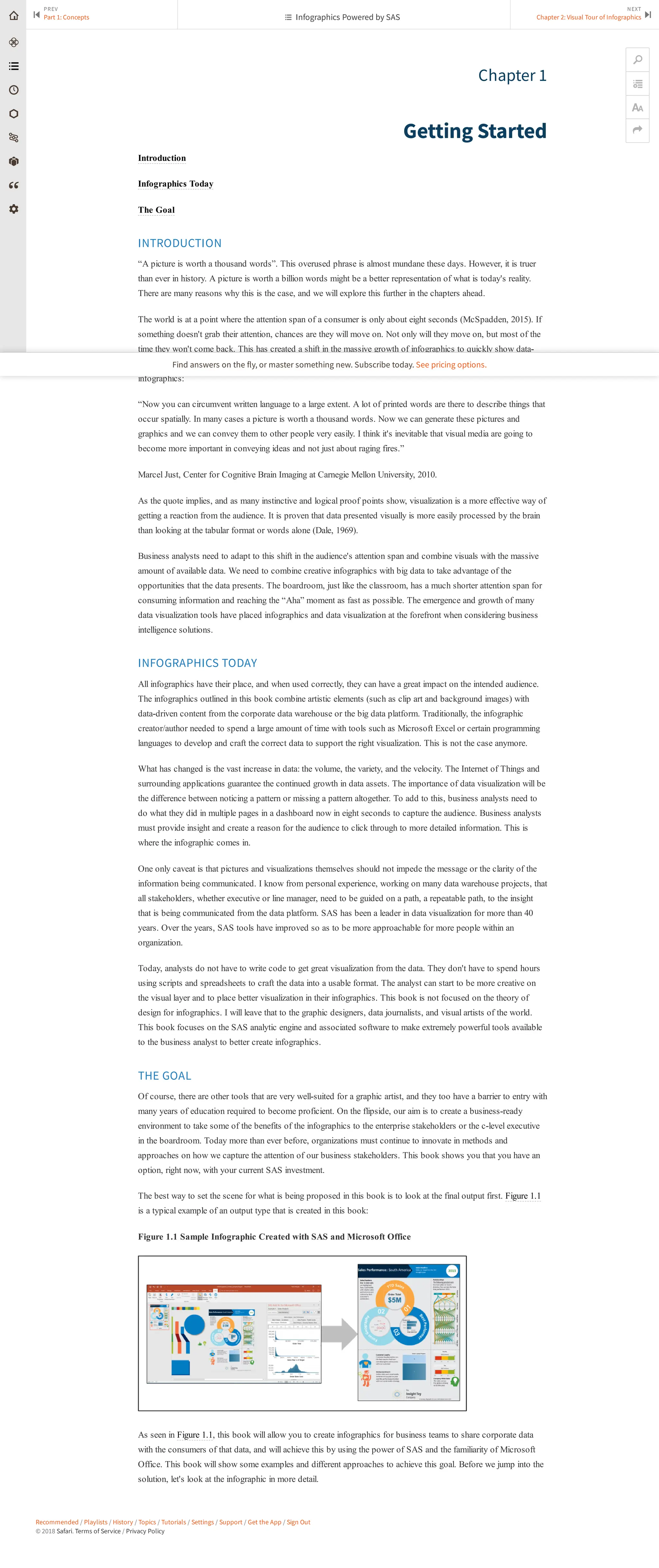
The best way to set the scene for what is being proposed in this book is to look at the final output first. Figure 1.1
is a typical example of an output type that is created in this book:
Figure 1.1 Sample Infographic Created with SAS and Microsoft Office
As seen in Figure 1.1, this book will allow you to create infographics for business teams to share corporate data
with the consumers of that data, and will achieve this by using the power of SAS and the familiarity of Microsoft
Office. This book will show some examples and different approaches to achieve this goal. Before we jump into the
solution, let's look at the infographic in more detail.
PREV
Part 1: Concepts
⏮
NEXT
Chapter 2: Visual Tour of Infographics ⏭
🔎


 Infographics Powered by SAS
Find answers on the fly, or master something new. Subscribe today. See pricing options.
Recommended / Playlists / History / Topics / Tutorials / Settings / Support / Get the App / Sign Out
© 2018 Safari. Terms of Service / Privacy Policy
Chapter 3
Art versus Science
Overview
Audience
Artistic Freedom versus Communication
Traditional Personas
Traditional Outputs
Spreadsheets
Dashboards
Reports
Email
Presentations
Infographics
Flexible Tools
OVERVIEW
The aim of this chapter is to outline the importance of design and the ability to strike a balance between a robust
and repeatable data-driven approach when designing an infographic. This chapter explores the combination of
being a data artist while still being a data scientist. We look at how graphic design sensibilities are useful in business
today when they don’t take away from the clarity of the message being shared from the data.
AUDIENCE
This chapter is designed for all SAS skill levels and is an important foundation for the remainder of the book.
ARTISTIC FREEDOM VERSUS COMMUNICATION
Data analysts struggle with today’s requirements to present data in a highly visual and appealing manner. I remember
predictions that the shift from print to online media would shatter the graphic design industry. What I saw instead
was a huge opportunity for online content to apply visual elements in order to compete and remain engaging. I
believe this has been proven with the rise of graphic art in today's world especially in marketing practices.
We might have heard about and read the theory that people understand visual communication better than any other
format. In my research for this book, I came across many perspectives that share this basic point of view. Science
tells us that half the human brain is involved with visual processing (Merieb and Hoehn, 2007) and that 70% of all
sensory receptors are located in the eyes (Merieb and Hoehn, 2007), which tells us that humans are all about the
visuals. If humans can process context and get a sense of a visual scene in one-tenth of a second, this knowledge
should motivate information producers to make their information more easily understood (Semetko and Scammell,
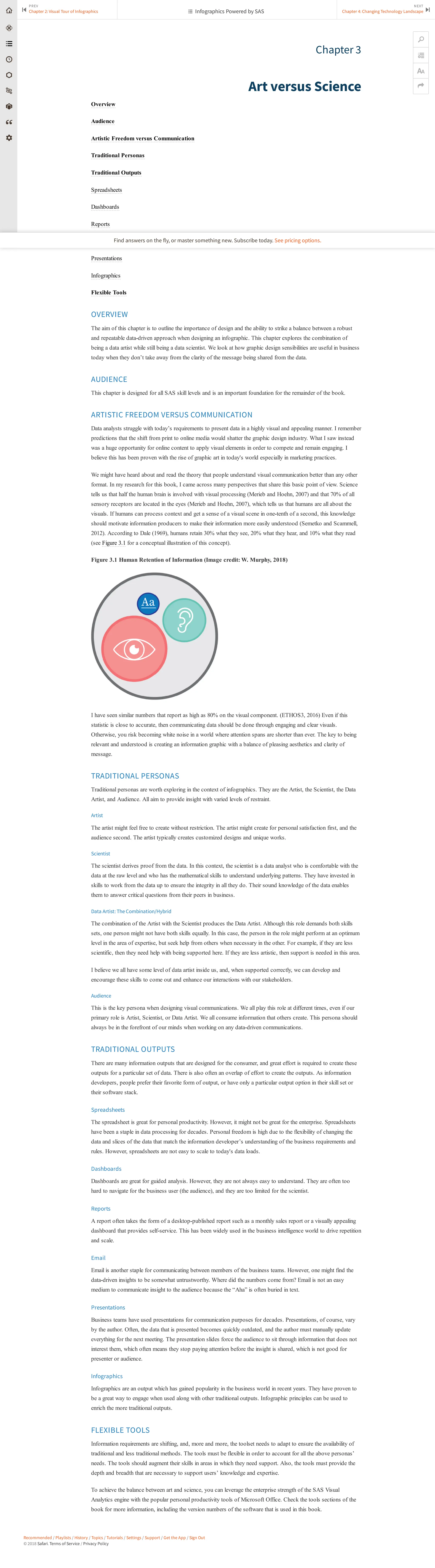
2012). According to Dale (1969), humans retain 30% what they see, 20% what they hear, and 10% what they read
(see Figure 3.1 for a conceptual illustration of this concept).
Figure 3.1 Human Retention of Information (Image credit: W. Murphy, 2018)
I have seen similar numbers that report as high as 80% on the visual component. (ETHOS3, 2016) Even if this
statistic is close to accurate, then communicating data should be done through engaging and clear visuals.
Otherwise, you risk becoming white noise in a world where attention spans are shorter than ever. The key to being
relevant and understood is creating an information graphic with a balance of pleasing aesthetics and clarity of
message.
TRADITIONAL PERSONAS
Traditional personas are worth exploring in the context of infographics. They are the Artist, the Scientist, the Data
Artist, and Audience. All aim to provide insight with varied levels of restraint.
Artist
The artist might feel free to create without restriction. The artist might create for personal satisfaction first, and the
audience second. The artist typically creates customized designs and unique works.
Scientist
The scientist derives proof from the data. In this context, the scientist is a data analyst who is comfortable with the
data at the raw level and who has the mathematical skills to understand underlying patterns. They have invested in
skills to work from the data up to ensure the integrity in all they do. Their sound knowledge of the data enables
them to answer critical questions from their peers in business.
Data Artist: The Combination/Hybrid
The combination of the Artist with the Scientist produces the Data Artist. Although this role demands both skills
sets, one person might not have both skills equally. In this case, the person in the role might perform at an optimum
level in the area of expertise, but seek help from others when necessary in the other. For example, if they are less
scientific, then they need help with being supported here. If they are less artistic, then support is needed in this area.
I believe we all have some level of data artist inside us, and, when supported correctly, we can develop and
encourage these skills to come out and enhance our interactions with our stakeholders.
Audience
This is the key persona when designing visual communications. We all play this role at different times, even if our
primary role is Artist, Scientist, or Data Artist. We all consume information that others create. This persona should
always be in the forefront of our minds when working on any data-driven communications.
TRADITIONAL OUTPUTS
There are many information outputs that are designed for the consumer, and great effort is required to create these
outputs for a particular set of data. There is also often an overlap of effort to create the outputs. As information
developers, people prefer their favorite form of output, or have only a particular output option in their skill set or
their software stack.
Spreadsheets
The spreadsheet is great for personal productivity. However, it might not be great for the enterprise. Spreadsheets
have been a staple in data processing for decades. Personal freedom is high due to the flexibility of changing the
data and slices of the data that match the information developer’s understanding of the business requirements and
rules. However, spreadsheets are not easy to scale to today's data loads.
Dashboards
Dashboards are great for guided analysis. However, they are not always easy to understand. They are often too
hard to navigate for the business user (the audience), and they are too limited for the scientist.
Reports
A report often takes the form of a desktop-published report such as a monthly sales report or a visually appealing
dashboard that provides self-service. This has been widely used in the business intelligence world to drive repetition
and scale.
Email
Email is another staple for communicating between members of the business teams. However, one might find the
data-driven insights to be somewhat untrustworthy. Where did the numbers come from? Email is not an easy
medium to communicate insight to the audience because the “Aha” is often buried in text.
Presentations
Business teams have used presentations for communication purposes for decades. Presentations, of course, vary
by the author. Often, the data that is presented becomes quickly outdated, and the author must manually update
everything for the next meeting. The presentation slides force the audience to sit through information that does not
interest them, which often means they stop paying attention before the insight is shared, which is not good for
presenter or audience.
Infographics
Infographics are an output which has gained popularity in the business world in recent years. They have proven to
be a great way to engage when used along with other traditional outputs. Infographic principles can be used to
enrich the more traditional outputs.
FLEXIBLE TOOLS
Information requirements are shifting, and, more and more, the toolset needs to adapt to ensure the availability of
traditional and less traditional methods. The tools must be flexible in order to account for all the above personas’
needs. The tools should augment their skills in areas in which they need support. Also, the tools must provide the
depth and breadth that are necessary to support users’ knowledge and expertise.
To achieve the balance between art and science, you can leverage the enterprise strength of the SAS Visual
Analytics engine with the popular personal productivity tools of Microsoft Office. Check the tools sections of the
book for more information, including the version numbers of the software that is used in this book.
PREV
Chapter 2: Visual Tour of Infographics
⏮
NEXT
Chapter 4: Changing Technology Landscape ⏭
🔎


 Infographics Powered by SAS
Find answers on the fly, or master something new. Subscribe today. See pricing options.
Recommended / Playlists / History / Topics / Tutorials / Settings / Support / Get the App / Sign Out
© 2018 Safari. Terms of Service / Privacy Policy
Chapter 4
Changing Technology Landscape
Overview
Audience
Technology
Market Trends for Data Visualization
API Economy and the Age of Analytics
Technology Improvements Continue to Drive Innovation
OVERVIEW
This chapter talks about the shifting sands of technology and the impact on infographic design and consumption.
Information delivery has evolved from its origins in spreadsheets, PDF documents and Adobe Flash deliverables
and has moved to the world that we are in today with interactive technologies like HTML5. The movement from
static deliverables toward a visual and interactive medium challenges all companies in the technology industry to
adapt to new demands or risk becoming obsolete.
The aim of this chapter is to provide the reader with a reference of why this is important today more than ever and
how the Internet of Things (IoT) and digital culture has demanded a new approach in order to engage stakeholders.
Big data in the era of IoT requires that a story is told using visuals to elevate the narrative to an audience who lacks
the time and skill in analyzing the results. Spreadsheets no longer “cut the mustard.” Data visualization and
infographics are a great way to derive value from this vast data.
AUDIENCE
This chapter will be interesting to novice SAS users who are starting to understand the importance of technology
for enabling the business to achieve their goals. Furthermore, advanced SAS programmers will see the business
context and the impact of technology.
TECHNOLOGY
In recent years, many new tools (open source and from vendors) have created a wave of interest like never before.
Some might say that the plethora of new tools is due to innovation and disruption. However, I say that the large
number of tools has responded to the growth of data. The explosion of data to be precise. More data requires new
ways to think about how to make sense of it all. According to Jim Goodnight, SAS CEO (Shaw, 2017):
"Over the past 40 years we have seen visualization go from standard X, Y charts to dashboards and scorecards but
frankly these do not work for dimensional data – it’s big data in overdrive."
SAS has been quick to adapt to this shift in big data with continuous improvement around how to apply analytics
to this growth in data. The examples in the book show the combination of big data analytics and traditional
techniques to support the belief that having the right options for all analysts is the correct approach. Many tools in
the market today look to solve some, rarely all, of what is needed for all analytics users in an enterprise. The right
tools should be selected according to the skills of the user who is analyzing the data.
I am totally onboard with this approach. Also, customers tell me that big data is not a problem for them, and they
have all they need to make their decisions. I would question these beliefs. More data is available today than what
organizations are using, and traditional tools for data analysis really can’t keep up. I believe that one reason
infographics are on the rise is because of this struggle to leverage the vast amount of available data.
MARKET TRENDS FOR DATA VISUALIZATION
Along with big data, other technology elements keep moving and will continue to drive innovation in the
requirements for information developers and the audience. Here are the technology elements that can help deliver
information:
● Mobile – create and consume content anywhere at anytime.
● Self-service – provides analytics, data wrangling and blending to all users.
● Cloud – removes barriers to entry for business teams.
● Cognitive – helps, wherever possible, to use machine learning and to strive toward artificial intelligence.
In her presentation at the 2017 SAS Global Forum in Orlando, Florida, Amanda Farnsworth said that when she
started her current role at the BBC in 2013, she observed users "switch from accessing from desktop to accessing
on mobile, and we were thinking of screens that shape, and tabs, and clicking, and interactivity, and the audience
had to work pretty hard to find some really important information" (Farnsworth, 2017).
In the same presentation, Farnsworth continued with noting where we are today:
"Now we think in the screen like this (mobile/smart phone), and scrolling, we have to adapt and unlearn some of
things we used to know about the job we do, and learn new techniques to engage an audience on smartphone"
(Farnsworth, 2017).
These quotations are validation that we need to change the way we think about communicating with stakeholders in
our businesses and to our customers or citizens. News is such a competitive industry, and we can all look to apply
these lessons from data journalists to other industries. No wonder this was such a popular talk at 2017 SAS Global
Forum: many industries are taking notice on how to engage customers with data and graphics.
API ECONOMY AND THE AGE OF ANALYTICS
The rise of the API (Application Programming Interface) has seen an urgency for integration. It is no longer
acceptable to be a silo in an organization. A data visualization toolset, and more broadly, an analytics engine, needs
to ensure that they can consume and be consumed by other technologies today. The API economy is seeing very
focused development of capabilities by both start-ups and Fortune 500s. I have former SAS colleague who is
involved with one such start-up and they continue to grow.
With these advances, we also see the age of analytics (Mckinsey, 2016), which exceeds the scope of this book.
Analytics continues to be a disruptor in many traditional markets such as driverless cars or Uber to the taxi
industry. As an illustration of disruption in the field of data visualization, bots are being used by organizations to
suggest possible infographic designs and insights for social media-ready data visualizations. Bots are even used to
automate publishing from existing information feeds. Analytics underpins the ability for true automation and is the
key to machine-to-machine communication. Analytics also supports the drive toward artificial intelligence (AI).
TECHNOLOGY IMPROVEMENTS CONTINUE TO DRIVE INNOVATION
At the heart of these shifts is advancement in technology: the cost of computing and the speed of computing.
Moore's law (projection of compute power doubling every two years) is a well-known theory on computing power
(Britannica, 2017). Whether you agree with the specifics of the theory, it illustrates the point well: compute power
continues to increase. The cost of this compute power is also reducing over time. This cost reduction opens up
more available computing power for more users and more organizations. Combined with the growth in available
data, and the lower cost, less technically complex deployment of this compute power via cloud platforms and
SaaS/PaaS vendors, we see more organizations looking to apply analytics to problems that they were not looking at
in the past.
The challenge and opportunity for IT vendors is to remove all barriers to access, deployment, and management of
the analytics platform for organizations. Innovation is key to taking advantage of these technological advances. SAS
continues to invest in Research and Development and to innovate on all layers of the analytics platform to assist
customers to take advantage of this shift in technologies.
The release of SAS Viya as part of the SAS platform, which is used in this book’s infographics examples, was
created to embrace these technology improvements outlined here.
PREV
Chapter 3: Art versus Science
⏮
NEXT
Chapter 5: General Considerations for Desi… ⏭
🔎


 Infographics Powered by SAS
Find answers on the fly, or master something new. Subscribe today. See pricing options.
Recommended / Playlists / History / Topics / Tutorials / Settings / Support / Get the App / Sign Out
© 2018 Safari. Terms of Service / Privacy Policy
Chapter 5
General Considerations for Designing
Infographics
Overview
Audience
Analytics for Everyone
Data Visualization 101: The Basics
Data Accuracy
Storytelling
Foundations of Visual Perception
Elements of an Infographic
Quantitative: Data-Driven Elements
Subjective: Creative Elements
Designing an Infographic
Designing for Audience
Designing for the Non-designer
Top-Ten Infographic Elements
Infographic Toolkit
OVERVIEW
This chapter highlights some of the considerations needed to get the most from infographics in your business. The
information in this chapter is based on my research for this book and on my experience working with customers
over the years to communicate insight from their data.
AUDIENCE
This is aimed at all SAS users who might be new to infographics.
ANALYTICS FOR EVERYONE
Similar to how data analysts benefit from a visual interpretation of data, a business user or executive stakeholder
might also benefit from data visualization.
The data alone is difficult to engage with for most consumers of data. It is not impossible, as proven by the
spreadsheet culture that has become entrenched in organizations over the past 30 years. The time spent in learning
the spreadsheet’s context for the data often exceeds the time spent in making business decisions from the data.
In the past, the spreadsheet was a useful and acceptable option because the volume of data was small enough so
that the user could get oriented and learn the context fairly quickly. Today, this is not the case. The volume of data
is too large and varied to use this approach.
Data analysis might be complex, but it does not have to be “ugly.” This complexity can be reduced by using
repeatable and approachable visualizations. Approachable software, such as SAS, can introduce users to concepts
that are learned and unlocked by seeing and understanding analytic models through visualization. In short, the
business data might change for each business question. However, the business analyst learns how to interpret the
visualization in context of the business data. Data visualization can drastically reduce the learning curve for the entire
organization. This is true self-service analytics.
DATA VISUALIZATION 101: THE BASICS
It is important to set a few rules about data visualization before we get too far downstream with infographic design.
Data Accuracy
According to Cool Infographics: Effective Communication with Data Visualization and Design (Krum, 2014),
the most important aspect of any infographic is accuracy. Everything else is secondary. The best way to ensure that
accuracy is achieved is to understand the data the best you can. Therefore, you need to explore the data first. You
need to check the numbers from many angles and confirm your understanding and assumptions. Then, you decide
on the important numbers that you want to highlight. Finally, you decide how to communicate the important
numbers in your infographic.
Storytelling
Telling the right story is supported by specific options that you have for displaying the data, but choosing the right
graph to visualize your data can be hard. It is easier when you consider the goal of your visualization. This handy
visual, designed by Dr. Andrew Abela and shown in Figure 5.1, provides some ideas on deciding what visualization
will tell the story that you want to tell. Of course, there are many more options that are available to visualize your
data. However, this approach can be useful for starting to frame the data visualization options.
Figure 5.1. Chart Suggestions (Image © Dr. Andrew V. Abela, 2017, www.ExtremePresentation.com)
Foundations of Visual Perception
In his book, Information Dashboard Design, Stephen Few discusses the Gestalt Principles of Visual Perception.
Research from the Gestalt school of psychology in 1912 focused on how we perceive pattern, form, and
organization, and many of their findings remain in practice today (Few, 2006).
From my research, how you decide on displaying the information in your infographic should be based on your
knowledge of how the audience processes the information you are highlighting. Some ideas to consider are the
proximity of related data, the use of similar shapes and colors for related data, and the grouping and connection of
data together for clear relationships.
As highlighted by Few:
“Two of the greatest challenges... are to make the most important data stand out from the rest, and to arrange what
is often a great deal of disparate information in a way that makes sense” (Few, 2006).
ELEMENTS OF AN INFOGRAPHIC
The following types of elements are a good foundation for data visualization and infographics design: quantitative
elements and subjective elements.
Quantitative: Data-Driven Elements
Choose the right visual or graphic to fit the situation. Choose carefully what you are aiming to highlight. Also, if a
graph is not the best way to communicate the data insight, use an image or a high-level number to highlight the
context of the data, according to the data. Dynamic text can also be powerful according to the data selected. Use a
data comprehension test before you build the data visualization. This means will your audience understand what
you are showing in your design.
Subjective: Creative Elements
Icons can assist with getting the point across quickly and can act as a reference, analogy, or metaphor. Symbolism
and metaphors can be a great way to anchor the message of your infographic, and often this means custom icons
or images. Text is also a great way to add some context to the infographic and to provide a layer of understanding.
This includes title text and explanatory comments.
Branding creates an identity for your content. This could also be a way of aligning your themes to the corporate
branding of your organization by using the logo or corporate colors. Colors do matter. Use color to highlight data,
rather than to distract the audience. We all struggle with this fine line of color and often use too much color. More is
not always better.
User experience is sometimes misplaced or forgotten, but ultimately user experience is what makes the infographic
hit its mark. What story are you telling, and how easy is it for the user to see, without you being there to guide them.
The best infographics are the ones that work on different levels. Someone who has a quick glance gets something
from it, and someone who spends more time gets something extra.
DESIGNING AN INFOGRAPHIC
Here is the process that I use to design an infographic:
1. Idea – Research and decide on what questions might be interesting to answer. Also, what data do you need in
order to answer the questions?
2. Design – Use a whiteboard or a piece of paper to get the ideas out of your head and into the real world. This
step should provide ideas for topic, context, and questions that I want to answer or highlight, and design ideas for
the infographic.
3. Discover – Do some iterations and use trial-and-error to see whether your ideas are achievable. Do some data
analysis and understand what is possible in achieving your design.
4. Deliver – How will you deliver the infographic, is it on-demand, or shared as a static image? What will the
infographic look like, is it an infofragment, or a poster? Patience and persistence will ensure that you build the best
infographic.
5. Share – Publish the infographic, and get it out to your audience. You can use a small group first if you have the
time, and this helps you catch anything that you might have missed before publishing to all.
6. Refine – Gather inputs from everywhere, refine your design, and build again. The feedback loop is important.
With each iteration, you get more of an idea of what your audience wants and how you can deliver the infographic
better each time.
Figure 5.2 shows a graphical summary of the process:
Figure 5.2. Infographic Creation Process
And yes, this creation process could be used for dashboards or other information products. However, it is very
useful when designing infographics of all types.
Experimenting is key in hitting the mark with your audience. In marketing to your customers, there are many
approaches to ensure that your message hits the mark, like using A-B testing methods to select the best marketing
message for a particular audience. This can provide the best "bang for buck" and make your message hit the mark
with your customer. Similarly, when designing information graphics, we need to test and refine the message and the
story with our intended audience.
DESIGNING FOR AUDIENCE
For years, I have used a simple, layered approach to designing information products. Here is a simple workflow for
your audience to follow their "line of thought":
1. Infofragment – This is the snippet of key information that hooks viewers and gets them asking for more.
2. Infographic – The infographic will provide more layers and information than the infofragment, as the viewer
investigates further.
3. Dashboard – The dashboard provides the viewer with self-service analysis and interactive slice-and-dice.
4. Data – Often, the viewer will require proof that the data in the dashboard is accurate, and they get this by
seeing the detailed data, in context.
5. Sharing – Collaboration and sharing is key to all steps, and collaboration should be consistent from start to
finish, as this sharing builds trust between audience and the data visualization.
Figure 5.3 shows a graphical summary of the process:
Figure 5.3. Information Navigation Flow
DESIGNING FOR THE NON-DESIGNER
You don’t have to be a graphic designer to make effective infographics. However, some self-education is a great
step forward. Get inspiration and be creative like a child. This is true with data visualization, and one way to do this
is to increase your inputs. Consider feedback from colleagues, websites and magazines, wherever ideas come.
Then, capture them on paper, the whiteboard, or digital tablet.
Here are some design tips for the non-designer:
● Ensure that your story is clear. No matter how much extra effort goes into the polish or sizzle, the story is
always key.
● Train yourself in some design principles if you can. It helps!
● Professional design teams can help add pizzazz. They take your idea and add the polish to make it shine.
● “Aspire to inspire” is design-speak for designing to make a difference to your audience. Try to make your
infographic matter.
● Less can be more. This is often true in many aspects of life, and is especially true with infographics.
● Know the value of white space. Content in your infographics will stand out and be clear if you get the spacing
just right.
● Channel your inner designer. Get out of your comfort zone and try new things. The more you do it, the better
you get in matching your message to your audience.
TOP-TEN INFOGRAPHIC ELEMENTS
These are simple, yet powerful data-driven visual elements for your infographic. There are many types of
visualizations that can highlight data. Table 5.1 includes my “Top Ten” approachable visualizations for use in
infographics, in no particular order:
Table 5.1. Top Ten Infographic Elements
Many more graph options are available depending on the story that needs to be told from the data. If you are like
me, you might find one option that you use for a while, and then move onto another one, which might be more
interesting to you and the audience.
INFOGRAPHIC TOOLKIT
It is sometimes hard to make a start with a task, but it is much easier when you have the tools to do what you need.
Here is a checklist to get you started with your infographic:
● A question to answer – This is the fun part. What do you want to highlight to the audience?
● Whiteboard or piece of paper – These are used to get the ideas into the real world, and they are key tools in
all information product design.
● Data (the bigger, the better) – There are more options for a story when you have more data. So, big data
really is big opportunity when designing infographics. (Public data sources such as http://www.data.gov or
http://www.open.canada.ca are good places to start. There are some great articles online that have done the hard
work for you. Many articles provide links to particular open data).
● Third-party graphics – Like clip art is to typical business presentations, a good stock image and icon library is
useful for infographics. Examples are at http://www.istockphoto.com, or free at http://www.freepik.com.
● Color – Get your color scheme organized early for less rework later. Some websites are really useful for
generating compatible colors for use in your infographic. Two examples are Color Wheel
(https://color.adobe.com/create/color-wheel) and Color Calculator (https://www.sessions.edu/color-calculator/).
● Software (in this case, SAS and Microsoft Office).
PREV
Chapter 4: Changing Technology Landscape
⏮
NEXT
Chapter 6: Data to Insight ⏭
🔎


 Infographics Powered by SAS
Find answers on the fly, or master something new. Subscribe today. See pricing options.
Recommended / Playlists / History / Topics / Tutorials / Settings / Support / Get the App / Sign Out
© 2018 Safari. Terms of Service / Privacy Policy
Chapter 6
Data to Insight
Overview
Audience
The Challenge: From Data to Insight
Exploring the Requirements Continuum
Exploring the Roles Continuum
OVERVIEW
You might have read the title of this book and thought SAS is not a toolset for creating infographics. I would
counter that SAS has been about creating information graphics to interpret data and information from the beginning
and continues to provide context and enhance data to provide insight. This book is focused on a particular
information product: the infographic.
AUDIENCE
This chapter has a little bit of everything for everyone. It discusses the roles and requirements for analytics and
what SAS considers to be important considerations for true enterprise analytics.
THE CHALLENGE: FROM DATA TO INSIGHT
Infographics are one way of communicating data through visualization. They are not the only information product
that does a great job of highlighting the value of data. SAS has focused heavily on approachable ways to analyze
data, to quickly focus on the value and to share insights.
The process to get the fastest insight from all available data requires us to understand the roles and requirements of
all users in the organization to achieve the outcomes that are needed today and to provide a path for their use of
data tomorrow and into the future. There is a growing need in organizations to enable all users to explore data and
share insights when and if they require it. SAS has focused on all information users and is always trying to ensure
that it provides the right tool for the right requirement.
The previous chapters contain ideas about creating infographics. So, let’s now look a little closer at all information
requirements and users in the enterprise. This chapter highlights the roles and requirements that users have in an
organization and opens the conversation that more than just pretty pictures are needed to change behaviors and get
competitive advantage.
Exploring the Requirements Continuum
Each user typically has an area of expertise within the requirements continuum. For example, consider the data
scientist who works in finance, but does not have expertise in the sales domain. This type of user would need some
guided entry points for areas in which they are not an expert although they can just access raw data within their
focus domain.
The analytics platform should be flexible enough to cover all users’ requirements in all scenarios, and not limit any
user's potential. SAS enables all users to grow their skills inside an analytics platform that provides self-service
software tools for all skills and requirements.
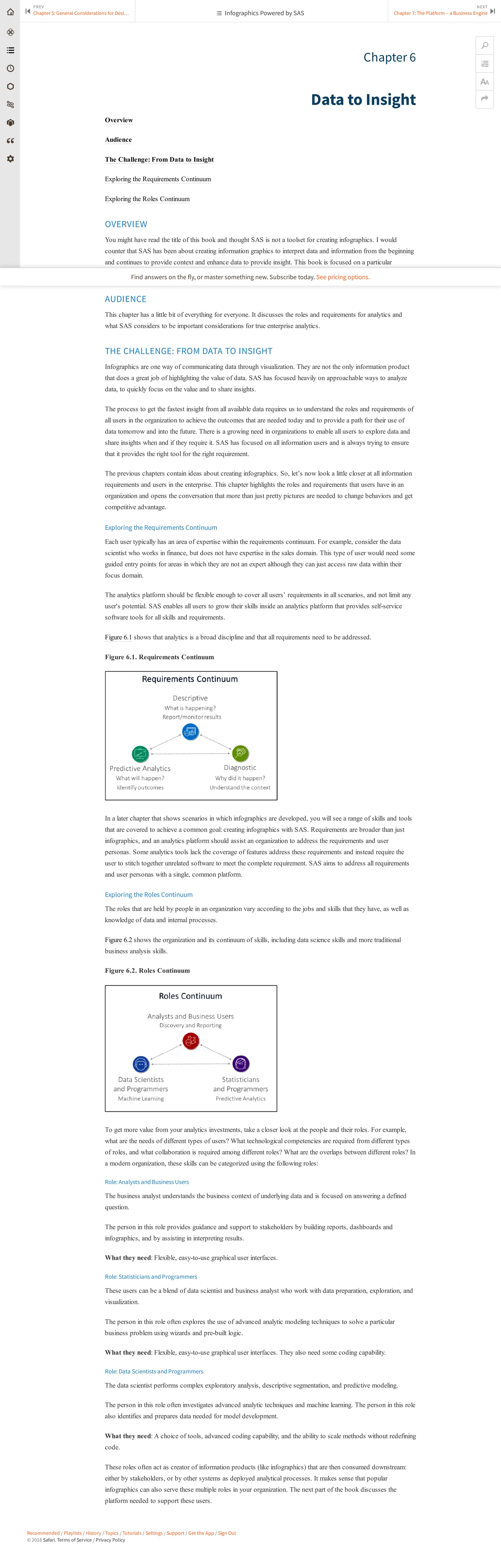
Figure 6.1 shows that analytics is a broad discipline and that all requirements need to be addressed.
Figure 6.1. Requirements Continuum
In a later chapter that shows scenarios in which infographics are developed, you will see a range of skills and tools
that are covered to achieve a common goal: creating infographics with SAS. Requirements are broader than just
infographics, and an analytics platform should assist an organization to address the requirements and user
personas. Some analytics tools lack the coverage of features address these requirements and instead require the
user to stitch together unrelated software to meet the complete requirement. SAS aims to address all requirements
and user personas with a single, common platform.
Exploring the Roles Continuum
The roles that are held by people in an organization vary according to the jobs and skills that they have, as well as
knowledge of data and internal processes.
Figure 6.2 shows the organization and its continuum of skills, including data science skills and more traditional
business analysis skills.
Figure 6.2. Roles Continuum
To get more value from your analytics investments, take a closer look at the people and their roles. For example,
what are the needs of different types of users? What technological competencies are required from different types
of roles, and what collaboration is required among different roles? What are the overlaps between different roles? In
a modern organization, these skills can be categorized using the following roles:
Role: Analysts and Business Users
The business analyst understands the business context of underlying data and is focused on answering a defined
question.
The person in this role provides guidance and support to stakeholders by building reports, dashboards and
infographics, and by assisting in interpreting results.
What they need: Flexible, easy-to-use graphical user interfaces.
Role: Statisticians and Programmers
These users can be a blend of data scientist and business analyst who work with data preparation, exploration, and
visualization.
The person in this role often explores the use of advanced analytic modeling techniques to solve a particular
business problem using wizards and pre-built logic.
What they need: Flexible, easy-to-use graphical user interfaces. They also need some coding capability.
Role: Data Scientists and Programmers
The data scientist performs complex exploratory analysis, descriptive segmentation, and predictive modeling.
The person in this role often investigates advanced analytic techniques and machine learning. The person in this role
also identifies and prepares data needed for model development.
What they need: A choice of tools, advanced coding capability, and the ability to scale methods without redefining
code.
These roles often act as creator of information products (like infographics) that are then consumed downstream:
either by stakeholders, or by other systems as deployed analytical processes. It makes sense that popular
infographics can also serve these multiple roles in your organization. The next part of the book discusses the
platform needed to support these users.
PREV
Chapter 5: General Considerations for Desi…
⏮
NEXT
Chapter 7: The Platform – a Business Engine ⏭
🔎


 Infographics Powered by SAS
Find answers on the fly, or master something new. Subscribe today. See pricing options.
Recommended / Playlists / History / Topics / Tutorials / Settings / Support / Get the App / Sign Out
© 2018 Safari. Terms of Service / Privacy Policy
Chapter 7
The Platform – a Business Engine
Overview
Audience
SAS and the Analytics Lifecycle
Data: Fuel for Decisions
Discovery: Make Data-Driven Decisions
Deployment: Drive the Business Where It Happens
OVERVIEW
This chapter provides an overview of what a platform to support all analytics users and requirements would look
like. This is an outline only, and will illustrate functional components that are leveraged to achieve the end-to-end
analytics workflow: the analytics life cycle. The ultimate goal of an analytics platform is to create the shortest path
from data to decision, and this could be in the form of an infographic that is created from a vast volume of data in
your organization.
AUDIENCE
All SAS users will get value from this section. It highlights how SAS is much broader than just the infographic.
SAS AND THE ANALYTICS LIFECYCLE
If you bought this book, then you probably already know what SAS does. I will explain it quickly and you can
either confirm your knowledge or pick up an additional piece of information.
SAS is the leader in advanced analytics. I could stop there, and it should then be very clear. However, I will drill
down a bit further to explain what SAS does. As the market leader in analytics and data management, SAS has
worked with customers to leverage data and analytics to impact business results. SAS is committed to helping
organizations find critical answers to the biggest challenges. SAS customers are organizations large and small,
including Fortune 500 companies, governments, nonprofit organizations, academia, small business, and even
individuals.
Data is everywhere, but data alone has no value. To find the value and deeper understanding of data, there must be
analytics. SAS knows that you and your organization want to find that deeper insight and do more than just solve
basic problems. SAS is the engine to help you determine what's next.
SAS can embed intelligence into everything that an organization does, and can execute analytics wherever it is
needed, whether on-site, in the cloud, or at the device. SAS can analyze any type of data. SAS provides an
analytics platform that delivers business value and replaces confusion with clarity.
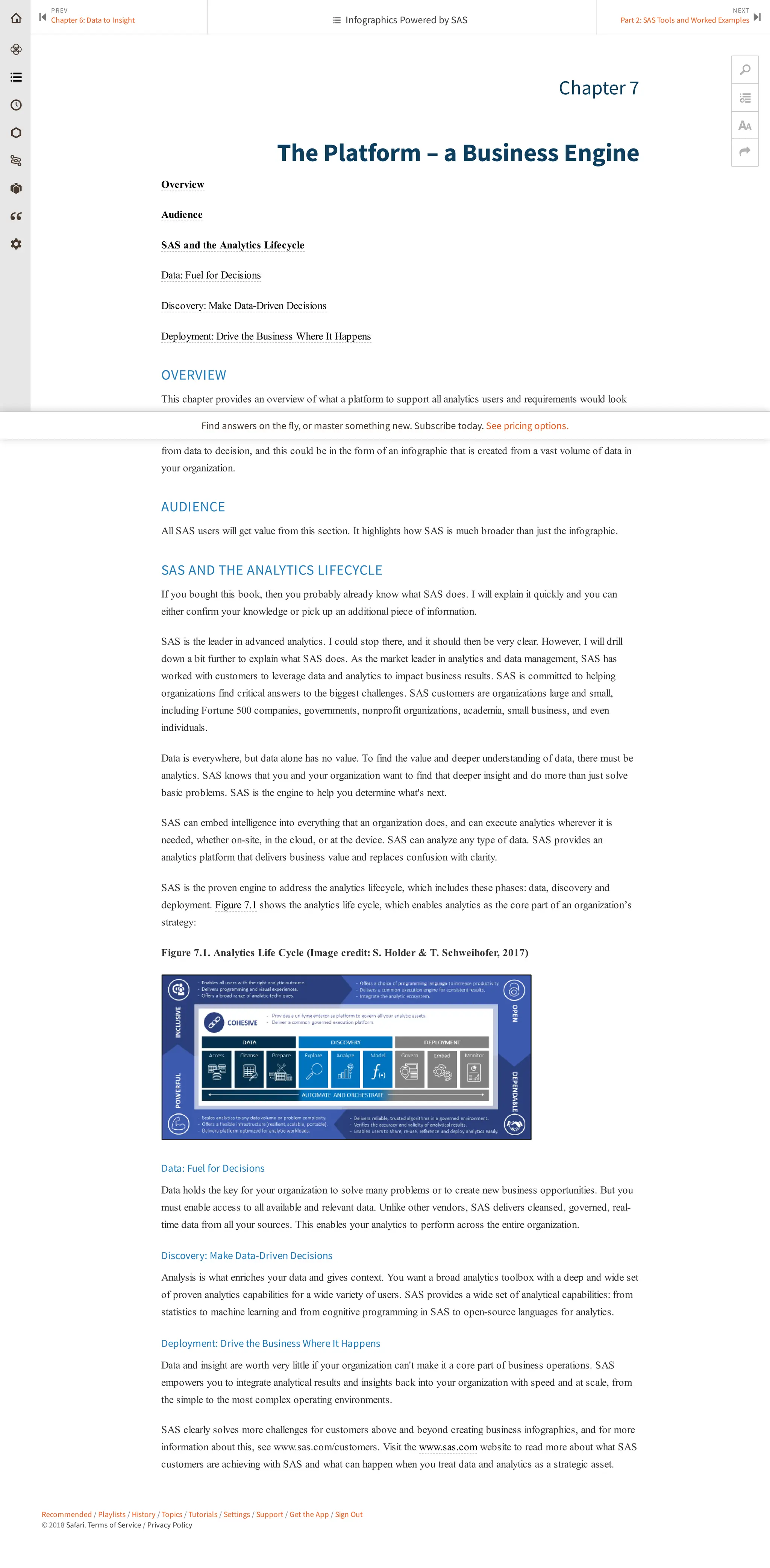
SAS is the proven engine to address the analytics lifecycle, which includes these phases: data, discovery and
deployment. Figure 7.1 shows the analytics life cycle, which enables analytics as the core part of an organization’s
strategy:
Figure 7.1. Analytics Life Cycle (Image credit: S. Holder & T. Schweihofer, 2017)
Data: Fuel for Decisions
Data holds the key for your organization to solve many problems or to create new business opportunities. But you
must enable access to all available and relevant data. Unlike other vendors, SAS delivers cleansed, governed, real-
time data from all your sources. This enables your analytics to perform across the entire organization.
Discovery: Make Data-Driven Decisions
Analysis is what enriches your data and gives context. You want a broad analytics toolbox with a deep and wide set
of proven analytics capabilities for a wide variety of users. SAS provides a wide set of analytical capabilities: from
statistics to machine learning and from cognitive programming in SAS to open-source languages for analytics.
Deployment: Drive the Business Where It Happens
Data and insight are worth very little if your organization can't make it a core part of business operations. SAS
empowers you to integrate analytical results and insights back into your organization with speed and at scale, from
the simple to the most complex operating environments.
SAS clearly solves more challenges for customers above and beyond creating business infographics, and for more
information about this, see www.sas.com/customers. Visit the www.sas.com website to read more about what SAS
customers are achieving with SAS and what can happen when you treat data and analytics as a strategic asset.
PREV
Chapter 6: Data to Insight
⏮
NEXT
Part 2: SAS Tools and Worked Examples ⏭
🔎


 Infographics Powered by SAS
Find answers on the fly, or master something new. Subscribe today. See pricing options.
Recommended / Playlists / History / Topics / Tutorials / Settings / Support / Get the App / Sign Out
© 2018 Safari. Terms of Service / Privacy Policy
Chapter 8
The Tools: So ware Used in this Book
Overview
Audience
Tools Overview
SAS Add-In for Microsoft Office
Capability Overview
Typical Use Cases
Tools Used
SAS Visual Analytics
Capability Overview
SAS Visual Analytics Capabilities
Typical Use Cases
Tools Used
SAS Code
Design Intent
Typical Use Cases
Tools Used
SAS Studio
Capability Overview
Typical Use Cases
Tools Used
OVERVIEW
Even though the focus of this book is to create infographics with SAS, the tools we're covering, and SAS, more
generally, has a much broader capability than what we use to achieve this focused task. This next section of the
book aims to step you through the SAS products that we leverage in this book and to discuss their broader
capability.
AUDIENCE
This is a general topic for all SAS users and will provide insight for all readers.
TOOLS OVERVIEW
There are many tools in the market to create and publish infographics as well as graphic designs, more generally.
The focus is to show that SAS can be used to solve this business challenge. There is a rise in the market of
providers trying to solve this data visualization challenge and to make it more approachable by removing the barrier
to entry for business users and programmers. Many of these offerings require extensibility to solve for serious
enterprise requirements. The power of the proven SAS platform is placed well to be extended to this business
challenge. SAS is a proven and powerful tool that can be utilized to solve analytics problems and produce
infographics without needing other software.
Here is an overview of selected SAS tools that can be used to produce the infographic examples that are outlined in
this book. This is an overview of the SAS software components and a list of references to further enhance your
learning. There are some great resources provided by SAS experts for each of these tools, and I have included
some of these in the recommended reading listed in this book. The focus of this chapter is to ensure that
functionality is understood, both to create the infographic and to understand the use cases beyond the infographics.
This section outlines the following tools from SAS:
● SAS Add-In for Microsoft Office (later used in Example 1 and 2)
● SAS Visual Analytics (later used in Examples 1, 2, and 3)
● SAS Studio (later used in Example 4)
SAS ADD-IN FOR MICROSOFT OFFICE
Capability Overview
SAS Add-In for Microsoft Office is designed to enable users of Microsoft Office access to SAS analytics and
visualization capabilities from within the Microsoft Office suite. SAS Add-In for Microsoft Office has been around
for many years because SAS was early in determining the importance of bringing the analytics to the user rather
than bringing the user to the analytics. SAS Add-In For Microsoft Office provides users with a customized ribbon
inside the Microsoft Office products: Microsoft Word, Microsoft Excel, Microsoft PowerPoint and Microsoft
Outlook. Here are the primary capabilities within SAS add-In for Microsoft Office:
● Leverage SAS platform – Add-In for Microsoft Office leverages the broader SAS platform, which includes
functions like high-performance analytics and grid computing.
● Familiarity – Add-In for Microsoft Office provides a Microsoft Office user who uses familiar Windows
desktop applications everyday with the exact same interface to access powerful features from SAS.
● IT friendly – Add-In for Microsoft Office connects using secure and auditable access to data and provides
business users a great way to load spreadsheets and other business-specific content to the SAS enterprise analytics
platform. This allows for reuse and sharing, which enables a true collaboration for business teams.
● Guided analysis – Add-In for Microsoft Office provides a simple wizard-driven. task-oriented user interface to
enable a business user to get more than just data access. Users can apply analytics and create visualizations and
reports from within Microsoft Office.
Figure 8.1 shows that every user gets the right interface when using SAS software.
Figure 8.1. Every User, Right Interface
NOTE: SAS Visual Analytics Add-In for Office
A software bundle was released in 2016, SAS Visual Analytics Add-In for Office, which provides an
abbreviated version of SAS Add-In for Microsoft Office. It includes a subset of features that focus on SAS
Visual Analytics users. This version provides Excel and PowerPoint integration, but also removes more
advanced features so that a business user can gradually step into more analytics features that are available in the
complete SAS Add-In for Microsoft Office.
Typical Use Cases
In addition to creating business infographics with SAS and Microsoft Office, here are three use cases to show the
value of using the SAS Add-In for Microsoft Office:
Use Case 1: The Presenter
The business user needs to embed one or more graphics elements from the SAS Visual Analytics dashboard or
report. This user opens Microsoft PowerPoint and needs to present some company statistics to the boardroom
each month. In the past, this user might have taken a screen capture and pasted the image into the presentation each
month. However, this is very limited in management capability, not to mention understanding where the information
ends up and if that information is secure.
This user can now open PowerPoint and insert a snapshot of year-to-date performance, which is automatically
updated each month. A slide in the presentation needs to show only the business unit’s performance and not show
the company’s overall performance. In this case the user can embed a filter to show only the business unit. Now the
user is ready to present to the board meeting, not just today, but each month. This is due to the linkage between the
presentation and the SAS analytics platform, which will now be refreshed each time the presentation deck is
opened. Similar functions are highlighted in examples in the book, using Microsoft PowerPoint and SAS to create
an infographic.
Use Case 2: The Spreadsheet Jockey
We all know people within our business who are the subject matter experts, they know all about the data and their
business, and they are frequently asked by management to provide a view to support stakeholders and their
business discussions. One problem with this type of approach is that the spreadsheet easily gets out of date. I've
seen where a simple date filter written into a spreadsheet has turned a very serious discussion about performance
into a data quality issue, which had been hidden by the spreadsheet’s complexity. This user can still use the
spreadsheet. However, now the user can drive elements of the data from other SAS assets that are defined in the
platform. An example for this user is the ability to embed the data, which sits behind the same chart that is used by
the preceding Use Case 1. The chart will stay linked to the original report and any subsequent functions and filters
will flow through to the spreadsheet. Similar functions are highlighted in Example 2 later in the book, using
Microsoft Excel and SAS to create a business infographic.
Use Case 3: "Regular Ad Hoc" Report Writer
In this use case, we see a business team that needs to provide the same highly formatted Word document each
month and that needs a data-driven visual to embed into a handful of locations within the Word document. A
customer once said to me that they do “regular ad hoc” reports, which is an interesting phrase, yet a common
problem. Previously, this was not easy because, first, they had to find the data, and then they had to craft a visual
or graphic representation for inclusion into the final document. This often meant that next month the whole process
had to start over, wasting multiple people's time to validate an update on what were effectively the same elements
with refreshed data. Using SAS Add-In for Microsoft Office and Microsoft Word, this team can now insert
elements from multiple locations such as SAS Visual Analytics or custom visualizations using SAS tasks or even
embed unique SAS stored processes to drive precise visuals. The benefits mean that this team needs only to open
the document and refresh the content from SAS before sending the updated report to stakeholders. Savings in time
alone make this use case a worthwhile activity. Figure 8.2 shows SAS Add-In for Microsoft Office within
Microsoft Word which can help solve the regular reporting requirements.
Figure 8.2. SAS and Microsoft Word
Tools Used
Tools used in this section are the SAS Add-In for Microsoft Office, which includes integration with Microsoft
PowerPoint, Excel, Word, and Outlook. Examples in this book use SAS Add-In for Microsoft Office 7.15.
SAS VISUAL ANALYTICS
Capability Overview
SAS Visual Analytics was designed to make data discovery and data visualization more approachable and to take
analytics to a much broader audience. SAS released the SAS Visual Analytics suite to provide a much more user-
friendly way to interact with big data. SAS Visual Analytics has provided access to the powerful SAS platform for
a whole new set of users because no coding was required. This suite of visual products continues to develop, and
the latest releases of SAS Visual Analytics include modules such as SAS Visual Statistics and SAS Visual Data
Mining and Machine Learning, which use this same drag-and-drop approach as well as visualization to demystify
analytics and statistics for a broader audience.
SAS tools have always been used to understand data and to surface patterns within the data. This traditionally was
done by analysts and programmers who would write code that subsets the data and pull down what their computer
could handle. Then, they would design their analysis on the sample of data that they could work with. This time-
consuming process was done only because the computation could not scale for the analyst. Today, with so much
data, this approach was not sustainable.
SAS tools have been used for data discovery and deep exploration for many years. So, you might ask what is there
to talk about here. The focus of this technology section is the self-service data exploration and deep exploration
tools of SAS, SAS Visual Analytics, SAS Visual Statistics, and SAS Visual Data Mining and Machine Learning that
access the high-performance analytic engine that runs on SAS Viya.
SAS Visual Analytics on SAS Viya was designed for a business user to perform self-service analysis and also to
complement the broader analysis throughout the analytics lifecycle. From dashboards and reports to deep data
exploration: SAS Visual Analytics is the solution to achieve self-service analytics.
Many people purchase SAS Visual Analytics for a particular use case. They have an immediate business problem
and learn just enough to solve that need. In my experience, it is rare for a person to learn more about a software
product than the initial demand. However, without a broader understanding of the capabilities of their software,
when the next business challenge surfaces, the user might not know that SAS Visual Analytics could also be used
to solve that next problem.
SAS Visual Analytics Capabilities
SAS Visual Analytics has a breadth of functionality that can be used to solve the following business tasks:
● Visual data flow to conduct data preparation – You can create data queries to perform joins, add calculated
columns, transpose, subset and sort data, and load new data.
● Reports and dashboards – You can design reports once, and then distribute and publish anywhere (web,
mobile, and Microsoft Office).
● Interactive charts, visuals, and explorations – You can discover insights from any size and type of data,
from spreadsheets to Hadoop data, and all things in between.
● Powerful, easy-to-use analytics – You can use forecasting, goal seeking, scenario analysis, decision trees,
path analysis. and other analytic visualizations. SAS Visual Analytics makes analytics approachable for the entire
team. The machine-learning capability is enhanced further when adding SAS Visual Statistics and SAS Visual Data
Mining and Machine Learning.
Figure 8.3 shows approachable analytics in one SAS solution.
Figure 8.3. SAS Visual Analytics Capability Overview
Typical Use Cases
Use cases for SAS Visual Analytics (SAS Visual Statistics and SAS Visual Data Mining and Machine Learning
modules), are vast and varied. Here are a few use cases for which SAS Visual Analytics is used to solve business
problems for customers.
Use Case 1: Approachable Analytics
Before looking to design an infographic or any information product, a user must first understand the data. One of
the use cases for this toolset is for a business analyst to look at the data to understand the data and to clarify
whether the data is useful to solving the business challenge. This use case identifies a subject matter expert in the
data who can look into the data to see a clear picture of what is happening and to confirm or deny the assumptions
that they have. Data analysis can be done using a highly visual user interface instead of understanding complex
technology or coding to achieve the outcome.
Use Case 2: Deep Exploration
What fits nicely into the analytics life cycle is where the data scientist or traditional analyst uses a visual and a high
performance toolset to achieve what would have taken much longer using traditional tools and methods. They can
see all the data and quickly understand if the attributes in the data could assist with their models and further
analysis.
Use Case 3: Dashboards and Reports
SAS Visual Analytics is great for easy-to-create and “accessible anywhere” dashboards for any business data.
These dashboards are simple for a business analyst to create and share and collaborate with information
consumers. The benefit here still remains the ability to embed highly visual, analytically powered elements to users
who previously might never have seen these visuals as tools that they could use to tell a story with their data.
Dashboards can also include infographic principles depending on your use case, as you will see in the worked
examples in the following chapters.
Figure 8.4 shows simple, powerful, and flexible approachable analytics for all users.
Figure 8.4. SAS Visual Analytics Dashboard
NOTE: Skills Progression with SAS Visual Analytics
Analytics skills improvement is a by-product of deploying SAS Visual Analytics. A final example of where this
process is useful is developing analytic skills within a business team. For example, a business team might not
have the requisite skills to jump directly into analytics and would benefit from an easy-to-use toolset to start to
understand how and where analytics will assist with their business challenges.
There are many more use cases for self-service data exploration and visualization with SAS Visual Analytics, and all
business teams can benefit from these capabilities. Clearly, SAS Visual Analytics is much more powerful than just
to assist in producing business infographics. SAS Visual Analytics is used in examples later in this book.
Tools Used
SAS has focused on developing data science skills in its customers, and, over recent years, with innovative self-
service tools like SAS Visual Analytics and SAS Visual Statistics, SAS enables business analysts to gain skills
toward data science. SAS provides the right tools for each person’s skills, which means that each interface
provides the right amount of functionality for any user's skill set, while providing a pathway to move forward once
their skills develop.
● SAS Visual Analytics 8.2 on SAS Viya
● SAS Visual Statistics 8.2 on SAS Viya
● SAS Visual Data Mining and Machine Learning 8.2 on SAS Viya
SAS CODE
Design Intent
When you use SAS software (listed in the preceding section), you will be executing commands generated using
SAS code. SAS can be used to create business infographics. However, this is just the tip of the iceberg when
talking about SAS capability. SAS code can perform an extensive range of tasks with regard to analytics, data
management, and deployment.
At its core, SAS consists of code packages including Base SAS, which can be extended using various modules like
SAS/STAT, SAS/GRAPH, SAS/OR, and SAS/ETS among others. Each module comes with SAS procedures to
assist with specific functions. For example, SAS/GRAPH includes PROC GRADAR to create radar plots and to
control all aspects of this process. SAS procedures include many options to be controlled by the analyst such as
data, colors, visual display, and much more. This simple description only touches the surface of the capability of
SAS. The main idea is that the SAS code modules are the engine room of SAS, and they are relied upon by
customers across the globe to drive critical analysis and business solutions. This book is about visualizing data
through infographics. Therefore, the focus is on SAS code to create infographics.
SAS has a component called SAS/GRAPH, which is the traditional graphing software module. SAS/GRAPH is a
powerful data visualization tool that has been around for many releases of SAS and is still a very capable option for
power users to visualize data. A newer graphing software option is an extension to SAS Output Display System
(ODS), which can deliver content in almost unlimited ways. SAS ODS Graphics continues to be extended and is
included within Base SAS and is used by the SAS procedures to generate graphics. It can be used directly with
PROC SGPLOT and PROC SGRENDER.
In this book, SAS/GRAPH is mostly used to generate the coded infographic examples. However, you could
achieve similar results if you used SAS ODS graphics. The goal of this book is to show examples of how SAS
code can be used to create infographics, whichever component you choose to achieve this.
Figure 8.5 shows how SAS code can be used to visualize data.
Figure 8.5. SAS Code in SAS Studio
Typical Use Cases
Here are a few typical use cases for using SAS code to visualize data:
Use Case 1: Custom Designs
Customized and precise graphical output – Tell a story and control every element of the output with SAS code.
Remember that with so much data out there today, you need powerful yet simple graphics to help the consumer
understand the results.
Use Case 2: Templates
Leverage the Graph Template Language (GTL) – An extension to ODS, it enables you to create reusable
graph templates that can be shared and are ready for the next data that you “throw” at them.
Use Case 3: Accessibility
Design data visualization with accessibility in mind – This is key to ensuring that all users can leverage your
analysis. SAS graphics in combination with a SAS graphics accelerator – enable alternative presentations of SAS
graphs for people who are visually impaired. SAS uses a combination of text and sonification (non-speech audio)
to describe the data visualization to the end user to allow all users access to your graphics.
SAS code is used in examples later in this book.
Tools Used
SAS 9.4 M5 (including SAS/GRAPH software and SAS Output Delivery System)
NOTE: SAS Office Analytics
Base SAS, SAS/GRAPH, and SAS/STAT come as part of the SAS Office Analytics bundle, which is
referenced throughout this book. This bundle includes SAS Add-In for Microsoft Office and SAS Enterprise
Guide, among other software.
SAS STUDIO
Capability Overview
SAS Studio is a modern, unified graphical user interface (GUI) for use with the broader analytics platform. SAS
has made SAS software available to all students around the world and provides SAS Studio as the GUI to learn
SAS.
Many people write programs in SAS by using an application on their PC desktop or SAS server. SAS Studio is
similar. However, it is a tool that you can use to write and run SAS code through your web browser. With SAS
Studio, you can access your data files, libraries, and existing programs, and you can write new programs. When
you use SAS Studio, you are also using SAS software, “behind-the-scenes.” SAS Studio connects to a SAS server
in order to process SAS commands. The SAS server can be a hosted server in a cloud environment, a server in
your local environment, or a copy of SAS on your local computer.
After the code is processed, the results are returned to SAS Studio.
Figure 8.6 shows the ease of self-service graphics and custom-coded graphics.
Figure 8.6. SAS Studio
Some people originally thought SAS Studio was only a code editor that was similar to the SAS windowing
environment, which is the programmer’s interface, and this was probably true at some point. However, SAS Studio
goes well beyond that initial goal. It is a “use anywhere” on any device development environment for SAS users. It
is a web browser-based, SAS development toolset, which includes an assistive framework that uses built-in tasks
and configurable, user-defined tasks to ensure a quick start for which repeatable benefit is gained for the analyst.
This enables analysts to get their SAS tasks done faster. This offering sits somewhere in between SAS Enterprise
Guide and the SAS windowing environment when comparing functionality. Like all great software, SAS Studio has
overachieved from a simple vision and includes a visual code workflow mode and a power user's code mode to
cover many preferences and many use cases.
This product is so important to SAS that it now fronts our next-generation offerings of SAS Viya and our SAS
Learning Edition, which has had over half a million downloads since its release and continues to grow. SAS Studio
is fast becoming the preferred interface of the next generation of SAS analysts and data scientists. Here are some
features that assist users in taking advantage of their SAS investment as well as developing their skills in data
science:
● Assistive task framework – Create reusable and shared tasks to grow the broader team's skills and share best
practices.
● Programming interface – A web browser-based coding interface that is modern and simple.
● Table viewer and automated query options – A simple way to look at data.
● Visual workflow – Easy-to-use visual flows to understand each step in the analysis.
● Security and auditability – Enterprise grade software for IT teams.
● User-specific preferences – Remembers the user’s preferences, even though you are using a web browser.
● Automated code prompting and in-context help options – Includes all the user needs to understand the
procedures and options without leaving the code.
There are many more capabilities and more are added to each release of SAS Studio.
Typical Use Cases
In Chapter 13, you will see examples of infographics that were created with SAS code and that is submitted using
SAS Studio. However, here are three more use cases to show where SAS Studio could be useful in your day job.
Use Case 1: Sitting on the Beach
If your idea of fun is sitting poolside or surfside and logging on to work on your mobile device, tablet. or wafer-
thin, super-expensive laptop, to run some SAS jobs, then SAS Studio is for you! By accessing SAS on your web
browser, a SAS analyst is now ready to work anywhere, anytime.
Use Case 2: Drive Reuse and Collaboration
SAS Studio enables you to create a pool of analytics assets for your broader analytics team to leverage. This use
case highlights the ability for a group of users to access out-of-the-box, ready-to-fill-in the prompts, self-service
analytics. This gives the analyst a bit of help while still giving access to the code to try other options in their
analysis.
Use Case 3: Explore Data in a Simple Way
SAS Studio enables access for an analyst to view the data in a table, or even generate data if they have the
permission to do so. This means that analysts can use the SAS platform to access and generate queries to
understand the data and decide what the data could offer.
NOTE: SAS Enterprise Guide
SAS has other client software to execute SAS such as SAS Enterprise Guide, which continues to be popular for
many SAS customers. It is not covered in the book. However, many books and blogs have been written to
show how SAS Enterprise Guide helps analysts deliver value from their data.
SAS Studio is used to execute the SAS code and return the outputs for some examples in this book.
Tools Used
SAS Studio
PREV
Part 2: SAS Tools and Worked Examples
⏮
NEXT
Chapter 9: Worked Examples ⏭
🔎


 Infographics Powered by SAS
Find answers on the fly, or master something new. Subscribe today. See pricing options.
Recommended / Playlists / History / Topics / Tutorials / Settings / Support / Get the App / Sign Out
© 2018 Safari. Terms of Service / Privacy Policy
Chapter 9
Worked Examples
Overview
Audience
Sample Files
Creative Content
Tools
Ready, Set, Go!
OVERVIEW
This chapter introduces worked examples of the approaches to create infographics with SAS. It contains step-by-
step procedures to produce sample infographics with SAS. This section uses the Add-In for Microsoft Office with
SAS, SAS Visual Analytics, and SAS code to design and create the infographics. All files are available for you to
step yourself through these scenarios on your own time.
This part of the book is where you get your hands on the tools, and you start to build the examples that can help
with your own data in your work environment. You will be leveraging the software outlined in the previous chapter
to create a combination of data-driven graphics in the SAS software tools and subjective content and building an
infographic template inside SAS Visual Analytics, Microsoft PowerPoint, and Microsoft Excel. The first examples
require no coding skills at all, and are the most approachable options to help get you started today.
To use any of these examples, you need to do some work inside SAS Visual Analytics first to create the data-
driven objects. Of course, you could just open a favorite SAS Visual Analytics report and use any object that other
users in the organization have created for you. You will use some existing graphs from existing SAS reports, and
you will later create your own graphs in SAS Visual Analytics.
AUDIENCE
All SAS users will be provided with options and examples in this chapter. You will move through basic,
intermediate, and advanced SAS skills with each example. There is something for everyone in the following worked
examples.
SAMPLE FILES
Sample SAS files are provided for reference along with the data and image files needed to reproduce these
examples.
All files are provided for download here:
http://support.sas.com/murphy
NOTE: Sample Data
In the book, the sales data is focused on a fictitious toy company utilizing sample data shipped with SAS Visual
Analytics. This focus enables you to maximize your efforts as you consider the visual elements of your
infographics. Also, many organizations are driven by metrics such as profit, revenue, and costs, which makes
this use case broad for many readers.
This data choice might make some readers sigh, thinking "more fake sales data for some made-up company!"
You are being heard, loud and clear. The reason to choose and stick with a simple and familiar SAS data set is
that this book aims to show you a repeatable approach to your own data. The more familiar you become with
the approach and the simpler it is to try for yourself, the more likely you will learn from the examples. Familiarity
with the data also helps people in all stages of their SAS skills journey.
I hope you see the benefits of using a simple data set throughout this book. The book is about what is possible
with your data, not the data itself. Based on your feedback, I will be open to include more data in future updates
of this book, especially because the sample data that ships with SAS also evolves over software releases.
Please refer to Appendix A for a complete overview of the Sample Data and the preparation steps to get ready
for these examples.
CREATIVE CONTENT
Prior to beginning the work on your infographic, you need to ensure that you have all images and creative content
for the infographic. This includes images for backgrounds and non-data-driven visuals, such as logos and layout
graphics. At this point, consider fonts that best reflect the look that you are after. Selection of your graphical and
typographical elements in advance will save you a huge amount of time. These assets are your infographic toolkit,
and are the building blocks for your design.
TOOLS
The following tools are required to start the process to create an infographic:
● Writing apparatus – Whiteboard or pen and paper.
● SAS software and Microsoft Office software – Check the Tools Used sections in Chapter 8 for more.
● Enthusiasm and patience – The trial-and-error approach can be frustrating until you get the hang of it all.
READY, SET, GO!
Let’s look at the SAS tools outlined in Chapter 8 and show by example, step-by-step, how you can create and
emulate some examples using SAS and Microsoft Office.
Here are the tools to be used in the examples following this chapter:
● SAS and Microsoft PowerPoint
● SAS and Microsoft Excel
● SAS Visual Analytics
● SAS code
PREV
Chapter 8: The Tools: So ware Used in this…
⏮
NEXT
Chapter 10: Example 1: SAS and Microso P… ⏭
🔎


 Infographics Powered by SAS
Find answers on the fly, or master something new. Subscribe today. See pricing options.
Recommended / Playlists / History / Topics / Tutorials / Settings / Support / Get the App / Sign Out
© 2018 Safari. Terms of Service / Privacy Policy
Chapter 10
Example 1: SAS and Microso PowerPoint
Overview
Audience
Sample Files
Getting Started with SAS and Microsoft Office
Step Zero: Start with a Mockup Design
Step 1: Open the Template in PowerPoint
Step 2: Connecting to SAS Visual Analytics
Step 3: Deciding What Content to Leverage from SAS
Report 1: The Sales Performance Dashboard
Report 2: Ad Hoc Analysis on Sales Performance
Step 4: Unifying the Content Elements
Step 5: Adding Elements to the Microsoft PowerPoint Document
From the Sales Dashboard: Report 1 Elements
From the Data Exploration: Report 2 Element
Step 6: The Final Touches
Step 7: Share the Infographic
Why Use this Approach?
Examples Gallery
OVERVIEW
This example provides a worked solution with zero code by using the drag-and-drop interfaces of SAS Visual
Analytics and SAS Add-In for Microsoft Office. This worked example uses SAS Visual Analytics dashboards and
insights. I will import elements of an existing dashboard and a report into an infographic created in Microsoft
PowerPoint. Business analysts are very familiar with Microsoft PowerPoint and will be extending their use of this
familiar toolset with content from SAS.
The general premise of designing infographics with SAS is that we are looking to create repeatable and robust
infographics that are suitable for business use, compared to those not created in SAS which, while beautiful, may
not provide the repeatable and simple access to corporate data.
AUDIENCE
This example can be skipped if the user is advanced. However, this user might find that the business interfaces and
easy drag-and-drop approach are interesting if they know only the coded interface. This example is designed for a
business user, a novice SAS user, or an intermediate SAS user.
SAMPLE FILES
Completed SAS Visual Analytics report examples and templates in PPTX format and completed infographics in
PPTX format are provided for reference along with the data and image files needed to reproduce these examples.
All files are provided for download here: http://support.sas.com/murphy
GETTING STARTED WITH SAS AND MICROSOFT OFFICE
For this example you will want some of your infographic content to be entered as subjective comments, with third-
party graphics, and other content imported easily from SAS Visual Analytics. This option enables you to leverage
the large investment in data assets in your enterprise, as well as provide the creative freedom that you need to create
the narrative required to communicate the insight in the “eight-second window.”
This option uses approachable analytics tools, SAS Visual Analytics and your Microsoft Office tools to make it
accessible by any business analyst or report user. This option can unlock big data analytics into the infographics
created by business analysts.
STEP ZERO: START WITH A MOCKUP DESIGN
To simplify this example, we will use a template as a starting point. I already know by looking at the template what
is required for design and subject matter.
If you want to save time in any infographic creation process, you should start with a whiteboard or piece of paper
and get it all out of your head and into the world. This step should provide ideas for topic, context, questions you
want to answer or highlight, and design ideas. You will see this message throughout the book, and is guaranteed to
provide you with a better infographic and to save you plenty of time. The mockup for Example 1 is shown in
Figure 10.1.
Figure 10.1. Whiteboard Mockup for Infographic Design
STEP 1: OPEN THE TEMPLATE IN POWERPOINT
Open the example file Example_1_Template.pptx from your sample files to get started with the activity.
Figure 10.2 shows template, which contains a selection of images and clipart that are ready to use in the
infographic.
Figure 10.2. PowerPoint Template
Inside this PowerPoint template are some important elements. There are some clipart-style images and icons, a
color palette, some text, and a layout that is already displayed. By using this template, you are not starting from a
blank canvas and you get some understanding of the context and design already by using this template.
The template has a custom slide size that is defined in PowerPoint and that allows for enough space to create the
infographic with correct ratios. You can create your own slide very quickly by copying this custom slide.
STEP 2: CONNECTING TO SAS VISUAL ANALYTICS
To connect to SAS, select the SAS tab from the Microsoft PowerPoint ribbon, as seen in Figure 10.3.
Figure 10.3. SAS Add-In for Microsoft Office ribbon
From Microsoft PowerPoint, select the Tools tab and the Connections option to connect to the SAS Visual
Analytics server (see Figure 10.4).
Figure 10.4. SAS and Microsoft PowerPoint - Connections
The user is presented with a window that includes options to add a new SAS server or to connect to an existing
SAS server (Figure 10.5).
Figure 10.5. SAS and Microsoft PowerPoint Connections window
Setting up the connections is a one-time task. Connections setup will provide the user with access to the SAS
servers from which to access reports, analysis, and functions that will allow content to be included in their
Microsoft Office document.
STEP 3: DECIDING WHAT CONTENT TO LEVERAGE FROM SAS
This example assumes that some SAS Visual Analytics reports and analysis have been created already by someone
in your organization. This means you don’t have to leave Microsoft PowerPoint at all. If you do not have the SAS
Visual Analytics reports, then this would be an additional step here. Please see other examples in Chapter 12 to see
how to create SAS Visual Analytics reports and dashboards.
In this example, you already have two reports created using SAS Visual Analytics. The first report is a dashboard
for a sales team, and the second is an ad hoc analysis created by the business analyst in the sales operations team.
Both reports add value to your understanding of the sales performance at the Insight Toy Company.
Report 1: The Sales Performance Dashboard
Figure 10.6 shows elements from a report that are interesting and that would enhance the infographic.
Figure 10.6. Sales Performance Dashboard
The infographic could contain a Top 5 performers bar chart, a word cloud of what is being sold, and a treemap (tile
chart) of products for sale. A key performance indicator or gauge could also be useful at calling out performance.
A geomap can also be a powerful visual from a traditional dashboard and in an infographic style dashboard.
Next, think about which of these elements will help to tell your story about sales performance. Do not include the
elements that distract from this message.
Report 2: Ad Hoc Analysis on Sales Performance
Figure 10.7 shows the elements of the ad hoc analysis, which include a correlation matrix, a parallel coordinates
plot, a forecast of sales overtime, and a network diagram about the relationship of products to product lines.
Figure 10.7. Ad Hoc Sales Data Exploration
Once again, from these elements, you will select the ones that assist in telling the story that you want to tell in your
infographic.
STEP 4: UNIFYING THE CONTENT ELEMENTS
It is now time to unify these visual elements into the infographic itself. If you are like me, you can spend a long time
getting your visual elements just right. Many iterations of design and trial-and-error will probably occur before you
have the desired layout and information to tell the narrative that you want from your data.
Figure 10.8 shows how you can navigate to all your SAS Visual Analytics reports and analysis, and insert the
desired elements into your infographic.
Figure 10.8. SAS and Microsoft PowerPoint: Navigation to Reports Using SAS Add-In for Microsoft
Office
Adding content from SAS Visual Analytics is very easy, and don't forget that the computation is happening on the
SAS platform, not on your computer.
After we select the appropriate content, we will select a report and click the Open button.
Repeat the preceding steps to add a second report, which is the ad hoc exploration report. This report has some
additional options for use in this infographic. The approachable analytics will make a big impact to your audience.
Once you have selected one or more reports to open in Microsoft PowerPoint, you are presented with a preview
window that shows the report contents. This is a live view of the report, and shows you the latest data that is
loaded into SAS (see Figure 10.9).
Figure 10.9. SAS Add-In for Microsoft Office Report Controls Dialog
The preceding figure shows the live preview dialog for the SAS report. You can select the report that you want to
work with if you have multiple reports open within the same Microsoft Office document. Your selected report
shows a preview of all available elements to use in your document.
STEP 5: ADDING ELEMENTS TO THE MICROSOFT POWERPOINT DOCUMENT
To add an element to the Microsoft PowerPoint document right-click the element and select Insert. The element
will now be added to the document.
From the Sales Dashboard: Report 1 Elements
Repeat the preceding steps to insert the following elements:
● Dynamic Text Object – Dynamic text can be added from the SAS Visual Analytics report to show a dynamic
Year to facilitate easier updates in the future.
● Key Value Object – Order Total can be added as a single number that is aggregated in the infographic.
● KPI Gauge Object – Sales by Product Brand can be added as a clear measure of performance at a high level
for each key product brand.
● Word Cloud Object – Sales by Country for Selected Continent can be added using a word cloud to show
the best sales across the focus region.
● Bar Graph – Top Product Sales by Product Line can be added to show the bestselling product lines for the
selected region.
● Treemap Object – The treemap can be added to show loyalty programs for customers in selected region.
Note these objects are filtered by our selections in the SAS Visual Analytics report. In this example, you are filtering
on “South America.” You make selections with the report controls dialog and filter selections in the report preview.
This context can be saved with the document, and the context can be cleared at any time.
From the Data Exploration: Report 2 Element
Repeat the process to insert the second report for Parallel Coordinates Graph which can be added to show
factors of each product line that is sold for the South America region of our toy company. The parallel coordinates
plot can show the pattern of what our customers are buying. As you can see in Figure 10.10, the SAS content has
been included in the Microsoft PowerPoint document while maintaining a link to SAS Visual Analytics. The
document can be edited for a better fit in the infographic design.
Figure 10.10. Elements Added to Microsoft PowerPoint
STEP 6: THE FINAL TOUCHES
Now the data has been included in the infographic, some formatting and updates to the text headings and comments
might be required. These subjective steps will add the final touches to the infographic in order to tell the story that
you want. Use this step to confirm that the context is clear for the intended audience of the infographic, and that
you have enough headings and commentary. Here are a few examples of final touches:
● Text – Add subjective context and clear linkage between the visuals and the story.
● Placement – Alignment, spacing, and scale are key to getting the infographic just right.
● Colors – SAS objects are being displayed as the SAS Visual Analytics report was set. These can be changed in
SAS and automatically refreshed in PowerPoint. Other colors for background and text within PowerPoint are worth
revisiting here.
STEP 7: SHARE THE INFOGRAPHIC
When you are happy with the final touches, you should save the output. Instead of selecting the standard document
type (PPTX format), you can choose either the PNG format or PDF format to save the entire infographic that is
ready for sharing. Figure 10.11 shows the final infographic.
Figure 10.11. Completed Infographic Created with SAS and Microsoft PowerPoint
This infographic contains visual objects that are driven by the SAS analytics platform. It is considered to be highly
credible for the boardroom because trusted data sources are used to drive the visual elements.
WHY USE THIS APPROACH?
Here are a few benefits of using SAS and Microsoft Office:
● Repeatable – You can refresh each visual at the preferred interval (weekly or monthly, as you wish). You can
leverage up-to-date SAS data via the SAS tab from the Microsoft Office ribbon.
● Scalable – You can scale to massive amounts of data, enabling the computational power of the SAS analytic
engine to be leveraged beneath what seems to be a simple summary.
● Approachable – No coding is required! This approach leverages skills that a novice SAS user already has,
including competency with Microsoft Office, the SAS drag-and-drop user interface, and SAS Visual Analytics.
Advanced SAS users can do more in Microsoft Office with SAS code, which is covered in Chapter 11.
EXAMPLES GALLERY
Using Example 1 as a model, Figures 10.12–10.14 give additional examples of infographics that use SAS and
Microsoft PowerPoint.
Figure 10.12. Example 1: Using SAS and Microsoft PowerPoint
Figure 10.13. Example 2: Using SAS and Microsoft PowerPoint
Figure 10.14. Example 3: Using SAS and Microsoft PowerPoint
PREV
Chapter 9: Worked Examples
⏮
NEXT
Chapter 11: Example 2: SAS and Microso E… ⏭
🔎


 Infographics Powered by SAS
Find answers on the fly, or master something new. Subscribe today. See pricing options.
Recommended / Playlists / History / Topics / Tutorials / Settings / Support / Get the App / Sign Out
© 2018 Safari. Terms of Service / Privacy Policy
Chapter 11
Example 2: SAS and Microso Excel
Overview
Audience
Sample Files
Enhance with Analytics
Step Zero: Create a Strawman Design for the Infographic
Step 1: Using SAS and Microsoft Excel
Step 2: Working with SAS Visual Analytics Report and Microsoft Excel
Step 2a: Insert the Heatmap
Step 2b: Insert the Word Cloud
Step 3: Add the Key Values from SAS Visual Analytics
Step 4: Using a SAS Stored Process inside Microsoft Excel
Step 5: Tell SAS Where to Put the SAS Stored Process Output
Step 6: Move the SAS Stored Process Output to the Desired Location in the Infographic
Using SAS Code Directly inside Microsoft Excel
Step 7: The Final Touches
Step 8: Share the Infographic
Examples Gallery
OVERVIEW
Example 2 is aimed at the spreadsheet user, and includes additional options for a traditional Microsoft Office user
beyond what is available in Example 1. Microsoft Excel is a popular software that is used by many organizations.
In this example, we are using both the simple drag-and-drop approach and a SAS code sample. This approach
enables members of the team with different skill sets to be part of a broader infographic project. This example uses
some SAS pre-built code and includes some SAS Visual Analytics elements. It also leverages SAS Add-In for
Microsoft Office with Microsoft Excel.
AUDIENCE
All SAS users are covered in this chapter because we use simple, intermediate and some advanced elements of the
SAS software.
SAMPLE FILES
Completed source SAS Visual Analytics report examples and templates in XLSX format, completed infographics in
XLSX format, and SAS code are provided for reference along with the data and image files that are needed to
reproduce these examples.
All files are provided for download here:
http://support.sas.com/murphy
ENHANCE WITH ANALYTICS
Example 2 targets a more advanced SAS user who leverages more advanced analytics and visualizations for the
infographic but who also uses a drag-and-drop interface. This example leverages the SAS stored process, which
allows a more advanced user to focus on elements that are not typically performed by the business user. This
approach removes limitations that might have existed in the first example because the data analyst with deeper skills
in a particular analytics discipline is able to create a custom graphic by leveraging the powerful code base of SAS.
There are also drag-and-drop options that are available for an intermediate user to also start down this path using
tools such as SAS Studio and SAS Enterprise Guide to create task-driven, yet configurable and powerful reusable
data visualizations.
This example shows that you are not limited to using SAS Visual Analytics reports only and demonstrates specific
features of the SAS engine. This example starts to bring the data science team into your general business operations
with your traditional business intelligence teams. Or, even your line of business can focus on what they're good at
and still stepping up and asking for a little bit extra help from the data science unit.
This example enables you to leverage some pre-built, yet custom, analytics from SAS to embed elements into your
infographics. You will leverage custom code and a SAS stored process from your data science team and create a
linked process to run each month, quarter, or week as required. This means you are not limited to using just the
predefined SAS Visual Analytics reports, but can include some custom SAS stored process and insert an element
of your infographics that is driven by custom analysis, right next to objects inserted via a simple drag-and-drop
method using approachable analytics tools such as SAS Visual Analytics.
This example provides a great way of adding some additional power into your infographics and still maintaining
governance and a simple and maintainable framework to repeat and update your infographics into the future.
STEP ZERO: CREATE A STRAWMAN DESIGN FOR THE INFOGRAPHIC
I have mentioned this a few times in the book, but if you want to save time in any infographic process, you should
start with a whiteboard or piece of paper, and get it all out of your head and into the world. This step should
provide ideas for topic, context, questions you want to answer or highlight, and design ideas. You are also not
inhibited or constrained at this point, and I find that you can innovate within this early stage better and more easily
than if you are at the computer.
Figure 11.1 is an example of a strawman design:
Figure 11.1. Strawman of Infographic Layout
STEP 1: USING SAS AND MICROSOFT EXCEL
We are opening a predefined template in XLSX format, which has some settings that are configured for a printable
and shareable infographic. This is done using options to manage the print area, page break definitions, and objects
included as text boxes for easier formatting in Microsoft Excel.
Using your PC, open Microsoft Excel using your icon in your programs menu.
The Example2_Template_Start.xlsx file will already have some content placeholders and some icons and images
included to give the start you need to progress in the steps to follow.
STEP 2: WORKING WITH SAS VISUAL ANALYTICS REPORT AND MICROSOFT
EXCEL
Connect to the SAS server, and open a SAS Visual Analytics report as we did in Example 1, Step 1. However, this
time we will open Example 2 - Sales Report from SAS and navigate to your SAS Visual Analytics report. See
Figure 11.2 for how to open a report.
Figure 11.2. SAS and Microsoft Excel: Opening a SAS Report using the SAS ribbon in Microsoft Excel
The report will open in Microsoft Excel. This should look familiar as the SAS Add-In for Microsoft Office is
consistent across all Microsoft Office tools to make it easy for a user to use skills in SAS regardless of how they
access it.
Step 2a: Insert the Heatmap
Using the SAS report controls dialog, you can explore and navigate to the reports to see what is useful for your
infographic. In the main tab of the workbook, insert the heatmap object from your Visual Analytics report tab
named Sales Vs Customer Satisfaction, as seen in Figure 11.3.
Figure 11.3. SAS and Microsoft Excel: SAS Visual Analytics report in Microsoft Excel
By inserting the element in this tab, we can use the graph in our design just as it comes out of SAS Visual Analytics.
This is done by selecting a cell inside your design and inserting the SAS Visual Analytics heatmap. The heatmap
now appears inside our Microsoft Excel infographic. You can also reposition this element to the desired size and
layout in your design.
Step 2b: Insert the Word Cloud
Using the SAS report controls dialog again, you can navigate to the report sections to see what else is useful for
your infographic, as seen in Figure 11.4.
Figure 11.4. SAS and Microsoft Excel: Inserting the Word Cloud Report Element from SAS Visual
Analytics into Microsoft Excel
Although the word cloud is a great visual for an infographic, in this example I am going to use the data derived from
this element in a standard Excel chart: the bar chart. This means I can use SAS Visual Analytics to provide
Microsoft Excel the data from SAS Viya, yet still use the familiar Excel charts that I want to include in my design.
In Figure 11.5, we can see the option to extract (or remove) data from the selected element.
Figure 11.5. SAS and Microsoft Excel: Extract Graph Data Option in SAS Add-In for Microsoft Office
Figure 11.6. Microsoft Excel with SAS – Extracted Graph Data inserted into Microsoft Excel
The extracted data can be placed in the same worksheet in Microsoft Excel or in a new worksheet by following the
numbered actions in Figure 11.6. An important note here is that the data is still connected to SAS Visual Analytics
on SAS Viya. Therefore, you can change the filters in the SAS Visual Analytics report and the data is updated.
Whatever happens to the word cloud graph will also apply to the extracted graph data. You can disconnect the data
if you desire. However, this is a powerful feature for reuse and scale to stay connected to your analytics platform.
You can see the result of your export in Figure 11.7.
Figure 11.7. SAS and Microsoft Excel: Data Extracted from the SAS Visual Analytics Word Cloud and
inserted into Excel.
It is now time to insert the Excel bar chart, and once this is in place, you can edit the source data, as seen in Figure
11.8.
Figure 11.8. SAS and Microsoft Excel: Using standard Microsoft Excel Menus to Assign Extracted SAS
Data to the Microsoft Excel Graph
The following two actions just add some extra Microsoft Excel formatting and sorting to the graph, as follows.
First, set the background to an image from our clipboard (using image person.png from the samples) as seen in
Figure 11.9:
Figure 11.9. SAS and Microsoft Excel: Excel properties used to format data sourced from SAS Visual
Analytics
Then, set the sort order for the Excel bar chart as seen in Figure 11.10:
11.10. SAS and Microsoft Excel: Excel Properties Used to Sort Data from SAS Visual Analytics
You could continue to configure the Excel graph if you think you need more formatting applied.
Figure 11.11 shows the final bar chart graph that is using SAS linked data, and a native Microsoft Excel chart.
Figure 11.11. SAS and Microsoft Excel: Bar Graph from Excel Using data from SAS Visual Analytics
A few final touches for this element include the custom title and some bold text on the axis, which provide the last
edits for this step in the example.
STEP 3: ADD THE KEY VALUES FROM SAS VISUAL ANALYTICS
Now you repeat the steps above to insert the Key Value objects from your SAS Visual Analytics report. Do this on
a new worksheet because we will be deriving the data to again use a native Excel element.
As seen in the following figure, you insert each key value into Excel and then use the SAS ribbon option to extract
graph data, as you did in the previous step. The following are the metrics you are adding to your design:
1. Order Total (SUM $)
2. Sales Rep % of Target (Average %)
3. Vendor Satisfaction (Average %)
This means that we edit the function with a simple click and select the SAS Key Value data from the previous step.
Do this for each of the items in your infographic and follow the numbers 1, 2, and 3 to assign the correct data.
Figure 11.12. SAS and Microsoft Excel: SAS Key Value Objects, Extracted Graph Fata for Use in the
Infographic with Microsoft Excel Standard Functions
You now have data to use elsewhere in your infographic.
Return to your infographic worksheet to assign the data to the text elements as seen in Figure 11.13:
Figure 11.13. SAS and Microsoft Excel: Extracted Graph Data from SAS Key Value Objects Used in the
Infographic with Microsoft Excel Functions
This means that we edit the function with a simple click and select the SAS Key Value data from the previous step.
Do this for each of the items in your infographic and follow the numbers 1, 2, and 3 to assign the correct data.
NOTE: Using SAS Tasks in Microsoft Office
We do not use the options in the Tasks panel in SAS Add-In for Microsoft Office in these examples. However.
they are very powerful self-service analytics for the business analyst to leverage. They include many powerful
functions, and the wizards also extend to match the analytic packages you have installed on the SAS server. This
means that a user can do high-end analytical functions, such as those in SAS Enterprise Guide, without leaving
Microsoft Office. Remember that all the calculations are done on the SAS server, which means you are not
limited to computation on your own computer.
STEP 4: USING A SAS STORED PROCESS INSIDE MICROSOFT EXCEL
Instead of using a task wizard, we will be leveraging a SAS stored process from the SAS server. This is a great
option for the data science team to create reusable analytic modules, which could be a data process that includes a
data visualization output.
Using the Reports option on the SAS ribbon, we will select the SAS stored process to use in this infographic.
Navigate to the required SAS stored process using the Reports option on the SAS Ribbon.
Navigate to Reports, as we have done multiple times using the SAS Visual Analytics reports. However, we can
also use any stored process. These stored processes can be secured, interactive via prompts, and extremely
complex analytic processes. SAS stored processes can also be a customized and governed corporate analytic
output like you can see in Figure 11.14.
Figure 11.14. SAS and Microsoft Excel: Inserting a SAS Stored Process into the Infographic for
Customized Analytical Processes
Navigate to the SAS stored process location and select Stored Process ► Staff Transfers ► Global. The
example SAS file is provided in the files for this book, and you need to create a stored process from this code to
use with this step in the example.
In this example, we use a SAS stored process that displays in a circle link graph the number and cost of internal
company transfers of sales staff at our fictitious toy company. This allows us to leverage the great work done by
the analytics team to generate this data and process. The code used inside this stored process was originally
published in the SAS blog, and is a great example of SAS code that is a flexible data visualization and that leverages
SAS ODS Graphics (Matange, 2016).
For more information about creating and managing a SAS stored process, please see SAS Institute (2014) in the
bibliography.
STEP 5: TELL SAS WHERE TO PUT THE SAS STORED PROCESS OUTPUT
Once you click open, as seen in the previous figure, you are then prompted to select the worksheet cell where you
want the element inserted.
Figure 11.15. SAS Stored Process: Using the SAS Stored Process Enables Reuse of Custom Analytic
Processes
You might consider inserting the element in a cell that is not on your final design for the main infographic first and
then moving the element into final position toward the end of your design process. This helps keep the infographic
canvas free for other use within the worksheet cells, as shown in Figure 11.16:
Figure 11.16. SAS Stored Process: Moving the SAS Stored Process Output into Your Infographic
STEP 6: MOVE THE SAS STORED PROCESS OUTPUT TO THE DESIRED
LOCATION IN THE INFOGRAPHIC
In Figure 11.16, the SAS stored process output is moved to the main area of the infographic in the top middle
section, in between our other data-driven elements. Now the infographic has some SAS stored process elements,
mixed with some Microsoft Excel charts and some SAS Visual Analytics report elements.
This example truly mixes the power of SAS and the features of Microsoft Excel, and extends the capabilities for the
business analyst.
Using SAS Code Directly inside Microso Excel
Using the SAS code feature inside the SAS Add-In for Microsoft Office, secured by administrators, you can
submit code directly from Microsoft Office (see Figure 11.17). This is a very powerful feature that has been added
over the recent releases of SAS Add-In for Microsoft Office. This feature can provide data and graphics to the
Excel spreadsheet and can still be secure and governed from the corporate platform. This is a great option if you
have the skills and requirement to execute SAS code, and is excellent if you have regular custom scripts that you
use for your analysis.
Figure 11.17. Example SAS Programs Dialog: A power user can leverage SAS from directly inside
Microsoft Excel with SAS Add in for Microsoft Office
Now, even though you don’t have to use this in your example, as we have all the visual elements we need, we could
run the code from the SAS stored process example directly from within this window, making you less reliant on IT
teams and data science teams in your organization.
STEP 7: THE FINAL TOUCHES
Like the previous example, now that the data is in the infographic, some formatting and updates to the text headings
and comments might be required. These subjective steps will add the final touches and make the infographic tell
your story. Microsoft Excel does not format your design as easily as Microsoft PowerPoint because each
productivity tool is very different from the other. Excel has enabled us to use a variety of data and visual options
that are specific to capabilities of the tool. Once again, use this step to confirm that the context is clear for the
intended audience of the infographic and that you have enough text and commentary. Here are a few examples of
final touches:
● Text and images – Add subjective context and custom images between the visuals and the story.
● Placement – Alignment, spacing, and scale are key to getting the infographic just right.
● Colors – SAS objects are being displayed as the SAS Visual Analytics report was set. These can be changed in
SAS and automatically refreshed in Excel. Other colors for background and text within Excel are worth revisiting
here.
STEP 8: SHARE THE INFOGRAPHIC
When you are happy with the final touches, you should save the output. Instead of selecting the standard document
type (XLSX format), you can choose either the HTML format or PDF format to save the entire infographic that is
ready for sharing. Figure 11.18 shows the final infographic.
Figure 11.18. Final XLS Infographic: SAS and Microsoft Excel Used to Create this Data-Driven
Infographic
If you do want others to edit your design, you can just email the document to reviewers for their review and editing.
They can update the data only if they have security permissions for the SAS analytics platform.
In Example 1, I highlighted the reason to use Microsoft Office combined with SAS. I believe that SAS and
Microsoft Office combined assist with repeatability, scalability, and approachability for more users. This could
prove to be a very popular combination in your organization for getting your data to your users.
EXAMPLES GALLERY
Figures 11.19 and 11.20 are some additional examples of SAS and Microsoft Excel for creating infographics.
Figure 11.19. Example 1: SAS and Microsoft Excel: Data from SAS Visual Analytics and Some Native
Microsoft Excel Graphs
Figure 11.20. Example 2: SAS and Microsoft Excel – All data elements from SAS VA formatted in
Microsoft Excel
PREV
Chapter 10: Example 1: SAS and Microso P…
⏮
NEXT
Chapter 12: Example 3: SAS Visual Analytic… ⏭
🔎


 Infographics Powered by SAS
Find answers on the fly, or master something new. Subscribe today. See pricing options.
Recommended / Playlists / History / Topics / Tutorials / Settings / Support / Get the App / Sign Out
© 2018 Safari. Terms of Service / Privacy Policy
Chapter 12
Example 3: SAS Visual Analytics Infographic
Inspired Dashboards
Overview
Audience
Sample Files
Step 1: Start with Your Idea and Rough Design
Step 2: Explore Your Data
Step 3: Build the Basic Infographic
Sales Performance: Set Up Our Basic Infographic
Top Container
Middle Container
Bottom Container
Step 4: Add some Approachable Analytics
Geo Maps: Bringing Data to Life
Add Some Advanced Analytics
Add Analytics Objects to Examples
Step 5: Add External Graphics
Add Custom Data-Driven Content
Step 5a: Adding the Data-Driven Content: Example using the Condegram
Step 5b: Adding Data-Driven Content: Third-Party Graphic
Step 6: Add Interactivity
Step 6a: Setting Automatic Actions
Step 6b: Adding an Additional Data-Driven Content Object
Step 7: Share the Infographic
Examples Gallery
OVERVIEW
The primary focus of SAS Visual Analytics is to analyze and visualize any data. It makes sense to show that it can
also be used in this context to create reports with infographics. In Example 1 and Example 2, we already used
existing reports from SAS Visual Analytics as the source for other infographics. Example 3 shows how to create
these SAS Visual Analytics reports and dashboards, and how to enhance them with infographic concepts.
AUDIENCE
This chapter is for SAS Visual Analytics users. Other users can gain an appreciation for SAS Visual Analytics and
use the ideas presented here in order to articulate their own requirements.
SAMPLE FILES
Completed SAS Visual Analytics report examples are provided for reference along with the data and image files that
are needed to reproduce these examples.
All files are provided for download here:
http://support.sas.com/murphy
STEP 1: START WITH YOUR IDEA AND ROUGH DESIGN
Example 3 might be considered to be the best of both worlds: traditional dashboards and infographics.
Remember, if you want to save time in any infographics creation process, you should start with a whiteboard or
piece of paper and get it all out of your head and into the world. This step should provide ideas for topic, context,
questions I want to answer or highlight, and design ideas.
Figure 12.1 shows an initial mock-up.
Figure 12.1. Initial Mock-Up and Design of an Infographic with SAS Visual Analytics
As you see, the ideas of the story are taking shape without using software. This step helps with ideas and the initial
vetting of what matters and what does not matter to the story that we are trying to tell in the infographic. This can
also highlight scale and white space in the design, which is good to understand before you start to drag elements
onto the canvas.
STEP 2: EXPLORE YOUR DATA
Familiarizing yourself with the data at the beginning of the project is essential. Consider these tips to further
understand your data:
● Refer to your data dictionary (Appendix A) for an understanding of the data.
● Use the data load screen in SAS Visual Analytics which provides a data profile tab before you even load the
data to understand the data contents before you start analyzing.
● Use the Measure Details option in SAS Visual Analytics to quickly understand the summary information.
● Explore the data using SAS Visual Analytics drag-and-drop options.
Now you have some data. Here are your choices:
● Jump right into the data.
● Create a new report.
● Open an existing report.
Figure 12.2 shows the choices:
Figure 12.2. Welcome Screen SAS Visual Analytics Choices
The quickest option is Data. The following figure shows the selection of VA_SAMPLE_SMALLINSIGHT, which
has already been loaded into SAS Visual Analytics (see Figure 12.3).
Figure 12.3. SAS Visual Analytics Open Data Source Window
If you were working on your own data, you could load the data from the Import tab in this view, or you would ask
your administrator for help to identify the data source that is available in your SAS Visual Analytics system. Figure
12.4 identifies these data options.
Figure 12.4. Data Options in SAS Visual Analytics
Each circled number corresponds to the part of the window that contains these specific features:
❶ Contains three panels, one each for Data, Objects, and Outline.
❷ Provides a canvas (destination for drag-and-drop operations) for designing your report.
❸ Gives access to other context-sensitive menus such as properties, filters and ranks, actions for interactivity, and
roles for data allocation for each object.
The Objects panel is where all elements of our report will be dragged from and inserted onto the report canvas.
You can start by creating a fresh report and add some objects (such as bar graphs, line graphs and cross tabs) to
get a clearer understanding of the profile and shape of your data. It is up to you to decide what to include at this
stage. We are not creating the infographic at this point. We are in exploration phase and are developing a preliminary
analysis of how the data could be used to build the infographic. Figure 12.5 shows a typical exploration.
Figure 12.5. Using SAS Visual Analytics to Explore the Data
STEP 3: BUILD THE BASIC INFOGRAPHIC
You can either create a new report, which will provide you with a blank canvas, or open an existing report to use as
a template.
As shown in Figure 12.2, after you log on to SAS Visual Analytics, you can choose an appropriate option for
creating your infographic. The quickest option is Data.
In this example, the data is already loaded in SAS Visual Analytics, and the table is called
VA_SAMPLE_SMALLINSIGHT. If you don’t have the data loaded yet, then use the Import tab to load the data
into SAS Visual Analytics.
To start, let’s create a strawman design and use the container object. Figure 12.6 shows how the container objects
are used to provide the overall structure to the infographic design. Examples of container properties are
background color and height. We are going to add three containers to our canvas in order to impose structure to
our design. We can simply drag and drop these onto the canvas. We can assign these names and properties to the
containers:
❶ Top Container – Set the background to blue and the height to 20.
❷ Middle Container – Set the height to 70.
❸ Bottom Container – Set the background to blue and the height to 10.
Figure 12.6. SAS Visual Analytics Container Objects.
NOTE: Report Containers
The container is an object that controls the behavior of any other objects that are added to them. A container in
SAS Visual Analytics can be set to have the following properties:
Standard – enables the objects to fit in the available space.
Precision – enables full control over where the content is placed.
Stack – enables the content to be stacked so that you can have more than one element in the same allocated
space.
You can nest containers within containers to provide more control over design elements in your SAS Visual
Analytics infographic inspired dashboard. For example, to control a group of objects as if they were a single
object, you could use a container to bind them together. You could also set properties such as width and height
for the container one time only, which would eliminate the need to set the properties for each of the other objects
within the container.
Note that a container is not always required. The layout and the objects in a report determine whether you use
the simple drag-and-drop method (with intelligent drop zones) or a container. I find that containers are a great
way to organize the objects in SAS Visual Analytics. However, containers are not required to start designing
your report or dashboard. You can just drag objects to the desired location if that works for your design.
You can see in Figure 12.7 that the container object provides a rough wireframe design for the infographic.
Figure 12.7. SAS Visual Analytics Outline Panel
NOTE: Naming Objects in a Report
As a best practice and a method to improve ease of use with your SAS Visual Analytics design, it is best to
name the objects using the Options panel or to directly edit the names in the Outline panel. If you do this from
the beginning, then you, and anyone else who uses the report, will have a much clearer idea of the elements in the
report. You can use the Outline view to select each specific object in order to edit properties and context-
sensitive options.
Now that you have the general layout using containers, we can add the remaining objects that we need for the rest
of the infographic-inspired dashboard. Add the following objects to your design. You can add the data as you go
or after you have all the objects on the canvas. Don’t worry if you drag the object onto the wrong location. You can
change the location of the object at any time using the Outline panel, the click-and-drag method on the canvas, or
the Undo button.
Objects are the elements that you want in your infographic, and there are many to choose from. Not all are designed
for data, but most of the objects are for data inside SAS Visual Analytics. You add these objects by drag-and-drop
using the Objects panel on the left as shown in Figure 12.8.
Figure 12.8. Objects Panel in SAS Visual Analytics
You can add static text and data-driven text from the Objects panel. The inclusion of data is a great way to literally
tell a story with the numbers. Your narrative can come to life with some facts to highlight in-line with the text. Icons
and images are powerful non-data elements to add to the context within the infographic. Data-driven figures, or key
values, with headlines are a great way to call out some important numbers for your infographic.
From the Objects panel, you can add the following objects to the Top Container of the infographic.
To frame our story, let’s add some time context to the infographic. You can do this by adding a filter to the
infographic to enable you to show one year at a time. The time element instantly makes this infographic more useful
and reusable. Add the drop-down list object to the page level prompts at the top of your infographic. Assign the
Transaction Date – Year data item to the drop-down list using the roles panel. This user defined filter provides
context for every object that we include from here on.
Sales Performance: Set Up Our Basic Infographic
Figure 12.9 shows the objects inside Top Container:
Figure 12.9. Top Container Objects
Top Container
Data Objects
❶ Show the count of orders placed for the selected year. You must add a Key Value object for sales volume. Use
the Options panel to title it Sales Volume. Also, use this panel to specify the size and position settings for the
desired location on the canvas. You then use the Roles panel to assign sales count to the measures role, which will
create a single aggregated value in our infographic. Note that the text color and settings can be leveraged quickly by
duplicating the object for use elsewhere in the infographic. This is especially useful for inheriting settings and
properties after you have spent some time to get things just right on one object. Then, you just update the data on
the Roles panel and you are done.
❷ Show the total revenue for orders placed in the selected year. To determine the total revenue, you must add a
Key Value object for Sales Revenue ($). Use the Options panel to title it Sales $. You then use the Roles panel to
assign Order Total to the measures role, which will create a single aggregated value in our infographic.
❸ Show the total $ of orders placed for the selected year over time. You must add a Line Chart for Sales $ Over
Selected Time. Use the Options panel to title it Sales $. Also, use this panel to specify the size and position
settings for the desired location on the canvas. You then use the Roles panel to assign, Order Total and
Transaction Day – MMMYYY, which will create a single line chart in our infographic.
❹ Show key summary numbers and some additional text commentary for the selected year. You must add a text
object with dynamic text. Use the Options panel to title it Key Numbers. Also, use this panel to specify the size
and position settings for the desired location on the canvas. You then use the Roles panel to assign Order Total,
Frequency, and Order Sales Cost, which will enable them to be used inline within your text object. You can tell a
story with numbers and free text in the single object.
Remember that the entire infographic returns data in the context of the selected year. This is due to the drop-down
list (page filter) that we added earlier in the example.
Non-data Elements
❺ Add the image object, which is the company logo for the Insight Toy Company.
❻ Add a text object for an overview and purpose of the infographic. This provides a description for the audience
to gain some context.
❼ Add another image to provide a visual reference for the key value number and KPI/Gauge in the infographic.
These are muted colors to ensure that the data is the focus
Middle Container
Figure 12.10 shows the objects in the Middle Container:
Figure 12.10. Middle Container Objects
Data-Driven Objects
❶ Show the total count of orders that are placed for the Top 20 states and provinces. Add a bar graph for Sales $
Over Selected Time. Use the Options panel to title it Top 20 State/Province – Sales Volume. Also, use this panel
to specify the size and position settings for the desired location on the canvas. You then use the Roles panel to
assign State/Province and Frequency, and add a group role of Product Brand, which will create a bar graph in our
infographic. Use the Rank panel and apply a Top 20 ranking.
❷ Show the total revenue by city on a map. Add a Geo Map object. Use the Options panel to title it Company
Map. Also, use this panel to specify the size and position settings for the desired location on the canvas. You then
use the Roles panel to assign Facility City and Order Total. Then, add a color role of Region to color the map in
groups of cities. Use the Options panel again to change the map provider setting, select ESRI, and change the map
to the World Light Grey Base to fit with the desired theme for this infographic.
❸ Show the Top 10 facilities for sales in the specified period using a Treemap object. Use the Options panel to
title it Top 10 Facilities $. Also, use this panel to specify the size and position settings for the desired location on
the canvas. You then use the Roles panel to assign Facility City and Order Total. You can overlay the Geo Map
with this.
❹ Show the Top selling products in the specified period using a Word Cloud object. Use the Options panel to
title it Word Cloud Product Line $. Also, use this panel to specify the size and position settings for the desired
location on the canvas. You then use the Roles panel to assign Product Line and Order Total. You can overlay the
Geo Map with this.
Non-data Objects
Add an image object to show the shoppers bag icon next to the product line word cloud.
Bottom Container
Figure 12.11 shows the objects in Bottom Container:
Figure 12.11. Bottom Container Objects
Data Objects
❷ Show the total number of Sales Executives our company employs. By adding a text object that contains
dynamic text. Use the Options panel to title it Sales Execs. Also, use this panel to specify the size and position
settings for the desired location on the canvas. You then use the Roles panel to assign data, Sales Person (count).
Then, you can use static and dynamic text in your text object.
Non-data Objects
❶ Add another image to provide a visual reference for the staff numbers in the infographic. These are muted
colors to ensure that the data is the focus.
❸ Add the image object, which is the company logo for the Insight Toy Company.
❹ Add text for contact information for the audience.
As you can see in Figure 12.12, the infographic is taking shape. It might be ready, as is, to tell our story. However,
for the purpose of this exercise, we can enhance the infographic with some additional content to illustrate what is
possible.
Figure 12.12. Finished Infographic
STEP 4: ADD SOME APPROACHABLE ANALYTICS
Geo Maps: Bringing Data to Life
You already have included some approachable analytics in your existing design because of the default geographic
analysis features in SAS. I like to use geo maps to personalize the infographic with interactive drive-time analysis
and other options. The geo map feature is enabled by default in the preceding figure. You can use the search icon in
the corner of the map to try it yourself.
Used in the previous step, ESRI options are included in SAS, and the map that you selected is from the available
maps on the public ESRI server.
Add Some Advanced Analytics
This option is provided to show you that it is easy to introduce approachable analytics into your data visualization
projects.
There are many options for leveraging more advanced analytics-driven visualizations inside your infographics. Here
are a few options for business users to consider:
Cluster Analysis
Using clusters is a great way to tell a story from the data that is based on analytic models. I like the parallel
coordinates plot because it shows colorful patterns for static views of the data. It is also effective when used
interactively because it can clearly highlight common groups within the data.
Network Analysis
Using a network is a great way to show relationships within the data. A good example is the products that are part
of each product line. This can be powerful when you enable a map as a background to the network. All you need is
to use a geographic data item to unlock the network view on a map.
Sankey Diagrams
Using a Sankey diagram is excellent for both static and interactive viewers. You can see common paths that are
taken by customers in many contexts. This is great to visualize the customer’s journey through many contexts such
as their use of your marketing channels or the events that lead to customer churn.
Add Analytics Objects to Examples
Add the following objects to the infographic. Two objects need to be from the Objects panel to your infographic.
First, insert a parallel coordinates plot to the bottom container, which is already set as a precision container, and
now you can add your data roles to this object. Then, add a network diagram, which is composed of nodes
(values) and links (relationships). Our goal is to show Sales $ and Product Hierarchy in two levels of this hierarchy.
You can apply additional analytics to the containers for the infographic in this example.
Top Container
No changes are necessary for Top Container.
Middle Container
Data-Driven Objects
The following are changes to make to existing objects in the infographic. We create additional space in the Middle
Container to accommodate the migration of objects from Bottom Container.
● Resize the bar graph object to create space for the other objects being migrated to this container.
● Move the text object from Bottom Container to Middle Container.
● Move the Word Cloud object under the bar graph object.
● There are no changes to the Geo Map object.
● Move the Treemap object lower in the container, maintain overlay on the Geo Map object.
Non-data Objects
Move the images, the shopping bag, and the staff icon to align with other objects in this container.
Bottom Container
Most changes occur in Bottom Container.
Data Objects
Show the sales for the product brands and the product lines within each brand. Add a network object to show
these sales. Use the Options panel to title it “Product Network”. Also, use this panel to select the size and
position settings for the desired location on the canvas. Also, you want to ensure that it is a hierarchical network.
You then use the Roles panel to assign Product Hierarchy, and the Size role as the order total. To show more of
the data in the one visual, change the number of levels to 2. See Figure 12.13 for a view of Bottom Container:
Figure 12.13. Network Visualization and a Parallel Coordinates Plot Added to the Infographic
Next, show the common factors for sales by product line. Add a parallel coordinates plot object. Use the Options
panel to title it Relationships – Sales of Product by Brand. Also, use this panel to specify the size and position
settings for the desired location on the canvas. You then use the Roles panel to assign Product Line, Sales $,
Vendor Distance, Vendor Type, and Vendor Rating. This will cluster the common elements together and show
bands for each product line. See the preceding figure for a view of Bottom Container.
Non-data Objects
The non-data objects in Bottom Container have a few minor changes. Replace the white flare logo with a white full
flare logo. Also, resize and position it in the right corner of the container. Move information text and image objects
to their new positions within the container as shown in the preceding figure.
STEP 5: ADD EXTERNAL GRAPHICS
Add Custom Data-Driven Content
Adding a third-party chart object to your infographic can be a powerful visual enhancement.
This step is advanced, but not because data-driven content is used in the infographic, but rather how the data-
driven content is created to use in the infographic. The creation of this reusable content requires skills in coding for
the web and understanding what SAS will pass to the content. Check the SAS communities to learn more about
creating data-driven content objects.
NOTE: Data-Driven Content Object
Data-Driven Content is an object type that enables users to create their own custom visualization while still using
the SAS Visual Analytics user interface and query engine for assigning data, applying filters and ranks, and so
on. This object is similar to the Web Content object where a URL must be provided in order for the custom
content to be displayed in your report. However, the Data-Driven Content object requires data, specifically data
from SAS. When data is not assigned, the object displays a warning until data has been assigned.
The Data-Driven Content object is located in the Other group of the Objects panel.
Data-Driven Content can be the source or target of interactions (or both the source and the target), but it must
be coded into the custom content. The Data-Driven Content developer must use specific events to detect
selections or broadcast selections or to detect and broadcast selections in order to achieve this interactivity.
Results of the SAS query for the assigned data roles will be provided to the custom content in a specific
structure. The content author must have designed the object to consume and parse that data structure to render
the custom visualizations in the desired format and display.
Data-Driven Content should also be designed to show sample data and some information using text and images
to help inform and guide the SAS user in getting the most from the custom content.
In many cases, users will select the SAS component as visual objects that have been optimized for all devices
and data scenarios. However, sometimes you might want a particular visualization that tells a particular story
from your data. It could be a calendar chart, a spiral chart, or even a 3D map of Earth using Google Earth. SAS
can include third-party objects within SAS Visual Analytics and give the user the best of both worlds. SAS will
accept and extend the capabilities of these custom visual content and still leverage the benefits of the SAS
platform. This feature unleashes the power of SAS into the world of data art and creativity.
Step 5a: Adding the Data-Driven Content: Example using the Condegram
This example uses a third-party graphic called the condegram spiral plot that was customized for use with this book
and SAS Visual Analytics (Narechania, 2017). Figure 12.14 shows an example of a third-party visualization that has
been edited to enable use with SAS Visual Analytics.
Figure 12.14. Condegram Spiral Plot: JavaScript Graphic (Image credit, A. Narechania, 2017)
Using the data-driven content object in your infographic is the easy part. Go to the Objects panel and drag the
data-driven content onto the canvas, and remove the line graph and the Treemap (tile chart) from the current design.
The harder part is creating this object that is ready for use in SAS Visual Analytics. My colleague, Falko Schulz,
who is a SAS developer, edited this open source graph in this example according to my requirements for this book.
The sample HTML document is provided to show the additions for the data-driven content object.
Insert the Data-Driven Content object, the condegram timeline, and then assign the order amount by transaction day
on the Roles panel. You can also interact with this object to filter your condegram for only the required data. Your
data roles must be a date and a measure. If you want more roles and settings, then the person who designs your
data- driven content object or custom visualization must set it up first.
Step 5b: Adding Data-Driven Content: Third-Party Graphic
To add a third-party graphic to this infographic example, we will adjust the following elements inside SAS Visual
Analytics.
Top Container
No changes are necessary for Top Container.
Middle Container
Data-Driven Objects
We need to clean house in the middle container to make space for an additional object: the data-driven content
object.
Remove the Bar Graph and the Sales Execs text objects. Then, move the word cloud to the former location of the
bar graph. Leave the Geo Map object as it is for now.
Change the Treemap to a Boxplot Object by using the snowman icon in the top right corner of the treemap. Select
the Box Plot object from the available options and move the boxplot to the bottom container by drag-and-drop.
You now create a new object from the Object panel, the data-driven content object, and place it in the middle
container under the word cloud. Use the Options panel to link this object to the condegram example. Then, use the
Roles panel to assign the data to the object, order total and Transaction date – ddmmyy. This object should now
render with data.
Non-data Objects
Move the image, the shopping bag, to align into the new design. Remove the staff image entirely from the design.
Bottom Container
Data-Driven Objects
Remove the parallel coordinates plot object from the design and realign the boxplot, which was moved from the
middle container.
Non-data Objects
No changes are necessary for the non-data objects.
Figure 12.15 shows the result of the addition of the third-party data-driven content along with the edits to the three
containers.
Figure 12.15. SAS Visual Analytics Dashboard with Infographic Elements
As seen in this example, SAS Visual Analytics can display more visuals than ever before, and allows users at all
skill levels to develop their analytics skills, without restricting their storytelling options.
STEP 6: ADD INTERACTIVITY
Step 6a: Setting Automatic Actions
Even though, out of the box, SAS Visual Analytics is interactive, we can make this page interactive in many more
ways by adding prompts for users to decide what to show, or by adding discrete actions to each element of the
infographic using the Actions panel on the right. In this example, we can make this entire infographic interactive
with a single mouse click. Select automatic actions on all objects as shown in Figure 12.16.
Figure 12.16. Actions Panel
Step 6b: Adding an Additional Data-Driven Content Object
In this step, you will add an additional data-driven content object. However, this time, we will be using this object to
show an image when specific data is selected. This data-driven content object will assess the product line name and
show only the image that matches the selected product line name. Make the following changes to the infographic.
Top Container
No changes are necessary for Top Container.
Middle Container
Data-Driven Objects
● Move the Geo Map object to the left side of the middle container.
● Move the Word Cloud object to the top left of the Geo Map object.
● Move the Data-Driven Content Object – link to Condegram. Place to the right side of the middle container.
● Add the New Object.
◦ Data-Driven Content Object is a link to a dynamic image data-driven content object in product_image.html. Add
the data role, product line from the available data items. When a product line is passed to this object, the object will
fetch an image that matches this data to an image file from the web, and display the image in the container.
Non-data Objects
● Move the shoppers bag icon and align it with the new design.
● Add the new static image and point it to the color flare logo image for company branding. This object also fills
in the blank space until data is passed to the dynamic product image, which is the data-driven content object.
Bottom Container
No changes are necessary for the Bottom Container in the infographic.
The following example (Figure 12.17) shows the result of the addition of interactivity along with the edits to the
three containers.
Figure 12.17. SAS Visual Analytics Dashboard That Contains Infographics Displaying Interactivity
There are many ways to add interactivity into your infographic in SAS Visual Analytics. However, you have used
the easiest method in only one setting. We already selected this setting in Step 6a, with the Automatic Filters
option. Now, when you select the product line in the word cloud, you will show only the sales for that product line
in your condegram (data-driven content object) and also a dynamic image for that product line in the preceding
figure. For example, clicking the Game product line will show only Game sales, and also a picture of Game
console above it.
There are many more controls to try in the Actions panel. You used the simplest and most dynamic option to link
all actions to each other. The ribbon at the top of your infographic is updated with any filters that are applied in
your interaction.
STEP 7: SHARE THE INFOGRAPHIC
You could now share the infographic by taking a screen capture of the image, or you could email the link to others
so that they can provide access directly to SAS Visual Analytics. Sharing the infographic using SAS Visual
Analytics provides options such as collaboration and commentary for the broader team who might want to assist in
the design of the infographic.
SAS Visual Analytics can email directly from within the software to any user that is registered in the organization
and also provide a secured link so that the data does not get in the wrong hands (see Figure 12.18).
Figure 12.18. Email from SAS Visual Analytics
It is also worth noting that there are now APIs that allow you to call the elements of the SAS Visual Analytics
dashboard and share it in whatever way you want. This now means you can create endless entry points into SAS
Visual Analytics and display an entire dashboard or a single graph. This means that accessing your dashboard is
easier than ever before and provides flexibility for how you display and share your data-driven visuals.
EXAMPLES GALLERY
Figures 12.19–12.26 show additional examples of using SAS Visual Analytics to create dashboards that include
infographics. Many examples in this section contain geographic elements in the designs, which are highly interactive
and approachable for business users.
Figure 12.19. Example 1: College Basketball Infographic with SAS Visual Analytics (Image credit: F.
Schulz, 2017)
Figure 12.20. Example 2: Chicago Crime Infographic with SAS Visual Analytics (Image credit: F. Schulz,
2017)
Figure 12.21. Example 3: Electricity Plant Capacity Infographic with SAS Visual Analytics (Image credit:
F. Schulz, 2017)
Figure 12.22. Example 4: Volcano Activity Infographic with SAS Visual Analytics (Image Credit: F.
Schulz, 2017)
Figure 12.23. Example 5: Flights Cancelled Infographic with SAS Visual Analytics (Image credit: F.
Schulz, 2017)
Figure 12.24. Example 6: Obesity Statistics by Age Infographic (Using Center for Disease Control Data)
with SAS Visual Analytics (Image credit: F. Schulz, 2017)
Figure 12.25. Example 7: World Pollution Infographic with SAS Visual Analytics (Image credit: F. Schulz,
2017)
Figure 12.26. Example 8: Extraterrestrial Impacts Infographic with SAS Visual Analytics (Image credit:
F. Schulz, 2017)
PREV
Chapter 11: Example 2: SAS and Microso E…
⏮
NEXT
Chapter 13: Example 4: SAS Code to Create … ⏭
🔎


 Infographics Powered by SAS
Find answers on the fly, or master something new. Subscribe today. See pricing options.
Recommended / Playlists / History / Topics / Tutorials / Settings / Support / Get the App / Sign Out
© 2018 Safari. Terms of Service / Privacy Policy
Chapter 13
Example 4: SAS Code to Create Infographics
Overview
Audience
Sample Files
Using SAS Code for Data Visualization
Example 4.1: Custom Business Infographic Poster
Step 1: Design
Step 2: Required Elements
Step 3: Walking through the Code
Step 4: Run Time
Example 4.2: Social Media Tiles
Step 1: Design
Step 2: Required Elements
Step 3: Walking through the Code
Step 4: Run Time
Examples Gallery
OVERVIEW
Coding with SAS is a very powerful skill set for any data analyst, and this example will show the power of this
approach. My SAS programming skills are not as advanced as the skills of some of my colleagues. However, this
does not stop me from seeing the power and endless options that SAS code provides for anyone who is trying to
visualize and analyze data. I enlisted help from my colleague, Dr. Robert Allison, a software development tester, to
develop the code to support the SAS examples in this book. You might be familiar with Dr. Allison (or his moniker
“The Graph Guy”) via his blog called “SAS Graphics in Action!”, his book, SAS/GRAPH: Beyond the Basics
(Allison, 2012), and the worked examples that he has provided online for all SAS users who want to get a jump
start. I have used Dr. Allison’s examples many times with SAS customers to show the options that they can use to
leverage SAS in their organization. The following examples show how to use SAS code for data visualization for a
business outcome: creating an infographic.
AUDIENCE
Although the examples in this chapter can be appreciated by all levels of users, to actually write this example
requires advanced SAS programming skills. Therefore, Dr. Allison wrote the coded examples for me, based on my
requirements for this book.
SAMPLE FILES
The required sample files contain the sample data and the SAS program (file type .sas). There are also a few
required image files for the examples. All files are provided as part of the downloadable files for this book.
USING SAS CODE FOR DATA VISUALIZATION
This example creates an infographic with SAS Studio and SAS custom code. This example uses SAS/GRAPH to
create a custom design. The code will show the power and flexibility of SAS with some of the complexities of the
SAS platform in order to deliver a precise infographic.
The coding option is to do everything manually. For example, you build and design as a graphic artist, a data artist,
or a data scientist. This option can create an analytics process to create everything automatically, from the data and
the code. This means that you use SAS code, SAS/GRAPH and SAS Output Delivery System (ODS), to build the
entire infographic. This is a precise and valid option to build infographics and leverage the power in the SAS
analytics platform. However, you must be able to code in SAS. This is great for experienced SAS programmers,
but is not an option for all users because SAS coding skills, like any programming skills, can take time to develop.
However, you should jump in if you have interest in coding with SAS.
Example 4 is a custom design where you can achieve pixel-perfect results and create precise data- driven designs.
Although the learning curve might be steep, it might be appropriate option when you need ultimate control and exact
layout and formatting. In my experience, this option is excellent when working with a precise vision of the
infographic that is required. Like any coding, it is often the work done before you start coding that makes the
difference and saves a lot of time.
EXAMPLE 4.1: CUSTOM BUSINESS INFOGRAPHIC POSTER
Step 1: Design
Remember, if you want to save time in any infographic creation process, you should start with a whiteboard or
piece of paper and get it all out of your head and into the world. This step should provide ideas for topic, context,
questions I want to answer or highlight, and design ideas. Figure 13.1 shows an initial mock-up.
Figure 13.1. Initial Mock-Up and Design of an Infographic
Step 2: Required Elements
What objects are needed from SAS and elsewhere? Let’s break down the design to figure out the coding
requirements.
Elements
Non-data Elements
● Logo – Use an image that is not driven by the data but is important for branding.
● Text – Use non-data-driven text elements that will provide the context for the data inside the infographic.
● Palette – Use the color scheme in the design that is an important element in the design and the corporate
branding of the infographic.
Data Driven Elements
● Top Five Products – Use the data to rank the Top 5 products that we sell at the Insight Toy company.
● Show dates in text – Use the code to control the data that we use in the infographic. The code can be rerun in
the future.
● Box Plot – Repeat a box plot for each city with outliers for sales that occur in each location.
● Customer Satisfaction – Show customer satisfaction for each city.
● Map of USA sales locations – Display a map that contains exploding text to show where these products are
sold in the USA, satisfaction by color, and sales amount by size.
● Forecast – Show the sales of our two brands over a selected time period and a forecast of sales over the next
12 months.
● Big Numbers – Show single numbers and color-coded numbers based on the data.
Step 3: Walking through the Code
To avoid being overwhelmed, you don’t have to review the approximately 1000 lines of code for the dashboard
example in this book. Instead, it would be a good exercise to show a shortened version in the form of pseudocode
to let you know in a high-level way how such an infographic is put together.
This section contains the code steps that are used to create the infographic. Each step that contains the
pseudocode is following by an excerpt of SAS documentation that explains the SAS procedure that is used.
First, let’s create several graphs to be used on the dashboard. Here is the pseudocode for creating the graphs.
Note: For the full code, please refer to the sample files download for this book.
Program 13.1. Pseudocode for Creating Several Graphs
Proc gplot …
Plot y*x / name=’bubble’;
Proc gplot …
Plot y*x / name=’lines’;
Proc gplot …
Plot y*x / name=’box20’;
Proc gmap …
Choro / name=’map20’;
NOTE: PROC GPLOT
The SAS documentation introduces PROC GPLOT as follows:
The GPLOT procedure plots the values of two or more variables on a set of coordinate axes (X and Y). The
coordinates of each point on the plot correspond to two variable values in an observation of the input data set.
The procedure can also generate a separate plot for each value of a third (classification) variable. It can also
generate bubble plots in which circles of varying proportions representing the values of a third variable are
drawn at the data points.
The procedure produces a variety of two-dimensional graphs including the following plots:
- simple scatter plots
- overlay plots in which multiple sets of data points are displayed on one set of axes
- plots against a second vertical axis
- bubble plots
- logarithmic plots (controlled by the AXIS statement)
(For further details, see SAS/GRAPH(R) 9.3: Reference, Third Edition)
To place multiple SAS/GRAPH objects on a page, you can save them in grsegs, create a custom GREPLAY
template (with spaces where you want each graph), and then replay the grsegs (graphs) into the GREPLAY
template.
To save a graph in a GREPLAY template, use the NAME= option when you run PROC GRAPH.
Next, create a custom template using PROC GREPLAY where you lay out the areas to which these graphs are
placed.
Program 13.2. SAS Code for Creating a Custom Template
proc greplay tc=tempcat nofs igout=work.gseg;
tdef infogr des='infogr'
1/llx = 0 lly = 0
ulx = 0 uly = 100
urx =100 ury = 100
lrx =100 lry = 0
2/llx = 0 lly = 60
ulx = 0 uly = 82.5
urx =100 ury = 82.5
lrx =100 lry = 60
3/llx =32 lly = 38
ulx =32 uly = 60
urx =100 ury = 60
lrx =100 lry = 38
4/llx =32 lly = 9
ulx =32 uly = 33
urx =100 ury = 33
lrx =100 lry = 9
5/llx = 0 lly = 9
ulx = 0 uly = 33
urx = 32 ury = 33
lrx = 32 lry = 9
;
NOTE PROC GREPLAY
The SAS documentation introduces PROC GPLOT as follows:
The GREPLAY procedure displays and manages graphics output that is stored in SAS catalogs. The
GREPLAY procedure also creates templates and color maps that you can use when you replay your graphics
output. The GREPLAY procedure operates in line mode, batch mode, interactively in the SAS GUI.
With the GREPLAY procedure, you can perform any of the following actions:
- Layout multiple graphs on one page; this output can be used to create dashboards.
- Select one or more catalog entries from the same catalog for replay, and direct this output to your display or
other devices such as plotters and printers.
- Use, create, or modify templates. Use templates to describe positioning on a single display, for graphics
output stored in one or more graph catalog entries.
- Create new graphics output by replaying one or more catalog entries into panels within a template.
- Use, create, or modify color maps. Use color maps to map current colors to different colors.
- List templates in SASHELP.TEMPLT.
- Manage GRSEG, TEMPLATE, and CMAP entries in SAS catalogs by doing the following:
- Rearranging or creating logical groupings of catalog entries that contain graphics output.
- Renaming, deleting, or copying catalog entries that contain graphics output, templates, and color maps.
Graphics Output in a Template shows four catalog entries that were replayed into a template and displayed as a
single graph.
(For further details, see SAS/GRAPH(R) 9.3: Reference, Third Edition)
Figure 13.2 shows an example of the blank template that is created by the SAS code:
Figure 13.2. SAS Code Infographic: Template Example
The template is displayed with borders turned on so that you can see the areas. Numbers are used to identify
specific locations.
You then replay the grsegs (graphs) into the template. You can specify the area in the GREPLAY template to which
the grseg name is assigned:
Program 13.3. Replay the Graphs into the Template
template = infogr;
treplay
2:bubble
3:lines
4:map20
5:box20
;
Figure 13.3 shows the insertion of the graphs into the template:
Figure 13.3. SAS Code Infographic: Example of a Template with Inserted Graphs
Lastly, you can add some final touches to apply some subjective commentary and images for the visual effect. The
final infographic is almost complete, and it is now time to focus on the run time for this SAS program and make
this example complete.
Step 4: Run Time
The You can run the SAS code interactively or in batch mode, and you can use a variety of SAS client tools. In this
example, we will use SAS Studio to run the SAS code and view the results. This program could also be enhanced
to send the output to other formats. SAS Output Delivery System (ODS) includes many predefined options to
support Microsoft Excel, PowerPoint, PDF, and EPUB. You could send this file to all of them at once. In this
example, we are using HTML (with a PNG file and hover text). Workflow could also be included to enhance the
SAS code process. For example, you could email this infographic to interested parties, or specify a network
location at which to update the infographic on a regular basis without human intervention.
Figure 13.4 shows the SAS code:
Figure 13.4. Running the SAS Code with SAS Studio
When the code is run inside SAS Studio, the generated output is accessible via the Results tab. The results show a
complete business infographic poster that was created with the SAS code. This example provides a blend of data-
driven and non-data content. Figure 13.5:
Figure 13.5. Output of the SAS Program: a Business Infographic Poster
NOTE: Execute your SAS code
Executing the SAS code can be achieved in many ways. In this example, we are using the SAS Studio client to
execute the code interactively. We could use another client tool such as SAS Enterprise Guide, to execute this
code in batch mode or on-demand. We could also create the code as a SAS Stored Process, which would
produce an on-demand custom analytics process to execute by URL.
EXAMPLE 4.2: SOCIAL MEDIA TILES
Example 4.2 continues with the SAS code to visualize data. This is a simple example of creating an infofragment
type of infographic. This example is another approach to leverage SAS to turn your idea into a data-driven analytics
process.
Step 1: Design
Creating the design on a whiteboard again is a great way to create without jumping ahead and trying to code first.
Also, when you are passing your design to the SAS programmer, the better the mock-up, the less time you spend in
the coding stage, especially if you are not the SAS programmer who is writing the code.
Figure 13.6 is an example of the mock-up:
Figure 13.6. Mock-up of the Infofragment with SAS code
Step 2: Required Elements
Data-Driven Elements
● Maps – Each time this is run, you want the map image to change to the correct location that you are focused on
at that time.
● Arrow – Business rules are driving the behavior of this arrow: up is for positive performers, and down is for
lower-than-expected performers.
● Performance Year on Year – Each year is assessed individually, and can be changed to make this useful each
year.
● Text – Static and dynamic text elements are required for your infofragment. Some text (such as year and region)
is data-driven. Some text (such as for the heading) is rule-based and is adapted for good and not-so-good
performing teams.
Non-Data Driven Elements
● Logo – A static image for your logo is used each time.
● Text – Some connecting text for your infofragment is not data-driven. It essentially connects the data-driven and
business rule-driven text elements together. This creates a data paragraph and places the data-driven text into the
correct sentence structure.
To achieve this design, we need some conditional logic that is written into the code to dynamically decide on the
data to show and what text to display.
Step 3: Walking through the Code
Because this code example is simpler than the code in the previous example, we can show the full code. Read the
comments in the code to understand what is happening in each step.
Program 13.4. SAS Code Sample
%let name=map_tile;
filename odsout '.';
/* Set some variables to drive the data selection. */
%let thisyear=2013;
%let prevyear=2012;
%let curdate=30oct;
libname my_data '.';
/* Run this code just once, to make the dataset a bit smaller. */
/*
data my_data.va_data_continent; set my_data.va_sample_smallinsight
(keep = ordertotal facilitycontinent transactiondate);
run;
endsas;
*/
%macro do_cont(datacont, mapcont, contname);
proc sql noprint;
/* Calculate ytd revenue for this continent */
create table ytd_current as
select unique facilitycontinent, sum(ordertotal) as current_total
from my_data.va_data_continent
where
facilitycontinent="&datacont" and
transactiondate>="01jan&thisyear"d and
transactiondate<="&curdate&thisyear"d;
/* Calculate previous year's ytd revenue for this continent */
create table ytd_previous as
select unique facilitycontinent, sum(ordertotal) as previous_total
from my_data.va_data_continent
where
facilitycontinent="&datacont" and
transactiondate>="01jan&prevyear"d and
transactiondate<="&curdate&prevyear"d;
quit; run;
/* combine into one dataset, and calculate the % change */
data ytd_data; merge ytd_current ytd_previous;
by facilitycontinent;
percent_change=current_total/previous_total;
length revenue_direction $10;
if percent_change>=1.00 then revenue_direction='up';
else revenue_direction='down';
length percent_text $10;
percent_text=put(abs(percent_change-1),percentn7.0);
length message_text $50;
if percent_change>=1.10 then message_text="Awesome Job Team!";
else if percent_change>=1.00 then message_text="Good Job Team";
else if percent_change<1.00 then message_text="Keep Working Together";
run;
/*
Save the data values into macro variables, such as ...
%let message=Awesome Job!;
%let revdir=up;
%let percent=14%;
*/
proc sql noprint;
select unique message_text into :message separated by ' ' from ytd_data;
select unique revenue_direction into :revdir separated by ' ' from ytd_data;
select unique percent_text into :percent separated by ' ' from ytd_data;
quit; run;
data anno_stuff;
length function $8 style $35 color $12 text $100;
xsys='3'; ysys='3'; hsys='3';
/* annotate a different colored background for each continent */
when='b';
if "&datacont"='NA' then color="cx55934a"; /* green */
if "&datacont"='SA' then color="cxf36e42"; /* orange */
if "&datacont"='EU' then color="cx007dc3"; /* blue */
if "&datacont"='OC' then color="cxb72a2b"; /* dark red */
if "&datacont"='AS' then color="cxede941"; /* yellow */
if "&datacont"='AF' then color="cx8ec8d7"; /* light blue */
x=0; y=0; function='move'; output;
x=100; y=100; function='box'; style='solid'; line=0; output;
x=0; y=0; function='move'; output;
x=100; y=100; function='box'; style='empty'; line=0; color="gray55"; output;
color=''; when='a';
function='label';
/* Revenue % up/down arrow */
x=42; y=55;
size=17; position='4'; style="Wingdings 3";
if "&revdir"="up" then text="c7"x;
else if "&revdir"="down" then text="c8"x;
output;
/* Revenue percent (beside the arrow) */
x=x+4; y=55;
size=17; position='6'; style="albany amt/bold";
text="&percent";
output;
/* Text below map */
position='5'; size=4.5;
x=50;
y=23; text="The year to date sales for"; output;
y=y-6; text="&contname are &revdir for &thisyear"; output;
/* text for company logo at bottom */
x=50; position='6'; color="black";
y=9.8; size=2.5; style="albany amt"; text="The"; output;
y=7.0; size=3.0; style="albany amt/bold"; text="Insight Toy"; output;
y=3.2; size=2.5; style="albany amt"; text="Company"; output;
/* image for company logo at bottom */
x=33; y=1; function='move'; output;
x=48; y=11.5; function='image'; imgpath='logo.png'; style='fit'; output;
run;
/* Trim off some of the extreme outlier regions of the maps,
to get visually better 'continent' continent maps.
*/
data my_map other; set mapsgfk.&mapcont (where=(density<=2) drop=resolution);
if x^=. and
(
"&datacont"='NA' and x<-.7 /* Alaska */
or
"&datacont"='NA' and x>0.5 /* Some of the Caribbean Islands */
or
"&datacont"='SA' and x<-2000 /* Galapagos Islands */
or
"&datacont"='EU' and x<-.3 /* Canary Islands, etc */
or
"&datacont"='EU' and y>.35 /* Islands north of Europe */
or
"&datacont"='OC' and x>.39 /* Some Pacific Islands */
or
"&datacont"='OC' and y>.2 /* Some Pacific Islands */
or
"&datacont"='AF' and x<-.65 /* Islands west of Africa */
or
"&datacont"='AF' and x>.62 /* Islands east of Africa */
)
then output other;
else output my_map;
run;
goptions gunit=pct ftitle='albany amt/bold' ftext='albany amt' htitle=3.5 htext=2.5;
goptions ctext=white;
pattern1 v=s c=Affffff22;
/* Make some blank space to annotate things into */
title1 h=7pct ls=1.5 "&message";
footnote h=20pct " ";
proc gmap data=my_map map=my_map anno=anno_stuff;
id id segment;
choro segment / levels=1 nolegend
coutline=gray55
des='' name="&name..&datacont";
run;
%mend;
goptions device=png;
goptions noborder;
goptions xpixels=400 ypixels=500;
ODS LISTING CLOSE;
ODS HTML path=odsout body="&name..htm"
(title="Sales by Continent") style=htmlblue;
options mprint;
%do_cont(EU,europe,Europe);
%do_cont(AS,asia,Asia);
%do_cont(NA,namerica,North America);
%do_cont(SA,samerica,South America);
%do_cont(OC,oceania,Oceania);
%do_cont(AF,africa,Africa);
quit;
ODS HTML CLOSE;
ODS LISTING;
Step 4: Run Time
We can now run the code inside SAS Studio. The SAS code is formatted to make it easy to read for the SAS
programmer. One SAS program was written to create unique infographic per continent within our sales data (see
Figure 13.7). The code can automate your process and send an update each time this script is run on the latest data
each week, month, quarter, as needed. You could get more sophisticated and post this to your social network with
some additional SAS code.
Figure 13.7. Final Output of SAS Code for the Visualization to Social Media Tiles
Figure 13.8. Detail of Final Results for the Social Media Tile for the Europe Sales Team
EXAMPLES GALLERY
Other examples of creating infographics with SAS code are shown in Figures 13.9–13.17 to show you what others
have achieved with SAS. Many other examples are available online from SAS experts. However, many of the
examples are reproductions of other examples on the internet and in other publications. The infographics in this
collection have been re-created and improved, and are available for all to try online. I encourage you to refer to the
further reading section and investigate coding in SAS to produce your own infographics. Figures 13.9–13.17 are
some examples of using SAS for infographics:
Figure 13.9. Example 1: Using SGPLOT and Some Simple Images to Create Infographic Charts (Image
credit: S. Mantage, 2016)
Figure 13.10. Example 2: Coin Infographic Using Images for Bars (Image credit: S. Matange, 2016)
Figure 13.11. Example 3: SAS ODS Graphics Icons with Data Graphics (Image credit: S. Matange, 2016)
Figure 13.12. Example 4: SAS Global Forum Infographic Example (Image Credit: R. Allison, 2018)
Figure 13.13. Example 5: Pretty Maps with SAS Code. SAS/GRAPH Provides a Grid of Dots (Image
Credit: R. Allison, 2015)
Figure 13.14. Example 6: One SAS Program Creates Many Infographics Based on the Data (Image
credit: R. Allison, 2015)
Figure 13.15. Example 7: Floor Plan Infographic. Applying Data to the Floorplan of a Theatre to
Compare Performance against any Metric (Such as Profit, Popularity, and Availability) (Image credit: R.
Allison, 2015)
Figure 13.16. Example 8: Simple Infofragment Using a Headline to Reinforce the Data-Driven Visuals
(Image credit: R. Allison, 2015)
Figure 13.17. Example 9: Doomsday Infographic Example using SAS Code to Get a Point Across (Image
credit: R. Allison, 2015)
PREV
Chapter 12: Example 3: SAS Visual Analytic…
⏮
NEXT
Chapter 14: Where to Go from Here? ⏭
🔎


 Infographics Powered by SAS
Find answers on the fly, or master something new. Subscribe today. See pricing options.
Recommended / Playlists / History / Topics / Tutorials / Settings / Support / Get the App / Sign Out
© 2018 Safari. Terms of Service / Privacy Policy
Chapter 14
Where to Go from Here?
Overview
Audience
Which Approach Do I Choose?
Pathways and Training Resources
Free Video Library
"Ask the Experts" Series
SAS YouTube Channel
Future Trends
Open
Motion Infographics
Massive Data
Real-Time Infographics
Age of Automation
Crowd Sourcing / Data for Good
Hyper-Personalization
Evolution of Personal Productivity
Closing Comment
OVERVIEW
In this chapter, we look at planning where to go from here, and to highlight that the learning continues, and that the
software is forever changing. It is the reader’s challenge to stay informed and aware of the latest changes in SAS
software. This last chapter sets a vision for emerging trends and potential tools and technologies to influence the
next generation of business infographics that are powered by SAS. As SAS continues to innovate in data
visualization and analytics with regular updates to the software offerings used in this book, more power is being
introduced in this area all the time. Staying ahead of the curve is always a challenge.
AUDIENCE
All levels of SAS users will find this chapter of interest.
WHICH APPROACH DO I CHOOSE?
Of the options outlined in the examples, you can choose to use the one that fits the project that you have in mind. I
get asked often to show how SAS can do infographics, and I always say to define the project’s objective first. For
example, if the emphasis is on the ease of creation of the infographic, then I recommend using SAS Visual
Analytics to help develop a prototype to share with the team who is asking for it. They will quickly point out the
things that they like and dislike using the simple drag-and-drop interface of SAS Visual Analytics. Often their
requirements will solidify during this process, and you can gauge whether pixel-perfect design is the goal. Once you
have clarity on this requirement, you quickly learn which option will best meet your project's needs. What I think is
important to note here is the benefits of using SAS to step through each stage of your analysis and design process.
All examples shown illustrate creating infographics. However, as you see in Figure 14.1, the benefits are that all
options leverage data and computations from the SAS Analytics Platform.
Figure 14.1. All Options, Same Platform
PATHWAYS AND TRAINING RESOURCES
It is not enough to gain access to simple yet powerful software, such as SAS Visual Analytics. You need to get
instruction and techniques to use that software to achieve your tasks and to spot opportunities to apply it.
In my dealings with customers, I am often asked the same questions about SAS Visual Analytics, and when I finish
answering these, the customer nearly always says "I wish I had known that earlier. It could have saved me so much
time doing ...". This has prompted me to share some resources to help you understand SAS and all its functional
glory, and to empower you to get the most from your investment.
Many people purchase SAS Visual Analytics for a particular use case. They have an immediate business problem
and learn just enough to solve that problem. Rarely do they learn more than is necessary initially. Without a broader
understanding of the capabilities of their software, when the next business challenge surfaces, they might not know
that SAS could also solve that challenge. Infographics might the next area that you use SAS software for.
Another situation that we encounter at our customer sites is staff changeover in personnel that purchased SAS
software. Often, business units get told that they now have this great new software from SAS that is available for
use. This is great! However, at the core of "getting the most from your software" is developing the skills to go with
that software, which often occurs via trial and error. Reading this book is a step in that direction to help with your
learning curve with SAS software.
Through my years of using many vendors’ software, I believe that the knowledge that I have gained about the less
obvious features of certain software has provided me with many benefits that I can share across organizations.
I've scoured the globe (well, the internet) to find available resources that I think will help you learn about SAS
Visual Analytics and all that it offers. Below are the best sources of knowledge to start your skills development with
SAS, and you’ll find even more listed in the bibliography:
Free Video Library
http://video.sas.com/#category/videos/sas-visual-analytics
This resource contains simple "how to" videos that range in length from two to ten minutes. These are bite-sized
videos that focus on completing a particular task in SAS such as loading data and navigating the application. This is
a great resource for those who need a quick refresher as a follow-up to training course or those who need to learn
SAS "just in time" to complete a task today. The videos are organized by different functional areas, and also
include introduction and getting started tutorials.
"Ask the Experts" Series
https://support.sas.com/training/askexpert.html
This is a great resource for comprehensive video content that is delivered in webisode format. Webinar style videos
can be subscribed to either as live sessions or on-demand. This is a great way to learn and is a step farther than the
other resources in this section. I particularly like this resource because you get exposure to a wide range of people
with different experiences with SAS software. This range of knowledge makes the learning particularly rich. It
provides a deep dive into a particular topic, and it provides more context than a short video can. You can learn
from the experts without leaving your desk.
SAS YouTube Channel
https://www.youtube.com/user/SASsoftware
The SAS YouTube channel is a treasure trove of amazing software demonstrations and webinar content that shows
the power of SAS. We are using YouTube more and more to share the best practices of using SAS software. If you
are like me, you will find this channel to be a fun place to watch your favorite SAS experts share their tips and
tricks with you.
This channel is a great place to see industry examples and applications of SAS that solve specific problems. It
doesn’t just show software features and functions. This channel contains more end-to-end examples of SAS in the
real world in bite-size servings, which run mostly under ten minutes and give you great value. Another great reason
to visit this channel is to hear stories about customers and how they achieve success with SAS. You hear directly
from the source.
This is only a sample of what is available on the internet for self-paced learning and skills development with your
SAS software.
Of course, once you master these free channels for learning SAS, you can take your skills to the next level with
online and classroom training programs at https://support.sas.com/training/ and SAS certification programs at
https://www.sas.com/certification to really know the software and all it offers you and your business. So, remember
that investing some time for you and your team on the capabilities of SAS will enable you to spot the next business
opportunity while leveraging your software.
FUTURE TRENDS
The goal of this section of the book is to predict trends for the future of data visualization. Here are my top
emerging trends for the coming year in data visualization and analytics:
Open
“Open” does not just mean open source. In fact, many of the open-source data analysis and data visualization tools
will fall away while new ones will rise, and some will continue to improve. The challenges for enterprises are the
niche use cases and the skills that are required to use each of these offerings. The SAS roadmap shows a
continuation of what was started with the SAS platform. It extends and embraces more platforms to ensure that the
benefits of the SAS analytics engine are available to other tools such as R, Python, Java, Lua, and REST APIs.
“Open” also extends to curated open and public data sets for the world to use to solve complex problems. These
open resources will then be available to many more people who can tell stories and share insights.
Ubiquitous Data Visualization
The tides have turned, and in the next one to two years, we will see even more approachable data-driven
communication in the broader market place. SAS capabilities continue to innovate and focus on visual capability in
solutions, such as SAS Visual Analytics, to highlight and communicate value from analytics.
Motion Infographics
Animated and multi-frame visualizations will grow in use and ease of creation as the volume of data increases and
the appetite for data visualization increases. More motion will be added to clarify the infographic without audio or
context from a presenter or SME. This might also move us more into augmented reality with data visualization,
especially if technical implementations of augmented reality become mainstream.
Massive Data
I can’t even use the term “big data” anymore. It is just back to data and new data sources from here on. To reiterate
a statement from Dr. Goodnight, CEO of SAS, at SAS Global Forum 2017, “Data is your fuel, and analytics is
your engine.”
Data is everywhere, and with this data the story that we tell becomes even more important. Adding context and
driving action and insight is growing as was the case over the past decades. Ubiquitous access to core data sources
will continue to be a core requirement for data visualization.
Real-Time Infographics
Similar to operational dashboards in the power plant or the manufacturing floor, infographics with streamed feeds
from data is on the rise. The advent of the Internet of Things (IoT) and analytics at the edge will also need data
visualization. SAS is invested heavily in this area with event stream processing capabilities to analyze the data in the
stream and to update downstream flows and processes.
Age of Automation
For many industries, automation drives digital disruption around the globe. This is also true for data visualization.
Use of bots will grow to automatically create and distribute engaging snippets of data visuals to users. Machine-
assisted data visuals will continue to evolve and drive innovation in many aspects of self-service analytics and
infographics.
Crowd Sourcing / Data for Good
These might be separate items but the sharing of expertise will be a hallmark of the next few years in data
visualization. SAS launched GatherIQ (https://gatheriq.analytics/) to connect analysts with interesting data projects
and to host open and curated data sets. Analytics skills as well as custom data visualization and infographic skills
will be in demand to achieve the goals of “Data for Good”. So, make a difference and volunteer your skills today,
whether you are a data artist or a data scientist.
Hyper-Personalization
Customers are being treated as a unique person like never before, and personalized infographics will be available
that apply personal context for that single customer along with those unique behaviors. The online world will feel
more customized for the individual than ever before based on the data visuals and infographics that are being
displayed.
Evolution of Personal Productivity
New and improved tools continue to change the way we work, and SAS is also working to adapt to these
reimagined tools in personal productivity. Cloud services such as Microsoft Office 365 and Google Docs will
continue to remove the desktop dependence and make the experience consistent no matter where you use it or what
device you are using.
These are all happening today. However, I feel that the points that I made above will continue to make an impact on
the data visualization landscape more than ever over the next few years. I will check back with this list to see
whether that, in fact, actually happens.
CLOSING COMMENT
Here is a final comment on this book and the goals I aimed to achieve.
The aim of this book was to introduce a new use case for your trusted software from SAS, specifically SAS Visual
Analytics and SAS Office Analytics. I hope that this book has provided some ideas about how you could adopt
and achieve data-driven visualization in your business. I hope that a step-by-step guide to create business
infographics with SAS generates some ideas and helps you put these into action. I encourage you to share your
creations and experiences with the SAS Visual Analytics user community site at communities.sas.com.
Remember that infographics and data visualizations need to include the narrative or the context in order to meet the
needs of the audience. It’s not just about the aesthetics. I also note that some of my worked examples go beyond
my recommendations to you because I wanted to include some additional functionality and user options to show
you the “art of the possible” with SAS software. You can have repeatable infographics with restricted access to
analytics resources within your enterprise. This leverages the power of big data and the SAS analytics engine with
your familiar Microsoft Office productivity tools that you use every day. Thanks for taking the time to come down
this path with me. Let’s keep on telling these stories with data.
PREV
Chapter 13: Example 4: SAS Code to Create…
⏮
NEXT
Bibliography ⏭
🔎


 Infographics Powered by SAS
Find answers on the fly, or master something new. Subscribe today. See pricing options.
Recommended / Playlists / History / Topics / Tutorials / Settings / Support / Get the App / Sign Out
© 2018 Safari. Terms of Service / Privacy Policy
Appendix A
The Data – Why this Data? (Sample Data)
Data Overview
Data Location
Data Enrichment
Geographic Data Items
Other Data Items
DATA OVERVIEW
In this book, the sales data is focused on a fictitious toy company and has been shipped with SAS Visual Analytics
in earlier releases. This focus enables you to maximize your efforts as you consider the visual elements. Also, many
organizations are driven by metrics such as profit, revenue, and costs, which makes this use case relevant for many
readers.
This data choice could make some readers sigh, thinking "more fake sales data for some made-up company", and
you are heard loud and clear. The reason to choose and stick with a simple and familiar data set is that this book
aims to show a repeatable approach to use on your own data. The more familiar you become with the approach
and the simpler it is to try for yourself, the more likely you are to learn from the examples. This data also helps the
book be approachable for people in all stages of their SAS skills journey.
I hope you see the benefits of using a simple data set throughout this book. The book is about what is possible
with your data. I am always frustrated when I see worked examples in software books that use exotic data sets that
are located on a remote web page and that the reader to do the work on the data context, data preparation, and
information design. Based on your feedback to this book, I am receptive to the idea of including more data in future
updates, especially because the sample data that is shipped with SAS evolves across releases.
DATA LOCATION
Grab the data from SAS press page (VA_SAMPLE_SMALLINSIGHT.sas7bat). Located at this link:
http://support.sas.com/murphy
The following table shows the data dictionary that corresponds with the sample data that is used in this book.
Table A.1. Sample Data: Data Dictionary
Name Role Description
Facility Geography/Category Unique identifier of the selling facility
Facility City Geography/Category City where the selling facility is located
Facility
Continents
Geography/Category Continent where the selling facility is located
Facility
Country/Region
Geography/Category Country where the selling facility is located
Facility
Country/Region
Code
Geography/Category Country where the selling facility is located
Facility
State/Province
Geography/Category State or Province where the selling facility is located
Manufacturing
Facility
Geography/Category Identifier and location of the manufacturing facility
Order Category Order ID
Product Brand Category 2 product brands: “Novelty” and “Toy”.
Product Line Category 8 product lines. A line belongs to one product brand (see above)
Product Make Category 77 product make, falling into the 8 product lines.71 product makes. A
make belongs to one product line (see above).
Product SKU Category 779 product SKUs produced, falling into the various product styles
Product Style Category 335 product styles. A style belongs to one product make (see above).
Sales Rep Category ID of the sales representative that made the sale.
Transaction
Date
Date Date of the sale, from January 1st, 1998 to December 31st, 2012.
Transaction
Day of Week
Date Day of the week when the sale happened (“Monday”, “Tuesday”, and
so on).
Transaction
Month of Year
Date Month and year of the sale, from January 1998 to December 2012.
Vendor Category Vendor ID
Vendor Loyalty
Program
Category Yes or No - part of our loyalty scheme
market
penetration
Measure For each transaction, the corresponding % of market share in that
particular region at that time.
Order
Distribution
Cost
Measure Distribution cost associated with that transaction
Order
Marketing Cost
Measure Marketing cost assigned to that transaction (through an activity-based
costing exercise)
Order Product
Cost
Measure Direct manufacturing costs associated with that transaction. Included
I the calculation of gross Margin.
Order Sales
Cost
Measure Sales-related costs assigned to that transaction (through an activity-
based costing exercise)
Order Total Measure Revenue from that sale.
Sales Rep % of
Target
Measure A ratio of Sales Rep Actual sales divided by Sales Rep target.
Calculated DAILY
Sales Rep
Actual
Measure Cumulative DAILY sales for each sales representative. This value
should not be summed across the transactions (since it has already
been aggregated).
Sales Rep
Orders
Measure Number of orders a sales representative is responsible for on each
date.
Sales Rep
Rating
Measure The internal organization’s evaluation of the performance of a sales
representative.
Sales Rep
Target
Measure Daily sales Target (goal) for each sales representative. This value
should not be summed across the transactions (since it has already
been aggregated).
Sales Rep
Vendor Base
Measure Potential revenue (funnel) from all the vendors (customers) assigned
to a sales representative. This value should not be summed across the
transactions (since it has already been aggregated).
Sales Rep
Vendors
Measure Number of customers (vendors) assigned to a sales representative.
This value should not be summed across the transactions (since it has
already been aggregated).
Vendor
Distance
Measure Distance from the vendor location to our selling facility.
Vendor Rating Measure Subjective evaluation, from 0% to 100%, representing the potential
value of a customer (vendor) for insight Toy.
Vendor
Satisfaction
Measure Satisfaction of the customer (vendor) based on a marketing survey.
From 0% to 100%.
vendor type Measure 5 types of vendors: Convenience store, Department store, Kiosk or
Other. 1-5 (see user created below)
Xyfacility city
lat
Measure Latitude
Xyfacility city
lon
Measure Longitude
Xyfacility
continent lat
Measure Latitude of continent
Xyfacility
continent lon
Measure Longitude of continent
Xyfacility
Country/Region
lat
Measure Latitude of region
Xyfacility
Country/Region
lon
Measure Longitude of region
Xyfacility
Facility lat
Measure Latitude of facility
Xyfacility
Facility lon
Measure Longitude of facility
Xyfacility
Facility
State/Province
lat
Measure Latitude of state
Xyfacility
Facility
State/Province
lon
Measure Longitude of state
Xy
Manufacturing
Facility lat
Measure Latitude of production facility
Xy
Manufacturing
Facility lon
Measure Longitude of production facility
Xy Vendor lat Measure Latitude of customer location
XY Vendor lon Measure Longitude of customer location
DATA ENRICHMENT
For the examples in this book, some additional steps are provided when using the data in SAS Visual Analytics.
These additional steps include the simple drag-and-drop features in SAS Visual Analytics to enhance and prepare
the data on your dashboards. You do not need to prepare the data before you load it into SAS Visual Analytics.
Geographic Data Items
To change a category to a geospatial data item, you simply edit the data item by changing the type option to
Geography and then complete the wizard-based prompts. Change the type option for the following data items:
● Continent (custom) using latitude and longitude
● Country (custom) using latitude and longitude
● Facility (custom) using latitude and longitude
● Sales City (custom) using latitude and longitude
● Sales Country (ISO 2-letter Country code) using system set values
● Vendor (custom) using latitude and longitude
Other Data Items
Use the following definitions to create some additional data items in SAS Visual Analytics to support the examples
in this book.
The following tables contain definitions that were used to create additional data items.
Table A.2. Sample Data: Definitions for Hierarchies
Name Role Description Notes
Geo Hierarchy Hierarchy A custom hierarchy made up of Facility, City, State, Country,
Continent.
User-
Created
Product
Hierarchy
Hierarchy A custom hierarchy made up of Product SKU, Style, Make, Line
and Brand
User-
Created
Table A.3. Sample Data: Definitions for Calculations
Name Role Description Notes
Gross Margin
Ratio
Aggregated
Measure
Sum of Gross Margins divided by Sum of Sales (‘Order
Total’)
User-Created
Gross Margin Measure Gross Margin for each Sale = ‘Order Total’ – ‘Order
Product Cost’
User-Created
Frequency Measure Sum of Tows in Table System-
Generated
Table A.4. Sample Data: Definitions for Aggregated Calculations
Name Role Description Notes
Frequency
Percent
Measure % aggregation of the frequency column that has been renamed in some
examples as ‘Market Share’
System-
Generated
Table A.5. Sample Data: Definitions for Custom Category
Name Role Description Notes
Vendor
Type
Original
column
Vendor
type
Mapped values 1=Kiosk, 2= online, 3= shopfront, 4= ??, 5=
Continents
Desc
Continents Description of Continents where values are re-coded to the names of
continents. (This changes the codes for the labels to display). Values are re-
coded on-the- ly.
Table A.6. Sample Data: Definitions for Duplicated Data Items
Original Name New Name Format
Transaction Date Transaction Date: Month and Year MMMYYYY
Transaction Date Transaction Date: Month - Year MMYYYY
PREV
Bibliography
⏮
NEXT
Index ⏭
🔎


 Infographics Powered by SAS
Find answers on the fly, or master something new. Subscribe today. See pricing options.
⬆
Recommended / Playlists / History / Topics / Tutorials / Settings / Support / Get the App / Sign Out
© 2018 Safari. Terms of Service / Privacy Policy
Contents
1. About This Book
2. About the Author
3. Acknowledgments
4. Part 1: Concepts
5. Chapter 1: Getting Started
6. Introduction
7. Infographics Today
8. The Goal
9. Chapter 2: Visual Tour of Infographics
10. Overview
11. Audience
12. Power of Infographics
13. Origins of Infographics
14. Types of Infographics
1. Artistic Infographics
2. Business Infographics
3. Information Fragments: A Common Subcategory
15. SAS Sees the Value in Infographics
16. Chapter 3: Art versus Science
17. Overview
18. Audience
19. Artistic Freedom versus Communication
20. Traditional Personas
21. Traditional Outputs
1. Spreadsheets
2. Dashboards
3. Reports
4. Email
5. Presentations
6. Infographics
22. Flexible Tools
23. Chapter 4: Changing Technology Landscape
24. Overview
25. Audience
26. Technology
27. Market Trends for Data Visualization
28. API Economy and the Age of Analytics
29. Technology Improvements Continue to Drive Innovation
30. Chapter 5: General Considerations for Designing Infographics
31. Overview
32. Audience
33. Analytics for Everyone
34. Data Visualization 101: The Basics
1. Data Accuracy
2. Storytelling
35. Foundations of Visual Perception
36. Elements of an Infographic
1. Quantitative: Data-Driven Elements
2. Subjective: Creative Elements
37. Designing an Infographic
38. Designing for Audience
39. Designing for the Non-designer
40. Top-Ten Infographic Elements
41. Infographic Toolkit
42. Chapter 6: Data to Insight
43. Overview
44. Audience
45. The Challenge: From Data to Insight
1. Exploring the Requirements Continuum
2. Exploring the Roles Continuum
46. Chapter 7: The Platform – a Business Engine
47. Overview
48. Audience
49. SAS and the Analytics Lifecycle
1. Data: Fuel for Decisions
2. Discovery: Make Data-Driven Decisions
3. Deployment: Drive the Business Where It Happens
50. Part 2: SAS Tools and Worked Examples
51. Chapter 8: The Tools: Software Used in this Book
52. Overview
53. Audience
54. Tools Overview
55. SAS Add-In for Microsoft Office
1. Capability Overview
2. Typical Use Cases
3. Tools Used
56. SAS Visual Analytics
1. Capability Overview
2. SAS Visual Analytics Capabilities
3. Typical Use Cases
4. Tools Used
57. SAS Code
1. Design Intent
2. Typical Use Cases
3. Tools Used
58. SAS Studio
1. Capability Overview
2. Typical Use Cases
3. Tools Used
59. Chapter 9: Worked Examples
60. Overview
61. Audience
62. Sample Files
63. Creative Content
64. Tools
65. Ready, Set, Go!
66. Chapter 10: Example 1: SAS and Microsoft PowerPoint
67. Overview
68. Audience
69. Sample Files
70. Getting Started with SAS and Microsoft Office
71. Step Zero: Start with a Mockup Design
72. Step 1: Open the Template in PowerPoint
73. Step 2: Connecting to SAS Visual Analytics
74. Step 3: Deciding What Content to Leverage from SAS
1. Report 1: The Sales Performance Dashboard
2. Report 2: Ad Hoc Analysis on Sales Performance
75. Step 4: Unifying the Content Elements
76. Step 5: Adding Elements to the Microsoft PowerPoint Document
1. From the Sales Dashboard: Report 1 Elements
2. From the Data Exploration: Report 2 Element
77. Step 6: The Final Touches
78. Step 7: Share the Infographic
79. Why Use this Approach?
80. Examples Gallery
81. Chapter 11: Example 2: SAS and Microsoft Excel
82. Overview
83. Audience
84. Sample Files
85. Enhance with Analytics
86. Step Zero: Create a Strawman Design for the Infographic
87. Step 1: Using SAS and Microsoft Excel
88. Step 2: Working with SAS Visual Analytics Report and Microsoft Excel
1. Step 2a: Insert the Heatmap
2. Step 2b: Insert the Word Cloud
89. Step 3: Add the Key Values from SAS Visual Analytics
90. Step 4: Using a SAS Stored Process inside Microsoft Excel
91. Step 5: Tell SAS Where to Put the SAS Stored Process Output
92. Step 6: Move the SAS Stored Process Output to the Desired Location in the Infographic
1. Using SAS Code Directly inside Microsoft Excel
93. Step 7: The Final Touches
94. Step 8: Share the Infographic
95. Examples Gallery
96. Chapter 12: Example 3: SAS Visual Analytics Infographic Inspired Dashboards
97. Overview
98. Audience
99. Sample Files
100. Step 1: Start with Your Idea and Rough Design
101. Step 2: Explore Your Data
102. Step 3: Build the Basic Infographic
1. Sales Performance: Set Up Our Basic Infographic
2. Top Container
3. Middle Container
4. Bottom Container
103. Step 4: Add some Approachable Analytics
1. Geo Maps: Bringing Data to Life
2. Add Some Advanced Analytics
3. Add Analytics Objects to Examples
104. Step 5: Add External Graphics
1. Add Custom Data-Driven Content
2. Step 5a: Adding the Data-Driven Content: Example using the Condegram
3. Step 5b: Adding Data-Driven Content: Third-Party Graphic
105. Step 6: Add Interactivity
1. Step 6a: Setting Automatic Actions
2. Step 6b: Adding an Additional Data-Driven Content Object
106. Step 7: Share the Infographic
107. Examples Gallery
108. Chapter 13: Example 4: SAS Code to Create Infographics
109. Overview
110. Audience
111. Sample Files
112. Using SAS Code for Data Visualization
113. Example 4.1: Custom Business Infographic Poster
1. Step 1: Design
2. Step 2: Required Elements
3. Step 3: Walking through the Code
4. Step 4: Run Time
114. Example 4.2: Social Media Tiles
1. Step 1: Design
2. Step 2: Required Elements
3. Step 3: Walking through the Code
4. Step 4: Run Time
115. Examples Gallery
116. Chapter 14: Where to Go from Here?
117. Overview
118. Audience
119. Which Approach Do I Choose?
120. Pathways and Training Resources
1. Free Video Library
2. "Ask the Experts" Series
3. SAS YouTube Channel
121. Future Trends
1. Open
2. Motion Infographics
3. Massive Data
4. Real-Time Infographics
5. Age of Automation
6. Crowd Sourcing / Data for Good
7. Hyper-Personalization
8. Evolution of Personal Productivity
122. Closing Comment
123. Bibliography
124. Appendix A: The Data – Why this Data? (Sample Data)
125. Data Overview
126. Data Location
127. Data Enrichment
1. Geographic Data Items
2. Other Data Items
128. Index
PREV
Infographics Powered by SAS®: Data Visuali…
⏮
🔎


 Infographics Powered by SAS
Find answers on the fly, or master something new. Subscribe today. See pricing options.
Exploring the Variety of Random
Documents with Different Content
"I shall unpack some of my boxes this morning, Barbara; and
later we will try some of your duets, if you like."
The unpacking of her Penates gave Millicent a certain
satisfaction, which was, however, tempered by the sad recollections
they brought to her mind, of her own apartment with its three pretty
rooms in the corner of the great Palazzo Fortunio.
Millicent Almsford was the daughter of an American gentleman
who had lived in Venice since before the birth of his daughter. Here
the greater portion of her life had been spent, with the interruption
only of one long visit made to a relative in England.
A month previous to the opening of our story her father,
widowed at her birth, had married for the third time, his wife being a
young and uninteresting Italian woman of the middle class. The
marriage, to which Millicent was strongly opposed, had led her to
accept the invitation of her half-brother to make him an extended
visit in his California home.
From the great cases she lifted, with the help of Ah Lam, the
household treasures which she had been unwilling to leave behind,
in the home which knew her as its mistress no longer. A motley
collection of articles had the great trunks enclosed: pictures, books,
a large Eastern carpet, a parchment missal of the fifteenth century
with beautiful illuminations, a guitar, a little majolica shrine with a
figure of San Antonio very much the worse for the journey, a set of
delicately wrought silken window and bed hangings of pale sea color,
a pair of heavy silver candelabra, with a ponderous packet of wax
tapers, and innumerable other knick-knacks.
With the willing and ingenious assistance of Ah Lam, this roba,
to borrow the untranslatable Italian phrase, was disposed about the
large room. The neat Nottingham lace curtains, at which Millicent
had looked askance, were now hidden beneath the blue-green
draperies, embroidered by the hands of the mother whose face she
had never seen. The pictures were hung upon the walls, and a deep-
hued Egyptian scarf disguised the pasteboard motto, with its friendly
welcome. A book-case was improvised by the Chinaman from some
old boxes, and covered by Millicent, who unhesitatingly cut to pieces
a heavy woollen gown whose color struck her as appropriate to that
end. Beside the bed she hung the little shrine of San Antonio, with
much grief that the long journey had damaged his saintly toes and
fingers. On a table were ranged the candlesticks and the missal, and
an old copy of Dante with a mouse-gnawed cover, and Lear's
"Nonsense Book,"--this last because it was an old friend from
childhood, which she, being a creature of habit, had forgotten to
discard.
The complete metamorphosis of the apartment was a work of
several days; and only when it was entirely accomplished were Mrs.
Deering and her daughter admitted to see the change. Poor Barbara!
All the pains and trouble she had taken, all the careful stitches she
had set, were unavailing. The new carpet she had bought with her
own pocket money was entirely covered by old rugs, some of which
were very faded and worn; none of them were as bright and clean
as the Kidderminster.
The warm knitted afghan had disappeared from the bed, which
was covered by a white quilt embroidered in strange floral designs.
The very toilet set had been replaced, and the pretty painted candles
had been banished.
"I have made it a little like Venice," cried Millicent excitedly,
"only the walls in my bedroom there are hung in silk and all painted
in water-color, and the rooms are so high,--you remember the green
room in the Palazzo Fortunio, Mrs. Deering, with the nymphs, the
sea gods, and the green hobgoblins painted all over it?"
"Yes, indeed, Millicent. What a change you have wrought in the
spare bedroom. Ralph would hardly recognize it. I see now what was
contained in the boxes which so aroused Hal's curiosity. I am afraid
you have made your room too attractive, dear, and that we shall find
difficulty in coaxing you out of it into our more prosaic apartments."
"Oh, I always live the greater part of my life between my own
four walls: I am not a sociable person, I am afraid. At least so
Barbara thinks."
Barbara said nothing; she was hurt and disappointed. The room,
with its strange furnishing, was unnatural to her. She felt, as she
looked at Millicent with this new setting which suited her so
perfectly, that neither in the room nor in the life of Millicent Almsford
was there a place for her. She had eagerly anticipated the advent of
this unknown girl, sisterless like herself, who should grow to be so
much to her, and in whom she should find the sympathetic friend of
whom she had greatly felt the need; and now that she had come,
Barbara was bitterly disappointed. Millicent was gracious, winning,
full of attractive qualities, intellectually sympathetic to a degree
which she had never before known. And yet the tall daughter of the
Ranch was cruelly disturbed.
"I can be nothing to her; she is complete without me," she had
said to her mother; and herein lay the reason for all her
disappointment. Living among people to whom her beauty, her
talent, and her warmth of heart had been the most poetic features
of their lives, Barbara Deering had grown to value men and women
according to the amount of good or pleasure she could impart to
them. Her life had been one wherein the tears and sighs had been
stifled, or hidden in the darkness of her chamber; the laughter and
smiles, the bright cheery face, the helping hand always meeting
those about her. Children loved her, and old people blessed her for
her sympathy and kindness. To her mother and brother she was sun,
moon, and stars; and to them every hour of her life was
consecrated. Naturally endowed with certain tastes which would
have somewhat interfered with the quiet plan of life laid out for her,
she had systematically neglected these gifts, sacrificing herself to an
imaginary duty which was always before her eyes. She had avoided
such pursuits as might have led her aside from the common life of
the family; and happiness for her was found in the happiness she
could afford to others. Enjoyment to her, unless her dear ones were
included in it, was something like a sin; and the pleasure she took in
her music gave her pangs of conscience.
One morning, about a week after her arrival, Millicent was
awakened by the sharp sound of a horse's hoofs clattering down the
stony road which led to the orchard from the hill behind the house.
She sprang up, and throwing wide the shutters, looked out to see
whence the sound came. It was still very early. The sun had not yet
clambered over the tops of the high hills; but the sky was bright,
and the shadows lay like a misty garment over the happy valley,
locked in its circle of hills. The great bull Jupiter, the terror of the
Ranch, stood near the house, sniffing the cool morning air, and
giving thunderous snorts of pleasure. The bars had been left down,
and he had gained access to the green orchard, forbidden ground to
him. The hedge of roses was hung with a wondrous garlanding of
dewdrops, and the dark-red lilies were just awakening to the draught
which the night winds had distilled in their chalices. From every
blade of grass and leaf of clover sparkled a diamond. The fair valley
had arrayed itself in jewels and fragance for another day of light and
love.
The sound of the horse's hoofs grew nearer; and as Millicent
looked expectantly along the bridle-path that descends from the
mountain, there came into sight, parting the wet boughs of the fruit
trees, a horseman mounted on a gray mustang. The rider was a
strong man, who sat his steed with the air of one to the manner
born. He was dressed in corduroy breeches, high top-boots, and
flannel shirt. He had no hat. In his belt shone a long hunting knife,
and over his shoulder was slung a rifle. Before him on the saddle lay
a stag whose heavy antlers hardly cleared the ground.
The first rays of the sun, just peeping over the hill-tops, touched
his thick brown hair, giving it a glint of bronze, shone on the wide
white forehead, flashed into the eyes, and showed her for an instant
a stern profile, exceedingly beautiful. Then she lost his face as he
turned the corner of the piazza. Here he dismounted, and lifting the
deer from the horse laid it on the grass. Perhaps the beauty of the
dead creature struck a chord of remorse in the breast of the hunter,
for he gave a sigh and turned it so that a gaping wound in the neck
was not visible. Then drawing a pencil and a bit of paper from his
pocket, he wrote something, and fastening the billet to the horns of
the deer, he mounted his horse, and giving him the rein returned
slowly by the same road. As he drew near again Millicent saw that
the mustache which hid the upper lip was golden-brown, that the
throat was white and shapely, that the mouth smiled not untenderly,
while the eyes smiled not at all. These details were noted with an
artist's love of beauty: and as she watched him out of sight, she
wondered with all a woman's curiosity who he might be.
Since Millicent's arrival there had been many visitors at the
Ranch. All the friends of the Deering family who were within calling
distance had either come to make the acquaintance of Miss
Almsford, or had signified their intention of shortly doing so.
Calling distance in California may be said to extend not over fifty
miles. The neighbor who lives half a hundred miles from you will
make a call, or in other words will come to pass the day. Calling
terms cease beyond these limits, and visits of not less than twenty-
four hours are exchanged.
In none of the people whom she had met had Millicent felt or
manifested the least interest. She had received them graciously, but
with a cordiality of manner only. Not one man or woman among the
circle of friends who were on familiar terms at the Ranch awoke in
her a desire for further acquaintance. But this one who had called at
six o'clock in the morning, and had left his visiting card pinned to the
antlers of a stag, piqued the curiosity of the indifferent young lady.
Wrapping herself in a soft gray woollen dressing-gown, she ran
downstairs in the liveliest manner.
It was a splendid animal, fine as the buck described by
Browning in "Donald." Alas, the slender legs would carry his noble
body and stately head no further; the branching horns would never
again clash against the antlers of a rival. Millicent touched the
beautiful dead creature tenderly between the horns, and tried to
close the dim eyes. At that moment she heard a step upon the
piazza, and Hal Deering joined her.
"Why, Miss Almsford, what does this mean? You to be up and
dressed"--he hesitated, "well, yes, you are dressed, and very
becomingly too; I like that loose gown--at six in the morning! sighing
over the fine piece of venison, and performing the last kind offices of
friendship too. Don't believe you would do as much for me."
The young man looked at the deer approvingly, and perceiving
the note, took it from the antler and deliberately read it aloud:--
HONORED MISTRESS DEERING,--I lay myself at your feet, and with
myself a pretty bit of game I have just killed, thinking that the fair
Venetian might fancy a venison steak for her breakfast. I kiss your
hand, dear my lady, and am your most unworthy but loyal servitor,
JOHN GRAHAM.
"Of course, knew it was Graham, queer creature. Wonder why he did
not stop and take breakfast with us. He is an unaccountable fellow."
"What did you call him?"
"Graham; his full name is John Douglass Graham. Just like a
hero's in a novel. But Graham never does anything very heroic, I
fancy."
"Shall you cut off his skin?"
"Whose? Graham's?"
"How foolish, Mr. Deering. I mean the deer's fur."
"Oh no, certainly not; in America we always serve game with
the hide or feathers. In fact, we usually do not remove the wool
from our mutton; but knowing that you were accustomed to seeing
it dressed after the super-civilized fashion of the Venetians, I have--"
"Mr. Deering, that is stupid. I want his skin and horns; please
arrange them for me."
"Yes, Princess; your most humble servant will obey your
mandate."
He seized the creature by its slender legs, hoisted it deftly to his
shoulders, and disappeared through the side door. Millicent picked
up the bit of a note, smoothed it, and laid it at Mrs. Deering's plate
on the breakfast table.
Millicent asked Barbara later on in the day who and what John
Graham might be. She was told that the man with the bronze hair
and strange eyes was a near neighbor, and that she would without
doubt soon make his acquaintance.
With this answer Millicent was fain to be content. She thought
about him all that day and dreamed of him that night; the next
morning his face was not so distinctly in her mind, but her thoughts
were constantly busy with weaving romances in which John Graham
played a conspicuous part. The girl was indeed a creature "of the
stuff which dreams are made of;" the web of her daily life, no matter
how common-place its actual experience might be, was rich with her
own vivid imaginings, like the gold thread that a weaver twists
through a sad-colored fabric.
"Mr. Deering, take me to the dairy. I have not yet seen it," said
Millicent one afternoon, as they all sat together on the wide piazza,
after the early dinner. The young man rose slowly, his great length
unfolding itself as he left his chair; and for answer put down his pipe
and reached up for Millicent's hat, which he had hung on a peg high
above her reach. The two young people passed down the gravel
walk between the broad flower beds fragrant with the wonderful
roses which grow only upon the shores of the Pacific. A geranium
tree twelve feet high, with its great scarlet bunches, and the vine of
Maréchal roses which climbed up the piazza and tapped with its
heavy blossoms at her casement, aroused Millicent's enthusiasm.
The dairy, Hal told her, was fully thirty years old. But her own
palace had frowned grim and black upon the Grand Canal before the
passengers on the good ship "Mayflower" had landed in Plymouth.
The dairy was a plain, neat frame-building painted white, looking out
upon a great farm-yard. Here the pretty cows all stood crowded
together, waiting their turn to offer up their evening tribute. Two
black-browed Mexicans were milking, and a tall Yankee was
overseeing the straining of the milk. He stood by a large trough and
received the brimming buckets from the milkers, pouring their
contents through a strainer into the great receptacle. In the midst of
the herd lay Jupiter, the splendid bull, lazily chewing his cud and
switching away the sand flies with his thick black tail.
In a cool inner room were long shelves ranged about the brick
walls, whereon stood a shining array of pans filled with milk in
different stages. Millicent was one of those people who are always
stimulated with a desire to accomplish whatever other people are
engaged in doing. She now announced her intention of learning to
milk. This suggestion was promptly vetoed by Hal, who, to divert her
attention, called to one of the men to bring him the skimming
utensils. He placed a large stone jar beneath the shelf, and taking
one of the milk pans which was covered with a rich coating of yellow
cream, proceeded to skim it. His only tool was a little wooden wand,
resembling a sculptor's modelling stick. With this he separated the
yellow disk of cream from the sides of the pan, tipping it slightly so
that the whole mass of cream slipped off unbroken, leaving the pale-
blue skimmed milk in the vessel. Millicent was delighted with the
operation which Hal accomplished with such skill, and after many
unsuccessful attempts finally performed the feat in a manner very
creditable to a beginner.
"If you will find your way back to the house, Princess, I will help
the men to finish the milking," said young Deering, when Millicent
had announced her intention of returning.
She nodded her assent, and walking a few steps stopped and
leaned over the gate of the farm-yard. Presently Deering came out
from the dairy, having donned his rough overalls and jersey, and,
placing himself on a three-legged stool, proceeded to milk a tall
white cow. Millicent looked at him musingly for a few minutes, and
then took her way down the path which led to the house. It was but
a short distance, and lay within sight of both farm and dwelling-
house, and yet she was somewhat astonished at the young man's
allowing her to return alone. To see him milking, too, at work with
the common laborers, had greatly perplexed her. She cast a glance
over her shoulder to reassure herself that it was really Hal's hatless
head which was bending forward, almost touching the side of the
white cow. "And yet he is a gentleman," she said aloud; and,
remembering the white hands of her papa and the gentlemen whom
she had known in the Old World, was reminded of the truth, which
when it is spoken seems a truism, and yet which is often lost sight
of, that the proof of gentlehood lies neither in the skin of the body,
nor its raiment.
Neither goodly clothes nor skin
Show the gentleman within.
CHAPTER III.
"And to watch you sink by the fireside now
Back again, as you mutely sit
Musing by fire-light, that great brow
And the spirit-small hand propping it."
John Douglass Graham, by birth American, by descent Scottish, by
profession painter, sat looking out from his tower window. It was too
dark to paint, and not yet late enough for him to light his study lamp
and begin his evening work; so he sat idle, a rare thing for him.
Before his window there stretched a fair landscape; and a man, a
painter above other men, might well be forgiven an hour's idleness
in such a place. The sun's last rays made the little copse look more
golden and dreamy than did the stronger morning light. The still
pool with its warm reflection of sky and trees, the mysterious dark
wood beyond, all shadowy and full of dreams, made a picture which
his hand never wearied of reproducing. On his easel stood a canvas
which bore a reflection of the scene on which he was looking,
painted in a strong, masterly manner, but not yet completed. "Ah,
Heavens! no wonder that men love to paint in cities, with nothing of
nature's beauty before them to shame their work. If I dwelt face to
face with a brick wall and saw no motion save that of horse-cars and
over-laden dray horses I might be more satisfied with what I
accomplish. This picture might then seem beautiful to me. It is a
different thing to look into the face of the great model and then at
one's work. Only the strongest of us can do that, only our Duprés
and Rousseaus. Shall I ever feel that I can even dimly picture this
one view? Can I ever send my testimony of beauty to the world?
Can I say the one word of truth which was given me to speak?"
Graham spoke to the four walls to which most of his
conversation was addressed. The only sympathy he ever received in
his bursts of enthusiasm or despair was from a portrait which hung
where the first rays of light fell upon it in the morning. It was the
portrait of a woman neither young nor beautiful with the beauty of
youth. A tender, sad face, with those heavy lines at the mouth and
nose which tell of grief and long weeping. The gray hair was
smoothly brushed from the forehead, and the whole mien and
costume showed that dignity of age so rarely seen in these days
when grandmothers dress in rainbow-hued garments fit for their
grandchildren, curl and frizzle their locks after the mode worn by the
reigning beauty of the time, and in every possible way simulate a
youth whose charm they have not, thus losing the real grace which
belongs to their age. Before his mother's portrait the artist always
kept fresh flowers, and to that dear and noble face his eyes were
turned in a mute appeal for sympathy many times during the long
solitary day.
The fires in the western sky burned low and finally faded out
before Graham rose from his seat near the window and touched his
lamp into flame. The searching light of the large astral revealed
clearly the interior of the apartment in which the artist lived and
worked. It was a square, high room, not very large, with a
miscellaneous furnishing. One corner, half hidden by a large canvas,
was devoted to his narrow wooden bed and dressing-table. Near a
large casement stood his easel with palette and brushes. On the
walls hung a pair of foils and masks and some boxing gloves. These,
and a pair of Indian clubs in the corner, proved that the occupant of
the tower was not careless of developing the splendid muscles with
which he was endowed. Near the doorway hung a string of curious
Japanese netshukés,--masks, monkeys, bears, men, women, and
fruit, carefully carved in wood or ivory by the greatest artificers the
world knows to-day. The walls were covered with pictures and
sketches; the large table littered with books and tubes of paint. A
group of deer antlers served as clothes-pegs, and the floor was
strewn with the skins of these and many other animals. A quaint
apartment, in which no attempts at the picturesque had been made,
which the careless grouping together of many objects had
nevertheless attained.
John Graham had reclaimed the old tower from utter desolation
two years before, when he took up his residence in the ruins of the
Spanish Mission. The adobe building had fallen to decay, a thick
cloak of ivy and flowering vines mercifully hiding from the light of
day the desolate ruin of what had been the religious centre of the
country of San Rosario. The church walls had fallen to the ground;
but the reredos and deserted altar stood swept by the winds of
heaven, and decked with climbing roses and clinging ferns. The
tower, which had been built very substantially, and with a view to
defence in case of danger, still stood stanch, gray and weather-
beaten. A flight of steep wooden stairs leading from what had been
the vestibule of the church gave access to the room.
The tower stood within the limits of the San Rosario Ranch, the
property of Mr. Ralph Almsford, which included twenty square miles
of wooded country and arable land.
When Graham had asked permission to establish himself in the
old tower, Mr. Almsford had readily granted the request, thinking,
however, that he would weary of the solitary life in a few weeks.
Two years had now passed, and the artist still inhabited his little
eyrie, whose possession he disputed with the night owls which had
been wont to sit blinking in the tower through the long hours of
daylight. The place was five miles distant from the Deering house,
and Graham's only neighbor was an old wood-cutter who lived in a
cabin hard by, and who went by the name of French John. He
prepared the artist's meals and took charge of his room. French John
was a strange, silent old creature, whose life had been a varied one.
He had served in the French army first as a soldier, then as an
officer's servant. His reminiscences, when he could be induced to tell
them, were full of interest. He had been in Paris in '48; his hands
had helped to tear up the pavement to make the blockades and
barriers. He had served in Algiers, whence he had come to America,
and gone as a private to the war of the Southern Rebellion. He had
finally drifted out to the San Rosario Ranch, where he would in all
probability pass the remainder of his days. For some reason he had
received no pension from either of the governments for the support
of which he had shed his blood. In his old age this stranded bit of
humanity was forced to support himself by the hard labor of a wood-
cutter. His little cabin was built behind the altar, where the Lady
Chapel had once stood, sheltered from the winds by the high screen
of the reredos.
It was to the humble dwelling of French John that Graham
proceeded after having made a toilet with unusual care. The door of
the little log hut was ajar; and as he approached, the interior was
entirely visible, revealed by the uncertain light of the wood-fire. The
old man was stooping over the blaze with a saucepan in his hand,
the contents of which he was vigorously stirring. Three cats of
preternaturally grave aspect sat nearby, intently watching the
culinary preparations. A mangy old hunting dog lay snoring in the
corner, gray and scarred as his master. A battered fowling-piece and
a greasy game-bag were flung on the wooden bench which served
as table and chair to the occupant of the humble dwelling. The
young man paused a moment on the threshold and sighed. The
unkempt little cot with its lonely owner only differed in degree from
his own tower, from himself. He had not even the companionship of
the dumb beasts. When he should grow as old and battered as the
wrinkled wood-cutter, would he be dependent for sympathy on a
purring cat, or an old dog? Presently he spoke, but it was in a loud,
cheery voice which in nowise indicated the sombre thought which
had just suggested itself to his mind.
"Good-evening, John. What luck did you have to-day?"
"Four quail and two rabbits," replied the old man laconically,
without returning the greeting of his visitor.
"And what have you in that old iron pot of yours? Something
very good, I warrant."
"Stewed quail with bacon."
"Well, you must eat it yourself, for I do not want any supper to-
night; I am going up to the house to pass the evening. Here is a
package of tobacco for you. I shall be ready at the usual time for my
breakfast."
The old man nodded his thanks for the present; and Graham
left the hut, and proceeded to the spot where his horse was
tethered. He saddled and mounted the mustang, and rode swiftly
down the narrow path. Old John watched from his doorway the
movements of the young man, and when he had disappeared, sat
down to his solitary meal. The brief glimpses of Graham and his
many kindly acts were the only human influences which touched the
life of poor old French John. His dealings with Hal Deering were rare;
once in a month the young man visited his cot, overlooked the work
he had been engaged upon, and paid him his wages. For the
occasional gifts of tobacco and wine, the chance newspaper from
Paris, which were the only events of importance in the dull routine of
his life, he was indebted to Graham. He gave no expression to his
gratitude, and would have been sorely puzzled to do so. But the
artist was none the less aware of it; and some portion of the
packages which occasionally came to the tower from San Francisco
never failed to find their way to the hut of the wood-cutter.
As Graham rode up the gravel path which led to the house, he
caught a glimpse of a tall, slender figure swaying out from the gloom
of the piazza. A white, bare arm was stretched upward to pluck a
bunch of roses from a vine twisted about the porch. Thus much he
saw and nothing more, as he fastened his horse and mounted to the
piazza, which had suddenly become tenantless. The house door
stood hospitably open, and the young man entered the hall and
passed into the library. The soft candle-light showed him the room
and its one occupant, the woman whom he had seen dimly amid the
climbing roses an instant before. Evidently she had not known that
the hoof-beats on the road were bringing a guest; for she was
kneeling upon the hearth, her graceful shoulders bent, her strong
white arms steadily working a pair of bellows. The total depravity of
inanimate things is never more clearly seen than in the case of a
wood-fire that refuses to burn. The girl, after several unavailing
efforts to rouse a flame from the smouldering mass of embers,
deliberately took the fire to pieces and rebuilt it after another
fashion, putting a handful of pine cones atop of the logs, and setting
them alight with a roll of paper. At last she succeeded in starting the
blaze, and, stretching her graceful length upon the deerskin rug, she
rested her elbows on the low bench before the fender, and lay quite
silent, her face supported by her hands, her dark eyes looking into
the fire.
John Graham, who had watched from the doorway every
movement of the unconscious young woman with the pleasure of an
artist in all things which are graceful and beautiful, still stood silent,
giving no sign of his presence. The warm, pleasant interior, with its
comfortable easy chairs and sofas, its open piano, near which stood
a work-basket, its shelves of books and vases of flowers, bore all the
infallible indications which mark the inmost shrine of domestic life.
This was a room where the members of the household lived. Here
was a home, the centre of affection and hospitality. The shadow of
the lonely old man and his desolate dwelling rose for a moment
before his eyes, and at that thought he stepped forward as if
irresistibly drawn toward the cheerful hearth and the graceful
woman whose eyes were lighted by the dancing flames. There was a
tender look about his mouth, usually so stern in expression, as he
came forward into the firelight with an expectant countenance, as if
he were about to meet an old friend. Hearing the footsteps, the girl
without turning her head said,--
"Well, Barbara, here you see me, making myself comfortable on
Graham's deerskin. It has just come home; is it not a beauty?"
Receiving no answer, Miss Millicent Almsford turned her face so
that her eyes fell upon John Graham standing near her, with a smile
on his lips, a flush on his cheek. Was it the sudden leaping of the fire
from the heart of the great apple log, John Graham asked himself, or
was it the shining of a flame from within that lighted Millicent's face
with a strange radiance at the instant when her eyes met his own?
For an instant, a space of time too short to be counted by seconds,
for something less than one quickened heartbeat, they looked at
each other, these two, the woman with his name still on her lips, the
man drawn toward the warm fireside by an uncontrollable desire to
take his place in the picture, to remain no longer an outsider, a
looker-on. One instant, and then habit, ceremony, the second nature
of both, asserted itself, and each shrank back from that too intimate
glance; the girl rising slowly to her feet, the man making a
ceremonious bow.
"I beg your pardon for disturbing you, Miss Almsford; but I
found the door open, and I am allowed the privilege of making
myself at home at San Rosario. As there is no one here to introduce
me, will you allow me to name myself as your most humble servitor,
John Graham? I am vain enough to hope that my name is not quite
unknown to you. Hal has perhaps spoken of me."
"Indeed, yes, they have all mentioned you frequently. Mrs.
Deering and Barbara have not yet returned from the station. When
you came in I thought they had returned. I think the train must be
late; they drove down to meet a friend. Will you not be seated, Mr.
Graham?"
Millicent had by this time quite recovered her equanimity,
somewhat shaken by the sudden appearance of the man who had
lived so persistently in her thoughts for the past fortnight. She
seated herself near the fire, motioning Graham to a chair on the
other side.
"I suppose that this fire quite shocks you? Mr. Deering cannot
bear to sit in the same room with it; but I have suffered so much
from the change of climate that I am allowed to have this little blaze
every evening. Do you see this pretty rug? It only came home to-
day. Mr. Deering had it dressed for me. It is from the deer which you
brought here one morning,--a beautiful, soft piece of fur."
"Yes, it is well arranged too. Did I understand you, Miss
Almsford, to say that Miss Deering had gone to meet some visitors?"
"Yes, but you need not mind,"--her quick ear had caught the
shade of annoyance in his voice,--"it is only poor Ferrara."
"Poor Ferrara? Ah, I see you have already guessed his secret."
"Who could help it when it was so very evident? Do you think
Barbara will ever say yes?"
"I cannot tell. I sometimes hope so, but she is over-fastidious."
"Fastidious? Is that the term to use? Surely you would not have
her marry him unless she loved him? To a woman like Barbara such
a fate would be intolerable."
"I do not quite agree with you. You know that self-sacrifice is
Miss Deering's greatest idea of happiness."
"I cannot comprehend it; truly I think I do not understand
Barbara, though I do appreciate her and admire her. They have been
expecting a visit from you for some time. Mr. Deering said he should
ride over to your tower and look you up to-morrow."
"I have been very much occupied of late, or I should have paid
my respects to you before this time. If you have heard anything
about me, you must have heard that I am an undependable person,
and never do the things which people expect of me. Besides, I am a
hard-working creature, and not of the butterfly genus of man like
our good Ferrara. Tell me a little how this new country strikes you.
What a change it must be, this sudden transplantation from Venice
to California!"
"I have suffered terribly. Ah! Mr. Graham, you who have known
my Venice can feel for me. None of them here can understand it. I
feel like a plant which has been torn suddenly from a garden
beautiful with flowers and sunshine, gentle showers and happy
birds, and placed with its roots all torn and bleeding on a barren
mountain-side, with no flowers near it, only sturdy, useful herbs,
which neither shrivel in the terrible sun, nor wither in the keen
mountain winds. But I fade and die. There is no room for me in this
great New World, where all are so busy and have so much work to
do. The few beauties which they have, their blue skies and grand
hills, they neither understand nor love. They have no time to look
back into the glorious past with its memories; they know not how to
seize the present with its actualities; they live and toil ever for the
future, which they will not live to see. I have nought in common with
them. I belong to the land of my birth, where the present is
beautiful with the splendors of the past. What are my books, my
studies, to these people? Nothing. They tolerate my eccentricity;
they listen patronizingly to the tales of what has been; but they
bemoan my wasted time, and would fain teach me to throw away
my embroidery needle and learn to use their horrible sewing-
machines. My music is my saving grace, but they approve of it more
than they enjoy it."
Millicent spoke rapidly and with shining eyes. She had at last
found a soul which, if not kindred to her own, was at least capable
of an intelligent sympathy.
"It is not strange that you should feel as you do; and, believe
me, I can sympathize with you; and yet, do not be hurt if I tell you
that this very transplanting is the thing which you needed. Do you
know how the finest peaches are produced? To borrow another
simile from nature, it is by taking a slip from an old tree and grafting
it to the sturdy trunk of a young fruit tree, that the most perfect fruit
is obtained. Be not afraid; the wound will heal; and the strong,
vigorous sap of the young tree will make the blossom, which now
droops, bloom as a rare fruit."
"I do not want it. I do not belong here. I have no part, no
sympathy with it," she said rebelliously. "I hate it, this land, where
you all strive for money, not for art, and where fame is measured
out with ingots for weights."
"When I was in Venice," said Graham, "there was with me a
fellow artist, a student like myself. We took our first trip through the
Grand Canal together. I remember his first criticism. Shall I tell it to
you? It was this: 'How terrible to see cabbage leaves floating on the
Grand Canal!' It was the feature which first struck him. For years
after he lived in the wonderful city, loving it better, painting it more
truly, day by day. He has long since forgotten the cabbage leaves
which at first annoyed his nice English taste. Believe me, you will
find, above and beneath the things which now jar and shock your
nerves, much that is grand in this country which you will one day be
proud to call your own."
"Never, never!" she cried impetuously.
At this moment voices sounded in the hall, and several persons
entered the library. These were Barbara and her mother, Hal
Deering, and a short gentleman with a very large round head, on
which the coarse black hair, closely cropped, stood straight in air, like
the hobbed mane of a Mexican pony. His piercing black eyes were
set too close to the well-shaped aquiline nose; and the black
mustache curled fiercely from the upper lip, revealing a good mouth
set with strong white teeth. His forehead was deeply seared with
lines which betokened frequent frowns, but the wrinkles about the
mouth looked as if it might be in the habit of laughing constantly. A
good olive complexion made the face not ill-looking, while the small,
well-modelled hands and feet redeemed the rather unwieldy little
body from absolute ugliness. On seeing Graham, the new-comer
frowned fiercely and twisted his mustache upward in an irritated
manner. When the artist stepped forward so that the light from the
lamp fell on his face, the irate expression died from the countenance
of the little gentleman; and, with a fat, good-natured laugh, he
shook him warmly by the hand, turning his mustachios downward so
that they resembled drooping commas. This act altered the
expression of his countenance to an extraordinary degree, half its
ferocity having disappeared with the tight upward twist of the
mustache.
By some coincidence or providence this had been a red-letter
day in the lives of several in the party. The morning mail had
brought young Deering the welcome news that his favorite pair of
oxen had taken a prize at a cattle-show the day before. The gentle
mother had received a letter by the same mail from her wandering
son-in-law, Ralph Almsford, full of affection and promising a speedy
return to the Ranch. Ferrara was greatly elated by Barbara's having
driven down to the station to meet him; and Millicent seemed, for
the first time since her arrival at the Ranch, to be thoroughly alive
and awake. Her pale cheek was softly flushed, the color shining
through the luminous skin like the fire of an opal seen beneath its
milky veil. Her eyes, usually deep and earnest, but without great
animation, were lit by a flame which was not reflected from the
firelight. Barbara was happy because those about her were so. Her
musical little laugh was not mechanical to-night; she was really in
good spirits and in no need of feigning them. Graham's rather frozen
existence seemed to be melted by the genial company; and the
evening passed by with that lightning rapidity unknown in social
gatherings, no matter how magnificently they be appointed, where
the spirit of cordiality and good-fellowship is lacking. Music was not
wanting to complete the jollity. Ferrara sang some delightful Spanish
songs with more animation than voice; and, to the astonishment of
the company, Millicent, who until that moment had not sung a note,
at Graham's request seated herself at the piano, and sang, with a
voice of rare beauty and power, ballads tender and war-songs gay,
old Italian music of masters long forgotten.
"Sweet Mistress Deering, will you not give us some music?"
asked Graham, as Millicent left the piano.
"After such singing as Millicent's and Mr. Ferrara's, my little
thread of a voice could hardly be heard, Graham."
"Play for us then, my lady. Miss Barbara, are you not in the
mood for a dance?"
"Of course she is," said Hal, "and so is Ferrara. Come, Princess,
I will give you your first lesson in the American waltz."
The young men rolled back the huge rugs, leaving the hard-
wood floor exposed. Mrs. Deering placed herself at the piano and
struck up a little old-fashioned waltz which she had learned in her
youth, and Millicent was whirled off her feet by her energetic
partner. Not till she had danced twice with Deering and Ferrara, did
Graham claim her hand for a waltz; and not till Mrs. Deering struck
the last chords of the music did he loose her waist from his circling
arm. Then a stroll on the piazza was proposed, and it was not till the
last stroke of twelve warned them that the new day had begun that
the party broke up. Barbara and Millicent stood together watching
for Hal, who had gone to fetch Graham's horse, when the artist
joined them on the piazza and bade them good-night. Millicent, with
her foreign breeding, never had conformed to the American habit of
hand-shaking, but when Graham wished her good-night she
instinctively and unconsciously gave him her hand. He held it
possibly a half second longer than was necessary, and then sprang
on his horse. As he rode down the dark path, he turned in his saddle
and took a last look at the house. Barbara had gone indoors; one
figure alone stood beneath the rose-vine with bare white arms, the
figure he had seen on his arrival earlier in the evening.
"Good-night to you," he cried. The deep, musical tones were
answered by a farewell greeting from the girl who stood there alone
in the night watching his retreating form.
CHAPTER IV.
"Then, in the boyhood of the year,
Sir Launcelot and Queen Guinevere
Rode through the coverts of the deer
With blissful treble ringing clear;
She seemed a part of joyous Spring."
Though the greater part of his time was spent in the old tower, John
Graham was well known in San Francisco. His studio, at the top of a
tall apartment-house in one of the unfrequented thoroughfares of
the city, was familiar to most of its aspirants to artistic fame. In this
large bare room, with its strong north light, there assembled every
morning a dozen young men who were busily engaged in cast
drawing and model painting. To the instruction of these youths two
days of the week were devoted by the artist, whose only
recompense was in the gratitude of his scholars. One morning not
long after his meeting with Miss Almsford, John Graham might have
been seen carefully examining his pupils' work, giving a word of
advice here, a criticism there, and a hearty encouragement to all. On
his return from Paris he had opened his studio to all those who were
desirous of studying art. The first year he had had but three
students; at the end of the second year the number had quadrupled.
On the morning in question Graham had arrived with a new model,--
a rough-looking fellow whom he had met in the street, and induced
to accompany him to the studio. On a platform at the end of the
room stood the stalwart model; while the artist, standing beside him,
gave an off-hand lecture on anatomy, the students sketched the man
or took notes of what their master was saying. It was not Graham's
habit to do any work at the studio; but this morning, after he had
finished his discourse, he placed himself at a vacant easel, and with
a strong, bold hand made a free drawing of the superbly modelled
figure. As he worked he forgot his class, his lecture, everything but
the canvas before him and the subject he was studying. As the
sketch grew beneath his hand the scholars one by one forsook their
work, and stood watching him silently. The perfect confidence with
which he worked--never hesitating, never altering what was already
done--was fascinating to the younger men; and even the sculptor,
Arthur Northcote, who inhabited the adjoining studio, stopped on his
way upstairs and joined the group behind his chair. When the model
declared himself unable longer to maintain the pose in which he had
been placed, Graham threw down his brush with a sigh, saying,--
"Well, Horton, you may go now if you must, but do not fail to
come to-morrow. I have your name correctly,--Daniel Horton? Where
do you live?"
The stranger declined to give his address, and promised to
come the next day at the appointed hour. After he had left the room
the artist had something to say about expression, characterizing the
face of the model as one indicative of brutal cunning and impudent
daring.
As Graham quitted the studio the young sculptor joined him,
and they walked together toward the station. Northcote was a
slender, delicately built man some years Graham's junior. His face
was instinct with the poetry of art, but was lacking in force. By the
side of Graham's strong, resolute countenance his delicate features
appeared weak and effeminate. The younger man took his friend's
arm, as if relying on him for physical as well as moral support, and
said as they walked along,--
"Graham, where did you pick up that model this morning?"
"I found him lounging about the station. Why do you ask?"
"He has such a bad face. You should be more careful about the
men you engage to pose for you."
"And why, Arthur?"
"Because you lead such an unprotected life in that terrible old
ruin."
"What a fanciful creature you are, Northcote. As if there was
anything to be gained in molesting a beggarly artist in an
inaccessible fortress. You have never seen my tower, or you would
not think that it would be an attractive spot to thieves."
"Did you not hear," continued Northcote, "of that case of
abduction in Cathgate County last week? A man was carried off by a
pair of brigands, and kept for a week until a large sum of money
was paid for his ransom."
"What manner of man was he?"
"The president of the county bank."
"Well, my dear Arthur, when I become a bank president, or even
a railroad treasurer, I will take better care of my worthless self. At
present I am not a promising prize to the most sanguine kidnapper. I
can fancy your feelings on receiving a notice that, unless five
thousand dollars be left in the hollow of a blasted pine-tree on the
high-road at San Rosario, a slice of my right ear would be forwarded
by way of a reminder! When are you coming out to pass the night
with me?"
"When I have sold my Diana, or when Patrick Shallop gives me
an order for a life-size statue of himself."
"Come with me to-day. It will do you good to pass an afternoon
in the woods."
"Do not ask me. I will take nothing more from you, Graham,--I
cannot,--not even a piece of bread, until--"
"Well, if you are so obstinate, farewell to you. I must hurry or I
shall miss my train."
The two men shook hands the sculptor turning into a dingy
restaurant, the artist walking rapidly in the direction of the railroad
station. Arthur Northcote made a light repast,--for he was poorer
than usual that day,--and soon returned to his studio, whose rental
was defrayed by his friend's slender purse.
Graham caught his train, and reached San Rosario at about
three o'clock. He found his horse at the station, and rode toward the
house. At a distant point he caught a glimpse of two figures on the
piazza, which he recognized as those of Miss Almsford and Hal
Deering, who were talking together, quite unconscious of his
approach.
"So you like Graham?" Henry Deering was the speaker.
Welcome to our website – the ideal destination for book lovers and
knowledge seekers. With a mission to inspire endlessly, we offer a
vast collection of books, ranging from classic literary works to
specialized publications, self-development books, and children's
literature. Each book is a new journey of discovery, expanding
knowledge and enriching the soul of the reade
Our website is not just a platform for buying books, but a bridge
connecting readers to the timeless values of culture and wisdom. With
an elegant, user-friendly interface and an intelligent search system,
we are committed to providing a quick and convenient shopping
experience. Additionally, our special promotions and home delivery
services ensure that you save time and fully enjoy the joy of reading.
Let us accompany you on the journey of exploring knowledge and
personal growth!
textbookfull.com

Infographics Powered by SAS:: Data Visualization Techniques for Business Reporting 1st Edition Travis Murphy
  • 1.
    Infographics Powered bySAS:: Data Visualization Techniques for Business Reporting 1st Edition Travis Murphy pdf download https://textbookfull.com/product/infographics-powered-by-sas- data-visualization-techniques-for-business-reporting-1st-edition- travis-murphy/ Download more ebook from https://textbookfull.com
  • 2.
    We believe theseproducts will be a great fit for you. Click the link to download now, or visit textbookfull.com to discover even more! Infographics Powered by SAS:: Data Visualization Techniques for Business Reporting 1st Edition Travis Murphy https://textbookfull.com/product/infographics-powered-by-sas- data-visualization-techniques-for-business-reporting-1st-edition- travis-murphy/ Coulson and Richardson’s Chemical Engineering, Fourth Edition: Volume 3A: Chemical and Biochemical Reactors and Reaction Engineering R. Ravi https://textbookfull.com/product/coulson-and-richardsons- chemical-engineering-fourth-edition-volume-3a-chemical-and- biochemical-reactors-and-reaction-engineering-r-ravi/ Matplotlib for Python Developers Effective techniques for data visualization with Python 2nd Edition Yim https://textbookfull.com/product/matplotlib-for-python- developers-effective-techniques-for-data-visualization-with- python-2nd-edition-yim/ Taken by Pirates 1st Edition Haley Travis https://textbookfull.com/product/taken-by-pirates-1st-edition- haley-travis/
  • 3.
    Essential Methods forPlanning Practitioners : Skills and Techniques for Data Analysis, Visualization, and Communication 1st Edition Laxmi Ramasubramanian https://textbookfull.com/product/essential-methods-for-planning- practitioners-skills-and-techniques-for-data-analysis- visualization-and-communication-1st-edition-laxmi- ramasubramanian/ Mastering the SAS DS2 Procedure Advanced Data Wrangling Techniques Second Edition Mark Jordan https://textbookfull.com/product/mastering-the-sas-ds2-procedure- advanced-data-wrangling-techniques-second-edition-mark-jordan/ Data Visualization for People of All Ages (AK Peters Visualization Series) 1st Edition Nancy Organ https://textbookfull.com/product/data-visualization-for-people- of-all-ages-ak-peters-visualization-series-1st-edition-nancy- organ/ Interactive Data Visualization for the Web Murray https://textbookfull.com/product/interactive-data-visualization- for-the-web-murray/ Jumpstart Tableau A Step By Step Guide to Better Data Visualization 1st Edition Arshad Khan https://textbookfull.com/product/jumpstart-tableau-a-step-by- step-guide-to-better-data-visualization-1st-edition-arshad-khan/
  • 4.
    Recommended / Playlists/ History / Topics / Tutorials / Settings / Support / Get the App / Sign Out © 2018 Safari. Terms of Service / Privacy Policy NEXT Infographics Powered by SAS®: Data Visuali… ⏭ 🔎    Infographics Powered by SAS Find answers on the fly, or master something new. Subscribe today. See pricing options.
  • 5.
    Recommended / Playlists/ History / Topics / Tutorials / Settings / Support / Get the App / Sign Out © 2018 Safari. Terms of Service / Privacy Policy Contents About This Book About the Author Acknowledgments Part 1: Concepts Chapter 1: Getting Started Introduction Infographics Today The Goal Chapter 2: Visual Tour of Infographics Overview Audience Power of Infographics Origins of Infographics Types of Infographics Artistic Infographics Business Infographics Information Fragments: A Common Subcategory SAS Sees the Value in Infographics Chapter 3: Art versus Science Overview Audience Artistic Freedom versus Communication Traditional Personas Traditional Outputs Spreadsheets Dashboards Reports Email Presentations Infographics Flexible Tools Chapter 4: Changing Technology Landscape Overview Audience Technology Market Trends for Data Visualization API Economy and the Age of Analytics Technology Improvements Continue to Drive Innovation Chapter 5: General Considerations for Designing Infographics Overview Audience Analytics for Everyone Data Visualization 101: The Basics Data Accuracy Storytelling Foundations of Visual Perception Elements of an Infographic Quantitative: Data-Driven Elements Subjective: Creative Elements Designing an Infographic Designing for Audience Designing for the Non-designer Top-Ten Infographic Elements Infographic Toolkit Chapter 6: Data to Insight Overview Audience The Challenge: From Data to Insight Exploring the Requirements Continuum Exploring the Roles Continuum Chapter 7: The Platform – a Business Engine Overview Audience SAS and the Analytics Lifecycle Data: Fuel for Decisions Discovery: Make Data-Driven Decisions Deployment: Drive the Business Where It Happens Part 2: SAS Tools and Worked Examples Chapter 8: The Tools: Software Used in this Book Overview Audience Tools Overview SAS Add-In for Microsoft Office Capability Overview Typical Use Cases Tools Used SAS Visual Analytics Capability Overview SAS Visual Analytics Capabilities Typical Use Cases Tools Used SAS Code Design Intent Typical Use Cases Tools Used SAS Studio Capability Overview Typical Use Cases Tools Used Chapter 9: Worked Examples Overview Audience Sample Files Creative Content Tools Ready, Set, Go! Chapter 10: Example 1: SAS and Microsoft PowerPoint Overview Audience Sample Files Getting Started with SAS and Microsoft Office Step Zero: Start with a Mockup Design Step 1: Open the Template in PowerPoint Step 2: Connecting to SAS Visual Analytics Step 3: Deciding What Content to Leverage from SAS Report 1: The Sales Performance Dashboard Report 2: Ad Hoc Analysis on Sales Performance Step 4: Unifying the Content Elements Step 5: Adding Elements to the Microsoft PowerPoint Document From the Sales Dashboard: Report 1 Elements From the Data Exploration: Report 2 Element Step 6: The Final Touches Step 7: Share the Infographic Why Use this Approach? Examples Gallery Chapter 11: Example 2: SAS and Microsoft Excel Overview Audience Sample Files Enhance with Analytics Step Zero: Create a Strawman Design for the Infographic Step 1: Using SAS and Microsoft Excel Step 2: Working with SAS Visual Analytics Report and Microsoft Excel Step 2a: Insert the Heatmap Step 2b: Insert the Word Cloud Step 3: Add the Key Values from SAS Visual Analytics Step 4: Using a SAS Stored Process inside Microsoft Excel Step 5: Tell SAS Where to Put the SAS Stored Process Output Step 6: Move the SAS Stored Process Output to the Desired Location in the Infographic Using SAS Code Directly inside Microsoft Excel Step 7: The Final Touches Step 8: Share the Infographic Examples Gallery Chapter 12: Example 3: SAS Visual Analytics Infographic Inspired Dashboards Overview Audience Sample Files Step 1: Start with Your Idea and Rough Design Step 2: Explore Your Data Step 3: Build the Basic Infographic Sales Performance: Set Up Our Basic Infographic Top Container Middle Container Bottom Container Step 4: Add some Approachable Analytics Geo Maps: Bringing Data to Life Add Some Advanced Analytics Add Analytics Objects to Examples Step 5: Add External Graphics Add Custom Data-Driven Content Step 5a: Adding the Data-Driven Content: Example using the Condegram Step 5b: Adding Data-Driven Content: Third-Party Graphic Step 6: Add Interactivity Step 6a: Setting Automatic Actions Step 6b: Adding an Additional Data-Driven Content Object Step 7: Share the Infographic Examples Gallery Chapter 13: Example 4: SAS Code to Create Infographics Overview Audience Sample Files Using SAS Code for Data Visualization Example 4.1: Custom Business Infographic Poster Step 1: Design Step 2: Required Elements Step 3: Walking through the Code Step 4: Run Time Example 4.2: Social Media Tiles Step 1: Design Step 2: Required Elements Step 3: Walking through the Code Step 4: Run Time Examples Gallery Chapter 14: Where to Go from Here? Overview Audience Which Approach Do I Choose? Pathways and Training Resources Free Video Library "Ask the Experts" Series SAS YouTube Channel Future Trends Open Motion Infographics Massive Data Real-Time Infographics Age of Automation Crowd Sourcing / Data for Good Hyper-Personalization Evolution of Personal Productivity Closing Comment Bibliography Appendix A: The Data – Why this Data? (Sample Data) Data Overview Data Location Data Enrichment Geographic Data Items Other Data Items Index PREV Infographics Powered by SAS®: Data Visuali… ⏮ NEXT About This Book ⏭ 🔎    Infographics Powered by SAS Find answers on the fly, or master something new. Subscribe today. See pricing options.
  • 6.
    Recommended / Playlists/ History / Topics / Tutorials / Settings / Support / Get the App / Sign Out © 2018 Safari. Terms of Service / Privacy Policy Chapter 1 Getting Started Introduction Infographics Today The Goal INTRODUCTION “A picture is worth a thousand words”. This overused phrase is almost mundane these days. However, it is truer than ever in history. A picture is worth a billion words might be a better representation of what is today's reality. There are many reasons why this is the case, and we will explore this further in the chapters ahead. The world is at a point where the attention span of a consumer is only about eight seconds (McSpadden, 2015). If something doesn't grab their attention, chances are they will move on. Not only will they move on, but most of the time they won't come back. This has created a shift in the massive growth of infographics to quickly show data- driven visuals for immediate impact. According to Just and Ludtke (2010), there is a reason for this growth in infographics: “Now you can circumvent written language to a large extent. A lot of printed words are there to describe things that occur spatially. In many cases a picture is worth a thousand words. Now we can generate these pictures and graphics and we can convey them to other people very easily. I think it's inevitable that visual media are going to become more important in conveying ideas and not just about raging fires.” Marcel Just, Center for Cognitive Brain Imaging at Carnegie Mellon University, 2010. As the quote implies, and as many instinctive and logical proof points show, visualization is a more effective way of getting a reaction from the audience. It is proven that data presented visually is more easily processed by the brain than looking at the tabular format or words alone (Dale, 1969). Business analysts need to adapt to this shift in the audience's attention span and combine visuals with the massive amount of available data. We need to combine creative infographics with big data to take advantage of the opportunities that the data presents. The boardroom, just like the classroom, has a much shorter attention span for consuming information and reaching the “Aha” moment as fast as possible. The emergence and growth of many data visualization tools have placed infographics and data visualization at the forefront when considering business intelligence solutions. INFOGRAPHICS TODAY All infographics have their place, and when used correctly, they can have a great impact on the intended audience. The infographics outlined in this book combine artistic elements (such as clip art and background images) with data-driven content from the corporate data warehouse or the big data platform. Traditionally, the infographic creator/author needed to spend a large amount of time with tools such as Microsoft Excel or certain programming languages to develop and craft the correct data to support the right visualization. This is not the case anymore. What has changed is the vast increase in data: the volume, the variety, and the velocity. The Internet of Things and surrounding applications guarantee the continued growth in data assets. The importance of data visualization will be the difference between noticing a pattern or missing a pattern altogether. To add to this, business analysts need to do what they did in multiple pages in a dashboard now in eight seconds to capture the audience. Business analysts must provide insight and create a reason for the audience to click through to more detailed information. This is where the infographic comes in. One only caveat is that pictures and visualizations themselves should not impede the message or the clarity of the information being communicated. I know from personal experience, working on many data warehouse projects, that all stakeholders, whether executive or line manager, need to be guided on a path, a repeatable path, to the insight that is being communicated from the data platform. SAS has been a leader in data visualization for more than 40 years. Over the years, SAS tools have improved so as to be more approachable for more people within an organization. Today, analysts do not have to write code to get great visualization from the data. They don't have to spend hours using scripts and spreadsheets to craft the data into a usable format. The analyst can start to be more creative on the visual layer and to place better visualization in their infographics. This book is not focused on the theory of design for infographics. I will leave that to the graphic designers, data journalists, and visual artists of the world. This book focuses on the SAS analytic engine and associated software to make extremely powerful tools available to the business analyst to better create infographics. THE GOAL Of course, there are other tools that are very well-suited for a graphic artist, and they too have a barrier to entry with many years of education required to become proficient. On the flipside, our aim is to create a business-ready environment to take some of the benefits of the infographics to the enterprise stakeholders or the c-level executive in the boardroom. Today more than ever before, organizations must continue to innovate in methods and approaches on how we capture the attention of our business stakeholders. This book shows you that you have an option, right now, with your current SAS investment. The best way to set the scene for what is being proposed in this book is to look at the final output first. Figure 1.1 is a typical example of an output type that is created in this book: Figure 1.1 Sample Infographic Created with SAS and Microsoft Office As seen in Figure 1.1, this book will allow you to create infographics for business teams to share corporate data with the consumers of that data, and will achieve this by using the power of SAS and the familiarity of Microsoft Office. This book will show some examples and different approaches to achieve this goal. Before we jump into the solution, let's look at the infographic in more detail. PREV Part 1: Concepts ⏮ NEXT Chapter 2: Visual Tour of Infographics ⏭ 🔎    Infographics Powered by SAS Find answers on the fly, or master something new. Subscribe today. See pricing options.
  • 7.
    Recommended / Playlists/ History / Topics / Tutorials / Settings / Support / Get the App / Sign Out © 2018 Safari. Terms of Service / Privacy Policy Chapter 3 Art versus Science Overview Audience Artistic Freedom versus Communication Traditional Personas Traditional Outputs Spreadsheets Dashboards Reports Email Presentations Infographics Flexible Tools OVERVIEW The aim of this chapter is to outline the importance of design and the ability to strike a balance between a robust and repeatable data-driven approach when designing an infographic. This chapter explores the combination of being a data artist while still being a data scientist. We look at how graphic design sensibilities are useful in business today when they don’t take away from the clarity of the message being shared from the data. AUDIENCE This chapter is designed for all SAS skill levels and is an important foundation for the remainder of the book. ARTISTIC FREEDOM VERSUS COMMUNICATION Data analysts struggle with today’s requirements to present data in a highly visual and appealing manner. I remember predictions that the shift from print to online media would shatter the graphic design industry. What I saw instead was a huge opportunity for online content to apply visual elements in order to compete and remain engaging. I believe this has been proven with the rise of graphic art in today's world especially in marketing practices. We might have heard about and read the theory that people understand visual communication better than any other format. In my research for this book, I came across many perspectives that share this basic point of view. Science tells us that half the human brain is involved with visual processing (Merieb and Hoehn, 2007) and that 70% of all sensory receptors are located in the eyes (Merieb and Hoehn, 2007), which tells us that humans are all about the visuals. If humans can process context and get a sense of a visual scene in one-tenth of a second, this knowledge should motivate information producers to make their information more easily understood (Semetko and Scammell, 2012). According to Dale (1969), humans retain 30% what they see, 20% what they hear, and 10% what they read (see Figure 3.1 for a conceptual illustration of this concept). Figure 3.1 Human Retention of Information (Image credit: W. Murphy, 2018) I have seen similar numbers that report as high as 80% on the visual component. (ETHOS3, 2016) Even if this statistic is close to accurate, then communicating data should be done through engaging and clear visuals. Otherwise, you risk becoming white noise in a world where attention spans are shorter than ever. The key to being relevant and understood is creating an information graphic with a balance of pleasing aesthetics and clarity of message. TRADITIONAL PERSONAS Traditional personas are worth exploring in the context of infographics. They are the Artist, the Scientist, the Data Artist, and Audience. All aim to provide insight with varied levels of restraint. Artist The artist might feel free to create without restriction. The artist might create for personal satisfaction first, and the audience second. The artist typically creates customized designs and unique works. Scientist The scientist derives proof from the data. In this context, the scientist is a data analyst who is comfortable with the data at the raw level and who has the mathematical skills to understand underlying patterns. They have invested in skills to work from the data up to ensure the integrity in all they do. Their sound knowledge of the data enables them to answer critical questions from their peers in business. Data Artist: The Combination/Hybrid The combination of the Artist with the Scientist produces the Data Artist. Although this role demands both skills sets, one person might not have both skills equally. In this case, the person in the role might perform at an optimum level in the area of expertise, but seek help from others when necessary in the other. For example, if they are less scientific, then they need help with being supported here. If they are less artistic, then support is needed in this area. I believe we all have some level of data artist inside us, and, when supported correctly, we can develop and encourage these skills to come out and enhance our interactions with our stakeholders. Audience This is the key persona when designing visual communications. We all play this role at different times, even if our primary role is Artist, Scientist, or Data Artist. We all consume information that others create. This persona should always be in the forefront of our minds when working on any data-driven communications. TRADITIONAL OUTPUTS There are many information outputs that are designed for the consumer, and great effort is required to create these outputs for a particular set of data. There is also often an overlap of effort to create the outputs. As information developers, people prefer their favorite form of output, or have only a particular output option in their skill set or their software stack. Spreadsheets The spreadsheet is great for personal productivity. However, it might not be great for the enterprise. Spreadsheets have been a staple in data processing for decades. Personal freedom is high due to the flexibility of changing the data and slices of the data that match the information developer’s understanding of the business requirements and rules. However, spreadsheets are not easy to scale to today's data loads. Dashboards Dashboards are great for guided analysis. However, they are not always easy to understand. They are often too hard to navigate for the business user (the audience), and they are too limited for the scientist. Reports A report often takes the form of a desktop-published report such as a monthly sales report or a visually appealing dashboard that provides self-service. This has been widely used in the business intelligence world to drive repetition and scale. Email Email is another staple for communicating between members of the business teams. However, one might find the data-driven insights to be somewhat untrustworthy. Where did the numbers come from? Email is not an easy medium to communicate insight to the audience because the “Aha” is often buried in text. Presentations Business teams have used presentations for communication purposes for decades. Presentations, of course, vary by the author. Often, the data that is presented becomes quickly outdated, and the author must manually update everything for the next meeting. The presentation slides force the audience to sit through information that does not interest them, which often means they stop paying attention before the insight is shared, which is not good for presenter or audience. Infographics Infographics are an output which has gained popularity in the business world in recent years. They have proven to be a great way to engage when used along with other traditional outputs. Infographic principles can be used to enrich the more traditional outputs. FLEXIBLE TOOLS Information requirements are shifting, and, more and more, the toolset needs to adapt to ensure the availability of traditional and less traditional methods. The tools must be flexible in order to account for all the above personas’ needs. The tools should augment their skills in areas in which they need support. Also, the tools must provide the depth and breadth that are necessary to support users’ knowledge and expertise. To achieve the balance between art and science, you can leverage the enterprise strength of the SAS Visual Analytics engine with the popular personal productivity tools of Microsoft Office. Check the tools sections of the book for more information, including the version numbers of the software that is used in this book. PREV Chapter 2: Visual Tour of Infographics ⏮ NEXT Chapter 4: Changing Technology Landscape ⏭ 🔎    Infographics Powered by SAS Find answers on the fly, or master something new. Subscribe today. See pricing options.
  • 8.
    Recommended / Playlists/ History / Topics / Tutorials / Settings / Support / Get the App / Sign Out © 2018 Safari. Terms of Service / Privacy Policy Chapter 4 Changing Technology Landscape Overview Audience Technology Market Trends for Data Visualization API Economy and the Age of Analytics Technology Improvements Continue to Drive Innovation OVERVIEW This chapter talks about the shifting sands of technology and the impact on infographic design and consumption. Information delivery has evolved from its origins in spreadsheets, PDF documents and Adobe Flash deliverables and has moved to the world that we are in today with interactive technologies like HTML5. The movement from static deliverables toward a visual and interactive medium challenges all companies in the technology industry to adapt to new demands or risk becoming obsolete. The aim of this chapter is to provide the reader with a reference of why this is important today more than ever and how the Internet of Things (IoT) and digital culture has demanded a new approach in order to engage stakeholders. Big data in the era of IoT requires that a story is told using visuals to elevate the narrative to an audience who lacks the time and skill in analyzing the results. Spreadsheets no longer “cut the mustard.” Data visualization and infographics are a great way to derive value from this vast data. AUDIENCE This chapter will be interesting to novice SAS users who are starting to understand the importance of technology for enabling the business to achieve their goals. Furthermore, advanced SAS programmers will see the business context and the impact of technology. TECHNOLOGY In recent years, many new tools (open source and from vendors) have created a wave of interest like never before. Some might say that the plethora of new tools is due to innovation and disruption. However, I say that the large number of tools has responded to the growth of data. The explosion of data to be precise. More data requires new ways to think about how to make sense of it all. According to Jim Goodnight, SAS CEO (Shaw, 2017): "Over the past 40 years we have seen visualization go from standard X, Y charts to dashboards and scorecards but frankly these do not work for dimensional data – it’s big data in overdrive." SAS has been quick to adapt to this shift in big data with continuous improvement around how to apply analytics to this growth in data. The examples in the book show the combination of big data analytics and traditional techniques to support the belief that having the right options for all analysts is the correct approach. Many tools in the market today look to solve some, rarely all, of what is needed for all analytics users in an enterprise. The right tools should be selected according to the skills of the user who is analyzing the data. I am totally onboard with this approach. Also, customers tell me that big data is not a problem for them, and they have all they need to make their decisions. I would question these beliefs. More data is available today than what organizations are using, and traditional tools for data analysis really can’t keep up. I believe that one reason infographics are on the rise is because of this struggle to leverage the vast amount of available data. MARKET TRENDS FOR DATA VISUALIZATION Along with big data, other technology elements keep moving and will continue to drive innovation in the requirements for information developers and the audience. Here are the technology elements that can help deliver information: ● Mobile – create and consume content anywhere at anytime. ● Self-service – provides analytics, data wrangling and blending to all users. ● Cloud – removes barriers to entry for business teams. ● Cognitive – helps, wherever possible, to use machine learning and to strive toward artificial intelligence. In her presentation at the 2017 SAS Global Forum in Orlando, Florida, Amanda Farnsworth said that when she started her current role at the BBC in 2013, she observed users "switch from accessing from desktop to accessing on mobile, and we were thinking of screens that shape, and tabs, and clicking, and interactivity, and the audience had to work pretty hard to find some really important information" (Farnsworth, 2017). In the same presentation, Farnsworth continued with noting where we are today: "Now we think in the screen like this (mobile/smart phone), and scrolling, we have to adapt and unlearn some of things we used to know about the job we do, and learn new techniques to engage an audience on smartphone" (Farnsworth, 2017). These quotations are validation that we need to change the way we think about communicating with stakeholders in our businesses and to our customers or citizens. News is such a competitive industry, and we can all look to apply these lessons from data journalists to other industries. No wonder this was such a popular talk at 2017 SAS Global Forum: many industries are taking notice on how to engage customers with data and graphics. API ECONOMY AND THE AGE OF ANALYTICS The rise of the API (Application Programming Interface) has seen an urgency for integration. It is no longer acceptable to be a silo in an organization. A data visualization toolset, and more broadly, an analytics engine, needs to ensure that they can consume and be consumed by other technologies today. The API economy is seeing very focused development of capabilities by both start-ups and Fortune 500s. I have former SAS colleague who is involved with one such start-up and they continue to grow. With these advances, we also see the age of analytics (Mckinsey, 2016), which exceeds the scope of this book. Analytics continues to be a disruptor in many traditional markets such as driverless cars or Uber to the taxi industry. As an illustration of disruption in the field of data visualization, bots are being used by organizations to suggest possible infographic designs and insights for social media-ready data visualizations. Bots are even used to automate publishing from existing information feeds. Analytics underpins the ability for true automation and is the key to machine-to-machine communication. Analytics also supports the drive toward artificial intelligence (AI). TECHNOLOGY IMPROVEMENTS CONTINUE TO DRIVE INNOVATION At the heart of these shifts is advancement in technology: the cost of computing and the speed of computing. Moore's law (projection of compute power doubling every two years) is a well-known theory on computing power (Britannica, 2017). Whether you agree with the specifics of the theory, it illustrates the point well: compute power continues to increase. The cost of this compute power is also reducing over time. This cost reduction opens up more available computing power for more users and more organizations. Combined with the growth in available data, and the lower cost, less technically complex deployment of this compute power via cloud platforms and SaaS/PaaS vendors, we see more organizations looking to apply analytics to problems that they were not looking at in the past. The challenge and opportunity for IT vendors is to remove all barriers to access, deployment, and management of the analytics platform for organizations. Innovation is key to taking advantage of these technological advances. SAS continues to invest in Research and Development and to innovate on all layers of the analytics platform to assist customers to take advantage of this shift in technologies. The release of SAS Viya as part of the SAS platform, which is used in this book’s infographics examples, was created to embrace these technology improvements outlined here. PREV Chapter 3: Art versus Science ⏮ NEXT Chapter 5: General Considerations for Desi… ⏭ 🔎    Infographics Powered by SAS Find answers on the fly, or master something new. Subscribe today. See pricing options.
  • 9.
    Recommended / Playlists/ History / Topics / Tutorials / Settings / Support / Get the App / Sign Out © 2018 Safari. Terms of Service / Privacy Policy Chapter 5 General Considerations for Designing Infographics Overview Audience Analytics for Everyone Data Visualization 101: The Basics Data Accuracy Storytelling Foundations of Visual Perception Elements of an Infographic Quantitative: Data-Driven Elements Subjective: Creative Elements Designing an Infographic Designing for Audience Designing for the Non-designer Top-Ten Infographic Elements Infographic Toolkit OVERVIEW This chapter highlights some of the considerations needed to get the most from infographics in your business. The information in this chapter is based on my research for this book and on my experience working with customers over the years to communicate insight from their data. AUDIENCE This is aimed at all SAS users who might be new to infographics. ANALYTICS FOR EVERYONE Similar to how data analysts benefit from a visual interpretation of data, a business user or executive stakeholder might also benefit from data visualization. The data alone is difficult to engage with for most consumers of data. It is not impossible, as proven by the spreadsheet culture that has become entrenched in organizations over the past 30 years. The time spent in learning the spreadsheet’s context for the data often exceeds the time spent in making business decisions from the data. In the past, the spreadsheet was a useful and acceptable option because the volume of data was small enough so that the user could get oriented and learn the context fairly quickly. Today, this is not the case. The volume of data is too large and varied to use this approach. Data analysis might be complex, but it does not have to be “ugly.” This complexity can be reduced by using repeatable and approachable visualizations. Approachable software, such as SAS, can introduce users to concepts that are learned and unlocked by seeing and understanding analytic models through visualization. In short, the business data might change for each business question. However, the business analyst learns how to interpret the visualization in context of the business data. Data visualization can drastically reduce the learning curve for the entire organization. This is true self-service analytics. DATA VISUALIZATION 101: THE BASICS It is important to set a few rules about data visualization before we get too far downstream with infographic design. Data Accuracy According to Cool Infographics: Effective Communication with Data Visualization and Design (Krum, 2014), the most important aspect of any infographic is accuracy. Everything else is secondary. The best way to ensure that accuracy is achieved is to understand the data the best you can. Therefore, you need to explore the data first. You need to check the numbers from many angles and confirm your understanding and assumptions. Then, you decide on the important numbers that you want to highlight. Finally, you decide how to communicate the important numbers in your infographic. Storytelling Telling the right story is supported by specific options that you have for displaying the data, but choosing the right graph to visualize your data can be hard. It is easier when you consider the goal of your visualization. This handy visual, designed by Dr. Andrew Abela and shown in Figure 5.1, provides some ideas on deciding what visualization will tell the story that you want to tell. Of course, there are many more options that are available to visualize your data. However, this approach can be useful for starting to frame the data visualization options. Figure 5.1. Chart Suggestions (Image © Dr. Andrew V. Abela, 2017, www.ExtremePresentation.com) Foundations of Visual Perception In his book, Information Dashboard Design, Stephen Few discusses the Gestalt Principles of Visual Perception. Research from the Gestalt school of psychology in 1912 focused on how we perceive pattern, form, and organization, and many of their findings remain in practice today (Few, 2006). From my research, how you decide on displaying the information in your infographic should be based on your knowledge of how the audience processes the information you are highlighting. Some ideas to consider are the proximity of related data, the use of similar shapes and colors for related data, and the grouping and connection of data together for clear relationships. As highlighted by Few: “Two of the greatest challenges... are to make the most important data stand out from the rest, and to arrange what is often a great deal of disparate information in a way that makes sense” (Few, 2006). ELEMENTS OF AN INFOGRAPHIC The following types of elements are a good foundation for data visualization and infographics design: quantitative elements and subjective elements. Quantitative: Data-Driven Elements Choose the right visual or graphic to fit the situation. Choose carefully what you are aiming to highlight. Also, if a graph is not the best way to communicate the data insight, use an image or a high-level number to highlight the context of the data, according to the data. Dynamic text can also be powerful according to the data selected. Use a data comprehension test before you build the data visualization. This means will your audience understand what you are showing in your design. Subjective: Creative Elements Icons can assist with getting the point across quickly and can act as a reference, analogy, or metaphor. Symbolism and metaphors can be a great way to anchor the message of your infographic, and often this means custom icons or images. Text is also a great way to add some context to the infographic and to provide a layer of understanding. This includes title text and explanatory comments. Branding creates an identity for your content. This could also be a way of aligning your themes to the corporate branding of your organization by using the logo or corporate colors. Colors do matter. Use color to highlight data, rather than to distract the audience. We all struggle with this fine line of color and often use too much color. More is not always better. User experience is sometimes misplaced or forgotten, but ultimately user experience is what makes the infographic hit its mark. What story are you telling, and how easy is it for the user to see, without you being there to guide them. The best infographics are the ones that work on different levels. Someone who has a quick glance gets something from it, and someone who spends more time gets something extra. DESIGNING AN INFOGRAPHIC Here is the process that I use to design an infographic: 1. Idea – Research and decide on what questions might be interesting to answer. Also, what data do you need in order to answer the questions? 2. Design – Use a whiteboard or a piece of paper to get the ideas out of your head and into the real world. This step should provide ideas for topic, context, and questions that I want to answer or highlight, and design ideas for the infographic. 3. Discover – Do some iterations and use trial-and-error to see whether your ideas are achievable. Do some data analysis and understand what is possible in achieving your design. 4. Deliver – How will you deliver the infographic, is it on-demand, or shared as a static image? What will the infographic look like, is it an infofragment, or a poster? Patience and persistence will ensure that you build the best infographic. 5. Share – Publish the infographic, and get it out to your audience. You can use a small group first if you have the time, and this helps you catch anything that you might have missed before publishing to all. 6. Refine – Gather inputs from everywhere, refine your design, and build again. The feedback loop is important. With each iteration, you get more of an idea of what your audience wants and how you can deliver the infographic better each time. Figure 5.2 shows a graphical summary of the process: Figure 5.2. Infographic Creation Process And yes, this creation process could be used for dashboards or other information products. However, it is very useful when designing infographics of all types. Experimenting is key in hitting the mark with your audience. In marketing to your customers, there are many approaches to ensure that your message hits the mark, like using A-B testing methods to select the best marketing message for a particular audience. This can provide the best "bang for buck" and make your message hit the mark with your customer. Similarly, when designing information graphics, we need to test and refine the message and the story with our intended audience. DESIGNING FOR AUDIENCE For years, I have used a simple, layered approach to designing information products. Here is a simple workflow for your audience to follow their "line of thought": 1. Infofragment – This is the snippet of key information that hooks viewers and gets them asking for more. 2. Infographic – The infographic will provide more layers and information than the infofragment, as the viewer investigates further. 3. Dashboard – The dashboard provides the viewer with self-service analysis and interactive slice-and-dice. 4. Data – Often, the viewer will require proof that the data in the dashboard is accurate, and they get this by seeing the detailed data, in context. 5. Sharing – Collaboration and sharing is key to all steps, and collaboration should be consistent from start to finish, as this sharing builds trust between audience and the data visualization. Figure 5.3 shows a graphical summary of the process: Figure 5.3. Information Navigation Flow DESIGNING FOR THE NON-DESIGNER You don’t have to be a graphic designer to make effective infographics. However, some self-education is a great step forward. Get inspiration and be creative like a child. This is true with data visualization, and one way to do this is to increase your inputs. Consider feedback from colleagues, websites and magazines, wherever ideas come. Then, capture them on paper, the whiteboard, or digital tablet. Here are some design tips for the non-designer: ● Ensure that your story is clear. No matter how much extra effort goes into the polish or sizzle, the story is always key. ● Train yourself in some design principles if you can. It helps! ● Professional design teams can help add pizzazz. They take your idea and add the polish to make it shine. ● “Aspire to inspire” is design-speak for designing to make a difference to your audience. Try to make your infographic matter. ● Less can be more. This is often true in many aspects of life, and is especially true with infographics. ● Know the value of white space. Content in your infographics will stand out and be clear if you get the spacing just right. ● Channel your inner designer. Get out of your comfort zone and try new things. The more you do it, the better you get in matching your message to your audience. TOP-TEN INFOGRAPHIC ELEMENTS These are simple, yet powerful data-driven visual elements for your infographic. There are many types of visualizations that can highlight data. Table 5.1 includes my “Top Ten” approachable visualizations for use in infographics, in no particular order: Table 5.1. Top Ten Infographic Elements Many more graph options are available depending on the story that needs to be told from the data. If you are like me, you might find one option that you use for a while, and then move onto another one, which might be more interesting to you and the audience. INFOGRAPHIC TOOLKIT It is sometimes hard to make a start with a task, but it is much easier when you have the tools to do what you need. Here is a checklist to get you started with your infographic: ● A question to answer – This is the fun part. What do you want to highlight to the audience? ● Whiteboard or piece of paper – These are used to get the ideas into the real world, and they are key tools in all information product design. ● Data (the bigger, the better) – There are more options for a story when you have more data. So, big data really is big opportunity when designing infographics. (Public data sources such as http://www.data.gov or http://www.open.canada.ca are good places to start. There are some great articles online that have done the hard work for you. Many articles provide links to particular open data). ● Third-party graphics – Like clip art is to typical business presentations, a good stock image and icon library is useful for infographics. Examples are at http://www.istockphoto.com, or free at http://www.freepik.com. ● Color – Get your color scheme organized early for less rework later. Some websites are really useful for generating compatible colors for use in your infographic. Two examples are Color Wheel (https://color.adobe.com/create/color-wheel) and Color Calculator (https://www.sessions.edu/color-calculator/). ● Software (in this case, SAS and Microsoft Office). PREV Chapter 4: Changing Technology Landscape ⏮ NEXT Chapter 6: Data to Insight ⏭ 🔎    Infographics Powered by SAS Find answers on the fly, or master something new. Subscribe today. See pricing options.
  • 10.
    Recommended / Playlists/ History / Topics / Tutorials / Settings / Support / Get the App / Sign Out © 2018 Safari. Terms of Service / Privacy Policy Chapter 6 Data to Insight Overview Audience The Challenge: From Data to Insight Exploring the Requirements Continuum Exploring the Roles Continuum OVERVIEW You might have read the title of this book and thought SAS is not a toolset for creating infographics. I would counter that SAS has been about creating information graphics to interpret data and information from the beginning and continues to provide context and enhance data to provide insight. This book is focused on a particular information product: the infographic. AUDIENCE This chapter has a little bit of everything for everyone. It discusses the roles and requirements for analytics and what SAS considers to be important considerations for true enterprise analytics. THE CHALLENGE: FROM DATA TO INSIGHT Infographics are one way of communicating data through visualization. They are not the only information product that does a great job of highlighting the value of data. SAS has focused heavily on approachable ways to analyze data, to quickly focus on the value and to share insights. The process to get the fastest insight from all available data requires us to understand the roles and requirements of all users in the organization to achieve the outcomes that are needed today and to provide a path for their use of data tomorrow and into the future. There is a growing need in organizations to enable all users to explore data and share insights when and if they require it. SAS has focused on all information users and is always trying to ensure that it provides the right tool for the right requirement. The previous chapters contain ideas about creating infographics. So, let’s now look a little closer at all information requirements and users in the enterprise. This chapter highlights the roles and requirements that users have in an organization and opens the conversation that more than just pretty pictures are needed to change behaviors and get competitive advantage. Exploring the Requirements Continuum Each user typically has an area of expertise within the requirements continuum. For example, consider the data scientist who works in finance, but does not have expertise in the sales domain. This type of user would need some guided entry points for areas in which they are not an expert although they can just access raw data within their focus domain. The analytics platform should be flexible enough to cover all users’ requirements in all scenarios, and not limit any user's potential. SAS enables all users to grow their skills inside an analytics platform that provides self-service software tools for all skills and requirements. Figure 6.1 shows that analytics is a broad discipline and that all requirements need to be addressed. Figure 6.1. Requirements Continuum In a later chapter that shows scenarios in which infographics are developed, you will see a range of skills and tools that are covered to achieve a common goal: creating infographics with SAS. Requirements are broader than just infographics, and an analytics platform should assist an organization to address the requirements and user personas. Some analytics tools lack the coverage of features address these requirements and instead require the user to stitch together unrelated software to meet the complete requirement. SAS aims to address all requirements and user personas with a single, common platform. Exploring the Roles Continuum The roles that are held by people in an organization vary according to the jobs and skills that they have, as well as knowledge of data and internal processes. Figure 6.2 shows the organization and its continuum of skills, including data science skills and more traditional business analysis skills. Figure 6.2. Roles Continuum To get more value from your analytics investments, take a closer look at the people and their roles. For example, what are the needs of different types of users? What technological competencies are required from different types of roles, and what collaboration is required among different roles? What are the overlaps between different roles? In a modern organization, these skills can be categorized using the following roles: Role: Analysts and Business Users The business analyst understands the business context of underlying data and is focused on answering a defined question. The person in this role provides guidance and support to stakeholders by building reports, dashboards and infographics, and by assisting in interpreting results. What they need: Flexible, easy-to-use graphical user interfaces. Role: Statisticians and Programmers These users can be a blend of data scientist and business analyst who work with data preparation, exploration, and visualization. The person in this role often explores the use of advanced analytic modeling techniques to solve a particular business problem using wizards and pre-built logic. What they need: Flexible, easy-to-use graphical user interfaces. They also need some coding capability. Role: Data Scientists and Programmers The data scientist performs complex exploratory analysis, descriptive segmentation, and predictive modeling. The person in this role often investigates advanced analytic techniques and machine learning. The person in this role also identifies and prepares data needed for model development. What they need: A choice of tools, advanced coding capability, and the ability to scale methods without redefining code. These roles often act as creator of information products (like infographics) that are then consumed downstream: either by stakeholders, or by other systems as deployed analytical processes. It makes sense that popular infographics can also serve these multiple roles in your organization. The next part of the book discusses the platform needed to support these users. PREV Chapter 5: General Considerations for Desi… ⏮ NEXT Chapter 7: The Platform – a Business Engine ⏭ 🔎    Infographics Powered by SAS Find answers on the fly, or master something new. Subscribe today. See pricing options.
  • 11.
    Recommended / Playlists/ History / Topics / Tutorials / Settings / Support / Get the App / Sign Out © 2018 Safari. Terms of Service / Privacy Policy Chapter 7 The Platform – a Business Engine Overview Audience SAS and the Analytics Lifecycle Data: Fuel for Decisions Discovery: Make Data-Driven Decisions Deployment: Drive the Business Where It Happens OVERVIEW This chapter provides an overview of what a platform to support all analytics users and requirements would look like. This is an outline only, and will illustrate functional components that are leveraged to achieve the end-to-end analytics workflow: the analytics life cycle. The ultimate goal of an analytics platform is to create the shortest path from data to decision, and this could be in the form of an infographic that is created from a vast volume of data in your organization. AUDIENCE All SAS users will get value from this section. It highlights how SAS is much broader than just the infographic. SAS AND THE ANALYTICS LIFECYCLE If you bought this book, then you probably already know what SAS does. I will explain it quickly and you can either confirm your knowledge or pick up an additional piece of information. SAS is the leader in advanced analytics. I could stop there, and it should then be very clear. However, I will drill down a bit further to explain what SAS does. As the market leader in analytics and data management, SAS has worked with customers to leverage data and analytics to impact business results. SAS is committed to helping organizations find critical answers to the biggest challenges. SAS customers are organizations large and small, including Fortune 500 companies, governments, nonprofit organizations, academia, small business, and even individuals. Data is everywhere, but data alone has no value. To find the value and deeper understanding of data, there must be analytics. SAS knows that you and your organization want to find that deeper insight and do more than just solve basic problems. SAS is the engine to help you determine what's next. SAS can embed intelligence into everything that an organization does, and can execute analytics wherever it is needed, whether on-site, in the cloud, or at the device. SAS can analyze any type of data. SAS provides an analytics platform that delivers business value and replaces confusion with clarity. SAS is the proven engine to address the analytics lifecycle, which includes these phases: data, discovery and deployment. Figure 7.1 shows the analytics life cycle, which enables analytics as the core part of an organization’s strategy: Figure 7.1. Analytics Life Cycle (Image credit: S. Holder & T. Schweihofer, 2017) Data: Fuel for Decisions Data holds the key for your organization to solve many problems or to create new business opportunities. But you must enable access to all available and relevant data. Unlike other vendors, SAS delivers cleansed, governed, real- time data from all your sources. This enables your analytics to perform across the entire organization. Discovery: Make Data-Driven Decisions Analysis is what enriches your data and gives context. You want a broad analytics toolbox with a deep and wide set of proven analytics capabilities for a wide variety of users. SAS provides a wide set of analytical capabilities: from statistics to machine learning and from cognitive programming in SAS to open-source languages for analytics. Deployment: Drive the Business Where It Happens Data and insight are worth very little if your organization can't make it a core part of business operations. SAS empowers you to integrate analytical results and insights back into your organization with speed and at scale, from the simple to the most complex operating environments. SAS clearly solves more challenges for customers above and beyond creating business infographics, and for more information about this, see www.sas.com/customers. Visit the www.sas.com website to read more about what SAS customers are achieving with SAS and what can happen when you treat data and analytics as a strategic asset. PREV Chapter 6: Data to Insight ⏮ NEXT Part 2: SAS Tools and Worked Examples ⏭ 🔎    Infographics Powered by SAS Find answers on the fly, or master something new. Subscribe today. See pricing options.
  • 12.
    Recommended / Playlists/ History / Topics / Tutorials / Settings / Support / Get the App / Sign Out © 2018 Safari. Terms of Service / Privacy Policy Chapter 8 The Tools: So ware Used in this Book Overview Audience Tools Overview SAS Add-In for Microsoft Office Capability Overview Typical Use Cases Tools Used SAS Visual Analytics Capability Overview SAS Visual Analytics Capabilities Typical Use Cases Tools Used SAS Code Design Intent Typical Use Cases Tools Used SAS Studio Capability Overview Typical Use Cases Tools Used OVERVIEW Even though the focus of this book is to create infographics with SAS, the tools we're covering, and SAS, more generally, has a much broader capability than what we use to achieve this focused task. This next section of the book aims to step you through the SAS products that we leverage in this book and to discuss their broader capability. AUDIENCE This is a general topic for all SAS users and will provide insight for all readers. TOOLS OVERVIEW There are many tools in the market to create and publish infographics as well as graphic designs, more generally. The focus is to show that SAS can be used to solve this business challenge. There is a rise in the market of providers trying to solve this data visualization challenge and to make it more approachable by removing the barrier to entry for business users and programmers. Many of these offerings require extensibility to solve for serious enterprise requirements. The power of the proven SAS platform is placed well to be extended to this business challenge. SAS is a proven and powerful tool that can be utilized to solve analytics problems and produce infographics without needing other software. Here is an overview of selected SAS tools that can be used to produce the infographic examples that are outlined in this book. This is an overview of the SAS software components and a list of references to further enhance your learning. There are some great resources provided by SAS experts for each of these tools, and I have included some of these in the recommended reading listed in this book. The focus of this chapter is to ensure that functionality is understood, both to create the infographic and to understand the use cases beyond the infographics. This section outlines the following tools from SAS: ● SAS Add-In for Microsoft Office (later used in Example 1 and 2) ● SAS Visual Analytics (later used in Examples 1, 2, and 3) ● SAS Studio (later used in Example 4) SAS ADD-IN FOR MICROSOFT OFFICE Capability Overview SAS Add-In for Microsoft Office is designed to enable users of Microsoft Office access to SAS analytics and visualization capabilities from within the Microsoft Office suite. SAS Add-In for Microsoft Office has been around for many years because SAS was early in determining the importance of bringing the analytics to the user rather than bringing the user to the analytics. SAS Add-In For Microsoft Office provides users with a customized ribbon inside the Microsoft Office products: Microsoft Word, Microsoft Excel, Microsoft PowerPoint and Microsoft Outlook. Here are the primary capabilities within SAS add-In for Microsoft Office: ● Leverage SAS platform – Add-In for Microsoft Office leverages the broader SAS platform, which includes functions like high-performance analytics and grid computing. ● Familiarity – Add-In for Microsoft Office provides a Microsoft Office user who uses familiar Windows desktop applications everyday with the exact same interface to access powerful features from SAS. ● IT friendly – Add-In for Microsoft Office connects using secure and auditable access to data and provides business users a great way to load spreadsheets and other business-specific content to the SAS enterprise analytics platform. This allows for reuse and sharing, which enables a true collaboration for business teams. ● Guided analysis – Add-In for Microsoft Office provides a simple wizard-driven. task-oriented user interface to enable a business user to get more than just data access. Users can apply analytics and create visualizations and reports from within Microsoft Office. Figure 8.1 shows that every user gets the right interface when using SAS software. Figure 8.1. Every User, Right Interface NOTE: SAS Visual Analytics Add-In for Office A software bundle was released in 2016, SAS Visual Analytics Add-In for Office, which provides an abbreviated version of SAS Add-In for Microsoft Office. It includes a subset of features that focus on SAS Visual Analytics users. This version provides Excel and PowerPoint integration, but also removes more advanced features so that a business user can gradually step into more analytics features that are available in the complete SAS Add-In for Microsoft Office. Typical Use Cases In addition to creating business infographics with SAS and Microsoft Office, here are three use cases to show the value of using the SAS Add-In for Microsoft Office: Use Case 1: The Presenter The business user needs to embed one or more graphics elements from the SAS Visual Analytics dashboard or report. This user opens Microsoft PowerPoint and needs to present some company statistics to the boardroom each month. In the past, this user might have taken a screen capture and pasted the image into the presentation each month. However, this is very limited in management capability, not to mention understanding where the information ends up and if that information is secure. This user can now open PowerPoint and insert a snapshot of year-to-date performance, which is automatically updated each month. A slide in the presentation needs to show only the business unit’s performance and not show the company’s overall performance. In this case the user can embed a filter to show only the business unit. Now the user is ready to present to the board meeting, not just today, but each month. This is due to the linkage between the presentation and the SAS analytics platform, which will now be refreshed each time the presentation deck is opened. Similar functions are highlighted in examples in the book, using Microsoft PowerPoint and SAS to create an infographic. Use Case 2: The Spreadsheet Jockey We all know people within our business who are the subject matter experts, they know all about the data and their business, and they are frequently asked by management to provide a view to support stakeholders and their business discussions. One problem with this type of approach is that the spreadsheet easily gets out of date. I've seen where a simple date filter written into a spreadsheet has turned a very serious discussion about performance into a data quality issue, which had been hidden by the spreadsheet’s complexity. This user can still use the spreadsheet. However, now the user can drive elements of the data from other SAS assets that are defined in the platform. An example for this user is the ability to embed the data, which sits behind the same chart that is used by the preceding Use Case 1. The chart will stay linked to the original report and any subsequent functions and filters will flow through to the spreadsheet. Similar functions are highlighted in Example 2 later in the book, using Microsoft Excel and SAS to create a business infographic. Use Case 3: "Regular Ad Hoc" Report Writer In this use case, we see a business team that needs to provide the same highly formatted Word document each month and that needs a data-driven visual to embed into a handful of locations within the Word document. A customer once said to me that they do “regular ad hoc” reports, which is an interesting phrase, yet a common problem. Previously, this was not easy because, first, they had to find the data, and then they had to craft a visual or graphic representation for inclusion into the final document. This often meant that next month the whole process had to start over, wasting multiple people's time to validate an update on what were effectively the same elements with refreshed data. Using SAS Add-In for Microsoft Office and Microsoft Word, this team can now insert elements from multiple locations such as SAS Visual Analytics or custom visualizations using SAS tasks or even embed unique SAS stored processes to drive precise visuals. The benefits mean that this team needs only to open the document and refresh the content from SAS before sending the updated report to stakeholders. Savings in time alone make this use case a worthwhile activity. Figure 8.2 shows SAS Add-In for Microsoft Office within Microsoft Word which can help solve the regular reporting requirements. Figure 8.2. SAS and Microsoft Word Tools Used Tools used in this section are the SAS Add-In for Microsoft Office, which includes integration with Microsoft PowerPoint, Excel, Word, and Outlook. Examples in this book use SAS Add-In for Microsoft Office 7.15. SAS VISUAL ANALYTICS Capability Overview SAS Visual Analytics was designed to make data discovery and data visualization more approachable and to take analytics to a much broader audience. SAS released the SAS Visual Analytics suite to provide a much more user- friendly way to interact with big data. SAS Visual Analytics has provided access to the powerful SAS platform for a whole new set of users because no coding was required. This suite of visual products continues to develop, and the latest releases of SAS Visual Analytics include modules such as SAS Visual Statistics and SAS Visual Data Mining and Machine Learning, which use this same drag-and-drop approach as well as visualization to demystify analytics and statistics for a broader audience. SAS tools have always been used to understand data and to surface patterns within the data. This traditionally was done by analysts and programmers who would write code that subsets the data and pull down what their computer could handle. Then, they would design their analysis on the sample of data that they could work with. This time- consuming process was done only because the computation could not scale for the analyst. Today, with so much data, this approach was not sustainable. SAS tools have been used for data discovery and deep exploration for many years. So, you might ask what is there to talk about here. The focus of this technology section is the self-service data exploration and deep exploration tools of SAS, SAS Visual Analytics, SAS Visual Statistics, and SAS Visual Data Mining and Machine Learning that access the high-performance analytic engine that runs on SAS Viya. SAS Visual Analytics on SAS Viya was designed for a business user to perform self-service analysis and also to complement the broader analysis throughout the analytics lifecycle. From dashboards and reports to deep data exploration: SAS Visual Analytics is the solution to achieve self-service analytics. Many people purchase SAS Visual Analytics for a particular use case. They have an immediate business problem and learn just enough to solve that need. In my experience, it is rare for a person to learn more about a software product than the initial demand. However, without a broader understanding of the capabilities of their software, when the next business challenge surfaces, the user might not know that SAS Visual Analytics could also be used to solve that next problem. SAS Visual Analytics Capabilities SAS Visual Analytics has a breadth of functionality that can be used to solve the following business tasks: ● Visual data flow to conduct data preparation – You can create data queries to perform joins, add calculated columns, transpose, subset and sort data, and load new data. ● Reports and dashboards – You can design reports once, and then distribute and publish anywhere (web, mobile, and Microsoft Office). ● Interactive charts, visuals, and explorations – You can discover insights from any size and type of data, from spreadsheets to Hadoop data, and all things in between. ● Powerful, easy-to-use analytics – You can use forecasting, goal seeking, scenario analysis, decision trees, path analysis. and other analytic visualizations. SAS Visual Analytics makes analytics approachable for the entire team. The machine-learning capability is enhanced further when adding SAS Visual Statistics and SAS Visual Data Mining and Machine Learning. Figure 8.3 shows approachable analytics in one SAS solution. Figure 8.3. SAS Visual Analytics Capability Overview Typical Use Cases Use cases for SAS Visual Analytics (SAS Visual Statistics and SAS Visual Data Mining and Machine Learning modules), are vast and varied. Here are a few use cases for which SAS Visual Analytics is used to solve business problems for customers. Use Case 1: Approachable Analytics Before looking to design an infographic or any information product, a user must first understand the data. One of the use cases for this toolset is for a business analyst to look at the data to understand the data and to clarify whether the data is useful to solving the business challenge. This use case identifies a subject matter expert in the data who can look into the data to see a clear picture of what is happening and to confirm or deny the assumptions that they have. Data analysis can be done using a highly visual user interface instead of understanding complex technology or coding to achieve the outcome. Use Case 2: Deep Exploration What fits nicely into the analytics life cycle is where the data scientist or traditional analyst uses a visual and a high performance toolset to achieve what would have taken much longer using traditional tools and methods. They can see all the data and quickly understand if the attributes in the data could assist with their models and further analysis. Use Case 3: Dashboards and Reports SAS Visual Analytics is great for easy-to-create and “accessible anywhere” dashboards for any business data. These dashboards are simple for a business analyst to create and share and collaborate with information consumers. The benefit here still remains the ability to embed highly visual, analytically powered elements to users who previously might never have seen these visuals as tools that they could use to tell a story with their data. Dashboards can also include infographic principles depending on your use case, as you will see in the worked examples in the following chapters. Figure 8.4 shows simple, powerful, and flexible approachable analytics for all users. Figure 8.4. SAS Visual Analytics Dashboard NOTE: Skills Progression with SAS Visual Analytics Analytics skills improvement is a by-product of deploying SAS Visual Analytics. A final example of where this process is useful is developing analytic skills within a business team. For example, a business team might not have the requisite skills to jump directly into analytics and would benefit from an easy-to-use toolset to start to understand how and where analytics will assist with their business challenges. There are many more use cases for self-service data exploration and visualization with SAS Visual Analytics, and all business teams can benefit from these capabilities. Clearly, SAS Visual Analytics is much more powerful than just to assist in producing business infographics. SAS Visual Analytics is used in examples later in this book. Tools Used SAS has focused on developing data science skills in its customers, and, over recent years, with innovative self- service tools like SAS Visual Analytics and SAS Visual Statistics, SAS enables business analysts to gain skills toward data science. SAS provides the right tools for each person’s skills, which means that each interface provides the right amount of functionality for any user's skill set, while providing a pathway to move forward once their skills develop. ● SAS Visual Analytics 8.2 on SAS Viya ● SAS Visual Statistics 8.2 on SAS Viya ● SAS Visual Data Mining and Machine Learning 8.2 on SAS Viya SAS CODE Design Intent When you use SAS software (listed in the preceding section), you will be executing commands generated using SAS code. SAS can be used to create business infographics. However, this is just the tip of the iceberg when talking about SAS capability. SAS code can perform an extensive range of tasks with regard to analytics, data management, and deployment. At its core, SAS consists of code packages including Base SAS, which can be extended using various modules like SAS/STAT, SAS/GRAPH, SAS/OR, and SAS/ETS among others. Each module comes with SAS procedures to assist with specific functions. For example, SAS/GRAPH includes PROC GRADAR to create radar plots and to control all aspects of this process. SAS procedures include many options to be controlled by the analyst such as data, colors, visual display, and much more. This simple description only touches the surface of the capability of SAS. The main idea is that the SAS code modules are the engine room of SAS, and they are relied upon by customers across the globe to drive critical analysis and business solutions. This book is about visualizing data through infographics. Therefore, the focus is on SAS code to create infographics. SAS has a component called SAS/GRAPH, which is the traditional graphing software module. SAS/GRAPH is a powerful data visualization tool that has been around for many releases of SAS and is still a very capable option for power users to visualize data. A newer graphing software option is an extension to SAS Output Display System (ODS), which can deliver content in almost unlimited ways. SAS ODS Graphics continues to be extended and is included within Base SAS and is used by the SAS procedures to generate graphics. It can be used directly with PROC SGPLOT and PROC SGRENDER. In this book, SAS/GRAPH is mostly used to generate the coded infographic examples. However, you could achieve similar results if you used SAS ODS graphics. The goal of this book is to show examples of how SAS code can be used to create infographics, whichever component you choose to achieve this. Figure 8.5 shows how SAS code can be used to visualize data. Figure 8.5. SAS Code in SAS Studio Typical Use Cases Here are a few typical use cases for using SAS code to visualize data: Use Case 1: Custom Designs Customized and precise graphical output – Tell a story and control every element of the output with SAS code. Remember that with so much data out there today, you need powerful yet simple graphics to help the consumer understand the results. Use Case 2: Templates Leverage the Graph Template Language (GTL) – An extension to ODS, it enables you to create reusable graph templates that can be shared and are ready for the next data that you “throw” at them. Use Case 3: Accessibility Design data visualization with accessibility in mind – This is key to ensuring that all users can leverage your analysis. SAS graphics in combination with a SAS graphics accelerator – enable alternative presentations of SAS graphs for people who are visually impaired. SAS uses a combination of text and sonification (non-speech audio) to describe the data visualization to the end user to allow all users access to your graphics. SAS code is used in examples later in this book. Tools Used SAS 9.4 M5 (including SAS/GRAPH software and SAS Output Delivery System) NOTE: SAS Office Analytics Base SAS, SAS/GRAPH, and SAS/STAT come as part of the SAS Office Analytics bundle, which is referenced throughout this book. This bundle includes SAS Add-In for Microsoft Office and SAS Enterprise Guide, among other software. SAS STUDIO Capability Overview SAS Studio is a modern, unified graphical user interface (GUI) for use with the broader analytics platform. SAS has made SAS software available to all students around the world and provides SAS Studio as the GUI to learn SAS. Many people write programs in SAS by using an application on their PC desktop or SAS server. SAS Studio is similar. However, it is a tool that you can use to write and run SAS code through your web browser. With SAS Studio, you can access your data files, libraries, and existing programs, and you can write new programs. When you use SAS Studio, you are also using SAS software, “behind-the-scenes.” SAS Studio connects to a SAS server in order to process SAS commands. The SAS server can be a hosted server in a cloud environment, a server in your local environment, or a copy of SAS on your local computer. After the code is processed, the results are returned to SAS Studio. Figure 8.6 shows the ease of self-service graphics and custom-coded graphics. Figure 8.6. SAS Studio Some people originally thought SAS Studio was only a code editor that was similar to the SAS windowing environment, which is the programmer’s interface, and this was probably true at some point. However, SAS Studio goes well beyond that initial goal. It is a “use anywhere” on any device development environment for SAS users. It is a web browser-based, SAS development toolset, which includes an assistive framework that uses built-in tasks and configurable, user-defined tasks to ensure a quick start for which repeatable benefit is gained for the analyst. This enables analysts to get their SAS tasks done faster. This offering sits somewhere in between SAS Enterprise Guide and the SAS windowing environment when comparing functionality. Like all great software, SAS Studio has overachieved from a simple vision and includes a visual code workflow mode and a power user's code mode to cover many preferences and many use cases. This product is so important to SAS that it now fronts our next-generation offerings of SAS Viya and our SAS Learning Edition, which has had over half a million downloads since its release and continues to grow. SAS Studio is fast becoming the preferred interface of the next generation of SAS analysts and data scientists. Here are some features that assist users in taking advantage of their SAS investment as well as developing their skills in data science: ● Assistive task framework – Create reusable and shared tasks to grow the broader team's skills and share best practices. ● Programming interface – A web browser-based coding interface that is modern and simple. ● Table viewer and automated query options – A simple way to look at data. ● Visual workflow – Easy-to-use visual flows to understand each step in the analysis. ● Security and auditability – Enterprise grade software for IT teams. ● User-specific preferences – Remembers the user’s preferences, even though you are using a web browser. ● Automated code prompting and in-context help options – Includes all the user needs to understand the procedures and options without leaving the code. There are many more capabilities and more are added to each release of SAS Studio. Typical Use Cases In Chapter 13, you will see examples of infographics that were created with SAS code and that is submitted using SAS Studio. However, here are three more use cases to show where SAS Studio could be useful in your day job. Use Case 1: Sitting on the Beach If your idea of fun is sitting poolside or surfside and logging on to work on your mobile device, tablet. or wafer- thin, super-expensive laptop, to run some SAS jobs, then SAS Studio is for you! By accessing SAS on your web browser, a SAS analyst is now ready to work anywhere, anytime. Use Case 2: Drive Reuse and Collaboration SAS Studio enables you to create a pool of analytics assets for your broader analytics team to leverage. This use case highlights the ability for a group of users to access out-of-the-box, ready-to-fill-in the prompts, self-service analytics. This gives the analyst a bit of help while still giving access to the code to try other options in their analysis. Use Case 3: Explore Data in a Simple Way SAS Studio enables access for an analyst to view the data in a table, or even generate data if they have the permission to do so. This means that analysts can use the SAS platform to access and generate queries to understand the data and decide what the data could offer. NOTE: SAS Enterprise Guide SAS has other client software to execute SAS such as SAS Enterprise Guide, which continues to be popular for many SAS customers. It is not covered in the book. However, many books and blogs have been written to show how SAS Enterprise Guide helps analysts deliver value from their data. SAS Studio is used to execute the SAS code and return the outputs for some examples in this book. Tools Used SAS Studio PREV Part 2: SAS Tools and Worked Examples ⏮ NEXT Chapter 9: Worked Examples ⏭ 🔎    Infographics Powered by SAS Find answers on the fly, or master something new. Subscribe today. See pricing options.
  • 13.
    Recommended / Playlists/ History / Topics / Tutorials / Settings / Support / Get the App / Sign Out © 2018 Safari. Terms of Service / Privacy Policy Chapter 9 Worked Examples Overview Audience Sample Files Creative Content Tools Ready, Set, Go! OVERVIEW This chapter introduces worked examples of the approaches to create infographics with SAS. It contains step-by- step procedures to produce sample infographics with SAS. This section uses the Add-In for Microsoft Office with SAS, SAS Visual Analytics, and SAS code to design and create the infographics. All files are available for you to step yourself through these scenarios on your own time. This part of the book is where you get your hands on the tools, and you start to build the examples that can help with your own data in your work environment. You will be leveraging the software outlined in the previous chapter to create a combination of data-driven graphics in the SAS software tools and subjective content and building an infographic template inside SAS Visual Analytics, Microsoft PowerPoint, and Microsoft Excel. The first examples require no coding skills at all, and are the most approachable options to help get you started today. To use any of these examples, you need to do some work inside SAS Visual Analytics first to create the data- driven objects. Of course, you could just open a favorite SAS Visual Analytics report and use any object that other users in the organization have created for you. You will use some existing graphs from existing SAS reports, and you will later create your own graphs in SAS Visual Analytics. AUDIENCE All SAS users will be provided with options and examples in this chapter. You will move through basic, intermediate, and advanced SAS skills with each example. There is something for everyone in the following worked examples. SAMPLE FILES Sample SAS files are provided for reference along with the data and image files needed to reproduce these examples. All files are provided for download here: http://support.sas.com/murphy NOTE: Sample Data In the book, the sales data is focused on a fictitious toy company utilizing sample data shipped with SAS Visual Analytics. This focus enables you to maximize your efforts as you consider the visual elements of your infographics. Also, many organizations are driven by metrics such as profit, revenue, and costs, which makes this use case broad for many readers. This data choice might make some readers sigh, thinking "more fake sales data for some made-up company!" You are being heard, loud and clear. The reason to choose and stick with a simple and familiar SAS data set is that this book aims to show you a repeatable approach to your own data. The more familiar you become with the approach and the simpler it is to try for yourself, the more likely you will learn from the examples. Familiarity with the data also helps people in all stages of their SAS skills journey. I hope you see the benefits of using a simple data set throughout this book. The book is about what is possible with your data, not the data itself. Based on your feedback, I will be open to include more data in future updates of this book, especially because the sample data that ships with SAS also evolves over software releases. Please refer to Appendix A for a complete overview of the Sample Data and the preparation steps to get ready for these examples. CREATIVE CONTENT Prior to beginning the work on your infographic, you need to ensure that you have all images and creative content for the infographic. This includes images for backgrounds and non-data-driven visuals, such as logos and layout graphics. At this point, consider fonts that best reflect the look that you are after. Selection of your graphical and typographical elements in advance will save you a huge amount of time. These assets are your infographic toolkit, and are the building blocks for your design. TOOLS The following tools are required to start the process to create an infographic: ● Writing apparatus – Whiteboard or pen and paper. ● SAS software and Microsoft Office software – Check the Tools Used sections in Chapter 8 for more. ● Enthusiasm and patience – The trial-and-error approach can be frustrating until you get the hang of it all. READY, SET, GO! Let’s look at the SAS tools outlined in Chapter 8 and show by example, step-by-step, how you can create and emulate some examples using SAS and Microsoft Office. Here are the tools to be used in the examples following this chapter: ● SAS and Microsoft PowerPoint ● SAS and Microsoft Excel ● SAS Visual Analytics ● SAS code PREV Chapter 8: The Tools: So ware Used in this… ⏮ NEXT Chapter 10: Example 1: SAS and Microso P… ⏭ 🔎    Infographics Powered by SAS Find answers on the fly, or master something new. Subscribe today. See pricing options.
  • 14.
    Recommended / Playlists/ History / Topics / Tutorials / Settings / Support / Get the App / Sign Out © 2018 Safari. Terms of Service / Privacy Policy Chapter 10 Example 1: SAS and Microso PowerPoint Overview Audience Sample Files Getting Started with SAS and Microsoft Office Step Zero: Start with a Mockup Design Step 1: Open the Template in PowerPoint Step 2: Connecting to SAS Visual Analytics Step 3: Deciding What Content to Leverage from SAS Report 1: The Sales Performance Dashboard Report 2: Ad Hoc Analysis on Sales Performance Step 4: Unifying the Content Elements Step 5: Adding Elements to the Microsoft PowerPoint Document From the Sales Dashboard: Report 1 Elements From the Data Exploration: Report 2 Element Step 6: The Final Touches Step 7: Share the Infographic Why Use this Approach? Examples Gallery OVERVIEW This example provides a worked solution with zero code by using the drag-and-drop interfaces of SAS Visual Analytics and SAS Add-In for Microsoft Office. This worked example uses SAS Visual Analytics dashboards and insights. I will import elements of an existing dashboard and a report into an infographic created in Microsoft PowerPoint. Business analysts are very familiar with Microsoft PowerPoint and will be extending their use of this familiar toolset with content from SAS. The general premise of designing infographics with SAS is that we are looking to create repeatable and robust infographics that are suitable for business use, compared to those not created in SAS which, while beautiful, may not provide the repeatable and simple access to corporate data. AUDIENCE This example can be skipped if the user is advanced. However, this user might find that the business interfaces and easy drag-and-drop approach are interesting if they know only the coded interface. This example is designed for a business user, a novice SAS user, or an intermediate SAS user. SAMPLE FILES Completed SAS Visual Analytics report examples and templates in PPTX format and completed infographics in PPTX format are provided for reference along with the data and image files needed to reproduce these examples. All files are provided for download here: http://support.sas.com/murphy GETTING STARTED WITH SAS AND MICROSOFT OFFICE For this example you will want some of your infographic content to be entered as subjective comments, with third- party graphics, and other content imported easily from SAS Visual Analytics. This option enables you to leverage the large investment in data assets in your enterprise, as well as provide the creative freedom that you need to create the narrative required to communicate the insight in the “eight-second window.” This option uses approachable analytics tools, SAS Visual Analytics and your Microsoft Office tools to make it accessible by any business analyst or report user. This option can unlock big data analytics into the infographics created by business analysts. STEP ZERO: START WITH A MOCKUP DESIGN To simplify this example, we will use a template as a starting point. I already know by looking at the template what is required for design and subject matter. If you want to save time in any infographic creation process, you should start with a whiteboard or piece of paper and get it all out of your head and into the world. This step should provide ideas for topic, context, questions you want to answer or highlight, and design ideas. You will see this message throughout the book, and is guaranteed to provide you with a better infographic and to save you plenty of time. The mockup for Example 1 is shown in Figure 10.1. Figure 10.1. Whiteboard Mockup for Infographic Design STEP 1: OPEN THE TEMPLATE IN POWERPOINT Open the example file Example_1_Template.pptx from your sample files to get started with the activity. Figure 10.2 shows template, which contains a selection of images and clipart that are ready to use in the infographic. Figure 10.2. PowerPoint Template Inside this PowerPoint template are some important elements. There are some clipart-style images and icons, a color palette, some text, and a layout that is already displayed. By using this template, you are not starting from a blank canvas and you get some understanding of the context and design already by using this template. The template has a custom slide size that is defined in PowerPoint and that allows for enough space to create the infographic with correct ratios. You can create your own slide very quickly by copying this custom slide. STEP 2: CONNECTING TO SAS VISUAL ANALYTICS To connect to SAS, select the SAS tab from the Microsoft PowerPoint ribbon, as seen in Figure 10.3. Figure 10.3. SAS Add-In for Microsoft Office ribbon From Microsoft PowerPoint, select the Tools tab and the Connections option to connect to the SAS Visual Analytics server (see Figure 10.4). Figure 10.4. SAS and Microsoft PowerPoint - Connections The user is presented with a window that includes options to add a new SAS server or to connect to an existing SAS server (Figure 10.5). Figure 10.5. SAS and Microsoft PowerPoint Connections window Setting up the connections is a one-time task. Connections setup will provide the user with access to the SAS servers from which to access reports, analysis, and functions that will allow content to be included in their Microsoft Office document. STEP 3: DECIDING WHAT CONTENT TO LEVERAGE FROM SAS This example assumes that some SAS Visual Analytics reports and analysis have been created already by someone in your organization. This means you don’t have to leave Microsoft PowerPoint at all. If you do not have the SAS Visual Analytics reports, then this would be an additional step here. Please see other examples in Chapter 12 to see how to create SAS Visual Analytics reports and dashboards. In this example, you already have two reports created using SAS Visual Analytics. The first report is a dashboard for a sales team, and the second is an ad hoc analysis created by the business analyst in the sales operations team. Both reports add value to your understanding of the sales performance at the Insight Toy Company. Report 1: The Sales Performance Dashboard Figure 10.6 shows elements from a report that are interesting and that would enhance the infographic. Figure 10.6. Sales Performance Dashboard The infographic could contain a Top 5 performers bar chart, a word cloud of what is being sold, and a treemap (tile chart) of products for sale. A key performance indicator or gauge could also be useful at calling out performance. A geomap can also be a powerful visual from a traditional dashboard and in an infographic style dashboard. Next, think about which of these elements will help to tell your story about sales performance. Do not include the elements that distract from this message. Report 2: Ad Hoc Analysis on Sales Performance Figure 10.7 shows the elements of the ad hoc analysis, which include a correlation matrix, a parallel coordinates plot, a forecast of sales overtime, and a network diagram about the relationship of products to product lines. Figure 10.7. Ad Hoc Sales Data Exploration Once again, from these elements, you will select the ones that assist in telling the story that you want to tell in your infographic. STEP 4: UNIFYING THE CONTENT ELEMENTS It is now time to unify these visual elements into the infographic itself. If you are like me, you can spend a long time getting your visual elements just right. Many iterations of design and trial-and-error will probably occur before you have the desired layout and information to tell the narrative that you want from your data. Figure 10.8 shows how you can navigate to all your SAS Visual Analytics reports and analysis, and insert the desired elements into your infographic. Figure 10.8. SAS and Microsoft PowerPoint: Navigation to Reports Using SAS Add-In for Microsoft Office Adding content from SAS Visual Analytics is very easy, and don't forget that the computation is happening on the SAS platform, not on your computer. After we select the appropriate content, we will select a report and click the Open button. Repeat the preceding steps to add a second report, which is the ad hoc exploration report. This report has some additional options for use in this infographic. The approachable analytics will make a big impact to your audience. Once you have selected one or more reports to open in Microsoft PowerPoint, you are presented with a preview window that shows the report contents. This is a live view of the report, and shows you the latest data that is loaded into SAS (see Figure 10.9). Figure 10.9. SAS Add-In for Microsoft Office Report Controls Dialog The preceding figure shows the live preview dialog for the SAS report. You can select the report that you want to work with if you have multiple reports open within the same Microsoft Office document. Your selected report shows a preview of all available elements to use in your document. STEP 5: ADDING ELEMENTS TO THE MICROSOFT POWERPOINT DOCUMENT To add an element to the Microsoft PowerPoint document right-click the element and select Insert. The element will now be added to the document. From the Sales Dashboard: Report 1 Elements Repeat the preceding steps to insert the following elements: ● Dynamic Text Object – Dynamic text can be added from the SAS Visual Analytics report to show a dynamic Year to facilitate easier updates in the future. ● Key Value Object – Order Total can be added as a single number that is aggregated in the infographic. ● KPI Gauge Object – Sales by Product Brand can be added as a clear measure of performance at a high level for each key product brand. ● Word Cloud Object – Sales by Country for Selected Continent can be added using a word cloud to show the best sales across the focus region. ● Bar Graph – Top Product Sales by Product Line can be added to show the bestselling product lines for the selected region. ● Treemap Object – The treemap can be added to show loyalty programs for customers in selected region. Note these objects are filtered by our selections in the SAS Visual Analytics report. In this example, you are filtering on “South America.” You make selections with the report controls dialog and filter selections in the report preview. This context can be saved with the document, and the context can be cleared at any time. From the Data Exploration: Report 2 Element Repeat the process to insert the second report for Parallel Coordinates Graph which can be added to show factors of each product line that is sold for the South America region of our toy company. The parallel coordinates plot can show the pattern of what our customers are buying. As you can see in Figure 10.10, the SAS content has been included in the Microsoft PowerPoint document while maintaining a link to SAS Visual Analytics. The document can be edited for a better fit in the infographic design. Figure 10.10. Elements Added to Microsoft PowerPoint STEP 6: THE FINAL TOUCHES Now the data has been included in the infographic, some formatting and updates to the text headings and comments might be required. These subjective steps will add the final touches to the infographic in order to tell the story that you want. Use this step to confirm that the context is clear for the intended audience of the infographic, and that you have enough headings and commentary. Here are a few examples of final touches: ● Text – Add subjective context and clear linkage between the visuals and the story. ● Placement – Alignment, spacing, and scale are key to getting the infographic just right. ● Colors – SAS objects are being displayed as the SAS Visual Analytics report was set. These can be changed in SAS and automatically refreshed in PowerPoint. Other colors for background and text within PowerPoint are worth revisiting here. STEP 7: SHARE THE INFOGRAPHIC When you are happy with the final touches, you should save the output. Instead of selecting the standard document type (PPTX format), you can choose either the PNG format or PDF format to save the entire infographic that is ready for sharing. Figure 10.11 shows the final infographic. Figure 10.11. Completed Infographic Created with SAS and Microsoft PowerPoint This infographic contains visual objects that are driven by the SAS analytics platform. It is considered to be highly credible for the boardroom because trusted data sources are used to drive the visual elements. WHY USE THIS APPROACH? Here are a few benefits of using SAS and Microsoft Office: ● Repeatable – You can refresh each visual at the preferred interval (weekly or monthly, as you wish). You can leverage up-to-date SAS data via the SAS tab from the Microsoft Office ribbon. ● Scalable – You can scale to massive amounts of data, enabling the computational power of the SAS analytic engine to be leveraged beneath what seems to be a simple summary. ● Approachable – No coding is required! This approach leverages skills that a novice SAS user already has, including competency with Microsoft Office, the SAS drag-and-drop user interface, and SAS Visual Analytics. Advanced SAS users can do more in Microsoft Office with SAS code, which is covered in Chapter 11. EXAMPLES GALLERY Using Example 1 as a model, Figures 10.12–10.14 give additional examples of infographics that use SAS and Microsoft PowerPoint. Figure 10.12. Example 1: Using SAS and Microsoft PowerPoint Figure 10.13. Example 2: Using SAS and Microsoft PowerPoint Figure 10.14. Example 3: Using SAS and Microsoft PowerPoint PREV Chapter 9: Worked Examples ⏮ NEXT Chapter 11: Example 2: SAS and Microso E… ⏭ 🔎    Infographics Powered by SAS Find answers on the fly, or master something new. Subscribe today. See pricing options.
  • 15.
    Recommended / Playlists/ History / Topics / Tutorials / Settings / Support / Get the App / Sign Out © 2018 Safari. Terms of Service / Privacy Policy Chapter 11 Example 2: SAS and Microso Excel Overview Audience Sample Files Enhance with Analytics Step Zero: Create a Strawman Design for the Infographic Step 1: Using SAS and Microsoft Excel Step 2: Working with SAS Visual Analytics Report and Microsoft Excel Step 2a: Insert the Heatmap Step 2b: Insert the Word Cloud Step 3: Add the Key Values from SAS Visual Analytics Step 4: Using a SAS Stored Process inside Microsoft Excel Step 5: Tell SAS Where to Put the SAS Stored Process Output Step 6: Move the SAS Stored Process Output to the Desired Location in the Infographic Using SAS Code Directly inside Microsoft Excel Step 7: The Final Touches Step 8: Share the Infographic Examples Gallery OVERVIEW Example 2 is aimed at the spreadsheet user, and includes additional options for a traditional Microsoft Office user beyond what is available in Example 1. Microsoft Excel is a popular software that is used by many organizations. In this example, we are using both the simple drag-and-drop approach and a SAS code sample. This approach enables members of the team with different skill sets to be part of a broader infographic project. This example uses some SAS pre-built code and includes some SAS Visual Analytics elements. It also leverages SAS Add-In for Microsoft Office with Microsoft Excel. AUDIENCE All SAS users are covered in this chapter because we use simple, intermediate and some advanced elements of the SAS software. SAMPLE FILES Completed source SAS Visual Analytics report examples and templates in XLSX format, completed infographics in XLSX format, and SAS code are provided for reference along with the data and image files that are needed to reproduce these examples. All files are provided for download here: http://support.sas.com/murphy ENHANCE WITH ANALYTICS Example 2 targets a more advanced SAS user who leverages more advanced analytics and visualizations for the infographic but who also uses a drag-and-drop interface. This example leverages the SAS stored process, which allows a more advanced user to focus on elements that are not typically performed by the business user. This approach removes limitations that might have existed in the first example because the data analyst with deeper skills in a particular analytics discipline is able to create a custom graphic by leveraging the powerful code base of SAS. There are also drag-and-drop options that are available for an intermediate user to also start down this path using tools such as SAS Studio and SAS Enterprise Guide to create task-driven, yet configurable and powerful reusable data visualizations. This example shows that you are not limited to using SAS Visual Analytics reports only and demonstrates specific features of the SAS engine. This example starts to bring the data science team into your general business operations with your traditional business intelligence teams. Or, even your line of business can focus on what they're good at and still stepping up and asking for a little bit extra help from the data science unit. This example enables you to leverage some pre-built, yet custom, analytics from SAS to embed elements into your infographics. You will leverage custom code and a SAS stored process from your data science team and create a linked process to run each month, quarter, or week as required. This means you are not limited to using just the predefined SAS Visual Analytics reports, but can include some custom SAS stored process and insert an element of your infographics that is driven by custom analysis, right next to objects inserted via a simple drag-and-drop method using approachable analytics tools such as SAS Visual Analytics. This example provides a great way of adding some additional power into your infographics and still maintaining governance and a simple and maintainable framework to repeat and update your infographics into the future. STEP ZERO: CREATE A STRAWMAN DESIGN FOR THE INFOGRAPHIC I have mentioned this a few times in the book, but if you want to save time in any infographic process, you should start with a whiteboard or piece of paper, and get it all out of your head and into the world. This step should provide ideas for topic, context, questions you want to answer or highlight, and design ideas. You are also not inhibited or constrained at this point, and I find that you can innovate within this early stage better and more easily than if you are at the computer. Figure 11.1 is an example of a strawman design: Figure 11.1. Strawman of Infographic Layout STEP 1: USING SAS AND MICROSOFT EXCEL We are opening a predefined template in XLSX format, which has some settings that are configured for a printable and shareable infographic. This is done using options to manage the print area, page break definitions, and objects included as text boxes for easier formatting in Microsoft Excel. Using your PC, open Microsoft Excel using your icon in your programs menu. The Example2_Template_Start.xlsx file will already have some content placeholders and some icons and images included to give the start you need to progress in the steps to follow. STEP 2: WORKING WITH SAS VISUAL ANALYTICS REPORT AND MICROSOFT EXCEL Connect to the SAS server, and open a SAS Visual Analytics report as we did in Example 1, Step 1. However, this time we will open Example 2 - Sales Report from SAS and navigate to your SAS Visual Analytics report. See Figure 11.2 for how to open a report. Figure 11.2. SAS and Microsoft Excel: Opening a SAS Report using the SAS ribbon in Microsoft Excel The report will open in Microsoft Excel. This should look familiar as the SAS Add-In for Microsoft Office is consistent across all Microsoft Office tools to make it easy for a user to use skills in SAS regardless of how they access it. Step 2a: Insert the Heatmap Using the SAS report controls dialog, you can explore and navigate to the reports to see what is useful for your infographic. In the main tab of the workbook, insert the heatmap object from your Visual Analytics report tab named Sales Vs Customer Satisfaction, as seen in Figure 11.3. Figure 11.3. SAS and Microsoft Excel: SAS Visual Analytics report in Microsoft Excel By inserting the element in this tab, we can use the graph in our design just as it comes out of SAS Visual Analytics. This is done by selecting a cell inside your design and inserting the SAS Visual Analytics heatmap. The heatmap now appears inside our Microsoft Excel infographic. You can also reposition this element to the desired size and layout in your design. Step 2b: Insert the Word Cloud Using the SAS report controls dialog again, you can navigate to the report sections to see what else is useful for your infographic, as seen in Figure 11.4. Figure 11.4. SAS and Microsoft Excel: Inserting the Word Cloud Report Element from SAS Visual Analytics into Microsoft Excel Although the word cloud is a great visual for an infographic, in this example I am going to use the data derived from this element in a standard Excel chart: the bar chart. This means I can use SAS Visual Analytics to provide Microsoft Excel the data from SAS Viya, yet still use the familiar Excel charts that I want to include in my design. In Figure 11.5, we can see the option to extract (or remove) data from the selected element. Figure 11.5. SAS and Microsoft Excel: Extract Graph Data Option in SAS Add-In for Microsoft Office Figure 11.6. Microsoft Excel with SAS – Extracted Graph Data inserted into Microsoft Excel The extracted data can be placed in the same worksheet in Microsoft Excel or in a new worksheet by following the numbered actions in Figure 11.6. An important note here is that the data is still connected to SAS Visual Analytics on SAS Viya. Therefore, you can change the filters in the SAS Visual Analytics report and the data is updated. Whatever happens to the word cloud graph will also apply to the extracted graph data. You can disconnect the data if you desire. However, this is a powerful feature for reuse and scale to stay connected to your analytics platform. You can see the result of your export in Figure 11.7. Figure 11.7. SAS and Microsoft Excel: Data Extracted from the SAS Visual Analytics Word Cloud and inserted into Excel. It is now time to insert the Excel bar chart, and once this is in place, you can edit the source data, as seen in Figure 11.8. Figure 11.8. SAS and Microsoft Excel: Using standard Microsoft Excel Menus to Assign Extracted SAS Data to the Microsoft Excel Graph The following two actions just add some extra Microsoft Excel formatting and sorting to the graph, as follows. First, set the background to an image from our clipboard (using image person.png from the samples) as seen in Figure 11.9: Figure 11.9. SAS and Microsoft Excel: Excel properties used to format data sourced from SAS Visual Analytics Then, set the sort order for the Excel bar chart as seen in Figure 11.10: 11.10. SAS and Microsoft Excel: Excel Properties Used to Sort Data from SAS Visual Analytics You could continue to configure the Excel graph if you think you need more formatting applied. Figure 11.11 shows the final bar chart graph that is using SAS linked data, and a native Microsoft Excel chart. Figure 11.11. SAS and Microsoft Excel: Bar Graph from Excel Using data from SAS Visual Analytics A few final touches for this element include the custom title and some bold text on the axis, which provide the last edits for this step in the example. STEP 3: ADD THE KEY VALUES FROM SAS VISUAL ANALYTICS Now you repeat the steps above to insert the Key Value objects from your SAS Visual Analytics report. Do this on a new worksheet because we will be deriving the data to again use a native Excel element. As seen in the following figure, you insert each key value into Excel and then use the SAS ribbon option to extract graph data, as you did in the previous step. The following are the metrics you are adding to your design: 1. Order Total (SUM $) 2. Sales Rep % of Target (Average %) 3. Vendor Satisfaction (Average %) This means that we edit the function with a simple click and select the SAS Key Value data from the previous step. Do this for each of the items in your infographic and follow the numbers 1, 2, and 3 to assign the correct data. Figure 11.12. SAS and Microsoft Excel: SAS Key Value Objects, Extracted Graph Fata for Use in the Infographic with Microsoft Excel Standard Functions You now have data to use elsewhere in your infographic. Return to your infographic worksheet to assign the data to the text elements as seen in Figure 11.13: Figure 11.13. SAS and Microsoft Excel: Extracted Graph Data from SAS Key Value Objects Used in the Infographic with Microsoft Excel Functions This means that we edit the function with a simple click and select the SAS Key Value data from the previous step. Do this for each of the items in your infographic and follow the numbers 1, 2, and 3 to assign the correct data. NOTE: Using SAS Tasks in Microsoft Office We do not use the options in the Tasks panel in SAS Add-In for Microsoft Office in these examples. However. they are very powerful self-service analytics for the business analyst to leverage. They include many powerful functions, and the wizards also extend to match the analytic packages you have installed on the SAS server. This means that a user can do high-end analytical functions, such as those in SAS Enterprise Guide, without leaving Microsoft Office. Remember that all the calculations are done on the SAS server, which means you are not limited to computation on your own computer. STEP 4: USING A SAS STORED PROCESS INSIDE MICROSOFT EXCEL Instead of using a task wizard, we will be leveraging a SAS stored process from the SAS server. This is a great option for the data science team to create reusable analytic modules, which could be a data process that includes a data visualization output. Using the Reports option on the SAS ribbon, we will select the SAS stored process to use in this infographic. Navigate to the required SAS stored process using the Reports option on the SAS Ribbon. Navigate to Reports, as we have done multiple times using the SAS Visual Analytics reports. However, we can also use any stored process. These stored processes can be secured, interactive via prompts, and extremely complex analytic processes. SAS stored processes can also be a customized and governed corporate analytic output like you can see in Figure 11.14. Figure 11.14. SAS and Microsoft Excel: Inserting a SAS Stored Process into the Infographic for Customized Analytical Processes Navigate to the SAS stored process location and select Stored Process ► Staff Transfers ► Global. The example SAS file is provided in the files for this book, and you need to create a stored process from this code to use with this step in the example. In this example, we use a SAS stored process that displays in a circle link graph the number and cost of internal company transfers of sales staff at our fictitious toy company. This allows us to leverage the great work done by the analytics team to generate this data and process. The code used inside this stored process was originally published in the SAS blog, and is a great example of SAS code that is a flexible data visualization and that leverages SAS ODS Graphics (Matange, 2016). For more information about creating and managing a SAS stored process, please see SAS Institute (2014) in the bibliography. STEP 5: TELL SAS WHERE TO PUT THE SAS STORED PROCESS OUTPUT Once you click open, as seen in the previous figure, you are then prompted to select the worksheet cell where you want the element inserted. Figure 11.15. SAS Stored Process: Using the SAS Stored Process Enables Reuse of Custom Analytic Processes You might consider inserting the element in a cell that is not on your final design for the main infographic first and then moving the element into final position toward the end of your design process. This helps keep the infographic canvas free for other use within the worksheet cells, as shown in Figure 11.16: Figure 11.16. SAS Stored Process: Moving the SAS Stored Process Output into Your Infographic STEP 6: MOVE THE SAS STORED PROCESS OUTPUT TO THE DESIRED LOCATION IN THE INFOGRAPHIC In Figure 11.16, the SAS stored process output is moved to the main area of the infographic in the top middle section, in between our other data-driven elements. Now the infographic has some SAS stored process elements, mixed with some Microsoft Excel charts and some SAS Visual Analytics report elements. This example truly mixes the power of SAS and the features of Microsoft Excel, and extends the capabilities for the business analyst. Using SAS Code Directly inside Microso Excel Using the SAS code feature inside the SAS Add-In for Microsoft Office, secured by administrators, you can submit code directly from Microsoft Office (see Figure 11.17). This is a very powerful feature that has been added over the recent releases of SAS Add-In for Microsoft Office. This feature can provide data and graphics to the Excel spreadsheet and can still be secure and governed from the corporate platform. This is a great option if you have the skills and requirement to execute SAS code, and is excellent if you have regular custom scripts that you use for your analysis. Figure 11.17. Example SAS Programs Dialog: A power user can leverage SAS from directly inside Microsoft Excel with SAS Add in for Microsoft Office Now, even though you don’t have to use this in your example, as we have all the visual elements we need, we could run the code from the SAS stored process example directly from within this window, making you less reliant on IT teams and data science teams in your organization. STEP 7: THE FINAL TOUCHES Like the previous example, now that the data is in the infographic, some formatting and updates to the text headings and comments might be required. These subjective steps will add the final touches and make the infographic tell your story. Microsoft Excel does not format your design as easily as Microsoft PowerPoint because each productivity tool is very different from the other. Excel has enabled us to use a variety of data and visual options that are specific to capabilities of the tool. Once again, use this step to confirm that the context is clear for the intended audience of the infographic and that you have enough text and commentary. Here are a few examples of final touches: ● Text and images – Add subjective context and custom images between the visuals and the story. ● Placement – Alignment, spacing, and scale are key to getting the infographic just right. ● Colors – SAS objects are being displayed as the SAS Visual Analytics report was set. These can be changed in SAS and automatically refreshed in Excel. Other colors for background and text within Excel are worth revisiting here. STEP 8: SHARE THE INFOGRAPHIC When you are happy with the final touches, you should save the output. Instead of selecting the standard document type (XLSX format), you can choose either the HTML format or PDF format to save the entire infographic that is ready for sharing. Figure 11.18 shows the final infographic. Figure 11.18. Final XLS Infographic: SAS and Microsoft Excel Used to Create this Data-Driven Infographic If you do want others to edit your design, you can just email the document to reviewers for their review and editing. They can update the data only if they have security permissions for the SAS analytics platform. In Example 1, I highlighted the reason to use Microsoft Office combined with SAS. I believe that SAS and Microsoft Office combined assist with repeatability, scalability, and approachability for more users. This could prove to be a very popular combination in your organization for getting your data to your users. EXAMPLES GALLERY Figures 11.19 and 11.20 are some additional examples of SAS and Microsoft Excel for creating infographics. Figure 11.19. Example 1: SAS and Microsoft Excel: Data from SAS Visual Analytics and Some Native Microsoft Excel Graphs Figure 11.20. Example 2: SAS and Microsoft Excel – All data elements from SAS VA formatted in Microsoft Excel PREV Chapter 10: Example 1: SAS and Microso P… ⏮ NEXT Chapter 12: Example 3: SAS Visual Analytic… ⏭ 🔎    Infographics Powered by SAS Find answers on the fly, or master something new. Subscribe today. See pricing options.
  • 16.
    Recommended / Playlists/ History / Topics / Tutorials / Settings / Support / Get the App / Sign Out © 2018 Safari. Terms of Service / Privacy Policy Chapter 12 Example 3: SAS Visual Analytics Infographic Inspired Dashboards Overview Audience Sample Files Step 1: Start with Your Idea and Rough Design Step 2: Explore Your Data Step 3: Build the Basic Infographic Sales Performance: Set Up Our Basic Infographic Top Container Middle Container Bottom Container Step 4: Add some Approachable Analytics Geo Maps: Bringing Data to Life Add Some Advanced Analytics Add Analytics Objects to Examples Step 5: Add External Graphics Add Custom Data-Driven Content Step 5a: Adding the Data-Driven Content: Example using the Condegram Step 5b: Adding Data-Driven Content: Third-Party Graphic Step 6: Add Interactivity Step 6a: Setting Automatic Actions Step 6b: Adding an Additional Data-Driven Content Object Step 7: Share the Infographic Examples Gallery OVERVIEW The primary focus of SAS Visual Analytics is to analyze and visualize any data. It makes sense to show that it can also be used in this context to create reports with infographics. In Example 1 and Example 2, we already used existing reports from SAS Visual Analytics as the source for other infographics. Example 3 shows how to create these SAS Visual Analytics reports and dashboards, and how to enhance them with infographic concepts. AUDIENCE This chapter is for SAS Visual Analytics users. Other users can gain an appreciation for SAS Visual Analytics and use the ideas presented here in order to articulate their own requirements. SAMPLE FILES Completed SAS Visual Analytics report examples are provided for reference along with the data and image files that are needed to reproduce these examples. All files are provided for download here: http://support.sas.com/murphy STEP 1: START WITH YOUR IDEA AND ROUGH DESIGN Example 3 might be considered to be the best of both worlds: traditional dashboards and infographics. Remember, if you want to save time in any infographics creation process, you should start with a whiteboard or piece of paper and get it all out of your head and into the world. This step should provide ideas for topic, context, questions I want to answer or highlight, and design ideas. Figure 12.1 shows an initial mock-up. Figure 12.1. Initial Mock-Up and Design of an Infographic with SAS Visual Analytics As you see, the ideas of the story are taking shape without using software. This step helps with ideas and the initial vetting of what matters and what does not matter to the story that we are trying to tell in the infographic. This can also highlight scale and white space in the design, which is good to understand before you start to drag elements onto the canvas. STEP 2: EXPLORE YOUR DATA Familiarizing yourself with the data at the beginning of the project is essential. Consider these tips to further understand your data: ● Refer to your data dictionary (Appendix A) for an understanding of the data. ● Use the data load screen in SAS Visual Analytics which provides a data profile tab before you even load the data to understand the data contents before you start analyzing. ● Use the Measure Details option in SAS Visual Analytics to quickly understand the summary information. ● Explore the data using SAS Visual Analytics drag-and-drop options. Now you have some data. Here are your choices: ● Jump right into the data. ● Create a new report. ● Open an existing report. Figure 12.2 shows the choices: Figure 12.2. Welcome Screen SAS Visual Analytics Choices The quickest option is Data. The following figure shows the selection of VA_SAMPLE_SMALLINSIGHT, which has already been loaded into SAS Visual Analytics (see Figure 12.3). Figure 12.3. SAS Visual Analytics Open Data Source Window If you were working on your own data, you could load the data from the Import tab in this view, or you would ask your administrator for help to identify the data source that is available in your SAS Visual Analytics system. Figure 12.4 identifies these data options. Figure 12.4. Data Options in SAS Visual Analytics Each circled number corresponds to the part of the window that contains these specific features: ❶ Contains three panels, one each for Data, Objects, and Outline. ❷ Provides a canvas (destination for drag-and-drop operations) for designing your report. ❸ Gives access to other context-sensitive menus such as properties, filters and ranks, actions for interactivity, and roles for data allocation for each object. The Objects panel is where all elements of our report will be dragged from and inserted onto the report canvas. You can start by creating a fresh report and add some objects (such as bar graphs, line graphs and cross tabs) to get a clearer understanding of the profile and shape of your data. It is up to you to decide what to include at this stage. We are not creating the infographic at this point. We are in exploration phase and are developing a preliminary analysis of how the data could be used to build the infographic. Figure 12.5 shows a typical exploration. Figure 12.5. Using SAS Visual Analytics to Explore the Data STEP 3: BUILD THE BASIC INFOGRAPHIC You can either create a new report, which will provide you with a blank canvas, or open an existing report to use as a template. As shown in Figure 12.2, after you log on to SAS Visual Analytics, you can choose an appropriate option for creating your infographic. The quickest option is Data. In this example, the data is already loaded in SAS Visual Analytics, and the table is called VA_SAMPLE_SMALLINSIGHT. If you don’t have the data loaded yet, then use the Import tab to load the data into SAS Visual Analytics. To start, let’s create a strawman design and use the container object. Figure 12.6 shows how the container objects are used to provide the overall structure to the infographic design. Examples of container properties are background color and height. We are going to add three containers to our canvas in order to impose structure to our design. We can simply drag and drop these onto the canvas. We can assign these names and properties to the containers: ❶ Top Container – Set the background to blue and the height to 20. ❷ Middle Container – Set the height to 70. ❸ Bottom Container – Set the background to blue and the height to 10. Figure 12.6. SAS Visual Analytics Container Objects. NOTE: Report Containers The container is an object that controls the behavior of any other objects that are added to them. A container in SAS Visual Analytics can be set to have the following properties: Standard – enables the objects to fit in the available space. Precision – enables full control over where the content is placed. Stack – enables the content to be stacked so that you can have more than one element in the same allocated space. You can nest containers within containers to provide more control over design elements in your SAS Visual Analytics infographic inspired dashboard. For example, to control a group of objects as if they were a single object, you could use a container to bind them together. You could also set properties such as width and height for the container one time only, which would eliminate the need to set the properties for each of the other objects within the container. Note that a container is not always required. The layout and the objects in a report determine whether you use the simple drag-and-drop method (with intelligent drop zones) or a container. I find that containers are a great way to organize the objects in SAS Visual Analytics. However, containers are not required to start designing your report or dashboard. You can just drag objects to the desired location if that works for your design. You can see in Figure 12.7 that the container object provides a rough wireframe design for the infographic. Figure 12.7. SAS Visual Analytics Outline Panel NOTE: Naming Objects in a Report As a best practice and a method to improve ease of use with your SAS Visual Analytics design, it is best to name the objects using the Options panel or to directly edit the names in the Outline panel. If you do this from the beginning, then you, and anyone else who uses the report, will have a much clearer idea of the elements in the report. You can use the Outline view to select each specific object in order to edit properties and context- sensitive options. Now that you have the general layout using containers, we can add the remaining objects that we need for the rest of the infographic-inspired dashboard. Add the following objects to your design. You can add the data as you go or after you have all the objects on the canvas. Don’t worry if you drag the object onto the wrong location. You can change the location of the object at any time using the Outline panel, the click-and-drag method on the canvas, or the Undo button. Objects are the elements that you want in your infographic, and there are many to choose from. Not all are designed for data, but most of the objects are for data inside SAS Visual Analytics. You add these objects by drag-and-drop using the Objects panel on the left as shown in Figure 12.8. Figure 12.8. Objects Panel in SAS Visual Analytics You can add static text and data-driven text from the Objects panel. The inclusion of data is a great way to literally tell a story with the numbers. Your narrative can come to life with some facts to highlight in-line with the text. Icons and images are powerful non-data elements to add to the context within the infographic. Data-driven figures, or key values, with headlines are a great way to call out some important numbers for your infographic. From the Objects panel, you can add the following objects to the Top Container of the infographic. To frame our story, let’s add some time context to the infographic. You can do this by adding a filter to the infographic to enable you to show one year at a time. The time element instantly makes this infographic more useful and reusable. Add the drop-down list object to the page level prompts at the top of your infographic. Assign the Transaction Date – Year data item to the drop-down list using the roles panel. This user defined filter provides context for every object that we include from here on. Sales Performance: Set Up Our Basic Infographic Figure 12.9 shows the objects inside Top Container: Figure 12.9. Top Container Objects Top Container Data Objects ❶ Show the count of orders placed for the selected year. You must add a Key Value object for sales volume. Use the Options panel to title it Sales Volume. Also, use this panel to specify the size and position settings for the desired location on the canvas. You then use the Roles panel to assign sales count to the measures role, which will create a single aggregated value in our infographic. Note that the text color and settings can be leveraged quickly by duplicating the object for use elsewhere in the infographic. This is especially useful for inheriting settings and properties after you have spent some time to get things just right on one object. Then, you just update the data on the Roles panel and you are done. ❷ Show the total revenue for orders placed in the selected year. To determine the total revenue, you must add a Key Value object for Sales Revenue ($). Use the Options panel to title it Sales $. You then use the Roles panel to assign Order Total to the measures role, which will create a single aggregated value in our infographic. ❸ Show the total $ of orders placed for the selected year over time. You must add a Line Chart for Sales $ Over Selected Time. Use the Options panel to title it Sales $. Also, use this panel to specify the size and position settings for the desired location on the canvas. You then use the Roles panel to assign, Order Total and Transaction Day – MMMYYY, which will create a single line chart in our infographic. ❹ Show key summary numbers and some additional text commentary for the selected year. You must add a text object with dynamic text. Use the Options panel to title it Key Numbers. Also, use this panel to specify the size and position settings for the desired location on the canvas. You then use the Roles panel to assign Order Total, Frequency, and Order Sales Cost, which will enable them to be used inline within your text object. You can tell a story with numbers and free text in the single object. Remember that the entire infographic returns data in the context of the selected year. This is due to the drop-down list (page filter) that we added earlier in the example. Non-data Elements ❺ Add the image object, which is the company logo for the Insight Toy Company. ❻ Add a text object for an overview and purpose of the infographic. This provides a description for the audience to gain some context. ❼ Add another image to provide a visual reference for the key value number and KPI/Gauge in the infographic. These are muted colors to ensure that the data is the focus Middle Container Figure 12.10 shows the objects in the Middle Container: Figure 12.10. Middle Container Objects Data-Driven Objects ❶ Show the total count of orders that are placed for the Top 20 states and provinces. Add a bar graph for Sales $ Over Selected Time. Use the Options panel to title it Top 20 State/Province – Sales Volume. Also, use this panel to specify the size and position settings for the desired location on the canvas. You then use the Roles panel to assign State/Province and Frequency, and add a group role of Product Brand, which will create a bar graph in our infographic. Use the Rank panel and apply a Top 20 ranking. ❷ Show the total revenue by city on a map. Add a Geo Map object. Use the Options panel to title it Company Map. Also, use this panel to specify the size and position settings for the desired location on the canvas. You then use the Roles panel to assign Facility City and Order Total. Then, add a color role of Region to color the map in groups of cities. Use the Options panel again to change the map provider setting, select ESRI, and change the map to the World Light Grey Base to fit with the desired theme for this infographic. ❸ Show the Top 10 facilities for sales in the specified period using a Treemap object. Use the Options panel to title it Top 10 Facilities $. Also, use this panel to specify the size and position settings for the desired location on the canvas. You then use the Roles panel to assign Facility City and Order Total. You can overlay the Geo Map with this. ❹ Show the Top selling products in the specified period using a Word Cloud object. Use the Options panel to title it Word Cloud Product Line $. Also, use this panel to specify the size and position settings for the desired location on the canvas. You then use the Roles panel to assign Product Line and Order Total. You can overlay the Geo Map with this. Non-data Objects Add an image object to show the shoppers bag icon next to the product line word cloud. Bottom Container Figure 12.11 shows the objects in Bottom Container: Figure 12.11. Bottom Container Objects Data Objects ❷ Show the total number of Sales Executives our company employs. By adding a text object that contains dynamic text. Use the Options panel to title it Sales Execs. Also, use this panel to specify the size and position settings for the desired location on the canvas. You then use the Roles panel to assign data, Sales Person (count). Then, you can use static and dynamic text in your text object. Non-data Objects ❶ Add another image to provide a visual reference for the staff numbers in the infographic. These are muted colors to ensure that the data is the focus. ❸ Add the image object, which is the company logo for the Insight Toy Company. ❹ Add text for contact information for the audience. As you can see in Figure 12.12, the infographic is taking shape. It might be ready, as is, to tell our story. However, for the purpose of this exercise, we can enhance the infographic with some additional content to illustrate what is possible. Figure 12.12. Finished Infographic STEP 4: ADD SOME APPROACHABLE ANALYTICS Geo Maps: Bringing Data to Life You already have included some approachable analytics in your existing design because of the default geographic analysis features in SAS. I like to use geo maps to personalize the infographic with interactive drive-time analysis and other options. The geo map feature is enabled by default in the preceding figure. You can use the search icon in the corner of the map to try it yourself. Used in the previous step, ESRI options are included in SAS, and the map that you selected is from the available maps on the public ESRI server. Add Some Advanced Analytics This option is provided to show you that it is easy to introduce approachable analytics into your data visualization projects. There are many options for leveraging more advanced analytics-driven visualizations inside your infographics. Here are a few options for business users to consider: Cluster Analysis Using clusters is a great way to tell a story from the data that is based on analytic models. I like the parallel coordinates plot because it shows colorful patterns for static views of the data. It is also effective when used interactively because it can clearly highlight common groups within the data. Network Analysis Using a network is a great way to show relationships within the data. A good example is the products that are part of each product line. This can be powerful when you enable a map as a background to the network. All you need is to use a geographic data item to unlock the network view on a map. Sankey Diagrams Using a Sankey diagram is excellent for both static and interactive viewers. You can see common paths that are taken by customers in many contexts. This is great to visualize the customer’s journey through many contexts such as their use of your marketing channels or the events that lead to customer churn. Add Analytics Objects to Examples Add the following objects to the infographic. Two objects need to be from the Objects panel to your infographic. First, insert a parallel coordinates plot to the bottom container, which is already set as a precision container, and now you can add your data roles to this object. Then, add a network diagram, which is composed of nodes (values) and links (relationships). Our goal is to show Sales $ and Product Hierarchy in two levels of this hierarchy. You can apply additional analytics to the containers for the infographic in this example. Top Container No changes are necessary for Top Container. Middle Container Data-Driven Objects The following are changes to make to existing objects in the infographic. We create additional space in the Middle Container to accommodate the migration of objects from Bottom Container. ● Resize the bar graph object to create space for the other objects being migrated to this container. ● Move the text object from Bottom Container to Middle Container. ● Move the Word Cloud object under the bar graph object. ● There are no changes to the Geo Map object. ● Move the Treemap object lower in the container, maintain overlay on the Geo Map object. Non-data Objects Move the images, the shopping bag, and the staff icon to align with other objects in this container. Bottom Container Most changes occur in Bottom Container. Data Objects Show the sales for the product brands and the product lines within each brand. Add a network object to show these sales. Use the Options panel to title it “Product Network”. Also, use this panel to select the size and position settings for the desired location on the canvas. Also, you want to ensure that it is a hierarchical network. You then use the Roles panel to assign Product Hierarchy, and the Size role as the order total. To show more of the data in the one visual, change the number of levels to 2. See Figure 12.13 for a view of Bottom Container: Figure 12.13. Network Visualization and a Parallel Coordinates Plot Added to the Infographic Next, show the common factors for sales by product line. Add a parallel coordinates plot object. Use the Options panel to title it Relationships – Sales of Product by Brand. Also, use this panel to specify the size and position settings for the desired location on the canvas. You then use the Roles panel to assign Product Line, Sales $, Vendor Distance, Vendor Type, and Vendor Rating. This will cluster the common elements together and show bands for each product line. See the preceding figure for a view of Bottom Container. Non-data Objects The non-data objects in Bottom Container have a few minor changes. Replace the white flare logo with a white full flare logo. Also, resize and position it in the right corner of the container. Move information text and image objects to their new positions within the container as shown in the preceding figure. STEP 5: ADD EXTERNAL GRAPHICS Add Custom Data-Driven Content Adding a third-party chart object to your infographic can be a powerful visual enhancement. This step is advanced, but not because data-driven content is used in the infographic, but rather how the data- driven content is created to use in the infographic. The creation of this reusable content requires skills in coding for the web and understanding what SAS will pass to the content. Check the SAS communities to learn more about creating data-driven content objects. NOTE: Data-Driven Content Object Data-Driven Content is an object type that enables users to create their own custom visualization while still using the SAS Visual Analytics user interface and query engine for assigning data, applying filters and ranks, and so on. This object is similar to the Web Content object where a URL must be provided in order for the custom content to be displayed in your report. However, the Data-Driven Content object requires data, specifically data from SAS. When data is not assigned, the object displays a warning until data has been assigned. The Data-Driven Content object is located in the Other group of the Objects panel. Data-Driven Content can be the source or target of interactions (or both the source and the target), but it must be coded into the custom content. The Data-Driven Content developer must use specific events to detect selections or broadcast selections or to detect and broadcast selections in order to achieve this interactivity. Results of the SAS query for the assigned data roles will be provided to the custom content in a specific structure. The content author must have designed the object to consume and parse that data structure to render the custom visualizations in the desired format and display. Data-Driven Content should also be designed to show sample data and some information using text and images to help inform and guide the SAS user in getting the most from the custom content. In many cases, users will select the SAS component as visual objects that have been optimized for all devices and data scenarios. However, sometimes you might want a particular visualization that tells a particular story from your data. It could be a calendar chart, a spiral chart, or even a 3D map of Earth using Google Earth. SAS can include third-party objects within SAS Visual Analytics and give the user the best of both worlds. SAS will accept and extend the capabilities of these custom visual content and still leverage the benefits of the SAS platform. This feature unleashes the power of SAS into the world of data art and creativity. Step 5a: Adding the Data-Driven Content: Example using the Condegram This example uses a third-party graphic called the condegram spiral plot that was customized for use with this book and SAS Visual Analytics (Narechania, 2017). Figure 12.14 shows an example of a third-party visualization that has been edited to enable use with SAS Visual Analytics. Figure 12.14. Condegram Spiral Plot: JavaScript Graphic (Image credit, A. Narechania, 2017) Using the data-driven content object in your infographic is the easy part. Go to the Objects panel and drag the data-driven content onto the canvas, and remove the line graph and the Treemap (tile chart) from the current design. The harder part is creating this object that is ready for use in SAS Visual Analytics. My colleague, Falko Schulz, who is a SAS developer, edited this open source graph in this example according to my requirements for this book. The sample HTML document is provided to show the additions for the data-driven content object. Insert the Data-Driven Content object, the condegram timeline, and then assign the order amount by transaction day on the Roles panel. You can also interact with this object to filter your condegram for only the required data. Your data roles must be a date and a measure. If you want more roles and settings, then the person who designs your data- driven content object or custom visualization must set it up first. Step 5b: Adding Data-Driven Content: Third-Party Graphic To add a third-party graphic to this infographic example, we will adjust the following elements inside SAS Visual Analytics. Top Container No changes are necessary for Top Container. Middle Container Data-Driven Objects We need to clean house in the middle container to make space for an additional object: the data-driven content object. Remove the Bar Graph and the Sales Execs text objects. Then, move the word cloud to the former location of the bar graph. Leave the Geo Map object as it is for now. Change the Treemap to a Boxplot Object by using the snowman icon in the top right corner of the treemap. Select the Box Plot object from the available options and move the boxplot to the bottom container by drag-and-drop. You now create a new object from the Object panel, the data-driven content object, and place it in the middle container under the word cloud. Use the Options panel to link this object to the condegram example. Then, use the Roles panel to assign the data to the object, order total and Transaction date – ddmmyy. This object should now render with data. Non-data Objects Move the image, the shopping bag, to align into the new design. Remove the staff image entirely from the design. Bottom Container Data-Driven Objects Remove the parallel coordinates plot object from the design and realign the boxplot, which was moved from the middle container. Non-data Objects No changes are necessary for the non-data objects. Figure 12.15 shows the result of the addition of the third-party data-driven content along with the edits to the three containers. Figure 12.15. SAS Visual Analytics Dashboard with Infographic Elements As seen in this example, SAS Visual Analytics can display more visuals than ever before, and allows users at all skill levels to develop their analytics skills, without restricting their storytelling options. STEP 6: ADD INTERACTIVITY Step 6a: Setting Automatic Actions Even though, out of the box, SAS Visual Analytics is interactive, we can make this page interactive in many more ways by adding prompts for users to decide what to show, or by adding discrete actions to each element of the infographic using the Actions panel on the right. In this example, we can make this entire infographic interactive with a single mouse click. Select automatic actions on all objects as shown in Figure 12.16. Figure 12.16. Actions Panel Step 6b: Adding an Additional Data-Driven Content Object In this step, you will add an additional data-driven content object. However, this time, we will be using this object to show an image when specific data is selected. This data-driven content object will assess the product line name and show only the image that matches the selected product line name. Make the following changes to the infographic. Top Container No changes are necessary for Top Container. Middle Container Data-Driven Objects ● Move the Geo Map object to the left side of the middle container. ● Move the Word Cloud object to the top left of the Geo Map object. ● Move the Data-Driven Content Object – link to Condegram. Place to the right side of the middle container. ● Add the New Object. ◦ Data-Driven Content Object is a link to a dynamic image data-driven content object in product_image.html. Add the data role, product line from the available data items. When a product line is passed to this object, the object will fetch an image that matches this data to an image file from the web, and display the image in the container. Non-data Objects ● Move the shoppers bag icon and align it with the new design. ● Add the new static image and point it to the color flare logo image for company branding. This object also fills in the blank space until data is passed to the dynamic product image, which is the data-driven content object. Bottom Container No changes are necessary for the Bottom Container in the infographic. The following example (Figure 12.17) shows the result of the addition of interactivity along with the edits to the three containers. Figure 12.17. SAS Visual Analytics Dashboard That Contains Infographics Displaying Interactivity There are many ways to add interactivity into your infographic in SAS Visual Analytics. However, you have used the easiest method in only one setting. We already selected this setting in Step 6a, with the Automatic Filters option. Now, when you select the product line in the word cloud, you will show only the sales for that product line in your condegram (data-driven content object) and also a dynamic image for that product line in the preceding figure. For example, clicking the Game product line will show only Game sales, and also a picture of Game console above it. There are many more controls to try in the Actions panel. You used the simplest and most dynamic option to link all actions to each other. The ribbon at the top of your infographic is updated with any filters that are applied in your interaction. STEP 7: SHARE THE INFOGRAPHIC You could now share the infographic by taking a screen capture of the image, or you could email the link to others so that they can provide access directly to SAS Visual Analytics. Sharing the infographic using SAS Visual Analytics provides options such as collaboration and commentary for the broader team who might want to assist in the design of the infographic. SAS Visual Analytics can email directly from within the software to any user that is registered in the organization and also provide a secured link so that the data does not get in the wrong hands (see Figure 12.18). Figure 12.18. Email from SAS Visual Analytics It is also worth noting that there are now APIs that allow you to call the elements of the SAS Visual Analytics dashboard and share it in whatever way you want. This now means you can create endless entry points into SAS Visual Analytics and display an entire dashboard or a single graph. This means that accessing your dashboard is easier than ever before and provides flexibility for how you display and share your data-driven visuals. EXAMPLES GALLERY Figures 12.19–12.26 show additional examples of using SAS Visual Analytics to create dashboards that include infographics. Many examples in this section contain geographic elements in the designs, which are highly interactive and approachable for business users. Figure 12.19. Example 1: College Basketball Infographic with SAS Visual Analytics (Image credit: F. Schulz, 2017) Figure 12.20. Example 2: Chicago Crime Infographic with SAS Visual Analytics (Image credit: F. Schulz, 2017) Figure 12.21. Example 3: Electricity Plant Capacity Infographic with SAS Visual Analytics (Image credit: F. Schulz, 2017) Figure 12.22. Example 4: Volcano Activity Infographic with SAS Visual Analytics (Image Credit: F. Schulz, 2017) Figure 12.23. Example 5: Flights Cancelled Infographic with SAS Visual Analytics (Image credit: F. Schulz, 2017) Figure 12.24. Example 6: Obesity Statistics by Age Infographic (Using Center for Disease Control Data) with SAS Visual Analytics (Image credit: F. Schulz, 2017) Figure 12.25. Example 7: World Pollution Infographic with SAS Visual Analytics (Image credit: F. Schulz, 2017) Figure 12.26. Example 8: Extraterrestrial Impacts Infographic with SAS Visual Analytics (Image credit: F. Schulz, 2017) PREV Chapter 11: Example 2: SAS and Microso E… ⏮ NEXT Chapter 13: Example 4: SAS Code to Create … ⏭ 🔎    Infographics Powered by SAS Find answers on the fly, or master something new. Subscribe today. See pricing options.

  • 17.
    Recommended / Playlists/ History / Topics / Tutorials / Settings / Support / Get the App / Sign Out © 2018 Safari. Terms of Service / Privacy Policy Chapter 13 Example 4: SAS Code to Create Infographics Overview Audience Sample Files Using SAS Code for Data Visualization Example 4.1: Custom Business Infographic Poster Step 1: Design Step 2: Required Elements Step 3: Walking through the Code Step 4: Run Time Example 4.2: Social Media Tiles Step 1: Design Step 2: Required Elements Step 3: Walking through the Code Step 4: Run Time Examples Gallery OVERVIEW Coding with SAS is a very powerful skill set for any data analyst, and this example will show the power of this approach. My SAS programming skills are not as advanced as the skills of some of my colleagues. However, this does not stop me from seeing the power and endless options that SAS code provides for anyone who is trying to visualize and analyze data. I enlisted help from my colleague, Dr. Robert Allison, a software development tester, to develop the code to support the SAS examples in this book. You might be familiar with Dr. Allison (or his moniker “The Graph Guy”) via his blog called “SAS Graphics in Action!”, his book, SAS/GRAPH: Beyond the Basics (Allison, 2012), and the worked examples that he has provided online for all SAS users who want to get a jump start. I have used Dr. Allison’s examples many times with SAS customers to show the options that they can use to leverage SAS in their organization. The following examples show how to use SAS code for data visualization for a business outcome: creating an infographic. AUDIENCE Although the examples in this chapter can be appreciated by all levels of users, to actually write this example requires advanced SAS programming skills. Therefore, Dr. Allison wrote the coded examples for me, based on my requirements for this book. SAMPLE FILES The required sample files contain the sample data and the SAS program (file type .sas). There are also a few required image files for the examples. All files are provided as part of the downloadable files for this book. USING SAS CODE FOR DATA VISUALIZATION This example creates an infographic with SAS Studio and SAS custom code. This example uses SAS/GRAPH to create a custom design. The code will show the power and flexibility of SAS with some of the complexities of the SAS platform in order to deliver a precise infographic. The coding option is to do everything manually. For example, you build and design as a graphic artist, a data artist, or a data scientist. This option can create an analytics process to create everything automatically, from the data and the code. This means that you use SAS code, SAS/GRAPH and SAS Output Delivery System (ODS), to build the entire infographic. This is a precise and valid option to build infographics and leverage the power in the SAS analytics platform. However, you must be able to code in SAS. This is great for experienced SAS programmers, but is not an option for all users because SAS coding skills, like any programming skills, can take time to develop. However, you should jump in if you have interest in coding with SAS. Example 4 is a custom design where you can achieve pixel-perfect results and create precise data- driven designs. Although the learning curve might be steep, it might be appropriate option when you need ultimate control and exact layout and formatting. In my experience, this option is excellent when working with a precise vision of the infographic that is required. Like any coding, it is often the work done before you start coding that makes the difference and saves a lot of time. EXAMPLE 4.1: CUSTOM BUSINESS INFOGRAPHIC POSTER Step 1: Design Remember, if you want to save time in any infographic creation process, you should start with a whiteboard or piece of paper and get it all out of your head and into the world. This step should provide ideas for topic, context, questions I want to answer or highlight, and design ideas. Figure 13.1 shows an initial mock-up. Figure 13.1. Initial Mock-Up and Design of an Infographic Step 2: Required Elements What objects are needed from SAS and elsewhere? Let’s break down the design to figure out the coding requirements. Elements Non-data Elements ● Logo – Use an image that is not driven by the data but is important for branding. ● Text – Use non-data-driven text elements that will provide the context for the data inside the infographic. ● Palette – Use the color scheme in the design that is an important element in the design and the corporate branding of the infographic. Data Driven Elements ● Top Five Products – Use the data to rank the Top 5 products that we sell at the Insight Toy company. ● Show dates in text – Use the code to control the data that we use in the infographic. The code can be rerun in the future. ● Box Plot – Repeat a box plot for each city with outliers for sales that occur in each location. ● Customer Satisfaction – Show customer satisfaction for each city. ● Map of USA sales locations – Display a map that contains exploding text to show where these products are sold in the USA, satisfaction by color, and sales amount by size. ● Forecast – Show the sales of our two brands over a selected time period and a forecast of sales over the next 12 months. ● Big Numbers – Show single numbers and color-coded numbers based on the data. Step 3: Walking through the Code To avoid being overwhelmed, you don’t have to review the approximately 1000 lines of code for the dashboard example in this book. Instead, it would be a good exercise to show a shortened version in the form of pseudocode to let you know in a high-level way how such an infographic is put together. This section contains the code steps that are used to create the infographic. Each step that contains the pseudocode is following by an excerpt of SAS documentation that explains the SAS procedure that is used. First, let’s create several graphs to be used on the dashboard. Here is the pseudocode for creating the graphs. Note: For the full code, please refer to the sample files download for this book. Program 13.1. Pseudocode for Creating Several Graphs Proc gplot … Plot y*x / name=’bubble’; Proc gplot … Plot y*x / name=’lines’; Proc gplot … Plot y*x / name=’box20’; Proc gmap … Choro / name=’map20’; NOTE: PROC GPLOT The SAS documentation introduces PROC GPLOT as follows: The GPLOT procedure plots the values of two or more variables on a set of coordinate axes (X and Y). The coordinates of each point on the plot correspond to two variable values in an observation of the input data set. The procedure can also generate a separate plot for each value of a third (classification) variable. It can also generate bubble plots in which circles of varying proportions representing the values of a third variable are drawn at the data points. The procedure produces a variety of two-dimensional graphs including the following plots: - simple scatter plots - overlay plots in which multiple sets of data points are displayed on one set of axes - plots against a second vertical axis - bubble plots - logarithmic plots (controlled by the AXIS statement) (For further details, see SAS/GRAPH(R) 9.3: Reference, Third Edition) To place multiple SAS/GRAPH objects on a page, you can save them in grsegs, create a custom GREPLAY template (with spaces where you want each graph), and then replay the grsegs (graphs) into the GREPLAY template. To save a graph in a GREPLAY template, use the NAME= option when you run PROC GRAPH. Next, create a custom template using PROC GREPLAY where you lay out the areas to which these graphs are placed. Program 13.2. SAS Code for Creating a Custom Template proc greplay tc=tempcat nofs igout=work.gseg; tdef infogr des='infogr' 1/llx = 0 lly = 0 ulx = 0 uly = 100 urx =100 ury = 100 lrx =100 lry = 0 2/llx = 0 lly = 60 ulx = 0 uly = 82.5 urx =100 ury = 82.5 lrx =100 lry = 60 3/llx =32 lly = 38 ulx =32 uly = 60 urx =100 ury = 60 lrx =100 lry = 38 4/llx =32 lly = 9 ulx =32 uly = 33 urx =100 ury = 33 lrx =100 lry = 9 5/llx = 0 lly = 9 ulx = 0 uly = 33 urx = 32 ury = 33 lrx = 32 lry = 9 ; NOTE PROC GREPLAY The SAS documentation introduces PROC GPLOT as follows: The GREPLAY procedure displays and manages graphics output that is stored in SAS catalogs. The GREPLAY procedure also creates templates and color maps that you can use when you replay your graphics output. The GREPLAY procedure operates in line mode, batch mode, interactively in the SAS GUI. With the GREPLAY procedure, you can perform any of the following actions: - Layout multiple graphs on one page; this output can be used to create dashboards. - Select one or more catalog entries from the same catalog for replay, and direct this output to your display or other devices such as plotters and printers. - Use, create, or modify templates. Use templates to describe positioning on a single display, for graphics output stored in one or more graph catalog entries. - Create new graphics output by replaying one or more catalog entries into panels within a template. - Use, create, or modify color maps. Use color maps to map current colors to different colors. - List templates in SASHELP.TEMPLT. - Manage GRSEG, TEMPLATE, and CMAP entries in SAS catalogs by doing the following: - Rearranging or creating logical groupings of catalog entries that contain graphics output. - Renaming, deleting, or copying catalog entries that contain graphics output, templates, and color maps. Graphics Output in a Template shows four catalog entries that were replayed into a template and displayed as a single graph. (For further details, see SAS/GRAPH(R) 9.3: Reference, Third Edition) Figure 13.2 shows an example of the blank template that is created by the SAS code: Figure 13.2. SAS Code Infographic: Template Example The template is displayed with borders turned on so that you can see the areas. Numbers are used to identify specific locations. You then replay the grsegs (graphs) into the template. You can specify the area in the GREPLAY template to which the grseg name is assigned: Program 13.3. Replay the Graphs into the Template template = infogr; treplay 2:bubble 3:lines 4:map20 5:box20 ; Figure 13.3 shows the insertion of the graphs into the template: Figure 13.3. SAS Code Infographic: Example of a Template with Inserted Graphs Lastly, you can add some final touches to apply some subjective commentary and images for the visual effect. The final infographic is almost complete, and it is now time to focus on the run time for this SAS program and make this example complete. Step 4: Run Time The You can run the SAS code interactively or in batch mode, and you can use a variety of SAS client tools. In this example, we will use SAS Studio to run the SAS code and view the results. This program could also be enhanced to send the output to other formats. SAS Output Delivery System (ODS) includes many predefined options to support Microsoft Excel, PowerPoint, PDF, and EPUB. You could send this file to all of them at once. In this example, we are using HTML (with a PNG file and hover text). Workflow could also be included to enhance the SAS code process. For example, you could email this infographic to interested parties, or specify a network location at which to update the infographic on a regular basis without human intervention. Figure 13.4 shows the SAS code: Figure 13.4. Running the SAS Code with SAS Studio When the code is run inside SAS Studio, the generated output is accessible via the Results tab. The results show a complete business infographic poster that was created with the SAS code. This example provides a blend of data- driven and non-data content. Figure 13.5: Figure 13.5. Output of the SAS Program: a Business Infographic Poster NOTE: Execute your SAS code Executing the SAS code can be achieved in many ways. In this example, we are using the SAS Studio client to execute the code interactively. We could use another client tool such as SAS Enterprise Guide, to execute this code in batch mode or on-demand. We could also create the code as a SAS Stored Process, which would produce an on-demand custom analytics process to execute by URL. EXAMPLE 4.2: SOCIAL MEDIA TILES Example 4.2 continues with the SAS code to visualize data. This is a simple example of creating an infofragment type of infographic. This example is another approach to leverage SAS to turn your idea into a data-driven analytics process. Step 1: Design Creating the design on a whiteboard again is a great way to create without jumping ahead and trying to code first. Also, when you are passing your design to the SAS programmer, the better the mock-up, the less time you spend in the coding stage, especially if you are not the SAS programmer who is writing the code. Figure 13.6 is an example of the mock-up: Figure 13.6. Mock-up of the Infofragment with SAS code Step 2: Required Elements Data-Driven Elements ● Maps – Each time this is run, you want the map image to change to the correct location that you are focused on at that time. ● Arrow – Business rules are driving the behavior of this arrow: up is for positive performers, and down is for lower-than-expected performers. ● Performance Year on Year – Each year is assessed individually, and can be changed to make this useful each year. ● Text – Static and dynamic text elements are required for your infofragment. Some text (such as year and region) is data-driven. Some text (such as for the heading) is rule-based and is adapted for good and not-so-good performing teams. Non-Data Driven Elements ● Logo – A static image for your logo is used each time. ● Text – Some connecting text for your infofragment is not data-driven. It essentially connects the data-driven and business rule-driven text elements together. This creates a data paragraph and places the data-driven text into the correct sentence structure. To achieve this design, we need some conditional logic that is written into the code to dynamically decide on the data to show and what text to display. Step 3: Walking through the Code Because this code example is simpler than the code in the previous example, we can show the full code. Read the comments in the code to understand what is happening in each step. Program 13.4. SAS Code Sample %let name=map_tile; filename odsout '.'; /* Set some variables to drive the data selection. */ %let thisyear=2013; %let prevyear=2012; %let curdate=30oct; libname my_data '.'; /* Run this code just once, to make the dataset a bit smaller. */ /* data my_data.va_data_continent; set my_data.va_sample_smallinsight (keep = ordertotal facilitycontinent transactiondate); run; endsas; */ %macro do_cont(datacont, mapcont, contname); proc sql noprint; /* Calculate ytd revenue for this continent */ create table ytd_current as select unique facilitycontinent, sum(ordertotal) as current_total from my_data.va_data_continent where facilitycontinent="&datacont" and transactiondate>="01jan&thisyear"d and transactiondate<="&curdate&thisyear"d; /* Calculate previous year's ytd revenue for this continent */ create table ytd_previous as select unique facilitycontinent, sum(ordertotal) as previous_total from my_data.va_data_continent where facilitycontinent="&datacont" and transactiondate>="01jan&prevyear"d and transactiondate<="&curdate&prevyear"d; quit; run; /* combine into one dataset, and calculate the % change */ data ytd_data; merge ytd_current ytd_previous; by facilitycontinent; percent_change=current_total/previous_total; length revenue_direction $10; if percent_change>=1.00 then revenue_direction='up'; else revenue_direction='down'; length percent_text $10; percent_text=put(abs(percent_change-1),percentn7.0); length message_text $50; if percent_change>=1.10 then message_text="Awesome Job Team!"; else if percent_change>=1.00 then message_text="Good Job Team"; else if percent_change<1.00 then message_text="Keep Working Together"; run; /* Save the data values into macro variables, such as ... %let message=Awesome Job!; %let revdir=up; %let percent=14%; */ proc sql noprint; select unique message_text into :message separated by ' ' from ytd_data; select unique revenue_direction into :revdir separated by ' ' from ytd_data; select unique percent_text into :percent separated by ' ' from ytd_data; quit; run; data anno_stuff; length function $8 style $35 color $12 text $100; xsys='3'; ysys='3'; hsys='3'; /* annotate a different colored background for each continent */ when='b'; if "&datacont"='NA' then color="cx55934a"; /* green */ if "&datacont"='SA' then color="cxf36e42"; /* orange */ if "&datacont"='EU' then color="cx007dc3"; /* blue */ if "&datacont"='OC' then color="cxb72a2b"; /* dark red */ if "&datacont"='AS' then color="cxede941"; /* yellow */ if "&datacont"='AF' then color="cx8ec8d7"; /* light blue */ x=0; y=0; function='move'; output; x=100; y=100; function='box'; style='solid'; line=0; output; x=0; y=0; function='move'; output; x=100; y=100; function='box'; style='empty'; line=0; color="gray55"; output; color=''; when='a'; function='label'; /* Revenue % up/down arrow */ x=42; y=55; size=17; position='4'; style="Wingdings 3"; if "&revdir"="up" then text="c7"x; else if "&revdir"="down" then text="c8"x; output; /* Revenue percent (beside the arrow) */ x=x+4; y=55; size=17; position='6'; style="albany amt/bold"; text="&percent"; output; /* Text below map */ position='5'; size=4.5; x=50; y=23; text="The year to date sales for"; output; y=y-6; text="&contname are &revdir for &thisyear"; output; /* text for company logo at bottom */ x=50; position='6'; color="black"; y=9.8; size=2.5; style="albany amt"; text="The"; output; y=7.0; size=3.0; style="albany amt/bold"; text="Insight Toy"; output; y=3.2; size=2.5; style="albany amt"; text="Company"; output; /* image for company logo at bottom */ x=33; y=1; function='move'; output; x=48; y=11.5; function='image'; imgpath='logo.png'; style='fit'; output; run; /* Trim off some of the extreme outlier regions of the maps, to get visually better 'continent' continent maps. */ data my_map other; set mapsgfk.&mapcont (where=(density<=2) drop=resolution); if x^=. and ( "&datacont"='NA' and x<-.7 /* Alaska */ or "&datacont"='NA' and x>0.5 /* Some of the Caribbean Islands */ or "&datacont"='SA' and x<-2000 /* Galapagos Islands */ or "&datacont"='EU' and x<-.3 /* Canary Islands, etc */ or "&datacont"='EU' and y>.35 /* Islands north of Europe */ or "&datacont"='OC' and x>.39 /* Some Pacific Islands */ or "&datacont"='OC' and y>.2 /* Some Pacific Islands */ or "&datacont"='AF' and x<-.65 /* Islands west of Africa */ or "&datacont"='AF' and x>.62 /* Islands east of Africa */ ) then output other; else output my_map; run; goptions gunit=pct ftitle='albany amt/bold' ftext='albany amt' htitle=3.5 htext=2.5; goptions ctext=white; pattern1 v=s c=Affffff22; /* Make some blank space to annotate things into */ title1 h=7pct ls=1.5 "&message"; footnote h=20pct " "; proc gmap data=my_map map=my_map anno=anno_stuff; id id segment; choro segment / levels=1 nolegend coutline=gray55 des='' name="&name..&datacont"; run; %mend; goptions device=png; goptions noborder; goptions xpixels=400 ypixels=500; ODS LISTING CLOSE; ODS HTML path=odsout body="&name..htm" (title="Sales by Continent") style=htmlblue; options mprint; %do_cont(EU,europe,Europe); %do_cont(AS,asia,Asia); %do_cont(NA,namerica,North America); %do_cont(SA,samerica,South America); %do_cont(OC,oceania,Oceania); %do_cont(AF,africa,Africa); quit; ODS HTML CLOSE; ODS LISTING; Step 4: Run Time We can now run the code inside SAS Studio. The SAS code is formatted to make it easy to read for the SAS programmer. One SAS program was written to create unique infographic per continent within our sales data (see Figure 13.7). The code can automate your process and send an update each time this script is run on the latest data each week, month, quarter, as needed. You could get more sophisticated and post this to your social network with some additional SAS code. Figure 13.7. Final Output of SAS Code for the Visualization to Social Media Tiles Figure 13.8. Detail of Final Results for the Social Media Tile for the Europe Sales Team EXAMPLES GALLERY Other examples of creating infographics with SAS code are shown in Figures 13.9–13.17 to show you what others have achieved with SAS. Many other examples are available online from SAS experts. However, many of the examples are reproductions of other examples on the internet and in other publications. The infographics in this collection have been re-created and improved, and are available for all to try online. I encourage you to refer to the further reading section and investigate coding in SAS to produce your own infographics. Figures 13.9–13.17 are some examples of using SAS for infographics: Figure 13.9. Example 1: Using SGPLOT and Some Simple Images to Create Infographic Charts (Image credit: S. Mantage, 2016) Figure 13.10. Example 2: Coin Infographic Using Images for Bars (Image credit: S. Matange, 2016) Figure 13.11. Example 3: SAS ODS Graphics Icons with Data Graphics (Image credit: S. Matange, 2016) Figure 13.12. Example 4: SAS Global Forum Infographic Example (Image Credit: R. Allison, 2018) Figure 13.13. Example 5: Pretty Maps with SAS Code. SAS/GRAPH Provides a Grid of Dots (Image Credit: R. Allison, 2015) Figure 13.14. Example 6: One SAS Program Creates Many Infographics Based on the Data (Image credit: R. Allison, 2015) Figure 13.15. Example 7: Floor Plan Infographic. Applying Data to the Floorplan of a Theatre to Compare Performance against any Metric (Such as Profit, Popularity, and Availability) (Image credit: R. Allison, 2015) Figure 13.16. Example 8: Simple Infofragment Using a Headline to Reinforce the Data-Driven Visuals (Image credit: R. Allison, 2015) Figure 13.17. Example 9: Doomsday Infographic Example using SAS Code to Get a Point Across (Image credit: R. Allison, 2015) PREV Chapter 12: Example 3: SAS Visual Analytic… ⏮ NEXT Chapter 14: Where to Go from Here? ⏭ 🔎    Infographics Powered by SAS Find answers on the fly, or master something new. Subscribe today. See pricing options.
  • 18.
    Recommended / Playlists/ History / Topics / Tutorials / Settings / Support / Get the App / Sign Out © 2018 Safari. Terms of Service / Privacy Policy Chapter 14 Where to Go from Here? Overview Audience Which Approach Do I Choose? Pathways and Training Resources Free Video Library "Ask the Experts" Series SAS YouTube Channel Future Trends Open Motion Infographics Massive Data Real-Time Infographics Age of Automation Crowd Sourcing / Data for Good Hyper-Personalization Evolution of Personal Productivity Closing Comment OVERVIEW In this chapter, we look at planning where to go from here, and to highlight that the learning continues, and that the software is forever changing. It is the reader’s challenge to stay informed and aware of the latest changes in SAS software. This last chapter sets a vision for emerging trends and potential tools and technologies to influence the next generation of business infographics that are powered by SAS. As SAS continues to innovate in data visualization and analytics with regular updates to the software offerings used in this book, more power is being introduced in this area all the time. Staying ahead of the curve is always a challenge. AUDIENCE All levels of SAS users will find this chapter of interest. WHICH APPROACH DO I CHOOSE? Of the options outlined in the examples, you can choose to use the one that fits the project that you have in mind. I get asked often to show how SAS can do infographics, and I always say to define the project’s objective first. For example, if the emphasis is on the ease of creation of the infographic, then I recommend using SAS Visual Analytics to help develop a prototype to share with the team who is asking for it. They will quickly point out the things that they like and dislike using the simple drag-and-drop interface of SAS Visual Analytics. Often their requirements will solidify during this process, and you can gauge whether pixel-perfect design is the goal. Once you have clarity on this requirement, you quickly learn which option will best meet your project's needs. What I think is important to note here is the benefits of using SAS to step through each stage of your analysis and design process. All examples shown illustrate creating infographics. However, as you see in Figure 14.1, the benefits are that all options leverage data and computations from the SAS Analytics Platform. Figure 14.1. All Options, Same Platform PATHWAYS AND TRAINING RESOURCES It is not enough to gain access to simple yet powerful software, such as SAS Visual Analytics. You need to get instruction and techniques to use that software to achieve your tasks and to spot opportunities to apply it. In my dealings with customers, I am often asked the same questions about SAS Visual Analytics, and when I finish answering these, the customer nearly always says "I wish I had known that earlier. It could have saved me so much time doing ...". This has prompted me to share some resources to help you understand SAS and all its functional glory, and to empower you to get the most from your investment. Many people purchase SAS Visual Analytics for a particular use case. They have an immediate business problem and learn just enough to solve that problem. Rarely do they learn more than is necessary initially. Without a broader understanding of the capabilities of their software, when the next business challenge surfaces, they might not know that SAS could also solve that challenge. Infographics might the next area that you use SAS software for. Another situation that we encounter at our customer sites is staff changeover in personnel that purchased SAS software. Often, business units get told that they now have this great new software from SAS that is available for use. This is great! However, at the core of "getting the most from your software" is developing the skills to go with that software, which often occurs via trial and error. Reading this book is a step in that direction to help with your learning curve with SAS software. Through my years of using many vendors’ software, I believe that the knowledge that I have gained about the less obvious features of certain software has provided me with many benefits that I can share across organizations. I've scoured the globe (well, the internet) to find available resources that I think will help you learn about SAS Visual Analytics and all that it offers. Below are the best sources of knowledge to start your skills development with SAS, and you’ll find even more listed in the bibliography: Free Video Library http://video.sas.com/#category/videos/sas-visual-analytics This resource contains simple "how to" videos that range in length from two to ten minutes. These are bite-sized videos that focus on completing a particular task in SAS such as loading data and navigating the application. This is a great resource for those who need a quick refresher as a follow-up to training course or those who need to learn SAS "just in time" to complete a task today. The videos are organized by different functional areas, and also include introduction and getting started tutorials. "Ask the Experts" Series https://support.sas.com/training/askexpert.html This is a great resource for comprehensive video content that is delivered in webisode format. Webinar style videos can be subscribed to either as live sessions or on-demand. This is a great way to learn and is a step farther than the other resources in this section. I particularly like this resource because you get exposure to a wide range of people with different experiences with SAS software. This range of knowledge makes the learning particularly rich. It provides a deep dive into a particular topic, and it provides more context than a short video can. You can learn from the experts without leaving your desk. SAS YouTube Channel https://www.youtube.com/user/SASsoftware The SAS YouTube channel is a treasure trove of amazing software demonstrations and webinar content that shows the power of SAS. We are using YouTube more and more to share the best practices of using SAS software. If you are like me, you will find this channel to be a fun place to watch your favorite SAS experts share their tips and tricks with you. This channel is a great place to see industry examples and applications of SAS that solve specific problems. It doesn’t just show software features and functions. This channel contains more end-to-end examples of SAS in the real world in bite-size servings, which run mostly under ten minutes and give you great value. Another great reason to visit this channel is to hear stories about customers and how they achieve success with SAS. You hear directly from the source. This is only a sample of what is available on the internet for self-paced learning and skills development with your SAS software. Of course, once you master these free channels for learning SAS, you can take your skills to the next level with online and classroom training programs at https://support.sas.com/training/ and SAS certification programs at https://www.sas.com/certification to really know the software and all it offers you and your business. So, remember that investing some time for you and your team on the capabilities of SAS will enable you to spot the next business opportunity while leveraging your software. FUTURE TRENDS The goal of this section of the book is to predict trends for the future of data visualization. Here are my top emerging trends for the coming year in data visualization and analytics: Open “Open” does not just mean open source. In fact, many of the open-source data analysis and data visualization tools will fall away while new ones will rise, and some will continue to improve. The challenges for enterprises are the niche use cases and the skills that are required to use each of these offerings. The SAS roadmap shows a continuation of what was started with the SAS platform. It extends and embraces more platforms to ensure that the benefits of the SAS analytics engine are available to other tools such as R, Python, Java, Lua, and REST APIs. “Open” also extends to curated open and public data sets for the world to use to solve complex problems. These open resources will then be available to many more people who can tell stories and share insights. Ubiquitous Data Visualization The tides have turned, and in the next one to two years, we will see even more approachable data-driven communication in the broader market place. SAS capabilities continue to innovate and focus on visual capability in solutions, such as SAS Visual Analytics, to highlight and communicate value from analytics. Motion Infographics Animated and multi-frame visualizations will grow in use and ease of creation as the volume of data increases and the appetite for data visualization increases. More motion will be added to clarify the infographic without audio or context from a presenter or SME. This might also move us more into augmented reality with data visualization, especially if technical implementations of augmented reality become mainstream. Massive Data I can’t even use the term “big data” anymore. It is just back to data and new data sources from here on. To reiterate a statement from Dr. Goodnight, CEO of SAS, at SAS Global Forum 2017, “Data is your fuel, and analytics is your engine.” Data is everywhere, and with this data the story that we tell becomes even more important. Adding context and driving action and insight is growing as was the case over the past decades. Ubiquitous access to core data sources will continue to be a core requirement for data visualization. Real-Time Infographics Similar to operational dashboards in the power plant or the manufacturing floor, infographics with streamed feeds from data is on the rise. The advent of the Internet of Things (IoT) and analytics at the edge will also need data visualization. SAS is invested heavily in this area with event stream processing capabilities to analyze the data in the stream and to update downstream flows and processes. Age of Automation For many industries, automation drives digital disruption around the globe. This is also true for data visualization. Use of bots will grow to automatically create and distribute engaging snippets of data visuals to users. Machine- assisted data visuals will continue to evolve and drive innovation in many aspects of self-service analytics and infographics. Crowd Sourcing / Data for Good These might be separate items but the sharing of expertise will be a hallmark of the next few years in data visualization. SAS launched GatherIQ (https://gatheriq.analytics/) to connect analysts with interesting data projects and to host open and curated data sets. Analytics skills as well as custom data visualization and infographic skills will be in demand to achieve the goals of “Data for Good”. So, make a difference and volunteer your skills today, whether you are a data artist or a data scientist. Hyper-Personalization Customers are being treated as a unique person like never before, and personalized infographics will be available that apply personal context for that single customer along with those unique behaviors. The online world will feel more customized for the individual than ever before based on the data visuals and infographics that are being displayed. Evolution of Personal Productivity New and improved tools continue to change the way we work, and SAS is also working to adapt to these reimagined tools in personal productivity. Cloud services such as Microsoft Office 365 and Google Docs will continue to remove the desktop dependence and make the experience consistent no matter where you use it or what device you are using. These are all happening today. However, I feel that the points that I made above will continue to make an impact on the data visualization landscape more than ever over the next few years. I will check back with this list to see whether that, in fact, actually happens. CLOSING COMMENT Here is a final comment on this book and the goals I aimed to achieve. The aim of this book was to introduce a new use case for your trusted software from SAS, specifically SAS Visual Analytics and SAS Office Analytics. I hope that this book has provided some ideas about how you could adopt and achieve data-driven visualization in your business. I hope that a step-by-step guide to create business infographics with SAS generates some ideas and helps you put these into action. I encourage you to share your creations and experiences with the SAS Visual Analytics user community site at communities.sas.com. Remember that infographics and data visualizations need to include the narrative or the context in order to meet the needs of the audience. It’s not just about the aesthetics. I also note that some of my worked examples go beyond my recommendations to you because I wanted to include some additional functionality and user options to show you the “art of the possible” with SAS software. You can have repeatable infographics with restricted access to analytics resources within your enterprise. This leverages the power of big data and the SAS analytics engine with your familiar Microsoft Office productivity tools that you use every day. Thanks for taking the time to come down this path with me. Let’s keep on telling these stories with data. PREV Chapter 13: Example 4: SAS Code to Create… ⏮ NEXT Bibliography ⏭ 🔎    Infographics Powered by SAS Find answers on the fly, or master something new. Subscribe today. See pricing options.
  • 19.
    Recommended / Playlists/ History / Topics / Tutorials / Settings / Support / Get the App / Sign Out © 2018 Safari. Terms of Service / Privacy Policy Appendix A The Data – Why this Data? (Sample Data) Data Overview Data Location Data Enrichment Geographic Data Items Other Data Items DATA OVERVIEW In this book, the sales data is focused on a fictitious toy company and has been shipped with SAS Visual Analytics in earlier releases. This focus enables you to maximize your efforts as you consider the visual elements. Also, many organizations are driven by metrics such as profit, revenue, and costs, which makes this use case relevant for many readers. This data choice could make some readers sigh, thinking "more fake sales data for some made-up company", and you are heard loud and clear. The reason to choose and stick with a simple and familiar data set is that this book aims to show a repeatable approach to use on your own data. The more familiar you become with the approach and the simpler it is to try for yourself, the more likely you are to learn from the examples. This data also helps the book be approachable for people in all stages of their SAS skills journey. I hope you see the benefits of using a simple data set throughout this book. The book is about what is possible with your data. I am always frustrated when I see worked examples in software books that use exotic data sets that are located on a remote web page and that the reader to do the work on the data context, data preparation, and information design. Based on your feedback to this book, I am receptive to the idea of including more data in future updates, especially because the sample data that is shipped with SAS evolves across releases. DATA LOCATION Grab the data from SAS press page (VA_SAMPLE_SMALLINSIGHT.sas7bat). Located at this link: http://support.sas.com/murphy The following table shows the data dictionary that corresponds with the sample data that is used in this book. Table A.1. Sample Data: Data Dictionary Name Role Description Facility Geography/Category Unique identifier of the selling facility Facility City Geography/Category City where the selling facility is located Facility Continents Geography/Category Continent where the selling facility is located Facility Country/Region Geography/Category Country where the selling facility is located Facility Country/Region Code Geography/Category Country where the selling facility is located Facility State/Province Geography/Category State or Province where the selling facility is located Manufacturing Facility Geography/Category Identifier and location of the manufacturing facility Order Category Order ID Product Brand Category 2 product brands: “Novelty” and “Toy”. Product Line Category 8 product lines. A line belongs to one product brand (see above) Product Make Category 77 product make, falling into the 8 product lines.71 product makes. A make belongs to one product line (see above). Product SKU Category 779 product SKUs produced, falling into the various product styles Product Style Category 335 product styles. A style belongs to one product make (see above). Sales Rep Category ID of the sales representative that made the sale. Transaction Date Date Date of the sale, from January 1st, 1998 to December 31st, 2012. Transaction Day of Week Date Day of the week when the sale happened (“Monday”, “Tuesday”, and so on). Transaction Month of Year Date Month and year of the sale, from January 1998 to December 2012. Vendor Category Vendor ID Vendor Loyalty Program Category Yes or No - part of our loyalty scheme market penetration Measure For each transaction, the corresponding % of market share in that particular region at that time. Order Distribution Cost Measure Distribution cost associated with that transaction Order Marketing Cost Measure Marketing cost assigned to that transaction (through an activity-based costing exercise) Order Product Cost Measure Direct manufacturing costs associated with that transaction. Included I the calculation of gross Margin. Order Sales Cost Measure Sales-related costs assigned to that transaction (through an activity- based costing exercise) Order Total Measure Revenue from that sale. Sales Rep % of Target Measure A ratio of Sales Rep Actual sales divided by Sales Rep target. Calculated DAILY Sales Rep Actual Measure Cumulative DAILY sales for each sales representative. This value should not be summed across the transactions (since it has already been aggregated). Sales Rep Orders Measure Number of orders a sales representative is responsible for on each date. Sales Rep Rating Measure The internal organization’s evaluation of the performance of a sales representative. Sales Rep Target Measure Daily sales Target (goal) for each sales representative. This value should not be summed across the transactions (since it has already been aggregated). Sales Rep Vendor Base Measure Potential revenue (funnel) from all the vendors (customers) assigned to a sales representative. This value should not be summed across the transactions (since it has already been aggregated). Sales Rep Vendors Measure Number of customers (vendors) assigned to a sales representative. This value should not be summed across the transactions (since it has already been aggregated). Vendor Distance Measure Distance from the vendor location to our selling facility. Vendor Rating Measure Subjective evaluation, from 0% to 100%, representing the potential value of a customer (vendor) for insight Toy. Vendor Satisfaction Measure Satisfaction of the customer (vendor) based on a marketing survey. From 0% to 100%. vendor type Measure 5 types of vendors: Convenience store, Department store, Kiosk or Other. 1-5 (see user created below) Xyfacility city lat Measure Latitude Xyfacility city lon Measure Longitude Xyfacility continent lat Measure Latitude of continent Xyfacility continent lon Measure Longitude of continent Xyfacility Country/Region lat Measure Latitude of region Xyfacility Country/Region lon Measure Longitude of region Xyfacility Facility lat Measure Latitude of facility Xyfacility Facility lon Measure Longitude of facility Xyfacility Facility State/Province lat Measure Latitude of state Xyfacility Facility State/Province lon Measure Longitude of state Xy Manufacturing Facility lat Measure Latitude of production facility Xy Manufacturing Facility lon Measure Longitude of production facility Xy Vendor lat Measure Latitude of customer location XY Vendor lon Measure Longitude of customer location DATA ENRICHMENT For the examples in this book, some additional steps are provided when using the data in SAS Visual Analytics. These additional steps include the simple drag-and-drop features in SAS Visual Analytics to enhance and prepare the data on your dashboards. You do not need to prepare the data before you load it into SAS Visual Analytics. Geographic Data Items To change a category to a geospatial data item, you simply edit the data item by changing the type option to Geography and then complete the wizard-based prompts. Change the type option for the following data items: ● Continent (custom) using latitude and longitude ● Country (custom) using latitude and longitude ● Facility (custom) using latitude and longitude ● Sales City (custom) using latitude and longitude ● Sales Country (ISO 2-letter Country code) using system set values ● Vendor (custom) using latitude and longitude Other Data Items Use the following definitions to create some additional data items in SAS Visual Analytics to support the examples in this book. The following tables contain definitions that were used to create additional data items. Table A.2. Sample Data: Definitions for Hierarchies Name Role Description Notes Geo Hierarchy Hierarchy A custom hierarchy made up of Facility, City, State, Country, Continent. User- Created Product Hierarchy Hierarchy A custom hierarchy made up of Product SKU, Style, Make, Line and Brand User- Created Table A.3. Sample Data: Definitions for Calculations Name Role Description Notes Gross Margin Ratio Aggregated Measure Sum of Gross Margins divided by Sum of Sales (‘Order Total’) User-Created Gross Margin Measure Gross Margin for each Sale = ‘Order Total’ – ‘Order Product Cost’ User-Created Frequency Measure Sum of Tows in Table System- Generated Table A.4. Sample Data: Definitions for Aggregated Calculations Name Role Description Notes Frequency Percent Measure % aggregation of the frequency column that has been renamed in some examples as ‘Market Share’ System- Generated Table A.5. Sample Data: Definitions for Custom Category Name Role Description Notes Vendor Type Original column Vendor type Mapped values 1=Kiosk, 2= online, 3= shopfront, 4= ??, 5= Continents Desc Continents Description of Continents where values are re-coded to the names of continents. (This changes the codes for the labels to display). Values are re- coded on-the- ly. Table A.6. Sample Data: Definitions for Duplicated Data Items Original Name New Name Format Transaction Date Transaction Date: Month and Year MMMYYYY Transaction Date Transaction Date: Month - Year MMYYYY PREV Bibliography ⏮ NEXT Index ⏭ 🔎    Infographics Powered by SAS Find answers on the fly, or master something new. Subscribe today. See pricing options. ⬆
  • 20.
    Recommended / Playlists/ History / Topics / Tutorials / Settings / Support / Get the App / Sign Out © 2018 Safari. Terms of Service / Privacy Policy Contents 1. About This Book 2. About the Author 3. Acknowledgments 4. Part 1: Concepts 5. Chapter 1: Getting Started 6. Introduction 7. Infographics Today 8. The Goal 9. Chapter 2: Visual Tour of Infographics 10. Overview 11. Audience 12. Power of Infographics 13. Origins of Infographics 14. Types of Infographics 1. Artistic Infographics 2. Business Infographics 3. Information Fragments: A Common Subcategory 15. SAS Sees the Value in Infographics 16. Chapter 3: Art versus Science 17. Overview 18. Audience 19. Artistic Freedom versus Communication 20. Traditional Personas 21. Traditional Outputs 1. Spreadsheets 2. Dashboards 3. Reports 4. Email 5. Presentations 6. Infographics 22. Flexible Tools 23. Chapter 4: Changing Technology Landscape 24. Overview 25. Audience 26. Technology 27. Market Trends for Data Visualization 28. API Economy and the Age of Analytics 29. Technology Improvements Continue to Drive Innovation 30. Chapter 5: General Considerations for Designing Infographics 31. Overview 32. Audience 33. Analytics for Everyone 34. Data Visualization 101: The Basics 1. Data Accuracy 2. Storytelling 35. Foundations of Visual Perception 36. Elements of an Infographic 1. Quantitative: Data-Driven Elements 2. Subjective: Creative Elements 37. Designing an Infographic 38. Designing for Audience 39. Designing for the Non-designer 40. Top-Ten Infographic Elements 41. Infographic Toolkit 42. Chapter 6: Data to Insight 43. Overview 44. Audience 45. The Challenge: From Data to Insight 1. Exploring the Requirements Continuum 2. Exploring the Roles Continuum 46. Chapter 7: The Platform – a Business Engine 47. Overview 48. Audience 49. SAS and the Analytics Lifecycle 1. Data: Fuel for Decisions 2. Discovery: Make Data-Driven Decisions 3. Deployment: Drive the Business Where It Happens 50. Part 2: SAS Tools and Worked Examples 51. Chapter 8: The Tools: Software Used in this Book 52. Overview 53. Audience 54. Tools Overview 55. SAS Add-In for Microsoft Office 1. Capability Overview 2. Typical Use Cases 3. Tools Used 56. SAS Visual Analytics 1. Capability Overview 2. SAS Visual Analytics Capabilities 3. Typical Use Cases 4. Tools Used 57. SAS Code 1. Design Intent 2. Typical Use Cases 3. Tools Used 58. SAS Studio 1. Capability Overview 2. Typical Use Cases 3. Tools Used 59. Chapter 9: Worked Examples 60. Overview 61. Audience 62. Sample Files 63. Creative Content 64. Tools 65. Ready, Set, Go! 66. Chapter 10: Example 1: SAS and Microsoft PowerPoint 67. Overview 68. Audience 69. Sample Files 70. Getting Started with SAS and Microsoft Office 71. Step Zero: Start with a Mockup Design 72. Step 1: Open the Template in PowerPoint 73. Step 2: Connecting to SAS Visual Analytics 74. Step 3: Deciding What Content to Leverage from SAS 1. Report 1: The Sales Performance Dashboard 2. Report 2: Ad Hoc Analysis on Sales Performance 75. Step 4: Unifying the Content Elements 76. Step 5: Adding Elements to the Microsoft PowerPoint Document 1. From the Sales Dashboard: Report 1 Elements 2. From the Data Exploration: Report 2 Element 77. Step 6: The Final Touches 78. Step 7: Share the Infographic 79. Why Use this Approach? 80. Examples Gallery 81. Chapter 11: Example 2: SAS and Microsoft Excel 82. Overview 83. Audience 84. Sample Files 85. Enhance with Analytics 86. Step Zero: Create a Strawman Design for the Infographic 87. Step 1: Using SAS and Microsoft Excel 88. Step 2: Working with SAS Visual Analytics Report and Microsoft Excel 1. Step 2a: Insert the Heatmap 2. Step 2b: Insert the Word Cloud 89. Step 3: Add the Key Values from SAS Visual Analytics 90. Step 4: Using a SAS Stored Process inside Microsoft Excel 91. Step 5: Tell SAS Where to Put the SAS Stored Process Output 92. Step 6: Move the SAS Stored Process Output to the Desired Location in the Infographic 1. Using SAS Code Directly inside Microsoft Excel 93. Step 7: The Final Touches 94. Step 8: Share the Infographic 95. Examples Gallery 96. Chapter 12: Example 3: SAS Visual Analytics Infographic Inspired Dashboards 97. Overview 98. Audience 99. Sample Files 100. Step 1: Start with Your Idea and Rough Design 101. Step 2: Explore Your Data 102. Step 3: Build the Basic Infographic 1. Sales Performance: Set Up Our Basic Infographic 2. Top Container 3. Middle Container 4. Bottom Container 103. Step 4: Add some Approachable Analytics 1. Geo Maps: Bringing Data to Life 2. Add Some Advanced Analytics 3. Add Analytics Objects to Examples 104. Step 5: Add External Graphics 1. Add Custom Data-Driven Content 2. Step 5a: Adding the Data-Driven Content: Example using the Condegram 3. Step 5b: Adding Data-Driven Content: Third-Party Graphic 105. Step 6: Add Interactivity 1. Step 6a: Setting Automatic Actions 2. Step 6b: Adding an Additional Data-Driven Content Object 106. Step 7: Share the Infographic 107. Examples Gallery 108. Chapter 13: Example 4: SAS Code to Create Infographics 109. Overview 110. Audience 111. Sample Files 112. Using SAS Code for Data Visualization 113. Example 4.1: Custom Business Infographic Poster 1. Step 1: Design 2. Step 2: Required Elements 3. Step 3: Walking through the Code 4. Step 4: Run Time 114. Example 4.2: Social Media Tiles 1. Step 1: Design 2. Step 2: Required Elements 3. Step 3: Walking through the Code 4. Step 4: Run Time 115. Examples Gallery 116. Chapter 14: Where to Go from Here? 117. Overview 118. Audience 119. Which Approach Do I Choose? 120. Pathways and Training Resources 1. Free Video Library 2. "Ask the Experts" Series 3. SAS YouTube Channel 121. Future Trends 1. Open 2. Motion Infographics 3. Massive Data 4. Real-Time Infographics 5. Age of Automation 6. Crowd Sourcing / Data for Good 7. Hyper-Personalization 8. Evolution of Personal Productivity 122. Closing Comment 123. Bibliography 124. Appendix A: The Data – Why this Data? (Sample Data) 125. Data Overview 126. Data Location 127. Data Enrichment 1. Geographic Data Items 2. Other Data Items 128. Index PREV Infographics Powered by SAS®: Data Visuali… ⏮ 🔎    Infographics Powered by SAS Find answers on the fly, or master something new. Subscribe today. See pricing options.
  • 21.
    Exploring the Varietyof Random Documents with Different Content
  • 22.
    "I shall unpacksome of my boxes this morning, Barbara; and later we will try some of your duets, if you like." The unpacking of her Penates gave Millicent a certain satisfaction, which was, however, tempered by the sad recollections they brought to her mind, of her own apartment with its three pretty rooms in the corner of the great Palazzo Fortunio. Millicent Almsford was the daughter of an American gentleman who had lived in Venice since before the birth of his daughter. Here the greater portion of her life had been spent, with the interruption only of one long visit made to a relative in England. A month previous to the opening of our story her father, widowed at her birth, had married for the third time, his wife being a young and uninteresting Italian woman of the middle class. The marriage, to which Millicent was strongly opposed, had led her to accept the invitation of her half-brother to make him an extended visit in his California home. From the great cases she lifted, with the help of Ah Lam, the household treasures which she had been unwilling to leave behind, in the home which knew her as its mistress no longer. A motley collection of articles had the great trunks enclosed: pictures, books, a large Eastern carpet, a parchment missal of the fifteenth century with beautiful illuminations, a guitar, a little majolica shrine with a figure of San Antonio very much the worse for the journey, a set of delicately wrought silken window and bed hangings of pale sea color, a pair of heavy silver candelabra, with a ponderous packet of wax tapers, and innumerable other knick-knacks. With the willing and ingenious assistance of Ah Lam, this roba, to borrow the untranslatable Italian phrase, was disposed about the
  • 23.
    large room. Theneat Nottingham lace curtains, at which Millicent had looked askance, were now hidden beneath the blue-green draperies, embroidered by the hands of the mother whose face she had never seen. The pictures were hung upon the walls, and a deep- hued Egyptian scarf disguised the pasteboard motto, with its friendly welcome. A book-case was improvised by the Chinaman from some old boxes, and covered by Millicent, who unhesitatingly cut to pieces a heavy woollen gown whose color struck her as appropriate to that end. Beside the bed she hung the little shrine of San Antonio, with much grief that the long journey had damaged his saintly toes and fingers. On a table were ranged the candlesticks and the missal, and an old copy of Dante with a mouse-gnawed cover, and Lear's "Nonsense Book,"--this last because it was an old friend from childhood, which she, being a creature of habit, had forgotten to discard. The complete metamorphosis of the apartment was a work of several days; and only when it was entirely accomplished were Mrs. Deering and her daughter admitted to see the change. Poor Barbara! All the pains and trouble she had taken, all the careful stitches she had set, were unavailing. The new carpet she had bought with her own pocket money was entirely covered by old rugs, some of which were very faded and worn; none of them were as bright and clean as the Kidderminster. The warm knitted afghan had disappeared from the bed, which was covered by a white quilt embroidered in strange floral designs. The very toilet set had been replaced, and the pretty painted candles had been banished.
  • 24.
    "I have madeit a little like Venice," cried Millicent excitedly, "only the walls in my bedroom there are hung in silk and all painted in water-color, and the rooms are so high,--you remember the green room in the Palazzo Fortunio, Mrs. Deering, with the nymphs, the sea gods, and the green hobgoblins painted all over it?" "Yes, indeed, Millicent. What a change you have wrought in the spare bedroom. Ralph would hardly recognize it. I see now what was contained in the boxes which so aroused Hal's curiosity. I am afraid you have made your room too attractive, dear, and that we shall find difficulty in coaxing you out of it into our more prosaic apartments." "Oh, I always live the greater part of my life between my own four walls: I am not a sociable person, I am afraid. At least so Barbara thinks." Barbara said nothing; she was hurt and disappointed. The room, with its strange furnishing, was unnatural to her. She felt, as she looked at Millicent with this new setting which suited her so perfectly, that neither in the room nor in the life of Millicent Almsford was there a place for her. She had eagerly anticipated the advent of this unknown girl, sisterless like herself, who should grow to be so much to her, and in whom she should find the sympathetic friend of whom she had greatly felt the need; and now that she had come, Barbara was bitterly disappointed. Millicent was gracious, winning, full of attractive qualities, intellectually sympathetic to a degree which she had never before known. And yet the tall daughter of the Ranch was cruelly disturbed. "I can be nothing to her; she is complete without me," she had said to her mother; and herein lay the reason for all her disappointment. Living among people to whom her beauty, her
  • 25.
    talent, and herwarmth of heart had been the most poetic features of their lives, Barbara Deering had grown to value men and women according to the amount of good or pleasure she could impart to them. Her life had been one wherein the tears and sighs had been stifled, or hidden in the darkness of her chamber; the laughter and smiles, the bright cheery face, the helping hand always meeting those about her. Children loved her, and old people blessed her for her sympathy and kindness. To her mother and brother she was sun, moon, and stars; and to them every hour of her life was consecrated. Naturally endowed with certain tastes which would have somewhat interfered with the quiet plan of life laid out for her, she had systematically neglected these gifts, sacrificing herself to an imaginary duty which was always before her eyes. She had avoided such pursuits as might have led her aside from the common life of the family; and happiness for her was found in the happiness she could afford to others. Enjoyment to her, unless her dear ones were included in it, was something like a sin; and the pleasure she took in her music gave her pangs of conscience. One morning, about a week after her arrival, Millicent was awakened by the sharp sound of a horse's hoofs clattering down the stony road which led to the orchard from the hill behind the house. She sprang up, and throwing wide the shutters, looked out to see whence the sound came. It was still very early. The sun had not yet clambered over the tops of the high hills; but the sky was bright, and the shadows lay like a misty garment over the happy valley, locked in its circle of hills. The great bull Jupiter, the terror of the Ranch, stood near the house, sniffing the cool morning air, and giving thunderous snorts of pleasure. The bars had been left down,
  • 26.
    and he hadgained access to the green orchard, forbidden ground to him. The hedge of roses was hung with a wondrous garlanding of dewdrops, and the dark-red lilies were just awakening to the draught which the night winds had distilled in their chalices. From every blade of grass and leaf of clover sparkled a diamond. The fair valley had arrayed itself in jewels and fragance for another day of light and love. The sound of the horse's hoofs grew nearer; and as Millicent looked expectantly along the bridle-path that descends from the mountain, there came into sight, parting the wet boughs of the fruit trees, a horseman mounted on a gray mustang. The rider was a strong man, who sat his steed with the air of one to the manner born. He was dressed in corduroy breeches, high top-boots, and flannel shirt. He had no hat. In his belt shone a long hunting knife, and over his shoulder was slung a rifle. Before him on the saddle lay a stag whose heavy antlers hardly cleared the ground. The first rays of the sun, just peeping over the hill-tops, touched his thick brown hair, giving it a glint of bronze, shone on the wide white forehead, flashed into the eyes, and showed her for an instant a stern profile, exceedingly beautiful. Then she lost his face as he turned the corner of the piazza. Here he dismounted, and lifting the deer from the horse laid it on the grass. Perhaps the beauty of the dead creature struck a chord of remorse in the breast of the hunter, for he gave a sigh and turned it so that a gaping wound in the neck was not visible. Then drawing a pencil and a bit of paper from his pocket, he wrote something, and fastening the billet to the horns of the deer, he mounted his horse, and giving him the rein returned slowly by the same road. As he drew near again Millicent saw that
  • 27.
    the mustache whichhid the upper lip was golden-brown, that the throat was white and shapely, that the mouth smiled not untenderly, while the eyes smiled not at all. These details were noted with an artist's love of beauty: and as she watched him out of sight, she wondered with all a woman's curiosity who he might be. Since Millicent's arrival there had been many visitors at the Ranch. All the friends of the Deering family who were within calling distance had either come to make the acquaintance of Miss Almsford, or had signified their intention of shortly doing so. Calling distance in California may be said to extend not over fifty miles. The neighbor who lives half a hundred miles from you will make a call, or in other words will come to pass the day. Calling terms cease beyond these limits, and visits of not less than twenty- four hours are exchanged. In none of the people whom she had met had Millicent felt or manifested the least interest. She had received them graciously, but with a cordiality of manner only. Not one man or woman among the circle of friends who were on familiar terms at the Ranch awoke in her a desire for further acquaintance. But this one who had called at six o'clock in the morning, and had left his visiting card pinned to the antlers of a stag, piqued the curiosity of the indifferent young lady. Wrapping herself in a soft gray woollen dressing-gown, she ran downstairs in the liveliest manner. It was a splendid animal, fine as the buck described by Browning in "Donald." Alas, the slender legs would carry his noble body and stately head no further; the branching horns would never again clash against the antlers of a rival. Millicent touched the beautiful dead creature tenderly between the horns, and tried to
  • 28.
    close the dimeyes. At that moment she heard a step upon the piazza, and Hal Deering joined her. "Why, Miss Almsford, what does this mean? You to be up and dressed"--he hesitated, "well, yes, you are dressed, and very becomingly too; I like that loose gown--at six in the morning! sighing over the fine piece of venison, and performing the last kind offices of friendship too. Don't believe you would do as much for me." The young man looked at the deer approvingly, and perceiving the note, took it from the antler and deliberately read it aloud:-- HONORED MISTRESS DEERING,--I lay myself at your feet, and with myself a pretty bit of game I have just killed, thinking that the fair Venetian might fancy a venison steak for her breakfast. I kiss your hand, dear my lady, and am your most unworthy but loyal servitor, JOHN GRAHAM. "Of course, knew it was Graham, queer creature. Wonder why he did not stop and take breakfast with us. He is an unaccountable fellow." "What did you call him?" "Graham; his full name is John Douglass Graham. Just like a hero's in a novel. But Graham never does anything very heroic, I fancy." "Shall you cut off his skin?" "Whose? Graham's?" "How foolish, Mr. Deering. I mean the deer's fur." "Oh no, certainly not; in America we always serve game with the hide or feathers. In fact, we usually do not remove the wool
  • 29.
    from our mutton;but knowing that you were accustomed to seeing it dressed after the super-civilized fashion of the Venetians, I have--" "Mr. Deering, that is stupid. I want his skin and horns; please arrange them for me." "Yes, Princess; your most humble servant will obey your mandate." He seized the creature by its slender legs, hoisted it deftly to his shoulders, and disappeared through the side door. Millicent picked up the bit of a note, smoothed it, and laid it at Mrs. Deering's plate on the breakfast table. Millicent asked Barbara later on in the day who and what John Graham might be. She was told that the man with the bronze hair and strange eyes was a near neighbor, and that she would without doubt soon make his acquaintance. With this answer Millicent was fain to be content. She thought about him all that day and dreamed of him that night; the next morning his face was not so distinctly in her mind, but her thoughts were constantly busy with weaving romances in which John Graham played a conspicuous part. The girl was indeed a creature "of the stuff which dreams are made of;" the web of her daily life, no matter how common-place its actual experience might be, was rich with her own vivid imaginings, like the gold thread that a weaver twists through a sad-colored fabric. "Mr. Deering, take me to the dairy. I have not yet seen it," said Millicent one afternoon, as they all sat together on the wide piazza, after the early dinner. The young man rose slowly, his great length unfolding itself as he left his chair; and for answer put down his pipe and reached up for Millicent's hat, which he had hung on a peg high
  • 30.
    above her reach.The two young people passed down the gravel walk between the broad flower beds fragrant with the wonderful roses which grow only upon the shores of the Pacific. A geranium tree twelve feet high, with its great scarlet bunches, and the vine of Maréchal roses which climbed up the piazza and tapped with its heavy blossoms at her casement, aroused Millicent's enthusiasm. The dairy, Hal told her, was fully thirty years old. But her own palace had frowned grim and black upon the Grand Canal before the passengers on the good ship "Mayflower" had landed in Plymouth. The dairy was a plain, neat frame-building painted white, looking out upon a great farm-yard. Here the pretty cows all stood crowded together, waiting their turn to offer up their evening tribute. Two black-browed Mexicans were milking, and a tall Yankee was overseeing the straining of the milk. He stood by a large trough and received the brimming buckets from the milkers, pouring their contents through a strainer into the great receptacle. In the midst of the herd lay Jupiter, the splendid bull, lazily chewing his cud and switching away the sand flies with his thick black tail. In a cool inner room were long shelves ranged about the brick walls, whereon stood a shining array of pans filled with milk in different stages. Millicent was one of those people who are always stimulated with a desire to accomplish whatever other people are engaged in doing. She now announced her intention of learning to milk. This suggestion was promptly vetoed by Hal, who, to divert her attention, called to one of the men to bring him the skimming utensils. He placed a large stone jar beneath the shelf, and taking one of the milk pans which was covered with a rich coating of yellow cream, proceeded to skim it. His only tool was a little wooden wand,
  • 31.
    resembling a sculptor'smodelling stick. With this he separated the yellow disk of cream from the sides of the pan, tipping it slightly so that the whole mass of cream slipped off unbroken, leaving the pale- blue skimmed milk in the vessel. Millicent was delighted with the operation which Hal accomplished with such skill, and after many unsuccessful attempts finally performed the feat in a manner very creditable to a beginner. "If you will find your way back to the house, Princess, I will help the men to finish the milking," said young Deering, when Millicent had announced her intention of returning. She nodded her assent, and walking a few steps stopped and leaned over the gate of the farm-yard. Presently Deering came out from the dairy, having donned his rough overalls and jersey, and, placing himself on a three-legged stool, proceeded to milk a tall white cow. Millicent looked at him musingly for a few minutes, and then took her way down the path which led to the house. It was but a short distance, and lay within sight of both farm and dwelling- house, and yet she was somewhat astonished at the young man's allowing her to return alone. To see him milking, too, at work with the common laborers, had greatly perplexed her. She cast a glance over her shoulder to reassure herself that it was really Hal's hatless head which was bending forward, almost touching the side of the white cow. "And yet he is a gentleman," she said aloud; and, remembering the white hands of her papa and the gentlemen whom she had known in the Old World, was reminded of the truth, which when it is spoken seems a truism, and yet which is often lost sight of, that the proof of gentlehood lies neither in the skin of the body, nor its raiment.
  • 32.
    Neither goodly clothesnor skin Show the gentleman within. CHAPTER III. "And to watch you sink by the fireside now Back again, as you mutely sit Musing by fire-light, that great brow And the spirit-small hand propping it." John Douglass Graham, by birth American, by descent Scottish, by profession painter, sat looking out from his tower window. It was too dark to paint, and not yet late enough for him to light his study lamp and begin his evening work; so he sat idle, a rare thing for him. Before his window there stretched a fair landscape; and a man, a painter above other men, might well be forgiven an hour's idleness in such a place. The sun's last rays made the little copse look more golden and dreamy than did the stronger morning light. The still pool with its warm reflection of sky and trees, the mysterious dark wood beyond, all shadowy and full of dreams, made a picture which his hand never wearied of reproducing. On his easel stood a canvas which bore a reflection of the scene on which he was looking, painted in a strong, masterly manner, but not yet completed. "Ah, Heavens! no wonder that men love to paint in cities, with nothing of
  • 33.
    nature's beauty beforethem to shame their work. If I dwelt face to face with a brick wall and saw no motion save that of horse-cars and over-laden dray horses I might be more satisfied with what I accomplish. This picture might then seem beautiful to me. It is a different thing to look into the face of the great model and then at one's work. Only the strongest of us can do that, only our Duprés and Rousseaus. Shall I ever feel that I can even dimly picture this one view? Can I ever send my testimony of beauty to the world? Can I say the one word of truth which was given me to speak?" Graham spoke to the four walls to which most of his conversation was addressed. The only sympathy he ever received in his bursts of enthusiasm or despair was from a portrait which hung where the first rays of light fell upon it in the morning. It was the portrait of a woman neither young nor beautiful with the beauty of youth. A tender, sad face, with those heavy lines at the mouth and nose which tell of grief and long weeping. The gray hair was smoothly brushed from the forehead, and the whole mien and costume showed that dignity of age so rarely seen in these days when grandmothers dress in rainbow-hued garments fit for their grandchildren, curl and frizzle their locks after the mode worn by the reigning beauty of the time, and in every possible way simulate a youth whose charm they have not, thus losing the real grace which belongs to their age. Before his mother's portrait the artist always kept fresh flowers, and to that dear and noble face his eyes were turned in a mute appeal for sympathy many times during the long solitary day. The fires in the western sky burned low and finally faded out before Graham rose from his seat near the window and touched his
  • 34.
    lamp into flame.The searching light of the large astral revealed clearly the interior of the apartment in which the artist lived and worked. It was a square, high room, not very large, with a miscellaneous furnishing. One corner, half hidden by a large canvas, was devoted to his narrow wooden bed and dressing-table. Near a large casement stood his easel with palette and brushes. On the walls hung a pair of foils and masks and some boxing gloves. These, and a pair of Indian clubs in the corner, proved that the occupant of the tower was not careless of developing the splendid muscles with which he was endowed. Near the doorway hung a string of curious Japanese netshukés,--masks, monkeys, bears, men, women, and fruit, carefully carved in wood or ivory by the greatest artificers the world knows to-day. The walls were covered with pictures and sketches; the large table littered with books and tubes of paint. A group of deer antlers served as clothes-pegs, and the floor was strewn with the skins of these and many other animals. A quaint apartment, in which no attempts at the picturesque had been made, which the careless grouping together of many objects had nevertheless attained. John Graham had reclaimed the old tower from utter desolation two years before, when he took up his residence in the ruins of the Spanish Mission. The adobe building had fallen to decay, a thick cloak of ivy and flowering vines mercifully hiding from the light of day the desolate ruin of what had been the religious centre of the country of San Rosario. The church walls had fallen to the ground; but the reredos and deserted altar stood swept by the winds of heaven, and decked with climbing roses and clinging ferns. The tower, which had been built very substantially, and with a view to
  • 35.
    defence in caseof danger, still stood stanch, gray and weather- beaten. A flight of steep wooden stairs leading from what had been the vestibule of the church gave access to the room. The tower stood within the limits of the San Rosario Ranch, the property of Mr. Ralph Almsford, which included twenty square miles of wooded country and arable land. When Graham had asked permission to establish himself in the old tower, Mr. Almsford had readily granted the request, thinking, however, that he would weary of the solitary life in a few weeks. Two years had now passed, and the artist still inhabited his little eyrie, whose possession he disputed with the night owls which had been wont to sit blinking in the tower through the long hours of daylight. The place was five miles distant from the Deering house, and Graham's only neighbor was an old wood-cutter who lived in a cabin hard by, and who went by the name of French John. He prepared the artist's meals and took charge of his room. French John was a strange, silent old creature, whose life had been a varied one. He had served in the French army first as a soldier, then as an officer's servant. His reminiscences, when he could be induced to tell them, were full of interest. He had been in Paris in '48; his hands had helped to tear up the pavement to make the blockades and barriers. He had served in Algiers, whence he had come to America, and gone as a private to the war of the Southern Rebellion. He had finally drifted out to the San Rosario Ranch, where he would in all probability pass the remainder of his days. For some reason he had received no pension from either of the governments for the support of which he had shed his blood. In his old age this stranded bit of humanity was forced to support himself by the hard labor of a wood-
  • 36.
    cutter. His littlecabin was built behind the altar, where the Lady Chapel had once stood, sheltered from the winds by the high screen of the reredos. It was to the humble dwelling of French John that Graham proceeded after having made a toilet with unusual care. The door of the little log hut was ajar; and as he approached, the interior was entirely visible, revealed by the uncertain light of the wood-fire. The old man was stooping over the blaze with a saucepan in his hand, the contents of which he was vigorously stirring. Three cats of preternaturally grave aspect sat nearby, intently watching the culinary preparations. A mangy old hunting dog lay snoring in the corner, gray and scarred as his master. A battered fowling-piece and a greasy game-bag were flung on the wooden bench which served as table and chair to the occupant of the humble dwelling. The young man paused a moment on the threshold and sighed. The unkempt little cot with its lonely owner only differed in degree from his own tower, from himself. He had not even the companionship of the dumb beasts. When he should grow as old and battered as the wrinkled wood-cutter, would he be dependent for sympathy on a purring cat, or an old dog? Presently he spoke, but it was in a loud, cheery voice which in nowise indicated the sombre thought which had just suggested itself to his mind. "Good-evening, John. What luck did you have to-day?" "Four quail and two rabbits," replied the old man laconically, without returning the greeting of his visitor. "And what have you in that old iron pot of yours? Something very good, I warrant." "Stewed quail with bacon."
  • 37.
    "Well, you musteat it yourself, for I do not want any supper to- night; I am going up to the house to pass the evening. Here is a package of tobacco for you. I shall be ready at the usual time for my breakfast." The old man nodded his thanks for the present; and Graham left the hut, and proceeded to the spot where his horse was tethered. He saddled and mounted the mustang, and rode swiftly down the narrow path. Old John watched from his doorway the movements of the young man, and when he had disappeared, sat down to his solitary meal. The brief glimpses of Graham and his many kindly acts were the only human influences which touched the life of poor old French John. His dealings with Hal Deering were rare; once in a month the young man visited his cot, overlooked the work he had been engaged upon, and paid him his wages. For the occasional gifts of tobacco and wine, the chance newspaper from Paris, which were the only events of importance in the dull routine of his life, he was indebted to Graham. He gave no expression to his gratitude, and would have been sorely puzzled to do so. But the artist was none the less aware of it; and some portion of the packages which occasionally came to the tower from San Francisco never failed to find their way to the hut of the wood-cutter. As Graham rode up the gravel path which led to the house, he caught a glimpse of a tall, slender figure swaying out from the gloom of the piazza. A white, bare arm was stretched upward to pluck a bunch of roses from a vine twisted about the porch. Thus much he saw and nothing more, as he fastened his horse and mounted to the piazza, which had suddenly become tenantless. The house door stood hospitably open, and the young man entered the hall and
  • 38.
    passed into thelibrary. The soft candle-light showed him the room and its one occupant, the woman whom he had seen dimly amid the climbing roses an instant before. Evidently she had not known that the hoof-beats on the road were bringing a guest; for she was kneeling upon the hearth, her graceful shoulders bent, her strong white arms steadily working a pair of bellows. The total depravity of inanimate things is never more clearly seen than in the case of a wood-fire that refuses to burn. The girl, after several unavailing efforts to rouse a flame from the smouldering mass of embers, deliberately took the fire to pieces and rebuilt it after another fashion, putting a handful of pine cones atop of the logs, and setting them alight with a roll of paper. At last she succeeded in starting the blaze, and, stretching her graceful length upon the deerskin rug, she rested her elbows on the low bench before the fender, and lay quite silent, her face supported by her hands, her dark eyes looking into the fire. John Graham, who had watched from the doorway every movement of the unconscious young woman with the pleasure of an artist in all things which are graceful and beautiful, still stood silent, giving no sign of his presence. The warm, pleasant interior, with its comfortable easy chairs and sofas, its open piano, near which stood a work-basket, its shelves of books and vases of flowers, bore all the infallible indications which mark the inmost shrine of domestic life. This was a room where the members of the household lived. Here was a home, the centre of affection and hospitality. The shadow of the lonely old man and his desolate dwelling rose for a moment before his eyes, and at that thought he stepped forward as if irresistibly drawn toward the cheerful hearth and the graceful
  • 39.
    woman whose eyeswere lighted by the dancing flames. There was a tender look about his mouth, usually so stern in expression, as he came forward into the firelight with an expectant countenance, as if he were about to meet an old friend. Hearing the footsteps, the girl without turning her head said,-- "Well, Barbara, here you see me, making myself comfortable on Graham's deerskin. It has just come home; is it not a beauty?" Receiving no answer, Miss Millicent Almsford turned her face so that her eyes fell upon John Graham standing near her, with a smile on his lips, a flush on his cheek. Was it the sudden leaping of the fire from the heart of the great apple log, John Graham asked himself, or was it the shining of a flame from within that lighted Millicent's face with a strange radiance at the instant when her eyes met his own? For an instant, a space of time too short to be counted by seconds, for something less than one quickened heartbeat, they looked at each other, these two, the woman with his name still on her lips, the man drawn toward the warm fireside by an uncontrollable desire to take his place in the picture, to remain no longer an outsider, a looker-on. One instant, and then habit, ceremony, the second nature of both, asserted itself, and each shrank back from that too intimate glance; the girl rising slowly to her feet, the man making a ceremonious bow. "I beg your pardon for disturbing you, Miss Almsford; but I found the door open, and I am allowed the privilege of making myself at home at San Rosario. As there is no one here to introduce me, will you allow me to name myself as your most humble servitor, John Graham? I am vain enough to hope that my name is not quite unknown to you. Hal has perhaps spoken of me."
  • 40.
    "Indeed, yes, theyhave all mentioned you frequently. Mrs. Deering and Barbara have not yet returned from the station. When you came in I thought they had returned. I think the train must be late; they drove down to meet a friend. Will you not be seated, Mr. Graham?" Millicent had by this time quite recovered her equanimity, somewhat shaken by the sudden appearance of the man who had lived so persistently in her thoughts for the past fortnight. She seated herself near the fire, motioning Graham to a chair on the other side. "I suppose that this fire quite shocks you? Mr. Deering cannot bear to sit in the same room with it; but I have suffered so much from the change of climate that I am allowed to have this little blaze every evening. Do you see this pretty rug? It only came home to- day. Mr. Deering had it dressed for me. It is from the deer which you brought here one morning,--a beautiful, soft piece of fur." "Yes, it is well arranged too. Did I understand you, Miss Almsford, to say that Miss Deering had gone to meet some visitors?" "Yes, but you need not mind,"--her quick ear had caught the shade of annoyance in his voice,--"it is only poor Ferrara." "Poor Ferrara? Ah, I see you have already guessed his secret." "Who could help it when it was so very evident? Do you think Barbara will ever say yes?" "I cannot tell. I sometimes hope so, but she is over-fastidious." "Fastidious? Is that the term to use? Surely you would not have her marry him unless she loved him? To a woman like Barbara such a fate would be intolerable."
  • 41.
    "I do notquite agree with you. You know that self-sacrifice is Miss Deering's greatest idea of happiness." "I cannot comprehend it; truly I think I do not understand Barbara, though I do appreciate her and admire her. They have been expecting a visit from you for some time. Mr. Deering said he should ride over to your tower and look you up to-morrow." "I have been very much occupied of late, or I should have paid my respects to you before this time. If you have heard anything about me, you must have heard that I am an undependable person, and never do the things which people expect of me. Besides, I am a hard-working creature, and not of the butterfly genus of man like our good Ferrara. Tell me a little how this new country strikes you. What a change it must be, this sudden transplantation from Venice to California!" "I have suffered terribly. Ah! Mr. Graham, you who have known my Venice can feel for me. None of them here can understand it. I feel like a plant which has been torn suddenly from a garden beautiful with flowers and sunshine, gentle showers and happy birds, and placed with its roots all torn and bleeding on a barren mountain-side, with no flowers near it, only sturdy, useful herbs, which neither shrivel in the terrible sun, nor wither in the keen mountain winds. But I fade and die. There is no room for me in this great New World, where all are so busy and have so much work to do. The few beauties which they have, their blue skies and grand hills, they neither understand nor love. They have no time to look back into the glorious past with its memories; they know not how to seize the present with its actualities; they live and toil ever for the future, which they will not live to see. I have nought in common with
  • 42.
    them. I belongto the land of my birth, where the present is beautiful with the splendors of the past. What are my books, my studies, to these people? Nothing. They tolerate my eccentricity; they listen patronizingly to the tales of what has been; but they bemoan my wasted time, and would fain teach me to throw away my embroidery needle and learn to use their horrible sewing- machines. My music is my saving grace, but they approve of it more than they enjoy it." Millicent spoke rapidly and with shining eyes. She had at last found a soul which, if not kindred to her own, was at least capable of an intelligent sympathy. "It is not strange that you should feel as you do; and, believe me, I can sympathize with you; and yet, do not be hurt if I tell you that this very transplanting is the thing which you needed. Do you know how the finest peaches are produced? To borrow another simile from nature, it is by taking a slip from an old tree and grafting it to the sturdy trunk of a young fruit tree, that the most perfect fruit is obtained. Be not afraid; the wound will heal; and the strong, vigorous sap of the young tree will make the blossom, which now droops, bloom as a rare fruit." "I do not want it. I do not belong here. I have no part, no sympathy with it," she said rebelliously. "I hate it, this land, where you all strive for money, not for art, and where fame is measured out with ingots for weights." "When I was in Venice," said Graham, "there was with me a fellow artist, a student like myself. We took our first trip through the Grand Canal together. I remember his first criticism. Shall I tell it to you? It was this: 'How terrible to see cabbage leaves floating on the
  • 43.
    Grand Canal!' Itwas the feature which first struck him. For years after he lived in the wonderful city, loving it better, painting it more truly, day by day. He has long since forgotten the cabbage leaves which at first annoyed his nice English taste. Believe me, you will find, above and beneath the things which now jar and shock your nerves, much that is grand in this country which you will one day be proud to call your own." "Never, never!" she cried impetuously. At this moment voices sounded in the hall, and several persons entered the library. These were Barbara and her mother, Hal Deering, and a short gentleman with a very large round head, on which the coarse black hair, closely cropped, stood straight in air, like the hobbed mane of a Mexican pony. His piercing black eyes were set too close to the well-shaped aquiline nose; and the black mustache curled fiercely from the upper lip, revealing a good mouth set with strong white teeth. His forehead was deeply seared with lines which betokened frequent frowns, but the wrinkles about the mouth looked as if it might be in the habit of laughing constantly. A good olive complexion made the face not ill-looking, while the small, well-modelled hands and feet redeemed the rather unwieldy little body from absolute ugliness. On seeing Graham, the new-comer frowned fiercely and twisted his mustache upward in an irritated manner. When the artist stepped forward so that the light from the lamp fell on his face, the irate expression died from the countenance of the little gentleman; and, with a fat, good-natured laugh, he shook him warmly by the hand, turning his mustachios downward so that they resembled drooping commas. This act altered the expression of his countenance to an extraordinary degree, half its
  • 44.
    ferocity having disappearedwith the tight upward twist of the mustache. By some coincidence or providence this had been a red-letter day in the lives of several in the party. The morning mail had brought young Deering the welcome news that his favorite pair of oxen had taken a prize at a cattle-show the day before. The gentle mother had received a letter by the same mail from her wandering son-in-law, Ralph Almsford, full of affection and promising a speedy return to the Ranch. Ferrara was greatly elated by Barbara's having driven down to the station to meet him; and Millicent seemed, for the first time since her arrival at the Ranch, to be thoroughly alive and awake. Her pale cheek was softly flushed, the color shining through the luminous skin like the fire of an opal seen beneath its milky veil. Her eyes, usually deep and earnest, but without great animation, were lit by a flame which was not reflected from the firelight. Barbara was happy because those about her were so. Her musical little laugh was not mechanical to-night; she was really in good spirits and in no need of feigning them. Graham's rather frozen existence seemed to be melted by the genial company; and the evening passed by with that lightning rapidity unknown in social gatherings, no matter how magnificently they be appointed, where the spirit of cordiality and good-fellowship is lacking. Music was not wanting to complete the jollity. Ferrara sang some delightful Spanish songs with more animation than voice; and, to the astonishment of the company, Millicent, who until that moment had not sung a note, at Graham's request seated herself at the piano, and sang, with a voice of rare beauty and power, ballads tender and war-songs gay, old Italian music of masters long forgotten.
  • 45.
    "Sweet Mistress Deering,will you not give us some music?" asked Graham, as Millicent left the piano. "After such singing as Millicent's and Mr. Ferrara's, my little thread of a voice could hardly be heard, Graham." "Play for us then, my lady. Miss Barbara, are you not in the mood for a dance?" "Of course she is," said Hal, "and so is Ferrara. Come, Princess, I will give you your first lesson in the American waltz." The young men rolled back the huge rugs, leaving the hard- wood floor exposed. Mrs. Deering placed herself at the piano and struck up a little old-fashioned waltz which she had learned in her youth, and Millicent was whirled off her feet by her energetic partner. Not till she had danced twice with Deering and Ferrara, did Graham claim her hand for a waltz; and not till Mrs. Deering struck the last chords of the music did he loose her waist from his circling arm. Then a stroll on the piazza was proposed, and it was not till the last stroke of twelve warned them that the new day had begun that the party broke up. Barbara and Millicent stood together watching for Hal, who had gone to fetch Graham's horse, when the artist joined them on the piazza and bade them good-night. Millicent, with her foreign breeding, never had conformed to the American habit of hand-shaking, but when Graham wished her good-night she instinctively and unconsciously gave him her hand. He held it possibly a half second longer than was necessary, and then sprang on his horse. As he rode down the dark path, he turned in his saddle and took a last look at the house. Barbara had gone indoors; one figure alone stood beneath the rose-vine with bare white arms, the figure he had seen on his arrival earlier in the evening.
  • 46.
    "Good-night to you,"he cried. The deep, musical tones were answered by a farewell greeting from the girl who stood there alone in the night watching his retreating form. CHAPTER IV. "Then, in the boyhood of the year, Sir Launcelot and Queen Guinevere Rode through the coverts of the deer With blissful treble ringing clear; She seemed a part of joyous Spring." Though the greater part of his time was spent in the old tower, John Graham was well known in San Francisco. His studio, at the top of a tall apartment-house in one of the unfrequented thoroughfares of the city, was familiar to most of its aspirants to artistic fame. In this large bare room, with its strong north light, there assembled every morning a dozen young men who were busily engaged in cast drawing and model painting. To the instruction of these youths two days of the week were devoted by the artist, whose only recompense was in the gratitude of his scholars. One morning not long after his meeting with Miss Almsford, John Graham might have been seen carefully examining his pupils' work, giving a word of advice here, a criticism there, and a hearty encouragement to all. On his return from Paris he had opened his studio to all those who were
  • 47.
    desirous of studyingart. The first year he had had but three students; at the end of the second year the number had quadrupled. On the morning in question Graham had arrived with a new model,-- a rough-looking fellow whom he had met in the street, and induced to accompany him to the studio. On a platform at the end of the room stood the stalwart model; while the artist, standing beside him, gave an off-hand lecture on anatomy, the students sketched the man or took notes of what their master was saying. It was not Graham's habit to do any work at the studio; but this morning, after he had finished his discourse, he placed himself at a vacant easel, and with a strong, bold hand made a free drawing of the superbly modelled figure. As he worked he forgot his class, his lecture, everything but the canvas before him and the subject he was studying. As the sketch grew beneath his hand the scholars one by one forsook their work, and stood watching him silently. The perfect confidence with which he worked--never hesitating, never altering what was already done--was fascinating to the younger men; and even the sculptor, Arthur Northcote, who inhabited the adjoining studio, stopped on his way upstairs and joined the group behind his chair. When the model declared himself unable longer to maintain the pose in which he had been placed, Graham threw down his brush with a sigh, saying,-- "Well, Horton, you may go now if you must, but do not fail to come to-morrow. I have your name correctly,--Daniel Horton? Where do you live?" The stranger declined to give his address, and promised to come the next day at the appointed hour. After he had left the room the artist had something to say about expression, characterizing the
  • 48.
    face of themodel as one indicative of brutal cunning and impudent daring. As Graham quitted the studio the young sculptor joined him, and they walked together toward the station. Northcote was a slender, delicately built man some years Graham's junior. His face was instinct with the poetry of art, but was lacking in force. By the side of Graham's strong, resolute countenance his delicate features appeared weak and effeminate. The younger man took his friend's arm, as if relying on him for physical as well as moral support, and said as they walked along,-- "Graham, where did you pick up that model this morning?" "I found him lounging about the station. Why do you ask?" "He has such a bad face. You should be more careful about the men you engage to pose for you." "And why, Arthur?" "Because you lead such an unprotected life in that terrible old ruin." "What a fanciful creature you are, Northcote. As if there was anything to be gained in molesting a beggarly artist in an inaccessible fortress. You have never seen my tower, or you would not think that it would be an attractive spot to thieves." "Did you not hear," continued Northcote, "of that case of abduction in Cathgate County last week? A man was carried off by a pair of brigands, and kept for a week until a large sum of money was paid for his ransom." "What manner of man was he?" "The president of the county bank."
  • 49.
    "Well, my dearArthur, when I become a bank president, or even a railroad treasurer, I will take better care of my worthless self. At present I am not a promising prize to the most sanguine kidnapper. I can fancy your feelings on receiving a notice that, unless five thousand dollars be left in the hollow of a blasted pine-tree on the high-road at San Rosario, a slice of my right ear would be forwarded by way of a reminder! When are you coming out to pass the night with me?" "When I have sold my Diana, or when Patrick Shallop gives me an order for a life-size statue of himself." "Come with me to-day. It will do you good to pass an afternoon in the woods." "Do not ask me. I will take nothing more from you, Graham,--I cannot,--not even a piece of bread, until--" "Well, if you are so obstinate, farewell to you. I must hurry or I shall miss my train." The two men shook hands the sculptor turning into a dingy restaurant, the artist walking rapidly in the direction of the railroad station. Arthur Northcote made a light repast,--for he was poorer than usual that day,--and soon returned to his studio, whose rental was defrayed by his friend's slender purse. Graham caught his train, and reached San Rosario at about three o'clock. He found his horse at the station, and rode toward the house. At a distant point he caught a glimpse of two figures on the piazza, which he recognized as those of Miss Almsford and Hal Deering, who were talking together, quite unconscious of his approach. "So you like Graham?" Henry Deering was the speaker.
  • 50.
    Welcome to ourwebsite – the ideal destination for book lovers and knowledge seekers. With a mission to inspire endlessly, we offer a vast collection of books, ranging from classic literary works to specialized publications, self-development books, and children's literature. Each book is a new journey of discovery, expanding knowledge and enriching the soul of the reade Our website is not just a platform for buying books, but a bridge connecting readers to the timeless values of culture and wisdom. With an elegant, user-friendly interface and an intelligent search system, we are committed to providing a quick and convenient shopping experience. Additionally, our special promotions and home delivery services ensure that you save time and fully enjoy the joy of reading. Let us accompany you on the journey of exploring knowledge and personal growth! textbookfull.com