
BHARAT TECHNOLOGY
ULUBERIA,HOWRAH
SEMINAR ON HYPERTENSION AND
ANTIHYPERTENSIVE DRUGS
PRESENTED:DEBAM CHAKRABARTY
20801914029
B.PHARAM
Regestration : 142080210029
Symptoms of hypertension.
What is hypertension?
WHATIS BLOODPRESSURE?
BLOODPRESSURELEVELS
 SYMTOMSOF HYPERTESION
What is anti hypertensive drugor agent
Classification of antihypertensive drugexample
side effect of antihypertensivedrug
CONTENTS
Continue…
Structure of antihypertensive drug
Mechanismaction of antihypertensive drug
Synthesis of antihypertensive drug
Treatment of antihypertensive drug
SOME ANOTHERWAYTO TREATANTIHYPERTENSION
COMMONMARKETEDANTIHYPERTENSIVEDRUG
LATESTUPDATEOF ANTIHYPERTENSIVEDRUGS
 Hypertension (HTNor HT), alsoknown as highblood pressure (HBP),
is a longtermmedicalcondition in whichthe blood pressure in the
arteries is persistentlyelevated.
 Hypertension is defined as havinga blood pressure higher than 140
over90 mmHg, witha consensus across medical guidelines.
What is hypertension?
 Blood pressure is the force exertedby the bloodagainst the walls of blood vessels,
and the magnitude of this force depends on the cardiacoutput and the resistance of
the blood vessels.
 Bloodpressure is written as twonumbers, suchas 118/72. The first number is the
systolic pressure. This is the pressure in the arterieswhenthe heart beatsand fills
themwithblood. The second number is the diastolicpressure. Thisis thepressure
in the arteries when the heart rests betweenbeats
What is blood pressure ?
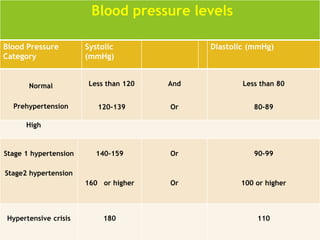
Blood Pressure
Category
Systolic
(mmHg)
Diastolic (mmHg)
Normal
Prehypertension
Less than 120
120-139
And
Or
Less than 80
80-89
High
Stage 1 hypertension
Stage2 hypertension
140-159
160 or higher
Or
Or
90-99
100 or higher
Hypertensive crisis 180 110
Blood pressure levels
 High blood pressure itself is usually asymptomatic , meaning
that patients do not experience any direct symptoms of the
condition. This is why hypertension is often referred to as "the
silent killer," as it can quietly causes damage to the
cardiovascular system.
Symptoms of hypertension.
 Antihypertensives are a classof drugs that are used to
treat hypertension (highblood pressure).
 Antihypertensivetherapyseeks to prevent the complications of
highbloodpressure, such as stroke and myocardial infarction.
What is antihypertensive drugs or agents?
pr
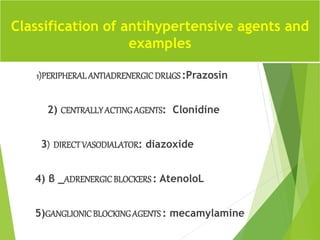
1)PERIPHERAL ANTIADRENERGICDRUGS:Prazosin
2) CENTRALLYACTINGAGENTS: Clonidine
3) DIRECTVASODIALATOR: diazoxide
4) β _ADRENERGICBLOCKERS: AtenoloL
5)GANGLIONIC BLOCKINGAGENTS : mecamylamine
Classification of antihypertensive agents and
examples
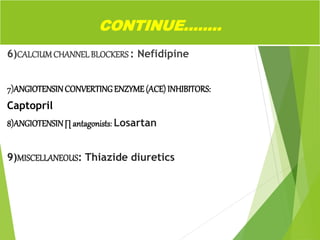
6)CALCIUMCHANNEL BLOCKERS : Nefidipine
7)ANGIOTENSINCONVERTINGENZYME(ACE) INHIBITORS:
Captopril
8)ANGIOTENSIN∏ antagonists: Losartan
9)MISCELLANEOUS: Thiazide diuretics
CONTINUE……..
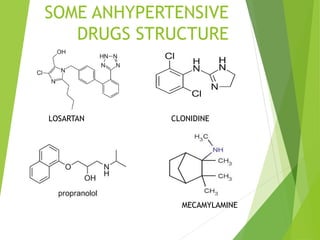
SOME ANHYPERTENSIVE
DRUGS STRUCTURE
LOSARTAN CLONIDINE
MECAMYLAMINE
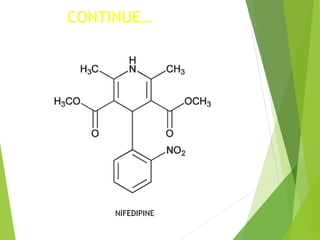
CONTINUE…
NIFEDIPINE
MECHANISM OF ACTION OF
ANTIHYPERTENSIVE DRUGS
1)Peripheral antiadrenergic drugs:
These drugs lower blood pressure by
blocking α1_adrenoceptors that subserve
vasoconstrictor function.
2)Centrally acting agents: The mechanism of these
drugs is caused by stimulation of
α2_adrenoceptors in the inhihitory structure
of the brain.
3)Direct vasodialators: It reduce blood pressure by
direct relaxation of smooth muscle of the
arterioles,possibly as a result of calcium
channel activation of smooth musculature in
arterioles
CONTINUE..
4) Ganglionic blocking agents: These drugs block
sympathetic ganglia, interrupting
adrenergic control of arterioles,and result
in vasodialation,improved peripheral
blood flow in some vascular beds,and a
fail in blood pressure
5)β _Adrenergic blockers: These drugs block the
β_receptor of the heart ,slow the heart
,reduce the force of contrustion,and
reduce the cardiac output
CONTINUE….
6) Calcium channel blockers: calcium channel
blockers drugs block voltage dependent
calcium cannels ,especially the calcium
channel in cardiac and smooth muscle.
7)Angiotensin converting enzyme(ACE) inhibitor:
Angiotensinogen→renin→angiotensin
ɪ(decapeptide,biologically
inactive)→angiotensin∏(octapeptide)→vaso
construction→Na+ retention→hypertension
CONTINUE…
8)Angiotensin∏ Antgonists: These compounds
compete with angiotensin∏ at the receptor
site and block the contractile effect of
angiotensin ∏ in all vascular smooth
muscles.
9)Miscellaneous drugs: Thiazide and high ceiling
diuretics lower blood pressure of pressure
with essential hypertension.
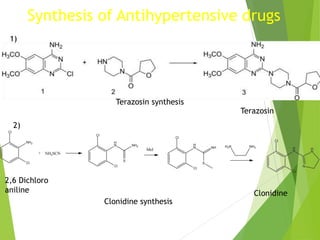
Synthesis of Antihypertensive drugs
Terazosin synthesis
1)
Clonidine synthesis
2)
2,6 Dichloro
aniline
Terazosin
Clonidine
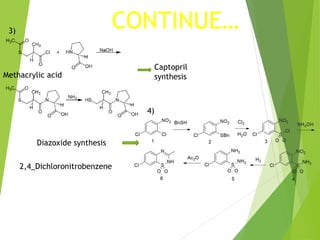
CONTINUE…3)
4)
Captopril
synthesis
Diazoxide synthesis
Methacrylic acid
2,4_Dichloronitrobenzene
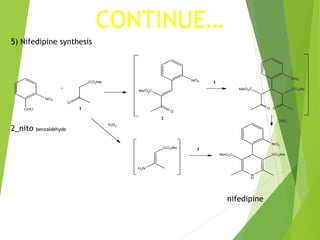
5) Nifedipine synthesis
CONTINUE…
2_nito benzaldehyde
nifedipine
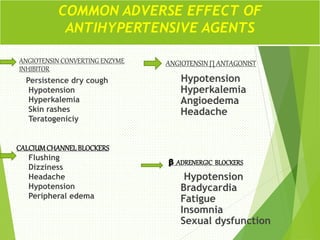
ANGIOTENSIN CONVERTING ENZYME
INHIBITOR
Persistence dry cough
Hypotension
Hyperkalemia
Skin rashes
Teratogeniciy
CALCIUMCHANNELBLOCKERS
Flushing
Dizziness
Headache
Hypotension
Peripheral edema
ANGIOTENSIN ∏ ANTAGONIST
Hypotension
Hyperkalemia
Angioedema
Headache
β _ADRENERGIC BLOCKERS
Hypotension
Bradycardia
Fatigue
Insomnia
Sexual dysfunction
COMMON ADVERSE EFFECT OF
ANTIHYPERTENSIVE AGENTS
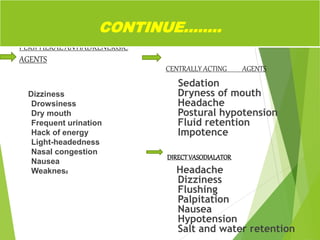
PERIPHERAL ANTIADRENERGIC
AGENTS
Dizziness
Drowsiness
Dry mouth
Frequent urination
Hack of energy
Light-headedness
Nasal congestion
Nausea
Weakness
CENTRALLY ACTING AGENTS
Sedation
Dryness of mouth
Headache
Postural hypotension
Fluid retention
Impotence
DIRECTVASODIALATOR
Headache
Dizziness
Flushing
Palpitation
Nausea
Hypotension
Salt and water retention
CONTINUE……..
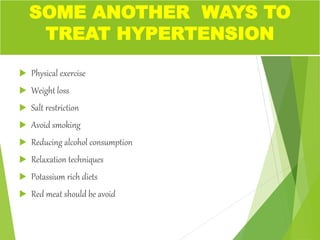
 Physical exercise
 Weight loss
 Salt restriction
 Avoid smoking
 Reducing alcohol consumption
 Relaxation techniques
 Potassium rich diets
 Red meat should be avoid
SOME ANOTHER WAYS TO
TREAT HYPERTENSION
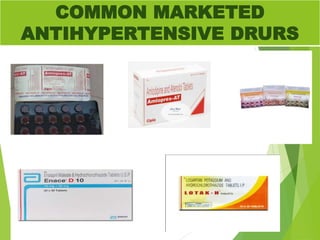
COMMON MARKETED
ANTIHYPERTENSIVE DRURS
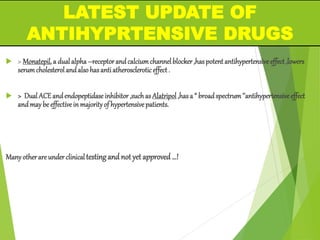
 > Monatepil,a dualalpha–receptorandcalciumchannelblocker,haspotentantihypertensiveeffect,lowers
serumcholesterolandalsohasantiatheroscleroticeffect.
 > DualACEandendopeptidaseinhibitor,suchas Alatripol,hasa “ broadspectrum’’antihypertensiveeffect
andmaybeeffectiveinmajorityof hypertensivepatients.
Manyotherareunderclinicaltestingand not yet approved …!
LATEST UPDATE OF
ANTIHYPRTENSIVE DRUGS
REFERENCE
1) MEDICINAL CHEMISTRY, SECOND
EDITION,( D.Sriram, P.Yogeeswari)
(page no 328_350)
2) GOOGLE and WEKIPEDIA
Thank You