ESTABLISHING
OBJECTIVES: SETTING
STAGE FOR STRATEGY
FORMULATION
http://solvetechnicalprob
lem.blogspot.com
“Establishing objectives is generally a
political process, characterized by
bargaining and conflict coupled with
rational analysis” Peter Fitzroy and James
Hulbert
ESTABLISHING OBJECTIVES
 Objectives will form the basis for formulating
strategy.
 There can be no strategy without objective.
 Establishing objectives is a direction setting task.
 Establishing objectives converts vision and
mission into specific performance outcomes.
 Top managers et broader objectives with longer
time horizons.
MEANING AND NATURE OF
OBJECTIVES
 An objective is a specific commitment to achieve
a measurable result within a give time frame.
 An objective describes the end result to be
achieved by the firm.
 An objectives need to written in quantitative,
measurable and concrete terms.
 An objective must clearly show what the
company wants to achieve and when it wants to
achieve it.
SMART OBJECTIVES
 A well formulated objective must be SMART
where-
 S stands for specific
 M for measurable
 A for achievable or Appropriate
 R for realistic
 T for time-bound
EXAMPLES OF SMART OBJECTIVES
 To increase the sales of all products of the
company by 5% during the year 2014.
 To reduce the overhead costs of the company by
Tk. 100000 during the next six months.
 To achieve 20% increase in the sales of brand-X
by December 31, 2014.
 To increase unit sales of ‘5M Family Software-
APONJON’ in Dhaka area by 5000 units by June
30, 2014.
GOALS VERSUS OBJECTIVES
 Goal is seen as being concerned with the long
term end points that the organization seeks to
achieve.
 Objective is seen as detailing out the steps along
the way to achieve the goal.
 Formulation of strategy usually starts with the
broad, wider vision, and from there moves to the
specific.
STRATEGIC PERFORMANCE
OBJECTIVES
“Strategic performance objectives are
concerned with sustaining and improving
company’s long term market position and
competitiveness”.
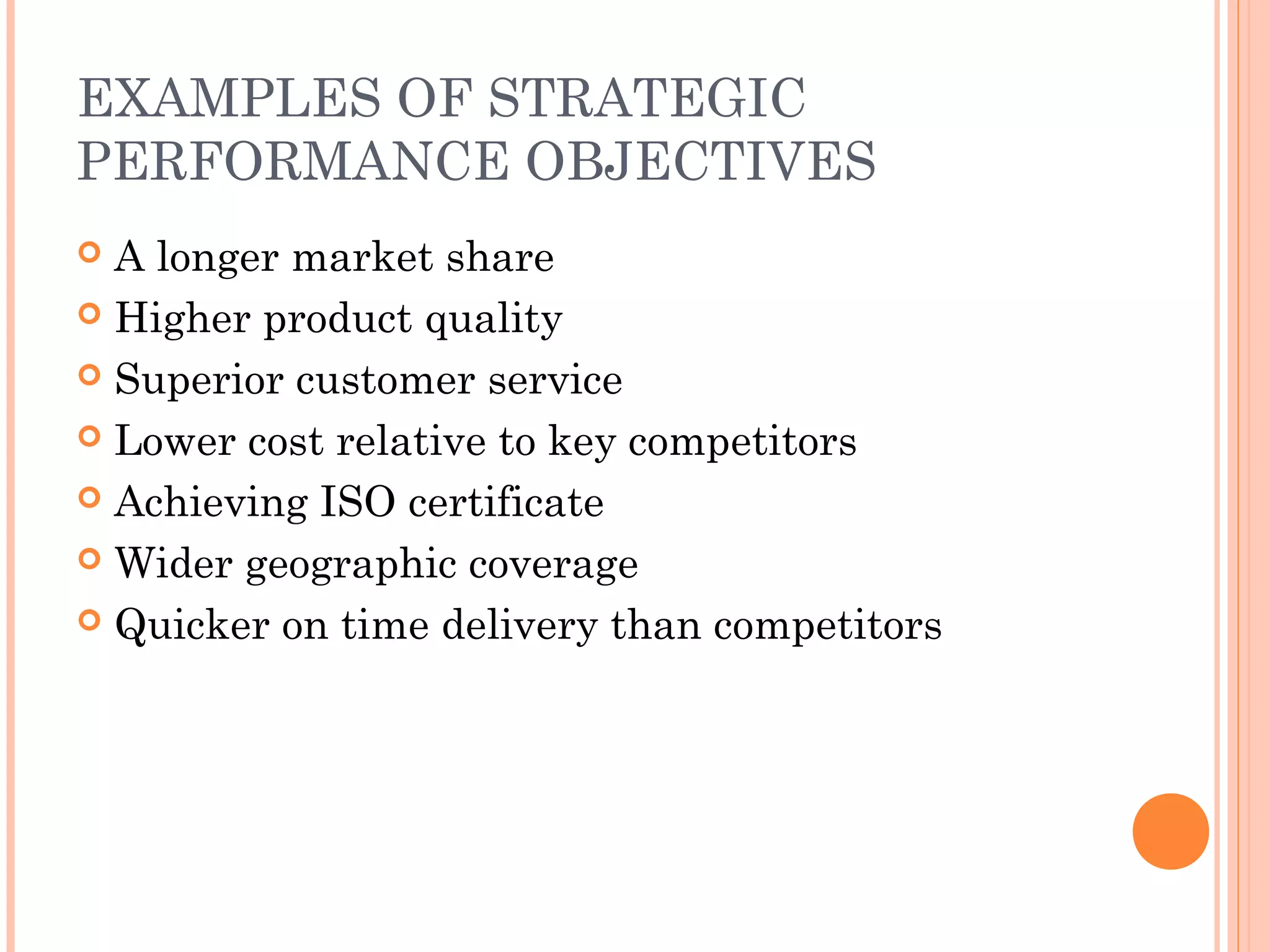
EXAMPLES OF STRATEGIC
PERFORMANCE OBJECTIVES
 A longer market share
 Higher product quality
 Superior customer service
 Lower cost relative to key competitors
 Achieving ISO certificate
 Wider geographic coverage
 Quicker on time delivery than competitors
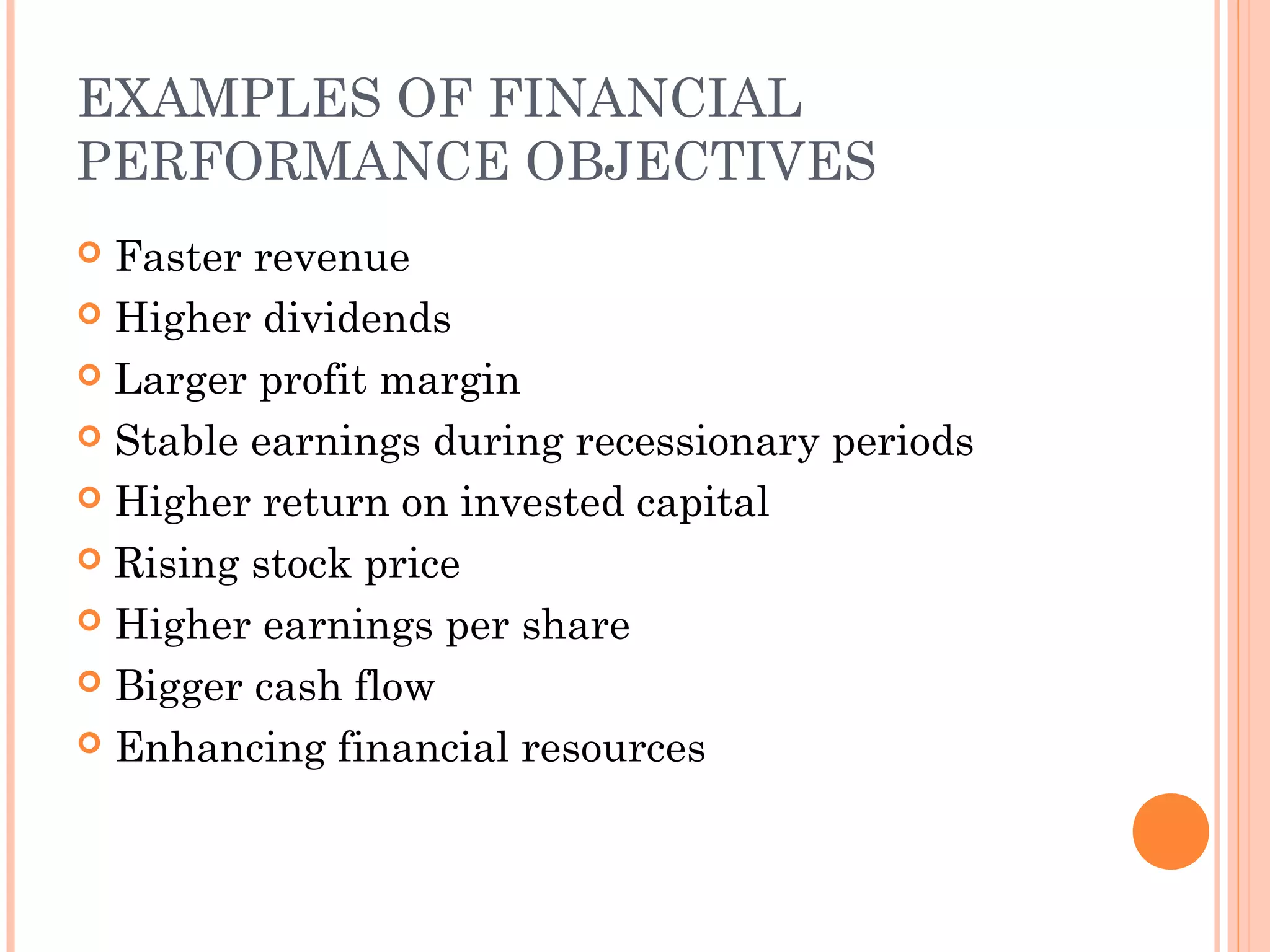
EXAMPLES OF FINANCIAL
PERFORMANCE OBJECTIVES
 Faster revenue
 Higher dividends
 Larger profit margin
 Stable earnings during recessionary periods
 Higher return on invested capital
 Rising stock price
 Higher earnings per share
 Bigger cash flow
 Enhancing financial resources
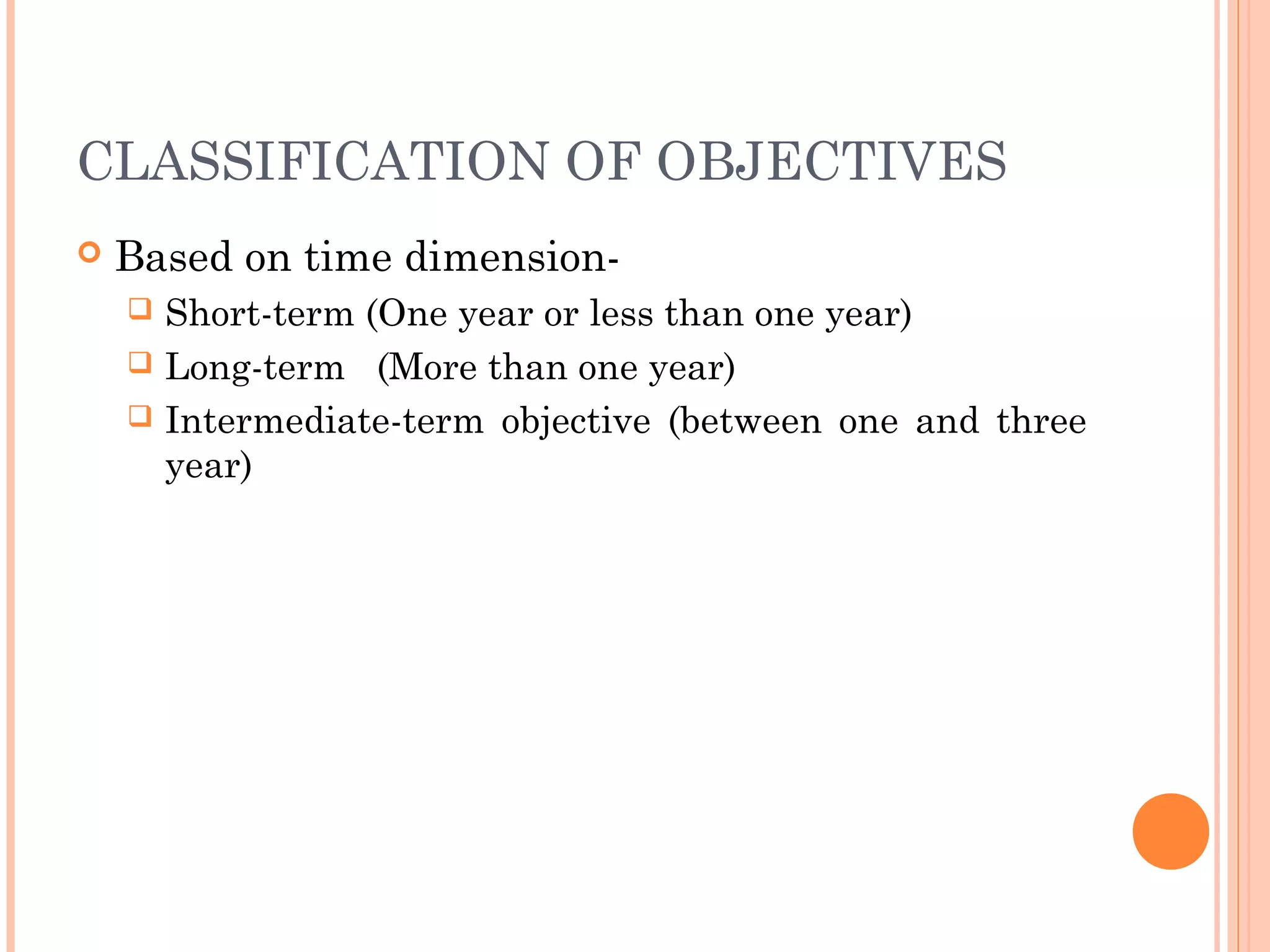
CLASSIFICATION OF OBJECTIVES
 Based on time dimension-
 Short-term (One year or less than one year)
 Long-term (More than one year)
 Intermediate-term objective (between one and three
year)
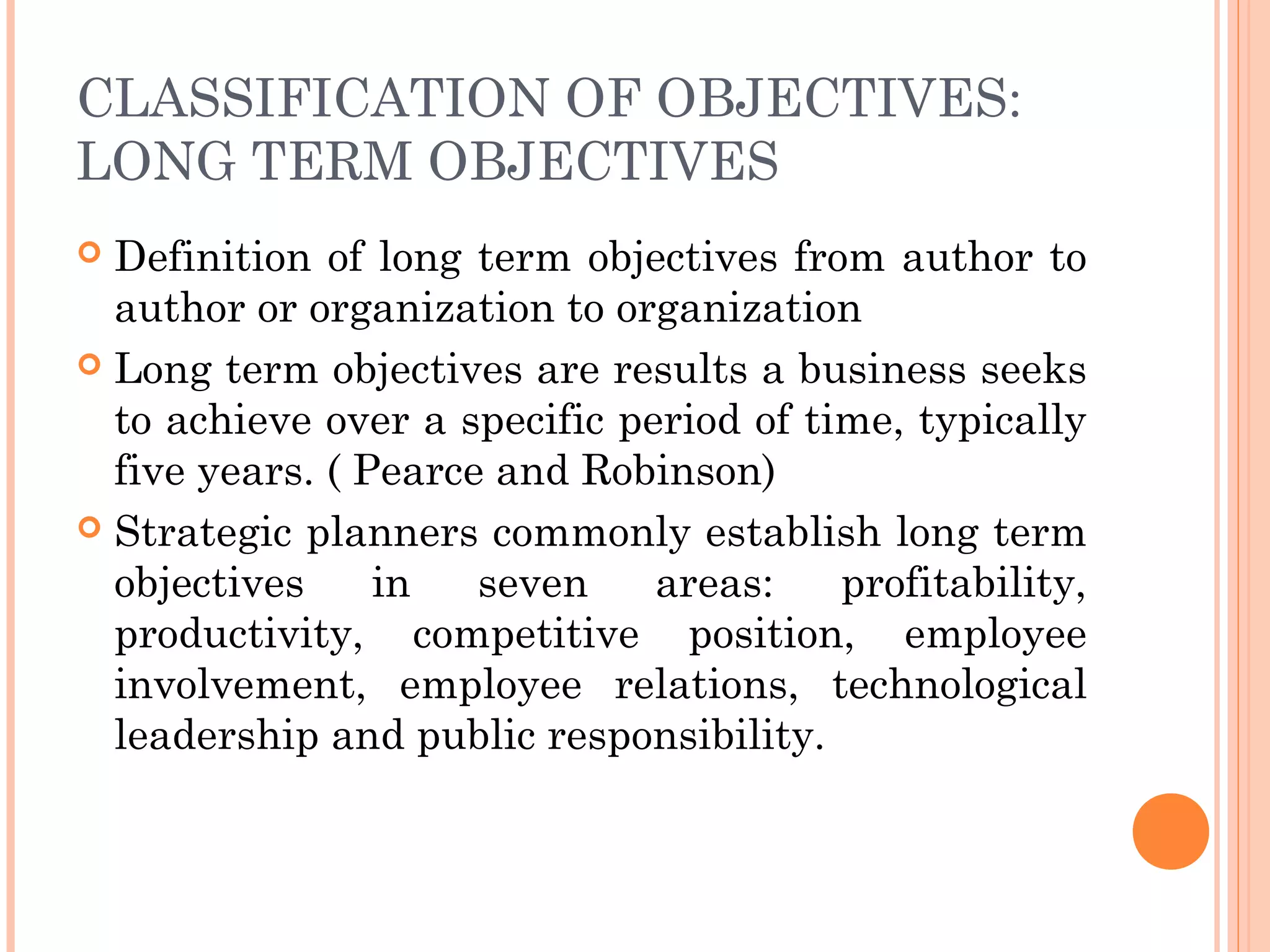
CLASSIFICATION OF OBJECTIVES:
LONG TERM OBJECTIVES
 Definition of long term objectives from author to
author or organization to organization
 Long term objectives are results a business seeks
to achieve over a specific period of time, typically
five years. ( Pearce and Robinson)
 Strategic planners commonly establish long term
objectives in seven areas: profitability,
productivity, competitive position, employee
involvement, employee relations, technological
leadership and public responsibility.
CLASSIFICATION OF OBJECTIVES
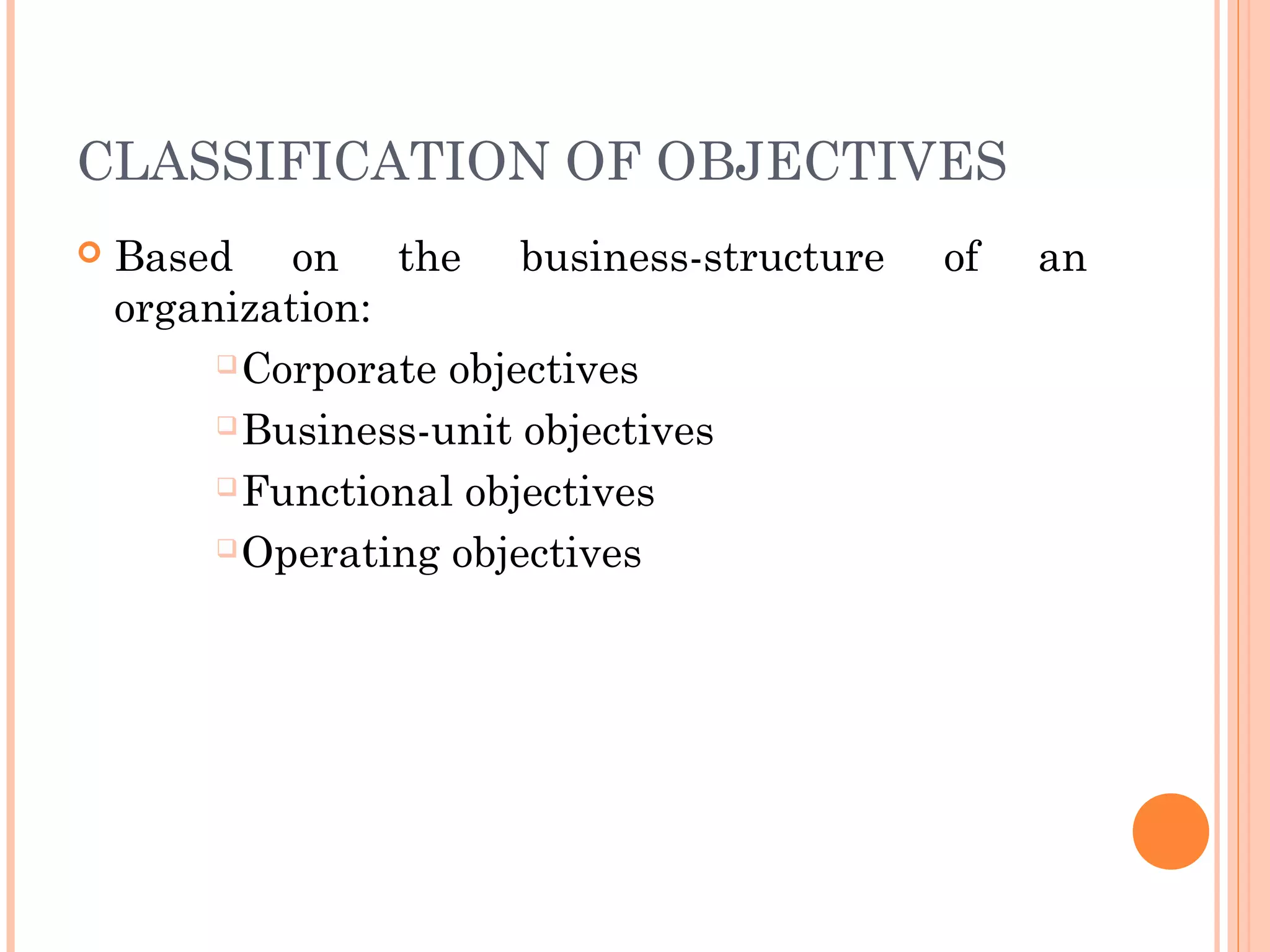
 Based on the business-structure of an
organization:
Corporate objectives
Business-unit objectives
Functional objectives
Operating objectives
CLASSIFICATION OF OBJECTIVES
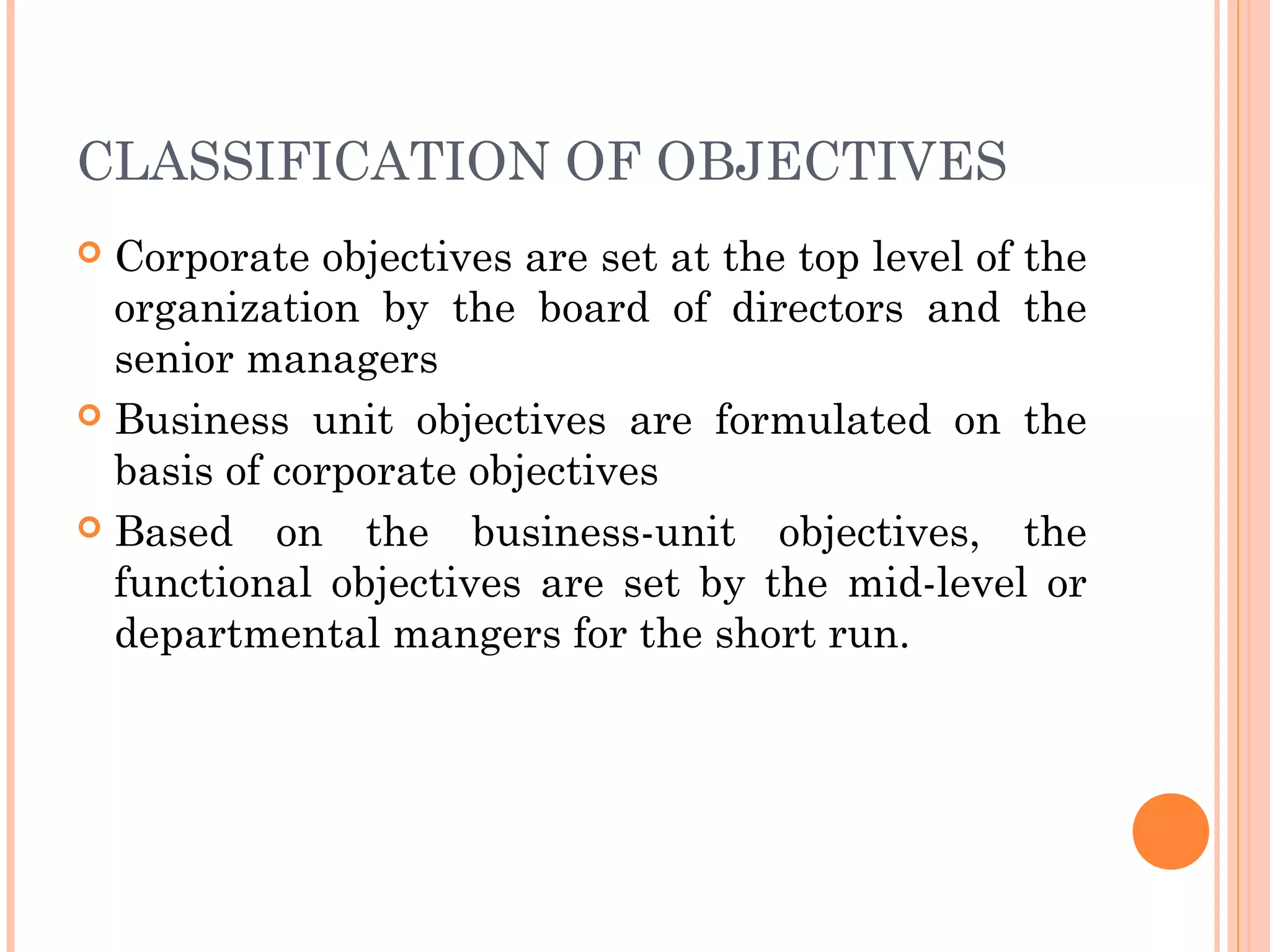
 Corporate objectives are set at the top level of the
organization by the board of directors and the
senior managers
 Business unit objectives are formulated on the
basis of corporate objectives
 Based on the business-unit objectives, the
functional objectives are set by the mid-level or
departmental mangers for the short run.
NECESSITY OF OBJECTIVES
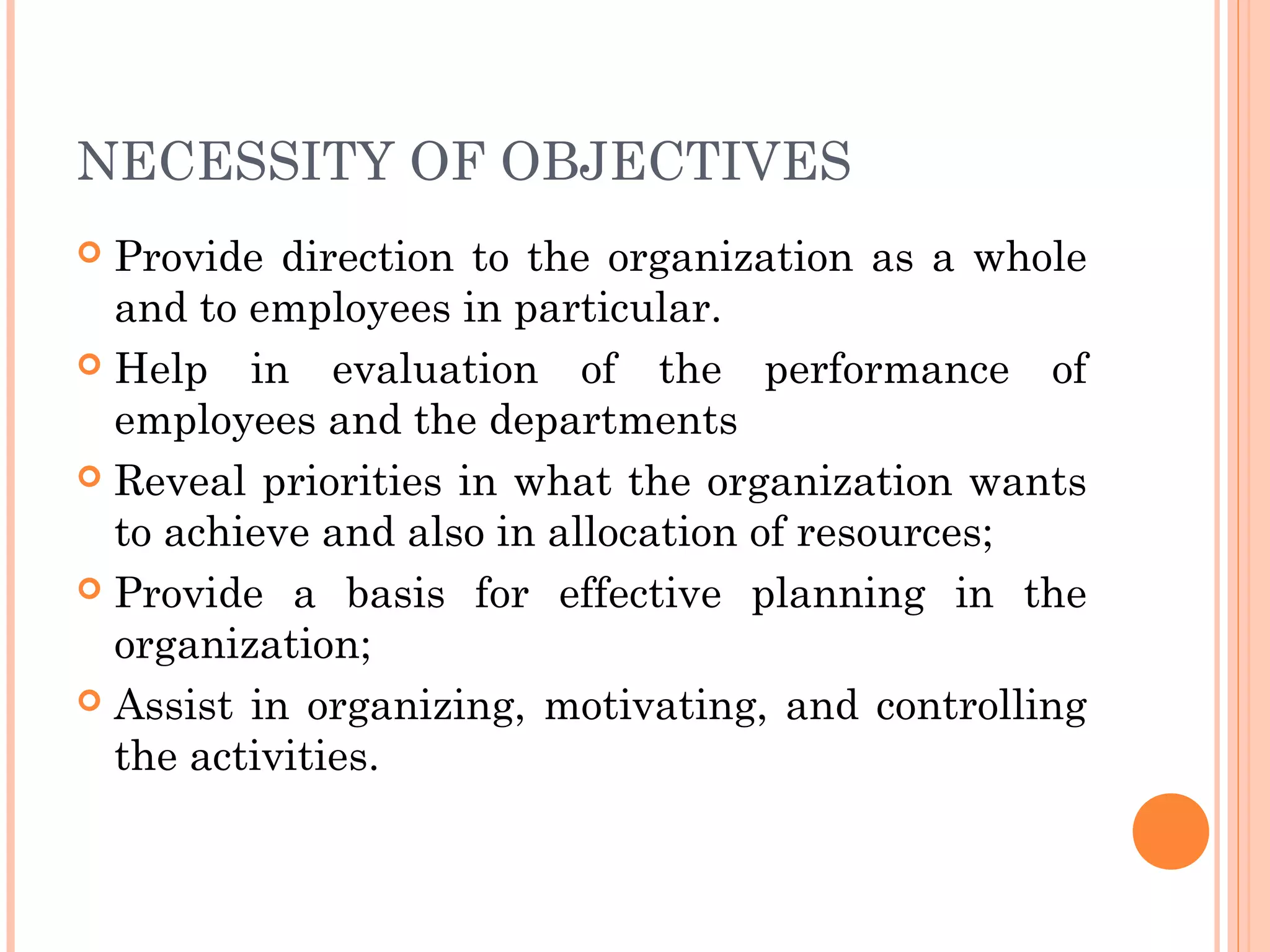
 Provide direction to the organization as a whole
and to employees in particular.
 Help in evaluation of the performance of
employees and the departments
 Reveal priorities in what the organization wants
to achieve and also in allocation of resources;
 Provide a basis for effective planning in the
organization;
 Assist in organizing, motivating, and controlling
the activities.
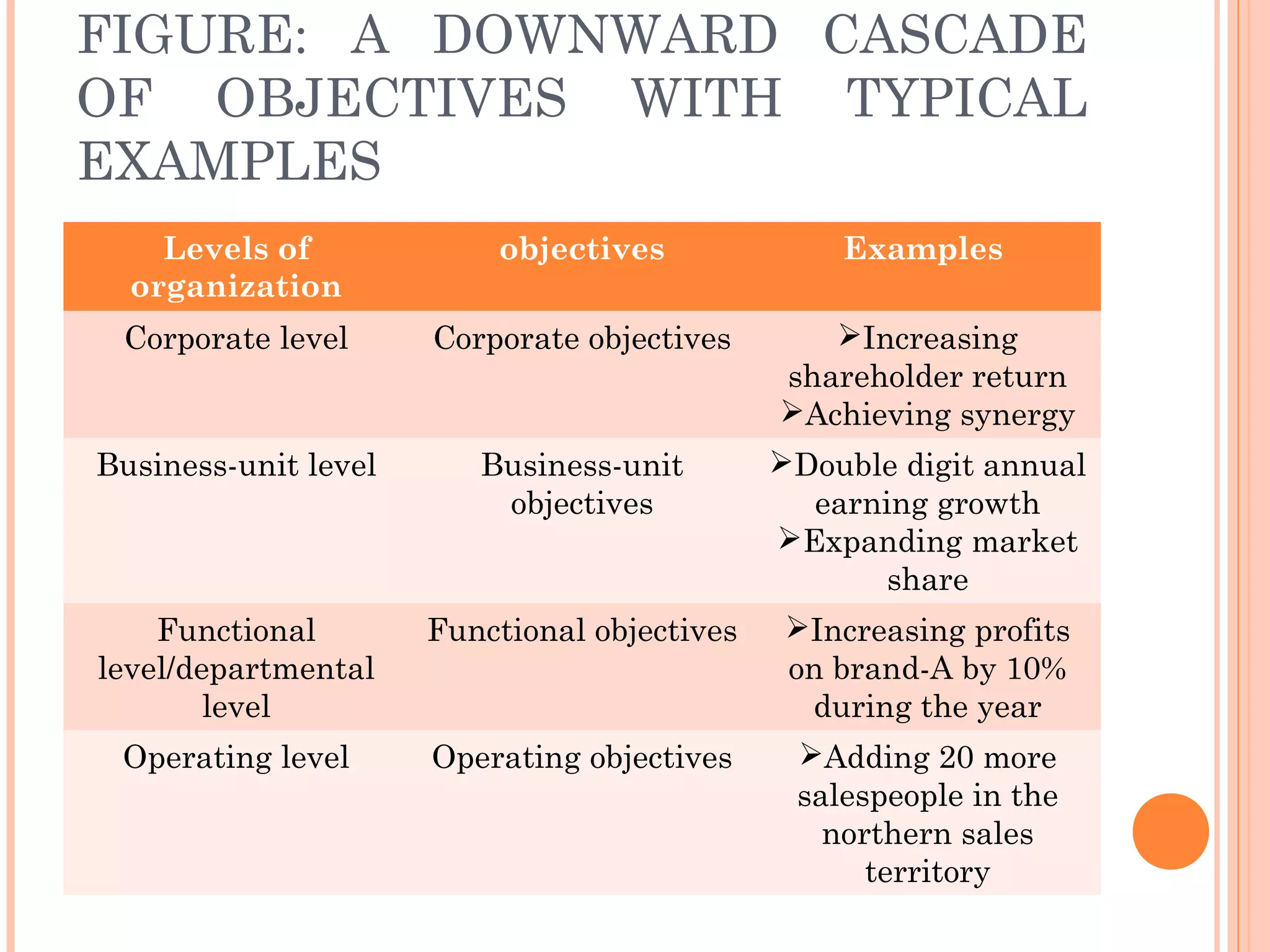
FIGURE: A DOWNWARD CASCADE
OF OBJECTIVES WITH TYPICAL
EXAMPLES
Levels of
organization
objectives Examples
Corporate level Corporate objectives Increasing
shareholder return
Achieving synergy
Business-unit level Business-unit
objectives
Double digit annual
earning growth
Expanding market
share
Functional
level/departmental
level
Functional objectives Increasing profits
on brand-A by 10%
during the year
Operating level Operating objectives Adding 20 more
salespeople in the
northern sales
territory
APPROACHES TO OBJECTIVE
SETTING: TOP DOWN OR BOTTOM
UP APPROACH?
 In case of top down approach, senior managers
set the objectives based on the needs of the
organization, and then they pass down these to
the lower levels.
 In bottom up approach, senior managers ask the
lower level managers to set objectives for their
units and send them to the top level for review
and approval.
LONG TERM OBJECTIVES AND
COMPETITIVE STRATEGY
 Competitive strategy is formulated based on long
term objective, which should have a time line.
 For effective implementation of competitive
strategy, long term objectives are broken down to
annual objectives.
 Annual objectives serve as milestones for
reaching the long term objectives.
 Each long term objectives may require a set of
annual objectives.
Thank You
For
Attending the Session
www.mhsoftbd.org

Establishing objectives

  • 1.
    ESTABLISHING OBJECTIVES: SETTING STAGE FORSTRATEGY FORMULATION http://solvetechnicalprob lem.blogspot.com
  • 2.
    “Establishing objectives isgenerally a political process, characterized by bargaining and conflict coupled with rational analysis” Peter Fitzroy and James Hulbert
  • 3.
    ESTABLISHING OBJECTIVES  Objectiveswill form the basis for formulating strategy.  There can be no strategy without objective.  Establishing objectives is a direction setting task.  Establishing objectives converts vision and mission into specific performance outcomes.  Top managers et broader objectives with longer time horizons.
  • 4.
    MEANING AND NATUREOF OBJECTIVES  An objective is a specific commitment to achieve a measurable result within a give time frame.  An objective describes the end result to be achieved by the firm.  An objectives need to written in quantitative, measurable and concrete terms.  An objective must clearly show what the company wants to achieve and when it wants to achieve it.
  • 5.
    SMART OBJECTIVES  Awell formulated objective must be SMART where-  S stands for specific  M for measurable  A for achievable or Appropriate  R for realistic  T for time-bound
  • 6.
    EXAMPLES OF SMARTOBJECTIVES  To increase the sales of all products of the company by 5% during the year 2014.  To reduce the overhead costs of the company by Tk. 100000 during the next six months.  To achieve 20% increase in the sales of brand-X by December 31, 2014.  To increase unit sales of ‘5M Family Software- APONJON’ in Dhaka area by 5000 units by June 30, 2014.
  • 7.
    GOALS VERSUS OBJECTIVES Goal is seen as being concerned with the long term end points that the organization seeks to achieve.  Objective is seen as detailing out the steps along the way to achieve the goal.  Formulation of strategy usually starts with the broad, wider vision, and from there moves to the specific.
  • 8.
    STRATEGIC PERFORMANCE OBJECTIVES “Strategic performanceobjectives are concerned with sustaining and improving company’s long term market position and competitiveness”.
  • 9.
    EXAMPLES OF STRATEGIC PERFORMANCEOBJECTIVES  A longer market share  Higher product quality  Superior customer service  Lower cost relative to key competitors  Achieving ISO certificate  Wider geographic coverage  Quicker on time delivery than competitors
  • 10.
    EXAMPLES OF FINANCIAL PERFORMANCEOBJECTIVES  Faster revenue  Higher dividends  Larger profit margin  Stable earnings during recessionary periods  Higher return on invested capital  Rising stock price  Higher earnings per share  Bigger cash flow  Enhancing financial resources
  • 11.
    CLASSIFICATION OF OBJECTIVES Based on time dimension-  Short-term (One year or less than one year)  Long-term (More than one year)  Intermediate-term objective (between one and three year)
  • 12.
    CLASSIFICATION OF OBJECTIVES: LONGTERM OBJECTIVES  Definition of long term objectives from author to author or organization to organization  Long term objectives are results a business seeks to achieve over a specific period of time, typically five years. ( Pearce and Robinson)  Strategic planners commonly establish long term objectives in seven areas: profitability, productivity, competitive position, employee involvement, employee relations, technological leadership and public responsibility.
  • 13.
    CLASSIFICATION OF OBJECTIVES Based on the business-structure of an organization: Corporate objectives Business-unit objectives Functional objectives Operating objectives
  • 14.
    CLASSIFICATION OF OBJECTIVES Corporate objectives are set at the top level of the organization by the board of directors and the senior managers  Business unit objectives are formulated on the basis of corporate objectives  Based on the business-unit objectives, the functional objectives are set by the mid-level or departmental mangers for the short run.
  • 15.
    NECESSITY OF OBJECTIVES Provide direction to the organization as a whole and to employees in particular.  Help in evaluation of the performance of employees and the departments  Reveal priorities in what the organization wants to achieve and also in allocation of resources;  Provide a basis for effective planning in the organization;  Assist in organizing, motivating, and controlling the activities.
  • 16.
    FIGURE: A DOWNWARDCASCADE OF OBJECTIVES WITH TYPICAL EXAMPLES Levels of organization objectives Examples Corporate level Corporate objectives Increasing shareholder return Achieving synergy Business-unit level Business-unit objectives Double digit annual earning growth Expanding market share Functional level/departmental level Functional objectives Increasing profits on brand-A by 10% during the year Operating level Operating objectives Adding 20 more salespeople in the northern sales territory
  • 17.
    APPROACHES TO OBJECTIVE SETTING:TOP DOWN OR BOTTOM UP APPROACH?  In case of top down approach, senior managers set the objectives based on the needs of the organization, and then they pass down these to the lower levels.  In bottom up approach, senior managers ask the lower level managers to set objectives for their units and send them to the top level for review and approval.
  • 18.
    LONG TERM OBJECTIVESAND COMPETITIVE STRATEGY  Competitive strategy is formulated based on long term objective, which should have a time line.  For effective implementation of competitive strategy, long term objectives are broken down to annual objectives.  Annual objectives serve as milestones for reaching the long term objectives.  Each long term objectives may require a set of annual objectives.
  • 19.
    Thank You For Attending theSession www.mhsoftbd.org