2
•
‫لهىيشس‬ِ
3
•
•
•
•
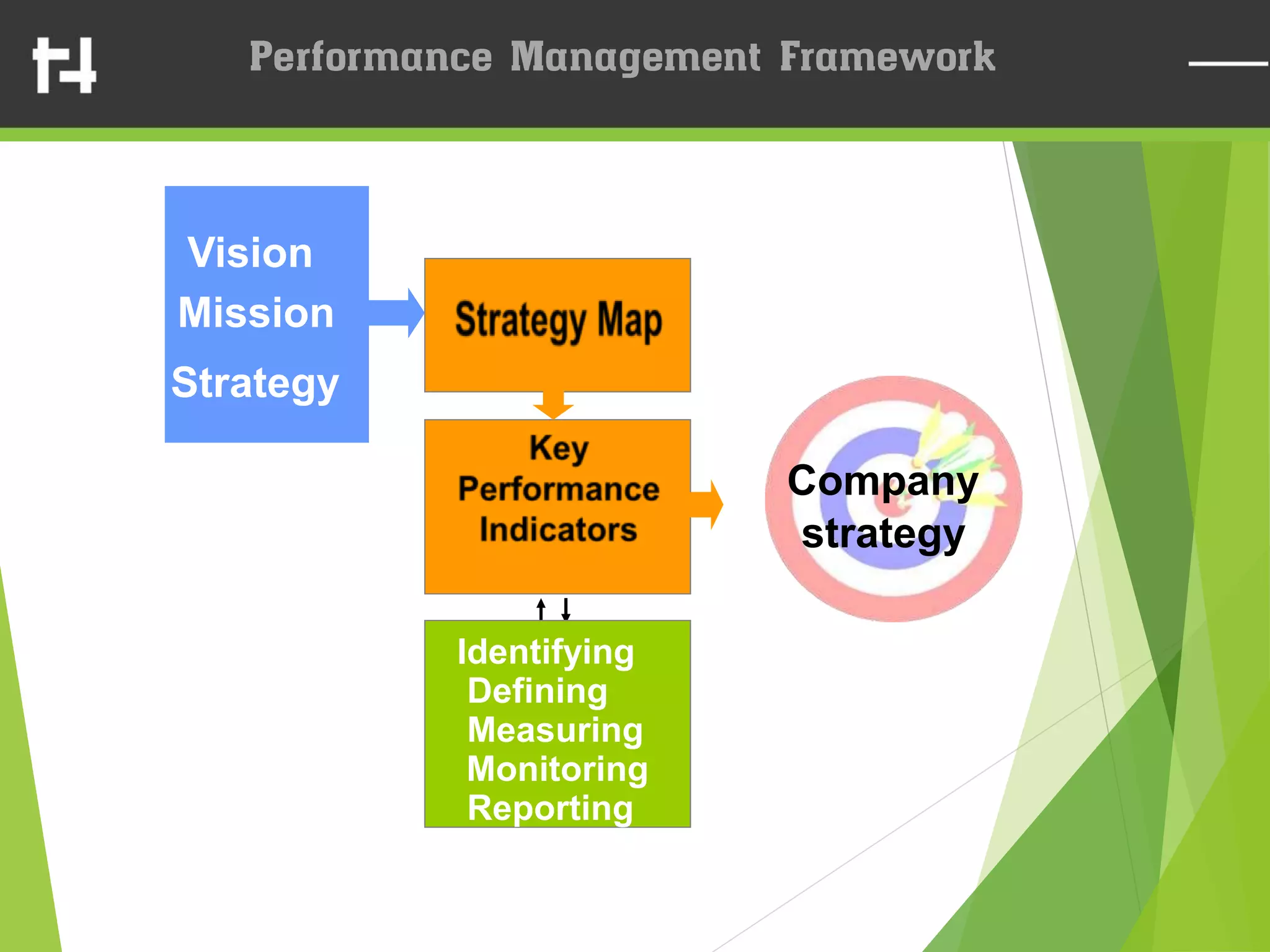
Identifying
Defining
Measuring
Monitoring
Reporting
Company
strategy
Vision
Mission
Strategy
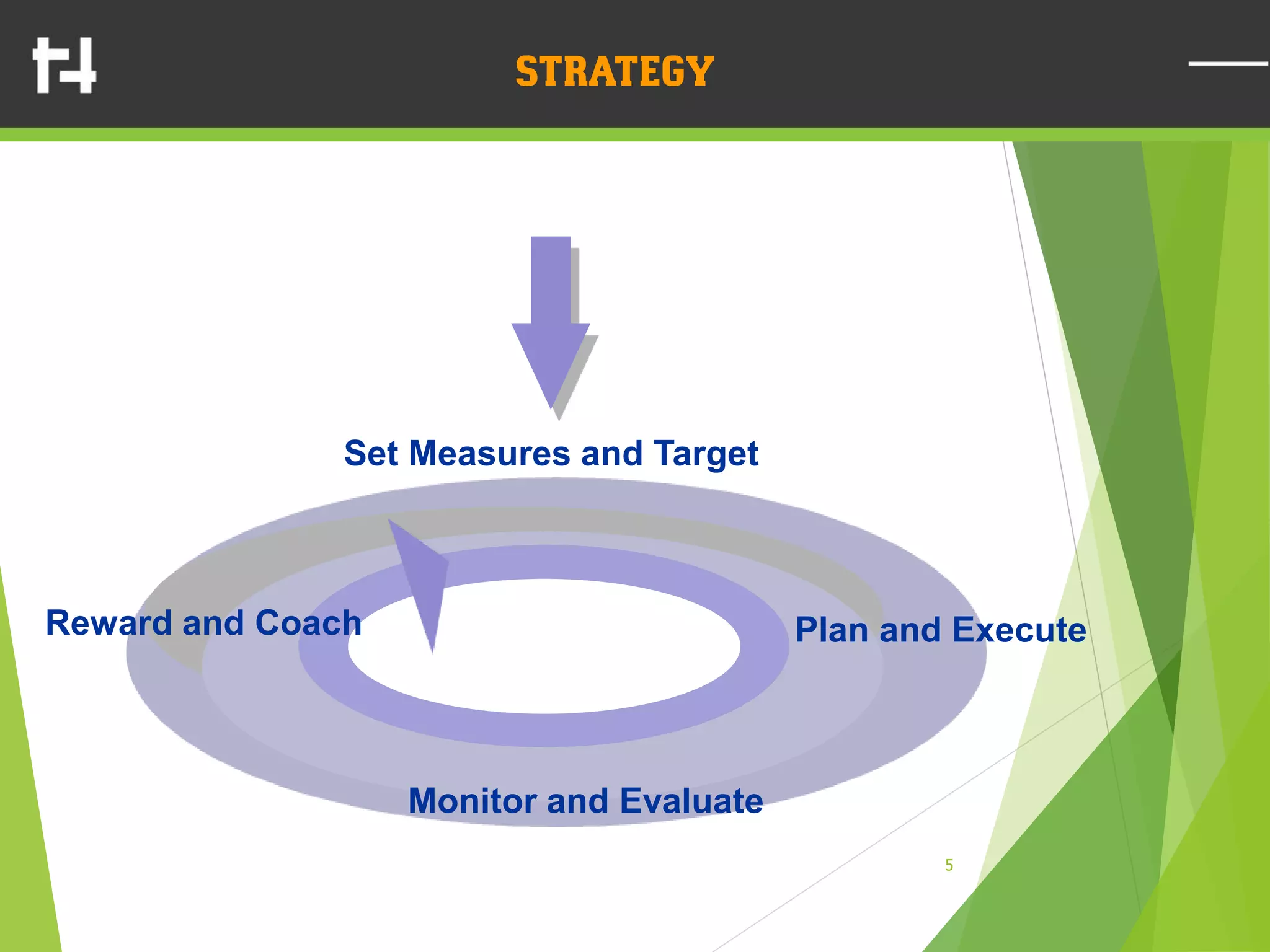
5
Contents
Plan and Execute
Monitor and Evaluate
Reward and Coach
Set Measures and Target
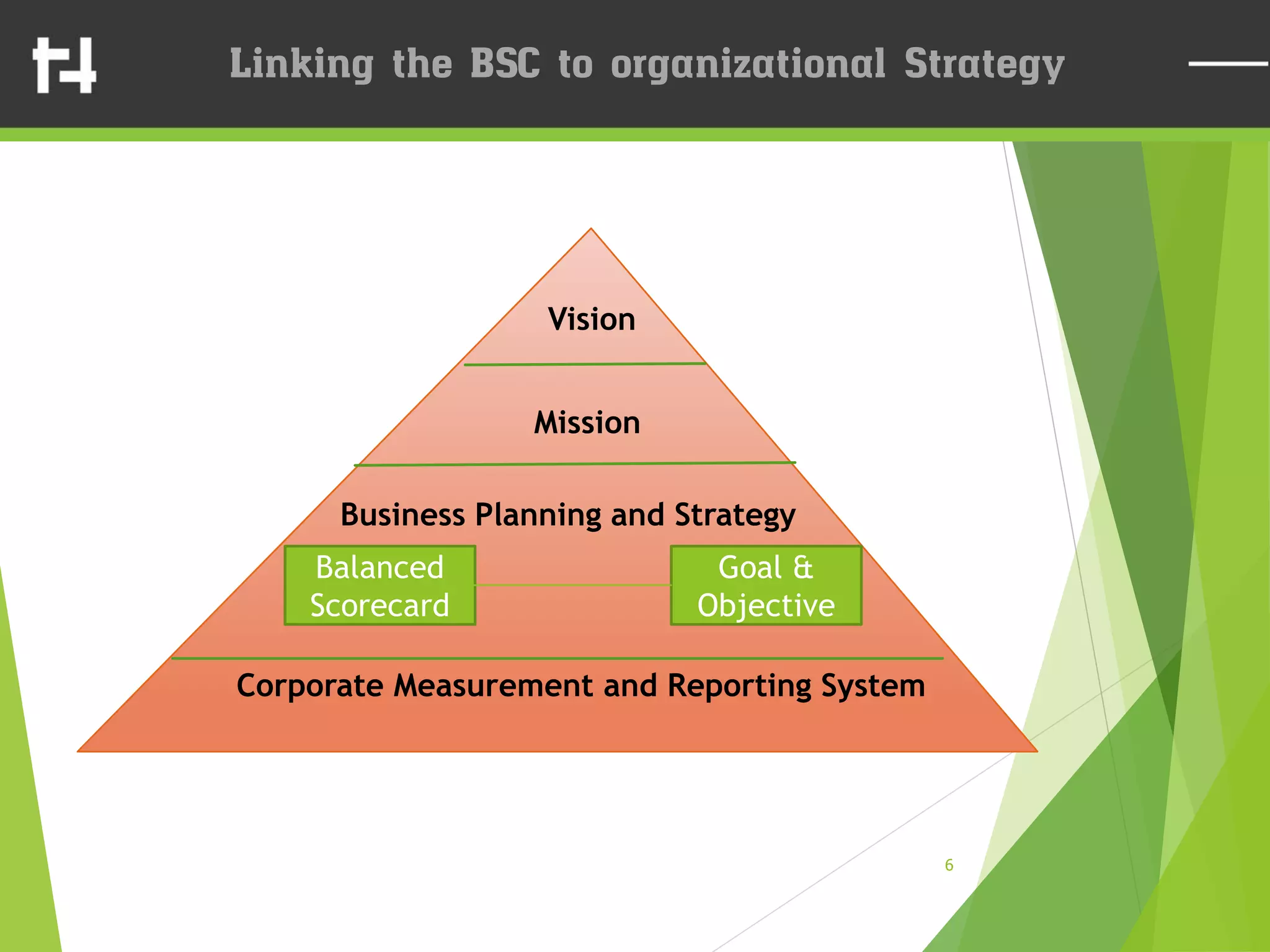
6
Business Planning and Strategy
Mission
Vision
GoalGoal &
Objective
Balanced
Scorecard
Corporate Measurement and Reporting System
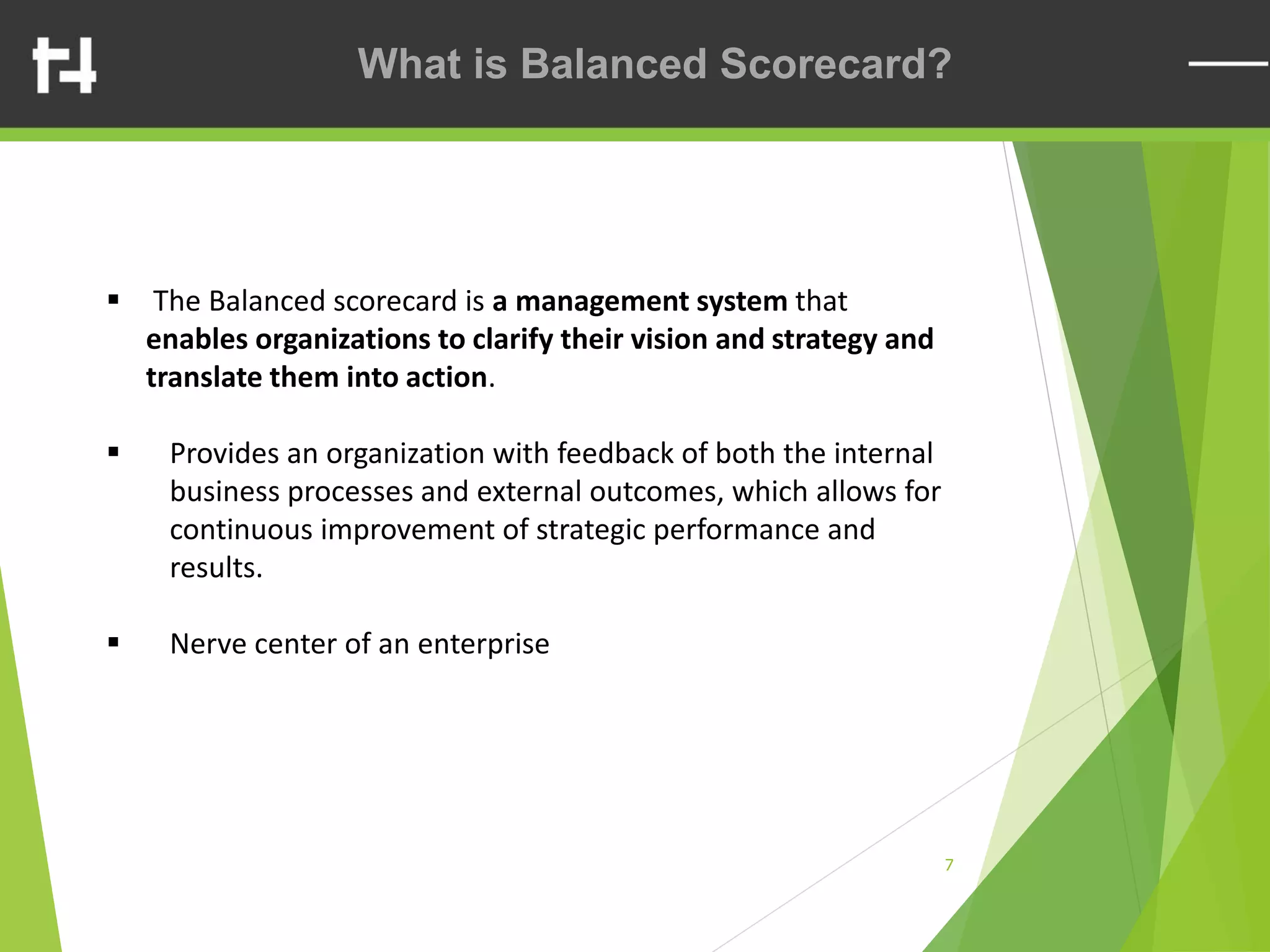
7
What is Balanced Scorecard?
▪ The Balanced scorecard is a management system that
enables organizations to clarify their vision and strategy and
translate them into action.
▪ Provides an organization with feedback of both the internal
business processes and external outcomes, which allows for
continuous improvement of strategic performance and
results.
▪ Nerve center of an enterprise
8
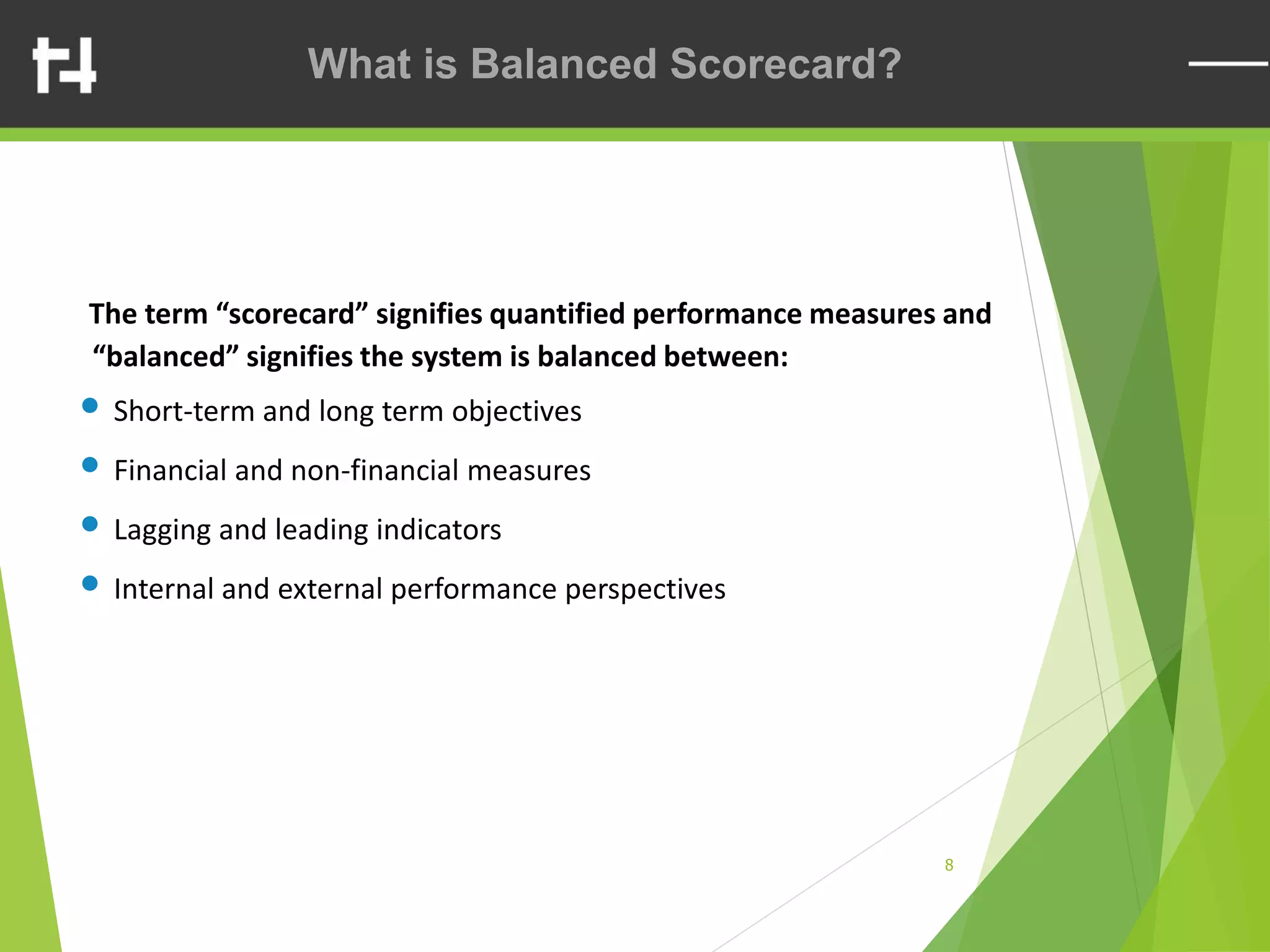
The term “scorecard” signifies quantified performance measures and
“balanced” signifies the system is balanced between:
• Short-term and long term objectives
• Financial and non-financial measures
• Lagging and leading indicators
• Internal and external performance perspectives
What is Balanced Scorecard?
9
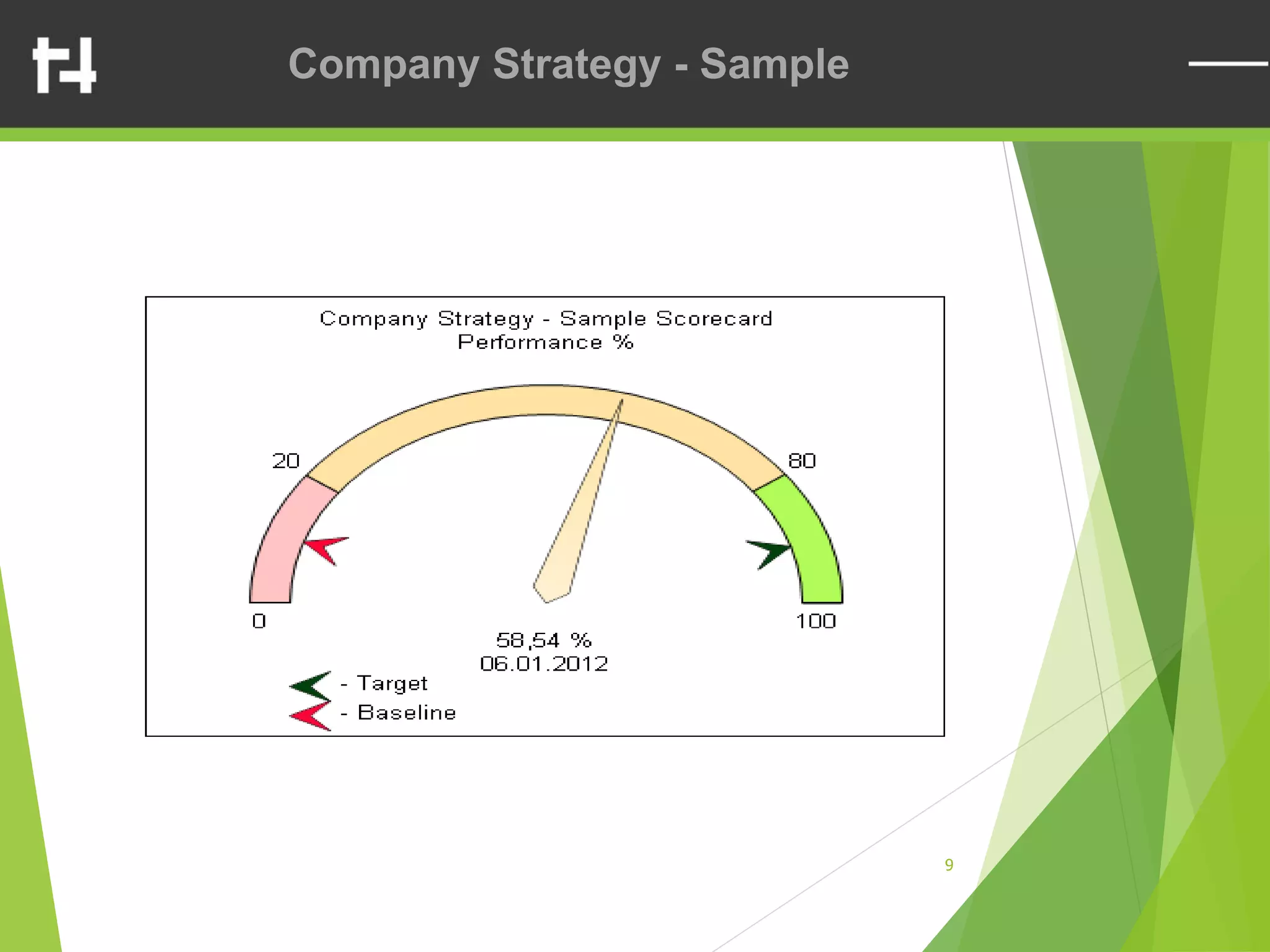
Company Strategy - Sample
10
The Four Perspectives of Balance Scorecard
The balanced scorecard is centered on four performance metrics or
perspectives:
• Customers
• Internal processes
• Financial
• Learning and growth
➢ When implemented properly, each one of these perspectives contains
four subparts consisting of
• Objectives
• Measures
• Targets
• Initiatives
11
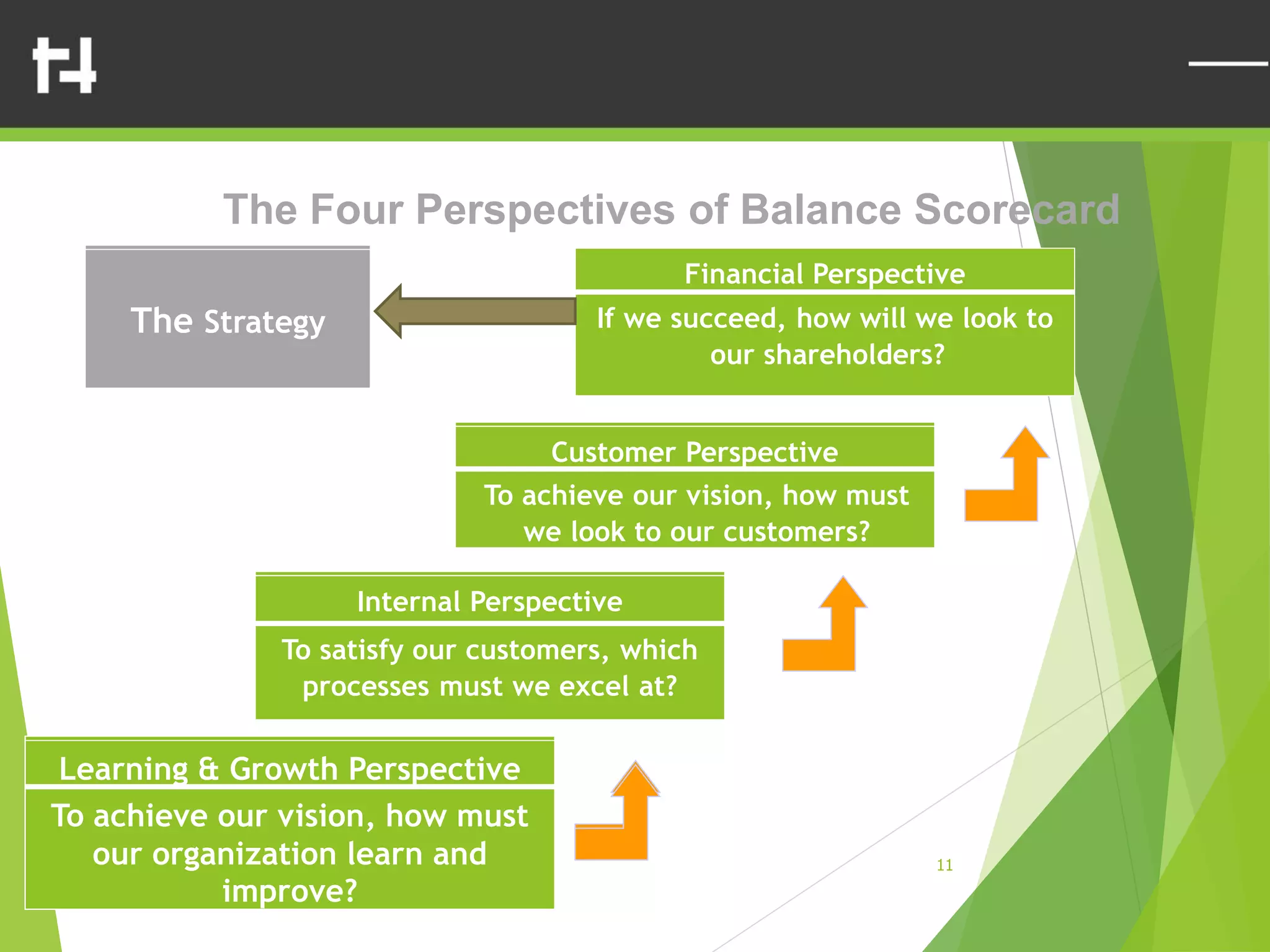
Customer Perspective
To achieve our vision, how must
we look to our customers?
Internal Perspective
To satisfy our customers, which
processes must we excel at?
Learning & Growth Perspective
To achieve our vision, how must
our organization learn and
improve?
Financial Perspective
If we succeed, how will we look to
our shareholders?
The Strategy
Contents The Four Perspectives of Balance Scorecard
Customer Perspective
To achieve our vision, how must
we look to our customers?
Internal Perspective
To satisfy our customers, which
processes must we excel at?
Learning & Growth Perspective
To achieve our vision, how must
our organization learn and
improve?
The Strategy
12
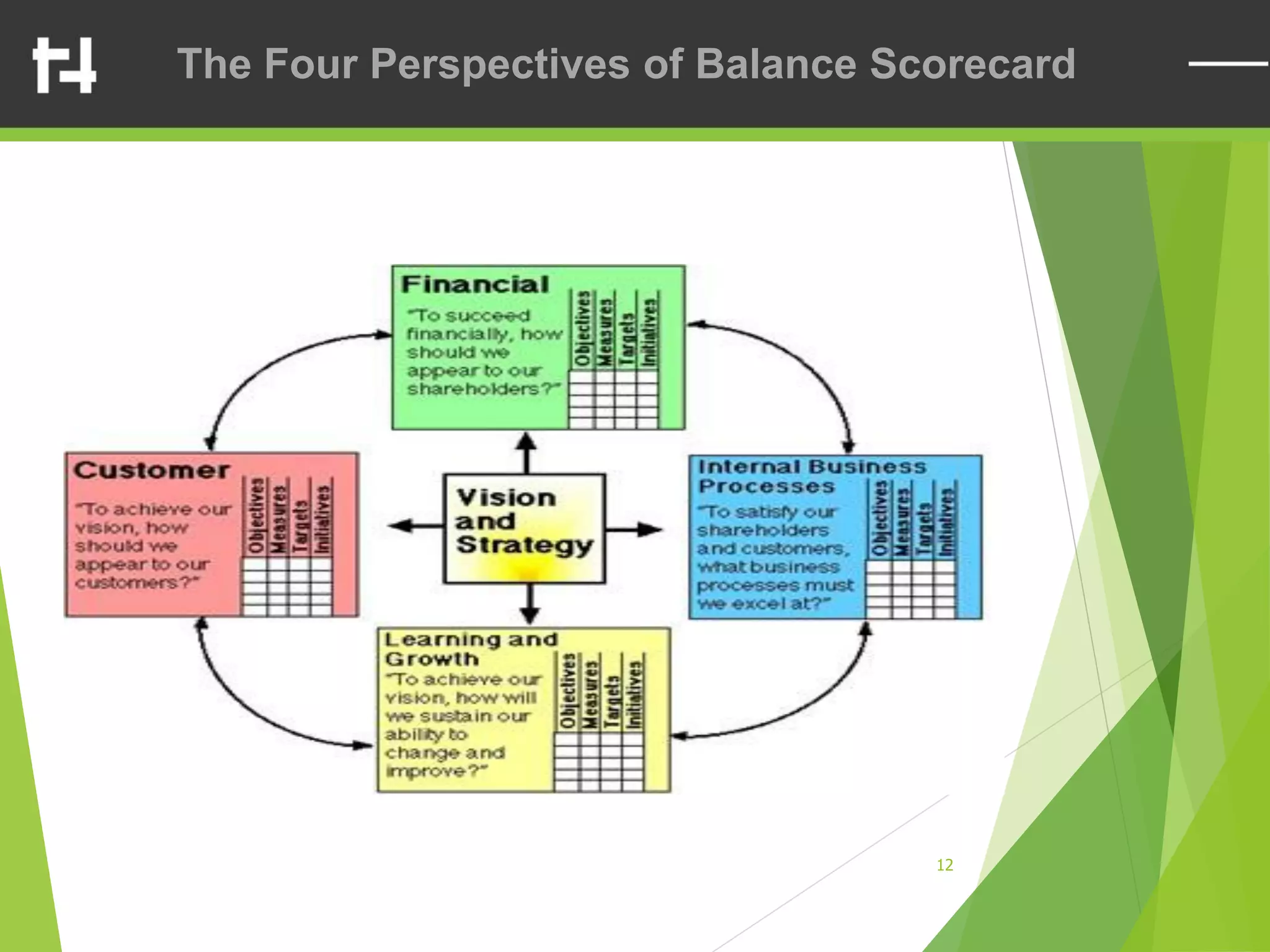
The Four Perspectives of Balance Scorecard
13
Financial Perspective
• In private companies, the financial perspective is the
main objective (ultimate goal) – without having to sacrifice
the interests of other relevant stakeholders
(community, environment, government, etc.)
• In the financial perspective, the strategic goal is the
long-term shareholder value. This goal is driven by
two factors, namely : revenue growth and cost
efficiency.
• How shareholders view the firm and which financial goals
are desired from the shareholder’s perspective.
• These financial goals are dependent on the company’s
stage in the business life cycle.
14
Strategic Theme for Financial Perspective
Revenue growth and mix.
This is mainly about reaching new customers and markets,
expanding products and services, introducing new pricing policies
etc.
Productivity improvement/cost reduction.
This may include reduction of indirect costs, sharing common
resources with other departments, lowering direct costs.
Investment strategy/assets utilization
This may include greater utilization of fixes assets base and
improving return on investment
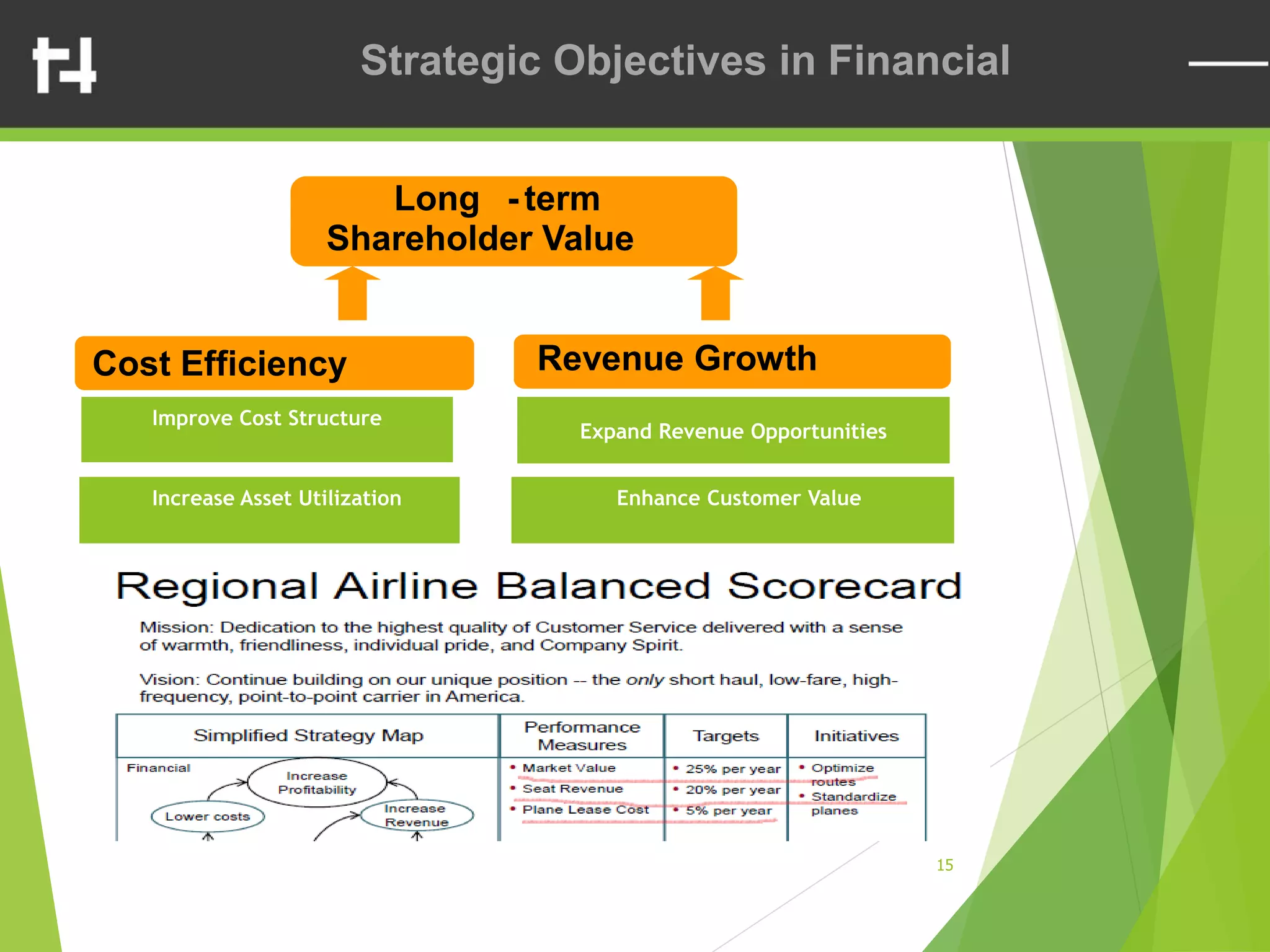
15
Strategic Objectives in Financial
Long - term
Shareholder Value
Revenue GrowthCost Efficiency
Improve Cost Structure
Increase Asset Utilization
Expand Revenue Opportunities
Enhance Customer Value
16
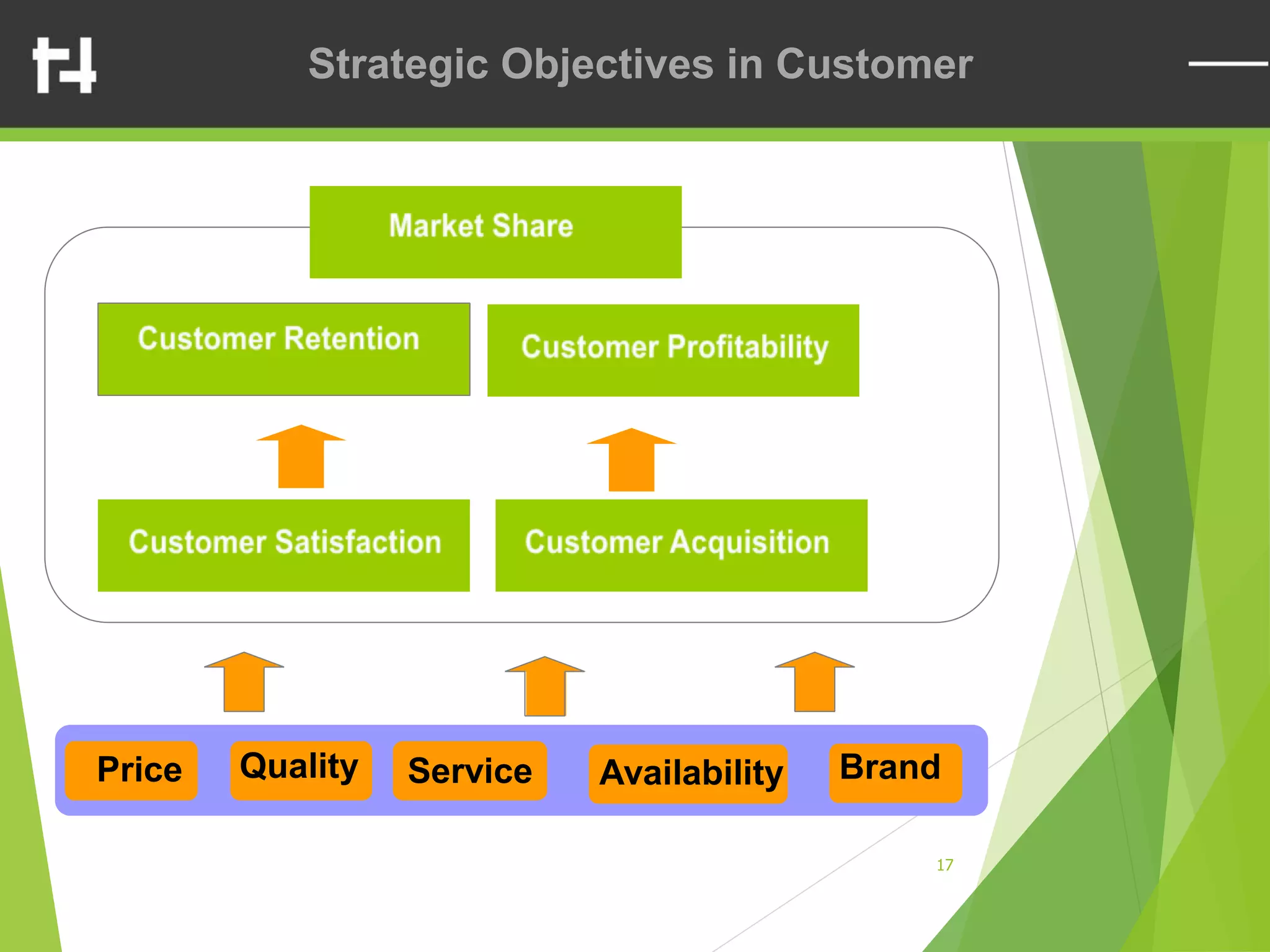
Customer Perspective
• This perspective is very instrumental, because without
customers, how can a company survive?
Customer perspective covers the following elements:
• Customer acquisition
• Customer retention
• Customer profitability
• Customer satisfaction
• Market Share
17
Strategic Objectives in Customer
Price Availability BrandServiceQuality
18
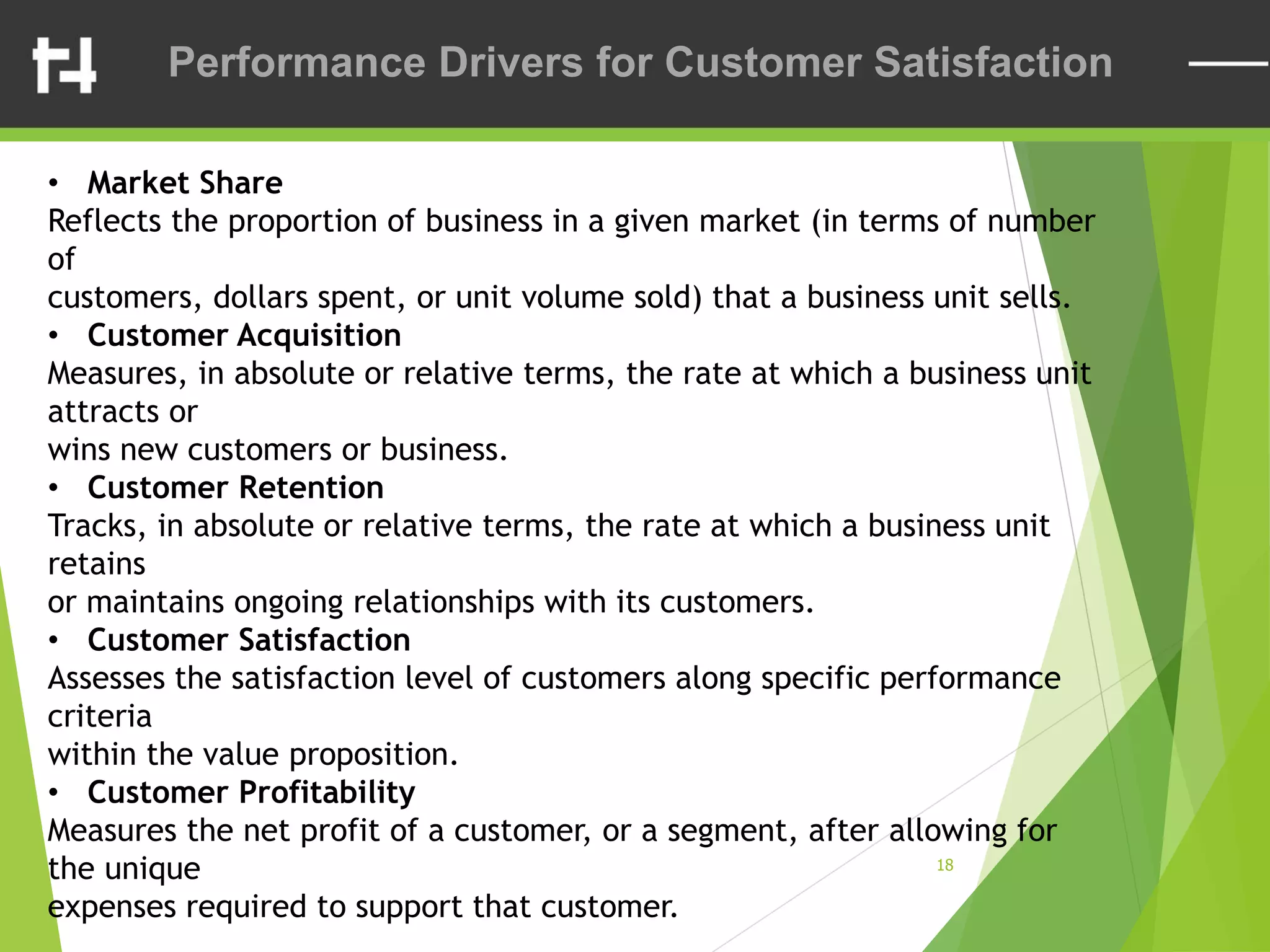
• Market Share
Reflects the proportion of business in a given market (in terms of number
of
customers, dollars spent, or unit volume sold) that a business unit sells.
• Customer Acquisition
Measures, in absolute or relative terms, the rate at which a business unit
attracts or
wins new customers or business.
• Customer Retention
Tracks, in absolute or relative terms, the rate at which a business unit
retains
or maintains ongoing relationships with its customers.
• Customer Satisfaction
Assesses the satisfaction level of customers along specific performance
criteria
within the value proposition.
• Customer Profitability
Measures the net profit of a customer, or a segment, after allowing for
the unique
expenses required to support that customer.
Performance Drivers for Customer Satisfaction
19
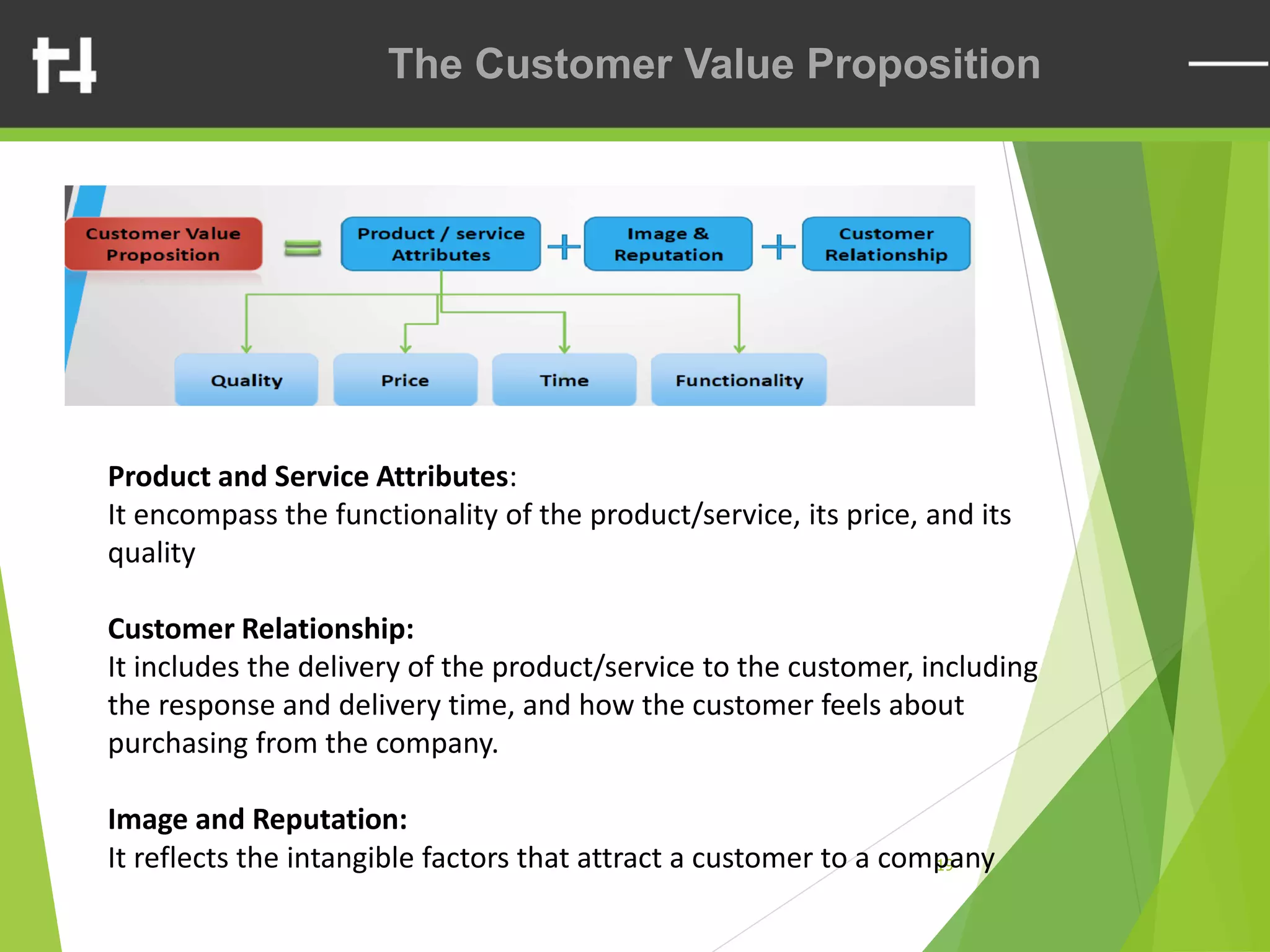
The Customer Value Proposition
Product and Service Attributes:
It encompass the functionality of the product/service, its price, and its
quality
Customer Relationship:
It includes the delivery of the product/service to the customer, including
the response and delivery time, and how the customer feels about
purchasing from the company.
Image and Reputation:
It reflects the intangible factors that attract a customer to a company
20
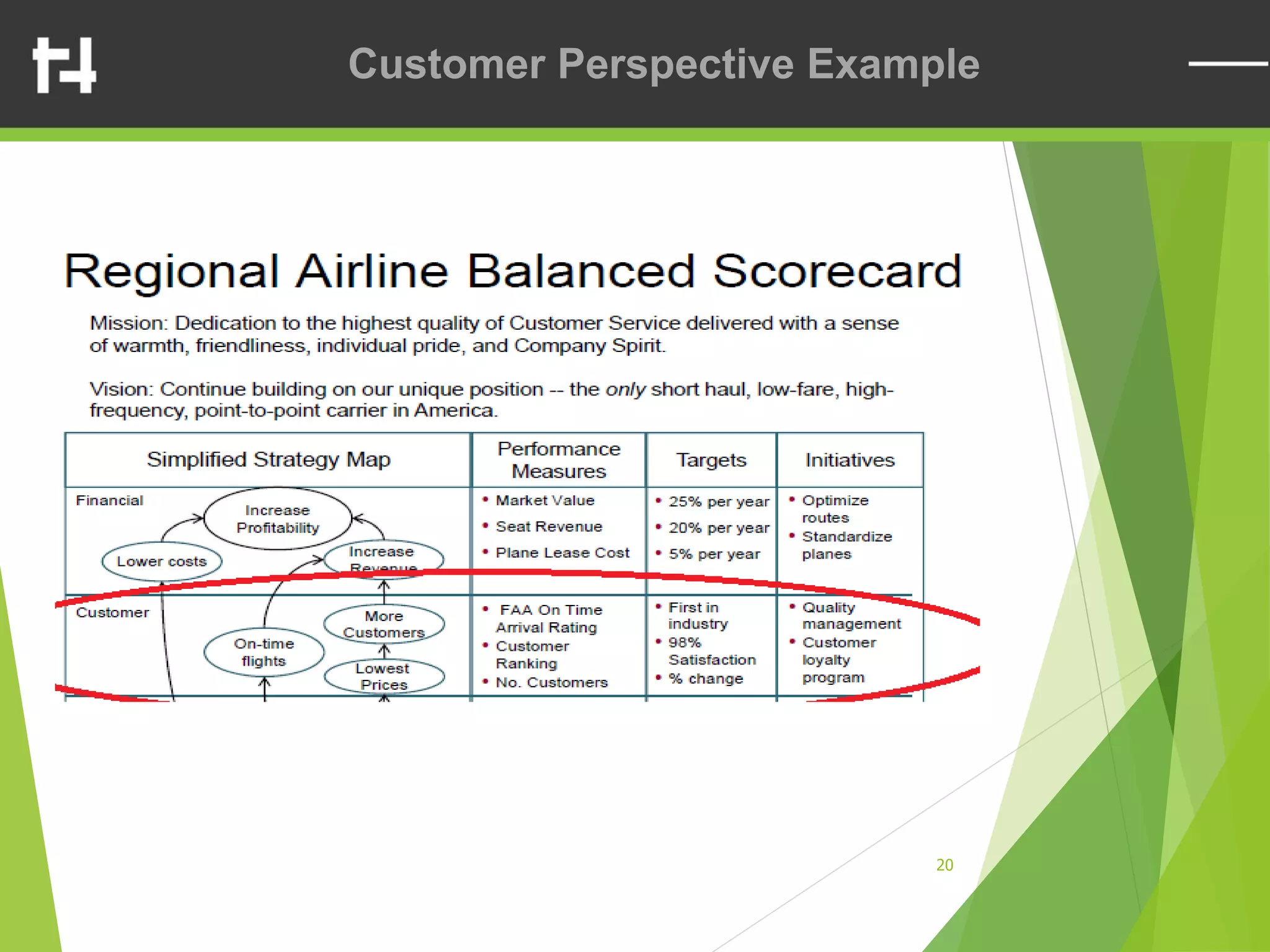
Customer Perspective Example
21
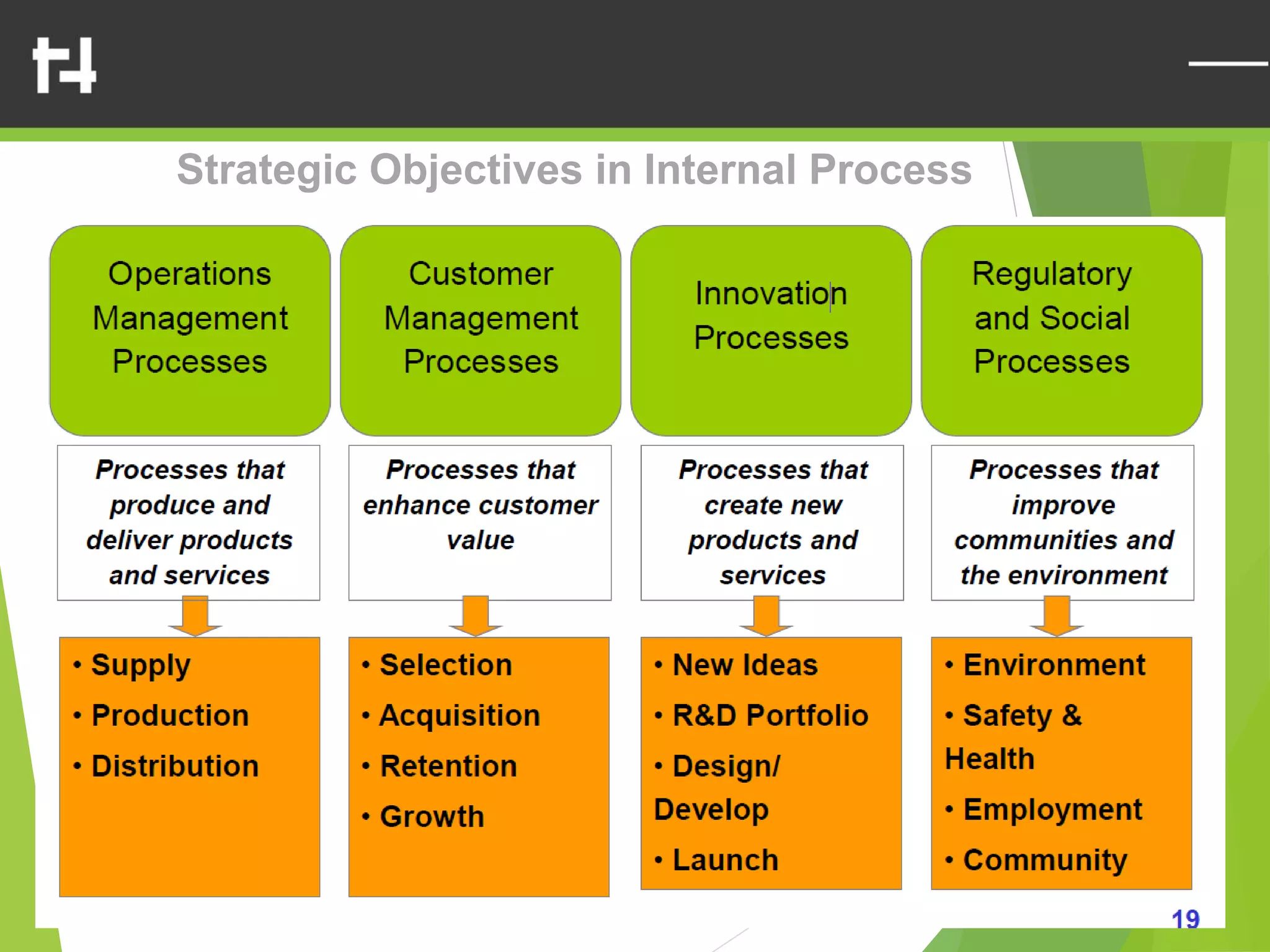
Strategic Objectives in Internal Process
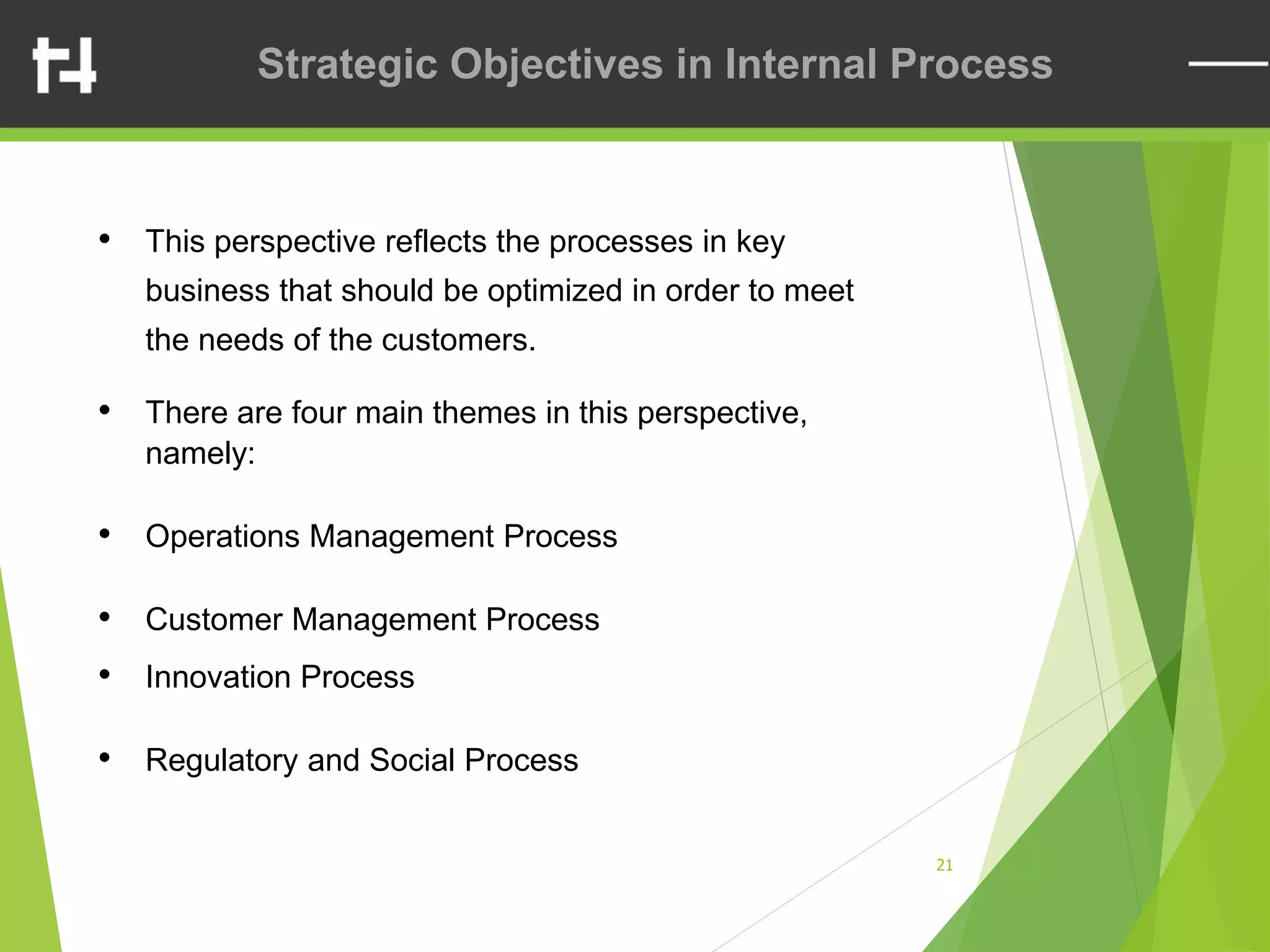
• This perspective reflects the processes in key
business that should be optimized in order to meet
the needs of the customers.
• There are four main themes in this perspective,
namely:
• Operations Management Process
• Customer Management Process
• Innovation Process
• Regulatory and Social Process
22
Strategic Objectives in Internal Process
23
Internal Processes
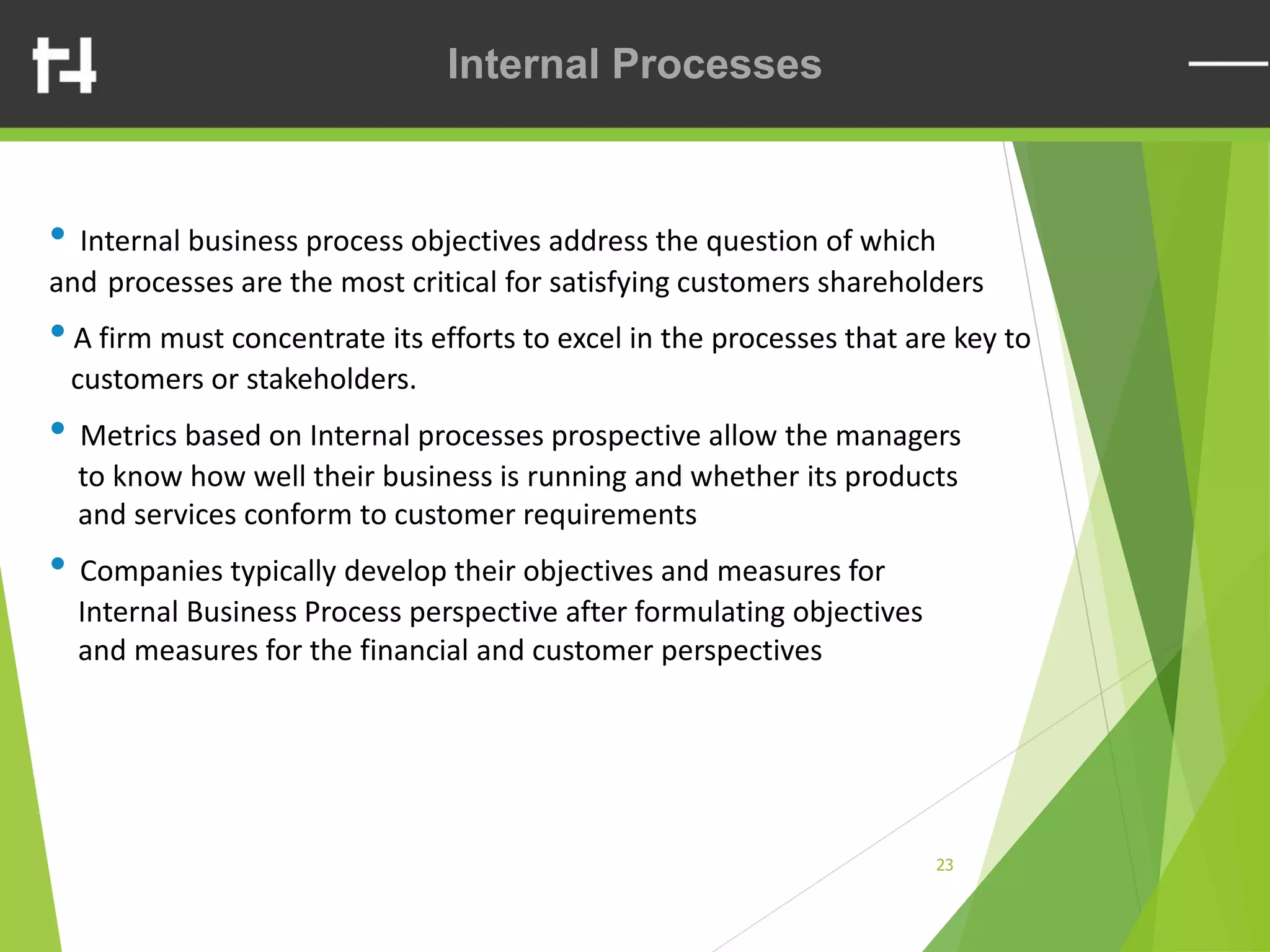
• Internal business process objectives address the question of which
and processes are the most critical for satisfying customers shareholders
•A firm must concentrate its efforts to excel in the processes that are key to
customers or stakeholders.
• Metrics based on Internal processes prospective allow the managers
to know how well their business is running and whether its products
and services conform to customer requirements
• Companies typically develop their objectives and measures for
Internal Business Process perspective after formulating objectives
and measures for the financial and customer perspectives
24
Internal Process Examples / Performance Drivers
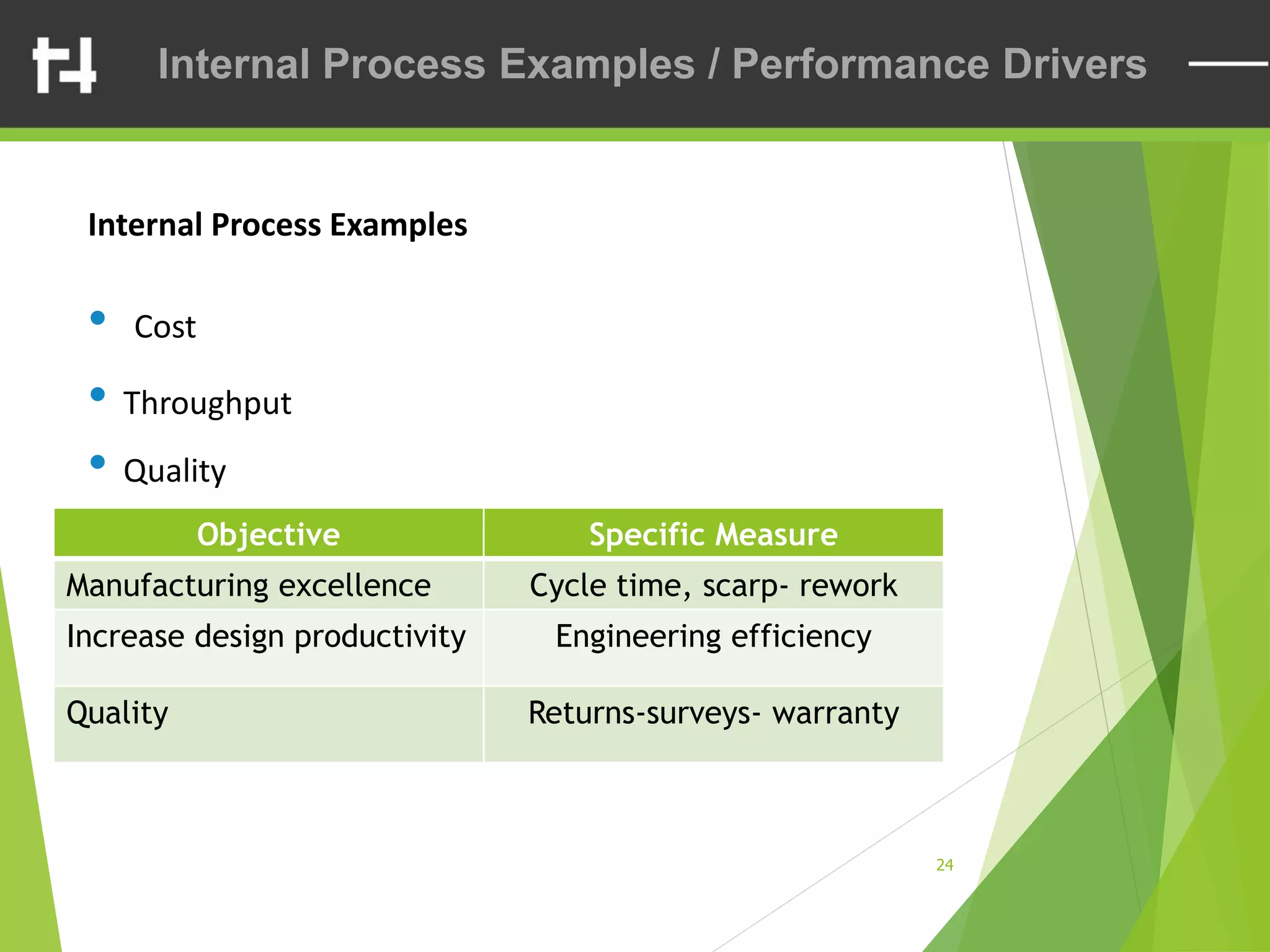
Internal Process Examples
• Cost
• Throughput
• Quality
Objective Specific Measure
Manufacturing excellence Cycle time, scarp- rework
Increase design productivity Engineering efficiency
Quality Returns-surveys- warranty
25
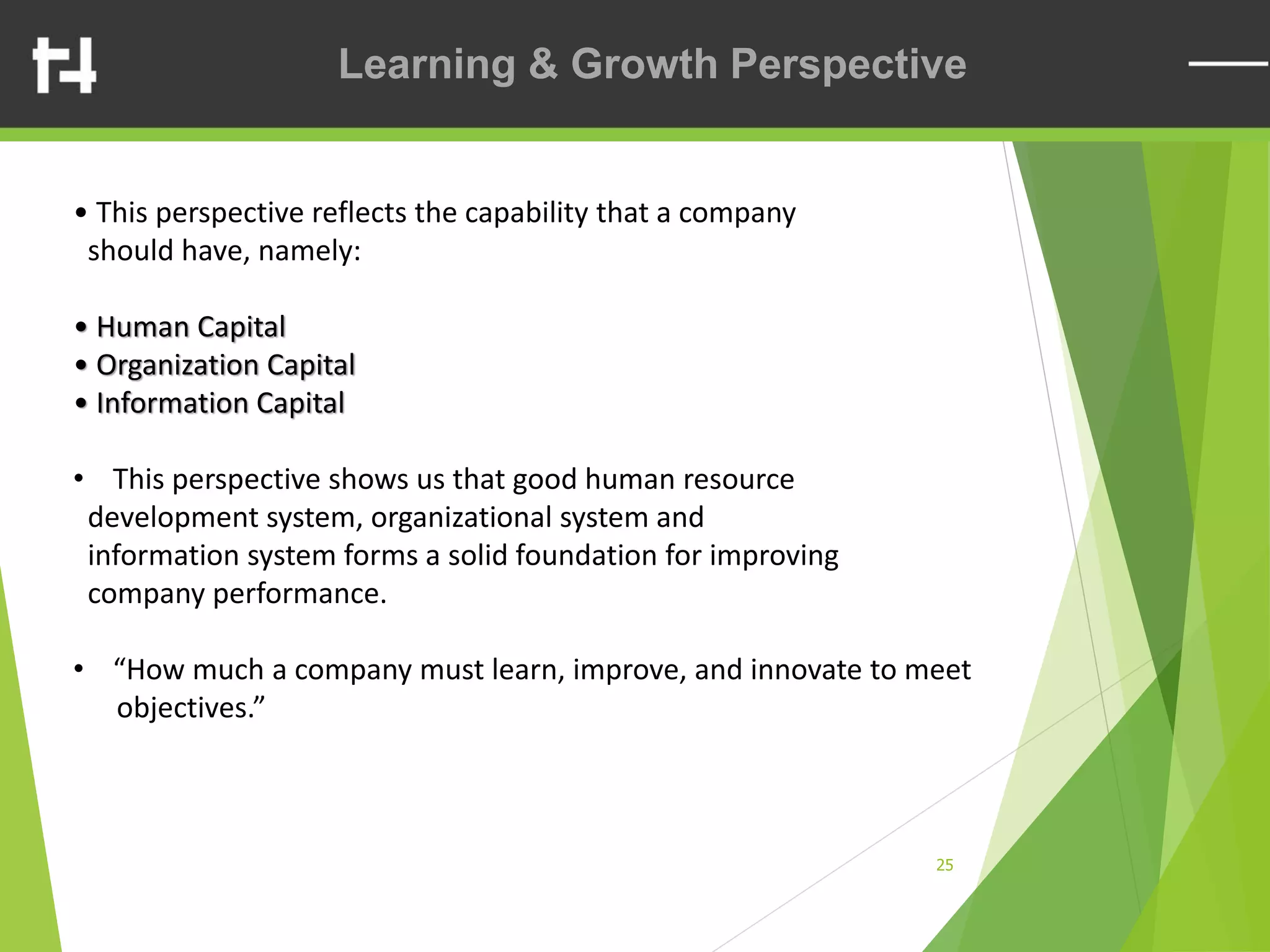
Learning & Growth Perspective
• This perspective reflects the capability that a company
should have, namely:
• Human Capital
• Organization Capital
• Information Capital
• This perspective shows us that good human resource
development system, organizational system and
information system forms a solid foundation for improving
company performance.
• “How much a company must learn, improve, and innovate to meet
objectives.”
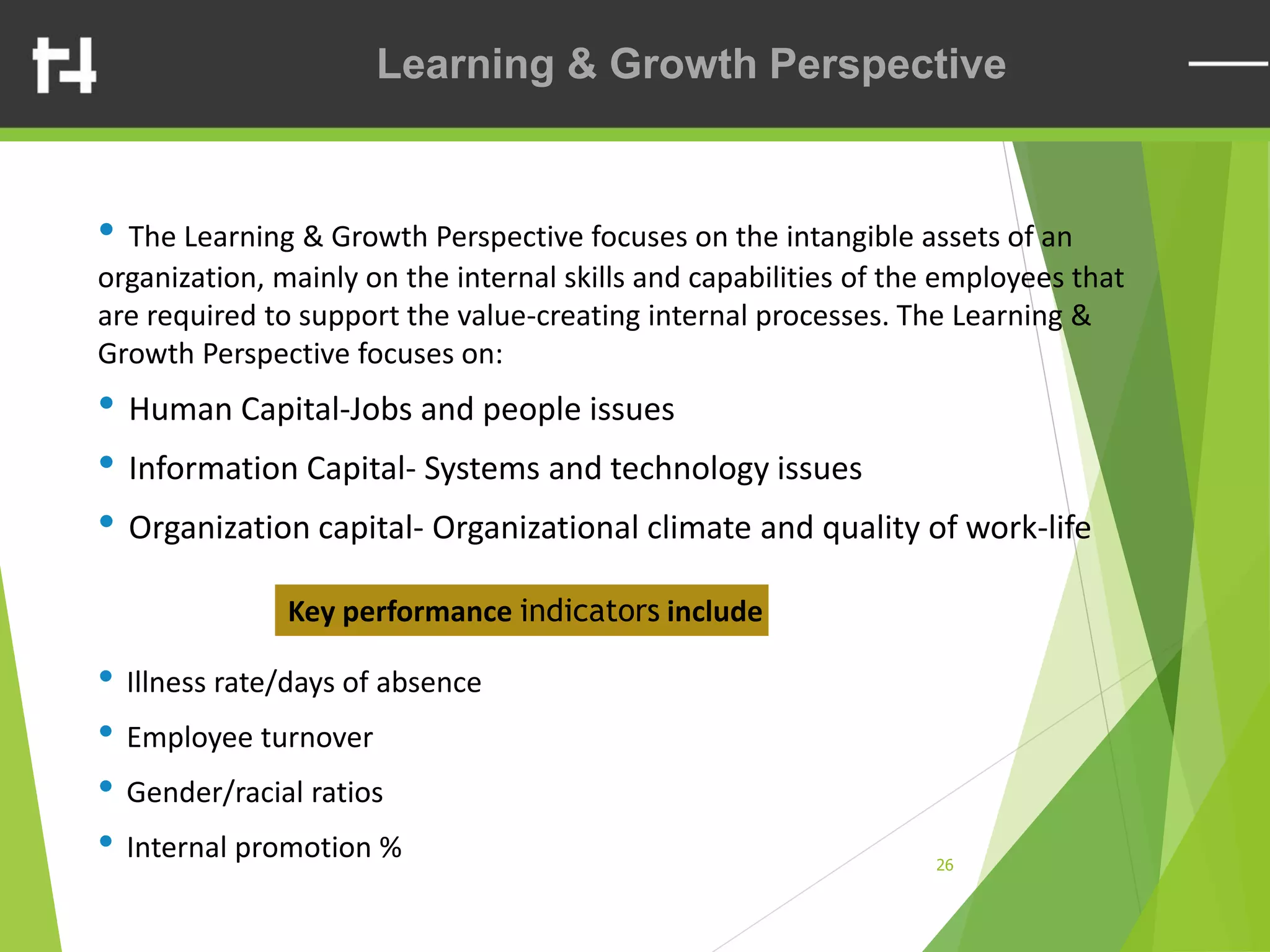
26
Contents
• The Learning & Growth Perspective focuses on the intangible assets of an
organization, mainly on the internal skills and capabilities of the employees that
are required to support the value-creating internal processes. The Learning &
Growth Perspective focuses on:
• Human Capital-Jobs and people issues
• Information Capital- Systems and technology issues
• Organization capital- Organizational climate and quality of work-life
Key performance indicators include
• Illness rate/days of absence
• Employee turnover
• Gender/racial ratios
• Internal promotion %
Learning & Growth Perspective
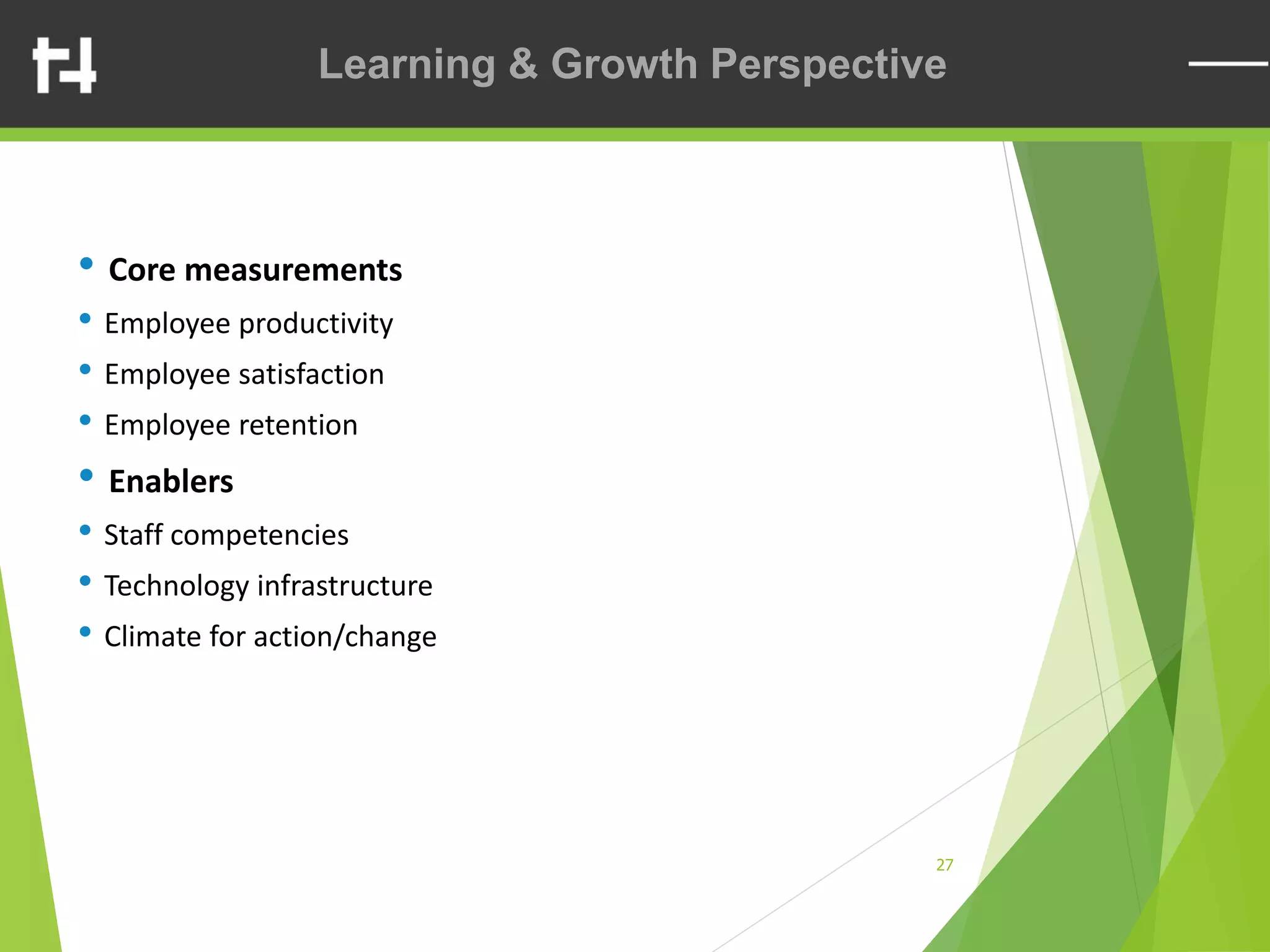
27
• Core measurements
• Employee productivity
• Employee satisfaction
• Employee retention
• Enablers
• Staff competencies
• Technology infrastructure
• Climate for action/change
Learning & Growth Perspective
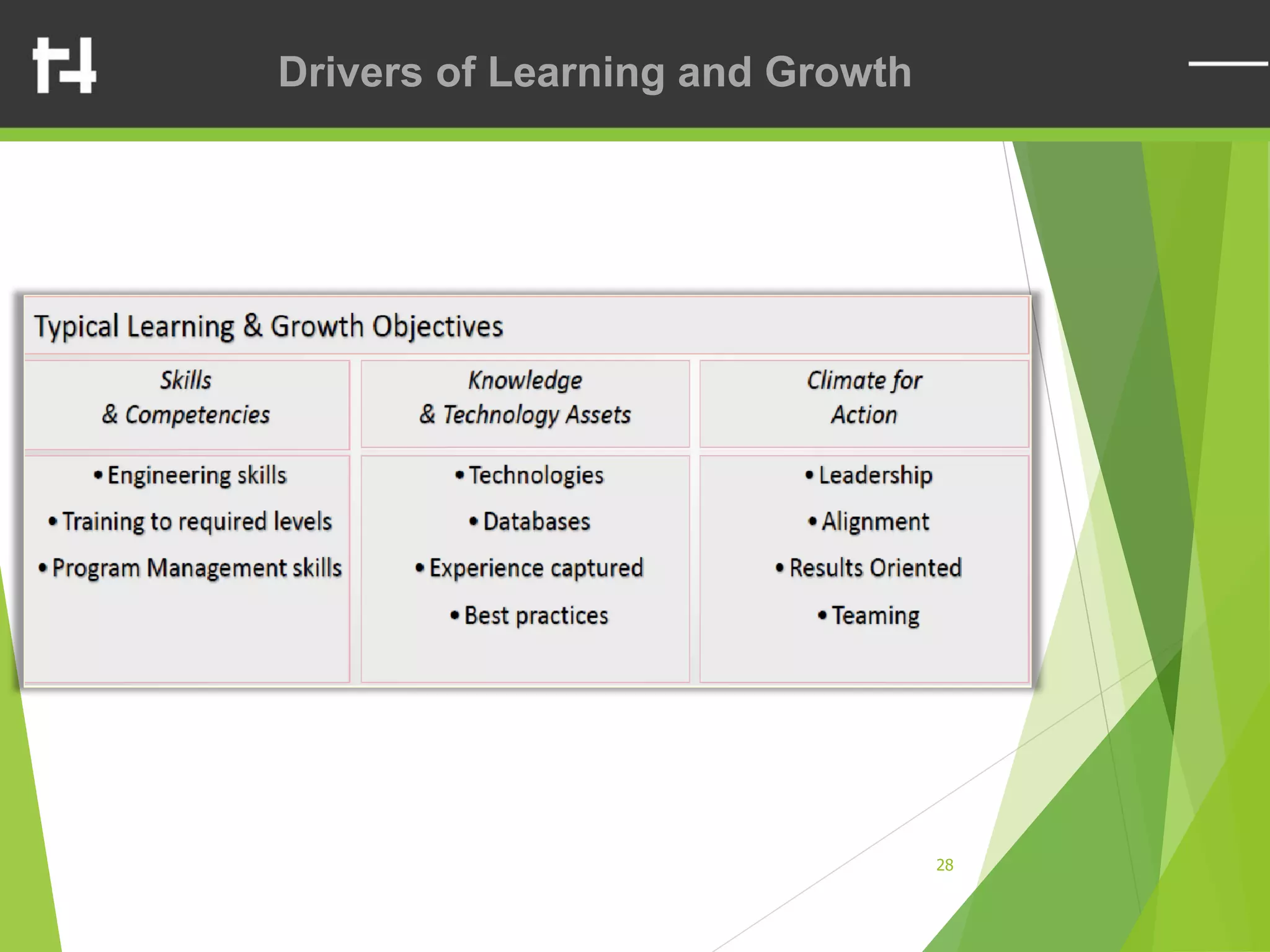
28
Drivers of Learning and Growth
29
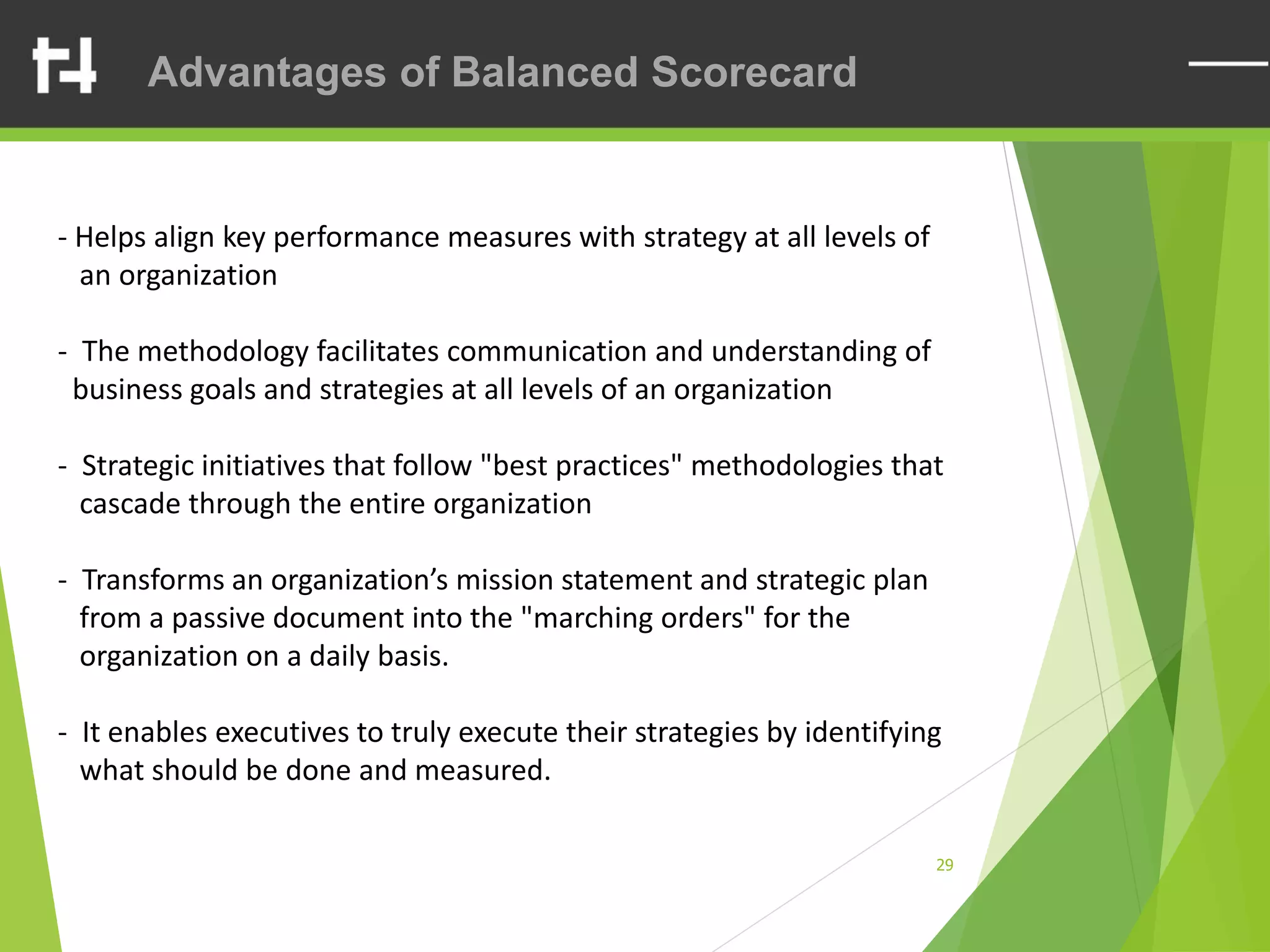
Advantages of Balanced Scorecard
- Helps align key performance measures with strategy at all levels of
an organization
- The methodology facilitates communication and understanding of
business goals and strategies at all levels of an organization
- Strategic initiatives that follow "best practices" methodologies that
cascade through the entire organization
- Transforms an organization’s mission statement and strategic plan
from a passive document into the "marching orders" for the
organization on a daily basis.
- It enables executives to truly execute their strategies by identifying
what should be done and measured.
30
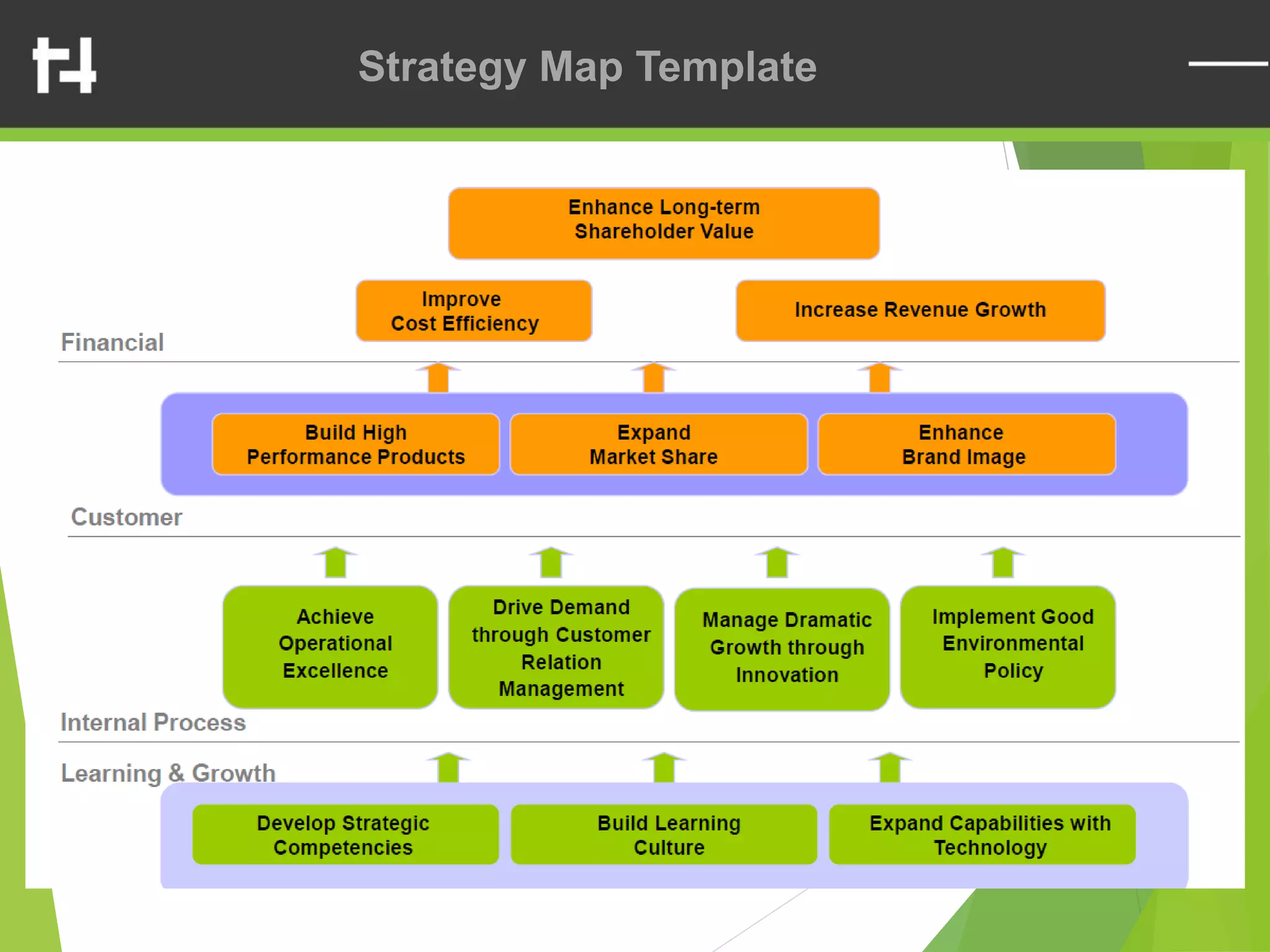
Strategy Map Template
31
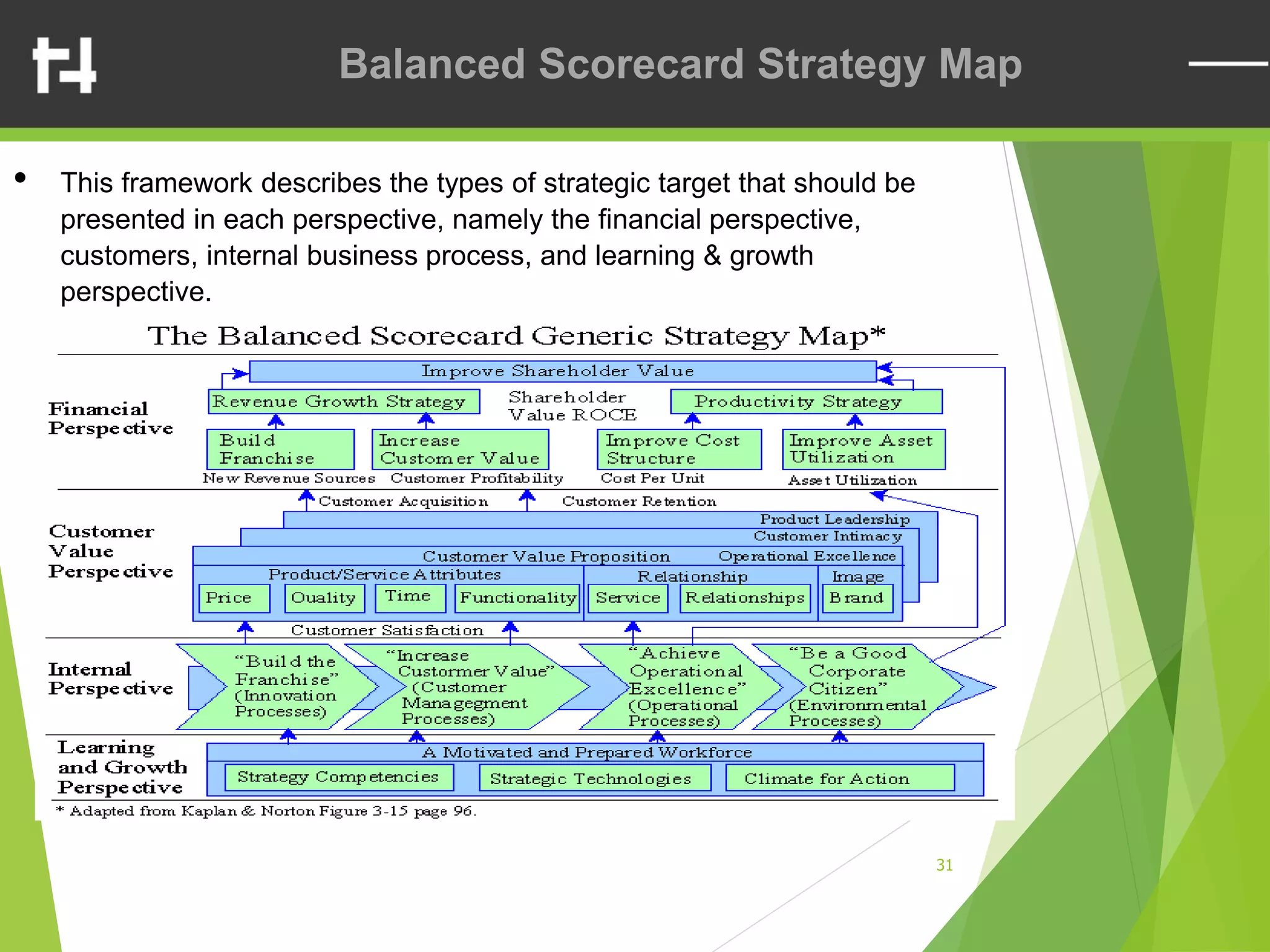
Balanced Scorecard Strategy Map
• This framework describes the types of strategic target that should be
presented in each perspective, namely the financial perspective,
customers, internal business process, and learning & growth
perspective.
32
2016

T2 presentations - balanced scorecard

  • 2.
  • 3.
  • 4.
  • 5.
    5 Contents Plan and Execute Monitorand Evaluate Reward and Coach Set Measures and Target
  • 6.
    6 Business Planning andStrategy Mission Vision GoalGoal & Objective Balanced Scorecard Corporate Measurement and Reporting System
  • 7.
    7 What is BalancedScorecard? ▪ The Balanced scorecard is a management system that enables organizations to clarify their vision and strategy and translate them into action. ▪ Provides an organization with feedback of both the internal business processes and external outcomes, which allows for continuous improvement of strategic performance and results. ▪ Nerve center of an enterprise
  • 8.
    8 The term “scorecard”signifies quantified performance measures and “balanced” signifies the system is balanced between: • Short-term and long term objectives • Financial and non-financial measures • Lagging and leading indicators • Internal and external performance perspectives What is Balanced Scorecard?
  • 9.
  • 10.
    10 The Four Perspectivesof Balance Scorecard The balanced scorecard is centered on four performance metrics or perspectives: • Customers • Internal processes • Financial • Learning and growth ➢ When implemented properly, each one of these perspectives contains four subparts consisting of • Objectives • Measures • Targets • Initiatives
  • 11.
    11 Customer Perspective To achieveour vision, how must we look to our customers? Internal Perspective To satisfy our customers, which processes must we excel at? Learning & Growth Perspective To achieve our vision, how must our organization learn and improve? Financial Perspective If we succeed, how will we look to our shareholders? The Strategy Contents The Four Perspectives of Balance Scorecard Customer Perspective To achieve our vision, how must we look to our customers? Internal Perspective To satisfy our customers, which processes must we excel at? Learning & Growth Perspective To achieve our vision, how must our organization learn and improve? The Strategy
  • 12.
    12 The Four Perspectivesof Balance Scorecard
  • 13.
    13 Financial Perspective • Inprivate companies, the financial perspective is the main objective (ultimate goal) – without having to sacrifice the interests of other relevant stakeholders (community, environment, government, etc.) • In the financial perspective, the strategic goal is the long-term shareholder value. This goal is driven by two factors, namely : revenue growth and cost efficiency. • How shareholders view the firm and which financial goals are desired from the shareholder’s perspective. • These financial goals are dependent on the company’s stage in the business life cycle.
  • 14.
    14 Strategic Theme forFinancial Perspective Revenue growth and mix. This is mainly about reaching new customers and markets, expanding products and services, introducing new pricing policies etc. Productivity improvement/cost reduction. This may include reduction of indirect costs, sharing common resources with other departments, lowering direct costs. Investment strategy/assets utilization This may include greater utilization of fixes assets base and improving return on investment
  • 15.
    15 Strategic Objectives inFinancial Long - term Shareholder Value Revenue GrowthCost Efficiency Improve Cost Structure Increase Asset Utilization Expand Revenue Opportunities Enhance Customer Value
  • 16.
    16 Customer Perspective • Thisperspective is very instrumental, because without customers, how can a company survive? Customer perspective covers the following elements: • Customer acquisition • Customer retention • Customer profitability • Customer satisfaction • Market Share
  • 17.
    17 Strategic Objectives inCustomer Price Availability BrandServiceQuality
  • 18.
    18 • Market Share Reflectsthe proportion of business in a given market (in terms of number of customers, dollars spent, or unit volume sold) that a business unit sells. • Customer Acquisition Measures, in absolute or relative terms, the rate at which a business unit attracts or wins new customers or business. • Customer Retention Tracks, in absolute or relative terms, the rate at which a business unit retains or maintains ongoing relationships with its customers. • Customer Satisfaction Assesses the satisfaction level of customers along specific performance criteria within the value proposition. • Customer Profitability Measures the net profit of a customer, or a segment, after allowing for the unique expenses required to support that customer. Performance Drivers for Customer Satisfaction
  • 19.
    19 The Customer ValueProposition Product and Service Attributes: It encompass the functionality of the product/service, its price, and its quality Customer Relationship: It includes the delivery of the product/service to the customer, including the response and delivery time, and how the customer feels about purchasing from the company. Image and Reputation: It reflects the intangible factors that attract a customer to a company
  • 20.
  • 21.
    21 Strategic Objectives inInternal Process • This perspective reflects the processes in key business that should be optimized in order to meet the needs of the customers. • There are four main themes in this perspective, namely: • Operations Management Process • Customer Management Process • Innovation Process • Regulatory and Social Process
  • 22.
  • 23.
    23 Internal Processes • Internalbusiness process objectives address the question of which and processes are the most critical for satisfying customers shareholders •A firm must concentrate its efforts to excel in the processes that are key to customers or stakeholders. • Metrics based on Internal processes prospective allow the managers to know how well their business is running and whether its products and services conform to customer requirements • Companies typically develop their objectives and measures for Internal Business Process perspective after formulating objectives and measures for the financial and customer perspectives
  • 24.
    24 Internal Process Examples/ Performance Drivers Internal Process Examples • Cost • Throughput • Quality Objective Specific Measure Manufacturing excellence Cycle time, scarp- rework Increase design productivity Engineering efficiency Quality Returns-surveys- warranty
  • 25.
    25 Learning & GrowthPerspective • This perspective reflects the capability that a company should have, namely: • Human Capital • Organization Capital • Information Capital • This perspective shows us that good human resource development system, organizational system and information system forms a solid foundation for improving company performance. • “How much a company must learn, improve, and innovate to meet objectives.”
  • 26.
    26 Contents • The Learning& Growth Perspective focuses on the intangible assets of an organization, mainly on the internal skills and capabilities of the employees that are required to support the value-creating internal processes. The Learning & Growth Perspective focuses on: • Human Capital-Jobs and people issues • Information Capital- Systems and technology issues • Organization capital- Organizational climate and quality of work-life Key performance indicators include • Illness rate/days of absence • Employee turnover • Gender/racial ratios • Internal promotion % Learning & Growth Perspective
  • 27.
    27 • Core measurements •Employee productivity • Employee satisfaction • Employee retention • Enablers • Staff competencies • Technology infrastructure • Climate for action/change Learning & Growth Perspective
  • 28.
  • 29.
    29 Advantages of BalancedScorecard - Helps align key performance measures with strategy at all levels of an organization - The methodology facilitates communication and understanding of business goals and strategies at all levels of an organization - Strategic initiatives that follow "best practices" methodologies that cascade through the entire organization - Transforms an organization’s mission statement and strategic plan from a passive document into the "marching orders" for the organization on a daily basis. - It enables executives to truly execute their strategies by identifying what should be done and measured.
  • 30.
  • 31.
    31 Balanced Scorecard StrategyMap • This framework describes the types of strategic target that should be presented in each perspective, namely the financial perspective, customers, internal business process, and learning & growth perspective.
  • 32.
  • 33.