STRATEGIC OBJECTIVES AND
FINANCIAL OBJECTIVES
STRATEGIC MANAGEMENT
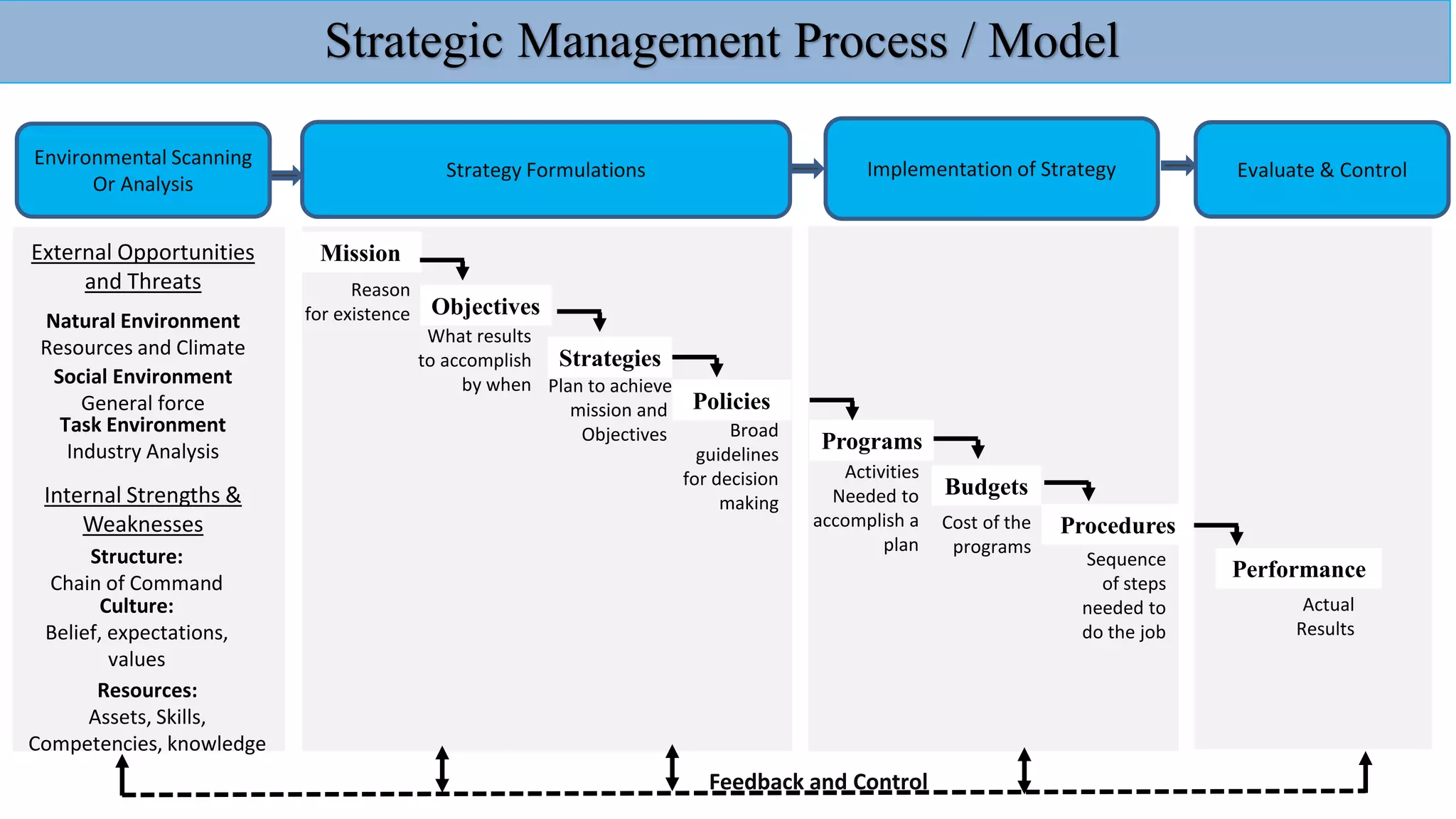
Feedback and Control
Strategic Management Process / Model
Environmental Scanning
Or Analysis
Strategy Formulations Implementation of Strategy Evaluate & Control
External Opportunities
and Threats
Natural Environment
Resources and Climate
Social Environment
General force
Task Environment
Industry Analysis
Internal Strengths &
Weaknesses
Structure:
Chain of Command
Culture:
Belief, expectations,
values
Resources:
Assets, Skills,
Competencies, knowledge
Mission
Objectives
Strategies
Policies
Programs
Performance
Procedures
Budgets
Reason
for existence
What results
to accomplish
by when Plan to achieve
mission and
Objectives Broad
guidelines
for decision
making
Activities
Needed to
accomplish a
plan
Cost of the
programs
Sequence
of steps
needed to
do the job
Actual
Results
STRATEGIC FORMULATION
VISION
MISSION
OBJECTIVES
STRATEGIES
POLICIES
VISION
 VISION IS A LONG TERM PLAN
 A statement that clearly defines the firm’s “reason” for
being in business(where we are going? And where we
want to be in future)
 Should unite and inspire people in the organization
toward the pursuit of one common goal.
MISSION
 A declaration of an organization’s “reason for being.”
 Answers the pivotal question “What is our business?”
 Essential for effectively establishing objectives and formulating
strategies
 Reveals what an organization wants to be and whom it wants to
serve and how we give value to people we serve
STRATEGIES AND POLICIES
 STRATEGY is a game plan made by the
organization/firm to remain and sustain in the
business/market for the longer duration of time .
 POLICIY is a SET of PRINCIPLES or rules to guide
decisions and achieve rational outcomes. Policies are
generally adopted or implemented by the senior
governance body within an organization.
OBJECTIVES
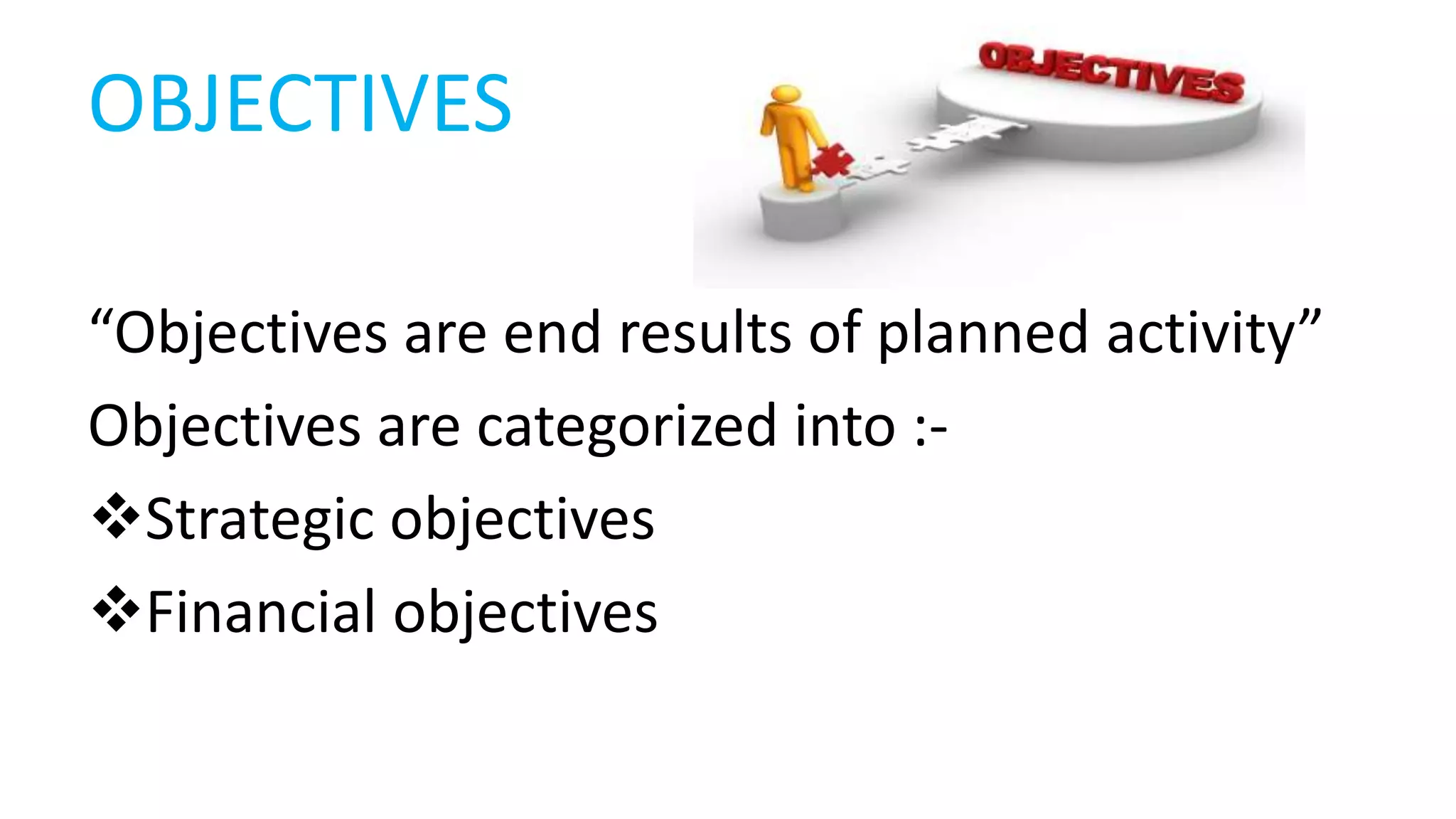
“Objectives are end results of planned activity”
Objectives are categorized into :-
Strategic objectives
Financial objectives
STRATEGIC OBJECTIVES
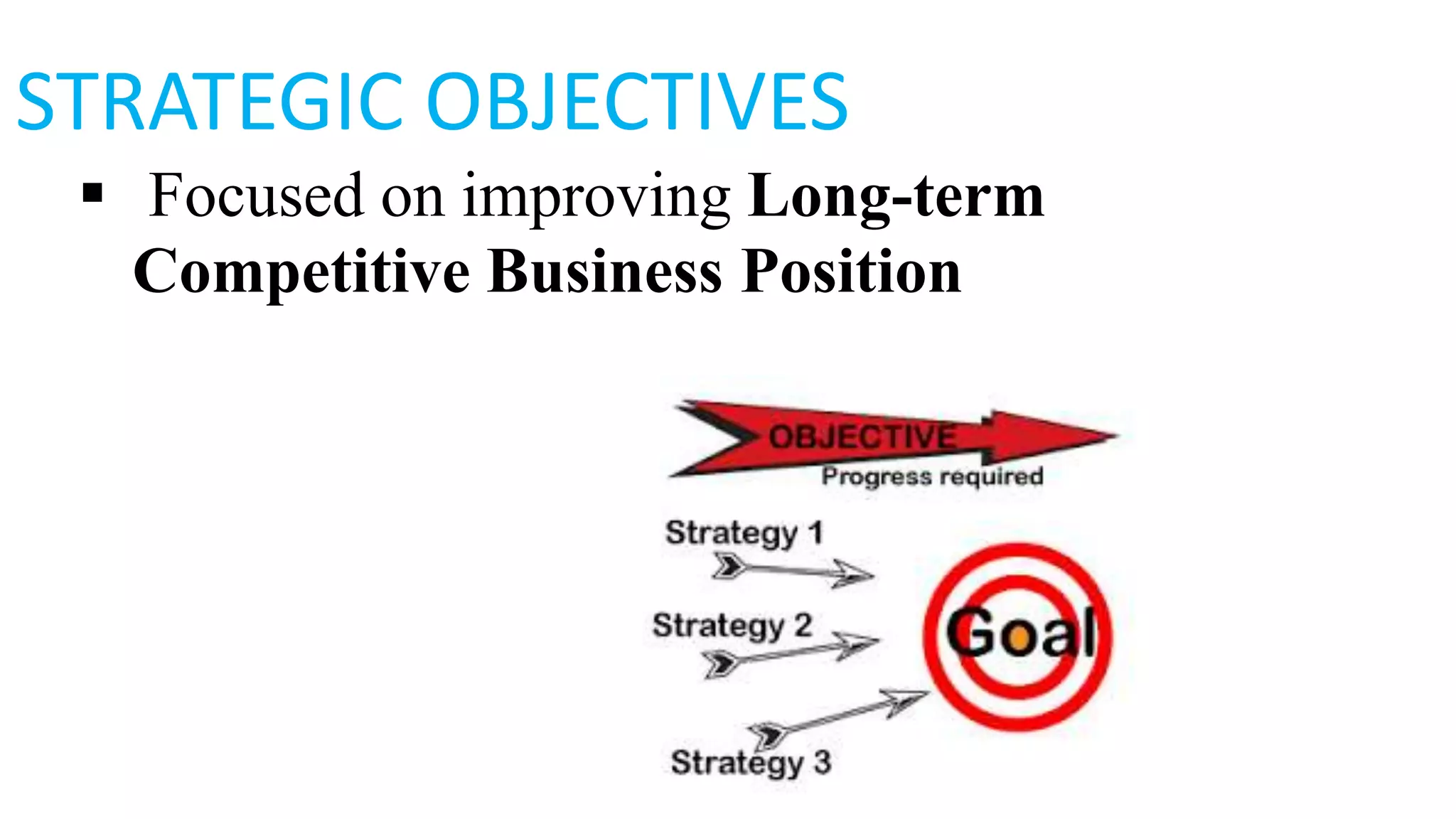
 Focused on improving Long-term
Competitive Business Position
STRATEGIC OBJECTIVES
 Winning an x percent of market share.
 Achieving lower overall costs than competitors.
 Overtaking key competitors on product performance or quality or
customer service.
 Having a wider product line than competitors.
 Having a better-know or more powerful brand name than competitors.
 Having stronger sales and distribution capabilities than competitors.
 Consistently introducing new or improved products to market .
FINANCIAL OBJECTIVES
• Outcomes focused on improving Financial
Performance
FINANCIAL OBJECTIVES
 An x percent of increase in annual revenues.
 Annual increase in after-tax profit of x percent.
 Annual increase in earnings per share of x percent.
 Profit margins of x percent.
 An x percent return on capital employed (ROCE)or return on shareholders
investment(ROI).
 Increasing shareholder value-in the form of an upward-trending stock price.
 Improving efficiency .
EXAMPLES
CONCLUSION
We require both financial and strategic
objectives but ,
Whatever may be the situation ,We select the
objectives based on the present performance
of organization and do accordingly
STRATEGIC OBJECTIVES AND FINANCIAL OBJECTIVES

STRATEGIC OBJECTIVES AND FINANCIAL OBJECTIVES

  • 1.
    STRATEGIC OBJECTIVES AND FINANCIALOBJECTIVES STRATEGIC MANAGEMENT
  • 2.
    Feedback and Control StrategicManagement Process / Model Environmental Scanning Or Analysis Strategy Formulations Implementation of Strategy Evaluate & Control External Opportunities and Threats Natural Environment Resources and Climate Social Environment General force Task Environment Industry Analysis Internal Strengths & Weaknesses Structure: Chain of Command Culture: Belief, expectations, values Resources: Assets, Skills, Competencies, knowledge Mission Objectives Strategies Policies Programs Performance Procedures Budgets Reason for existence What results to accomplish by when Plan to achieve mission and Objectives Broad guidelines for decision making Activities Needed to accomplish a plan Cost of the programs Sequence of steps needed to do the job Actual Results
  • 3.
  • 4.
    VISION  VISION ISA LONG TERM PLAN  A statement that clearly defines the firm’s “reason” for being in business(where we are going? And where we want to be in future)  Should unite and inspire people in the organization toward the pursuit of one common goal.
  • 5.
    MISSION  A declarationof an organization’s “reason for being.”  Answers the pivotal question “What is our business?”  Essential for effectively establishing objectives and formulating strategies  Reveals what an organization wants to be and whom it wants to serve and how we give value to people we serve
  • 6.
    STRATEGIES AND POLICIES STRATEGY is a game plan made by the organization/firm to remain and sustain in the business/market for the longer duration of time .  POLICIY is a SET of PRINCIPLES or rules to guide decisions and achieve rational outcomes. Policies are generally adopted or implemented by the senior governance body within an organization.
  • 7.
    OBJECTIVES “Objectives are endresults of planned activity” Objectives are categorized into :- Strategic objectives Financial objectives
  • 8.
    STRATEGIC OBJECTIVES  Focusedon improving Long-term Competitive Business Position
  • 9.
    STRATEGIC OBJECTIVES  Winningan x percent of market share.  Achieving lower overall costs than competitors.  Overtaking key competitors on product performance or quality or customer service.  Having a wider product line than competitors.  Having a better-know or more powerful brand name than competitors.  Having stronger sales and distribution capabilities than competitors.  Consistently introducing new or improved products to market .
  • 10.
    FINANCIAL OBJECTIVES • Outcomesfocused on improving Financial Performance
  • 11.
    FINANCIAL OBJECTIVES  Anx percent of increase in annual revenues.  Annual increase in after-tax profit of x percent.  Annual increase in earnings per share of x percent.  Profit margins of x percent.  An x percent return on capital employed (ROCE)or return on shareholders investment(ROI).  Increasing shareholder value-in the form of an upward-trending stock price.  Improving efficiency .
  • 12.
  • 13.
    CONCLUSION We require bothfinancial and strategic objectives but , Whatever may be the situation ,We select the objectives based on the present performance of organization and do accordingly