GPs
Suturing workshop
Suturing
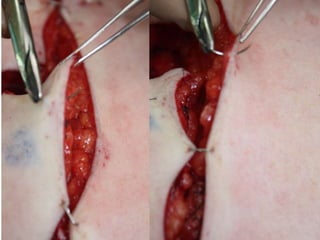
• The skin edges should always be everted when
  suturing is complete.
• This results in:
  • Better dermal apposition
  • Improved healing
  • A finer final scar.
Cutaneous suture
• The aim of this suture is to accurately appose
  and evert the skin edges.
Cutaneous suture
• The following may be helpful in achieving this.
• When viewed in a cross-section, the suture
  passage should be triangular-shaped
  – with its base located deeply as this will evert the
    wound edges.
  – A triangular-shaped suture passage with the base
    located superficially tends to invert the wound
    edges.
Trust the needle
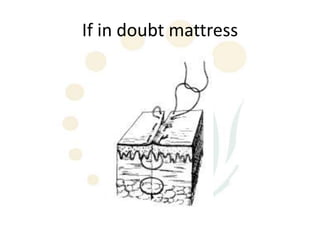
If in doubt mattress
Dermal suture
• Most wounds are closed by first opposing the
  skin edges with a dermal suture.
• This reduces the tension on the subsequent
  cutaneous suture and helps to limit
• stretching of the wound.
• Use either monocryl (face) or pds
Dermal suture
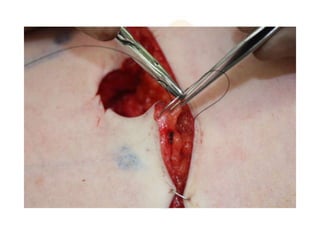
• The dermal suture should enter the deep reticular
  dermis on the incised edge of the wound.
• It should then pass superficially into the papillary
  dermis.
• The knot should be tied deeply to prevent
  subsequent exposure of the suture.
• This method of suture placement produces good
  apposition and eversion of the skin edges.
Cheat stitch
• This combination dermal and interrupted
  suture is helpful with wounds under tension
• Especially when you are happy to leave the
  suture in for 2 weeks and stitch marks not a
  great concern
  – Backs, legs, arms
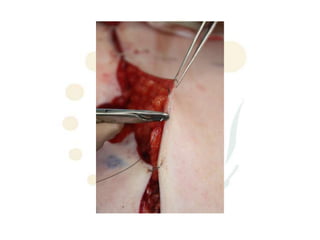
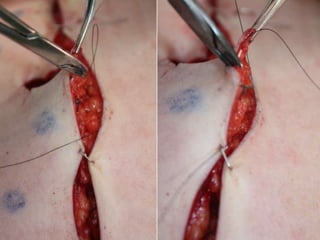
Fudging!
• If one of the wound edges lies lower than the
  other, the suture should be passed through
  the cut edge of the skin low on that side (‘low-
  on-the-low’).
Fudging!
• If one of the wound edges lies higher than the
  other, the suture should be passed through
  the dermis high on that side (‘high-on-the-
  high’)
• Passing the suture in this way acts to flatten
  out any vertical step between the wound
  edges and ensures that the sides are on a level
  plane.
• Fine adjustments can be made by changing
  the side on which the knot lies
  – the knot will tend to raise the side on which it lies
Subcuticular/Intradermal
• The suture passes through the dermis, not
  under the skin.
• Should always be there to approximate the
  epithelium with no tension
• The hard work is done by the deep dermals
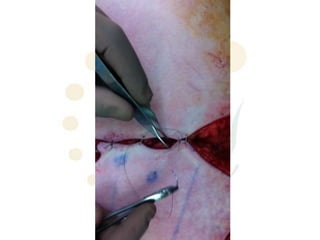
Another cheat stitch
• Useful for long wounds where you want to
  save time but still get everted skin edges
• Combination of “over and over” and
  horizontal mattress
What suture when?
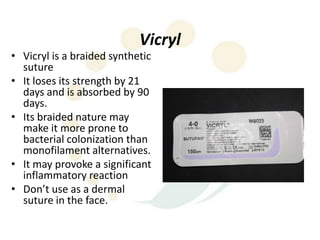
Vicryl
• Vicryl is a braided synthetic
  suture
• It loses its strength by 21
  days and is absorbed by 90
  days.
• Its braided nature may
  make it more prone to
  bacterial colonization than
  monofilament alternatives.
• It may provoke a significant
  inflammatory reaction
• Don’t use as a dermal
  suture in the face.
PDS
• PDS is a monofilament
  synthetic suture composed
  of polydioxone.
• It is absorbed more slowly
  than either vicryl, monocryl
  or dexon.
• It loses its strength by 3
  months and is absorbed by
  6 months.
• It is primarily used as a
  dermal suture in areas
  prone to developing
  stretched scars.
Monocryl
• Monocryl is a
   monofilament synthetic
   suture composed of
   poliglecaprone 25.
• It has similar absorption
   characteristics to vicryl.
• Its monofilament
   composition may make
   it less prone to bacterial
   colonization.
What suture when?
• Sutures that retain their strength for a
  significant amount of time, such as a
  PDS, should be used in areas prone to scar
  stretching, such as the back, legs torso.
• Sutures that elicit a minimal tissue
  reaction, such as monocryl, should be used in
  the face.
Face
• Kids                        • Adults
  – 6.0 fastgut with               – Nylon or prolene
    dermabond glue to                 • Skin
    waterproof                        • 5.0 or 6.0
  – Steristrips on top of          – Monocryl
    wound                             • Dermal
                                      • 5.0
                                   – Remove sutures day 5 or
                                     6
                                   – No later as may leave
                                     stitch marks
Scalp
• Kids                       • Adults
  – Vicrylrapide/vicryl           – Staples or any suture
  – monocryl                        different colour to
                                    patients hair
Rest of body
• Kids                     • Adults
  – Same as adults           – Depends on extent of
                               wound and depth
                                • Usually dermal
                                  pds/monocryl
                                • Interrupted
                                  nylon/prolene

G ps suture workshop

  • 2.
  • 3.
    Suturing • The skinedges should always be everted when suturing is complete. • This results in: • Better dermal apposition • Improved healing • A finer final scar.
  • 4.
    Cutaneous suture • Theaim of this suture is to accurately appose and evert the skin edges.
  • 5.
    Cutaneous suture • Thefollowing may be helpful in achieving this. • When viewed in a cross-section, the suture passage should be triangular-shaped – with its base located deeply as this will evert the wound edges. – A triangular-shaped suture passage with the base located superficially tends to invert the wound edges.
  • 7.
  • 8.
    If in doubtmattress
  • 9.
    If in doubtmattress
  • 10.
    Dermal suture • Mostwounds are closed by first opposing the skin edges with a dermal suture. • This reduces the tension on the subsequent cutaneous suture and helps to limit • stretching of the wound. • Use either monocryl (face) or pds
  • 11.
    Dermal suture • Thedermal suture should enter the deep reticular dermis on the incised edge of the wound. • It should then pass superficially into the papillary dermis. • The knot should be tied deeply to prevent subsequent exposure of the suture. • This method of suture placement produces good apposition and eversion of the skin edges.
  • 21.
    Cheat stitch • Thiscombination dermal and interrupted suture is helpful with wounds under tension • Especially when you are happy to leave the suture in for 2 weeks and stitch marks not a great concern – Backs, legs, arms
  • 29.
    Fudging! • If oneof the wound edges lies lower than the other, the suture should be passed through the cut edge of the skin low on that side (‘low- on-the-low’).
  • 30.
    Fudging! • If oneof the wound edges lies higher than the other, the suture should be passed through the dermis high on that side (‘high-on-the- high’) • Passing the suture in this way acts to flatten out any vertical step between the wound edges and ensures that the sides are on a level plane.
  • 31.
    • Fine adjustmentscan be made by changing the side on which the knot lies – the knot will tend to raise the side on which it lies
  • 35.
    Subcuticular/Intradermal • The suturepasses through the dermis, not under the skin. • Should always be there to approximate the epithelium with no tension • The hard work is done by the deep dermals
  • 36.
    Another cheat stitch •Useful for long wounds where you want to save time but still get everted skin edges • Combination of “over and over” and horizontal mattress
  • 38.
  • 39.
    Vicryl • Vicryl isa braided synthetic suture • It loses its strength by 21 days and is absorbed by 90 days. • Its braided nature may make it more prone to bacterial colonization than monofilament alternatives. • It may provoke a significant inflammatory reaction • Don’t use as a dermal suture in the face.
  • 40.
    PDS • PDS isa monofilament synthetic suture composed of polydioxone. • It is absorbed more slowly than either vicryl, monocryl or dexon. • It loses its strength by 3 months and is absorbed by 6 months. • It is primarily used as a dermal suture in areas prone to developing stretched scars.
  • 41.
    Monocryl • Monocryl isa monofilament synthetic suture composed of poliglecaprone 25. • It has similar absorption characteristics to vicryl. • Its monofilament composition may make it less prone to bacterial colonization.
  • 42.
    What suture when? •Sutures that retain their strength for a significant amount of time, such as a PDS, should be used in areas prone to scar stretching, such as the back, legs torso. • Sutures that elicit a minimal tissue reaction, such as monocryl, should be used in the face.
  • 43.
    Face • Kids • Adults – 6.0 fastgut with – Nylon or prolene dermabond glue to • Skin waterproof • 5.0 or 6.0 – Steristrips on top of – Monocryl wound • Dermal • 5.0 – Remove sutures day 5 or 6 – No later as may leave stitch marks
  • 45.
    Scalp • Kids • Adults – Vicrylrapide/vicryl – Staples or any suture – monocryl different colour to patients hair
  • 46.
    Rest of body •Kids • Adults – Same as adults – Depends on extent of wound and depth • Usually dermal pds/monocryl • Interrupted nylon/prolene