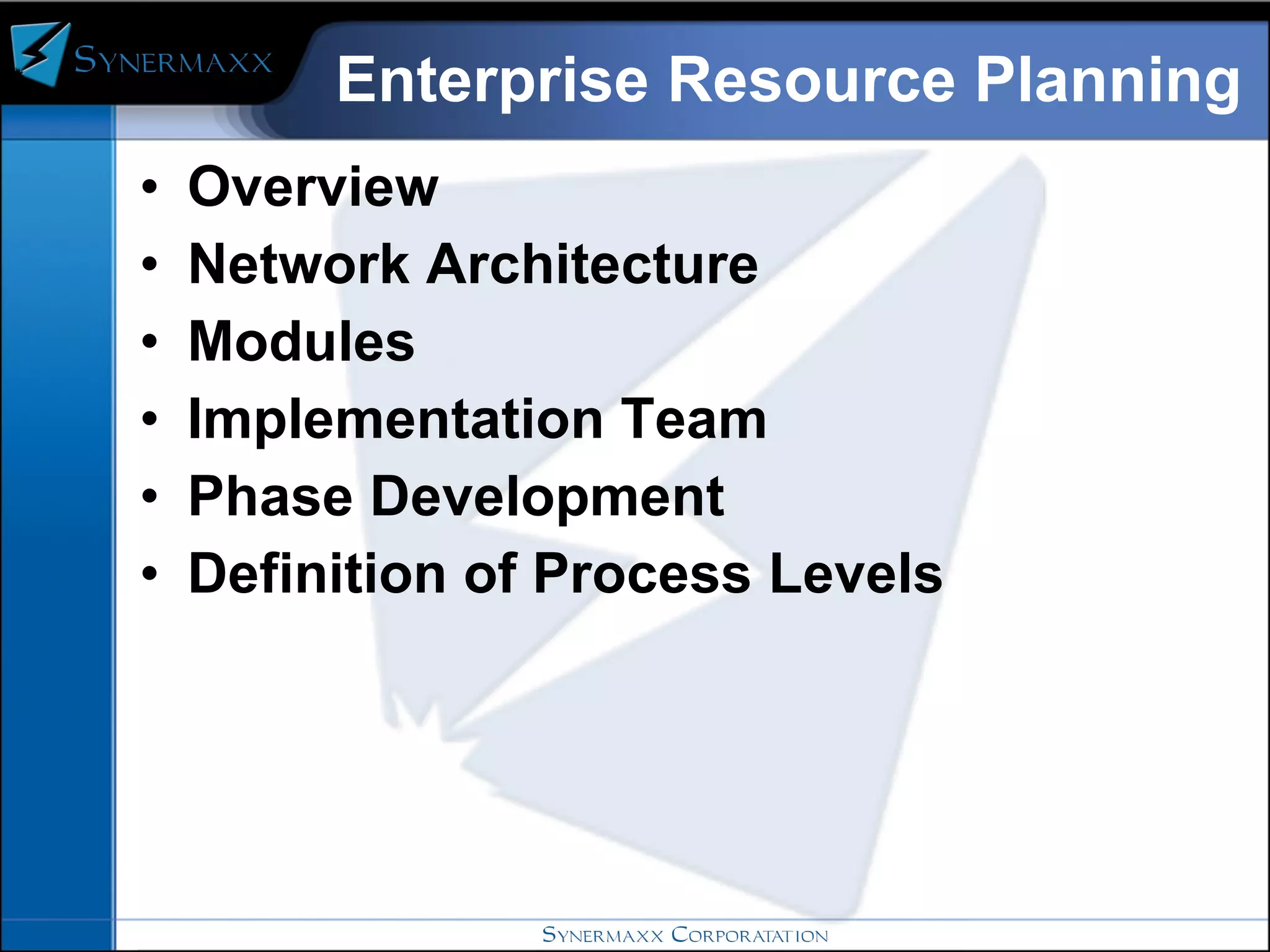
Enterprise Resource Planning Overview Network Architecture Modules Implementation Team Phase Development Definition of Process Levels
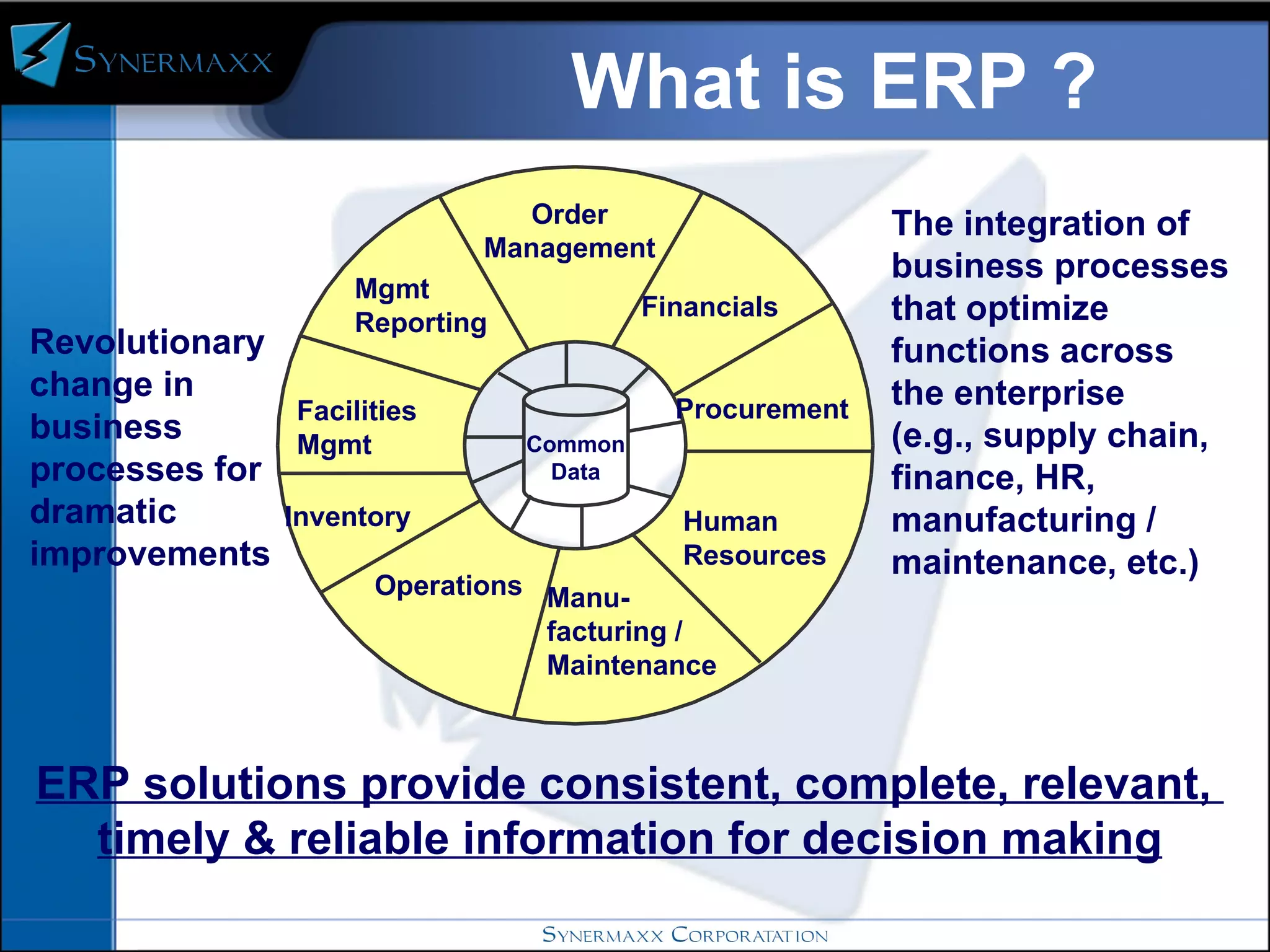
What is ERP ? Common Data Order Management Financials Manu- facturing / Maintenance Human Resources Procurement Mgmt Reporting Inventory Operations Facilities Mgmt Revolutionary  change in  business  processes for dramatic  improvements ERP solutions provide consistent, complete, relevant,  timely & reliable information for decision making The integration of business processes  that optimize  functions across  the enterprise  (e.g., supply chain, finance, HR, manufacturing / maintenance, etc.)
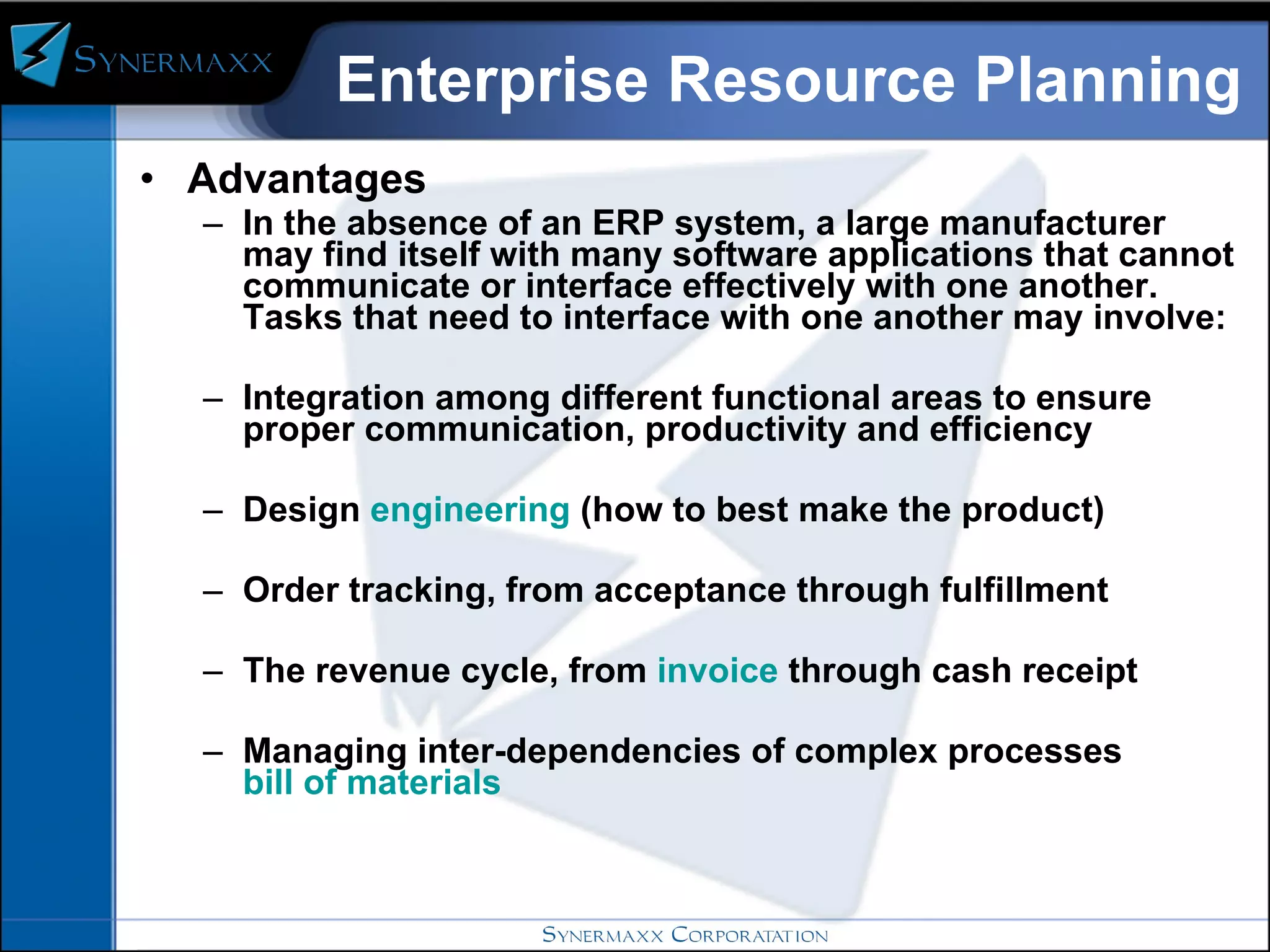
Enterprise Resource Planning Advantages In the absence of an ERP system, a large manufacturer may find itself with many software applications that cannot communicate or interface effectively with one another. Tasks that need to interface with one another may involve: Integration among different functional areas to ensure proper communication, productivity and efficiency  Design  engineering  (how to best make the product)  Order tracking, from acceptance through fulfillment  The revenue cycle, from  invoice  through cash receipt  Managing inter-dependencies of complex processes  bill of materials
Enterprise Resource Planning Advantages Tracking the three-way match between  purchase orders  (what was ordered),  inventory  receipts (what arrived), and  costing  (what the vendor invoiced)  The  accounting  for all of these tasks: tracking the  revenue ,  cost  and  profit  at a granular level.  ERP Systems centralize the data in one place. This eliminates the problem of synchronizing changes and can reduce the risk of loss of sensitive data by consolidating multiple permissions and security models into a single structure.  Some  security  features are included within an ERP system to protect against both outsider crime, such as  industrial espionage , and insider crime, such as  embezzlement . A data-tampering scenario, for example, might involve a disgruntled employee intentionally modifying prices to below-the-breakeven point in order to attempt to interfere with the company's profit or other sabotage. ERP systems typically provide functionality for implementing  internal controls  to prevent actions of this kind. ERP vendors are also moving toward better integration with other kinds of information security tools.
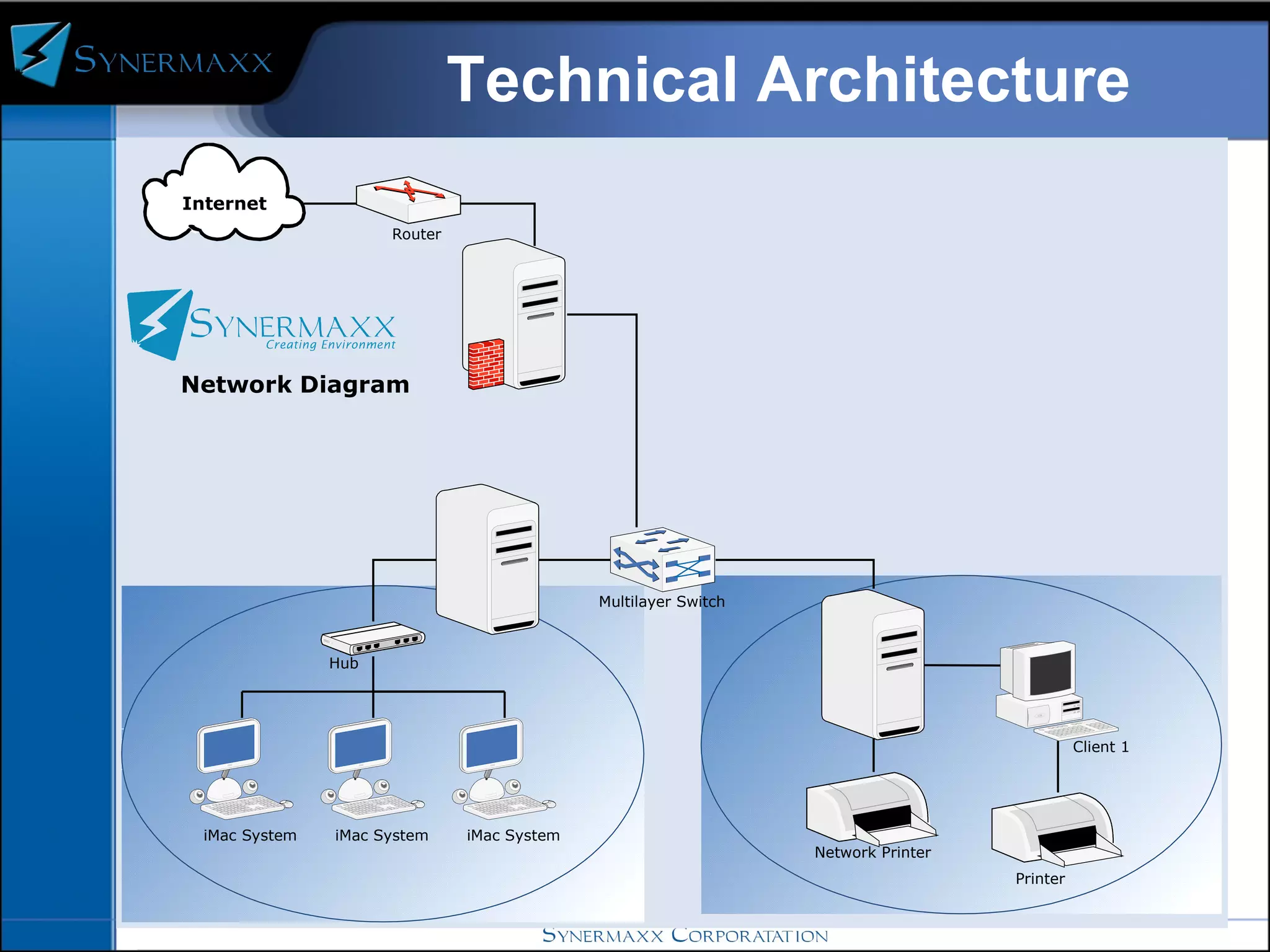
Technical Architecture
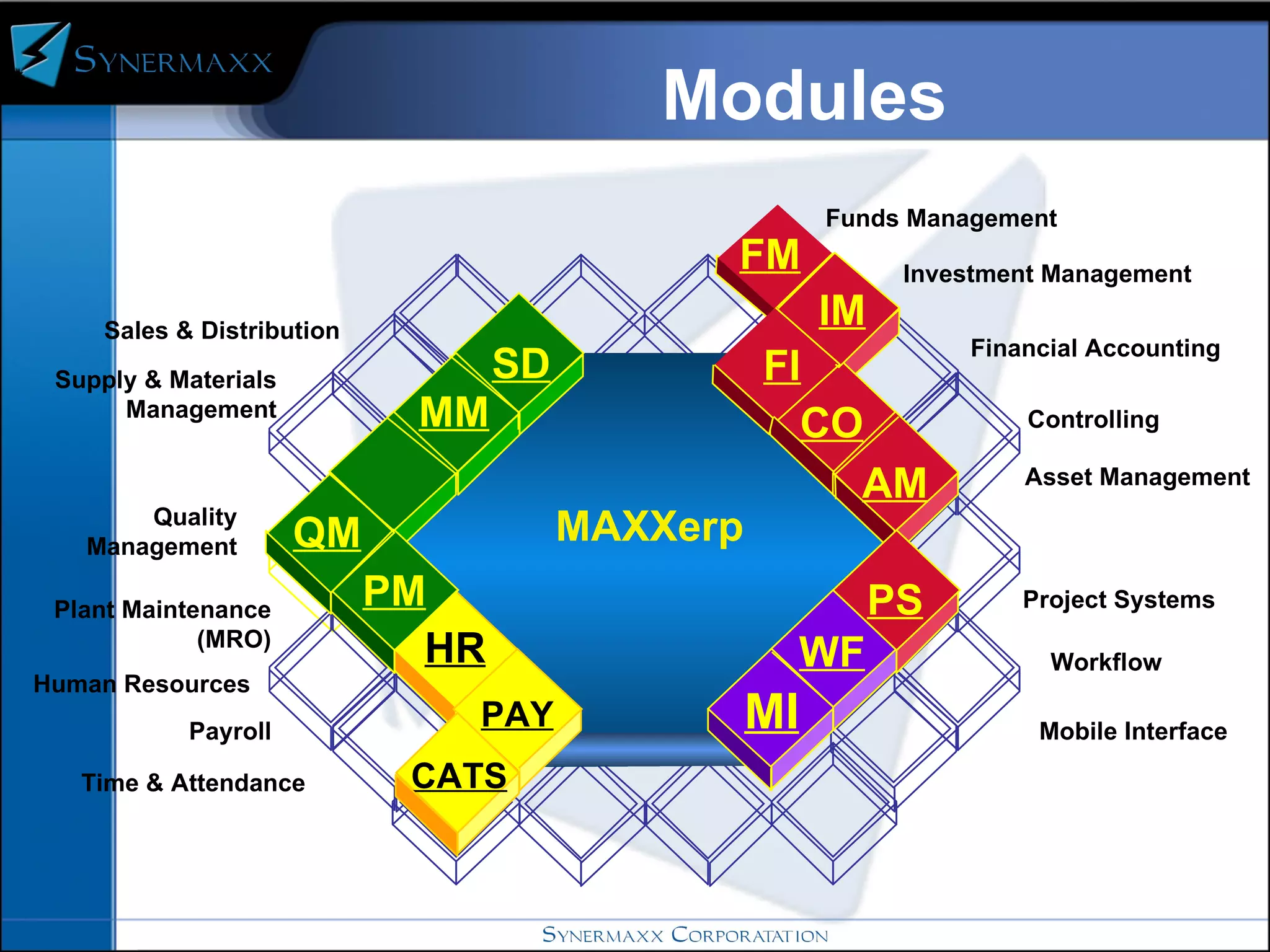
Modules MI MAXXerp SD MM WF PS AM CO FI HR PM FM IM Funds Management Investment Management Financial Accounting Controlling Asset Management Project Systems Quality Management Plant Maintenance (MRO) Human Resources Supply & Materials Management PAY FI Workflow QM CATS Time & Attendance Sales & Distribution Payroll Mobile Interface
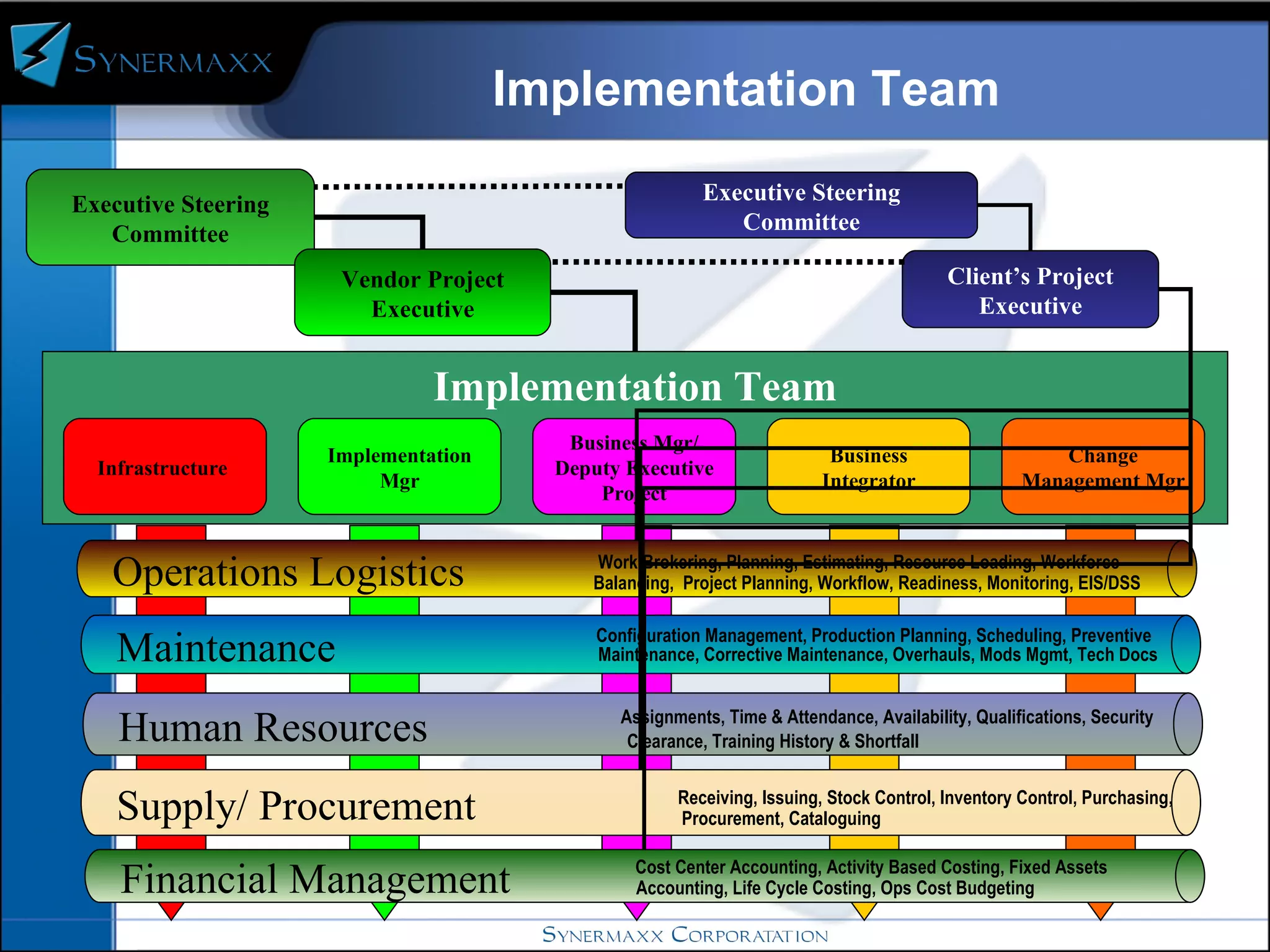
Implementation Team Implementation Team Executive Steering Committee Vendor Project Executive Infrastructure  Implementation Mgr Business Mgr/ Deputy Executive Project Business Integrator Change Management Mgr Financial Management Operations Logistics Supply/ Procurement Human Resources Maintenance Client’s Project Executive Executive Steering Committee Work Brokering, Planning, Estimating, Resource Loading, Workforce  Balancing,  Project Planning, Workflow, Readiness, Monitoring, EIS/DSS Configuration Management, Production Planning, Scheduling, Preventive Maintenance, Corrective Maintenance, Overhauls, Mods Mgmt, Tech Docs Assignments, Time & Attendance, Availability, Qualifications, Security Clearance, Training History & Shortfall Receiving, Issuing, Stock Control, Inventory Control, Purchasing, Procurement, Cataloguing Cost Center Accounting, Activity Based Costing, Fixed Assets Accounting, Life Cycle Costing, Ops Cost Budgeting
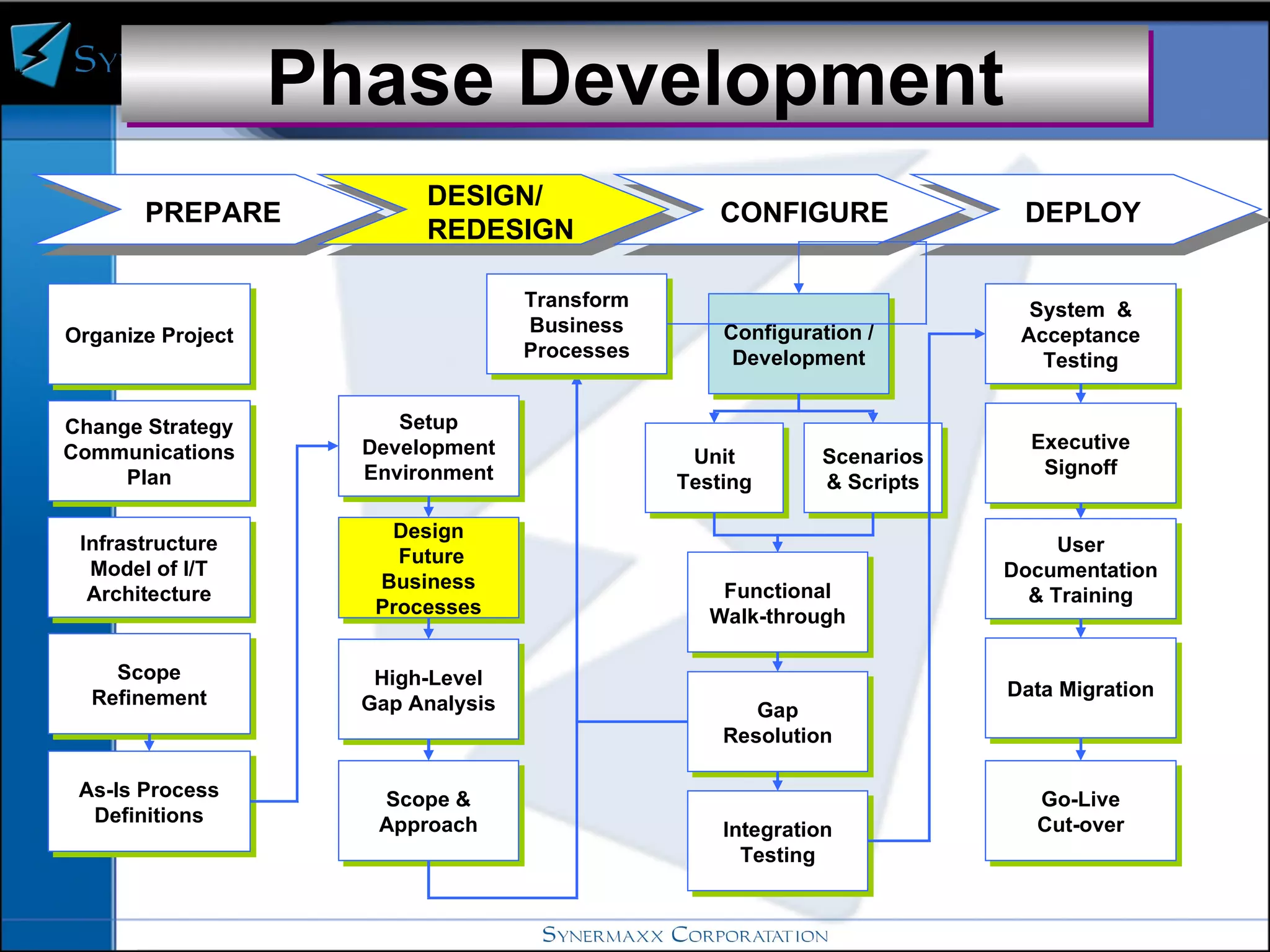
Phase Development As-Is Process Definitions Gap Resolution Integration Testing Organize Project Change Strategy Communications Plan Infrastructure Model of I/T Architecture Scope Refinement Setup Development Environment Design Future Business Processes High-Level Gap Analysis Scope & Approach Configuration / Development Functional Walk-through Unit Testing Scenarios & Scripts System  & Acceptance Testing User Documentation & Training Data Migration Go-Live Cut-over DESIGN/ REDESIGN PREPARE CONFIGURE DEPLOY Executive Signoff Transform Business Processes
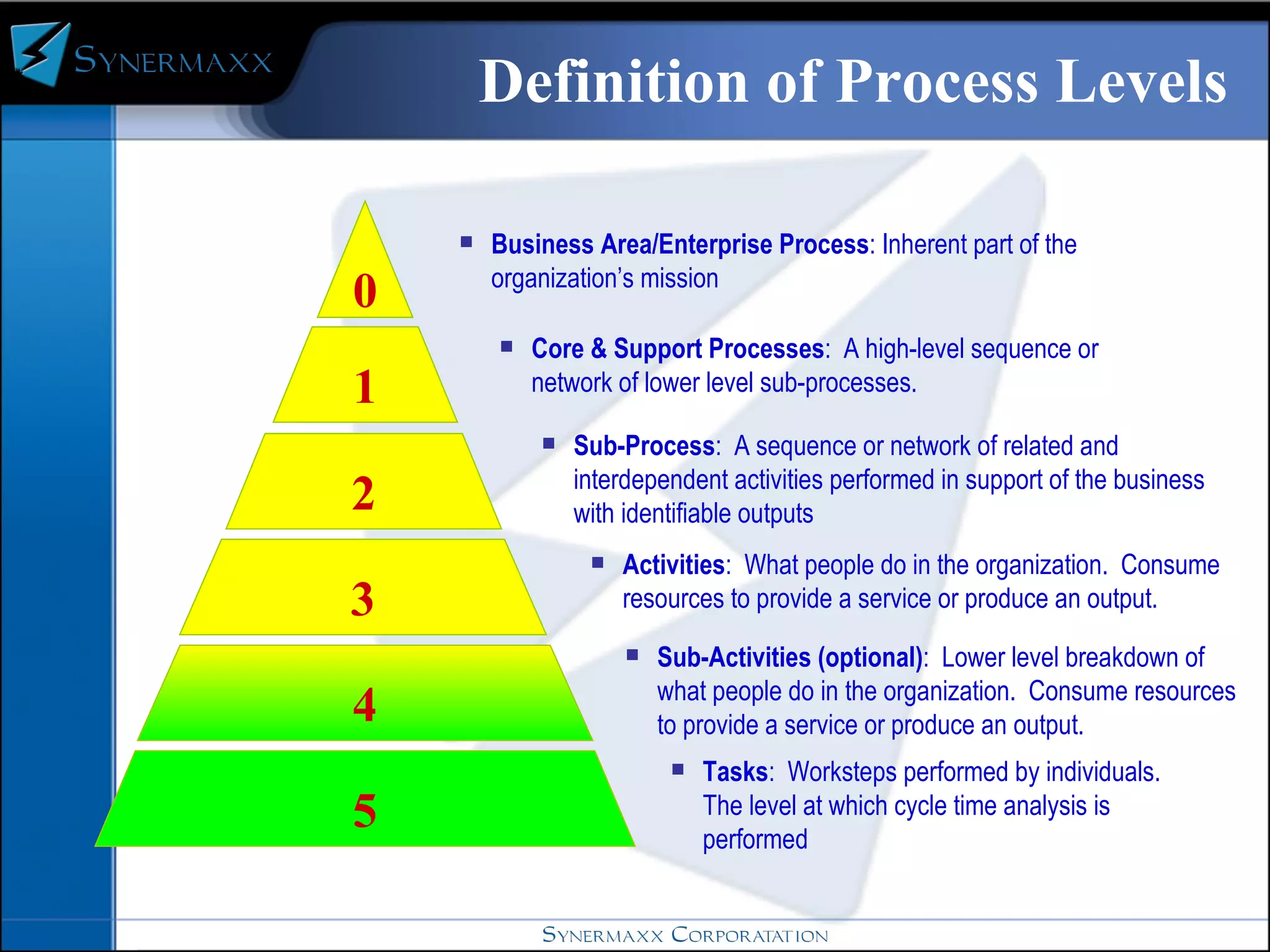
Business Area/Enterprise Process : Inherent part of the organization’s mission  Core & Support Processes :  A high-level sequence or network of lower level sub-processes.  Sub-Activities (optional) :  Lower level breakdown of what people do in the organization.  Consume resources to provide a service or produce an output. Tasks :  Worksteps performed by individuals. The level at which cycle time analysis is performed Sub-Process :  A sequence or network of related and interdependent activities performed in support of the business with identifiable outputs Activities :  What people do in the organization.  Consume resources to provide a service or produce an output. 2 1 3 4 5 0 Definition of Process Levels
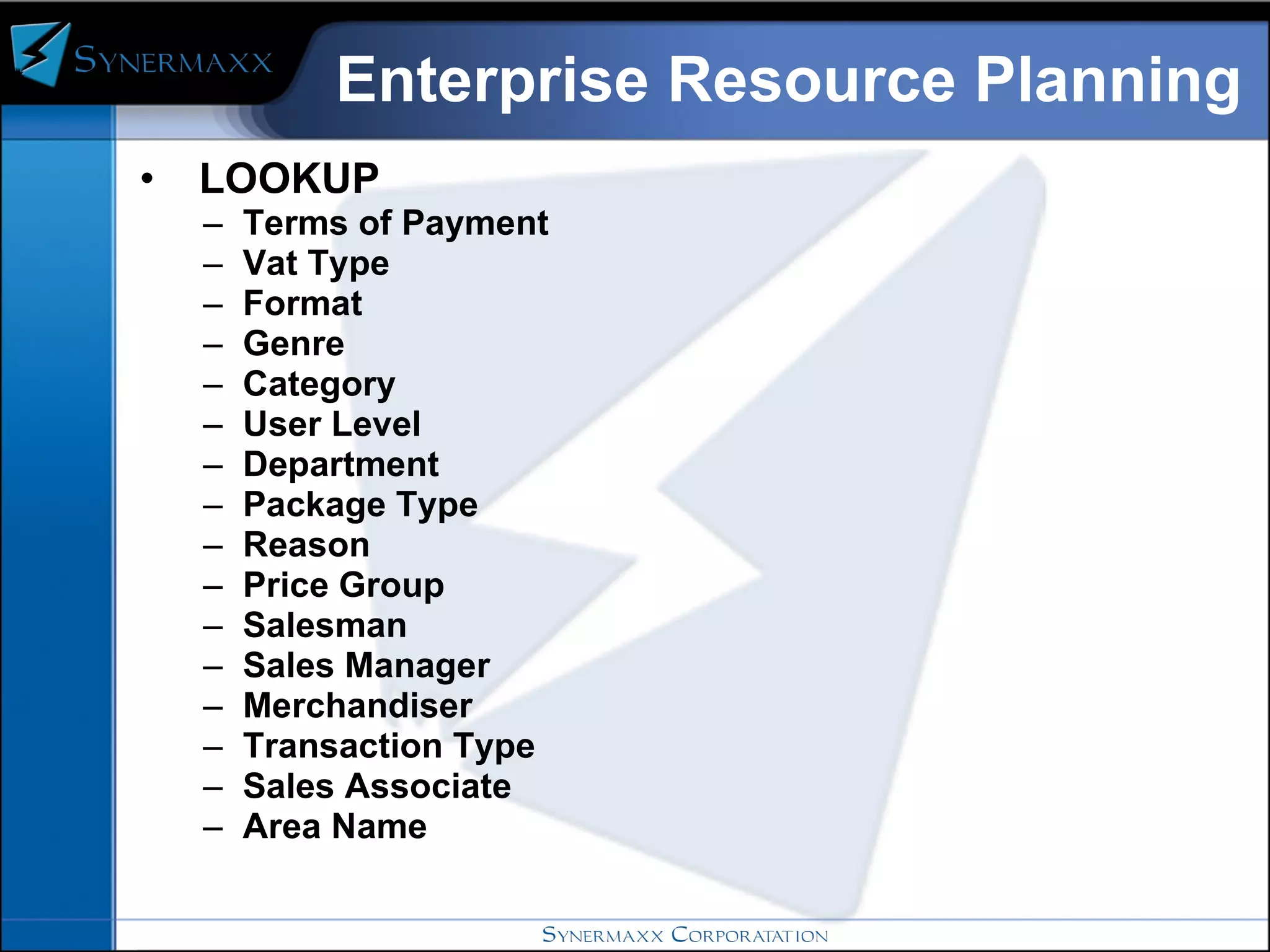
Enterprise Resource Planning LOOKUP Terms of Payment Vat Type Format Genre Category User Level Department Package Type Reason  Price Group Salesman Sales Manager Merchandiser Transaction Type Sales Associate Area Name
Enterprise Resource Planning MAINTENANCE  Product Item  Supplier  Supplier Product Customer  Outlet  Package Material  Customer Price Group  Mark Up/Down [Permanent]  Mark Up/Down [Outlet]  Physical Count Module Physical Count Variance History User  Change Password
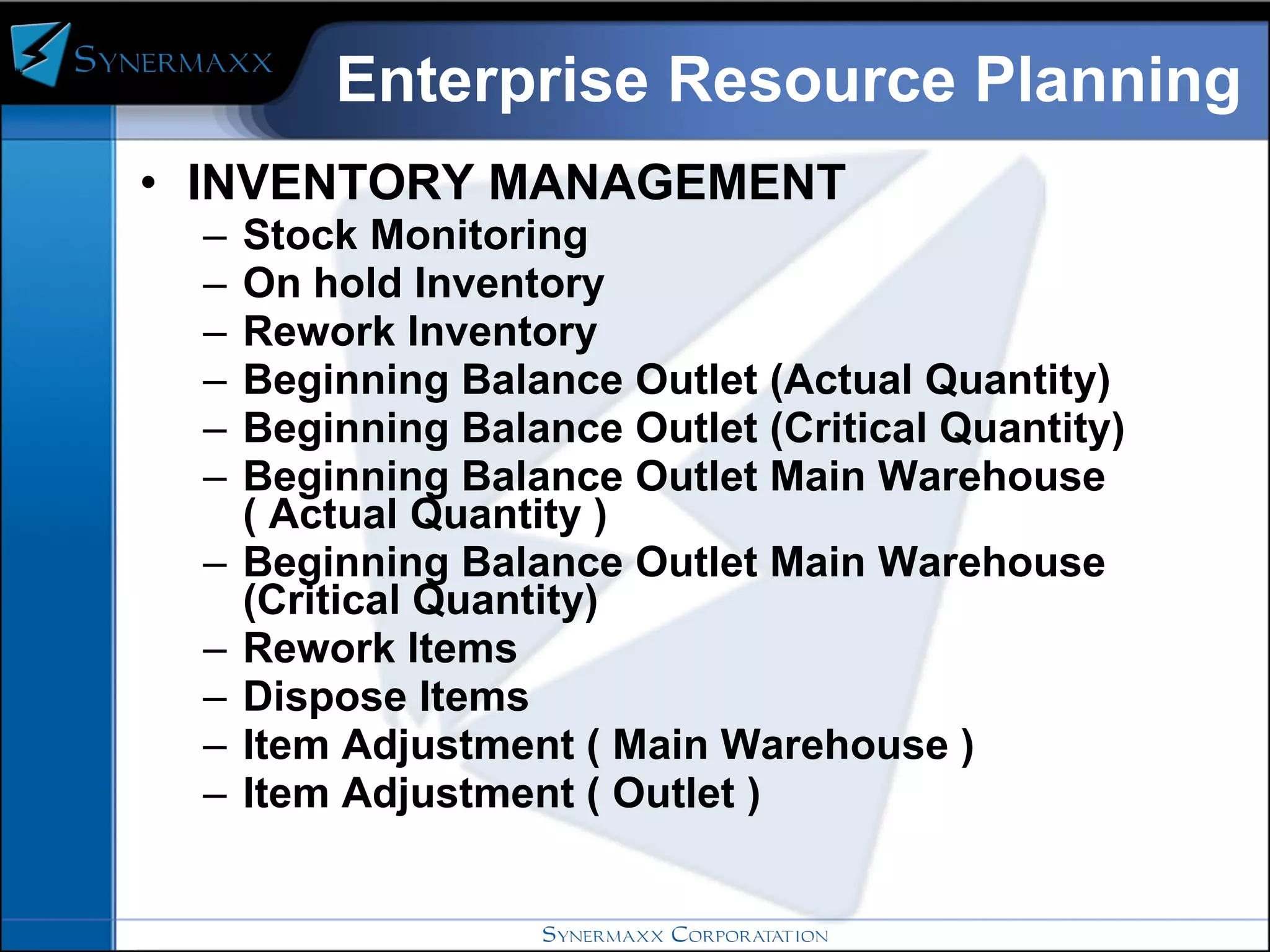
Enterprise Resource Planning INVENTORY MANAGEMENT  Stock Monitoring On hold Inventory Rework Inventory Beginning Balance Outlet (Actual Quantity) Beginning Balance Outlet (Critical Quantity) Beginning Balance Outlet Main Warehouse ( Actual Quantity ) Beginning Balance Outlet Main Warehouse (Critical Quantity) Rework Items Dispose Items Item Adjustment ( Main Warehouse ) Item Adjustment ( Outlet )
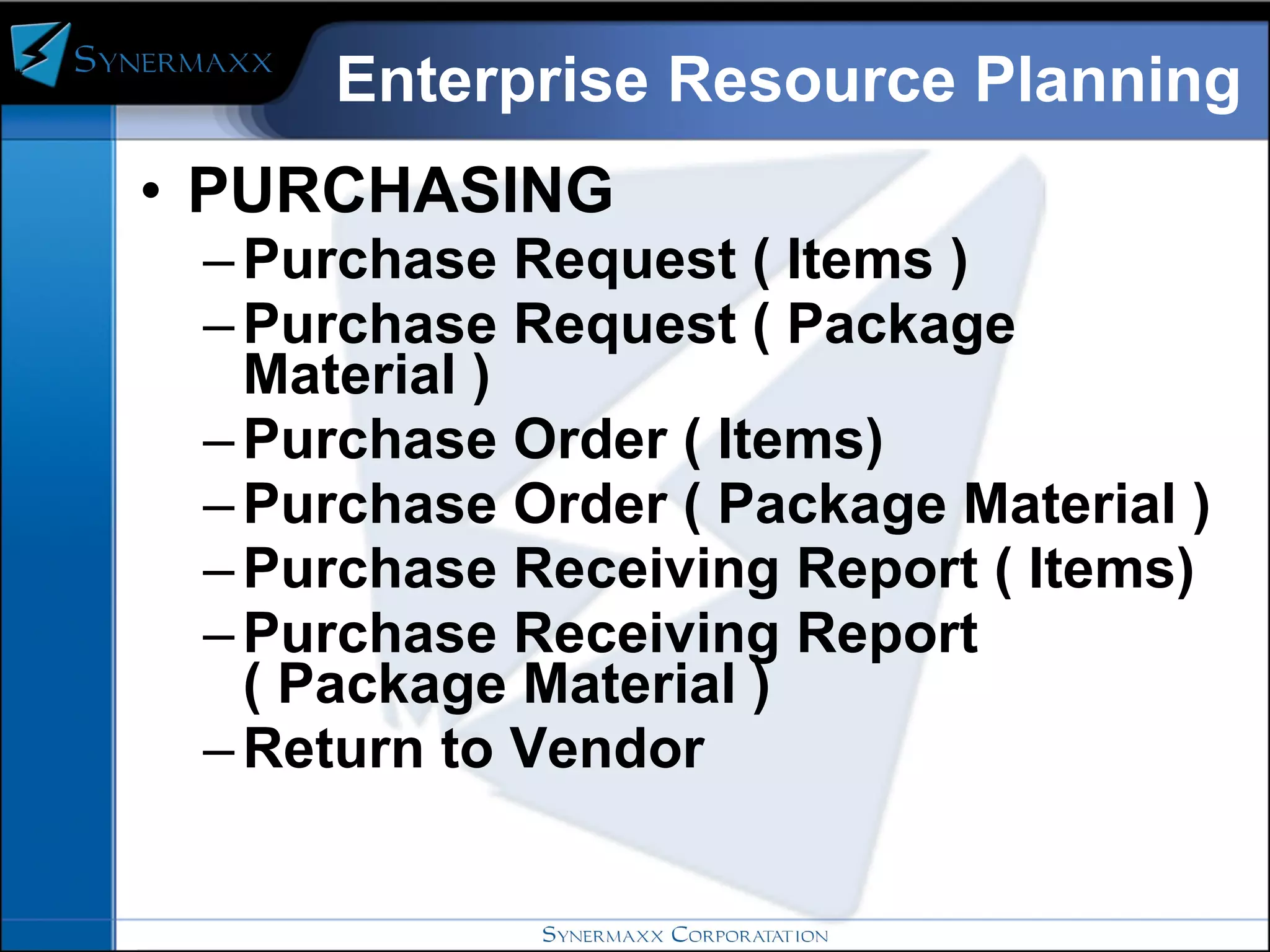
Enterprise Resource Planning PURCHASING  Purchase Request ( Items ) Purchase Request ( Package Material ) Purchase Order ( Items) Purchase Order ( Package Material ) Purchase Receiving Report ( Items) Purchase Receiving Report ( Package Material ) Return to Vendor
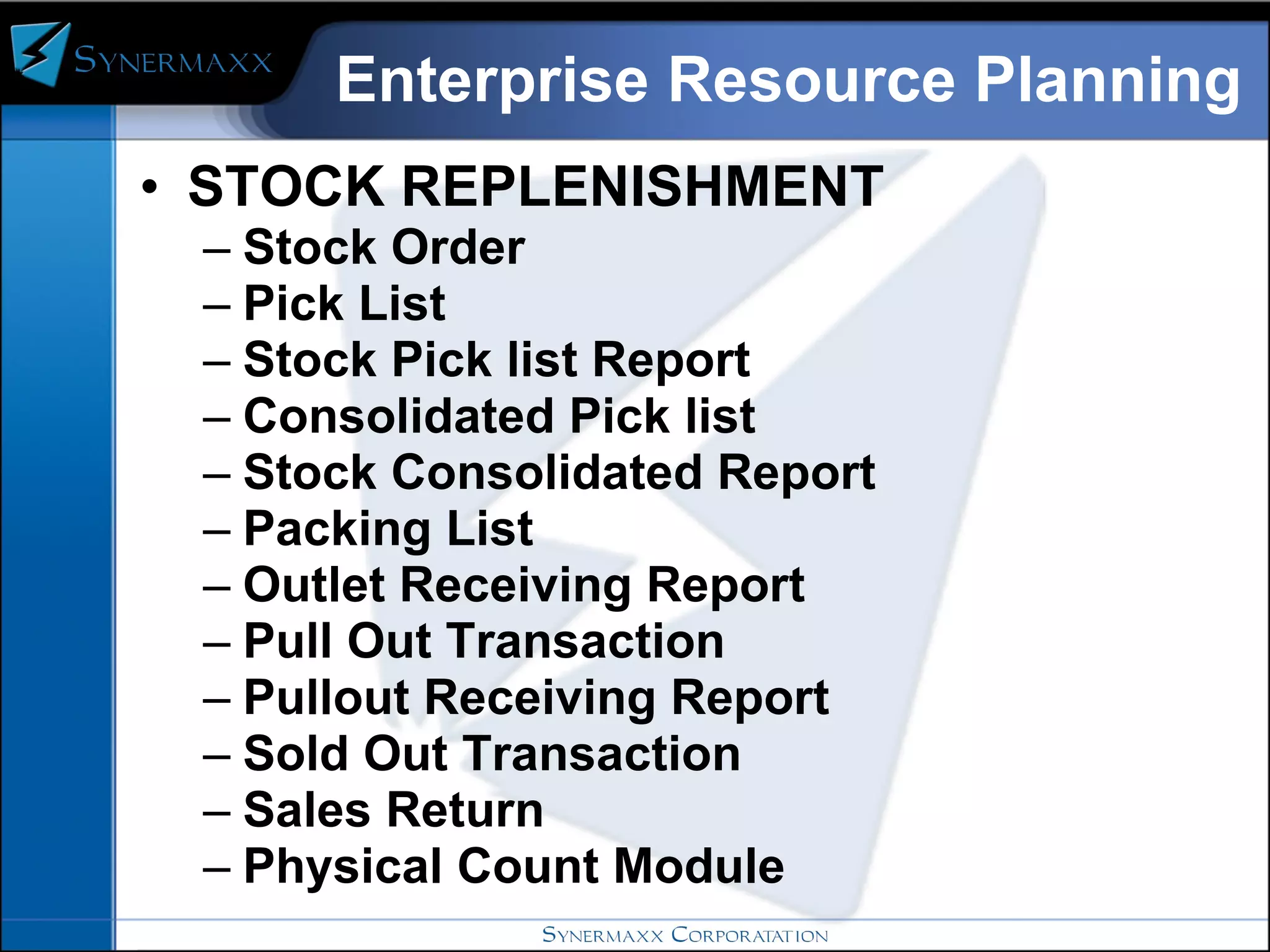
Enterprise Resource Planning STOCK REPLENISHMENT  Stock Order Pick List Stock Pick list Report Consolidated Pick list Stock Consolidated Report Packing List Outlet Receiving Report Pull Out Transaction Pullout Receiving Report Sold Out Transaction Sales Return Physical Count Module
Enterprise Resource Planning ACCOUNT RECEIVABLE  Billing Statement A/R Countering Ageing Monitoring Report Purchase Request & Check Summary A/R Collection Module Payment Summary Report CM/DM Module A/R History Report A/R History Report [Customer/AR #] Monthly Account Receivable Statement of Account
Enterprise Resource Planning REPORTS  Statement of Account for Countering  DR & RR Variance Price Group Billing Variance Itemized Billing Variance Packing List Variance Pull Out Variance Sales Report Un-served Orders [Outlet] Liquidation Report Pending Report DR Summary Report Inventory Report Pull Out Report [Good/Bad] Sold-out Transaction Report Summarized Ageing Report Inventory Report Inventory Per Customer
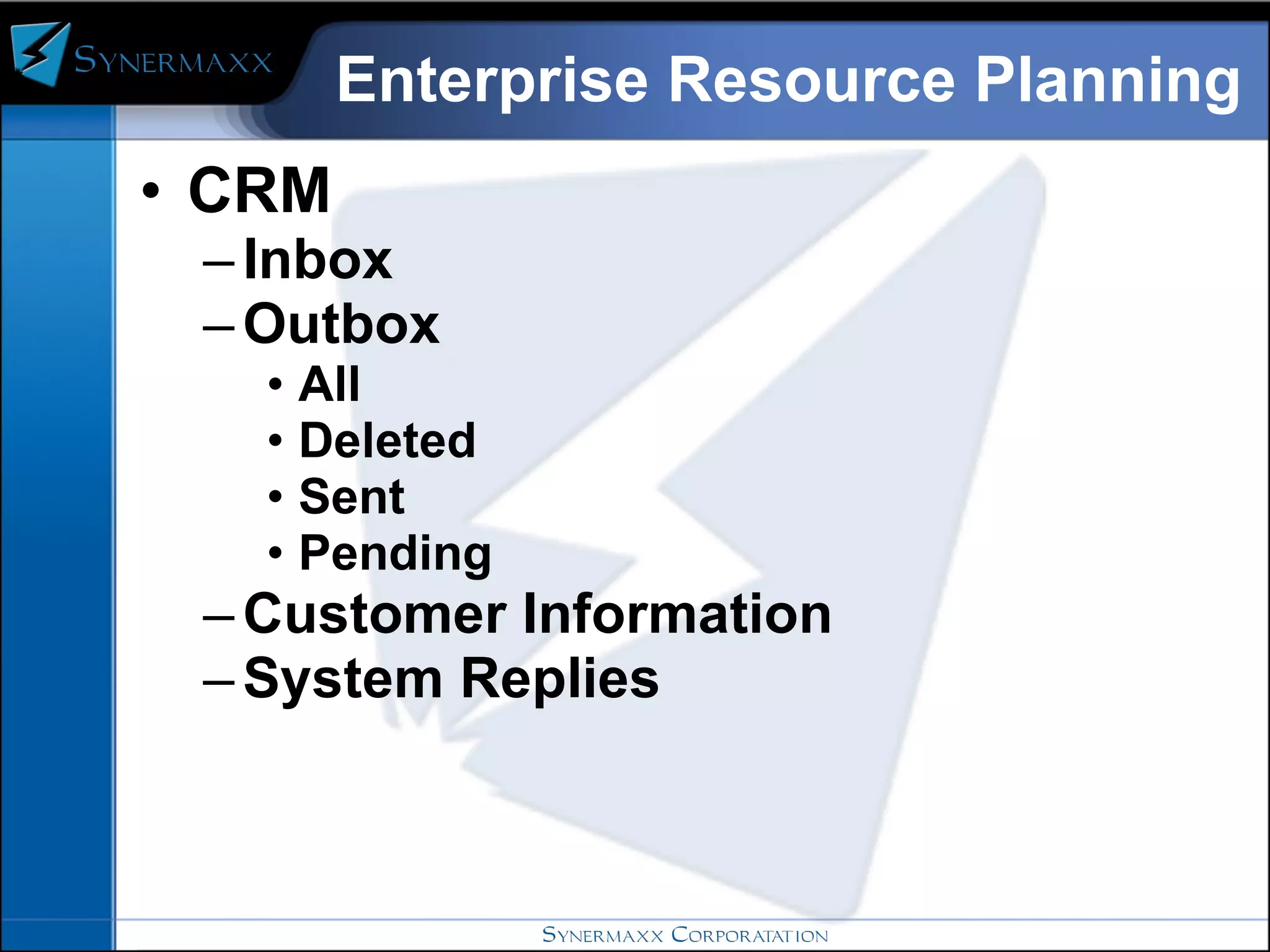
Enterprise Resource Planning CRM  Inbox Outbox All Deleted Sent Pending Customer Information System Replies

Erp Solutions(2)

  • 1.
  • 2.
    Enterprise Resource PlanningOverview Network Architecture Modules Implementation Team Phase Development Definition of Process Levels
  • 3.
    What is ERP? Common Data Order Management Financials Manu- facturing / Maintenance Human Resources Procurement Mgmt Reporting Inventory Operations Facilities Mgmt Revolutionary change in business processes for dramatic improvements ERP solutions provide consistent, complete, relevant, timely & reliable information for decision making The integration of business processes that optimize functions across the enterprise (e.g., supply chain, finance, HR, manufacturing / maintenance, etc.)
  • 4.
    Enterprise Resource PlanningAdvantages In the absence of an ERP system, a large manufacturer may find itself with many software applications that cannot communicate or interface effectively with one another. Tasks that need to interface with one another may involve: Integration among different functional areas to ensure proper communication, productivity and efficiency Design engineering (how to best make the product) Order tracking, from acceptance through fulfillment The revenue cycle, from invoice through cash receipt Managing inter-dependencies of complex processes bill of materials
  • 5.
    Enterprise Resource PlanningAdvantages Tracking the three-way match between purchase orders (what was ordered), inventory receipts (what arrived), and costing (what the vendor invoiced) The accounting for all of these tasks: tracking the revenue , cost and profit at a granular level. ERP Systems centralize the data in one place. This eliminates the problem of synchronizing changes and can reduce the risk of loss of sensitive data by consolidating multiple permissions and security models into a single structure. Some security features are included within an ERP system to protect against both outsider crime, such as industrial espionage , and insider crime, such as embezzlement . A data-tampering scenario, for example, might involve a disgruntled employee intentionally modifying prices to below-the-breakeven point in order to attempt to interfere with the company's profit or other sabotage. ERP systems typically provide functionality for implementing internal controls to prevent actions of this kind. ERP vendors are also moving toward better integration with other kinds of information security tools.
  • 6.
  • 7.
    Modules MI MAXXerpSD MM WF PS AM CO FI HR PM FM IM Funds Management Investment Management Financial Accounting Controlling Asset Management Project Systems Quality Management Plant Maintenance (MRO) Human Resources Supply & Materials Management PAY FI Workflow QM CATS Time & Attendance Sales & Distribution Payroll Mobile Interface
  • 8.
    Implementation Team ImplementationTeam Executive Steering Committee Vendor Project Executive Infrastructure Implementation Mgr Business Mgr/ Deputy Executive Project Business Integrator Change Management Mgr Financial Management Operations Logistics Supply/ Procurement Human Resources Maintenance Client’s Project Executive Executive Steering Committee Work Brokering, Planning, Estimating, Resource Loading, Workforce Balancing, Project Planning, Workflow, Readiness, Monitoring, EIS/DSS Configuration Management, Production Planning, Scheduling, Preventive Maintenance, Corrective Maintenance, Overhauls, Mods Mgmt, Tech Docs Assignments, Time & Attendance, Availability, Qualifications, Security Clearance, Training History & Shortfall Receiving, Issuing, Stock Control, Inventory Control, Purchasing, Procurement, Cataloguing Cost Center Accounting, Activity Based Costing, Fixed Assets Accounting, Life Cycle Costing, Ops Cost Budgeting
  • 9.
    Phase Development As-IsProcess Definitions Gap Resolution Integration Testing Organize Project Change Strategy Communications Plan Infrastructure Model of I/T Architecture Scope Refinement Setup Development Environment Design Future Business Processes High-Level Gap Analysis Scope & Approach Configuration / Development Functional Walk-through Unit Testing Scenarios & Scripts System & Acceptance Testing User Documentation & Training Data Migration Go-Live Cut-over DESIGN/ REDESIGN PREPARE CONFIGURE DEPLOY Executive Signoff Transform Business Processes
  • 10.
    Business Area/Enterprise Process: Inherent part of the organization’s mission Core & Support Processes : A high-level sequence or network of lower level sub-processes. Sub-Activities (optional) : Lower level breakdown of what people do in the organization. Consume resources to provide a service or produce an output. Tasks : Worksteps performed by individuals. The level at which cycle time analysis is performed Sub-Process : A sequence or network of related and interdependent activities performed in support of the business with identifiable outputs Activities : What people do in the organization. Consume resources to provide a service or produce an output. 2 1 3 4 5 0 Definition of Process Levels
  • 11.
    Enterprise Resource PlanningLOOKUP Terms of Payment Vat Type Format Genre Category User Level Department Package Type Reason Price Group Salesman Sales Manager Merchandiser Transaction Type Sales Associate Area Name
  • 12.
    Enterprise Resource PlanningMAINTENANCE Product Item Supplier Supplier Product Customer Outlet Package Material Customer Price Group Mark Up/Down [Permanent] Mark Up/Down [Outlet] Physical Count Module Physical Count Variance History User Change Password
  • 13.
    Enterprise Resource PlanningINVENTORY MANAGEMENT Stock Monitoring On hold Inventory Rework Inventory Beginning Balance Outlet (Actual Quantity) Beginning Balance Outlet (Critical Quantity) Beginning Balance Outlet Main Warehouse ( Actual Quantity ) Beginning Balance Outlet Main Warehouse (Critical Quantity) Rework Items Dispose Items Item Adjustment ( Main Warehouse ) Item Adjustment ( Outlet )
  • 14.
    Enterprise Resource PlanningPURCHASING Purchase Request ( Items ) Purchase Request ( Package Material ) Purchase Order ( Items) Purchase Order ( Package Material ) Purchase Receiving Report ( Items) Purchase Receiving Report ( Package Material ) Return to Vendor
  • 15.
    Enterprise Resource PlanningSTOCK REPLENISHMENT Stock Order Pick List Stock Pick list Report Consolidated Pick list Stock Consolidated Report Packing List Outlet Receiving Report Pull Out Transaction Pullout Receiving Report Sold Out Transaction Sales Return Physical Count Module
  • 16.
    Enterprise Resource PlanningACCOUNT RECEIVABLE Billing Statement A/R Countering Ageing Monitoring Report Purchase Request & Check Summary A/R Collection Module Payment Summary Report CM/DM Module A/R History Report A/R History Report [Customer/AR #] Monthly Account Receivable Statement of Account
  • 17.
    Enterprise Resource PlanningREPORTS Statement of Account for Countering DR & RR Variance Price Group Billing Variance Itemized Billing Variance Packing List Variance Pull Out Variance Sales Report Un-served Orders [Outlet] Liquidation Report Pending Report DR Summary Report Inventory Report Pull Out Report [Good/Bad] Sold-out Transaction Report Summarized Ageing Report Inventory Report Inventory Per Customer
  • 18.
    Enterprise Resource PlanningCRM Inbox Outbox All Deleted Sent Pending Customer Information System Replies