RECRUITMENT VIA EMPLOYEE REFERRALSBy Sourabh , 10HM30
CONTENTSIntroductionWhat motivates referrals ?AdvantagesDisadvantagesWhy employees don’t referTen steps for a successful employee-referral programConclusion
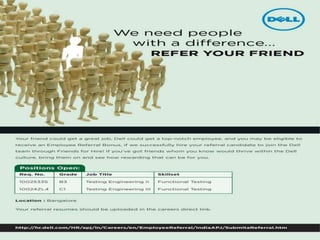
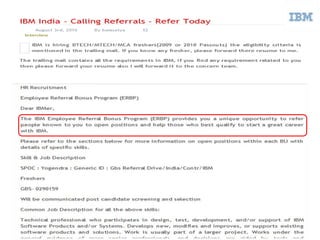
INTRODUCTIONAn employee referral scheme encourages a company's existing employees to select and recruit the suitable candidates from their social networks. As a reward, the employer typically pays the referring employee a referral bonus .
INTRODUCTIONThe employee referral system is the preferred source of recruitment for many IT organisations.Thoughtfully implemented employee referral plans are excellent ways to attract the best people at the lowest cost.
INTRODUCTIONIntel Corp. uses a combination of monetary and non-monetary incentivesIn addition to a cash reward for referrals, the company also offers a raffle for those employees who've made referrals. Ex : a $1,000 travel voucher or a home entertainment system.50 percent of the company's new hires have come from referrals.
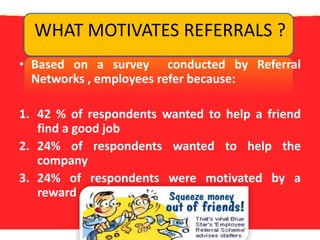
WHAT MOTIVATES REFERRALS ?Based on a survey  conducted by Referral Networks , employees refer because:42 % of respondents wanted to help a friend find a good job24% of respondents wanted to help the company24% of respondents were motivated by a reward
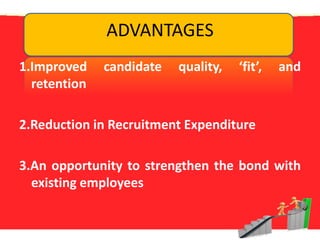
ADVANTAGES1.Improved candidate quality, ‘fit’, and retention2.Reduction in Recruitment Expenditure3.An opportunity to strengthen the bond with existing employees
1.IMPROVED CANDIDATE QUALITY, ‘FIT’, AND RETENTIONThe relationship between the referring employee and the candidate allows the candidate to understand the culture of the firmto assess  his/her own likelihood of success at that firmto be better prepared to face interviews and other steps in selectionAlso there is a matching of expectations between employer and candidate , resulting in increasesd level of staff retention
2.REDUCTION IN RECRUITMENT EXPENDITUREEven if incentives and rewards need to be paid to the referring employees , there are cost savings for the firmEx : Referral programs cost $500 for employees, versus $2,884 and S726 for print advertising, and even more for agencies and executive recruiting firms, according to the 2000 Employment Management Association's cost-per-hire surveyThe company’s Human Resources headcount can be streamlined and be used more efficiently
3.AN OPPORTUNITY TO STRENGTHEN THE BOND WITH EXISTING EMPLOYEES.Referral programs acknowledge and reinforce the company's commitment to rewarding the individual for helping the company. Additionally, an Ohio State University study shows that employees hired through referrals have a retention rate that's 25 percent higher than that of employees hired through other methods.
DISADVANTAGESAn employees social network is limited - It may compromise the diversity of the workforceActively referring candidates increases an employee’s workload and may be detrimental to their main responsibilitiesThe best and most relevant candidates may not be acquainted with an existing employee of the company
WHY EMPLOYEES DON'T REFERThe top three responses for not referring, according to the survey by Referral Networks:78 percent: Don't know anyone suitable for the positions42 percent: Afraid of  the consequences of referring a bad candidate21 percent: Process is too much of a hassle
TEN STEPS FOR A SUCCESSFUL EMPLOYEE-REFERRAL PROGRAM1.Strong commitment from the top management2.Simple minimum rules 3.Let everyone participate including senior managers and HR staff4.Involve and reward outsiders like employees' friends and former business associates
TEN STEPS FOR A SUCCESSFUL EMPLOYEE-REFERRAL PROGRAM5. Give VIP status to referred resumes6. Let employees track progress on the the hiring process7. Make it easy to refer by having a well designed Intranet
TEN STEPS FOR A SUCCESSFUL EMPLOYEE-REFERRAL PROGRAM8.Promote constantly and motivate staff with company-wide congratulatory e-mails from the CEO9.Pay a decent bonus  - neither too high nor too low10. Pay it fast
CONCLUSIONEmployee referrals provide a win-win-win situation to all the parties involved – Employer , Employee and the CandidateMore and more firms are resorting to employee referrals and are reaping the benefits .
THANK YOU

Employee Referrals

  • 1.
    RECRUITMENT VIA EMPLOYEEREFERRALSBy Sourabh , 10HM30
  • 2.
    CONTENTSIntroductionWhat motivates referrals?AdvantagesDisadvantagesWhy employees don’t referTen steps for a successful employee-referral programConclusion
  • 3.
    INTRODUCTIONAn employee referralscheme encourages a company's existing employees to select and recruit the suitable candidates from their social networks. As a reward, the employer typically pays the referring employee a referral bonus .
  • 4.
    INTRODUCTIONThe employee referralsystem is the preferred source of recruitment for many IT organisations.Thoughtfully implemented employee referral plans are excellent ways to attract the best people at the lowest cost.
  • 5.
    INTRODUCTIONIntel Corp. usesa combination of monetary and non-monetary incentivesIn addition to a cash reward for referrals, the company also offers a raffle for those employees who've made referrals. Ex : a $1,000 travel voucher or a home entertainment system.50 percent of the company's new hires have come from referrals.
  • 9.
    WHAT MOTIVATES REFERRALS?Based on a survey conducted by Referral Networks , employees refer because:42 % of respondents wanted to help a friend find a good job24% of respondents wanted to help the company24% of respondents were motivated by a reward
  • 10.
    ADVANTAGES1.Improved candidate quality,‘fit’, and retention2.Reduction in Recruitment Expenditure3.An opportunity to strengthen the bond with existing employees
  • 11.
    1.IMPROVED CANDIDATE QUALITY,‘FIT’, AND RETENTIONThe relationship between the referring employee and the candidate allows the candidate to understand the culture of the firmto assess his/her own likelihood of success at that firmto be better prepared to face interviews and other steps in selectionAlso there is a matching of expectations between employer and candidate , resulting in increasesd level of staff retention
  • 12.
    2.REDUCTION IN RECRUITMENTEXPENDITUREEven if incentives and rewards need to be paid to the referring employees , there are cost savings for the firmEx : Referral programs cost $500 for employees, versus $2,884 and S726 for print advertising, and even more for agencies and executive recruiting firms, according to the 2000 Employment Management Association's cost-per-hire surveyThe company’s Human Resources headcount can be streamlined and be used more efficiently
  • 13.
    3.AN OPPORTUNITY TOSTRENGTHEN THE BOND WITH EXISTING EMPLOYEES.Referral programs acknowledge and reinforce the company's commitment to rewarding the individual for helping the company. Additionally, an Ohio State University study shows that employees hired through referrals have a retention rate that's 25 percent higher than that of employees hired through other methods.
  • 14.
    DISADVANTAGESAn employees social network islimited - It may compromise the diversity of the workforceActively referring candidates increases an employee’s workload and may be detrimental to their main responsibilitiesThe best and most relevant candidates may not be acquainted with an existing employee of the company
  • 15.
    WHY EMPLOYEES DON'TREFERThe top three responses for not referring, according to the survey by Referral Networks:78 percent: Don't know anyone suitable for the positions42 percent: Afraid of the consequences of referring a bad candidate21 percent: Process is too much of a hassle
  • 16.
    TEN STEPS FORA SUCCESSFUL EMPLOYEE-REFERRAL PROGRAM1.Strong commitment from the top management2.Simple minimum rules 3.Let everyone participate including senior managers and HR staff4.Involve and reward outsiders like employees' friends and former business associates
  • 17.
    TEN STEPS FORA SUCCESSFUL EMPLOYEE-REFERRAL PROGRAM5. Give VIP status to referred resumes6. Let employees track progress on the the hiring process7. Make it easy to refer by having a well designed Intranet
  • 18.
    TEN STEPS FORA SUCCESSFUL EMPLOYEE-REFERRAL PROGRAM8.Promote constantly and motivate staff with company-wide congratulatory e-mails from the CEO9.Pay a decent bonus - neither too high nor too low10. Pay it fast
  • 19.
    CONCLUSIONEmployee referrals providea win-win-win situation to all the parties involved – Employer , Employee and the CandidateMore and more firms are resorting to employee referrals and are reaping the benefits .
  • 20.