Rapid Application
Development &
Deployment (RAD   2)
THE PROBLEM
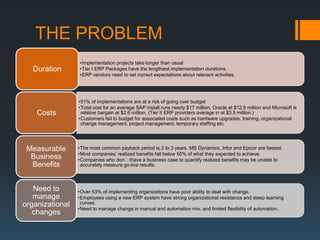
                 •Implementation projects take longer than usual
   Duration      •Tier I ERP Packages have the lengthiest implementation durations.
                 •ERP vendors need to set correct expectations about relevant activities.


                 •51% of implementations are at a risk of going over budget
                 •Total cost for an average SAP install runs nearly $17 million, Oracle at $12.6 million and Microsoft is
    Costs         relative bargain at $2.6 million. (Tier II ERP providers average in at $3.5 million.)
                 •Customers fail to budget for associated costs such as hardware upgrades, training, organizational
                  change management, project management, temporary staffing etc.


 Measurable      •The most common payback period is 2 to 3 years. MS Dynamics, Infor and Epicor are fastest.
                 •Most companies’ realized benefits fall below 50% of what they expected to achieve.
  Business       •Companies who donʼthave a business case to quantify realized benefits may be unable to
  Benefits        accurately measure go-live results.


   Need to       •Over 53% of implementing organizations have poor ability to deal with change.
   manage        •Employees using a new ERP system have strong organizational resistance and steep learning
organizational    curves.
                 •Need to manage change in manual and automation mix, and limited flexibility of automation.
   changes
THE PROBLEM
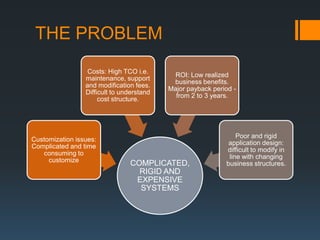
                  Costs: High TCO i.e.
                                            ROI: Low realized
                 maintenance, support
                                            business benefits.
                 and modification fees.
                                           Major payback period -
                 Difficult to understand
                                             from 2 to 3 years.
                      cost structure.


                                                                 Poor and rigid
Customization issues:
                                                              application design:
Complicated and time
                                                             difficult to modify in
   consuming to
                                                              line with changing
     customize
                                COMPLICATED,                 business structures.
                                  RIGID AND
                                 EXPENSIVE
                                  SYSTEMS
THE PROBLEM
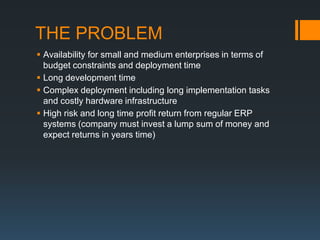
 Availability for small and medium enterprises in terms of
  budget constraints and deployment time
 Long development time
 Complex deployment including long implementation tasks
  and costly hardware infrastructure
 High risk and long time profit return from regular ERP
  systems (company must invest a lump sum of money and
  expect returns in years time)
THE ERP MARKET
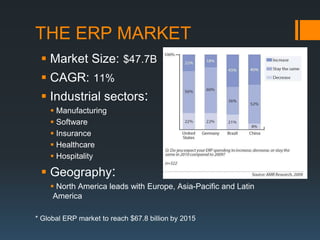
  Market Size: $47.7B
  CAGR: 11%
  Industrial sectors:
     Manufacturing
     Software
     Insurance
     Healthcare
     Hospitality

  Geography:
     North America leads with Europe, Asia-Pacific and Latin
     America

* Global ERP market to reach $67.8 billion by 2015
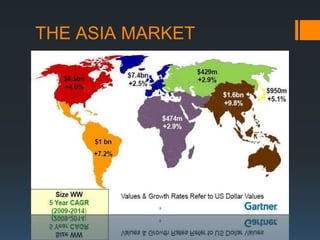
THE ASIA MARKET
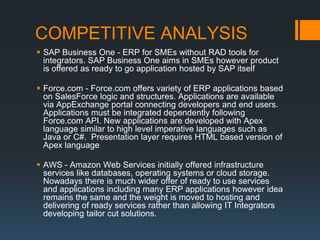
COMPETITIVE ANALYSIS
 SAP Business One - ERP for SMEs without RAD tools for
  integrators. SAP Business One aims in SMEs however product
  is offered as ready to go application hosted by SAP itself

 Force.com - Force.com offers variety of ERP applications based
  on SalesForce logic and structures. Applications are available
  via AppExchange portal connecting developers and end users.
  Applications must be integrated dependently following
  Force.com API. New applications are developed with Apex
  language similar to high level imperative languages such as
  Java or C#. Presentation layer requires HTML based version of
  Apex language

 AWS - Amazon Web Services initially offered infrastructure
  services like databases, operating systems or cloud storage.
  Nowadays there is much wider offer of ready to use services
  and applications including many ERP applications however idea
  remains the same and the weight is moved to hosting and
  delivering of ready services rather than allowing IT Integrators
  developing tailor cut solutions.
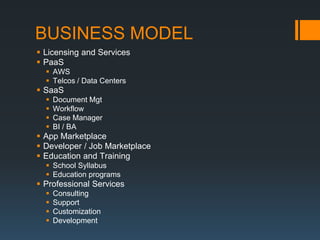
BUSINESS MODEL
 Licensing and Services
 PaaS
   AWS
   Telcos / Data Centers
 SaaS
     Document Mgt
     Workflow
     Case Manager
     BI / BA
 App Marketplace
 Developer / Job Marketplace
 Education and Training
   School Syllabus
   Education programs
 Professional Services
     Consulting
     Support
     Customization
     Development
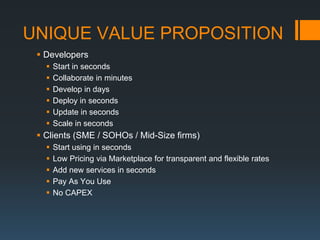
UNIQUE VALUE PROPOSITION
  Developers
      Start in seconds
      Collaborate in minutes
      Develop in days
      Deploy in seconds
      Update in seconds
      Scale in seconds
  Clients (SME / SOHOs / Mid-Size firms)
      Start using in seconds
      Low Pricing via Marketplace for transparent and flexible rates
      Add new services in seconds
      Pay As You Use
      No CAPEX
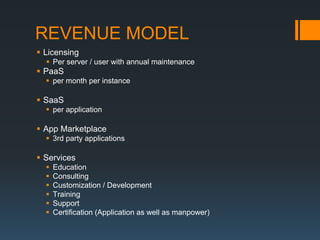
REVENUE MODEL
 Licensing
   Per server / user with annual maintenance
 PaaS
   per month per instance

 SaaS
   per application

 App Marketplace
   3rd party applications

 Services
     Education
     Consulting
     Customization / Development
     Training
     Support
     Certification (Application as well as manpower)
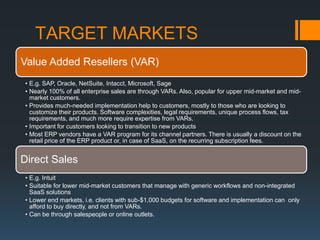
TARGET MARKETS
Value Added Resellers (VAR)
• E.g. SAP, Oracle, NetSuite, Intacct, Microsoft, Sage
• Nearly 100% of all enterprise sales are through VARs. Also, popular for upper mid-market and mid-
  market customers.
• Provides much-needed implementation help to customers, mostly to those who are looking to
  customize their products. Software complexities, legal requirements, unique process flows, tax
  requirements, and much more require expertise from VARs.
• Important for customers looking to transition to new products
• Most ERP vendors have a VAR program for its channel partners. There is usually a discount on the
  retail price of the ERP product or, in case of SaaS, on the recurring subscription fees.


Direct Sales
• E.g. Intuit
• Suitable for lower mid-market customers that manage with generic workflows and non-integrated
  SaaS solutions
• Lower end markets, i.e. clients with sub-$1,000 budgets for software and implementation can only
  afford to buy directly, and not from VARs.
• Can be through salespeople or online outlets.
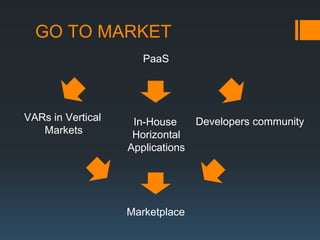
GO TO MARKET
                      PaaS


VARs in Vertical    In-House      Developers community
   Markets          Horizontal
                   Applications


                   Marketplace
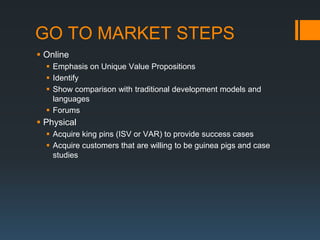
GO TO MARKET STEPS
 Online
   Emphasis on Unique Value Propositions
   Identify
   Show comparison with traditional development models and
    languages
   Forums
 Physical
   Acquire king pins (ISV or VAR) to provide success cases
   Acquire customers that are willing to be guinea pigs and case
    studies
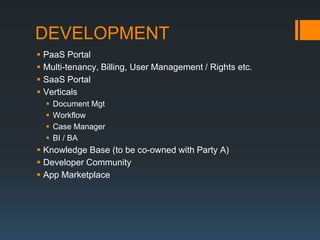
DEVELOPMENT
 PaaS Portal
 Multi-tenancy, Billing, User Management / Rights etc.
 SaaS Portal
 Verticals
     Document Mgt
     Workflow
     Case Manager
     BI / BA
 Knowledge Base (to be co-owned with Party A)
 Developer Community
 App Marketplace
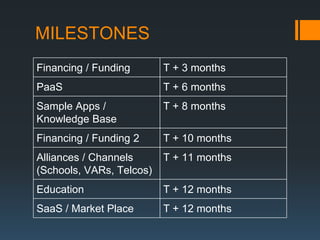
MILESTONES
Financing / Funding       T + 3 months
PaaS                      T + 6 months
Sample Apps /             T + 8 months
Knowledge Base
Financing / Funding 2     T + 10 months
Alliances / Channels      T + 11 months
(Schools, VARs, Telcos)
Education                 T + 12 months
SaaS / Market Place       T + 12 months
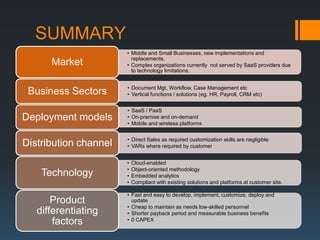
SUMMARY
                       • Middle and Small Businesses, new implementations and
                         replacements.
      Market           • Complex organizations currently not served by SaaS providers due
                         to technology limitations.


                       • Document Mgt, Workflow, Case Management etc
 Business Sectors      • Vertical functions / solutions (eg. HR, Payroll, CRM etc)


                       • SaaS / PaaS
Deployment models      • On-premise and on-demand
                       • Mobile and wireless platforms


                       • Direct Sales as required customization skills are negligible
Distribution channel   • VARs where required by customer


                       •   Cloud-enabled
                       •   Object-oriented methodology
    Technology         •   Embedded analytics
                       •   Compliant with existing solutions and platforms at customer site.

                       • Fast and easy to develop, implement, customize, deploy and
       Product           update
                       • Cheap to maintain as needs low-skilled personnel
   differentiating     • Shorter payback period and measurable business benefits
                       • 0 CAPEX
       factors

Rad2

  • 1.
  • 2.
    THE PROBLEM •Implementation projects take longer than usual Duration •Tier I ERP Packages have the lengthiest implementation durations. •ERP vendors need to set correct expectations about relevant activities. •51% of implementations are at a risk of going over budget •Total cost for an average SAP install runs nearly $17 million, Oracle at $12.6 million and Microsoft is Costs relative bargain at $2.6 million. (Tier II ERP providers average in at $3.5 million.) •Customers fail to budget for associated costs such as hardware upgrades, training, organizational change management, project management, temporary staffing etc. Measurable •The most common payback period is 2 to 3 years. MS Dynamics, Infor and Epicor are fastest. •Most companies’ realized benefits fall below 50% of what they expected to achieve. Business •Companies who donʼthave a business case to quantify realized benefits may be unable to Benefits accurately measure go-live results. Need to •Over 53% of implementing organizations have poor ability to deal with change. manage •Employees using a new ERP system have strong organizational resistance and steep learning organizational curves. •Need to manage change in manual and automation mix, and limited flexibility of automation. changes
  • 3.
    THE PROBLEM Costs: High TCO i.e. ROI: Low realized maintenance, support business benefits. and modification fees. Major payback period - Difficult to understand from 2 to 3 years. cost structure. Poor and rigid Customization issues: application design: Complicated and time difficult to modify in consuming to line with changing customize COMPLICATED, business structures. RIGID AND EXPENSIVE SYSTEMS
  • 4.
    THE PROBLEM  Availabilityfor small and medium enterprises in terms of budget constraints and deployment time  Long development time  Complex deployment including long implementation tasks and costly hardware infrastructure  High risk and long time profit return from regular ERP systems (company must invest a lump sum of money and expect returns in years time)
  • 5.
    THE ERP MARKET  Market Size: $47.7B  CAGR: 11%  Industrial sectors:  Manufacturing  Software  Insurance  Healthcare  Hospitality  Geography:  North America leads with Europe, Asia-Pacific and Latin America * Global ERP market to reach $67.8 billion by 2015
  • 6.
  • 7.
    COMPETITIVE ANALYSIS  SAPBusiness One - ERP for SMEs without RAD tools for integrators. SAP Business One aims in SMEs however product is offered as ready to go application hosted by SAP itself  Force.com - Force.com offers variety of ERP applications based on SalesForce logic and structures. Applications are available via AppExchange portal connecting developers and end users. Applications must be integrated dependently following Force.com API. New applications are developed with Apex language similar to high level imperative languages such as Java or C#. Presentation layer requires HTML based version of Apex language  AWS - Amazon Web Services initially offered infrastructure services like databases, operating systems or cloud storage. Nowadays there is much wider offer of ready to use services and applications including many ERP applications however idea remains the same and the weight is moved to hosting and delivering of ready services rather than allowing IT Integrators developing tailor cut solutions.
  • 8.
    BUSINESS MODEL  Licensingand Services  PaaS  AWS  Telcos / Data Centers  SaaS  Document Mgt  Workflow  Case Manager  BI / BA  App Marketplace  Developer / Job Marketplace  Education and Training  School Syllabus  Education programs  Professional Services  Consulting  Support  Customization  Development
  • 9.
    UNIQUE VALUE PROPOSITION  Developers  Start in seconds  Collaborate in minutes  Develop in days  Deploy in seconds  Update in seconds  Scale in seconds  Clients (SME / SOHOs / Mid-Size firms)  Start using in seconds  Low Pricing via Marketplace for transparent and flexible rates  Add new services in seconds  Pay As You Use  No CAPEX
  • 10.
    REVENUE MODEL  Licensing  Per server / user with annual maintenance  PaaS  per month per instance  SaaS  per application  App Marketplace  3rd party applications  Services  Education  Consulting  Customization / Development  Training  Support  Certification (Application as well as manpower)
  • 11.
    TARGET MARKETS Value AddedResellers (VAR) • E.g. SAP, Oracle, NetSuite, Intacct, Microsoft, Sage • Nearly 100% of all enterprise sales are through VARs. Also, popular for upper mid-market and mid- market customers. • Provides much-needed implementation help to customers, mostly to those who are looking to customize their products. Software complexities, legal requirements, unique process flows, tax requirements, and much more require expertise from VARs. • Important for customers looking to transition to new products • Most ERP vendors have a VAR program for its channel partners. There is usually a discount on the retail price of the ERP product or, in case of SaaS, on the recurring subscription fees. Direct Sales • E.g. Intuit • Suitable for lower mid-market customers that manage with generic workflows and non-integrated SaaS solutions • Lower end markets, i.e. clients with sub-$1,000 budgets for software and implementation can only afford to buy directly, and not from VARs. • Can be through salespeople or online outlets.
  • 12.
    GO TO MARKET PaaS VARs in Vertical In-House Developers community Markets Horizontal Applications Marketplace
  • 13.
    GO TO MARKETSTEPS  Online  Emphasis on Unique Value Propositions  Identify  Show comparison with traditional development models and languages  Forums  Physical  Acquire king pins (ISV or VAR) to provide success cases  Acquire customers that are willing to be guinea pigs and case studies
  • 14.
    DEVELOPMENT  PaaS Portal Multi-tenancy, Billing, User Management / Rights etc.  SaaS Portal  Verticals  Document Mgt  Workflow  Case Manager  BI / BA  Knowledge Base (to be co-owned with Party A)  Developer Community  App Marketplace
  • 15.
    MILESTONES Financing / Funding T + 3 months PaaS T + 6 months Sample Apps / T + 8 months Knowledge Base Financing / Funding 2 T + 10 months Alliances / Channels T + 11 months (Schools, VARs, Telcos) Education T + 12 months SaaS / Market Place T + 12 months
  • 16.
    SUMMARY • Middle and Small Businesses, new implementations and replacements. Market • Complex organizations currently not served by SaaS providers due to technology limitations. • Document Mgt, Workflow, Case Management etc Business Sectors • Vertical functions / solutions (eg. HR, Payroll, CRM etc) • SaaS / PaaS Deployment models • On-premise and on-demand • Mobile and wireless platforms • Direct Sales as required customization skills are negligible Distribution channel • VARs where required by customer • Cloud-enabled • Object-oriented methodology Technology • Embedded analytics • Compliant with existing solutions and platforms at customer site. • Fast and easy to develop, implement, customize, deploy and Product update • Cheap to maintain as needs low-skilled personnel differentiating • Shorter payback period and measurable business benefits • 0 CAPEX factors