ERPs & Disruptive Technologies Bobinson K B
Agenda What is an ERP Who should use an ERP Technology transition in ERPs Cloud Computing SaaS Future
ERP - definition Wikipedia.org Definition: Enterprise Resource Planning (ERP) is a term used to denote  integrated  software systems capable of managing internal an external assets of an organization including tangible assets, financial resources, materials and human resources. Contrary to the common myth an ERP is not for IT people, but its implemented by IT people with the help of say financial experts to be used by non-IT people.
Agenda What is an ERP Who should use an ERP Technology transition in ERPs Cloud Computing SaaS Future
Processes automated Human Resources Accounting Sales Order Entry Purchase Order Processing Supply Chain Management Cash Management Warehouse Management Bills of Material Material Requirements Planning Capacity Requirements Planning
A word about CRMs Any organization which doesn't give people the first priority – let it be employees or customers – the success will not follow them. CRMs tools MUST be tightly integrated with ERP Facebook & social media applications – Human Relationship Management tools
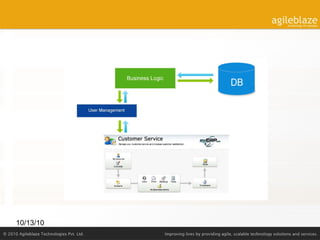
Core Technical components Business logic – say Accounting Data base Layer User Management, Acess Control (ACL) User Interface
 
The attrition use case HR_management_modules( ) { Application logic } catch (HRExcpetion. Attrition) { Handle_attrition() { policy changes, promotions, salary revisal etc etc} }
Who should use an ERP Organizations of any size and type Any business process  Large Company Solutions: SAP, Oracle, IFS Midsize solutions: Microsoft Dynamics, Sage, Epicor Small Market : Quickbooks and others Hosted ERPs & CRMs – to be discussed
Type comparison: Large  Vs Mid sized Large implementations should support: Multiple sites, ware houses, geographies, nationalities, legal guidelines in multiple countries, multi-lingual additional technical issues like synching between deployments, connectivity etc. Smaller personal editions often manages only accounting and CRM
ERP implementation Should be driven from within the organization ERP vendors involve in the following activities: Consulting Customizing the solution Long term support Consulting is has a major role & needs domain expertise as well as knowledge of business process
Opportunities Any ERP implementation involves consulting – which involves selection of the solution, train the personals, perform test runs, impleement and provide continuous assistance In depth knowledge of business process and functional domain is essential Training & mentoring can often prove to be a challenging opportunity especially when the existing practices are changed for optimization
Agenda What is an ERP Who should use an ERP Technology transition in ERPs Cloud Computing SaaS Future
Technology Transitions Transition from Manufacturing Resource Planning & Computer Integrated Manufacturing to ERP  Besides this advancement underlying technology remained same until recently Advancements in CRM Emergence of cloud computing &  SaaS Pay-As-you-Go model & cost savings The future is commoditization of computing & thus SaaS
Agenda What is an ERP Who should use an ERP Technology transition in ERPs Cloud Computing SaaS Future
Cloud computing National Institute of Standards and Technology (NIST) definition: Cloud computing is a model for enabling convenient, on-demand network access to a shared pool of configurable computing resources (e.g., networks, servers, storage, applications, and services) that can be rapidly provisioned and released with minimal management effort or service provider interaction. This cloud model promotes availability and is composed of five essential  characteristics,  three  service models , and four  deployment models . Gartner Definition: A style of computing where scalable and elastic IT-enabled capabilities are delivered as a service to customers using Internet technologies
Multi Tenant Model Unlike traditional model computing resources are shared Analogues to a shared, rented apartment complex
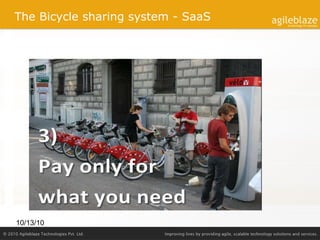
Advantages No capital Expenditure (CapEx) Pay as you go Pay for only what you need Elastic Capacity Focus on business
Agenda What is an ERP Who should use an ERP Technology transition in ERPs Cloud Computing SaaS Future
The Bicycle sharing system - SaaS
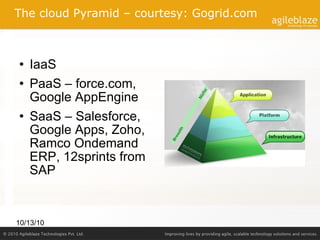
The cloud Pyramid – courtesy: Gogrid.com IaaS PaaS – force.com, Google AppEngine SaaS – Salesforce, Google Apps, Zoho, Ramco Ondemand ERP, 12sprints from SAP
Future The future of ERPs and CRMs is adopting the SaaS model Charge for consultation  Larger penetration and affordability More opportunities for consultants, integrators and requirement for domain expertise
Questions ? twitter.com/bobinson

primer to ERPs & disruptive technolgoies (Cloud computing)

  • 1.
    ERPs & DisruptiveTechnologies Bobinson K B
  • 2.
    Agenda What isan ERP Who should use an ERP Technology transition in ERPs Cloud Computing SaaS Future
  • 3.
    ERP - definitionWikipedia.org Definition: Enterprise Resource Planning (ERP) is a term used to denote integrated software systems capable of managing internal an external assets of an organization including tangible assets, financial resources, materials and human resources. Contrary to the common myth an ERP is not for IT people, but its implemented by IT people with the help of say financial experts to be used by non-IT people.
  • 4.
    Agenda What isan ERP Who should use an ERP Technology transition in ERPs Cloud Computing SaaS Future
  • 5.
    Processes automated HumanResources Accounting Sales Order Entry Purchase Order Processing Supply Chain Management Cash Management Warehouse Management Bills of Material Material Requirements Planning Capacity Requirements Planning
  • 6.
    A word aboutCRMs Any organization which doesn't give people the first priority – let it be employees or customers – the success will not follow them. CRMs tools MUST be tightly integrated with ERP Facebook & social media applications – Human Relationship Management tools
  • 7.
    Core Technical componentsBusiness logic – say Accounting Data base Layer User Management, Acess Control (ACL) User Interface
  • 8.
  • 9.
    The attrition usecase HR_management_modules( ) { Application logic } catch (HRExcpetion. Attrition) { Handle_attrition() { policy changes, promotions, salary revisal etc etc} }
  • 10.
    Who should usean ERP Organizations of any size and type Any business process Large Company Solutions: SAP, Oracle, IFS Midsize solutions: Microsoft Dynamics, Sage, Epicor Small Market : Quickbooks and others Hosted ERPs & CRMs – to be discussed
  • 11.
    Type comparison: Large Vs Mid sized Large implementations should support: Multiple sites, ware houses, geographies, nationalities, legal guidelines in multiple countries, multi-lingual additional technical issues like synching between deployments, connectivity etc. Smaller personal editions often manages only accounting and CRM
  • 12.
    ERP implementation Shouldbe driven from within the organization ERP vendors involve in the following activities: Consulting Customizing the solution Long term support Consulting is has a major role & needs domain expertise as well as knowledge of business process
  • 13.
    Opportunities Any ERPimplementation involves consulting – which involves selection of the solution, train the personals, perform test runs, impleement and provide continuous assistance In depth knowledge of business process and functional domain is essential Training & mentoring can often prove to be a challenging opportunity especially when the existing practices are changed for optimization
  • 14.
    Agenda What isan ERP Who should use an ERP Technology transition in ERPs Cloud Computing SaaS Future
  • 15.
    Technology Transitions Transitionfrom Manufacturing Resource Planning & Computer Integrated Manufacturing to ERP Besides this advancement underlying technology remained same until recently Advancements in CRM Emergence of cloud computing & SaaS Pay-As-you-Go model & cost savings The future is commoditization of computing & thus SaaS
  • 16.
    Agenda What isan ERP Who should use an ERP Technology transition in ERPs Cloud Computing SaaS Future
  • 17.
    Cloud computing NationalInstitute of Standards and Technology (NIST) definition: Cloud computing is a model for enabling convenient, on-demand network access to a shared pool of configurable computing resources (e.g., networks, servers, storage, applications, and services) that can be rapidly provisioned and released with minimal management effort or service provider interaction. This cloud model promotes availability and is composed of five essential characteristics, three service models , and four deployment models . Gartner Definition: A style of computing where scalable and elastic IT-enabled capabilities are delivered as a service to customers using Internet technologies
  • 18.
    Multi Tenant ModelUnlike traditional model computing resources are shared Analogues to a shared, rented apartment complex
  • 19.
    Advantages No capitalExpenditure (CapEx) Pay as you go Pay for only what you need Elastic Capacity Focus on business
  • 20.
    Agenda What isan ERP Who should use an ERP Technology transition in ERPs Cloud Computing SaaS Future
  • 21.
    The Bicycle sharingsystem - SaaS
  • 22.
    The cloud Pyramid– courtesy: Gogrid.com IaaS PaaS – force.com, Google AppEngine SaaS – Salesforce, Google Apps, Zoho, Ramco Ondemand ERP, 12sprints from SAP
  • 23.
    Future The futureof ERPs and CRMs is adopting the SaaS model Charge for consultation Larger penetration and affordability More opportunities for consultants, integrators and requirement for domain expertise
  • 24.