W H Y W E
C A N ’ T H AV E
N I C E T H I N G S
( Y E T )
E F F E C T I V E
G A M E S :
E R I N H O F F M A N , S E R I O U S P L AY 2 0 1 6
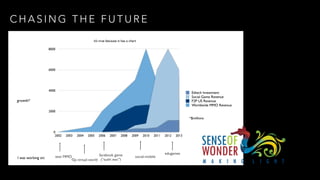
C H A S I N G T H E F U T U R E
0
2000
4000
6000
8000
2002 2003 2004 2005 2006 2007 2008 2009 2010 2011 2012 2013
Edtech Investment
Social Game Revenue
F2P US Revenue
Worldwide MMO Revenue
growth*
text MMO
f2p virtual world
facebook game
(“sushi war”)
social-mobile
edugames
I was working on:
*$millions
it’s true because it has a chart
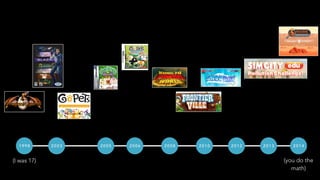
1 9 9 8 2 0 0 3 2 0 0 5 2 0 0 6 2 0 0 8 2 0 1 0 2 0 1 2 2 0 1 3 2 0 1 4
(I was 17) (you do the
math)
I N 2 0 1 3 , A F U N N Y
T H I N G H A P P E N E D
T O M E
• I was taken in by scientists.
• 24 scientists, to be exact,
from the likes of the
Stanford Research
Institute, NASA, and
Educational Testing
Service (the folk who make
the SAT).
• these are nerds among
nerds.
– S O R E N K I E R K E G A A R D , 1 8 4 8
“To be a teacher in the right sense is to be a learner.
Instruction begins when you, the teacher, learn from
the learner,
put yourself in his place so that you may understand
what he understands and the way he understands it.”
– S O R E N K I E R K E G A A R D , 1 8 4 8
“To be a teacher in the right sense is to be a learner.
Instruction begins when you, the teacher, learn from
the learner,
put yourself in his place so that you may understand
what he understands and the way he understands it.”
“Teaching well is really freaking hard.”
– E R I N H O F F M A N , 2 0 1 5
A S Y O U M I G H T
I M A G I N E
• game designers spend an
awful lot of time talking about
what “fun” is
• the most widely-accepted
definition comes from a game
designer named Raph Koster
(you might recognize Star
Wars Galaxies, EverQuest II,
Ultima Online - that’s Raph)
• though now he might be
more well known for his book:
– R A P H K O S T E R
“That’s what games are, in the end. Teachers.
Fun is just another word for learning.”
And Raph said…
• this hit the world of game design like a
bomb — it was so obvious and true
world model
space whales
*
worldmodel
spacewhales
*
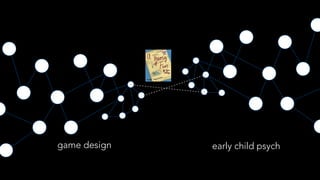
game design early child psych
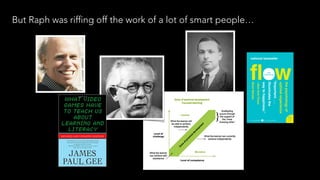
But Raph was riffing off the work of a lot of smart people…
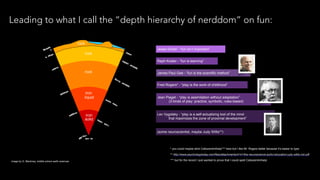
Leading to what I call the “depth hierarchy of nerddom” on fun:
Jesse Schell - “fun isn’t important”
Raph Koster - “fun is learning”
James Paul Gee - “fun is the scientific method”
Fred Rogers* - “play is the work of childhood”
Jean Piaget - “play is assimilation without adaptation”
(3 kinds of play: practice, symbolic, rules-based)
Lev Vygotsky - “play is a self-actualizing tool of the mind
that maximizes the zone of proximal development”
(some neuroscientist, maybe Judy Willis**)
** http://www.psychologytoday.com/files/attachments/4141/the-neuroscience-joyful-education-judy-willis-md.pdf
image by G. Blackney, middle school earth sciences
* you could maybe stick Csikszentmihalyi*** here but I like Mr. Rogers better because it’s easier to type
*** but for the record I just wanted to prove that I could spell Csikszentmihalyi
T H E R E V O L U T I O N A RY
I D E A B E H I N D
G L A S S L A B WA S
• school is really, really boring.
• maybe video game designers
could make school less boring.
• if kids are less bored, maybe they’ll
learn better.
• and maybe big data could enable
the creation of genuine adaptive,
personalized learning.
No problem!, we thought.
If games are about fun and fun is about learning,
this’ll be easy!
Time to revolutionize education!
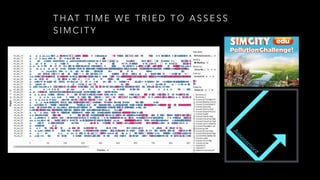
so we brought the brand new SimCity
into classrooms…
and the kids said:
so this is pretty fun,
but we’re not learning anything.
(and SimCity historically has been used by
teachers to teach all sorts of things)
This blew open Raph’s theory.
“Fun is learning” wasn’t the conclusive epiphany
we (designers) thought it was — it was just the
beginning.
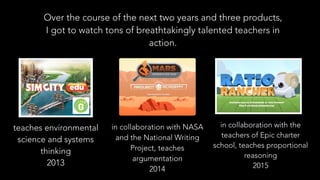
Over the course of the next two years and three products,
I got to watch tons of breathtakingly talented teachers in
action.
teaches environmental
science and systems
thinking
2013
in collaboration with NASA
and the National Writing
Project, teaches
argumentation
2014
in collaboration with the
teachers of Epic charter
school, teaches proportional
reasoning
2015
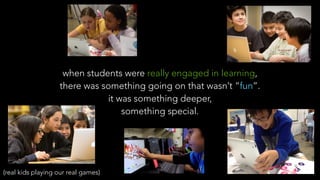
when students were really engaged in learning,
there was something going on that wasn’t “fun”.
it was something deeper,
something special.
(real kids playing our real games)
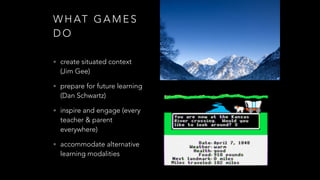
W H AT G A M E S
D O
• create situated context
(Jim Gee)
• prepare for future learning
(Dan Schwartz)
• inspire and engage (every
teacher & parent
everywhere)
• accommodate alternative
learning modalities
W H AT M O S T
G A M E S D O N ’ T
D O
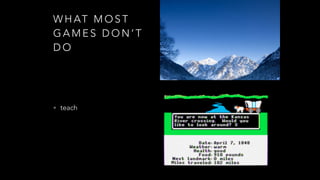
• teach
W H AT M O S T
G A M E S D O N ’ T
D O
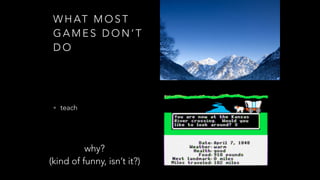
• teach
why?
(kind of funny, isn’t it?)
– S O R E N K I E R K E G A A R D , 1 8 4 8
“To be a teacher in the right sense is to be a learner.
Instruction begins when you, the teacher, learn from
the learner,
put yourself in his place so that you may understand
what he understands and the way he understands it.”
“Teaching well is really freaking hard.”
– E R I N H O F F M A N , 2 0 1 5
W H AT D O E S A
T E A C H I N G G A M E
N E E D T O D O ?
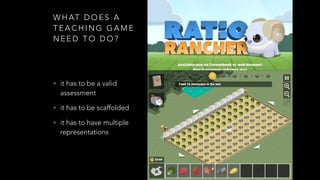
• it has to be a valid
assessment
• it has to be scaffolded
• it has to have multiple
representations
T H E A S S E S S M E N T
M O N S T E R
• most games do have
assessments (that’s what a
boss battle is)
• but they’re rarely valid
according to a learning
standard
• validity means correctness is
inescapable and blocks
progression - it means
you’re measured from every
angle
S C A F F O L D I N G
• most games do have
scaffolding (that’s what levels
are)
• most games even scaffold
you toward assessment (levels
prepare you for bosses)
• but few learning games are
properly scaffolded
• * actually, arguably, few
games are properly
scaffolded
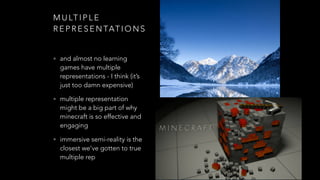
M U LT I P L E
R E P R E S E N TAT I O N S
• and almost no learning
games have multiple
representations - I think (it’s
just too damn expensive)
• multiple representation
might be a big part of why
minecraft is so effective and
engaging
• immersive semi-reality is the
closest we’ve gotten to true
multiple rep
how we began with design thinking and turned
mars generation one into a valid assessment
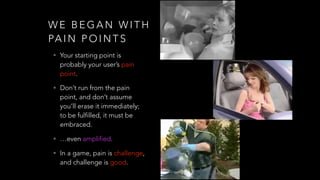
W E B E G A N W I T H
PA I N P O I N T S
• Your starting point is
probably your user’s pain
point.
• Don’t run from the pain
point, and don’t assume
you’ll erase it immediately;
to be fulfilled, it must be
embraced.
• …even amplified.
• In a game, pain is challenge,
and challenge is good.
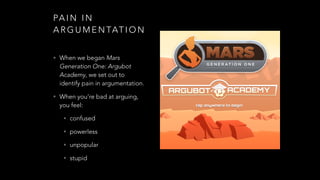
PA I N I N
A R G U M E N TAT I O N
• When we began Mars
Generation One: Argubot
Academy, we set out to
identify pain in argumentation.
• When you’re bad at arguing,
you feel:
• confused
• powerless
• unpopular
• stupid
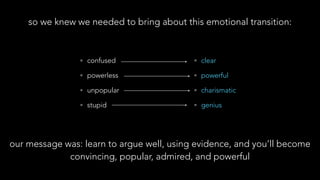
• confused
• powerless
• unpopular
• stupid
• clear
• powerful
• charismatic
• genius
so we knew we needed to bring about this emotional transition:
our message was: learn to argue well, using evidence, and you’ll become
convincing, popular, admired, and powerful
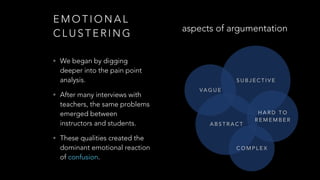
E M O T I O N A L
C L U S T E R I N G
• We began by digging
deeper into the pain point
analysis.
• After many interviews with
teachers, the same problems
emerged between
instructors and students.
• These qualities created the
dominant emotional reaction
of confusion.
VA G U E
aspects of argumentation
S U B J E C T I V E
A B S T R A C T
H A R D T O
R E M E M B E R
C O M P L E X
VA G U E
S U B J E C T I V E
A B S T R A C T
H A R D T O
R E M E M B E R
C O M P L E X
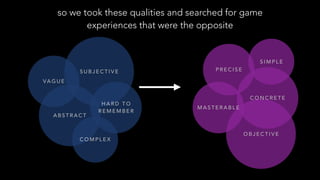
so we took these qualities and searched for game
experiences that were the opposite
P R E C I S E
O B J E C T I V E
C O N C R E T E
M A S T E R A B L E
S I M P L E
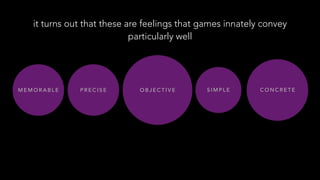
P R E C I S E O B J E C T I V E C O N C R E T EM E M O R A B L E S I M P L E
it turns out that these are feelings that games innately convey
particularly well
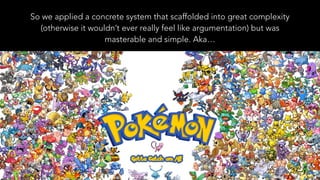
So we applied a concrete system that scaffolded into great complexity
(otherwise it wouldn’t ever really feel like argumentation) but was
masterable and simple. Aka…
G O T TA C AT C H
‘ E M A L L
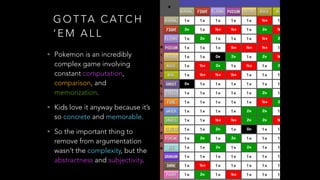
• Pokemon is an incredibly
complex game involving
constant computation,
comparison, and
memorization.
• Kids love it anyway because it’s
so concrete and memorable.
• So the important thing to
remove from argumentation
wasn’t the complexity, but the
abstractness and subjectivity.
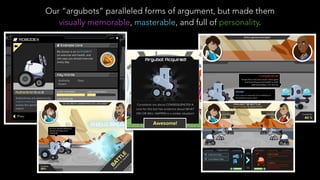
Our “argubots” paralleled forms of argument, but made them
visually memorable, masterable, and full of personality.
T H E R E S U LT S
• Well, ask the kids:
• “BOOM!”
• “wait wait wait we want to hear this!”
• “that’s TOTALLY not related!”
• “that [argument] wasn’t even, like, legit!”
• “omg, K-O!”
• “data was inconsistent, it wasn’t supporting”
• “fiiiiiiight!”
• “let’s go CQ!*”
This approach to argumentation was:
• concrete
• exciting
• masterable
• relatable
* a 6th grader referencing philosopher Stephen Toulmin
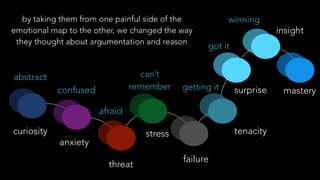
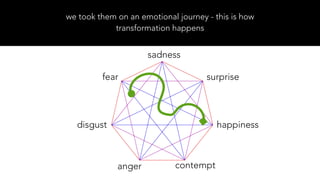
by taking them from one painful side of the
emotional map to the other, we changed the way
they thought about argumentation and reason
curiosity
anxiety
threat
stress
failure
tenacity
surprise mastery
insight
abstract
confused
afraid
can’t
remember getting it
got it
winning
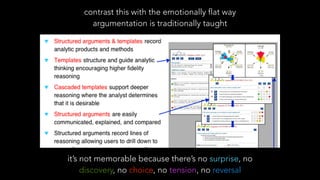
contrast this with the emotionally flat way
argumentation is traditionally taught
it’s not memorable because there’s no surprise, no
discovery, no choice, no tension, no reversal
we took them on an emotional journey - this is how
transformation happens
fear surprise
contempt
happiness
anger
disgust
sadness
but what about the competency?
T H AT T I M E W E T R I E D T O A S S E S S
S I M C I T Y
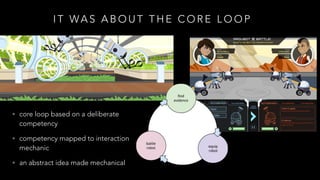
I T WA S A B O U T T H E C O R E L O O P
• core loop based on a deliberate
competency
• competency mapped to interaction
mechanic
• an abstract idea made mechanical
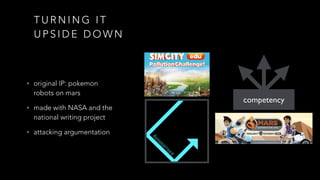
T U R N I N G I T
U P S I D E D O W N
• original IP: pokemon
robots on mars
• made with NASA and the
national writing project
• attacking argumentation
competency
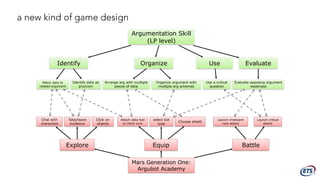
Argumentation Skill
(LP level)
Identify Organize Use Evaluate
Match data to
related argument
Arrange arg with multiple
pieces of data
Use a critical
question
Evaluate opposing argument
weakness
Identify data as
pro/com
Mars Generation One:
Argubot Academy
Explore Equip Battle
Chat with
characters
Click on
objects
Attach data fuel
to claim core
Launch irrelevant
core attack
select bot
type
Choose shield
Launch critical
attack
Take/leave
evidence
Organize argument with
multiple arg schemes
a new kind of game design
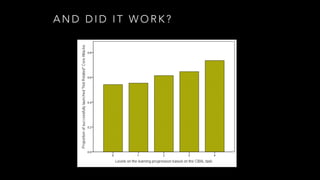
A N D D I D I T W O R K ?
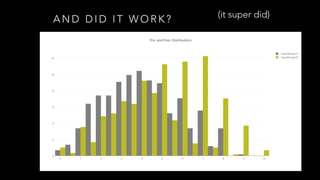
A N D D I D I T W O R K ? (it super did)
B U T W H AT
A B O U T T H E R E Q S
• it has to be a valid
assessment = A
• it has to be scaffolded =
= B-
• it has to have multiple
representations = C-
T H E R E A L
P R O B L E M
• (I’m not sure I should tell
you this)
• MGO took us about 1.5
years and $2m*
• (which for what it did and
the ice it broke really wasn’t
bad, especially in game
terms)
• but this kind of money isn’t
in the learning game system
* please don’t quote me
T H E R E A L
P R O B L E M
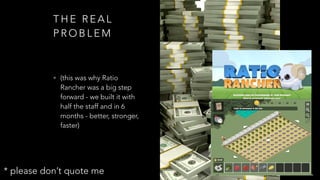
• (this was why Ratio
Rancher was a big step
forward - we built it with
half the staff and in 6
months - better, stronger,
faster)
* please don’t quote me
H E R E ’ S W H Y I T
( S H O U L D B E ) T H E
F U T U R E
• games that actually teach may be the only
way to achieve globally scalable education
H E R E ’ S W H Y I T
( S H O U L D B E ) T H E
F U T U R E
• games that actually teach may be the only
way to achieve globally scalable education
this was glasslab’s actual mission
T H A N K S F O R
P L AY I N G
T H A T ’ S I T
erin@makingwonder.com
@gryphoness
appendix
usually that emotion is pretty simple
(simple emotion sell$)
scary!
omg fast!
BAD.ASS.
epic!
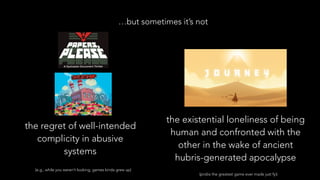
…but sometimes it’s not
the regret of well-intended
complicity in abusive
systems
the existential loneliness of being
human and confronted with the
other in the wake of ancient
hubris-generated apocalypse
(probs the greatest game ever made just fyi)
(e.g., while you weren’t looking, games kinda grew up)
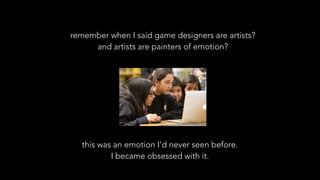
this was an emotion I’d never seen before.
I became obsessed with it.
remember when I said game designers are artists?
and artists are painters of emotion?
E M O T I O N
S O L E T ’ S TA L K A B O U T
pop quiz
how many of you know who paul eckman is?
pop quiz
how many of you have seen pixar’s Inside Out?
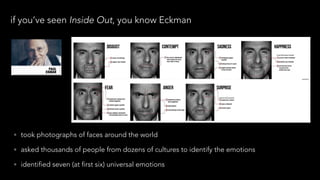
if you’ve seen Inside Out, you know Eckman
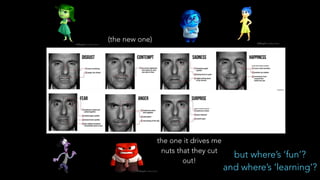
• took photographs of faces around the world
• asked thousands of people from dozens of cultures to identify the emotions
• identified seven (at first six) universal emotions
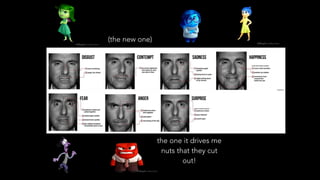
(the new one)
the one it drives me
nuts that they cut
out!
(the new one)
the one it drives me
nuts that they cut
out!
but where’s ‘fun’?
and where’s ‘learning’?
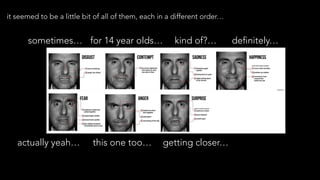
it seemed to be a little bit of all of them, each in a different order…
sometimes… for 14 year olds… kind of?… definitely…
actually yeah… this one too… getting closer…
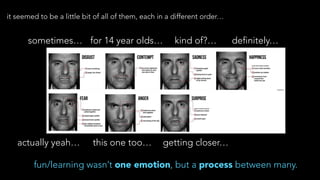
it seemed to be a little bit of all of them, each in a different order…
sometimes… for 14 year olds… kind of?… definitely…
actually yeah… this one too… getting closer…
fun/learning wasn’t one emotion, but a process between many.
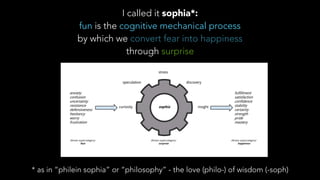
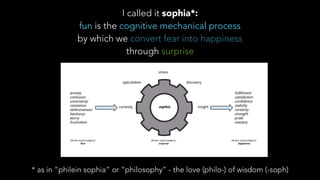
I called it sophia*:
fun is the cognitive mechanical process
by which we convert fear into happiness
through surprise
* as in “philein sophia” or “philosophy” - the love (philo-) of wisdom (-soph)
M I C R O B E S
S O L E T ’ S TA L K A B O U T
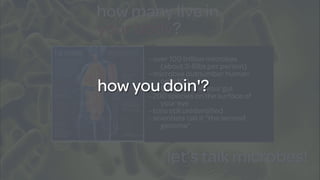
how many live in
your body?
how many live in
your body?
let’s talk microbes!
- over 100 trillion microbes
(about 2-6lbs per person)
- microbes outnumber human
cells 10:1
- 1000 species in your gut
- 200 species on the surface of
your eye
- tons still unidentified
- scientists call it “the second
genome”
how many live in
your body?
let’s talk microbes!
- over 100 trillion microbes
(about 2-6lbs per person)
- microbes outnumber human
cells 10:1
- 1000 species in your gut
- 200 species on the surface of
your eye
- tons still unidentified
- scientists call it “the second
genome”
how you doin'?
your microbiome
= ~100 trillion
microbes
the milky way
= ~100 billion
stars
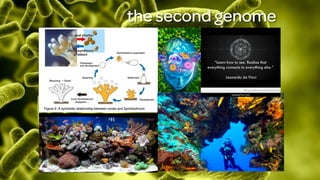
the second genome
the second genome
how many live in
your body?
let’s talk microbes!
- over 100 trillion microbes
(about 2-6lbs per person)
- microbes outnumber human
cells 10:1
- 1000 species in your gut
- 200 species on the surface of
your eye
- tons still unidentified
- scientists call it “the second
genome”
how you doin’ (now)?
I called it sophia*:
fun is the cognitive mechanical process
by which we convert fear into happiness
through surprise
* as in “philein sophia” or “philosophy” - the love (philo-) of wisdom (-soph)
the key is the arc
curiosity
anxiety
threat
stress
failure
tenacity
surprise
mastery
insight
S T O RY T E L L E R S
K N O W T H I S
• without foreshadowing
there is no anticipation
• without anticipation there’s
no tension
• without reversal there’s no
insight
• without insight there’s no
story
(segue)
And this is why it’s so damn annoying that Inside Out
left out Surprise.
when it comes to Eckman universals and both storytelling and product,
Surprise might be the most important emotion there is.
M O D E R N M E T H O D S
O F M E A S U R I N G
E M O T I O N I N C L U D E :
• surveys
• brain fMRIs that detect…
“excitation” (aka
something is happening
and we don’t really know
what)
• hand-encoding videos of
changes in facial expression
• …surveys
emotional research is really this gigantic
unexplored frontier now that we have the capability
to process dynamic data
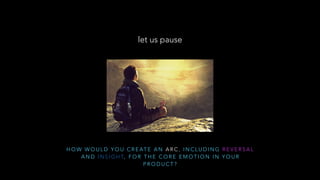
H O W W O U L D Y O U C R E AT E A N A R C , I N C L U D I N G R E V E R S A L
A N D I N S I G H T, F O R T H E C O R E E M O T I O N I N Y O U R
P R O D U C T ?
let us pause
D Y N A M I C E M O T I O N
S O L E T ’ S TA L K A B O U T
A L L E M O T I O N
I S D Y N A M I C
T H E T R U T H I S
W E ’ R E R E A L LY B A D
AT M E A S U R I N G
D Y N A M I C T H I N G S
T H E O T H E R T R U T H I S
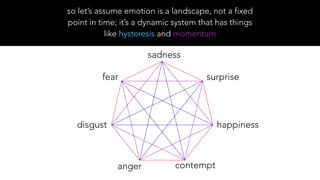
so let’s assume emotion is a landscape, not a fixed
point in time; it’s a dynamic system that has things
like hysteresis and momentum
fear surprise
contempt
happiness
anger
disgust
sadness
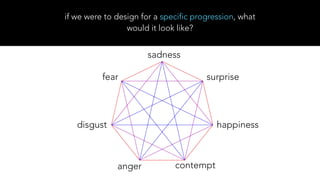
if we were to design for a specific progression, what
would it look like?
fear surprise
contempt
happiness
anger
disgust
sadness
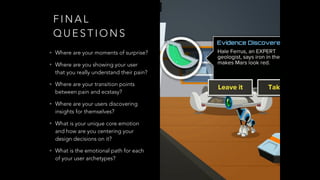
F I N A L
Q U E S T I O N S
• Where are your moments of surprise?
• Where are you showing your user
that you really understand their pain?
• Where are your transition points
between pain and ecstasy?
• Where are your users discovering
insights for themselves?
• What is your unique core emotion
and how are you centering your
design decisions on it?
• What is the emotional path for each
of your user archetypes?
T H A N K S F O R
P L AY I N G
T H A T ’ S I T
erin@makingwonder.com
@gryphoness
lately, this has become the context for some genuinely awful behavior
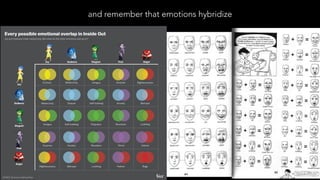
and remember that emotions hybridize

Erin Hoffman-John - Effective Games: Why We Can't Have Nice Things (Yet)

  • 1.
    W H YW E C A N ’ T H AV E N I C E T H I N G S ( Y E T ) E F F E C T I V E G A M E S : E R I N H O F F M A N , S E R I O U S P L AY 2 0 1 6
  • 2.
    C H AS I N G T H E F U T U R E 0 2000 4000 6000 8000 2002 2003 2004 2005 2006 2007 2008 2009 2010 2011 2012 2013 Edtech Investment Social Game Revenue F2P US Revenue Worldwide MMO Revenue growth* text MMO f2p virtual world facebook game (“sushi war”) social-mobile edugames I was working on: *$millions it’s true because it has a chart
  • 3.
    1 9 98 2 0 0 3 2 0 0 5 2 0 0 6 2 0 0 8 2 0 1 0 2 0 1 2 2 0 1 3 2 0 1 4 (I was 17) (you do the math)
  • 4.
    I N 20 1 3 , A F U N N Y T H I N G H A P P E N E D T O M E • I was taken in by scientists. • 24 scientists, to be exact, from the likes of the Stanford Research Institute, NASA, and Educational Testing Service (the folk who make the SAT). • these are nerds among nerds.
  • 5.
    – S OR E N K I E R K E G A A R D , 1 8 4 8 “To be a teacher in the right sense is to be a learner. Instruction begins when you, the teacher, learn from the learner, put yourself in his place so that you may understand what he understands and the way he understands it.”
  • 6.
    – S OR E N K I E R K E G A A R D , 1 8 4 8 “To be a teacher in the right sense is to be a learner. Instruction begins when you, the teacher, learn from the learner, put yourself in his place so that you may understand what he understands and the way he understands it.” “Teaching well is really freaking hard.” – E R I N H O F F M A N , 2 0 1 5
  • 7.
    A S YO U M I G H T I M A G I N E • game designers spend an awful lot of time talking about what “fun” is • the most widely-accepted definition comes from a game designer named Raph Koster (you might recognize Star Wars Galaxies, EverQuest II, Ultima Online - that’s Raph) • though now he might be more well known for his book:
  • 8.
    – R AP H K O S T E R “That’s what games are, in the end. Teachers. Fun is just another word for learning.” And Raph said… • this hit the world of game design like a bomb — it was so obvious and true
  • 9.
  • 10.
    But Raph wasriffing off the work of a lot of smart people…
  • 11.
    Leading to whatI call the “depth hierarchy of nerddom” on fun: Jesse Schell - “fun isn’t important” Raph Koster - “fun is learning” James Paul Gee - “fun is the scientific method” Fred Rogers* - “play is the work of childhood” Jean Piaget - “play is assimilation without adaptation” (3 kinds of play: practice, symbolic, rules-based) Lev Vygotsky - “play is a self-actualizing tool of the mind that maximizes the zone of proximal development” (some neuroscientist, maybe Judy Willis**) ** http://www.psychologytoday.com/files/attachments/4141/the-neuroscience-joyful-education-judy-willis-md.pdf image by G. Blackney, middle school earth sciences * you could maybe stick Csikszentmihalyi*** here but I like Mr. Rogers better because it’s easier to type *** but for the record I just wanted to prove that I could spell Csikszentmihalyi
  • 12.
    T H ER E V O L U T I O N A RY I D E A B E H I N D G L A S S L A B WA S • school is really, really boring. • maybe video game designers could make school less boring. • if kids are less bored, maybe they’ll learn better. • and maybe big data could enable the creation of genuine adaptive, personalized learning.
  • 13.
    No problem!, wethought. If games are about fun and fun is about learning, this’ll be easy! Time to revolutionize education!
  • 14.
    so we broughtthe brand new SimCity into classrooms… and the kids said: so this is pretty fun, but we’re not learning anything. (and SimCity historically has been used by teachers to teach all sorts of things)
  • 15.
    This blew openRaph’s theory. “Fun is learning” wasn’t the conclusive epiphany we (designers) thought it was — it was just the beginning.
  • 16.
    Over the courseof the next two years and three products, I got to watch tons of breathtakingly talented teachers in action. teaches environmental science and systems thinking 2013 in collaboration with NASA and the National Writing Project, teaches argumentation 2014 in collaboration with the teachers of Epic charter school, teaches proportional reasoning 2015
  • 17.
    when students werereally engaged in learning, there was something going on that wasn’t “fun”. it was something deeper, something special. (real kids playing our real games)
  • 18.
    W H ATG A M E S D O • create situated context (Jim Gee) • prepare for future learning (Dan Schwartz) • inspire and engage (every teacher & parent everywhere) • accommodate alternative learning modalities
  • 19.
    W H ATM O S T G A M E S D O N ’ T D O • teach
  • 20.
    W H ATM O S T G A M E S D O N ’ T D O • teach why? (kind of funny, isn’t it?)
  • 21.
    – S OR E N K I E R K E G A A R D , 1 8 4 8 “To be a teacher in the right sense is to be a learner. Instruction begins when you, the teacher, learn from the learner, put yourself in his place so that you may understand what he understands and the way he understands it.” “Teaching well is really freaking hard.” – E R I N H O F F M A N , 2 0 1 5
  • 22.
    W H ATD O E S A T E A C H I N G G A M E N E E D T O D O ? • it has to be a valid assessment • it has to be scaffolded • it has to have multiple representations
  • 23.
    T H EA S S E S S M E N T M O N S T E R • most games do have assessments (that’s what a boss battle is) • but they’re rarely valid according to a learning standard • validity means correctness is inescapable and blocks progression - it means you’re measured from every angle
  • 24.
    S C AF F O L D I N G • most games do have scaffolding (that’s what levels are) • most games even scaffold you toward assessment (levels prepare you for bosses) • but few learning games are properly scaffolded • * actually, arguably, few games are properly scaffolded
  • 25.
    M U LTI P L E R E P R E S E N TAT I O N S • and almost no learning games have multiple representations - I think (it’s just too damn expensive) • multiple representation might be a big part of why minecraft is so effective and engaging • immersive semi-reality is the closest we’ve gotten to true multiple rep
  • 26.
    how we beganwith design thinking and turned mars generation one into a valid assessment
  • 27.
    W E BE G A N W I T H PA I N P O I N T S • Your starting point is probably your user’s pain point. • Don’t run from the pain point, and don’t assume you’ll erase it immediately; to be fulfilled, it must be embraced. • …even amplified. • In a game, pain is challenge, and challenge is good.
  • 28.
    PA I NI N A R G U M E N TAT I O N • When we began Mars Generation One: Argubot Academy, we set out to identify pain in argumentation. • When you’re bad at arguing, you feel: • confused • powerless • unpopular • stupid
  • 29.
    • confused • powerless •unpopular • stupid • clear • powerful • charismatic • genius so we knew we needed to bring about this emotional transition: our message was: learn to argue well, using evidence, and you’ll become convincing, popular, admired, and powerful
  • 30.
    E M OT I O N A L C L U S T E R I N G • We began by digging deeper into the pain point analysis. • After many interviews with teachers, the same problems emerged between instructors and students. • These qualities created the dominant emotional reaction of confusion. VA G U E aspects of argumentation S U B J E C T I V E A B S T R A C T H A R D T O R E M E M B E R C O M P L E X
  • 31.
    VA G UE S U B J E C T I V E A B S T R A C T H A R D T O R E M E M B E R C O M P L E X so we took these qualities and searched for game experiences that were the opposite P R E C I S E O B J E C T I V E C O N C R E T E M A S T E R A B L E S I M P L E
  • 32.
    P R EC I S E O B J E C T I V E C O N C R E T EM E M O R A B L E S I M P L E it turns out that these are feelings that games innately convey particularly well
  • 33.
    So we applieda concrete system that scaffolded into great complexity (otherwise it wouldn’t ever really feel like argumentation) but was masterable and simple. Aka…
  • 34.
    G O TTA C AT C H ‘ E M A L L • Pokemon is an incredibly complex game involving constant computation, comparison, and memorization. • Kids love it anyway because it’s so concrete and memorable. • So the important thing to remove from argumentation wasn’t the complexity, but the abstractness and subjectivity.
  • 35.
    Our “argubots” paralleledforms of argument, but made them visually memorable, masterable, and full of personality.
  • 36.
    T H ER E S U LT S • Well, ask the kids: • “BOOM!” • “wait wait wait we want to hear this!” • “that’s TOTALLY not related!” • “that [argument] wasn’t even, like, legit!” • “omg, K-O!” • “data was inconsistent, it wasn’t supporting” • “fiiiiiiight!” • “let’s go CQ!*” This approach to argumentation was: • concrete • exciting • masterable • relatable * a 6th grader referencing philosopher Stephen Toulmin
  • 37.
    by taking themfrom one painful side of the emotional map to the other, we changed the way they thought about argumentation and reason curiosity anxiety threat stress failure tenacity surprise mastery insight abstract confused afraid can’t remember getting it got it winning
  • 38.
    contrast this withthe emotionally flat way argumentation is traditionally taught it’s not memorable because there’s no surprise, no discovery, no choice, no tension, no reversal
  • 39.
    we took themon an emotional journey - this is how transformation happens fear surprise contempt happiness anger disgust sadness
  • 40.
    but what aboutthe competency?
  • 41.
    T H ATT I M E W E T R I E D T O A S S E S S S I M C I T Y
  • 42.
    I T WAS A B O U T T H E C O R E L O O P • core loop based on a deliberate competency • competency mapped to interaction mechanic • an abstract idea made mechanical
  • 43.
    T U RN I N G I T U P S I D E D O W N • original IP: pokemon robots on mars • made with NASA and the national writing project • attacking argumentation competency
  • 44.
    Argumentation Skill (LP level) IdentifyOrganize Use Evaluate Match data to related argument Arrange arg with multiple pieces of data Use a critical question Evaluate opposing argument weakness Identify data as pro/com Mars Generation One: Argubot Academy Explore Equip Battle Chat with characters Click on objects Attach data fuel to claim core Launch irrelevant core attack select bot type Choose shield Launch critical attack Take/leave evidence Organize argument with multiple arg schemes a new kind of game design
  • 45.
    A N DD I D I T W O R K ?
  • 46.
    A N DD I D I T W O R K ? (it super did)
  • 47.
    B U TW H AT A B O U T T H E R E Q S • it has to be a valid assessment = A • it has to be scaffolded = = B- • it has to have multiple representations = C-
  • 48.
    T H ER E A L P R O B L E M • (I’m not sure I should tell you this) • MGO took us about 1.5 years and $2m* • (which for what it did and the ice it broke really wasn’t bad, especially in game terms) • but this kind of money isn’t in the learning game system * please don’t quote me
  • 49.
    T H ER E A L P R O B L E M • (this was why Ratio Rancher was a big step forward - we built it with half the staff and in 6 months - better, stronger, faster) * please don’t quote me
  • 50.
    H E RE ’ S W H Y I T ( S H O U L D B E ) T H E F U T U R E • games that actually teach may be the only way to achieve globally scalable education
  • 51.
    H E RE ’ S W H Y I T ( S H O U L D B E ) T H E F U T U R E • games that actually teach may be the only way to achieve globally scalable education this was glasslab’s actual mission
  • 52.
    T H AN K S F O R P L AY I N G T H A T ’ S I T erin@makingwonder.com @gryphoness
  • 53.
  • 54.
    usually that emotionis pretty simple (simple emotion sell$) scary! omg fast! BAD.ASS. epic!
  • 55.
    …but sometimes it’snot the regret of well-intended complicity in abusive systems the existential loneliness of being human and confronted with the other in the wake of ancient hubris-generated apocalypse (probs the greatest game ever made just fyi) (e.g., while you weren’t looking, games kinda grew up)
  • 56.
    this was anemotion I’d never seen before. I became obsessed with it. remember when I said game designers are artists? and artists are painters of emotion?
  • 57.
    E M OT I O N S O L E T ’ S TA L K A B O U T
  • 58.
    pop quiz how manyof you know who paul eckman is?
  • 59.
    pop quiz how manyof you have seen pixar’s Inside Out?
  • 60.
    if you’ve seenInside Out, you know Eckman • took photographs of faces around the world • asked thousands of people from dozens of cultures to identify the emotions • identified seven (at first six) universal emotions
  • 61.
    (the new one) theone it drives me nuts that they cut out!
  • 62.
    (the new one) theone it drives me nuts that they cut out! but where’s ‘fun’? and where’s ‘learning’?
  • 63.
    it seemed tobe a little bit of all of them, each in a different order… sometimes… for 14 year olds… kind of?… definitely… actually yeah… this one too… getting closer…
  • 64.
    it seemed tobe a little bit of all of them, each in a different order… sometimes… for 14 year olds… kind of?… definitely… actually yeah… this one too… getting closer… fun/learning wasn’t one emotion, but a process between many.
  • 65.
    I called itsophia*: fun is the cognitive mechanical process by which we convert fear into happiness through surprise * as in “philein sophia” or “philosophy” - the love (philo-) of wisdom (-soph)
  • 66.
    M I CR O B E S S O L E T ’ S TA L K A B O U T
  • 67.
    how many livein your body?
  • 68.
    how many livein your body? let’s talk microbes! - over 100 trillion microbes (about 2-6lbs per person) - microbes outnumber human cells 10:1 - 1000 species in your gut - 200 species on the surface of your eye - tons still unidentified - scientists call it “the second genome”
  • 69.
    how many livein your body? let’s talk microbes! - over 100 trillion microbes (about 2-6lbs per person) - microbes outnumber human cells 10:1 - 1000 species in your gut - 200 species on the surface of your eye - tons still unidentified - scientists call it “the second genome” how you doin'?
  • 70.
    your microbiome = ~100trillion microbes the milky way = ~100 billion stars
  • 71.
  • 72.
  • 73.
    how many livein your body? let’s talk microbes! - over 100 trillion microbes (about 2-6lbs per person) - microbes outnumber human cells 10:1 - 1000 species in your gut - 200 species on the surface of your eye - tons still unidentified - scientists call it “the second genome” how you doin’ (now)?
  • 74.
    I called itsophia*: fun is the cognitive mechanical process by which we convert fear into happiness through surprise * as in “philein sophia” or “philosophy” - the love (philo-) of wisdom (-soph)
  • 75.
    the key isthe arc curiosity anxiety threat stress failure tenacity surprise mastery insight
  • 76.
    S T ORY T E L L E R S K N O W T H I S • without foreshadowing there is no anticipation • without anticipation there’s no tension • without reversal there’s no insight • without insight there’s no story
  • 77.
    (segue) And this iswhy it’s so damn annoying that Inside Out left out Surprise. when it comes to Eckman universals and both storytelling and product, Surprise might be the most important emotion there is.
  • 78.
    M O DE R N M E T H O D S O F M E A S U R I N G E M O T I O N I N C L U D E : • surveys • brain fMRIs that detect… “excitation” (aka something is happening and we don’t really know what) • hand-encoding videos of changes in facial expression • …surveys
  • 79.
    emotional research isreally this gigantic unexplored frontier now that we have the capability to process dynamic data
  • 80.
    H O WW O U L D Y O U C R E AT E A N A R C , I N C L U D I N G R E V E R S A L A N D I N S I G H T, F O R T H E C O R E E M O T I O N I N Y O U R P R O D U C T ? let us pause
  • 81.
    D Y NA M I C E M O T I O N S O L E T ’ S TA L K A B O U T
  • 82.
    A L LE M O T I O N I S D Y N A M I C T H E T R U T H I S
  • 83.
    W E ’R E R E A L LY B A D AT M E A S U R I N G D Y N A M I C T H I N G S T H E O T H E R T R U T H I S
  • 84.
    so let’s assumeemotion is a landscape, not a fixed point in time; it’s a dynamic system that has things like hysteresis and momentum fear surprise contempt happiness anger disgust sadness
  • 85.
    if we wereto design for a specific progression, what would it look like? fear surprise contempt happiness anger disgust sadness
  • 86.
    F I NA L Q U E S T I O N S • Where are your moments of surprise? • Where are you showing your user that you really understand their pain? • Where are your transition points between pain and ecstasy? • Where are your users discovering insights for themselves? • What is your unique core emotion and how are you centering your design decisions on it? • What is the emotional path for each of your user archetypes?
  • 87.
    T H AN K S F O R P L AY I N G T H A T ’ S I T erin@makingwonder.com @gryphoness
  • 89.
    lately, this hasbecome the context for some genuinely awful behavior
  • 90.
    and remember thatemotions hybridize