Implementation of E-Government
in Cameroon
Presented by Eric Sindeu, Telecommunication Engineer
Head of Technical Studies Unit N° 2, Technical Department.
Telecommunication Regulatory Board of Cameroon (TRB)
www.art.cm
Muyono, Uganda 25th to 27th march 2013
7TH ANNUAL E-GOV FORUM
Summary
1. What’s E-Government?
2. Facts on Cameroon
3. Policy Environment
4. E-Government Readiness
5. Public Awareness
6. Major e-Governance Initiatives
7. Opportunities and Challenges
8. EGOV.CM’s Strategy
9. EGOV.CM’s Vision
10. Conclusion
11. References
E-Gov in Cameroon by Eric Sindeu
1- What’s E-Government?
 E-Government (short for electronic government, also known as e-gov, digital
government, online government, or connected government) is digital interactions
between a government and citizens, businesses, employees, agencies or other
governments.
e-gov delivery models can be briefly summed up as :1]
 G2C (Government to Citizens)
 G2B (Government to Businesses)
 G2E (Government to Employees)
 G2G (Government to Governments)
 C2G (Citizens to Governments)
 This digital interaction consists of governance, information and communication
technology (ICT), business process re-engineering(BPR), and e-citizen at all levels
of government (city, state/regional, national, and international).
E-Gov in Cameroon by Eric Sindeu
1- What’s E-Government? (c’d)
 E-Gov (or Digital Government) is defined as ‘The employment of the Internet and
the world-wide-web for delivering government information and services to the
citizens.’ (United Nations, 2006);
 E-Gov describes the use of technologies to facilitate the operation of government
and the publication of government information and services
 deals heavily with Internet and non-internet applications
 non-Internet forms include telephone, fax, PDA,SMS, MMS, wireless networks and
services, Bluetooth, CCTV, tracking systems, RFID, biometric identification, road
traffic management and regulatory enforcement, identity cards, smart cards and
other Near Field Communication applications; polling station technology (where
non-online e-voting is being considered), TV and radio-based delivery of
government services
 There are also some technology-specific sub-categories of e-gov, such as m-
government (mobile government), u-government (ubiquitous government), and
g-government (GIS/GPS applications for e-gov).
E-Gov in Cameroon by Eric Sindeu
1- What’s E-Government? (c’d)
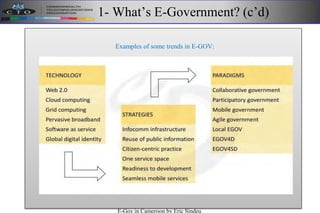
Examples of some trends in E-GOV:
E-Gov in Cameroon by Eric Sindeu
1- What’s E-Government? (c’d)
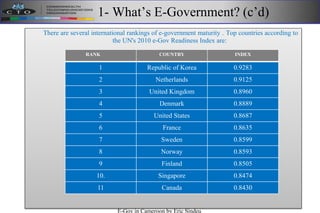
There are several international rankings of e-government maturity . Top countries according to
the UN's 2010 e-Gov Readiness Index are:
E-Gov in Cameroon by Eric Sindeu
RANK COUNTRY INDEX
1 Republic of Korea 0.9283
2 Netherlands 0.9125
3 United Kingdom 0.8960
4 Denmark 0.8889
5 United States 0.8687
6 France 0.8635
7 Sweden 0.8599
8 Norway 0.8593
9 Finland 0.8505
10. Singapore 0.8474
11 Canada 0.8430
1- What’s E-Government? (c’d)
 So far, only developed countries are ahead, but watch out for developing countries !!
 Mobile penetration rates are very high in Africa, and as ICT tools and services are
becoming more and more affordable, the opportunity is real..
 Governments and its agents also have the opportunity to follow citizens to monitor
satisfaction with services they receive.
Through ListServs, RSS feeds, mobile messaging, micro-blogging services and blogs,
government and its agencies can share information to citizens who share common interests
and concerns.
Governments are also beginning to Twitter.
 E-Gov is all about VALUE ADD !!!!!!!!!
E-Gov in Cameroon by Eric Sindeu
2- Facts on Cameroon
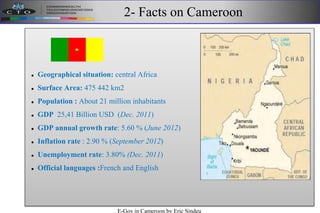
 Geographical situation: central Africa
 Surface Area: 475 442 km2
 Population : About 21 million inhabitants
 GDP 25,41 Billion USD (Dec. 2011)
 GDP annual growth rate: 5.60 % (June 2012)
 Inflation rate : 2.90 % (September 2012)
 Unemployment rate: 3.80% (Dec. 2011)
 Official languages :French and English
E-Gov in Cameroon by Eric Sindeu
2- Facts on Cameroon (c’d)
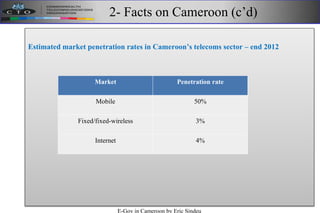
Estimated market penetration rates in Cameroon’s telecoms sector – end 2012
Market Penetration rate
Mobile 50%
Fixed/fixed-wireless 3%
Internet 4%
E-Gov in Cameroon by Eric Sindeu
3- Policy environment
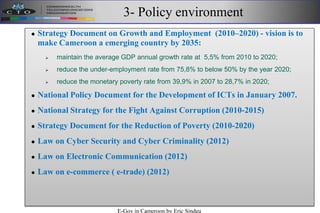
 Strategy Document on Growth and Employment (2010–2020) - vision is to
make Cameroon a emerging country by 2035:
 maintain the average GDP annual growth rate at 5,5% from 2010 to 2020;
 reduce the under-employment rate from 75,8% to below 50% by the year 2020;
 reduce the monetary poverty rate from 39,9% in 2007 to 28,7% in 2020;
 National Policy Document for the Development of ICTs in January 2007.
 National Strategy for the Fight Against Corruption (2010-2015)
 Strategy Document for the Reduction of Poverty (2010-2020)
 Law on Cyber Security and Cyber Criminality (2012)
 Law on Electronic Communication (2012)
 Law on e-commerce ( e-trade) (2012)
E-Gov in Cameroon by Eric Sindeu
3- Policy environment
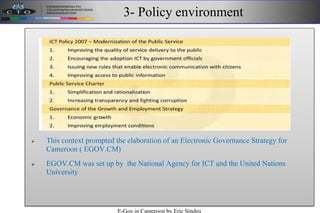
 This context prompted the elaboration of an Electronic Governance Strategy for
Cameroon ( EGOV.CM)
 EGOV.CM was set up by the National Agency for ICT and the United Nations
University
E-Gov in Cameroon by Eric Sindeu
4- E-government Readiness
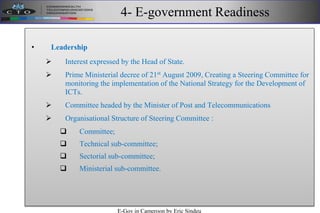
• Leadership
 Interest expressed by the Head of State.
 Prime Ministerial decree of 21st
August 2009, Creating a Steering Committee for
monitoring the implementation of the National Strategy for the Development of
ICTs.
 Committee headed by the Minister of Post and Telecommunications
 Organisational Structure of Steering Committee :
 Committee;
 Technical sub-committee;
 Sectorial sub-committee;
 Ministerial sub-committee.
E-Gov in Cameroon by Eric Sindeu
4- E-government Readiness (c’d)
 Institutions involved in the control and development of ICTs in
Cameroon:
 The Presidency of the Republic;
The Prime Minister's Office;
The National Assembly;
Several Ministries;
The Telecommunications Regulatory Board (TRB);
The National Agency for Information and Communication Technologies
(ANTIC);
Computer Units/Divisions in ministerial departments;
The National Centre for the Development of Computer Services
(CENADI).
E-Gov in Cameroon by Eric Sindeu
4- E-government Readiness (c’d)
• Human Resources :
About 500 graduates each year; Certificates from BSc. to MSc or IT Engineers from:
 African Computer Institute (IAI);
 Advanced National Polytechnic School (ENSP);
 National School of Post and Telecommunication ;
 Universities (5 state and several private)
• Infrastructure:
 RASCOM (satellite resources)
 WACS-SAT3 and ACE available (submarine broadband cable)
 Fibre Optic Cable deployed to more than 90% of ministries;
 Ongoing deployment of the national optical fibre network (close to 90%
completion).
 Central African Backbone (CAB) project ongoing
• Web portals (on-line) Presence: about 80% of public institutions
E-Gov in Cameroon by Eric Sindeu
5- Public awareness
 Some seminars organised to increase awareness include:
 ICT as facilitator of economic development 24 January 2007
 Putting in place of an IXP 18-22 February 2008
 E-Government in Cameroon 12-14 March 2008 (in partnership with UNU-IIST)
 E-Commerce (in partnership with Ministry of Commerce, International Chamber of Commerce
and ANTIC,19-20 March 2008)
 Modernisation of Cameroon by ICT, 19 June 2007
 Impact of ICTs on the quality of governance 27-29 October 2008
 E-GOV Africa /Cameroon edition in 2012
 International Events:
 International Telecommunications day – each year in may by the Ministry of Post and
Telecommunications
E-Gov in Cameroon by Eric Sindeu
6- Major e-Gov initiatives
 Computerisation Initiatives:
 Management of State Personnel and Salaries ( SIGIPES)‫‏‬
 Management of Public Finances (SIGEFI)
 Management of Customs Transactions (SYDONIA)
 Transport titles (driving licence, registration documents) (SYSTAC)‫‏‬
 Electoral documents and biometry process (ELECAM);
 civil status and identification documents – MINATD, Police
 Judicial system & database for prisoners by Ministry of Justice
 PRIMO project for Tender documents (Ministry of Public Contracts)
 Interconnection Initiatives:
- CRD (Database Resource Centre) – for State Universities
- Tele-education and Tele-medicine projects;
- High Level communications-Ministry of External Relations; (in partnership with the Indian
Government)
- Pilot projects for the Central African Region.
 Other Initiatives:
- Multi media centres in rural areas (50 operational and 145 in construction)
- 14 community radio stations
- E-post project ongoing
- Multi-media resource centres in government high schools - MINESEC
E-Gov in Cameroon by Eric Sindeu
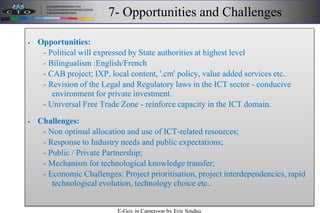
7- Opportunities and Challenges
• Opportunities:
- Political will expressed by State authorities at highest level
- Bilingualism :English/French
- CAB project; IXP, local content, '.cm' policy, value added services etc.
- Revision of the Legal and Regulatory laws in the ICT sector - conducive
environment for private investment.
- Universal Free Trade Zone - reinforce capacity in the ICT domain.
• Challenges:
- Non optimal allocation and use of ICT-related resources;
- Response to Industry needs and public expectations;
- Public / Private Partnership;
- Mechanism for technological knowledge transfer;
- Economic Challenges: Project prioritisation, project interdependencies, rapid
technological evolution, technology choice etc..
E-Gov in Cameroon by Eric Sindeu
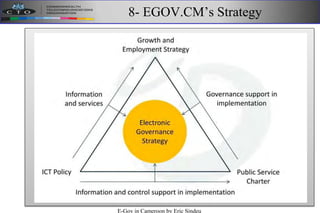
8- EGOV.CM’s Strategy
E-Gov in Cameroon by Eric Sindeu
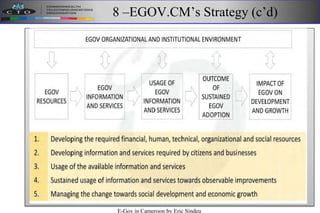
8 –EGOV.CM’s Strategy (c’d)
E-Gov in Cameroon by Eric Sindeu
8 –EGOV.CM’s Strategy (c’d)
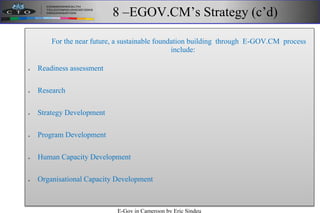
For the near future, a sustainable foundation building through E-GOV.CM process
include:
 Readiness assessment‫‏‬
 Research
 Strategy Development
 Program Development
 Human Capacity Development
 Organisational Capacity Development
E-Gov in Cameroon by Eric Sindeu
9 –EGOV.CM’s Vision
Vision statement:
“ The Electronic Governance vision for Cameroon is to effectively use both
traditional and new Information and Communication Technologies (ICT),
particularly those related to the internet and mobile technologies, in
transforming the Government of Cameroon to be perceived as open, inclusive,
friendly, efficient and effective by its people, businesses and international
community, by providing accessible information and services that meet the
socio-economic, environmental and political needs of all stakeholders
including public servants ”
E-Gov in Cameroon by Eric Sindeu
10 –Conclusion
 The transformation of Cameroon through ICT is justified in the National Policy
document for the Development of Information and Communication Technologies.
 There are a number of ongoing initiatives aiming the modernisation of the public
administration;
 Stronger coordination and integration between these initiatives is needed
 The EGOV.CM program aims at providing the foundation for the integration of
existing and planned e-governance initiatives in Cameroon.
 EGOV.CM ‘s vision defines an implementation strategy and a concrete
government program, through a participatory and inclusive approach, towards the
development of Electronic Governance in Cameroon.
E-Gov in Cameroon by Eric Sindeu
11 –References
• Presidency of the Republic of Cameroon (www.prc.cm)
• Telecommunications Regulatory Board (www.art.cm)
• National Institute of Statistics (nada.stat.cm)
• National Institute for Information and Communication Technologies (www.antic.cm)
• Ministry of Post and Telecommunications (www.minpostel.gov.cm)
• United Nations University
• Wikipedia
• Jeong
E-Gov in Cameroon by Eric Sindeu
THANK YOU FOR YOUR KIND ATTENTION
E-Gov in Cameroon by Eric Sindeu

Implementation in E-Government in Cameroon - Eric Sindeu

  • 1.
    Implementation of E-Government inCameroon Presented by Eric Sindeu, Telecommunication Engineer Head of Technical Studies Unit N° 2, Technical Department. Telecommunication Regulatory Board of Cameroon (TRB) www.art.cm Muyono, Uganda 25th to 27th march 2013 7TH ANNUAL E-GOV FORUM
  • 2.
    Summary 1. What’s E-Government? 2.Facts on Cameroon 3. Policy Environment 4. E-Government Readiness 5. Public Awareness 6. Major e-Governance Initiatives 7. Opportunities and Challenges 8. EGOV.CM’s Strategy 9. EGOV.CM’s Vision 10. Conclusion 11. References E-Gov in Cameroon by Eric Sindeu
  • 3.
    1- What’s E-Government? E-Government (short for electronic government, also known as e-gov, digital government, online government, or connected government) is digital interactions between a government and citizens, businesses, employees, agencies or other governments. e-gov delivery models can be briefly summed up as :1]  G2C (Government to Citizens)  G2B (Government to Businesses)  G2E (Government to Employees)  G2G (Government to Governments)  C2G (Citizens to Governments)  This digital interaction consists of governance, information and communication technology (ICT), business process re-engineering(BPR), and e-citizen at all levels of government (city, state/regional, national, and international). E-Gov in Cameroon by Eric Sindeu
  • 4.
    1- What’s E-Government?(c’d)  E-Gov (or Digital Government) is defined as ‘The employment of the Internet and the world-wide-web for delivering government information and services to the citizens.’ (United Nations, 2006);  E-Gov describes the use of technologies to facilitate the operation of government and the publication of government information and services  deals heavily with Internet and non-internet applications  non-Internet forms include telephone, fax, PDA,SMS, MMS, wireless networks and services, Bluetooth, CCTV, tracking systems, RFID, biometric identification, road traffic management and regulatory enforcement, identity cards, smart cards and other Near Field Communication applications; polling station technology (where non-online e-voting is being considered), TV and radio-based delivery of government services  There are also some technology-specific sub-categories of e-gov, such as m- government (mobile government), u-government (ubiquitous government), and g-government (GIS/GPS applications for e-gov). E-Gov in Cameroon by Eric Sindeu
  • 5.
    1- What’s E-Government?(c’d) Examples of some trends in E-GOV: E-Gov in Cameroon by Eric Sindeu
  • 6.
    1- What’s E-Government?(c’d) There are several international rankings of e-government maturity . Top countries according to the UN's 2010 e-Gov Readiness Index are: E-Gov in Cameroon by Eric Sindeu RANK COUNTRY INDEX 1 Republic of Korea 0.9283 2 Netherlands 0.9125 3 United Kingdom 0.8960 4 Denmark 0.8889 5 United States 0.8687 6 France 0.8635 7 Sweden 0.8599 8 Norway 0.8593 9 Finland 0.8505 10. Singapore 0.8474 11 Canada 0.8430
  • 7.
    1- What’s E-Government?(c’d)  So far, only developed countries are ahead, but watch out for developing countries !!  Mobile penetration rates are very high in Africa, and as ICT tools and services are becoming more and more affordable, the opportunity is real..  Governments and its agents also have the opportunity to follow citizens to monitor satisfaction with services they receive. Through ListServs, RSS feeds, mobile messaging, micro-blogging services and blogs, government and its agencies can share information to citizens who share common interests and concerns. Governments are also beginning to Twitter.  E-Gov is all about VALUE ADD !!!!!!!!! E-Gov in Cameroon by Eric Sindeu
  • 8.
    2- Facts onCameroon  Geographical situation: central Africa  Surface Area: 475 442 km2  Population : About 21 million inhabitants  GDP 25,41 Billion USD (Dec. 2011)  GDP annual growth rate: 5.60 % (June 2012)  Inflation rate : 2.90 % (September 2012)  Unemployment rate: 3.80% (Dec. 2011)  Official languages :French and English E-Gov in Cameroon by Eric Sindeu
  • 9.
    2- Facts onCameroon (c’d) Estimated market penetration rates in Cameroon’s telecoms sector – end 2012 Market Penetration rate Mobile 50% Fixed/fixed-wireless 3% Internet 4% E-Gov in Cameroon by Eric Sindeu
  • 10.
    3- Policy environment Strategy Document on Growth and Employment (2010–2020) - vision is to make Cameroon a emerging country by 2035:  maintain the average GDP annual growth rate at 5,5% from 2010 to 2020;  reduce the under-employment rate from 75,8% to below 50% by the year 2020;  reduce the monetary poverty rate from 39,9% in 2007 to 28,7% in 2020;  National Policy Document for the Development of ICTs in January 2007.  National Strategy for the Fight Against Corruption (2010-2015)  Strategy Document for the Reduction of Poverty (2010-2020)  Law on Cyber Security and Cyber Criminality (2012)  Law on Electronic Communication (2012)  Law on e-commerce ( e-trade) (2012) E-Gov in Cameroon by Eric Sindeu
  • 11.
    3- Policy environment This context prompted the elaboration of an Electronic Governance Strategy for Cameroon ( EGOV.CM)  EGOV.CM was set up by the National Agency for ICT and the United Nations University E-Gov in Cameroon by Eric Sindeu
  • 12.
    4- E-government Readiness •Leadership  Interest expressed by the Head of State.  Prime Ministerial decree of 21st August 2009, Creating a Steering Committee for monitoring the implementation of the National Strategy for the Development of ICTs.  Committee headed by the Minister of Post and Telecommunications  Organisational Structure of Steering Committee :  Committee;  Technical sub-committee;  Sectorial sub-committee;  Ministerial sub-committee. E-Gov in Cameroon by Eric Sindeu
  • 13.
    4- E-government Readiness(c’d)  Institutions involved in the control and development of ICTs in Cameroon:  The Presidency of the Republic; The Prime Minister's Office; The National Assembly; Several Ministries; The Telecommunications Regulatory Board (TRB); The National Agency for Information and Communication Technologies (ANTIC); Computer Units/Divisions in ministerial departments; The National Centre for the Development of Computer Services (CENADI). E-Gov in Cameroon by Eric Sindeu
  • 14.
    4- E-government Readiness(c’d) • Human Resources : About 500 graduates each year; Certificates from BSc. to MSc or IT Engineers from:  African Computer Institute (IAI);  Advanced National Polytechnic School (ENSP);  National School of Post and Telecommunication ;  Universities (5 state and several private) • Infrastructure:  RASCOM (satellite resources)  WACS-SAT3 and ACE available (submarine broadband cable)  Fibre Optic Cable deployed to more than 90% of ministries;  Ongoing deployment of the national optical fibre network (close to 90% completion).  Central African Backbone (CAB) project ongoing • Web portals (on-line) Presence: about 80% of public institutions E-Gov in Cameroon by Eric Sindeu
  • 15.
    5- Public awareness Some seminars organised to increase awareness include:  ICT as facilitator of economic development 24 January 2007  Putting in place of an IXP 18-22 February 2008  E-Government in Cameroon 12-14 March 2008 (in partnership with UNU-IIST)  E-Commerce (in partnership with Ministry of Commerce, International Chamber of Commerce and ANTIC,19-20 March 2008)  Modernisation of Cameroon by ICT, 19 June 2007  Impact of ICTs on the quality of governance 27-29 October 2008  E-GOV Africa /Cameroon edition in 2012  International Events:  International Telecommunications day – each year in may by the Ministry of Post and Telecommunications E-Gov in Cameroon by Eric Sindeu
  • 16.
    6- Major e-Govinitiatives  Computerisation Initiatives:  Management of State Personnel and Salaries ( SIGIPES)‫‏‬  Management of Public Finances (SIGEFI)  Management of Customs Transactions (SYDONIA)  Transport titles (driving licence, registration documents) (SYSTAC)‫‏‬  Electoral documents and biometry process (ELECAM);  civil status and identification documents – MINATD, Police  Judicial system & database for prisoners by Ministry of Justice  PRIMO project for Tender documents (Ministry of Public Contracts)  Interconnection Initiatives: - CRD (Database Resource Centre) – for State Universities - Tele-education and Tele-medicine projects; - High Level communications-Ministry of External Relations; (in partnership with the Indian Government) - Pilot projects for the Central African Region.  Other Initiatives: - Multi media centres in rural areas (50 operational and 145 in construction) - 14 community radio stations - E-post project ongoing - Multi-media resource centres in government high schools - MINESEC E-Gov in Cameroon by Eric Sindeu
  • 17.
    7- Opportunities andChallenges • Opportunities: - Political will expressed by State authorities at highest level - Bilingualism :English/French - CAB project; IXP, local content, '.cm' policy, value added services etc. - Revision of the Legal and Regulatory laws in the ICT sector - conducive environment for private investment. - Universal Free Trade Zone - reinforce capacity in the ICT domain. • Challenges: - Non optimal allocation and use of ICT-related resources; - Response to Industry needs and public expectations; - Public / Private Partnership; - Mechanism for technological knowledge transfer; - Economic Challenges: Project prioritisation, project interdependencies, rapid technological evolution, technology choice etc.. E-Gov in Cameroon by Eric Sindeu
  • 18.
    8- EGOV.CM’s Strategy E-Govin Cameroon by Eric Sindeu
  • 19.
    8 –EGOV.CM’s Strategy(c’d) E-Gov in Cameroon by Eric Sindeu
  • 20.
    8 –EGOV.CM’s Strategy(c’d) For the near future, a sustainable foundation building through E-GOV.CM process include:  Readiness assessment‫‏‬  Research  Strategy Development  Program Development  Human Capacity Development  Organisational Capacity Development E-Gov in Cameroon by Eric Sindeu
  • 21.
    9 –EGOV.CM’s Vision Visionstatement: “ The Electronic Governance vision for Cameroon is to effectively use both traditional and new Information and Communication Technologies (ICT), particularly those related to the internet and mobile technologies, in transforming the Government of Cameroon to be perceived as open, inclusive, friendly, efficient and effective by its people, businesses and international community, by providing accessible information and services that meet the socio-economic, environmental and political needs of all stakeholders including public servants ” E-Gov in Cameroon by Eric Sindeu
  • 22.
    10 –Conclusion  Thetransformation of Cameroon through ICT is justified in the National Policy document for the Development of Information and Communication Technologies.  There are a number of ongoing initiatives aiming the modernisation of the public administration;  Stronger coordination and integration between these initiatives is needed  The EGOV.CM program aims at providing the foundation for the integration of existing and planned e-governance initiatives in Cameroon.  EGOV.CM ‘s vision defines an implementation strategy and a concrete government program, through a participatory and inclusive approach, towards the development of Electronic Governance in Cameroon. E-Gov in Cameroon by Eric Sindeu
  • 23.
    11 –References • Presidencyof the Republic of Cameroon (www.prc.cm) • Telecommunications Regulatory Board (www.art.cm) • National Institute of Statistics (nada.stat.cm) • National Institute for Information and Communication Technologies (www.antic.cm) • Ministry of Post and Telecommunications (www.minpostel.gov.cm) • United Nations University • Wikipedia • Jeong E-Gov in Cameroon by Eric Sindeu
  • 24.
    THANK YOU FORYOUR KIND ATTENTION E-Gov in Cameroon by Eric Sindeu