Vibration Hazards
Prepared By,
Jignesh J. Raiyani
M E Semester I LDCE-Ahmedabad.
Enrollment no : 160280718015
Introduction
 Vibration is a physical factor which acts on human body by transmission
of mechanical energy from sources of oscillation.
 Vibration is mechanical oscillation about a reference position.
 It can be defined as oscillatory motion of solid bodies and can be visually
linked to waves .
Characteristics of wave
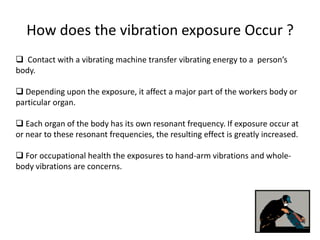
 Period : It is the time required to complete one pressure cycle and is
reciprocal of frequency. It is measured in seconds (T).
 Frequency : It is the number of cycles completed in unit second. Its unit is
cycles/sec or Hertz (Hz).
f = 1 / T
 Resonance : Every object tends to vibrate at one particular frequency that
depends on the composition of the object , its size , structure,weight and
shape. This frequency is called the resonant frequency.
 Amplitude : Amplitude is the acceleration given by meters per second(m/s2)
and denotes how far the surface moves each time when it vibrates
How does the vibration exposure Occur ?
 Contact with a vibrating machine transfer vibrating energy to a person’s
body.
 Depending upon the exposure, it affect a major part of the workers body or
particular organ.
 Each organ of the body has its own resonant frequency. If exposure occur at
or near to these resonant frequencies, the resulting effect is greatly increased.
 For occupational health the exposures to hand-arm vibrations and whole-
body vibrations are concerns.
Segmental Vibration Exposure
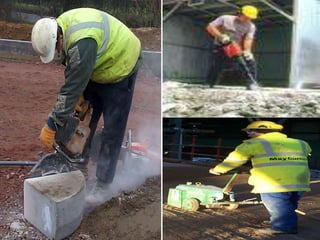
 ‘Segment of body’ such as hand-transmitted vibration (known as hand-
arm vibration or HAV) .
Example : chipping tools, jackhammers, grinders who use hand vibrating
tools.
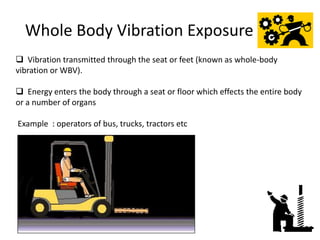
Whole Body Vibration Exposure
 Vibration transmitted through the seat or feet (known as whole-body
vibration or WBV).
 Energy enters the body through a seat or floor which effects the entire body
or a number of organs
Example : operators of bus, trucks, tractors etc
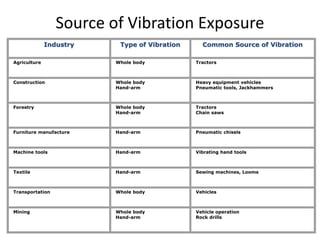
Source of Vibration Exposure
Industry Type of Vibration Common Source of Vibration
Agriculture Whole body Tractors
Construction Whole body
Hand-arm
Heavy equipment vehicles
Pneumatic tools, Jackhammers
Forestry Whole body
Hand-arm
Tractors
Chain saws
Furniture manufacture Hand-arm Pneumatic chisels
Machine tools Hand-arm Vibrating hand tools
Textile Hand-arm Sewing machines, Looms
Transportation Whole body Vehicles
Mining Whole body
Hand-arm
Vehicle operation
Rock drills
Measurement of Vibration
Exposure
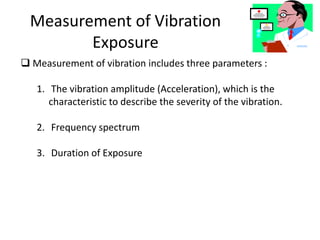
 Measurement of vibration includes three parameters :
1. The vibration amplitude (Acceleration), which is the
characteristic to describe the severity of the vibration.
2. Frequency spectrum
3. Duration of Exposure
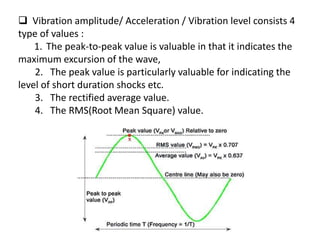
 Vibration amplitude/ Acceleration / Vibration level consists 4
type of values :
1. The peak-to-peak value is valuable in that it indicates the
maximum excursion of the wave,
2. The peak value is particularly valuable for indicating the
level of short duration shocks etc.
3. The rectified average value.
4. The RMS(Root Mean Square) value.
Vibration Measurement System
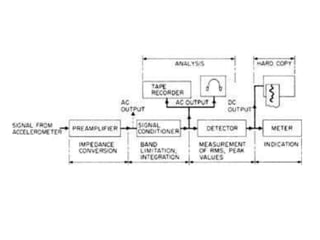
 A Typical Vibration System consist of :
1. A transducer( convert mechanical to electrical energy)
to sense the vibration .( Suitable transducers for
human vibration measurement is the Accelerometer)
2. A pre-amplifying device
3. Frequency weighing filter( to allow for the variation of
human response to vibration of different frequencies
& compared the measured vibration with standards)
4. Tape recorder to collect information for further
analysis
5. Signal analyzer to obtain relevant parameters like
acceleration and peak values
Transducers
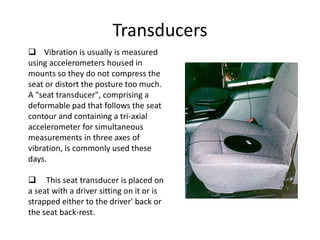
 Vibration is usually is measured
using accelerometers housed in
mounts so they do not compress the
seat or distort the posture too much.
A "seat transducer", comprising a
deformable pad that follows the seat
contour and containing a tri-axial
accelerometer for simultaneous
measurements in three axes of
vibration, is commonly used these
days.
 This seat transducer is placed on
a seat with a driver sitting on it or is
strapped either to the driver' back or
the seat back-rest.
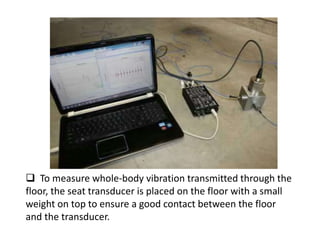
 To measure whole-body vibration transmitted through the
floor, the seat transducer is placed on the floor with a small
weight on top to ensure a good contact between the floor
and the transducer.
Vibration Meter
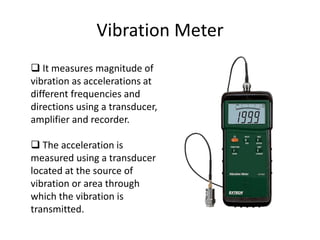
 It measures magnitude of
vibration as accelerations at
different frequencies and
directions using a transducer,
amplifier and recorder.
 The acceleration is
measured using a transducer
located at the source of
vibration or area through
which the vibration is
transmitted.
Standards for Vibration Exposure
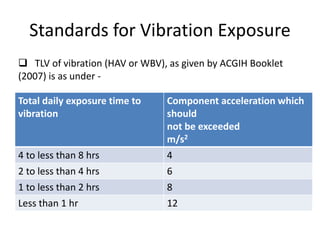
 TLV of vibration (HAV or WBV), as given by ACGIH Booklet
(2007) is as under -
Total daily exposure time to
vibration
Component acceleration which
should
not be exceeded
m/s2
4 to less than 8 hrs 4
2 to less than 4 hrs 6
1 to less than 2 hrs 8
Less than 1 hr 12
 Table gives acceleration levels and exposure duration to
which ACGIH has determined most workers exposed repeatedly
without severe damage to fingers.
 Hand-arm vibration syndrome (HAVS) cannot be controlled
by working within TLV only. It advises that these guidelines be
applied in conjunction with other protective measures including
vibration control such as ,
anti vibration tools and gloves,
proper work practices and
medical surveillance program are also necessary.
 Exposure limit are given as frequency-weighted acceleration
that represents a single number measure of the vibration
exposure level.
Effects of Vibration Exposure
 Vibration can cause annoyance and noise to human body
and physical damage to machines and structures. Vibration can
harm only if some part of the body is in direct contact with a
vibrating surface such as seat of a vehicle or the handle of a
power tool.
 Effects of vibration are feeling of disoriented or
displacement, giddiness, sickness, vibration disease and
sometimes fatal.
 Whole body vibration can cause permanent damage to body
or abdominal, spinal and bone damage.
 At low frequencies( up to 10Hz) the vibrations propagate
through the entire body regardless of the location of in put. In
case of high frequency vibration, the zone of propagation is
limited by the area of contact causing vascular disorder in that
part
 Low frequency vibration(3-6 Hz)=effects the chest region and
create the feelings of Nausea
 20-30 Hz frequency region resonance effect on head, neck
and shoulders
 60-90 Hz frequency effect the eye ball
 100-200 Hz frequency effect on lower jaw and skull system
 Between 3-400 Hz frequency will have normal ill effects
Effects on Human body
Whole body vibration may cause
1. Increase in oxygen consumption.
2. Increase in pulmonary ventilation and cardiac output. Affects CNS,
damages internal organs.
3. Difficulty in maintaining steady posture.
4. Effects on visual acuity and narrows the field of vision.
5. Marked changes in bone structure –
• Spondylities.
• Deformations.
• Intervertebral Osteochondrosis.
• Calcification of the intervertebral disc.
6. Blood changes -
• hypoglycaemia.
• hypocholesteremia.
• low ascorbic acid levels.
7. Alternations in the electrical activity of the brain.
8. Effects on endocrine, biochemical and histopathologic systems of
the body.
 It causes numbness and blanking of the fingers with probable
loss of muscular control and reduction of sensitivity to heat ,cold or
pain. It causes paleness of the skin due to oxygen deficiency. All
vibration make us tired or irritable.
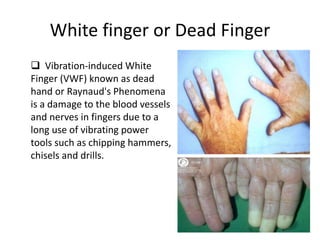
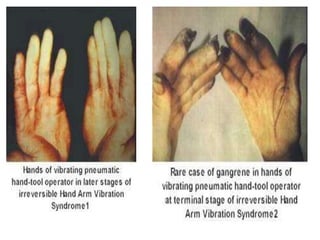
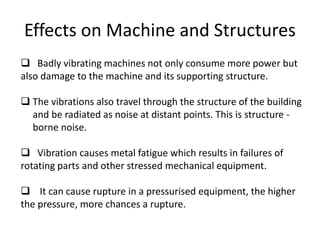
White finger or Dead Finger
 Vibration-induced White
Finger (VWF) known as dead
hand or Raynaud's Phenomena
is a damage to the blood vessels
and nerves in fingers due to a
long use of vibrating power
tools such as chipping hammers,
chisels and drills.
Effects on Machine and Structures
 Badly vibrating machines not only consume more power but
also damage to the machine and its supporting structure.
 The vibrations also travel through the structure of the building
and be radiated as noise at distant points. This is structure -
borne noise.
 Vibration causes metal fatigue which results in failures of
rotating parts and other stressed mechanical equipment.
 It can cause rupture in a pressurised equipment, the higher
the pressure, more chances a rupture.
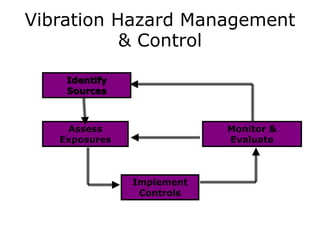
Vibration Hazard Management
& Control
Identify
Sources
Monitor &
Evaluate
Implement
Controls
Assess
Exposures
 Vibration control measures include technical,
organisational, hygienic, prophylactic and therapeutic
measures.
1. Technical or engineering measures include automation,
remote control and eliminating or reducing vibration
from the design stage or at source , use of vibration
dampers, device for prevention, suppression, damping
and insulation of harmful vibrations, use of automatic
devices to avoid contact with the vibrating body, changes
in the design parameters of machines, equipment and
mechanised tools
2. Organisation measures include good preventive and
corrective maintenance and arrangement of work
schedules in such a way to decrease time of exposure.
3. Prophylactic and therapeutic measures – pre-employment
and periodical medical examinations play an important
role. Special gymnastics, hydrotherapeutic procedures,
massage and UV radiation can prevent further
development of vibration disease and preserve working
capacity.
3. Special vibration absorbing handles fitted to hand tools,
springs, suspension seats and shock absorbers are useful.
5. Reduction in exposure time. Rotate vibrative job and
introduce rest schedules so that individual exposure is
shortened.
6. Personal precautions include watching for symptoms, to apply
loose grip, to wear gloves and footwear with shock-absorbing
soles to damp vibration to use PPE and to get medical
attention.
7. Automation and remote control system.
Anti Vibration Tools
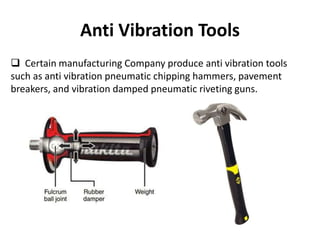
 Certain manufacturing Company produce anti vibration tools
such as anti vibration pneumatic chipping hammers, pavement
breakers, and vibration damped pneumatic riveting guns.
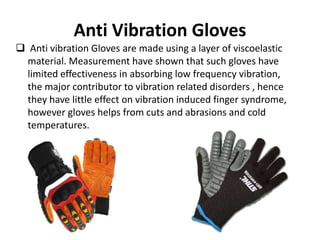
Anti Vibration Gloves
 Anti vibration Gloves are made using a layer of viscoelastic
material. Measurement have shown that such gloves have
limited effectiveness in absorbing low frequency vibration,
the major contributor to vibration related disorders , hence
they have little effect on vibration induced finger syndrome,
however gloves helps from cuts and abrasions and cold
temperatures.
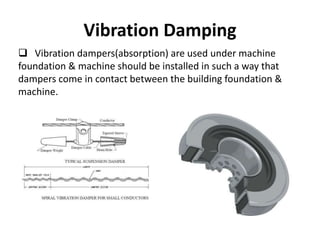
Vibration Damping
 Vibration dampers(absorption) are used under machine
foundation & machine should be installed in such a way that
dampers come in contact between the building foundation &
machine.
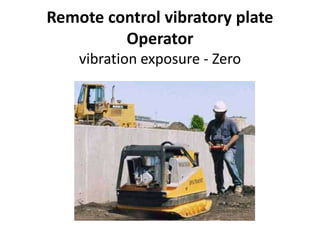
Remote control vibratory plate
Operator
vibration exposure - Zero
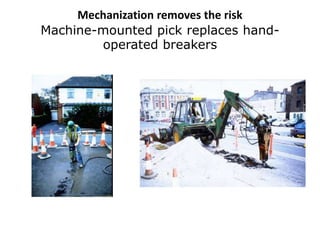
Mechanization removes the risk
Machine-mounted pick replaces hand-
operated breakers
Demolition without vibration
Use hydraulic crushers instead of
demolition hammers
Thank you…

Vibration hazards - OH & S

  • 1.
    Vibration Hazards Prepared By, JigneshJ. Raiyani M E Semester I LDCE-Ahmedabad. Enrollment no : 160280718015
  • 2.
    Introduction  Vibration isa physical factor which acts on human body by transmission of mechanical energy from sources of oscillation.  Vibration is mechanical oscillation about a reference position.  It can be defined as oscillatory motion of solid bodies and can be visually linked to waves .
  • 3.
    Characteristics of wave Period : It is the time required to complete one pressure cycle and is reciprocal of frequency. It is measured in seconds (T).  Frequency : It is the number of cycles completed in unit second. Its unit is cycles/sec or Hertz (Hz). f = 1 / T  Resonance : Every object tends to vibrate at one particular frequency that depends on the composition of the object , its size , structure,weight and shape. This frequency is called the resonant frequency.  Amplitude : Amplitude is the acceleration given by meters per second(m/s2) and denotes how far the surface moves each time when it vibrates
  • 4.
    How does thevibration exposure Occur ?  Contact with a vibrating machine transfer vibrating energy to a person’s body.  Depending upon the exposure, it affect a major part of the workers body or particular organ.  Each organ of the body has its own resonant frequency. If exposure occur at or near to these resonant frequencies, the resulting effect is greatly increased.  For occupational health the exposures to hand-arm vibrations and whole- body vibrations are concerns.
  • 5.
    Segmental Vibration Exposure ‘Segment of body’ such as hand-transmitted vibration (known as hand- arm vibration or HAV) . Example : chipping tools, jackhammers, grinders who use hand vibrating tools.
  • 7.
    Whole Body VibrationExposure  Vibration transmitted through the seat or feet (known as whole-body vibration or WBV).  Energy enters the body through a seat or floor which effects the entire body or a number of organs Example : operators of bus, trucks, tractors etc
  • 8.
    Source of VibrationExposure Industry Type of Vibration Common Source of Vibration Agriculture Whole body Tractors Construction Whole body Hand-arm Heavy equipment vehicles Pneumatic tools, Jackhammers Forestry Whole body Hand-arm Tractors Chain saws Furniture manufacture Hand-arm Pneumatic chisels Machine tools Hand-arm Vibrating hand tools Textile Hand-arm Sewing machines, Looms Transportation Whole body Vehicles Mining Whole body Hand-arm Vehicle operation Rock drills
  • 9.
    Measurement of Vibration Exposure Measurement of vibration includes three parameters : 1. The vibration amplitude (Acceleration), which is the characteristic to describe the severity of the vibration. 2. Frequency spectrum 3. Duration of Exposure
  • 10.
     Vibration amplitude/Acceleration / Vibration level consists 4 type of values : 1. The peak-to-peak value is valuable in that it indicates the maximum excursion of the wave, 2. The peak value is particularly valuable for indicating the level of short duration shocks etc. 3. The rectified average value. 4. The RMS(Root Mean Square) value.
  • 11.
    Vibration Measurement System A Typical Vibration System consist of : 1. A transducer( convert mechanical to electrical energy) to sense the vibration .( Suitable transducers for human vibration measurement is the Accelerometer) 2. A pre-amplifying device 3. Frequency weighing filter( to allow for the variation of human response to vibration of different frequencies & compared the measured vibration with standards) 4. Tape recorder to collect information for further analysis 5. Signal analyzer to obtain relevant parameters like acceleration and peak values
  • 13.
    Transducers  Vibration isusually is measured using accelerometers housed in mounts so they do not compress the seat or distort the posture too much. A "seat transducer", comprising a deformable pad that follows the seat contour and containing a tri-axial accelerometer for simultaneous measurements in three axes of vibration, is commonly used these days.  This seat transducer is placed on a seat with a driver sitting on it or is strapped either to the driver' back or the seat back-rest.
  • 14.
     To measurewhole-body vibration transmitted through the floor, the seat transducer is placed on the floor with a small weight on top to ensure a good contact between the floor and the transducer.
  • 15.
    Vibration Meter  Itmeasures magnitude of vibration as accelerations at different frequencies and directions using a transducer, amplifier and recorder.  The acceleration is measured using a transducer located at the source of vibration or area through which the vibration is transmitted.
  • 16.
    Standards for VibrationExposure  TLV of vibration (HAV or WBV), as given by ACGIH Booklet (2007) is as under - Total daily exposure time to vibration Component acceleration which should not be exceeded m/s2 4 to less than 8 hrs 4 2 to less than 4 hrs 6 1 to less than 2 hrs 8 Less than 1 hr 12
  • 17.
     Table givesacceleration levels and exposure duration to which ACGIH has determined most workers exposed repeatedly without severe damage to fingers.  Hand-arm vibration syndrome (HAVS) cannot be controlled by working within TLV only. It advises that these guidelines be applied in conjunction with other protective measures including vibration control such as , anti vibration tools and gloves, proper work practices and medical surveillance program are also necessary.  Exposure limit are given as frequency-weighted acceleration that represents a single number measure of the vibration exposure level.
  • 18.
    Effects of VibrationExposure  Vibration can cause annoyance and noise to human body and physical damage to machines and structures. Vibration can harm only if some part of the body is in direct contact with a vibrating surface such as seat of a vehicle or the handle of a power tool.  Effects of vibration are feeling of disoriented or displacement, giddiness, sickness, vibration disease and sometimes fatal.  Whole body vibration can cause permanent damage to body or abdominal, spinal and bone damage.
  • 19.
     At lowfrequencies( up to 10Hz) the vibrations propagate through the entire body regardless of the location of in put. In case of high frequency vibration, the zone of propagation is limited by the area of contact causing vascular disorder in that part  Low frequency vibration(3-6 Hz)=effects the chest region and create the feelings of Nausea  20-30 Hz frequency region resonance effect on head, neck and shoulders  60-90 Hz frequency effect the eye ball  100-200 Hz frequency effect on lower jaw and skull system  Between 3-400 Hz frequency will have normal ill effects
  • 20.
    Effects on Humanbody Whole body vibration may cause 1. Increase in oxygen consumption. 2. Increase in pulmonary ventilation and cardiac output. Affects CNS, damages internal organs. 3. Difficulty in maintaining steady posture. 4. Effects on visual acuity and narrows the field of vision. 5. Marked changes in bone structure – • Spondylities. • Deformations. • Intervertebral Osteochondrosis. • Calcification of the intervertebral disc.
  • 21.
    6. Blood changes- • hypoglycaemia. • hypocholesteremia. • low ascorbic acid levels. 7. Alternations in the electrical activity of the brain. 8. Effects on endocrine, biochemical and histopathologic systems of the body.  It causes numbness and blanking of the fingers with probable loss of muscular control and reduction of sensitivity to heat ,cold or pain. It causes paleness of the skin due to oxygen deficiency. All vibration make us tired or irritable.
  • 22.
    White finger orDead Finger  Vibration-induced White Finger (VWF) known as dead hand or Raynaud's Phenomena is a damage to the blood vessels and nerves in fingers due to a long use of vibrating power tools such as chipping hammers, chisels and drills.
  • 24.
    Effects on Machineand Structures  Badly vibrating machines not only consume more power but also damage to the machine and its supporting structure.  The vibrations also travel through the structure of the building and be radiated as noise at distant points. This is structure - borne noise.  Vibration causes metal fatigue which results in failures of rotating parts and other stressed mechanical equipment.  It can cause rupture in a pressurised equipment, the higher the pressure, more chances a rupture.
  • 25.
    Vibration Hazard Management &Control Identify Sources Monitor & Evaluate Implement Controls Assess Exposures
  • 26.
     Vibration controlmeasures include technical, organisational, hygienic, prophylactic and therapeutic measures. 1. Technical or engineering measures include automation, remote control and eliminating or reducing vibration from the design stage or at source , use of vibration dampers, device for prevention, suppression, damping and insulation of harmful vibrations, use of automatic devices to avoid contact with the vibrating body, changes in the design parameters of machines, equipment and mechanised tools
  • 27.
    2. Organisation measuresinclude good preventive and corrective maintenance and arrangement of work schedules in such a way to decrease time of exposure. 3. Prophylactic and therapeutic measures – pre-employment and periodical medical examinations play an important role. Special gymnastics, hydrotherapeutic procedures, massage and UV radiation can prevent further development of vibration disease and preserve working capacity. 3. Special vibration absorbing handles fitted to hand tools, springs, suspension seats and shock absorbers are useful.
  • 28.
    5. Reduction inexposure time. Rotate vibrative job and introduce rest schedules so that individual exposure is shortened. 6. Personal precautions include watching for symptoms, to apply loose grip, to wear gloves and footwear with shock-absorbing soles to damp vibration to use PPE and to get medical attention. 7. Automation and remote control system.
  • 29.
    Anti Vibration Tools Certain manufacturing Company produce anti vibration tools such as anti vibration pneumatic chipping hammers, pavement breakers, and vibration damped pneumatic riveting guns.
  • 30.
    Anti Vibration Gloves Anti vibration Gloves are made using a layer of viscoelastic material. Measurement have shown that such gloves have limited effectiveness in absorbing low frequency vibration, the major contributor to vibration related disorders , hence they have little effect on vibration induced finger syndrome, however gloves helps from cuts and abrasions and cold temperatures.
  • 31.
    Vibration Damping  Vibrationdampers(absorption) are used under machine foundation & machine should be installed in such a way that dampers come in contact between the building foundation & machine.
  • 32.
    Remote control vibratoryplate Operator vibration exposure - Zero
  • 33.
    Mechanization removes therisk Machine-mounted pick replaces hand- operated breakers
  • 34.
    Demolition without vibration Usehydraulic crushers instead of demolition hammers
  • 35.