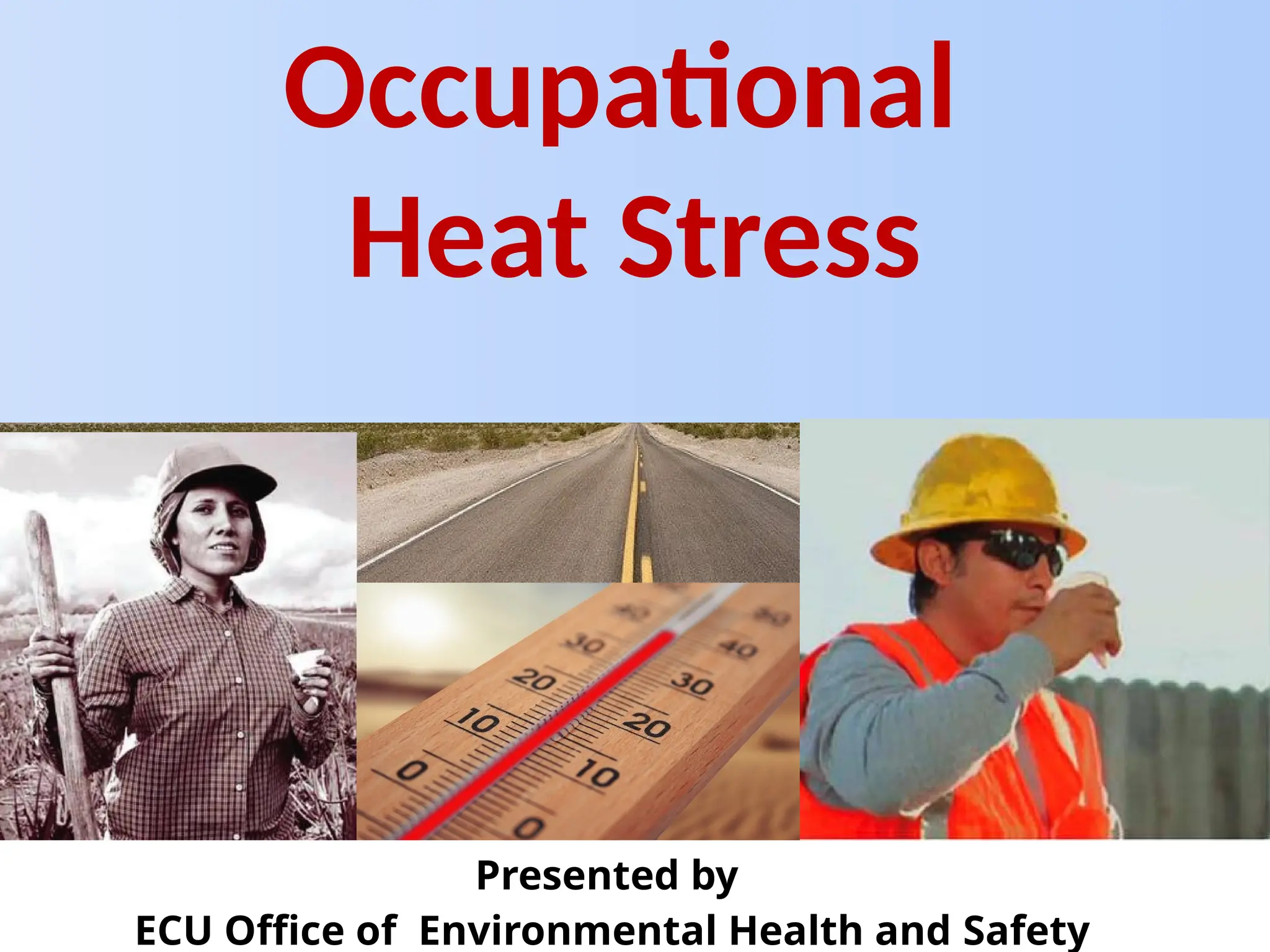
Occupational
Heat Stress
Presented by
ECU Office of Environmental Health and Safety
Individuals At Risk
• All individuals who work in hot environments
(inside and outside) are at risk of developing heat
stress.
• More intense and strenuous workloads, put
individuals at a greater risk.
• Wearing PPE such as respirators and protective
suits can also increase this risk.
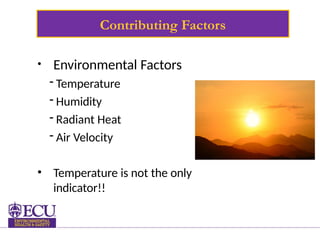
Contributing Factors
• Environmental Factors
- Temperature
- Humidity
- Radiant Heat
- Air Velocity
• Temperature is not the only
indicator!!
Contributing Factors
• Personal Factors
- Age
- Weight
- Fitness
- Acclimatization – increased tolerance to
heat that comes from working in a hot
environment for a period 1-2 weeks.
The Body’s Response to Heat
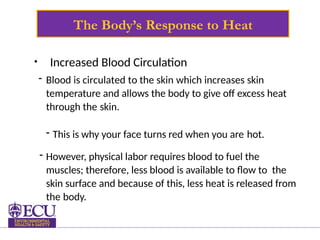
• Increased Blood Circulation
- Blood is circulated to the skin which increases skin
temperature and allows the body to give off excess heat
through the skin.
- This is why your face turns red when you are hot.
- However, physical labor requires blood to fuel the
muscles; therefore, less blood is available to flow to the
skin surface and because of this, less heat is released from
the body.
The Body’s Response to Heat
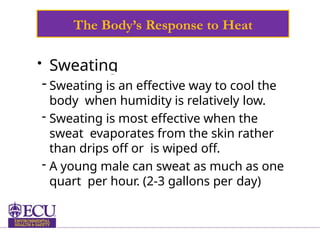
• Sweating
- Sweating is an effective way to cool the
body when humidity is relatively low.
- Sweating is most effective when the
sweat evaporates from the skin rather
than drips off or is wiped off.
- A young male can sweat as much as one
quart per hour. (2-3 gallons per day)
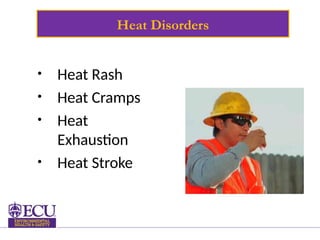
Heat Disorders
• Heat Rash
• Heat Cramps
• Heat
Exhaustion
• Heat Stroke
Heat Disorders
• Heat Rash
- Also known as “Prickly Heat.”
- Occurs when sweat cannot freely evaporate
from the skin and sweat ducts become plugged.
This inflammation can cause a red rash.
- Can be prevented by wearing clothes that allow
sweat to evaporate as well as bathing regularly
and drying the skin.
Heat Disorders
• Heat Cramps
- Cramps in the arms, legs or abdomen
- Occur in individuals who sweat profusely then
drink large quantities of water, but do not
adequately replace the body’s salt loss.
- To prevent, ensure that salts are replaced during
and after heavy sweating.
Heat Disorders
• Heat Exhaustion
Mild form of shock caused when the circulatory
system begins to fail as a result of the body’s
inadequate effort to give off excessive heat.
Although not an immediate threat to life, if not
properly treated, could evolve into heat stroke.
Heat Disorders
• Heat Exhaustion - Symptoms
• Skin is clammy and moist
- Extreme weakness or fatigue
- Nausea
- Headache
- Complexion pale or flushed
- Body temperature normal or slightly elevated
Heat Disorders
• Heat Exhaustion - Treatment
- Do not leave the person alone
- Move to a cool place to rest
- Drink water or electrolyte fluids
- Treat for shock, if necessary
- If unconscious, fails to recover rapidly, has
other injuries, or has a history of medical
problems, seek medical attention.
Heat Disorders
• Heat Stroke
Severe and sometimes fatal condition resulting
from the failure of the body to regulate its core
temperature.
The body’s normal cooling mechanisms stop
functioning, sweating stops.
True medical emergency requiring immediate
medical attention.
Heat Disorders
• Heat Stroke - Symptoms
- Stop Sweating
- Rapid Pulse
- Mental Confusion
- Loss of Consciousness
- Convulsions
- Body Temperature > 105
- Hot, dry skin
- Can die unless treated promptly
Heat Disorders
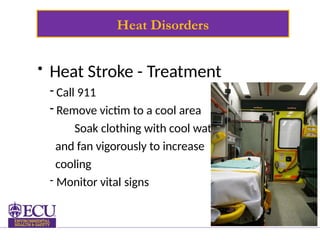
• Heat Stroke - Treatment
- Call 911
- Remove victim to a cool area
- Soak clothing with cool water
and fan vigorously to increase
cooling
- Monitor vital signs
Prevention Methods
• Acclimatization
• Work in pairs
• Drink plenty of cool water or electrolyte
replacement fluids even if not thirsty. (One
small cup every 15-20 minutes)
• Be able to recognize early signs & symptoms of
heat-induced illness and take appropriate action to
prevent serious heat disorders.
• Schedule most strenuous work during the
coolest times of the day.
Prevention Methods
• Spend as little time as possible in direct
sunlight.
• Take frequent breaks in cool, shaded
areas.
• Wear light, loose fitting, clothing.
• Avoid caffeine, which can make the body lose
water.
• Rotate workers in and out of hot areas if
possible.
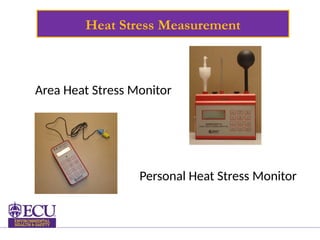
Heat Stress Measurement
Personal Heat Stress Monitor
Area Heat Stress Monitor
Wet Bulb Globe Temperature Index
• WBGT is a number that is calculated as a
combination of humidity, radiant, and ambient
temperature readings.
• This number is then combined with work load to
determine heat stress potential.
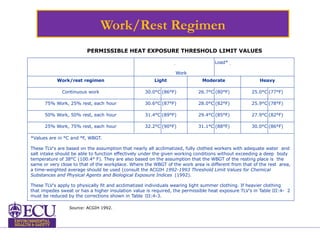
• The following table displays the recommended
work/rest regimen for corresponding WBGT
values.
Work/Rest Regimen
Work
Load*
Work/rest regimen Light Moderate Heavy
Continuous work 30.0°C (86°F) 26.7°C (80°F) 25.0°C (77°F)
75% Work, 25% rest, each hour 30.6°C (87°F) 28.0°C (82°F) 25.9°C (78°F)
50% Work, 50% rest, each hour 31.4°C (89°F) 29.4°C (85°F) 27.9°C (82°F)
25% Work, 75% rest, each hour 32.2°C (90°F) 31.1°C (88°F) 30.0°C (86°F)
*Values are in °C and °F, WBGT.
These TLV's are based on the assumption that nearly all acclimatized, fully clothed workers with adequate water and
salt intake should be able to function effectively under the given working conditions without exceeding a deep body
temperature of 38°C (100.4° F). They are also based on the assumption that the WBGT of the resting place is the
same or very close to that of the workplace. Where the WBGT of the work area is different from that of the rest area,
a time-weighted average should be used (consult the ACGIH 1992-1993 Threshold Limit Values for Chemical
Substances and Physical Agents and Biological Exposure Indices (1992).
These TLV's apply to physically fit and acclimatized individuals wearing light summer clothing. If heavier clothing
that impedes sweat or has a higher insulation value is required, the permissible heat exposure TLV's in Table III:4- 2
must be reduced by the corrections shown in Table III:4-3.
PERMISSIBLE HEAT EXPOSURE THRESHOLD LIMIT VALUES
Source: ACGIH 1992.
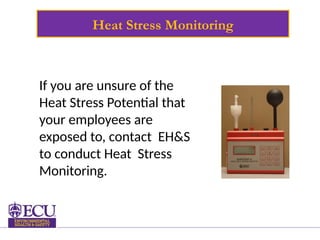
Heat Stress Monitoring
If you are unsure of the
Heat Stress Potential that
your employees are
exposed to, contact EH&S
to conduct Heat Stress
Monitoring.
211 South Jarvis Street, Suite 102, Greenville NC 27858
Online: www.ecu.edu/oehs
Email: safety@ecu.edu
Questions
QUIZ
To receive credit for this training please complete the linked

Heat-Stress..........................pptx

  • 1.
    Occupational Heat Stress Presented by ECUOffice of Environmental Health and Safety
  • 2.
    Individuals At Risk •All individuals who work in hot environments (inside and outside) are at risk of developing heat stress. • More intense and strenuous workloads, put individuals at a greater risk. • Wearing PPE such as respirators and protective suits can also increase this risk.
  • 3.
    Contributing Factors • EnvironmentalFactors - Temperature - Humidity - Radiant Heat - Air Velocity • Temperature is not the only indicator!!
  • 4.
    Contributing Factors • PersonalFactors - Age - Weight - Fitness - Acclimatization – increased tolerance to heat that comes from working in a hot environment for a period 1-2 weeks.
  • 5.
    The Body’s Responseto Heat • Increased Blood Circulation - Blood is circulated to the skin which increases skin temperature and allows the body to give off excess heat through the skin. - This is why your face turns red when you are hot. - However, physical labor requires blood to fuel the muscles; therefore, less blood is available to flow to the skin surface and because of this, less heat is released from the body.
  • 6.
    The Body’s Responseto Heat • Sweating - Sweating is an effective way to cool the body when humidity is relatively low. - Sweating is most effective when the sweat evaporates from the skin rather than drips off or is wiped off. - A young male can sweat as much as one quart per hour. (2-3 gallons per day)
  • 7.
    Heat Disorders • HeatRash • Heat Cramps • Heat Exhaustion • Heat Stroke
  • 8.
    Heat Disorders • HeatRash - Also known as “Prickly Heat.” - Occurs when sweat cannot freely evaporate from the skin and sweat ducts become plugged. This inflammation can cause a red rash. - Can be prevented by wearing clothes that allow sweat to evaporate as well as bathing regularly and drying the skin.
  • 9.
    Heat Disorders • HeatCramps - Cramps in the arms, legs or abdomen - Occur in individuals who sweat profusely then drink large quantities of water, but do not adequately replace the body’s salt loss. - To prevent, ensure that salts are replaced during and after heavy sweating.
  • 10.
    Heat Disorders • HeatExhaustion Mild form of shock caused when the circulatory system begins to fail as a result of the body’s inadequate effort to give off excessive heat. Although not an immediate threat to life, if not properly treated, could evolve into heat stroke.
  • 11.
    Heat Disorders • HeatExhaustion - Symptoms • Skin is clammy and moist - Extreme weakness or fatigue - Nausea - Headache - Complexion pale or flushed - Body temperature normal or slightly elevated
  • 12.
    Heat Disorders • HeatExhaustion - Treatment - Do not leave the person alone - Move to a cool place to rest - Drink water or electrolyte fluids - Treat for shock, if necessary - If unconscious, fails to recover rapidly, has other injuries, or has a history of medical problems, seek medical attention.
  • 13.
    Heat Disorders • HeatStroke Severe and sometimes fatal condition resulting from the failure of the body to regulate its core temperature. The body’s normal cooling mechanisms stop functioning, sweating stops. True medical emergency requiring immediate medical attention.
  • 14.
    Heat Disorders • HeatStroke - Symptoms - Stop Sweating - Rapid Pulse - Mental Confusion - Loss of Consciousness - Convulsions - Body Temperature > 105 - Hot, dry skin - Can die unless treated promptly
  • 15.
    Heat Disorders • HeatStroke - Treatment - Call 911 - Remove victim to a cool area - Soak clothing with cool water and fan vigorously to increase cooling - Monitor vital signs
  • 16.
    Prevention Methods • Acclimatization •Work in pairs • Drink plenty of cool water or electrolyte replacement fluids even if not thirsty. (One small cup every 15-20 minutes) • Be able to recognize early signs & symptoms of heat-induced illness and take appropriate action to prevent serious heat disorders. • Schedule most strenuous work during the coolest times of the day.
  • 17.
    Prevention Methods • Spendas little time as possible in direct sunlight. • Take frequent breaks in cool, shaded areas. • Wear light, loose fitting, clothing. • Avoid caffeine, which can make the body lose water. • Rotate workers in and out of hot areas if possible.
  • 18.
    Heat Stress Measurement PersonalHeat Stress Monitor Area Heat Stress Monitor
  • 19.
    Wet Bulb GlobeTemperature Index • WBGT is a number that is calculated as a combination of humidity, radiant, and ambient temperature readings. • This number is then combined with work load to determine heat stress potential. • The following table displays the recommended work/rest regimen for corresponding WBGT values.
  • 20.
    Work/Rest Regimen Work Load* Work/rest regimenLight Moderate Heavy Continuous work 30.0°C (86°F) 26.7°C (80°F) 25.0°C (77°F) 75% Work, 25% rest, each hour 30.6°C (87°F) 28.0°C (82°F) 25.9°C (78°F) 50% Work, 50% rest, each hour 31.4°C (89°F) 29.4°C (85°F) 27.9°C (82°F) 25% Work, 75% rest, each hour 32.2°C (90°F) 31.1°C (88°F) 30.0°C (86°F) *Values are in °C and °F, WBGT. These TLV's are based on the assumption that nearly all acclimatized, fully clothed workers with adequate water and salt intake should be able to function effectively under the given working conditions without exceeding a deep body temperature of 38°C (100.4° F). They are also based on the assumption that the WBGT of the resting place is the same or very close to that of the workplace. Where the WBGT of the work area is different from that of the rest area, a time-weighted average should be used (consult the ACGIH 1992-1993 Threshold Limit Values for Chemical Substances and Physical Agents and Biological Exposure Indices (1992). These TLV's apply to physically fit and acclimatized individuals wearing light summer clothing. If heavier clothing that impedes sweat or has a higher insulation value is required, the permissible heat exposure TLV's in Table III:4- 2 must be reduced by the corrections shown in Table III:4-3. PERMISSIBLE HEAT EXPOSURE THRESHOLD LIMIT VALUES Source: ACGIH 1992.
  • 21.
    Heat Stress Monitoring Ifyou are unsure of the Heat Stress Potential that your employees are exposed to, contact EH&S to conduct Heat Stress Monitoring.
  • 22.
    211 South JarvisStreet, Suite 102, Greenville NC 27858 Online: www.ecu.edu/oehs Email: safety@ecu.edu Questions QUIZ To receive credit for this training please complete the linked