Copyright McGraw-Hill 2009
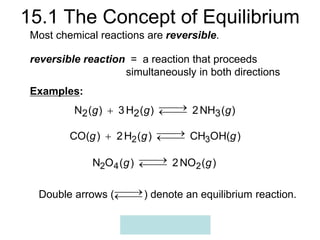
Doublearrows ( ) denote an equilibrium reaction.
15.1 The Concept of Equilibrium
Most chemical reactions are reversible.
reversible reaction = a reaction that proceeds
simultaneously in both directions
Examples:
)
(
NO
2
)
(
O
N 2
4
2 g
g
)
(
NH
2
)
(
H
3
)
(
N 3
2
2 g
g
g
)
OH(
CH
)
(
H
2
)
CO( 3
2 g
g
g
3.
Copyright McGraw-Hill 2009
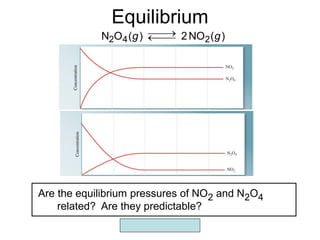
Equilibrium
)
(
NO
2
)
(
O
N2
4
2 g
g
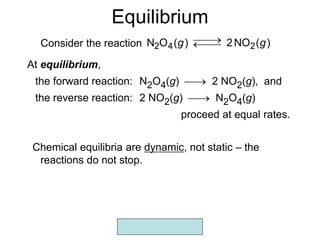
Consider the reaction
At equilibrium,
the forward reaction: N2O4(g) 2 NO2(g), and
the reverse reaction: 2 NO2(g) N2O4(g)
proceed at equal rates.
Chemical equilibria are dynamic, not static – the
reactions do not stop.
4.
Copyright McGraw-Hill 2009
Equilibrium
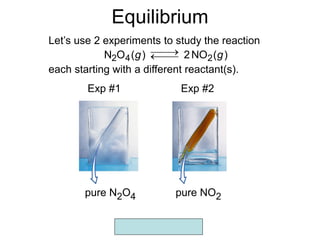
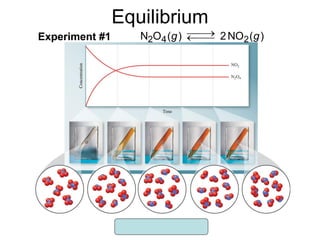
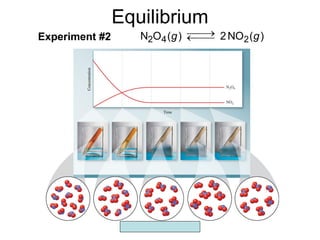
Let’suse 2 experiments to study the reaction
each starting with a different reactant(s).
)
(
NO
2
)
(
O
N 2
4
2 g
g
Exp #2
pure NO2
Exp #1
pure N2O4
Copyright McGraw-Hill 2009
15.2The Equilibrium Constant
rateforward ratereverse
At equilibrium,
2
f 2 4 eq r 2 eq
[N O ] [NO ]
k k
)
(
NO
2
)
(
O
N 2
4
2 g
g
or
2
2 eq
f
c
r 2 4 eq
[NO ]
[N O ]
k
K
k
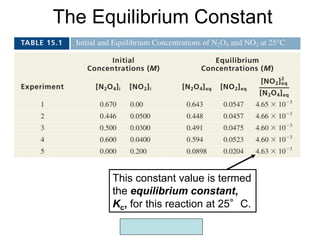
where Kc is the equilibrium constant
9.
Copyright McGraw-Hill 2009
TheEquilibrium Constant
This constant value is termed
the equilibrium constant,
Kc, for this reaction at 25°C.
10.
Copyright McGraw-Hill 2009
TheEquilibrium Constant
For the NO2 / N2O4 system:
equilibrium constant expression
equilibrium constant
2
4
[NO ]
O ]
K
2
2
0.143 at 25 C
[N
)
(
NO
2
)
(
O
N 2
4
2 g
g
Note: at100°C, K =
6.45
11.
Copyright McGraw-Hill 2009
TheEquilibrium Constant
reaction quotient = Qc = the value of the
“equilibrium constant expression” under
any conditions.
)
(
COCl
)
(
Cl
)
CO( 2
2 g
g
g
For,
2 eq
c
eq 2 eq
[COCl ]
[CO] [Cl ]
K 2
c
2
[COCl ]
[CO][Cl ]
Q
Q > K reverse reaction favored
Q = K equilibrium present
Q < K forward reaction favored
12.
Copyright McGraw-Hill 2009
TheEquilibrium Constant
The Law of Mass Action:
Cato Maximilian Guldberg & Peter Waage,
Forhandlinger: Videnskabs-Selskabet i
Christiana 1864, 35.
K
c d
c a b
[C] [D]
[A] [B]
For a reaction: D
C
B
A d
c
b
a
C D
A B
P
P P
K
P P
c d
a b
For gases:
For solutions: [ ] = mol/L
P in atm
13.
Copyright McGraw-Hill 2009
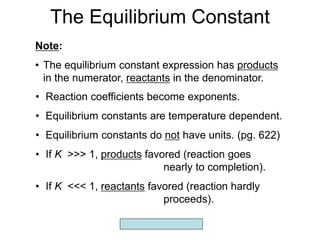
TheEquilibrium Constant
Note:
• The equilibrium constant expression has products
in the numerator, reactants in the denominator.
• Reaction coefficients become exponents.
• Equilibrium constants are temperature dependent.
• Equilibrium constants do not have units. (pg. 622)
• If K >>> 1, products favored (reaction goes
nearly to completion).
• If K <<< 1, reactants favored (reaction hardly
proceeds).
14.
. .
Relationship betweenKc and Kp
• Relationship between concentration and pressure obtained from the
ideal gas law.
– Assuming all the species behaving like ideal gasses
– PV = nRT or P=(n/V)RT=[Conc]RT
– Substitute for P in equilibrium expression.
– Consider the reaction:
aA(g) + bB(g) cC(g) + dD(g)
RT
]
A
[
RT
V
n
P A
A
n
c
)
b
a
(
)
d
c
(
c
P
b
a
b
a
d
c
d
c
b
a
d
c
b
B
a
A
d
D
c
C
P
RT
K
RT
K
K
RT
]
B
[
]
A
[
RT
]
D
[
]
C
[
RT
]
B
[
RT
]
A
[
RT
]
D
[
RT
]
C
[
P
P
P
P
K
15.
Copyright McGraw-Hill 2009
15.3Equilibrium Expressions
homogeneous equilibria = equilibria in which all
reactants and products are in the same phase.
• [CaO] and [CaCO3] are solids.
• Pure solids and liquids are omitted from equilibrium
constant expressions.
)
(
CO
)
CaO(
)
(
CaCO 2
3 g
s
s
Ex:
The equilibrium constant expression is,
K = [CO2]
heterogeneous equilibria = equilibria in which all
reactants and products are not in the same phase.
16.
. .
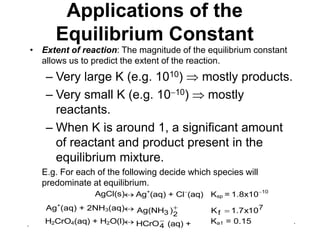
Applications ofthe
Equilibrium Constant
• Extent of reaction: The magnitude of the equilibrium constant
allows us to predict the extent of the reaction.
– Very large K (e.g. 1010) mostly products.
– Very small K (e.g. 1010) mostly
reactants.
– When K is around 1, a significant amount
of reactant and product present in the
equilibrium mixture.
E.g. For each of the following decide which species will
predominate at equilibrium.
AgCl(s) Ag+
(aq) + Cl
(aq) Ksp = 1.8x10¹⁰
Ag+
(aq) + 2NH3(aq)
2
3 )
Ag(NH 7
f 10
x
7
.
1
K
H2CrO4(aq) + H2O(l)
4
HCrO (aq) +
H3O+
(aq)
Ka1 = 0.15
17.
. .
Using theEquilibrium
Constant
• Direction of Reaction: the reaction quotient can be used to determine
the direction of a reaction with certain initial concentrations.
• Reaction Quotient: For the general reaction,
aA + bB cC + dD,.
where the t refers to the time that concentrations of the mixture are
measured; not necessarily at equilibrium.
• Comparison of Qc with Kc reveals direction of reaction.
• When only reactants Qc = 0; leads to
– If Qc < Kc, products will form.
• When only products present, Qc .
– If Qc > Kc, reactants will form.
• When Qc = Kc, no net reaction.
E.g. Determine direction of reaction: H2(g) + I2(g) 2HI(g). Assume
that [H2]o = [I2]o = [HI]o = 0.0020M at 490oC for which Kc = 46.
b
a
c
t
d
t
c
[B]
[A]
[C]
[D]
Q
t
t
18.
Copyright McGraw-Hill 2009
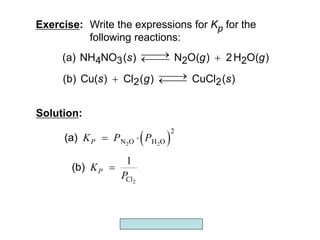
Exercise:Write the expressions for Kp for the
following reactions:
)
O(
H
2
)
O(
N
)
(
NO
NH
(a) 2
2
3
4 g
g
s
)
(
CuCl
)
(
Cl
)
Cu(
(b) 2
2 s
g
s
Solution:
2 2
2
N O H O
P
K P P
(a)
2
Cl
1
P
K
P
(b)
19.
Copyright McGraw-Hill 2009
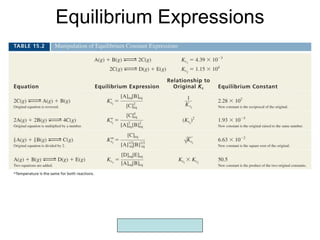
EquilibriumExpressions
A. Reverse Equations
[1]
)
(
NO
2
)
(
O
N 2
4
2 g
g
For,
Conclusion:
2
1
1
K
K
C
1
6.99 at 25
0.143
C
P
K
P
2
2 4
NO
1
N O
2
0.143 at 25
[2]
)
(
O
N
)
(
NO
2 4
2
2 g
g
For,
2 4
2
N O
NO
P
K
P
2 2
20.
Copyright McGraw-Hill 2009
EquilibriumExpressions
B. Coefficient Changes
[1]
)
(
NO
2
)
(
O
N 2
4
2 g
g
For,
Conclusion:
3 1
K K
C
0.143 0.378 at 25
For, [3]
)
(
NO
)
(
O
N
2
1
2
4
2 g
g
2
2 4
NO
1/2
N O
P
K
P
3
C
P
K
P
2
2 4
NO
1
N O
2
0.143 at 25
21.
Copyright McGraw-Hill 2009
EquilibriumExpressions
C. Reaction Sum (related to Hess’ Law)
[1]
)
(
NO
2
)
(
O
N 2
4
2 g
g
For,
For, [4]
)
(
O
)
NO(
2
)
(
NO
2 2
2 g
g
g
2
2
NO O
NO
P P
K
P
2
4 2
Add [1] + [4],
[5]
)
(
O
)
NO(
2
)
(
O
N 2
4
2 g
g
g
2
2 4
NO O
N O
P P
K
P
2
5
4
2
2
O
N
NO
1
P
P
K
2
K K
1 4
Copyright McGraw-Hill 2009
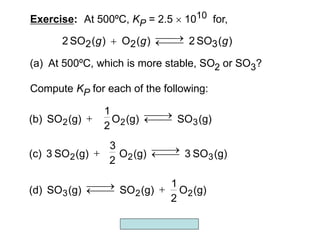
Exercise:At 500ºC, KP = 2.5 1010 for,
)
(
SO
2
)
(
O
)
(
SO
2 3
2
2 g
g
g
Compute KP for each of the following:
(a) At 500ºC, which is more stable, SO2 or SO3?
(g)
O
2
1
(g)
SO
(g)
SO
(d) 2
2
3
(g)
SO
(g)
O
(g)
SO
(b) 3
2
2
2
1
(g)
SO
3
(g)
O
(g)
SO
3
(c) 3
2
2
2
3
24.
Copyright McGraw-Hill 2009
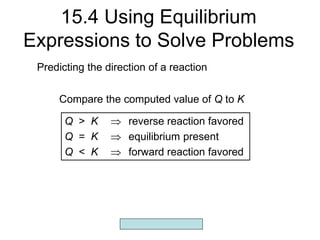
15.4Using Equilibrium
Expressions to Solve Problems
Q > K reverse reaction favored
Q = K equilibrium present
Q < K forward reaction favored
Predicting the direction of a reaction
Compare the computed value of Q to K
25.
Copyright McGraw-Hill 2009
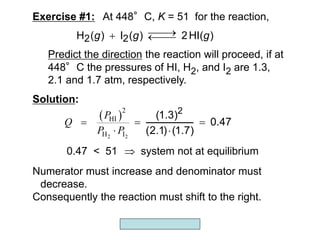
Exercise#1: At 448°C, K = 51 for the reaction,
)
HI(
2
)
(
I
)
(
H 2
2 g
g
g
Predict the direction the reaction will proceed, if at
448°C the pressures of HI, H2, and I2 are 1.3,
2.1 and 1.7 atm, respectively.
Solution:
2 2
2
HI
H I
P
Q
P P
0.47
)
7
.
1
(
)
1
.
2
(
)
3
.
1
( 2
0.47 < 51 system not at equilibrium
Numerator must increase and denominator must
decrease.
Consequently the reaction must shift to the right.
26.
Copyright McGraw-Hill 2009
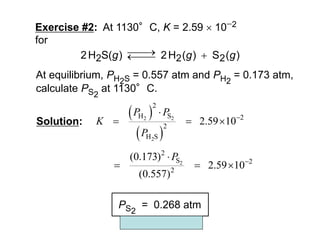
Exercise#2: At 1130°C, K = 2.59 102
for
)
(
S
)
(
H
2
)
S(
H
2 2
2
2 g
g
g
At equilibrium, PH2S = 0.557 atm and PH2
= 0.173 atm,
calculate PS2
at 1130°C.
Solution:
2 2
2
2
H S 2
2
H S
2.59 10
P P
K
P
PS2
= 0.268 atm
2
2
S 2
2
(0.173)
2.59 10
(0.557)
P
27.
Copyright McGraw-Hill 2009
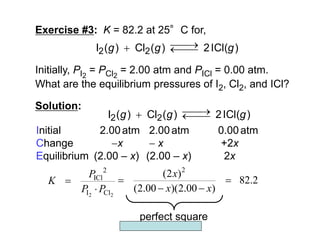
Exercise#3: K = 82.2 at 25°C for,
Initially, PI2
= PCl2
= 2.00 atm and PICl = 0.00 atm.
What are the equilibrium pressures of I2, Cl2, and ICl?
Solution:
)
ICl(
2
)
(
Cl
)
(
I 2
2 g
g
g
Initial 2.00atm 2.00atm 0.00atm
Change x x +2x
Equilibrium (2.00 – x) (2.00 – x) 2x
2 2
2
ICl
I Cl
P
K
P P
perfect square
2
(2 )
82.2
(2.00 )(2.00 )
x
x x
)
ICl(
2
)
(
Cl
)
(
I 2
2 g
g
g
28.
Copyright McGraw-Hill 2009
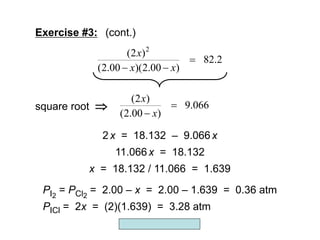
(2)
9.066
(2.00 )
x
x
square root
2x = 18.132 – 9.066x
11.066x = 18.132
x = 18.132 / 11.066 = 1.639
PI2
= PCl2
= 2.00 – x = 2.00 – 1.639 = 0.36 atm
PICl = 2x = (2)(1.639) = 3.28 atm
2
(2 )
82.2
(2.00 )(2.00 )
x
x x
Exercise #3: (cont.)
29.
Copyright McGraw-Hill 2009
Exercise#4: At 1280°C, Kc = 1.1 10
3 for
)
Br(
2
)
(
Br2 g
g
Initially, [Br2] = 6.3 10
2 M and [Br] = 1.2 10
2
M. What are the equilibrium concentrations of Br2
and Br at 1280°C?
Initial 6.3 102 M 1.2 102 M
Change -x +2x
Equilibrium (6.3 102) - x (1.2 102) + 2x
Solution: )
Br(
2
)
(
Br2 g
g
2 2 2
3
c 2
2
[Br] [(1.2 10 ) 2 ]
1.1 10
[Br ] (6.3 10 )
x
K
x
4x2 + 0.0491x + (7.47 105) = 0
30.
Copyright McGraw-Hill 2009
4x2+ 0.0491x + (7.47 10-5) =
0
quadratic equation: ax2 + bx + c = 0
2
4
2
b b ac
x
a
solution:
x = 1.779 103 and 1.050 102
Q: Two answers? Both negative? What’s happening?
Equilibrium Conc. x = 1.779 103 1.050 102
[Br2] = (6.3 102) – x = 0.0648 M 0.0735 M
[Br] = (1.2 102) + 2x = 0.00844 M 0.00900 M
impossible
[Br2] = 6.5 102 M
[Br] = 8.4 103 M
31.
Copyright McGraw-Hill 2009
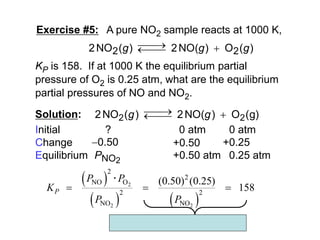
Exercise#5: A pure NO2 sample reacts at 1000 K,
KP is 158. If at 1000 K the equilibrium partial
pressure of O2 is 0.25 atm, what are the equilibrium
partial pressures of NO and NO2.
)
(
O
)
NO(
2
)
(
NO
2 2
2 g
g
g
Solution: )
g
(
O
)
NO(
2
)
(
NO
2 2
2
g
g
Initial ? 0 atm 0 atm
Change
Equilibrium 0.25 atm
+0.25
+0.50
+0.50 atm
0.50
2
2 2
2
2
NO O
2 2
NO NO
(0.50) (0.25)
158
P
P P
K
P P
rearrange and solve
PNO2
32.
Copyright McGraw-Hill 2009
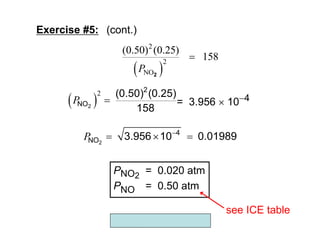
2
2
NO
(0.50) (0.25)
158
P
2
2
P
2
2
NO
(0.50) (0.25)
158
P
2
4
NO 3.956 10 0.01989
Exercise #5: (cont.)
= 3.956 104
PNO2
= 0.020 atm
PNO = 0.50 atm
see ICE table
33.
Copyright McGraw-Hill 2009
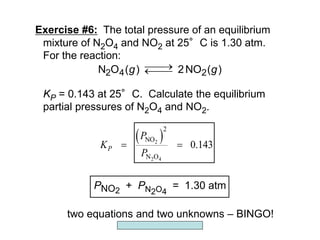
Exercise#6: The total pressure of an equilibrium
mixture of N2O4 and NO2 at 25°C is 1.30 atm.
For the reaction:
KP = 0.143 at 25°C. Calculate the equilibrium
partial pressures of N2O4 and NO2.
)
(
NO
2
)
(
O
N 2
4
2 g
g
2
2 4
2
NO
N O
0.143
P
P
K
P
PNO2
+ PN2O4
= 1.30 atm
two equations and two unknowns – BINGO!
34.
Copyright McGraw-Hill 2009
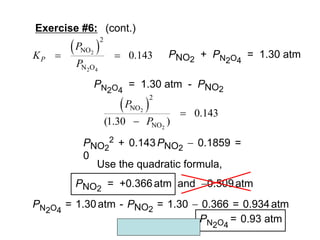
PNO2
2+ 0.143PNO2
0.1859 =
0
PN2O4
= 1.30 atm - PNO2
2
2
2
NO
NO
0.143
(1.30 )
P
P
2
2 4
2
NO
N O
0.143
P
P
K
P
PNO2
+ PN2O4
= 1.30 atm
Exercise #6: (cont.)
Use the quadratic formula,
PNO2
= +0.366atm and 0.509atm
PN2O4
= 1.30atm - PNO2
= 1.30 0.366 = 0.934atm
PN2O4
= 0.93 atm
Factors Affecting anEquilibrium System
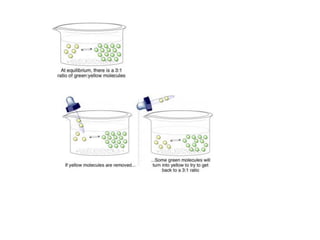
Equilibrium represents a balance between the
reactants and the products of a chemical reaction.
Changes to the conditions of the system can
disrupt that equilibrium.
When this occurs, the system reacts in such a
way as to restore the equilibrium.
37.
Stresses to achemical system include:
•changes in the concentrations of reactants
•changes in the concentrations of products
•changes in the temperature of the system
•changes in the pressure of the system
Factors Affecting an Equilibrium System
38.
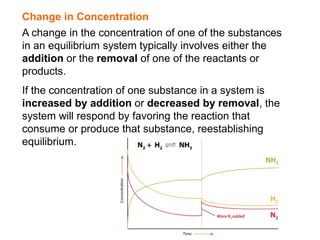
Change in Concentration
Achange in the concentration of one of the substances
in an equilibrium system typically involves either the
addition or the removal of one of the reactants or
products.
If the concentration of one substance in a system is
increased by addition or decreased by removal, the
system will respond by favoring the reaction that
consume or produce that substance, reestablishing
equilibrium.
40.
Change in Temperature
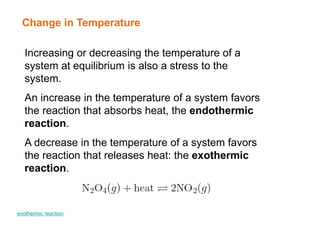
Increasingor decreasing the temperature of a
system at equilibrium is also a stress to the
system.
An increase in the temperature of a system favors
the reaction that absorbs heat, the endothermic
reaction.
A decrease in the temperature of a system favors
the reaction that releases heat: the exothermic
reaction.
exothermic reaction
41.
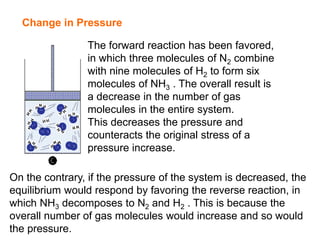
Change in Pressure
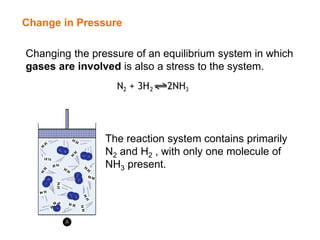
Changingthe pressure of an equilibrium system in which
gases are involved is also a stress to the system.
The reaction system contains primarily
N2 and H2 , with only one molecule of
NH3 present.
42.
Change in Pressure
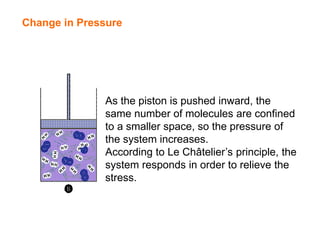
Asthe piston is pushed inward, the
same number of molecules are confined
to a smaller space, so the pressure of
the system increases.
According to Le Châtelier’s principle, the
system responds in order to relieve the
stress.
43.
Change in Pressure
Onthe contrary, if the pressure of the system is decreased, the
equilibrium would respond by favoring the reverse reaction, in
which NH3 decomposes to N2 and H2 . This is because the
overall number of gas molecules would increase and so would
the pressure.
The forward reaction has been favored,
in which three molecules of N2 combine
with nine molecules of H2 to form six
molecules of NH3 . The overall result is
a decrease in the number of gas
molecules in the entire system.
This decreases the pressure and
counteracts the original stress of a
pressure increase.
44.
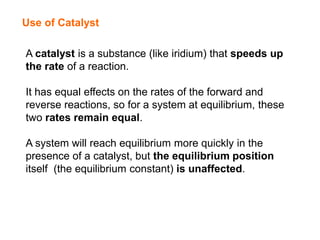
Use of Catalyst
Acatalyst is a substance (like iridium) that speeds up
the rate of a reaction.
It has equal effects on the rates of the forward and
reverse reactions, so for a system at equilibrium, these
two rates remain equal.
A system will reach equilibrium more quickly in the
presence of a catalyst, but the equilibrium position
itself (the equilibrium constant) is unaffected.
45.
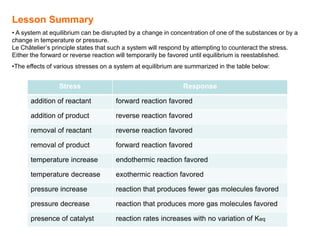
Lesson Summary
• Asystem at equilibrium can be disrupted by a change in concentration of one of the substances or by a
change in temperature or pressure.
Le Châtelier’s principle states that such a system will respond by attempting to counteract the stress.
Either the forward or reverse reaction will temporarily be favored until equilibrium is reestablished.
•The effects of various stresses on a system at equilibrium are summarized in the table below:
Stress Response
addition of reactant forward reaction favored
addition of product reverse reaction favored
removal of reactant reverse reaction favored
removal of product forward reaction favored
temperature increase endothermic reaction favored
temperature decrease exothermic reaction favored
pressure increase reaction that produces fewer gas molecules favored
pressure decrease reaction that produces more gas molecules favored
presence of catalyst reaction rates increases with no variation of Keq
46.
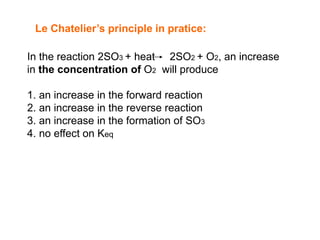
Le Chatelier’s principlein pratice:
In the reaction 2SO3 + heat 2SO2 + O2, an increase
in the concentration of O2 will produce
1. an increase in the forward reaction
2. an increase in the reverse reaction
3. an increase in the formation of SO3
4. no effect on Keq
Ionic
Equilibria (I)
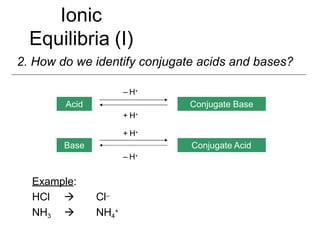
An acidis a proton (H+) donor.
•
•
•
A base is proton acceptor.
In an acid-base reaction, the transfer of protons occurs
from an acid to a base.
1. How do we identify acids and bases?
Bronsted-Lowry Definition
Tip: It may be helpful for beginners to memorise some
common acids and bases.
Ionic
Equilibria (I)
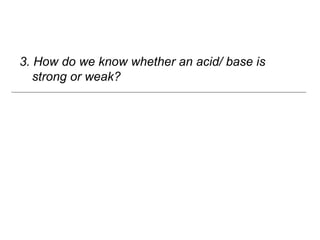
3. Howdo we know whether an acid/ base is
strong or weak?
Strong acids/ bases ionise completely in aqueous solution.
Weak acids/ bases ionise partially in aqueous solution.
Tip: An acid/ base can be predicted to be weak when:
• It is stated so in the question
• Ka or Kb value is given
• Degree/ percent of ionisation is given
• [H3O+] < [HA]; [OH–] < [B]
Ionic Equilibria
(II)
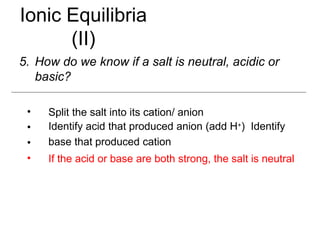
5. Howdo we know if a salt is neutral, acidic or
basic?
•
•
•
•
Split the salt into its cation/ anion
Identify acid that produced anion (add H+) Identify
base that produced cation
If the acid or base are both strong, the salt is neutral
61.
Ionic Equilibria
(II)
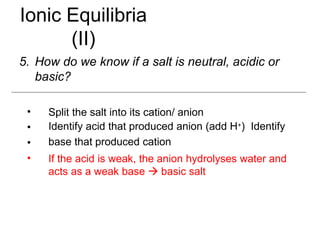
5. Howdo we know if a salt is neutral, acidic or
basic?
•
•
•
•
Split the salt into its cation/ anion
Identify acid that produced anion (add H+) Identify
base that produced cation
If the acid is weak, the anion hydrolyses water and
acts as a weak base basic salt
62.
Ionic Equilibria
(II)
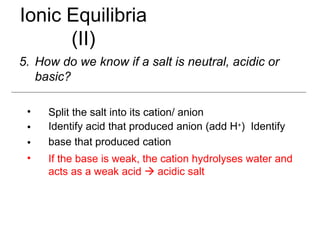
5. Howdo we know if a salt is neutral, acidic or
basic?
•
•
•
•
Split the salt into its cation/ anion
Identify acid that produced anion (add H+) Identify
base that produced cation
If the base is weak, the cation hydrolyses water and
acts as a weak acid acidic salt
Ionic Equilibria
(II)
6. Howdo we calculate the pH of a salt solution?
•
• Identify ion that hydrolyses H2O
• Write equation of the ion with H2O
• Find Ka/ Kb of the ion from Kb/ Ka of the parent acid/
base
Find pH by treating ion as weak acid or weak base
Recall:
[H3O+] = Ka ×
[HA]
[OH–] = Kb ×
[B]
Ionic Equilibria
(III)
7. Howdo know if a salt is sparingly soluble?
• From O level QA knowledge.
• When Ksp is given.
• When it is stated so in the question.
68.
Ionic Equilibria
(III)
General Tips
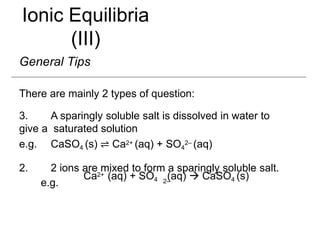
Thereare mainly 2 types of question:
3. A sparingly soluble salt is dissolved in water to
give a saturated solution
e.g. CaSO4 (s) ⇌ Ca2+ (aq) + SO4
2– (aq)
2. 2 ions are mixed to form a sparingly soluble salt.
e.g.
Ca2+ (aq) + SO4 (aq) CaSO4 (s)
2–
69.
Ionic Equilibria
(III)
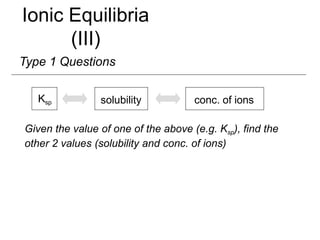
Type 1Questions
Ksp solubility conc. of ions
Given the value of one of the above (e.g. Ksp), find the
other 2 values (solubility and conc. of ions)
70.
Ionic Equilibria
(III)
Type 1Questions (Strategy)
I
CaF2 (s) ⇌ Ca2+ (aq) + 2F– (aq)
? 0 0
C -x +x +2x
E ? x 2x
Ksp solubility conc. of ions
Expressing each term in x can help in the interconversion.
solubility = x
Ksp = 4x3
[Ca2+] = x
[F–] = 2x
71.
Ionic Equilibria
(III)
Type 2Questions
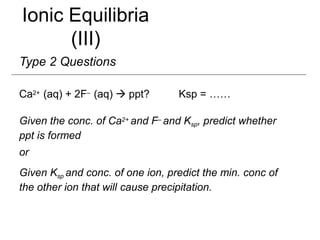
Ca2+ (aq) + 2F– (aq) ppt? Ksp = ……
Given the conc. of Ca2+ and F– and Ksp, predict whether
ppt is formed
or
Given Ksp and conc. of one ion, predict the min. conc of
the other ion that will cause precipitation.
72.
Ionic Equilibria
(III)
Type 2Questions (Strategy)
•
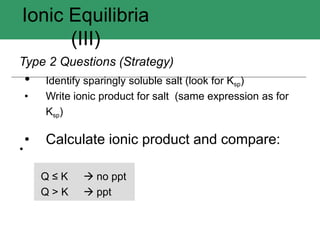
• Identify sparingly soluble salt (look for Ksp)
• Write ionic product for salt (same expression as for
Ksp)
• Calculate ionic product and compare:
Q ≤ K no ppt
Q > K ppt
![Copyright McGraw-Hill 2009
15.2 The Equilibrium Constant
rateforward ratereverse
At equilibrium,
2
f 2 4 eq r 2 eq
[N O ] [NO ]
k k
)
(
NO
2
)
(
O
N 2
4
2 g
g
or
2
2 eq
f
c
r 2 4 eq
[NO ]
[N O ]
k
K
k
where Kc is the equilibrium constant](https://image.slidesharecdn.com/chapter7equilibrium-ppt-250518064119-0fce0474/85/Chapter-7-Equilibrium-chemistry-class-11-ppt-pdf-8-320.jpg)
![Copyright McGraw-Hill 2009
The Equilibrium Constant
For the NO2 / N2O4 system:
equilibrium constant expression
equilibrium constant
2
4
[NO ]
O ]
K
2
2
0.143 at 25 C
[N
)
(
NO
2
)
(
O
N 2
4
2 g
g
Note: at100°C, K =
6.45](https://image.slidesharecdn.com/chapter7equilibrium-ppt-250518064119-0fce0474/85/Chapter-7-Equilibrium-chemistry-class-11-ppt-pdf-10-320.jpg)
![Copyright McGraw-Hill 2009
The Equilibrium Constant
reaction quotient = Qc = the value of the
“equilibrium constant expression” under
any conditions.
)
(
COCl
)
(
Cl
)
CO( 2
2 g
g
g
For,
2 eq
c
eq 2 eq
[COCl ]
[CO] [Cl ]
K 2
c
2
[COCl ]
[CO][Cl ]
Q
Q > K reverse reaction favored
Q = K equilibrium present
Q < K forward reaction favored](https://image.slidesharecdn.com/chapter7equilibrium-ppt-250518064119-0fce0474/85/Chapter-7-Equilibrium-chemistry-class-11-ppt-pdf-11-320.jpg)
![Copyright McGraw-Hill 2009
The Equilibrium Constant
The Law of Mass Action:
Cato Maximilian Guldberg & Peter Waage,
Forhandlinger: Videnskabs-Selskabet i
Christiana 1864, 35.
K
c d
c a b
[C] [D]
[A] [B]
For a reaction: D
C
B
A d
c
b
a
C D
A B
P
P P
K
P P
c d
a b
For gases:
For solutions: [ ] = mol/L
P in atm](https://image.slidesharecdn.com/chapter7equilibrium-ppt-250518064119-0fce0474/85/Chapter-7-Equilibrium-chemistry-class-11-ppt-pdf-12-320.jpg)
![. .
Relationship between Kc and Kp
• Relationship between concentration and pressure obtained from the
ideal gas law.
– Assuming all the species behaving like ideal gasses
– PV = nRT or P=(n/V)RT=[Conc]RT
– Substitute for P in equilibrium expression.
– Consider the reaction:
aA(g) + bB(g) cC(g) + dD(g)
RT
]
A
[
RT
V
n
P A
A
n
c
)
b
a
(
)
d
c
(
c
P
b
a
b
a
d
c
d
c
b
a
d
c
b
B
a
A
d
D
c
C
P
RT
K
RT
K
K
RT
]
B
[
]
A
[
RT
]
D
[
]
C
[
RT
]
B
[
RT
]
A
[
RT
]
D
[
RT
]
C
[
P
P
P
P
K
](https://image.slidesharecdn.com/chapter7equilibrium-ppt-250518064119-0fce0474/85/Chapter-7-Equilibrium-chemistry-class-11-ppt-pdf-14-320.jpg)
![Copyright McGraw-Hill 2009
15.3 Equilibrium Expressions
homogeneous equilibria = equilibria in which all
reactants and products are in the same phase.
• [CaO] and [CaCO3] are solids.
• Pure solids and liquids are omitted from equilibrium
constant expressions.
)
(
CO
)
CaO(
)
(
CaCO 2
3 g
s
s
Ex:
The equilibrium constant expression is,
K = [CO2]
heterogeneous equilibria = equilibria in which all
reactants and products are not in the same phase.](https://image.slidesharecdn.com/chapter7equilibrium-ppt-250518064119-0fce0474/85/Chapter-7-Equilibrium-chemistry-class-11-ppt-pdf-15-320.jpg)
![. .
Using the Equilibrium
Constant
• Direction of Reaction: the reaction quotient can be used to determine
the direction of a reaction with certain initial concentrations.
• Reaction Quotient: For the general reaction,
aA + bB cC + dD,.
where the t refers to the time that concentrations of the mixture are
measured; not necessarily at equilibrium.
• Comparison of Qc with Kc reveals direction of reaction.
• When only reactants Qc = 0; leads to
– If Qc < Kc, products will form.
• When only products present, Qc .
– If Qc > Kc, reactants will form.
• When Qc = Kc, no net reaction.
E.g. Determine direction of reaction: H2(g) + I2(g) 2HI(g). Assume
that [H2]o = [I2]o = [HI]o = 0.0020M at 490oC for which Kc = 46.
b
a
c
t
d
t
c
[B]
[A]
[C]
[D]
Q
t
t
](https://image.slidesharecdn.com/chapter7equilibrium-ppt-250518064119-0fce0474/85/Chapter-7-Equilibrium-chemistry-class-11-ppt-pdf-17-320.jpg)
![Copyright McGraw-Hill 2009
Equilibrium Expressions
A. Reverse Equations
[1]
)
(
NO
2
)
(
O
N 2
4
2 g
g
For,
Conclusion:
2
1
1
K
K
C
1
6.99 at 25
0.143
C
P
K
P
2
2 4
NO
1
N O
2
0.143 at 25
[2]
)
(
O
N
)
(
NO
2 4
2
2 g
g
For,
2 4
2
N O
NO
P
K
P
2 2](https://image.slidesharecdn.com/chapter7equilibrium-ppt-250518064119-0fce0474/85/Chapter-7-Equilibrium-chemistry-class-11-ppt-pdf-19-320.jpg)
![Copyright McGraw-Hill 2009
Equilibrium Expressions
B. Coefficient Changes
[1]
)
(
NO
2
)
(
O
N 2
4
2 g
g
For,
Conclusion:
3 1
K K
C
0.143 0.378 at 25
For, [3]
)
(
NO
)
(
O
N
2
1
2
4
2 g
g
2
2 4
NO
1/2
N O
P
K
P
3
C
P
K
P
2
2 4
NO
1
N O
2
0.143 at 25](https://image.slidesharecdn.com/chapter7equilibrium-ppt-250518064119-0fce0474/85/Chapter-7-Equilibrium-chemistry-class-11-ppt-pdf-20-320.jpg)
![Copyright McGraw-Hill 2009
Equilibrium Expressions
C. Reaction Sum (related to Hess’ Law)
[1]
)
(
NO
2
)
(
O
N 2
4
2 g
g
For,
For, [4]
)
(
O
)
NO(
2
)
(
NO
2 2
2 g
g
g
2
2
NO O
NO
P P
K
P
2
4 2
Add [1] + [4],
[5]
)
(
O
)
NO(
2
)
(
O
N 2
4
2 g
g
g
2
2 4
NO O
N O
P P
K
P
2
5
4
2
2
O
N
NO
1
P
P
K
2
K K
1 4](https://image.slidesharecdn.com/chapter7equilibrium-ppt-250518064119-0fce0474/85/Chapter-7-Equilibrium-chemistry-class-11-ppt-pdf-21-320.jpg)
![Copyright McGraw-Hill 2009
Exercise #4: At 1280°C, Kc = 1.1 10
3 for
)
Br(
2
)
(
Br2 g
g
Initially, [Br2] = 6.3 10
2 M and [Br] = 1.2 10
2
M. What are the equilibrium concentrations of Br2
and Br at 1280°C?
Initial 6.3 102 M 1.2 102 M
Change -x +2x
Equilibrium (6.3 102) - x (1.2 102) + 2x
Solution: )
Br(
2
)
(
Br2 g
g
2 2 2
3
c 2
2
[Br] [(1.2 10 ) 2 ]
1.1 10
[Br ] (6.3 10 )
x
K
x
4x2 + 0.0491x + (7.47 105) = 0](https://image.slidesharecdn.com/chapter7equilibrium-ppt-250518064119-0fce0474/85/Chapter-7-Equilibrium-chemistry-class-11-ppt-pdf-29-320.jpg)
![Copyright McGraw-Hill 2009
4x2 + 0.0491x + (7.47 10-5) =
0
quadratic equation: ax2 + bx + c = 0
2
4
2
b b ac
x
a
solution:
x = 1.779 103 and 1.050 102
Q: Two answers? Both negative? What’s happening?
Equilibrium Conc. x = 1.779 103 1.050 102
[Br2] = (6.3 102) – x = 0.0648 M 0.0735 M
[Br] = (1.2 102) + 2x = 0.00844 M 0.00900 M
impossible
[Br2] = 6.5 102 M
[Br] = 8.4 103 M](https://image.slidesharecdn.com/chapter7equilibrium-ppt-250518064119-0fce0474/85/Chapter-7-Equilibrium-chemistry-class-11-ppt-pdf-30-320.jpg)
![Ionic
Equilibria (I)
3. How do we know whether an acid/ base is
strong or weak?
Strong acids/ bases ionise completely in aqueous solution.
Weak acids/ bases ionise partially in aqueous solution.
Tip: An acid/ base can be predicted to be weak when:
• It is stated so in the question
• Ka or Kb value is given
• Degree/ percent of ionisation is given
• [H3O+] < [HA]; [OH–] < [B]](https://image.slidesharecdn.com/chapter7equilibrium-ppt-250518064119-0fce0474/85/Chapter-7-Equilibrium-chemistry-class-11-ppt-pdf-53-320.jpg)
![Ionic
Equilibria (I)
4. How do we calculate pH of an acid/ base?
(I) Learn the important terms/ relations
• pH, pOH
• Ka, pKa
• Kb, pKb
• Kw
pH + pOH = 14
pKa + pKb = 14
[H+][OH–] = 10-14
Ka . Kb = Kw = 10-14](https://image.slidesharecdn.com/chapter7equilibrium-ppt-250518064119-0fce0474/85/Chapter-7-Equilibrium-chemistry-class-11-ppt-pdf-55-320.jpg)
![Ionic
Equilibria (I)
4. How do we calculate pH of an acid/ base?
(II) Determine strong or weak
Strong acids ionise completely in aqueous solution.
[H3O+] = [HA] pH = - log [HA]
Strong bases ionise completely in aqueous solution.
[OH-] = [B] pOH = - log [B]
Strong Acid
Strong Base](https://image.slidesharecdn.com/chapter7equilibrium-ppt-250518064119-0fce0474/85/Chapter-7-Equilibrium-chemistry-class-11-ppt-pdf-56-320.jpg)
![Ionic
Equilibria (I)
4. How do we calculate pH of an acid/ base?
(II) Determine strong or weak
Weak bases ionise partially in aqueous solution.
[OH-] < [B] pOH = - log [OH–]
Weak Acid
Weak Base
Weak acids ionise partially in aqueous solution.
[H3O+] < [HA] pH = - log [H3O+]
[H3O+] = Ka ×C
[HA]
[OH–] = Kb ×C
[B]](https://image.slidesharecdn.com/chapter7equilibrium-ppt-250518064119-0fce0474/85/Chapter-7-Equilibrium-chemistry-class-11-ppt-pdf-57-320.jpg)

![Ionic Equilibria
(II)
6. How do we calculate the pH of a salt solution?
•
• Identify ion that hydrolyses H2O
• Write equation of the ion with H2O
• Find Ka/ Kb of the ion from Kb/ Ka of the parent acid/
base
Find pH by treating ion as weak acid or weak base
Recall:
[H3O+] = Ka ×
[HA]
[OH–] = Kb ×
[B]](https://image.slidesharecdn.com/chapter7equilibrium-ppt-250518064119-0fce0474/85/Chapter-7-Equilibrium-chemistry-class-11-ppt-pdf-64-320.jpg)
![Ionic Equilibria
(III)
Type 1 Questions (Strategy)
I
CaF2 (s) ⇌ Ca2+ (aq) + 2F– (aq)
? 0 0
C -x +x +2x
E ? x 2x
Ksp solubility conc. of ions
Expressing each term in x can help in the interconversion.
solubility = x
Ksp = 4x3
[Ca2+] = x
[F–] = 2x](https://image.slidesharecdn.com/chapter7equilibrium-ppt-250518064119-0fce0474/85/Chapter-7-Equilibrium-chemistry-class-11-ppt-pdf-70-320.jpg)