Reversible Reactions
Lecture 11Dr. Mohamed B. Suliman
Physical chemistry
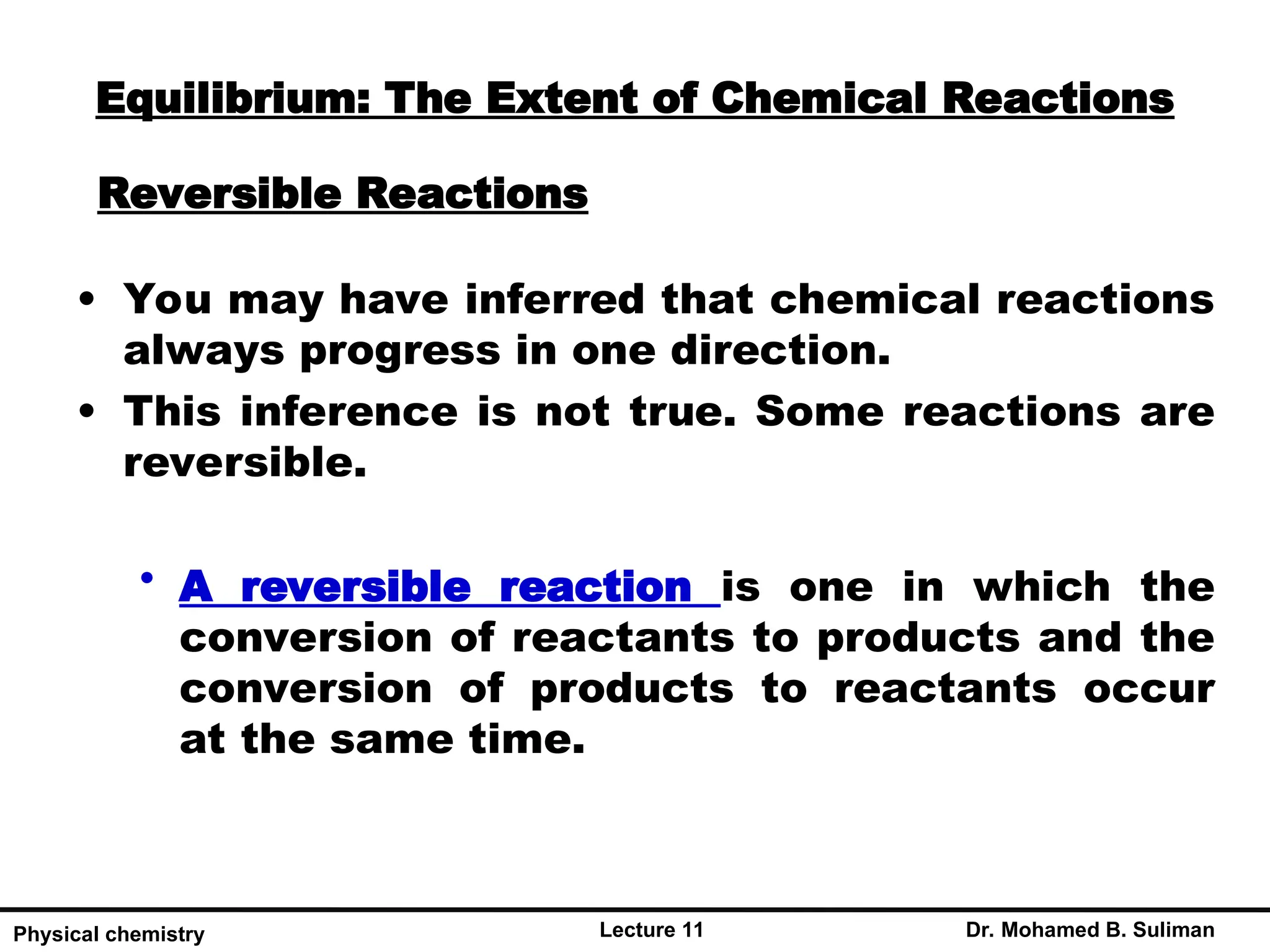
• You may have inferred that chemical reactions
always progress in one direction.
• This inference is not true. Some reactions are
reversible.
• A reversible reaction is one in which the
conversion of reactants to products and the
conversion of products to reactants occur
at the same time.
Equilibrium: The Extent of Chemical Reactions
2.
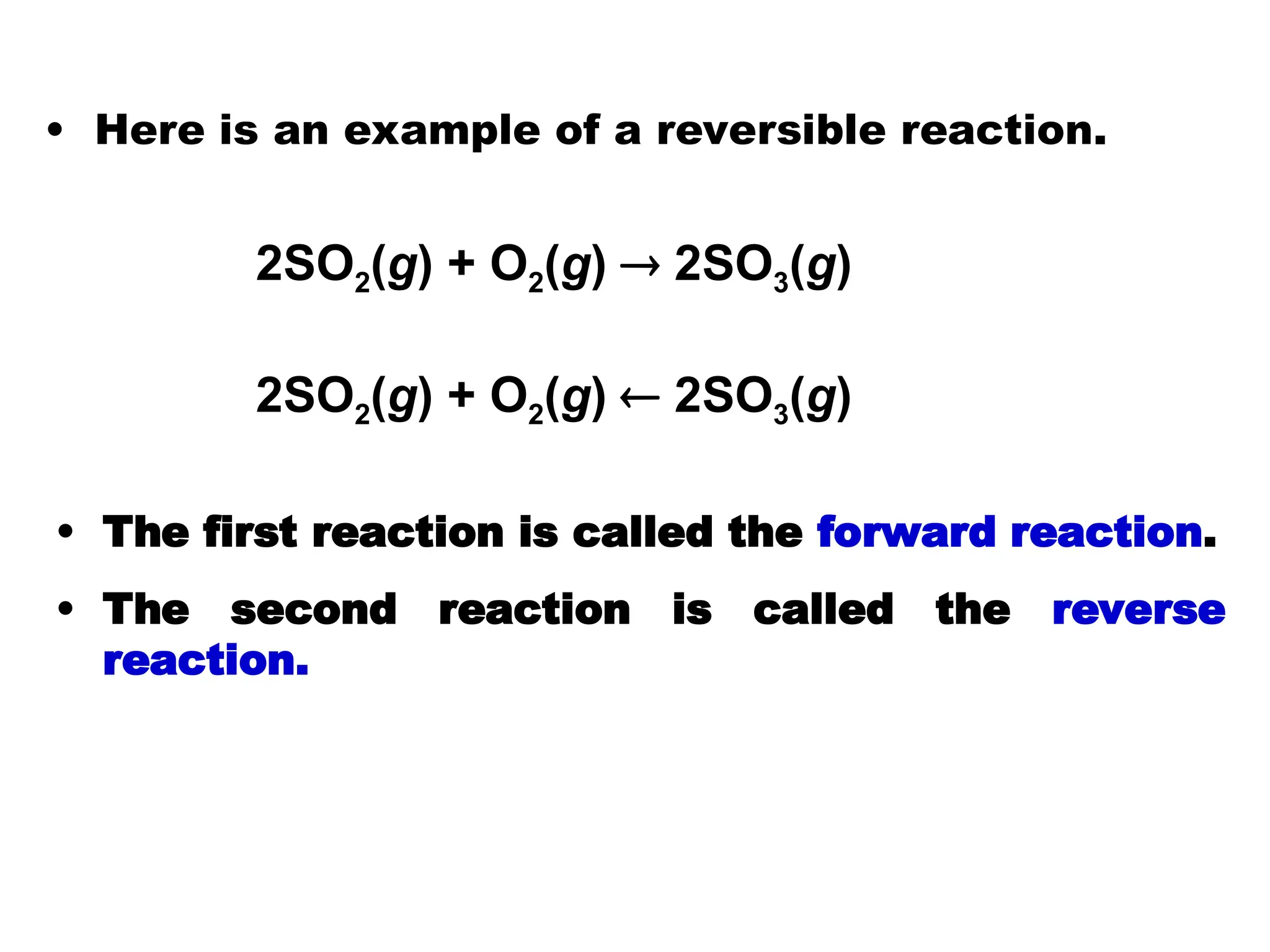
• Here isan example of a reversible reaction.
• The first reaction is called the forward reaction.
• The second reaction is called the reverse
reaction.
2SO2(g) + O2(g) 2SO3(g)
2SO2(g) + O2(g) 2SO3(g)
3.
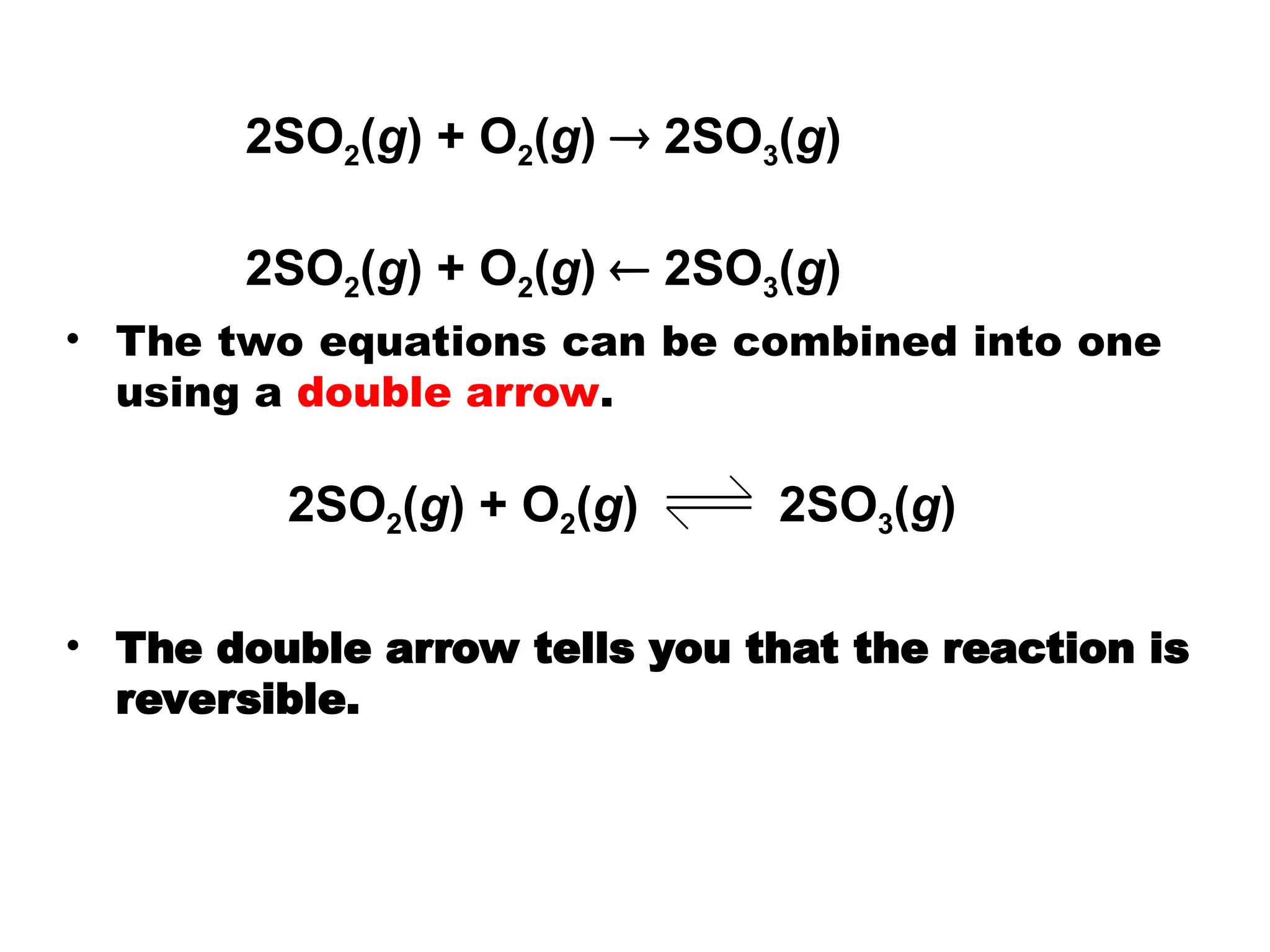
• The twoequations can be combined into one
using a double arrow.
• The double arrow tells you that the reaction is
reversible.
2SO2(g) + O2(g) 2SO3(g)
2SO2(g) + O2(g) 2SO3(g)
2SO2(g) + O2(g) 2SO3(g)
4.
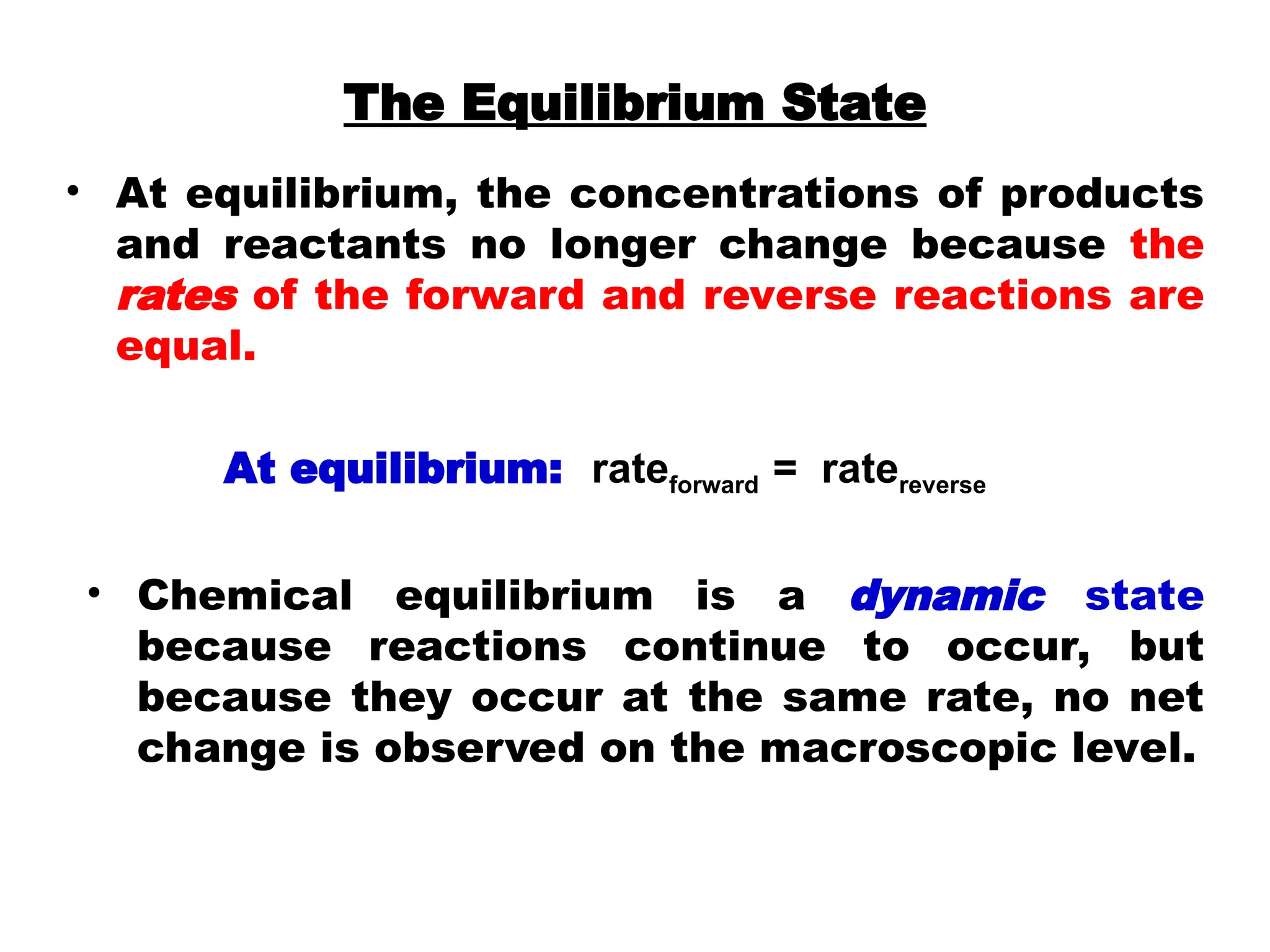
• At equilibrium,the concentrations of products
and reactants no longer change because the
rates of the forward and reverse reactions are
equal.
At equilibrium: rateforward = ratereverse
• Chemical equilibrium is a dynamic state
because reactions continue to occur, but
because they occur at the same rate, no net
change is observed on the macroscopic level.
The Equilibrium State
5.
At equilibrium ratefwd= raterev
so kfwd[N2O4] = krev[NO2]
2
kfwd
krev
[NO2]
[N2O4]
2
=
then
The ratio of constants gives a new constant, the
equilibrium constant:
kfwd
krev
[NO2]
[N2O4]
2
=
K =
Consider the reaction of N2O4(g) 2NO2(g)
The Equilibrium Constant
6.
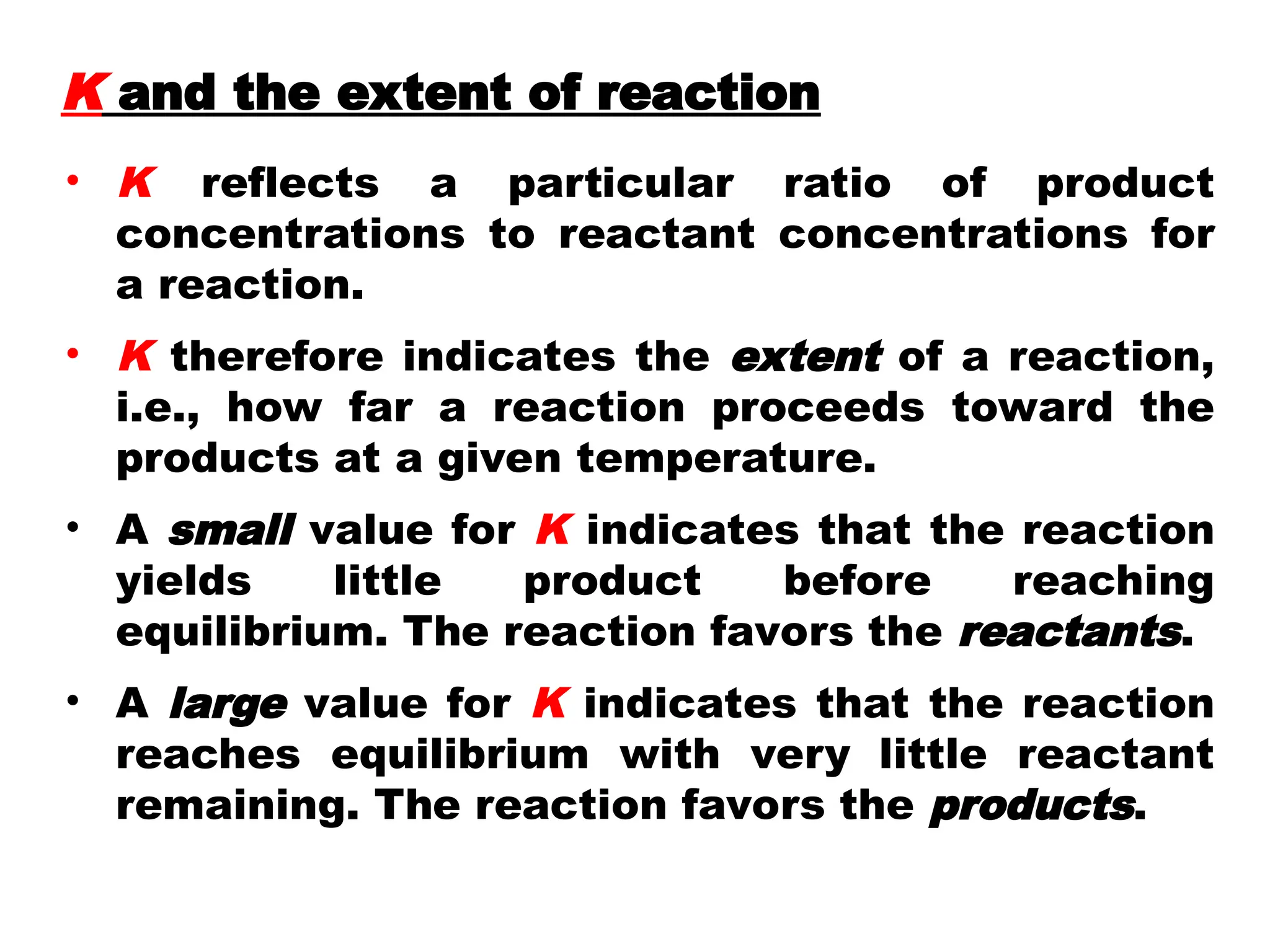
• K reflectsa particular ratio of product
concentrations to reactant concentrations for
a reaction.
• K therefore indicates the extent of a reaction,
i.e., how far a reaction proceeds toward the
products at a given temperature.
• A small value for K indicates that the reaction
yields little product before reaching
equilibrium. The reaction favors the reactants.
• A large value for K indicates that the reaction
reaches equilibrium with very little reactant
remaining. The reaction favors the products.
K and the extent of reaction
7.
For the generalreaction aA + bB cC + dD
the reaction quotient Qc =
[C]c
[D]d
[A]a
[B]b
• Q gives the ratio of product concentrations to reactant
concentrations at any point in a reaction.
At equilibrium: Q = K
• For a particular system and temperature, the same
equilibrium state is attained regardless of starting
concentrations. The value of Q indicates how close the
reaction is to equilibrium, and in which direction it
must proceed to reach equilibrium.
The Reaction Quotient Q
Qc =
[CO2]3
[H2O]4
[C3H8][O2]5
Qc =
[NO2]4
[O2]
[N2O5]2
2N2O5(g)4NO2(g) + O2(g)
(a)
(b) C3H8(g) + 5 O2(g) 3 CO2(g) + 4 H2O(g)
Solution
First We balance the equations and then construct the reaction quotient.
Write the reaction quotient, Qc, for each of the following reactions:
(a) N2O5(g) NO2(g) + O2(g)
(b) C3H8(g) + O2(g) CO2(g) + H2O(g)
Examples
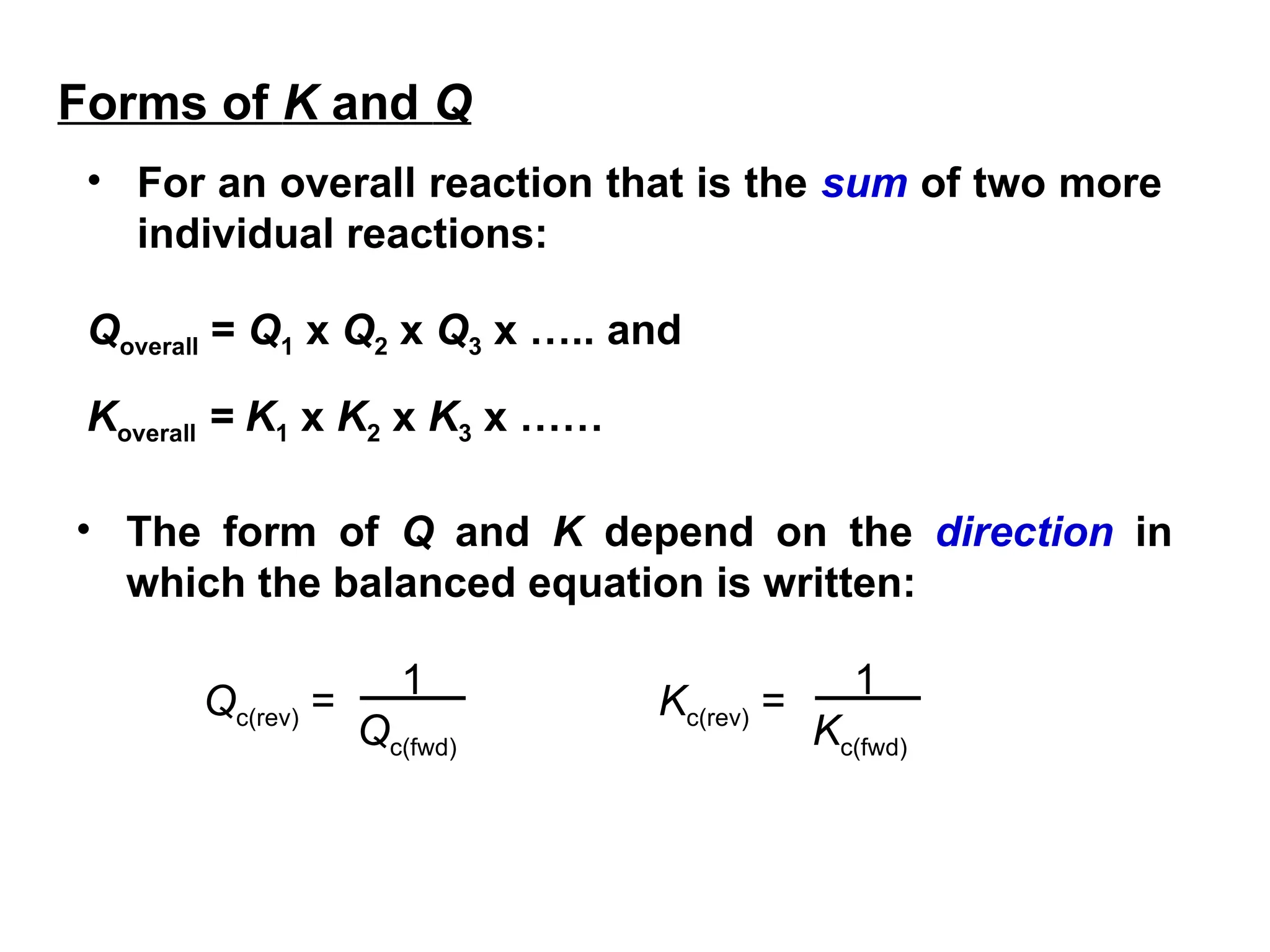
10.
• For anoverall reaction that is the sum of two more
individual reactions:
Qoverall = Q1 x Q2 x Q3 x ….. and
Koverall = K1 x K2 x K3 x ……
• The form of Q and K depend on the direction in
which the balanced equation is written:
1
Qc(fwd)
Qc(rev) = 1
Kc(fwd)
Kc(rev) =
Forms of K and Q
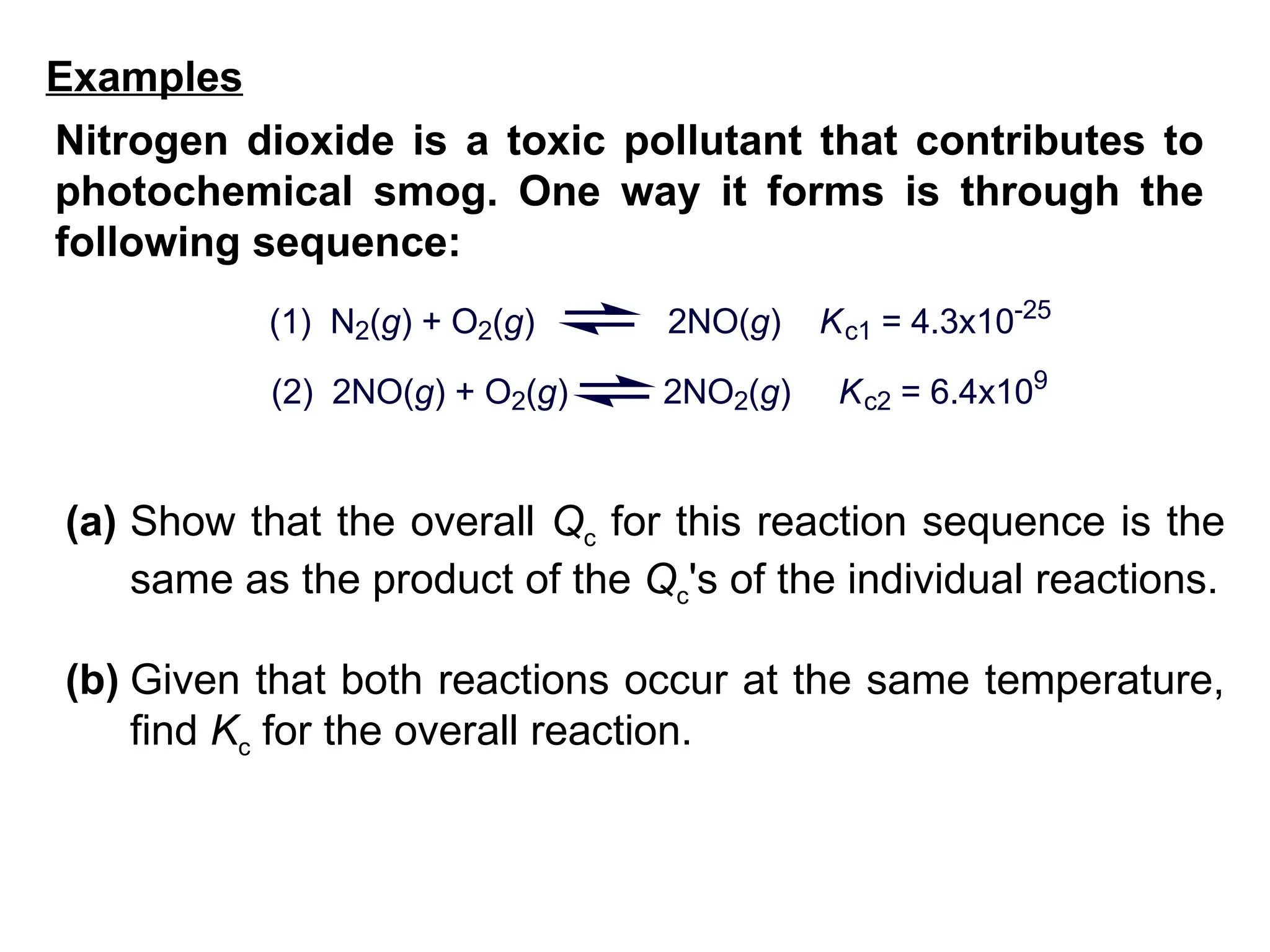
11.
(a) Show thatthe overall Qc for this reaction sequence is the
same as the product of the Qc's of the individual reactions.
(b) Given that both reactions occur at the same temperature,
find Kc for the overall reaction.
(1) N2(g) + O2(g) 2NO(g) Kc1 = 4.3x10⁻²⁵
(2) 2NO(g) + O2(g) 2NO2(g) Kc2 = 6.4x10⁹
Nitrogen dioxide is a toxic pollutant that contributes to
photochemical smog. One way it forms is through the
following sequence:
Examples
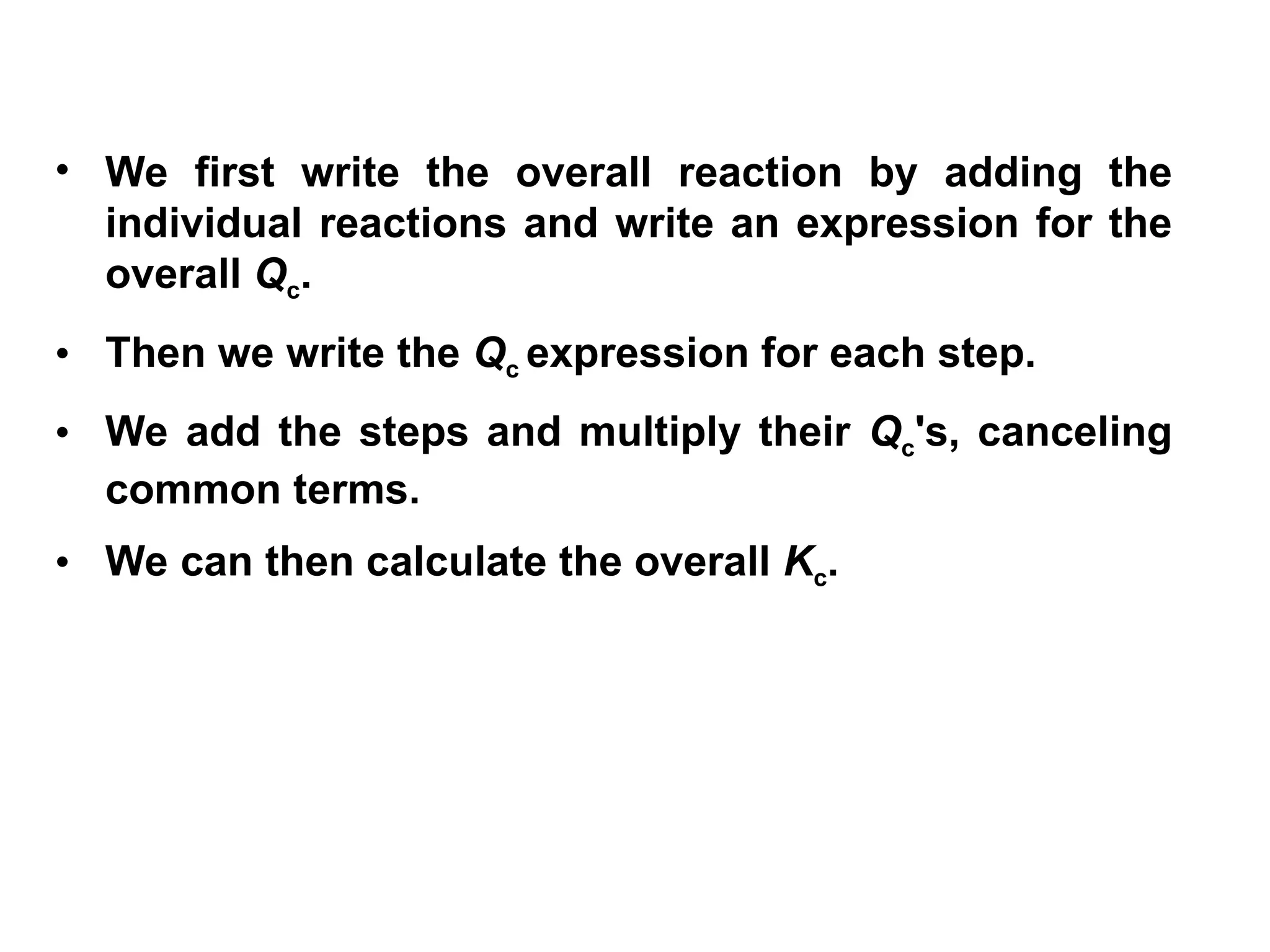
12.
• We firstwrite the overall reaction by adding the
individual reactions and write an expression for the
overall Qc.
• Then we write the Qc expression for each step.
• We add the steps and multiply their Qc's, canceling
common terms.
• We can then calculate the overall Kc.
• A heterogeneousequilibrium involves reactants and/or products
in different phases.
CaCO3(s) CaO(s) + CO2(g)
• A pure solid or liquid always has the same “concentration”, i.e.,
the same number of moles per liter of solid or liquid.
• The expressions for Q and K include only species whose
concentrations change as the reaction approaches equilibrium.
• Pure solids and liquids are omitted from the expression for Q or K..
For the above reaction, Q = [CO2]
K and Q for heterogeneous equilibrium
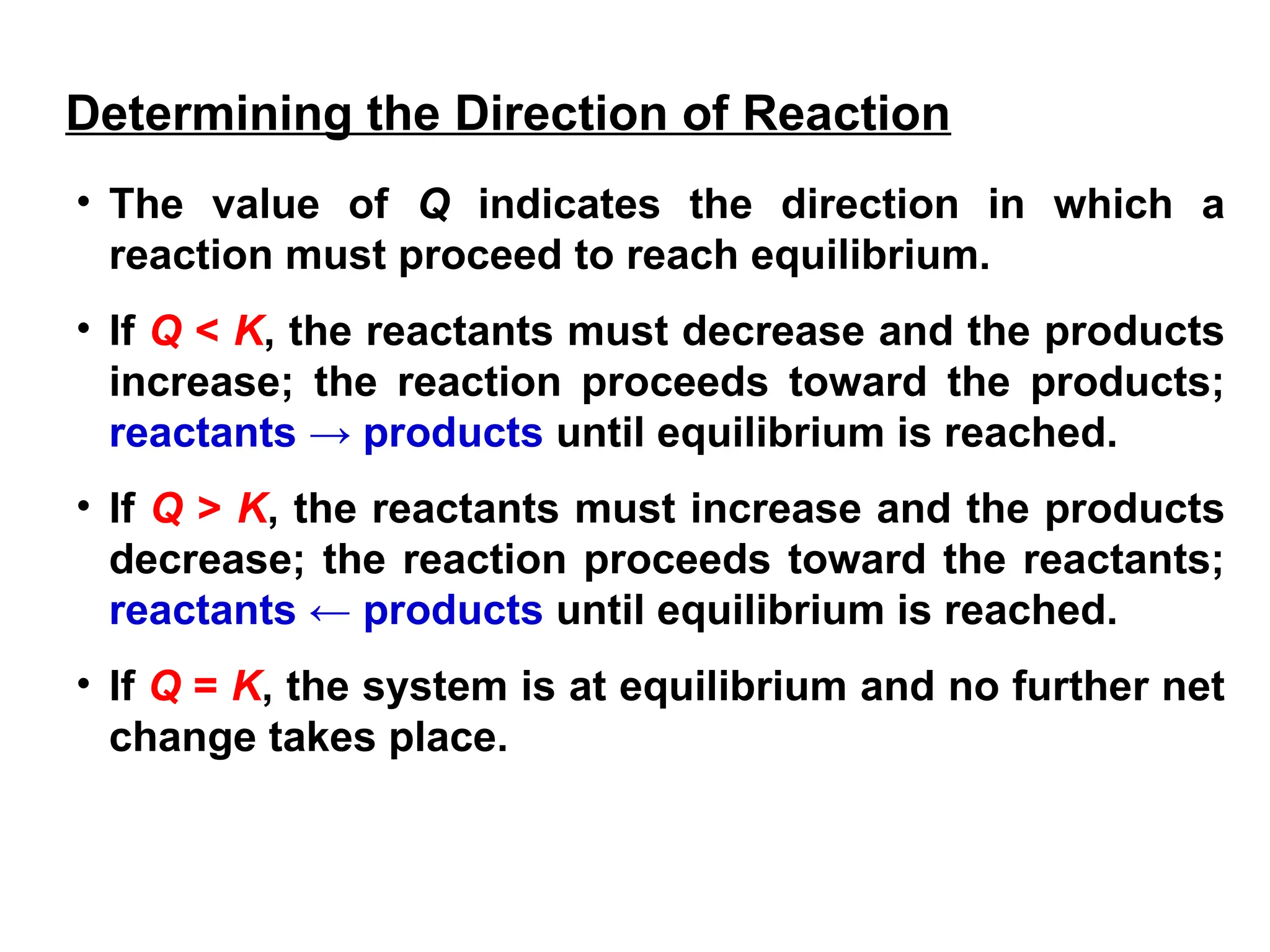
15.
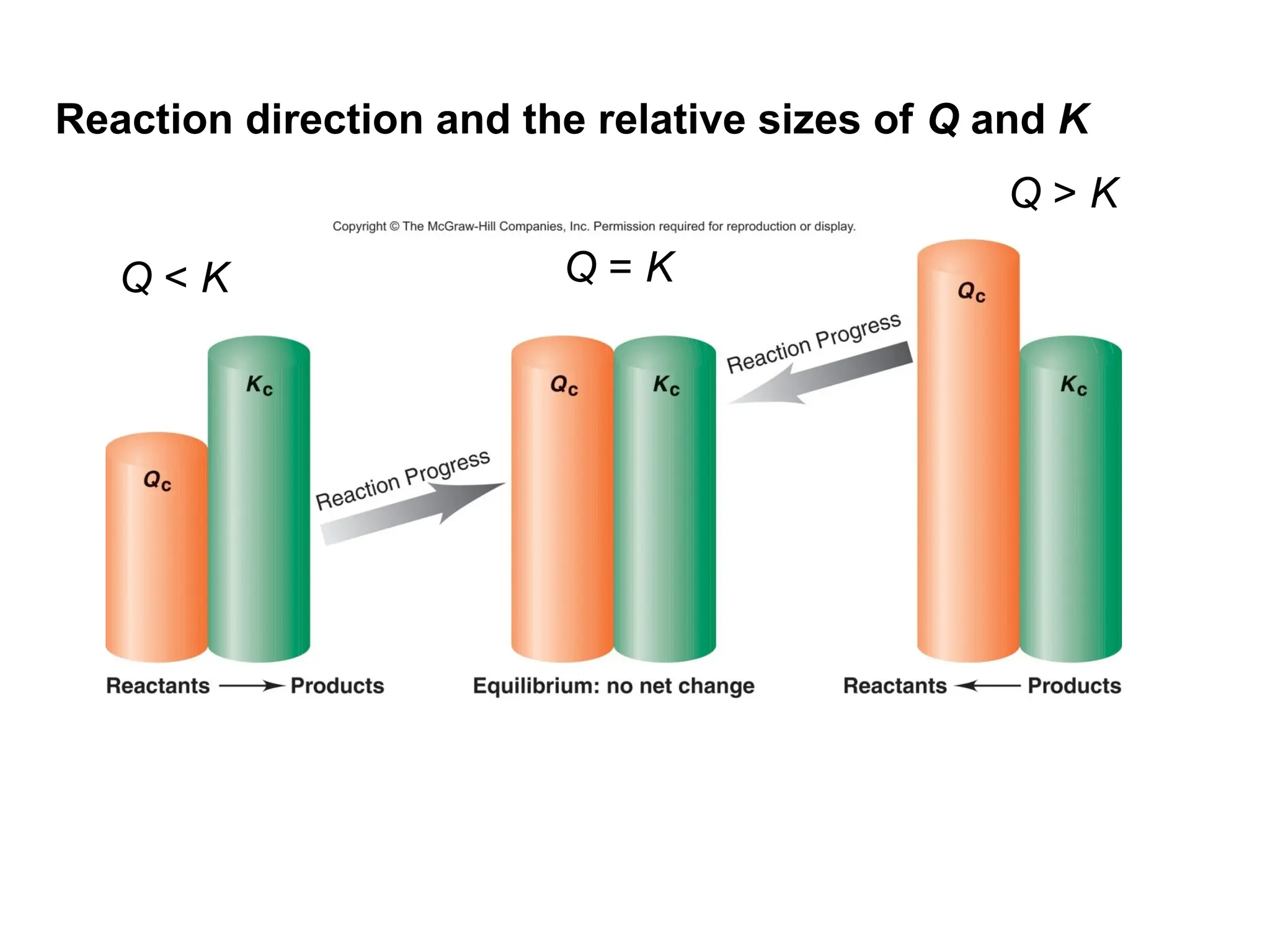
• The valueof Q indicates the direction in which a
reaction must proceed to reach equilibrium.
• If Q < K, the reactants must decrease and the products
increase; the reaction proceeds toward the products;
reactants → products until equilibrium is reached.
• If Q > K, the reactants must increase and the products
decrease; the reaction proceeds toward the reactants;
reactants ← products until equilibrium is reached.
• If Q = K, the system is at equilibrium and no further net
change takes place.
Determining the Direction of Reaction
16.
Q < K
Q> K
Q = K
Reaction direction and the relative sizes of Q and K
17.
Qc =
[NO2]2
[N2O4]
=
(0.55)2
(0.12)
= 2.5
Qc> Kc, therefore the reaction is not at equilibrium and will proceed
from right to left, from products to reactants, until Qc = Kc.
For the reaction N2O4(g) 2NO2(g), Kc = 0.21 at 100ºC. At a point
during the reaction, [N2O4] = 0.12 M and [NO2] = 0.55 M. Is the reaction
at equilibrium? If not, in which direction is it progressing?
We write an expression for Qc, find its value by substituting the
given concentrations, and compare its value with the given Kc.
Example
Solution
18.
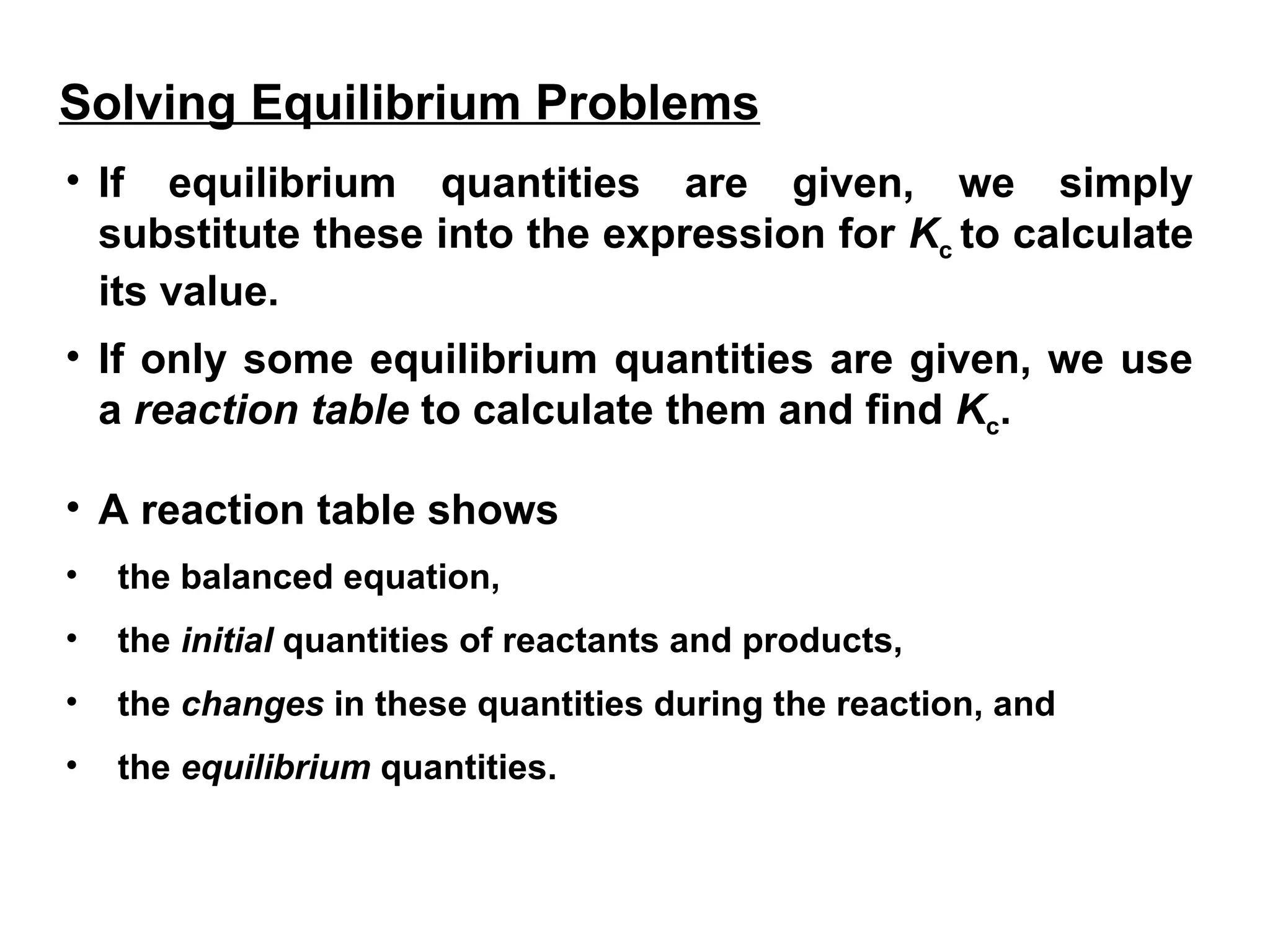
• If equilibriumquantities are given, we simply
substitute these into the expression for Kc to calculate
its value.
• If only some equilibrium quantities are given, we use
a reaction table to calculate them and find Kc.
• A reaction table shows
• the balanced equation,
• the initial quantities of reactants and products,
• the changes in these quantities during the reaction, and
• the equilibrium quantities.
Solving Equilibrium Problems
19.
At equilibrium, [HI]= 0.078 M. Calculate Kc.
To calculate Kc we need equilibrium concentrations. We can find the
initial [HI] from the amount and the flask volume, and we are given
[HI] at equilibrium. From the balanced equation, when 2x mol of HI
reacts, x mol of H2 and x mol of I2 form. We use this information to
set up a reaction table.
[HI] =
0.200 mol
2.00 L
= 0.100 M
2HI(g) H2(g) + I2(g)
Calculating initial [HI]:
Example
In order to study hydrogen halide decomposition, a researcher fills
an evacuated 2.00-L flask with 0.200 mol of HI gas and allows the
reaction to proceed at 453ºC.
Solution
20.
[HI] = 0.078= 0.100 – 2x; x = 0.011 M
Qc =
[H2] [I2]
[HI]2
=
(0.011)(0.011)
(0.078)2
= 0.020 = Kc
0.100 0 0
– 2x + x + x
0.100 – 2x x x
Initial
Change
Equilibrium
Concentration (M) 2HI(g) H2(g) + I2(g)
21.
In a studyof the conversion of methane to other fuels, a chemical
engineer mixes gaseous CH4 and H2O in a 0.32-L flask at 1200 K. At
equilibrium the flask contains 0.26 mol of CO, 0.091 mol of H2, and
0.041 mol of CH4. What is [H2O] at equilibrium? Kc = 0.26 for this
process at 1200 K.
First we write the balanced equation and the expression for Qc. We
calculate the equilibrium concentrations from the given numbers of
moles and the flask volume. We then use the value of Kc to solve for
[H2O].
CH4(g) + H2O(g) CO(g) + 3H2(g)
Example
Solution
22.
[CH4] =
0.041 mol
0.32L
= 0.13 M [CO] =
0.26 mol
0.32 L
= 0.81 M
[H2] =
0.091 mol
0.32 L
= 0.28 M
Qc =
[CO][H2]3
[CH4][H2O]
[H2O] =
[CO][H2]3
[CH4] Kc
= 0.53 M
=
(0.81)(0.28)3
(0.13)(0.26)
23.
Fuel engineers usethe extent of the change from CO and H2O to CO2
and H2 to regulate the proportions of synthetic fuel mixtures. If 0.250
mol of CO and 0.250 mol of H2O gases are placed in a 125-mL flask at
900 K, what is the composition of the equilibrium mixture? At this
temperature, Kc is 1.56.
We have to find the concentrations of all species at equilibrium and
then substitute into a Kc expression. First we write a balanced
equation, calculate initial concentrations and set up a reaction table.
CO(g) + H2O(g) CO2(g) + H2(g)
Calculating initial concentrations: [CO] = [H2O] =
0.250 mol
0.125 L
= 2.00 M
Example
Solution
24.
2.00 2.00 00
– x – x + x + x
2.00 - x 2.00 - x x x
CO(g) + H2O(g) CO2(g) + H2(g)
Concentration (M)
Initial
Change
Equilibrium
Qc = Kc =
[CO2][H2]
[CO][H2O]
=
(x)(x)
(2.00 – x) (2.00 – x)
=
(x)2
(2.00 – x)2
= ±1.25 x = 1.11 M 2.00 - x = 0.89 M
[CO] = [H2O] = 0.89 M [CO2] = [H2] = 1.11 M
=
x
2.00 – x
1.56
25.
Steps in solvingequilibrium problems
PRELIMINARY SETTING UP
1. Write the balanced equation.
2. Write the expression for the
reaction quotient, Q.
3.Convert all amounts into the
correct units (M or atm).
WORKING ON THE REACTION
TABLE
4.When reaction direction is not
known, compare Q with K.
5. Construct a reaction table.
Check the sign of x, the
change in the concentration
(or pressure).
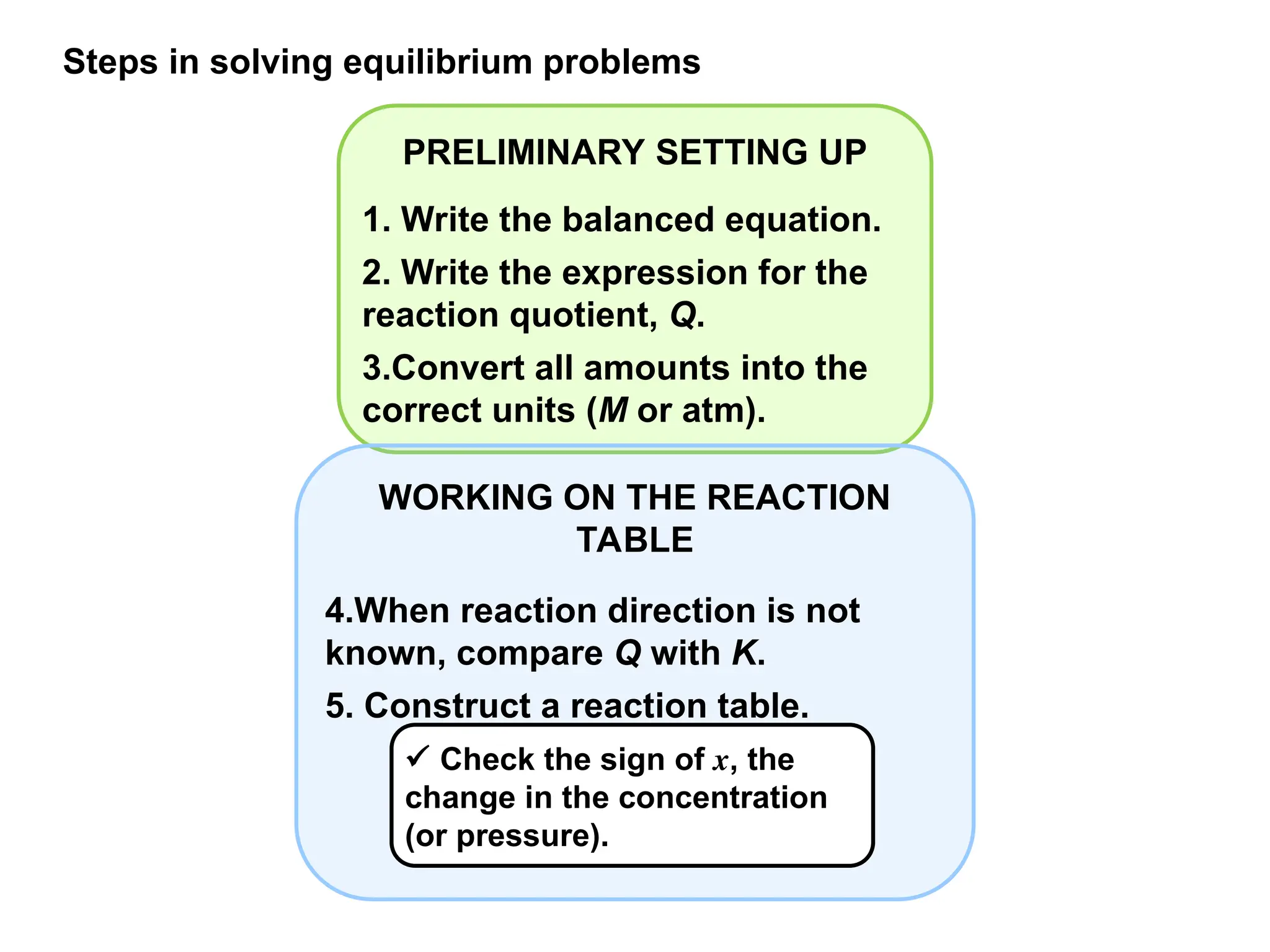
26.
tinued
SOLVING FOR xAND EQUILIBRIUM QUANTITIES
6. Substitute the quantities into the Q expression.
7. To simplify the math, assume that x is negligible:
([A]init – x = [A]eq ≈ [A]init)
8. Solve for x.
9. Find the equilibrium quantities.
Check to see that calculated values
give the known value for K.
Check that assumption is justified, i.e.,
< 5% error. If not, solve quadratic
equation for x.
27.
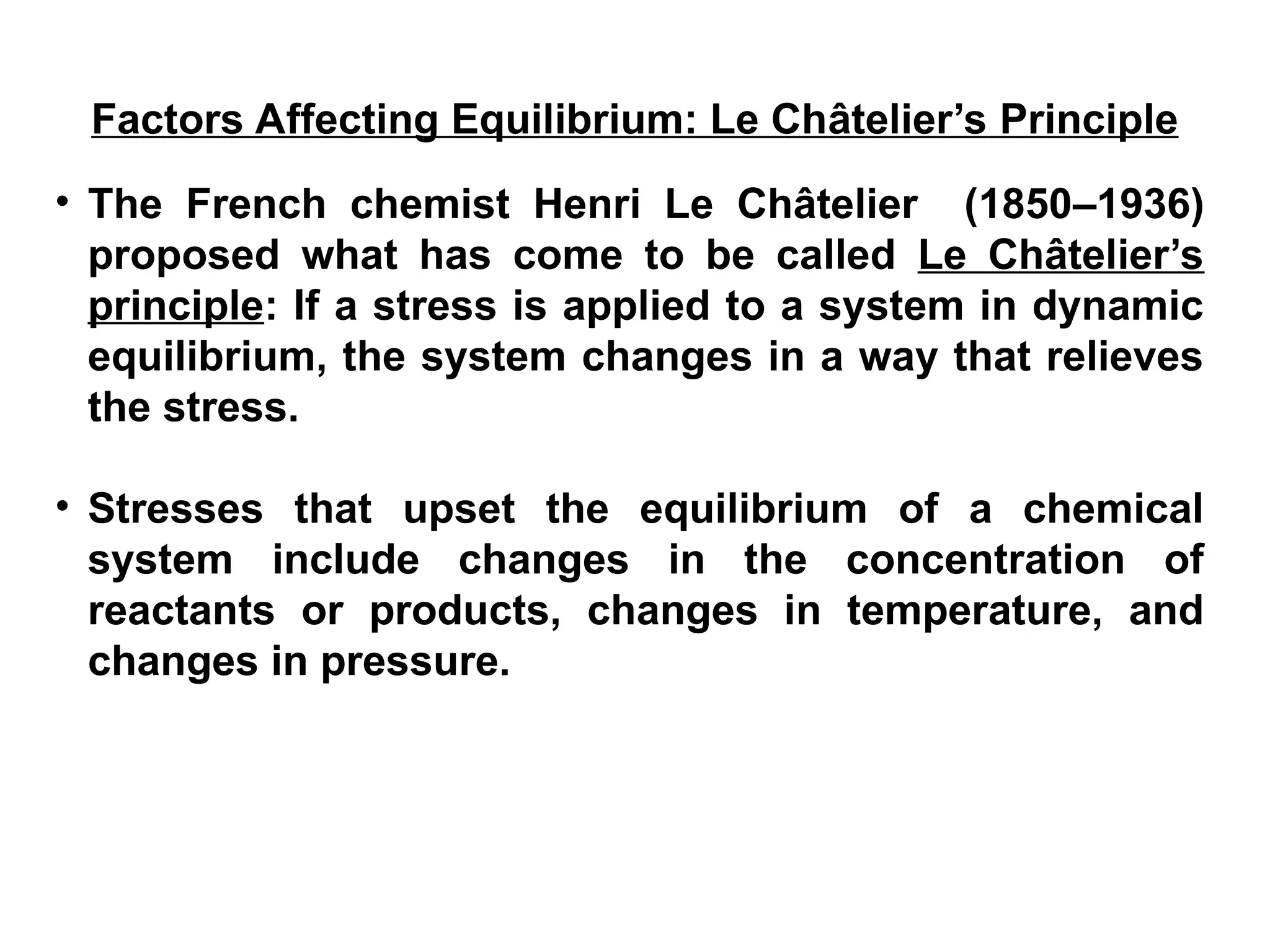
• The Frenchchemist Henri Le Châtelier (1850–1936)
proposed what has come to be called Le Châtelier’s
principle: If a stress is applied to a system in dynamic
equilibrium, the system changes in a way that relieves
the stress.
• Stresses that upset the equilibrium of a chemical
system include changes in the concentration of
reactants or products, changes in temperature, and
changes in pressure.
Factors Affecting Equilibrium: Le Châtelier’s Principle
28.
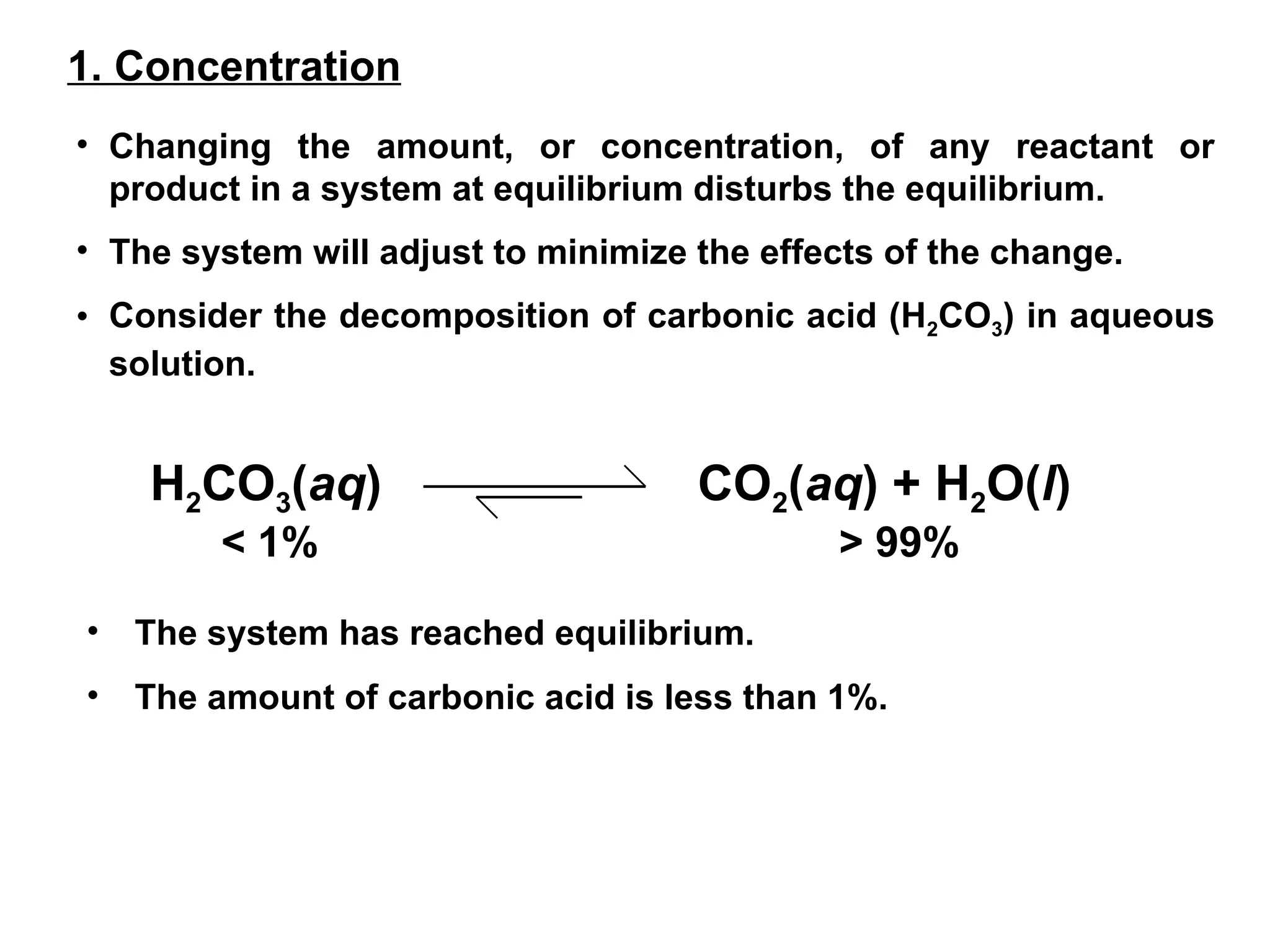
1. Concentration
• Changingthe amount, or concentration, of any reactant or
product in a system at equilibrium disturbs the equilibrium.
• The system will adjust to minimize the effects of the change.
• Consider the decomposition of carbonic acid (H2CO3) in aqueous
solution.
H2CO3(aq) CO2(aq) + H2O(l)
< 1% > 99%
• The system has reached equilibrium.
• The amount of carbonic acid is less than 1%.
29.
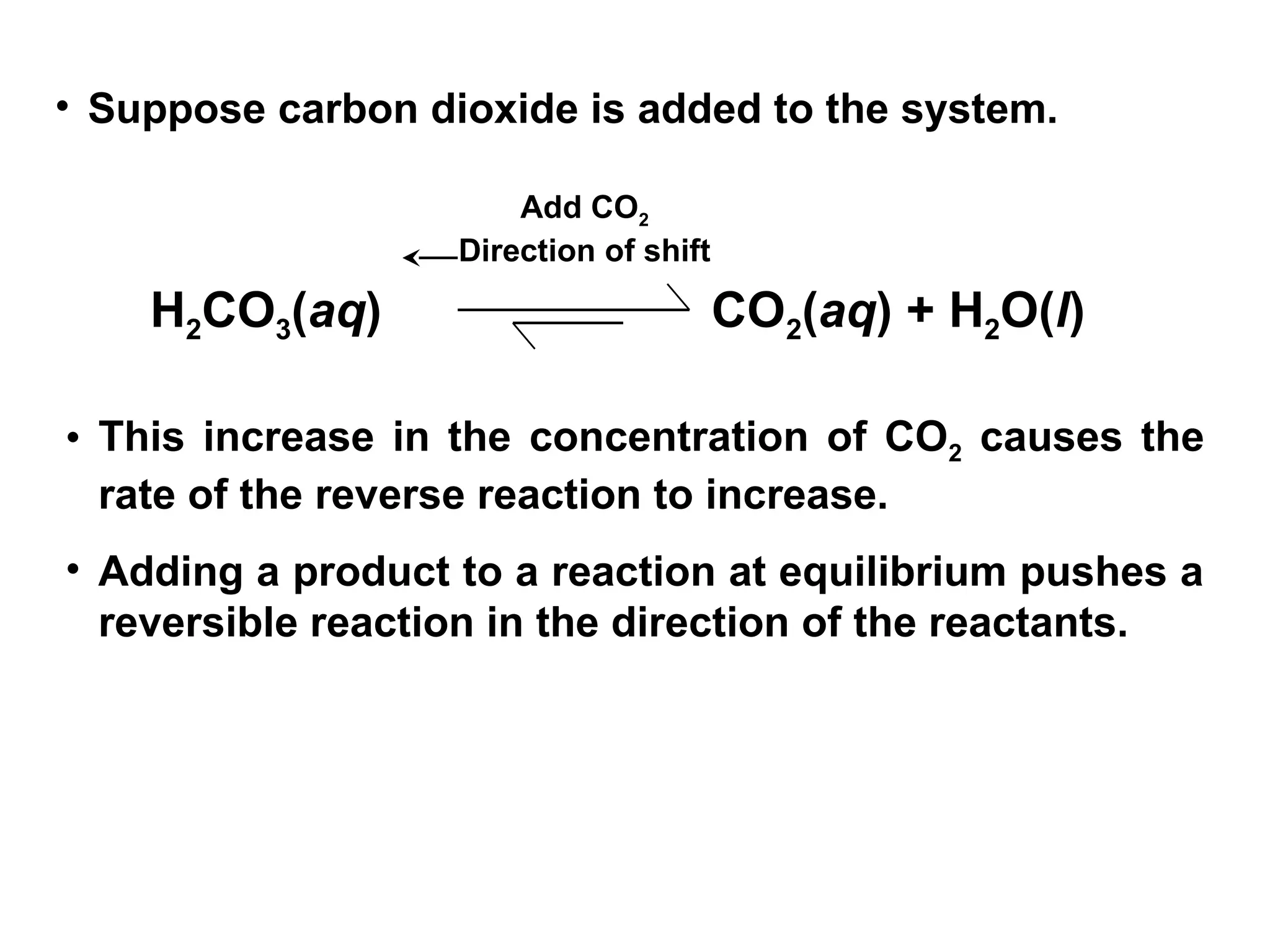
• Suppose carbondioxide is added to the system.
H2CO3(aq) CO2(aq) + H2O(l)
Add CO2
Direction of shift
• This increase in the concentration of CO2 causes the
rate of the reverse reaction to increase.
• Adding a product to a reaction at equilibrium pushes a
reversible reaction in the direction of the reactants.
30.
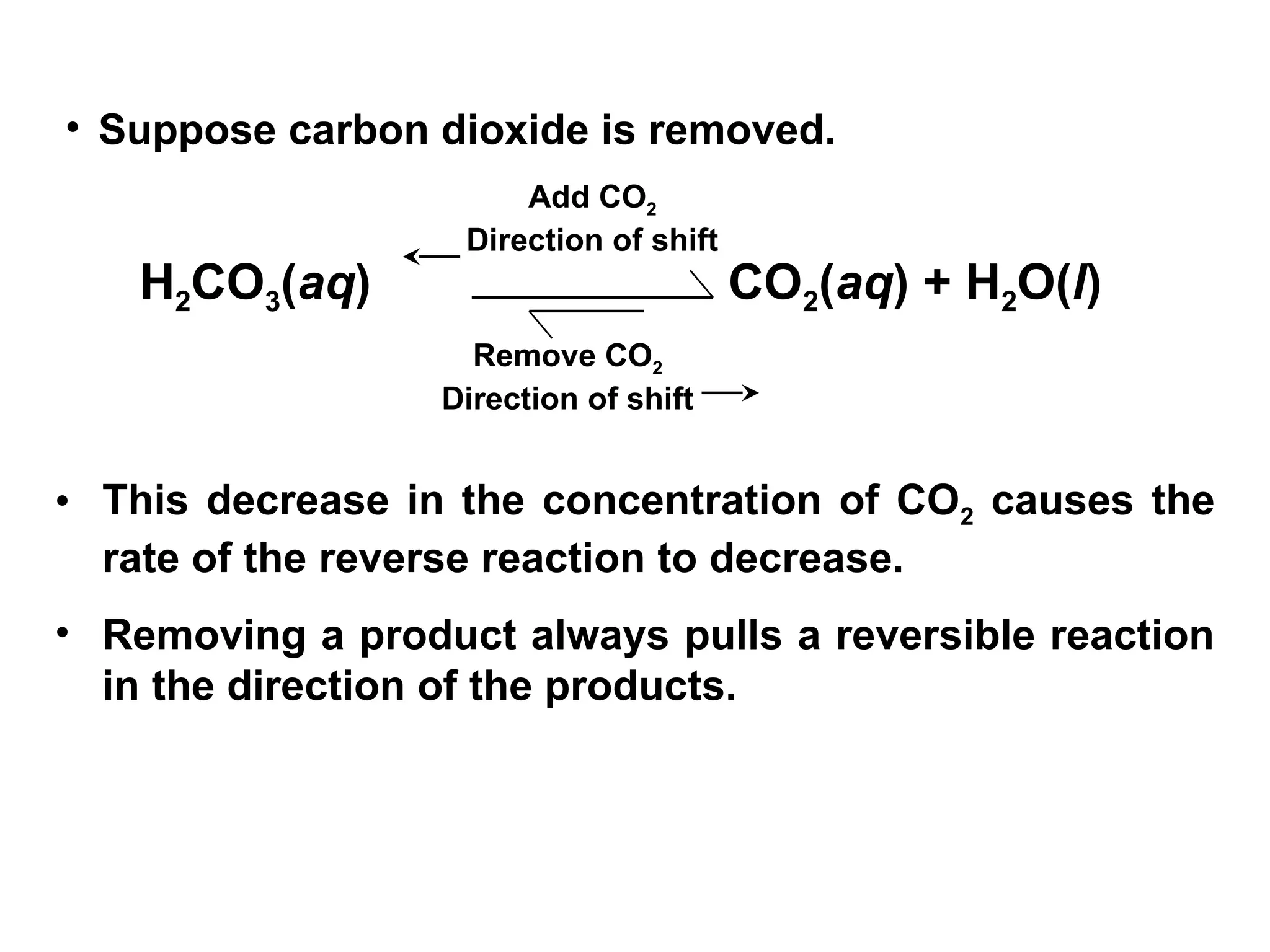
• Suppose carbondioxide is removed.
• This decrease in the concentration of CO2 causes the
rate of the reverse reaction to decrease.
• Removing a product always pulls a reversible reaction
in the direction of the products.
H2CO3(aq) CO2(aq) + H2O(l)
Add CO2
Direction of shift
Remove CO2
Direction of shift
31.
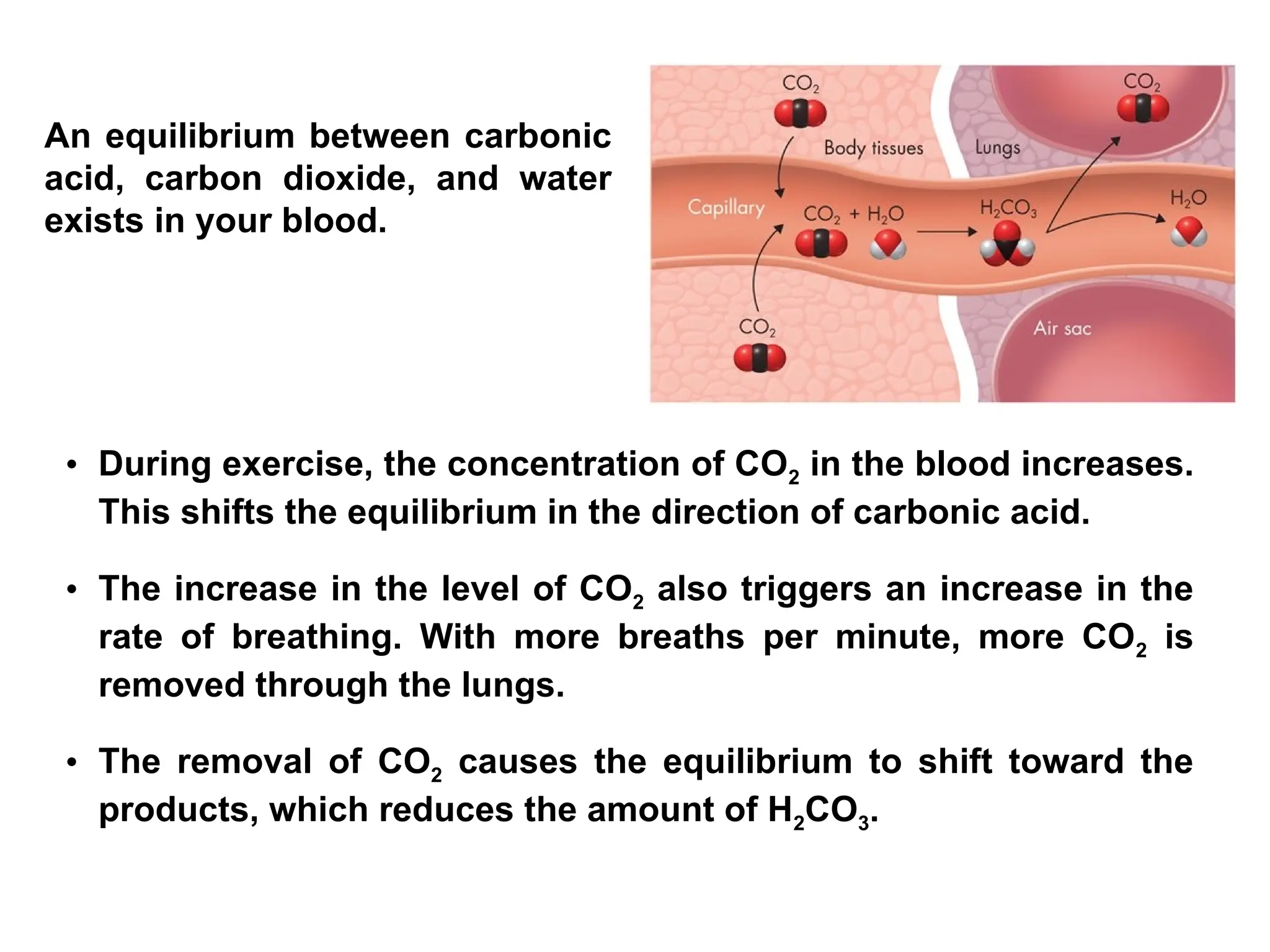
• During exercise,the concentration of CO2 in the blood increases.
This shifts the equilibrium in the direction of carbonic acid.
• The increase in the level of CO2 also triggers an increase in the
rate of breathing. With more breaths per minute, more CO2 is
removed through the lungs.
• The removal of CO2 causes the equilibrium to shift toward the
products, which reduces the amount of H2CO3.
An equilibrium between carbonic
acid, carbon dioxide, and water
exists in your blood.
32.
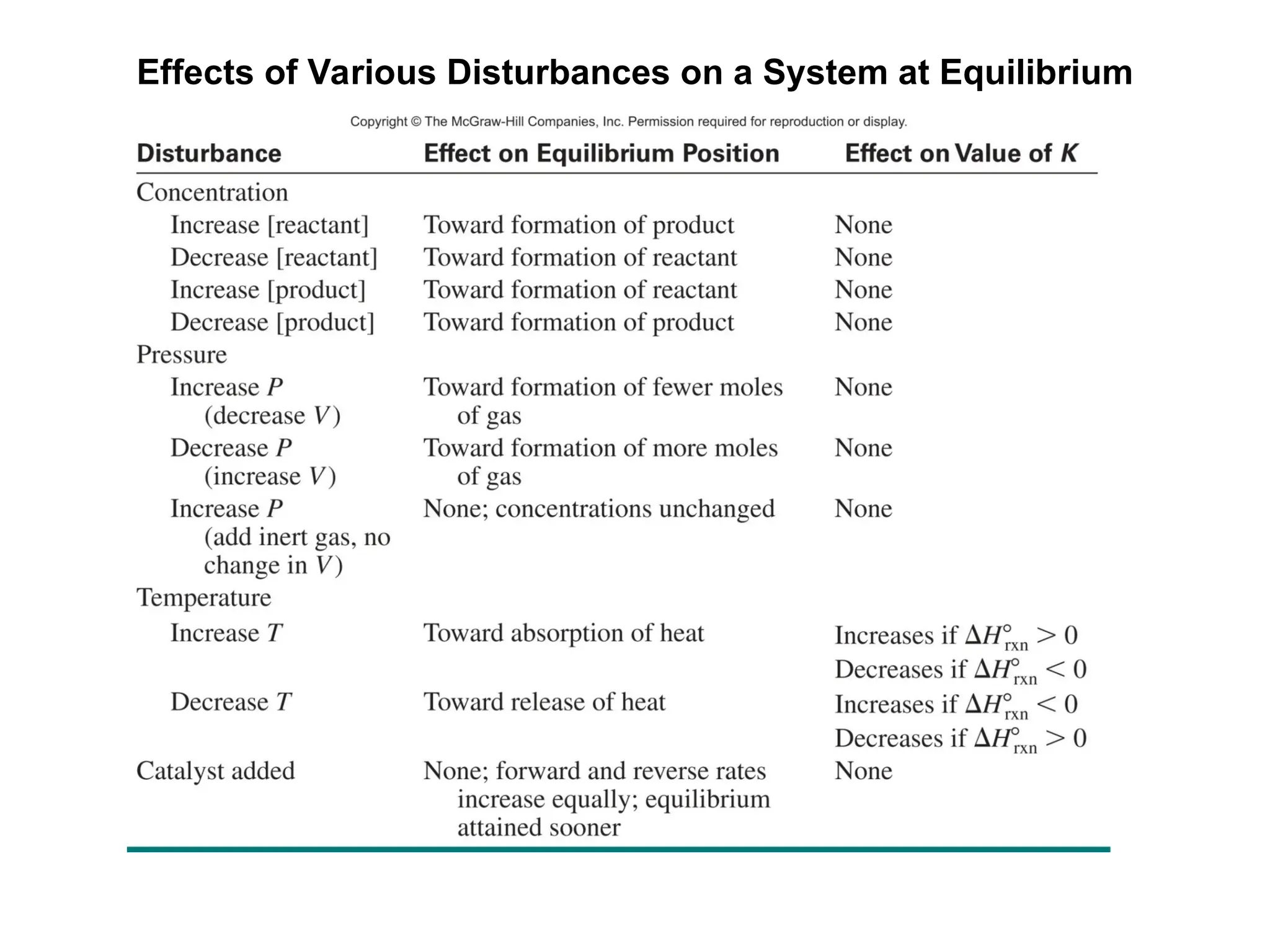
2. Temperature
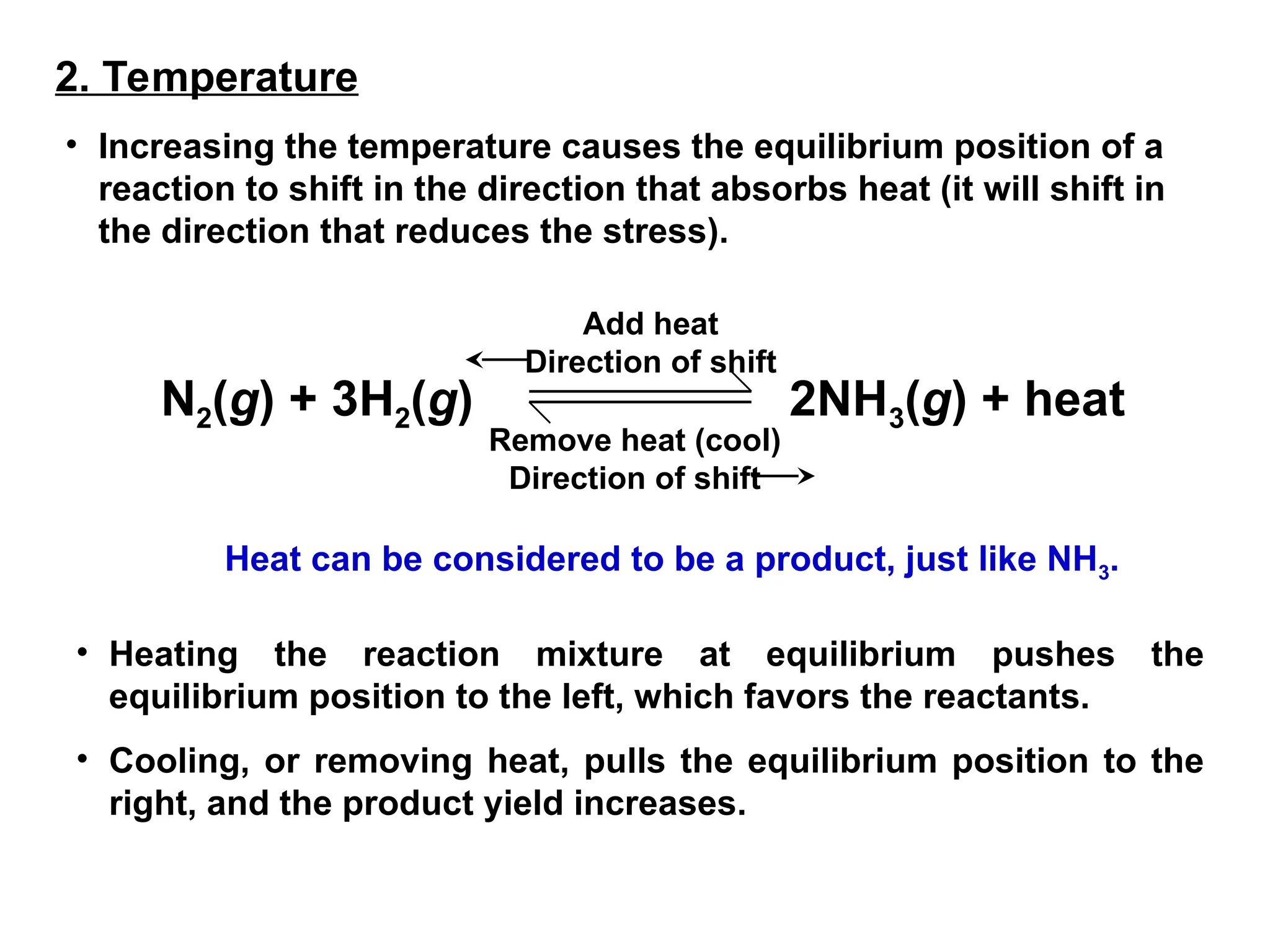
• Increasingthe temperature causes the equilibrium position of a
reaction to shift in the direction that absorbs heat (it will shift in
the direction that reduces the stress).
Heat can be considered to be a product, just like NH3.
• Heating the reaction mixture at equilibrium pushes the
equilibrium position to the left, which favors the reactants.
• Cooling, or removing heat, pulls the equilibrium position to the
right, and the product yield increases.
N2(g) + 3H2(g) 2NH3(g) + heat
Add heat
Direction of shift
Remove heat (cool)
Direction of shift
33.
3. Pressure
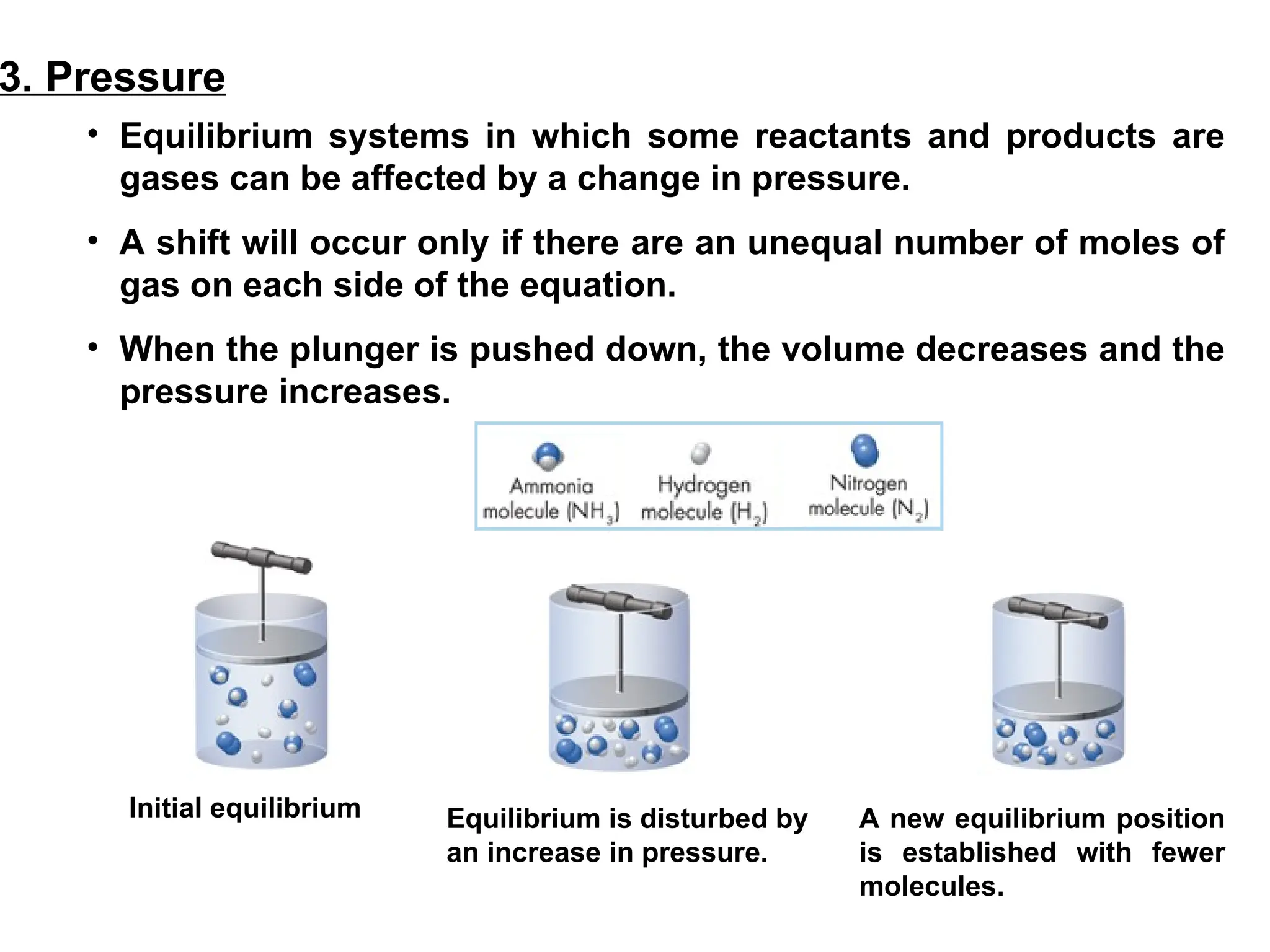
• Equilibriumsystems in which some reactants and products are
gases can be affected by a change in pressure.
• A shift will occur only if there are an unequal number of moles of
gas on each side of the equation.
• When the plunger is pushed down, the volume decreases and the
pressure increases.
Initial equilibrium Equilibrium is disturbed by
an increase in pressure.
A new equilibrium position
is established with fewer
molecules.
34.
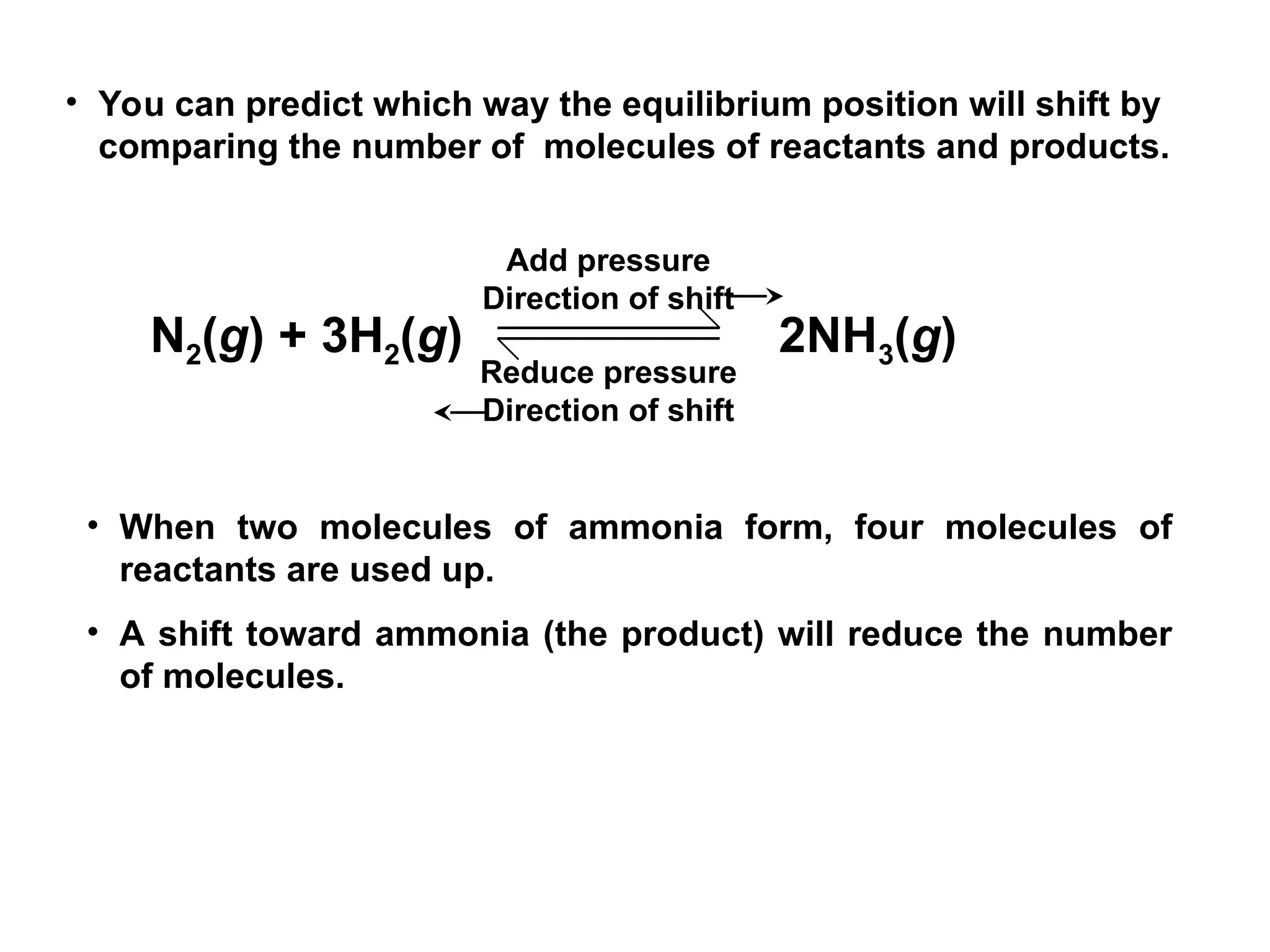
• When twomolecules of ammonia form, four molecules of
reactants are used up.
• A shift toward ammonia (the product) will reduce the number
of molecules.
• You can predict which way the equilibrium position will shift by
comparing the number of molecules of reactants and products.
N2(g) + 3H2(g) 2NH3(g)
Add pressure
Direction of shift
Reduce pressure
Direction of shift
35.
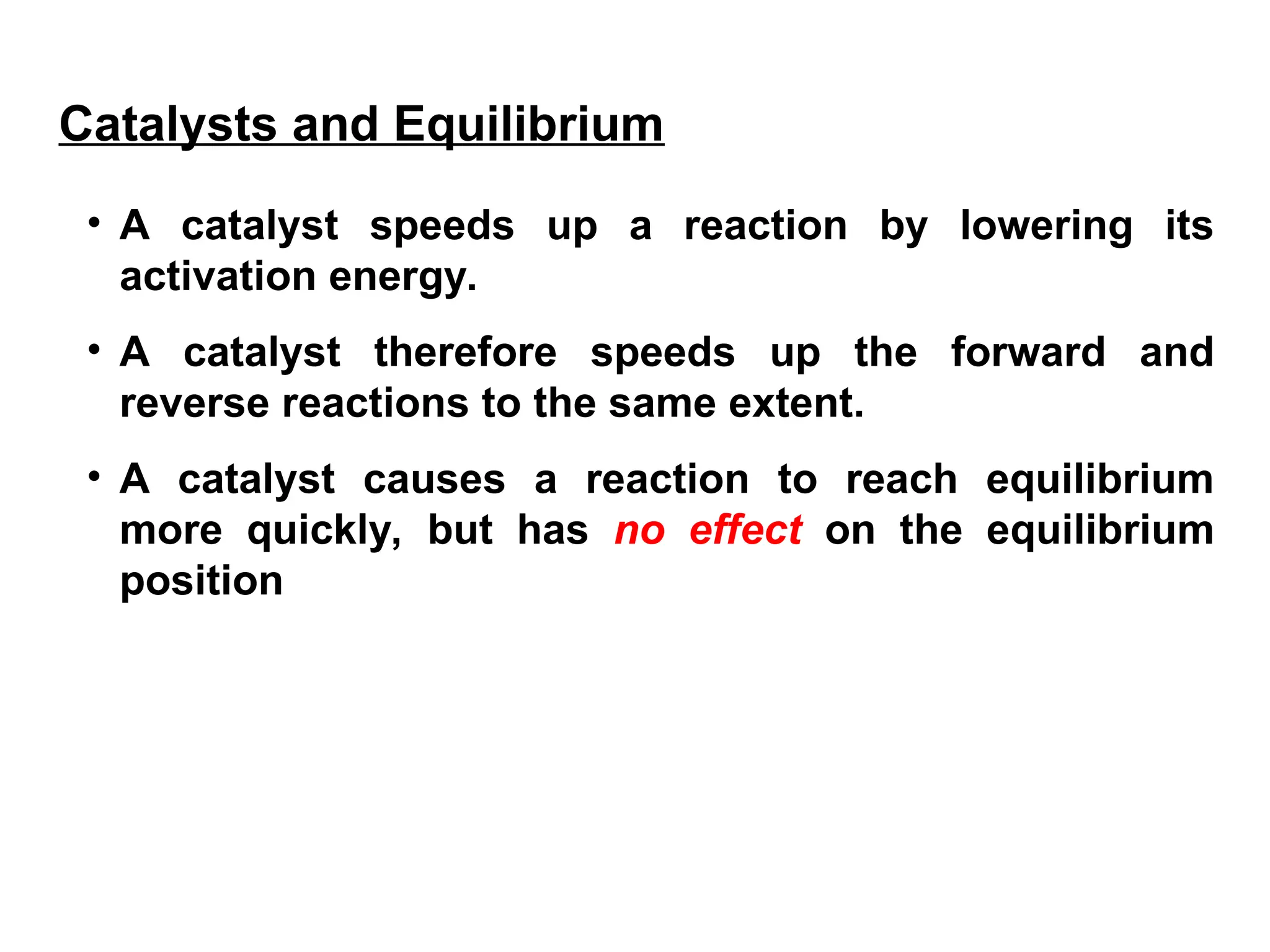
• A catalystspeeds up a reaction by lowering its
activation energy.
• A catalyst therefore speeds up the forward and
reverse reactions to the same extent.
• A catalyst causes a reaction to reach equilibrium
more quickly, but has no effect on the equilibrium
position
Catalysts and Equilibrium
36.
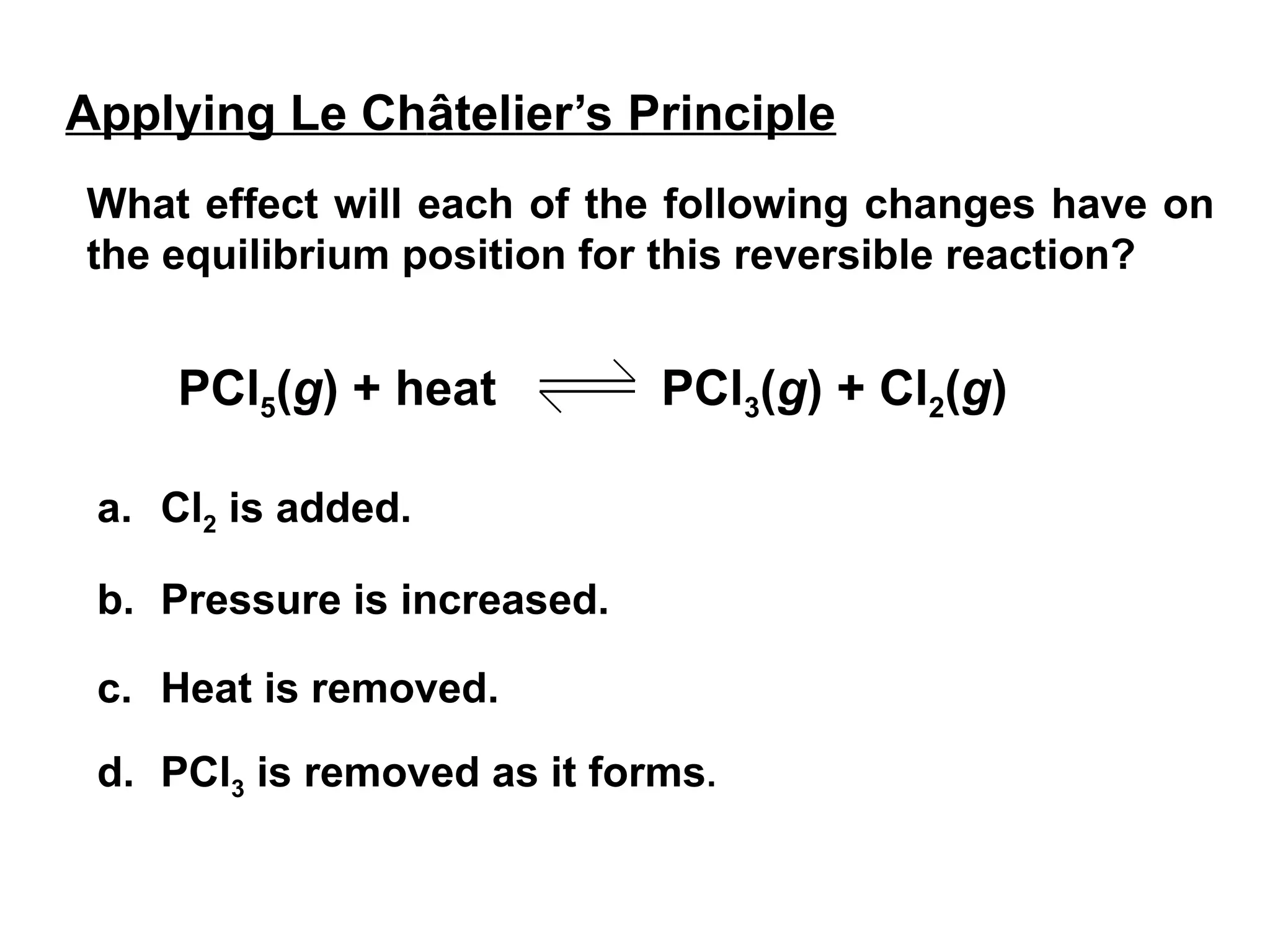
What effect willeach of the following changes have on
the equilibrium position for this reversible reaction?
Applying Le Châtelier’s Principle
a. Cl2 is added.
b. Pressure is increased.
c. Heat is removed.
d. PCl3 is removed as it forms.
PCl5(g) + heat PCl3(g) + Cl2(g)
37.
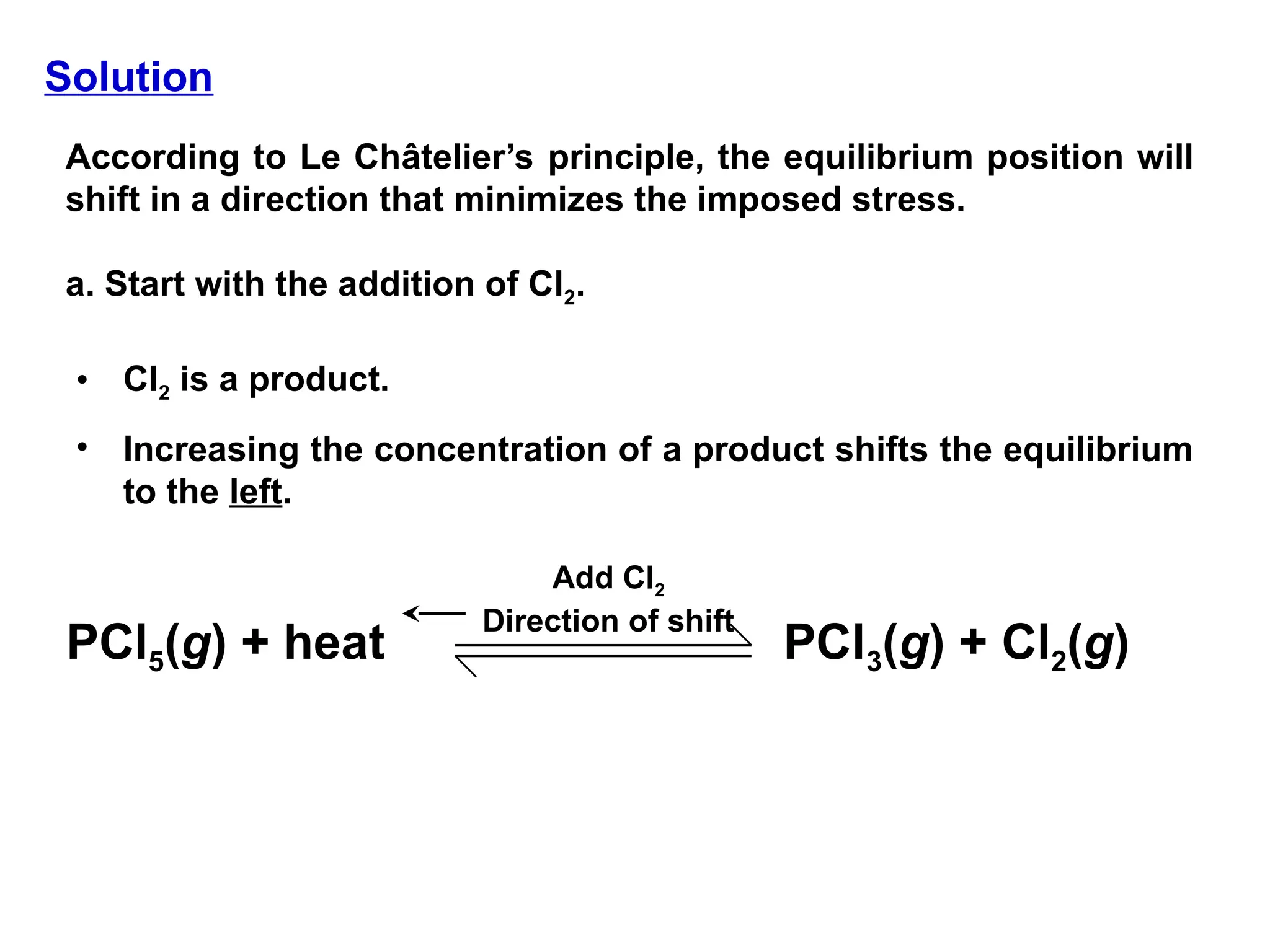
Solution
According to LeChâtelier’s principle, the equilibrium position will
shift in a direction that minimizes the imposed stress.
a. Start with the addition of Cl2.
• Cl2 is a product.
• Increasing the concentration of a product shifts the equilibrium
to the left.
PCl5(g) + heat PCl3(g) + Cl2(g)
Add Cl2
Direction of shift
38.
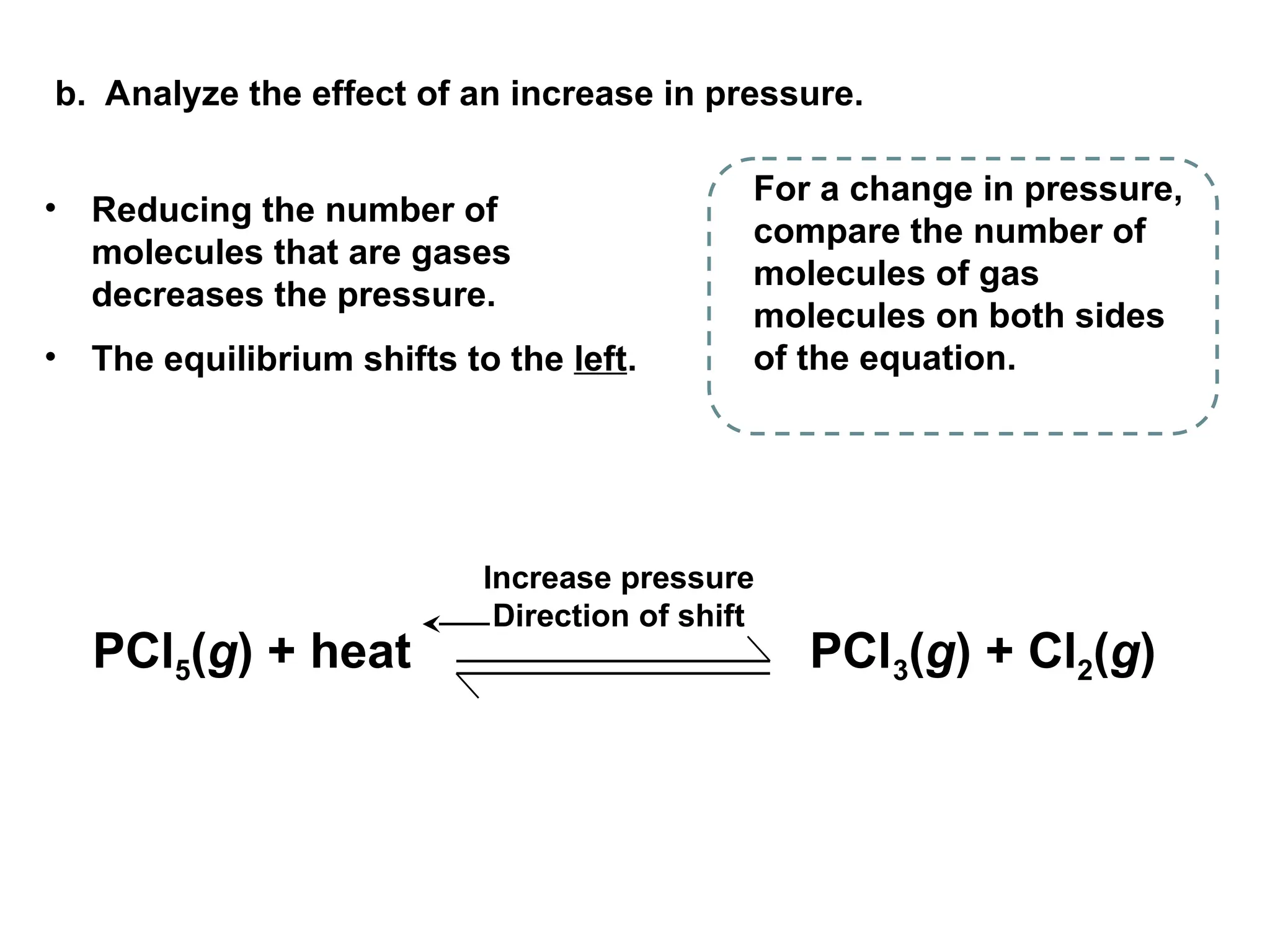
b. Analyze theeffect of an increase in pressure.
• Reducing the number of
molecules that are gases
decreases the pressure.
• The equilibrium shifts to the left.
For a change in pressure,
compare the number of
molecules of gas
molecules on both sides
of the equation.
Increase pressure
Direction of shift
PCl5(g) + heat PCl3(g) + Cl2(g)
39.
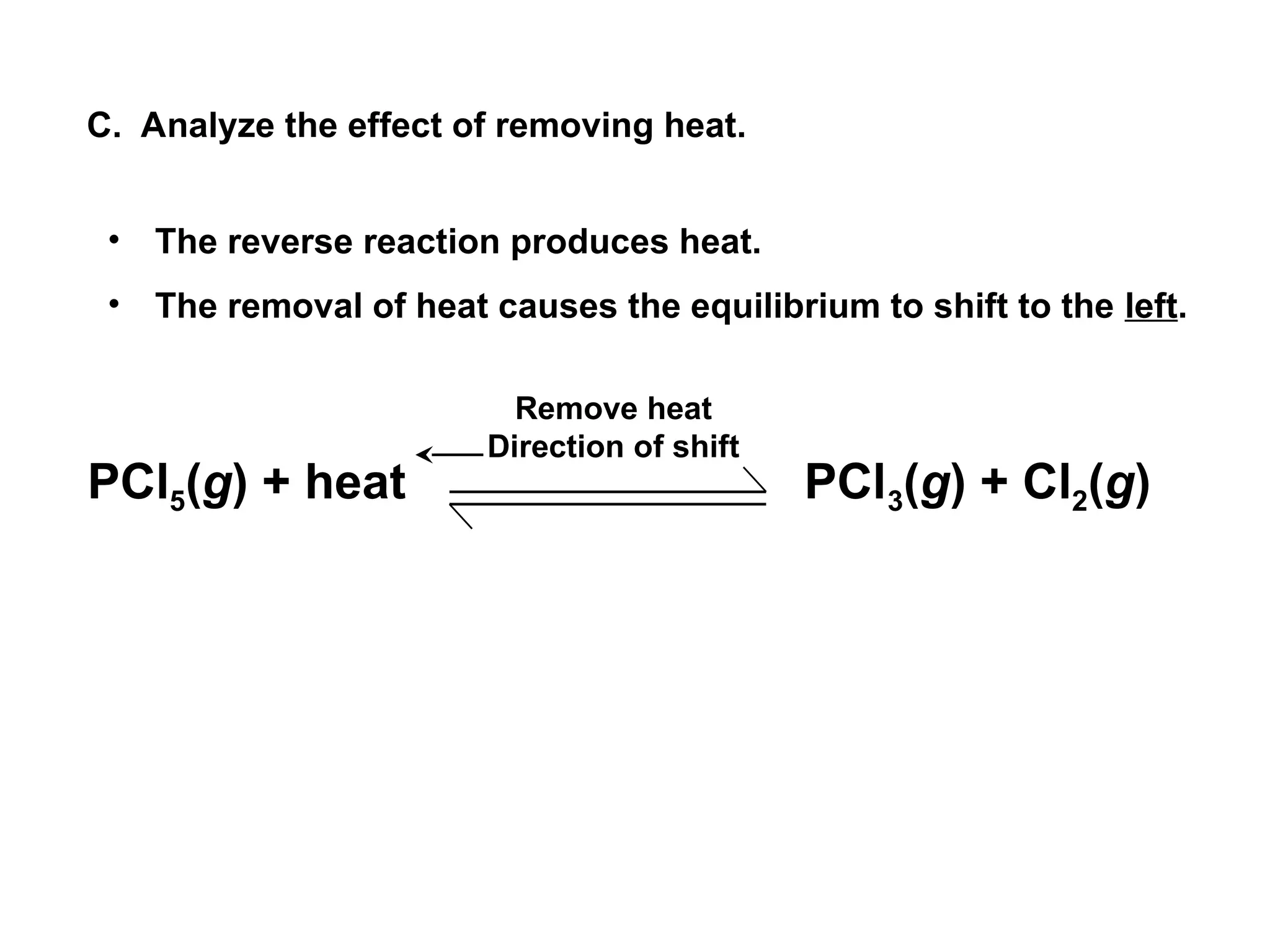
C. Analyze theeffect of removing heat.
• The reverse reaction produces heat.
• The removal of heat causes the equilibrium to shift to the left.
Remove heat
Direction of shift
PCl5(g) + heat PCl3(g) + Cl2(g)
40.
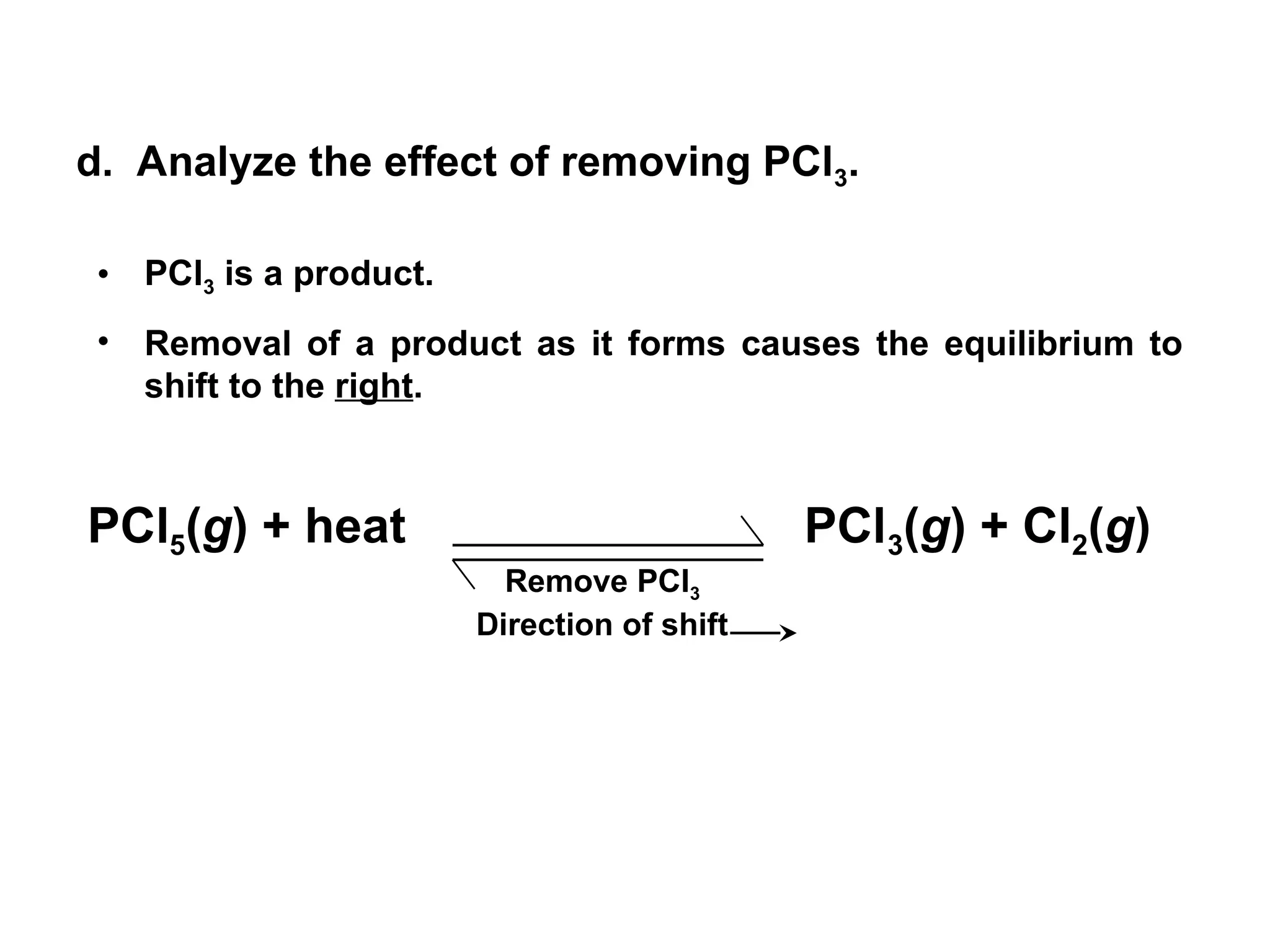
d. Analyze theeffect of removing PCl3.
• PCl3 is a product.
• Removal of a product as it forms causes the equilibrium to
shift to the right.
Remove PCl3
Direction of shift
PCl5(g) + heat PCl3(g) + Cl2(g)
![At equilibrium ratefwd = raterev
so kfwd[N2O4] = krev[NO2]
2
kfwd
krev
[NO2]
[N2O4]
2
=
then
The ratio of constants gives a new constant, the
equilibrium constant:
kfwd
krev
[NO2]
[N2O4]
2
=
K =
Consider the reaction of N2O4(g) 2NO2(g)
The Equilibrium Constant](https://image.slidesharecdn.com/lec11-250814053726-1db4f875/75/Lecture-notes-The-Chemical-Equilibrium-ppt-5-2048.jpg)
![For the general reaction aA + bB cC + dD
the reaction quotient Qc =
[C]c
[D]d
[A]a
[B]b
• Q gives the ratio of product concentrations to reactant
concentrations at any point in a reaction.
At equilibrium: Q = K
• For a particular system and temperature, the same
equilibrium state is attained regardless of starting
concentrations. The value of Q indicates how close the
reaction is to equilibrium, and in which direction it
must proceed to reach equilibrium.
The Reaction Quotient Q](https://image.slidesharecdn.com/lec11-250814053726-1db4f875/75/Lecture-notes-The-Chemical-Equilibrium-ppt-7-2048.jpg)

![Qc =
[CO2]3
[H2O]4
[C3H8][O2]5
Qc =
[NO2]4
[O2]
[N2O5]2
2N2O5(g) 4NO2(g) + O2(g)
(a)
(b) C3H8(g) + 5 O2(g) 3 CO2(g) + 4 H2O(g)
Solution
First We balance the equations and then construct the reaction quotient.
Write the reaction quotient, Qc, for each of the following reactions:
(a) N2O5(g) NO2(g) + O2(g)
(b) C3H8(g) + O2(g) CO2(g) + H2O(g)
Examples](https://image.slidesharecdn.com/lec11-250814053726-1db4f875/75/Lecture-notes-The-Chemical-Equilibrium-ppt-9-2048.jpg)
![Solution
(1) N2(g) + O2(g) 2NO(g) Kc1 = 4.3x10⁻²⁵
(2) 2NO(g) + O2(g) 2NO2(g) Kc2 = 6.4x10⁹
N2(g) + 2O2(g) 2NO2(g)
(a)
Qc(overall) =
[NO2]2
[N2][O2]2
Qc1 =
[NO]2
[N2][O2]
Qc2 =
[NO2]2
[NO]2
[O2]
=
[NO2]2
[N2] [O2] 2
[NO]2
[N2][O2]
Qc1 x Qc2 =
[NO2]2
[NO]2
[O2]
x
(b) Kc = Kc1 x Kc2 = (4.3x10⁻²⁵
) x (6.4x10⁹
) = 2.8x10–15](https://image.slidesharecdn.com/lec11-250814053726-1db4f875/75/Lecture-notes-The-Chemical-Equilibrium-ppt-13-2048.jpg)
![• A heterogeneous equilibrium involves reactants and/or products
in different phases.
CaCO3(s) CaO(s) + CO2(g)
• A pure solid or liquid always has the same “concentration”, i.e.,
the same number of moles per liter of solid or liquid.
• The expressions for Q and K include only species whose
concentrations change as the reaction approaches equilibrium.
• Pure solids and liquids are omitted from the expression for Q or K..
For the above reaction, Q = [CO2]
K and Q for heterogeneous equilibrium](https://image.slidesharecdn.com/lec11-250814053726-1db4f875/75/Lecture-notes-The-Chemical-Equilibrium-ppt-14-2048.jpg)
![Qc =
[NO2]2
[N2O4]
=
(0.55)2
(0.12)
= 2.5
Qc > Kc, therefore the reaction is not at equilibrium and will proceed
from right to left, from products to reactants, until Qc = Kc.
For the reaction N2O4(g) 2NO2(g), Kc = 0.21 at 100ºC. At a point
during the reaction, [N2O4] = 0.12 M and [NO2] = 0.55 M. Is the reaction
at equilibrium? If not, in which direction is it progressing?
We write an expression for Qc, find its value by substituting the
given concentrations, and compare its value with the given Kc.
Example
Solution](https://image.slidesharecdn.com/lec11-250814053726-1db4f875/75/Lecture-notes-The-Chemical-Equilibrium-ppt-17-2048.jpg)
![At equilibrium, [HI] = 0.078 M. Calculate Kc.
To calculate Kc we need equilibrium concentrations. We can find the
initial [HI] from the amount and the flask volume, and we are given
[HI] at equilibrium. From the balanced equation, when 2x mol of HI
reacts, x mol of H2 and x mol of I2 form. We use this information to
set up a reaction table.
[HI] =
0.200 mol
2.00 L
= 0.100 M
2HI(g) H2(g) + I2(g)
Calculating initial [HI]:
Example
In order to study hydrogen halide decomposition, a researcher fills
an evacuated 2.00-L flask with 0.200 mol of HI gas and allows the
reaction to proceed at 453ºC.
Solution](https://image.slidesharecdn.com/lec11-250814053726-1db4f875/75/Lecture-notes-The-Chemical-Equilibrium-ppt-19-2048.jpg)
![[HI] = 0.078 = 0.100 – 2x; x = 0.011 M
Qc =
[H2] [I2]
[HI]2
=
(0.011)(0.011)
(0.078)2
= 0.020 = Kc
0.100 0 0
– 2x + x + x
0.100 – 2x x x
Initial
Change
Equilibrium
Concentration (M) 2HI(g) H2(g) + I2(g)](https://image.slidesharecdn.com/lec11-250814053726-1db4f875/75/Lecture-notes-The-Chemical-Equilibrium-ppt-20-2048.jpg)
![In a study of the conversion of methane to other fuels, a chemical
engineer mixes gaseous CH4 and H2O in a 0.32-L flask at 1200 K. At
equilibrium the flask contains 0.26 mol of CO, 0.091 mol of H2, and
0.041 mol of CH4. What is [H2O] at equilibrium? Kc = 0.26 for this
process at 1200 K.
First we write the balanced equation and the expression for Qc. We
calculate the equilibrium concentrations from the given numbers of
moles and the flask volume. We then use the value of Kc to solve for
[H2O].
CH4(g) + H2O(g) CO(g) + 3H2(g)
Example
Solution](https://image.slidesharecdn.com/lec11-250814053726-1db4f875/75/Lecture-notes-The-Chemical-Equilibrium-ppt-21-2048.jpg)
![[CH4] =
0.041 mol
0.32 L
= 0.13 M [CO] =
0.26 mol
0.32 L
= 0.81 M
[H2] =
0.091 mol
0.32 L
= 0.28 M
Qc =
[CO][H2]3
[CH4][H2O]
[H2O] =
[CO][H2]3
[CH4] Kc
= 0.53 M
=
(0.81)(0.28)3
(0.13)(0.26)](https://image.slidesharecdn.com/lec11-250814053726-1db4f875/75/Lecture-notes-The-Chemical-Equilibrium-ppt-22-2048.jpg)
![Fuel engineers use the extent of the change from CO and H2O to CO2
and H2 to regulate the proportions of synthetic fuel mixtures. If 0.250
mol of CO and 0.250 mol of H2O gases are placed in a 125-mL flask at
900 K, what is the composition of the equilibrium mixture? At this
temperature, Kc is 1.56.
We have to find the concentrations of all species at equilibrium and
then substitute into a Kc expression. First we write a balanced
equation, calculate initial concentrations and set up a reaction table.
CO(g) + H2O(g) CO2(g) + H2(g)
Calculating initial concentrations: [CO] = [H2O] =
0.250 mol
0.125 L
= 2.00 M
Example
Solution](https://image.slidesharecdn.com/lec11-250814053726-1db4f875/75/Lecture-notes-The-Chemical-Equilibrium-ppt-23-2048.jpg)
![2.00 2.00 0 0
– x – x + x + x
2.00 - x 2.00 - x x x
CO(g) + H2O(g) CO2(g) + H2(g)
Concentration (M)
Initial
Change
Equilibrium
Qc = Kc =
[CO2][H2]
[CO][H2O]
=
(x)(x)
(2.00 – x) (2.00 – x)
=
(x)2
(2.00 – x)2
= ±1.25 x = 1.11 M 2.00 - x = 0.89 M
[CO] = [H2O] = 0.89 M [CO2] = [H2] = 1.11 M
=
x
2.00 – x
1.56
](https://image.slidesharecdn.com/lec11-250814053726-1db4f875/75/Lecture-notes-The-Chemical-Equilibrium-ppt-24-2048.jpg)
![tinued
SOLVING FOR x AND EQUILIBRIUM QUANTITIES
6. Substitute the quantities into the Q expression.
7. To simplify the math, assume that x is negligible:
([A]init – x = [A]eq ≈ [A]init)
8. Solve for x.
9. Find the equilibrium quantities.
Check to see that calculated values
give the known value for K.
Check that assumption is justified, i.e.,
< 5% error. If not, solve quadratic
equation for x.](https://image.slidesharecdn.com/lec11-250814053726-1db4f875/75/Lecture-notes-The-Chemical-Equilibrium-ppt-26-2048.jpg)