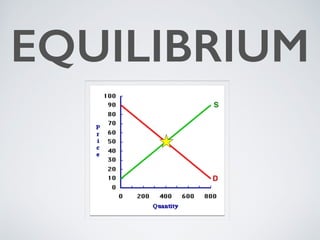
EQUILIBRIUM
LET’S CREATE 
A MARKET 
IN OUR CLASSROOM 
You need a pencil and a 
piece of scrap paper.
THE PRODUCT: 
“Econ Class Snack Pack” 
Glass of 
Coca-Cola 
Mini Brownie 
Fruit Shish-Kabob
STEP ONE: 
How much money 
are you willing to pay 
for an “Econ Class Snack Pack”? 
! 
Write the amount on a 
slip of paper.
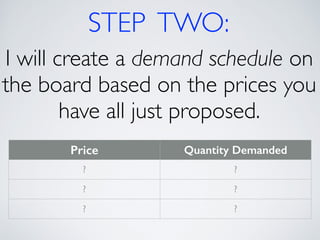
STEP TWO: 
I will create a demand schedule on 
the board based on the prices you 
have all just proposed. 
Price Quantity Demanded 
? ? 
? ? 
? ?
STEP THREE: 
Think like the supplier. 
What price do you think you 
should sell this product at? 
! 
Your goal: sell at the highest price 
and the highest quantity you 
possibly can.
HINTS: 
You can sell at a very high price and 
produce a large quantity…but how many 
people will be willing to buy the product? 
Will you have products that go unsold? 
You can sell at the lowest price and try to 
reach more customers, but remember 
that it cost you something to produce the 
product. You need to cover the costs of 
your own production.
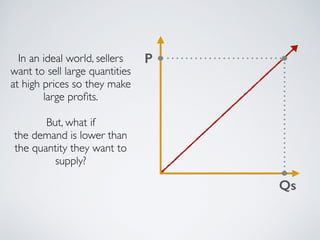
Qs 
In an ideal world, sellers 
P 
want to sell large quantities 
at high prices so they make 
large profits. 
! 
But, what if 
the demand is lower than 
the quantity they want to 
supply?
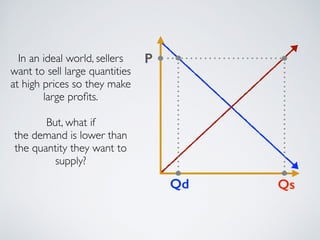
Qs 
P 
Qd 
In an ideal world, sellers 
want to sell large quantities 
at high prices so they make 
large profits. 
! 
But, what if 
the demand is lower than 
the quantity they want to 
supply?
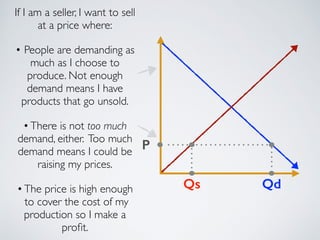
Qd 
P 
If I am a seller, I want to sell 
at a price where: 
! 
• People are demanding as 
much as I choose to 
produce. Not enough 
demand means I have 
products that go unsold. 
! 
• There is not too much 
demand, either. Too much 
demand means I could be 
raising my prices. 
! 
• The price is high enough 
to cover the cost of my 
production so I make a 
profit. 
Qs
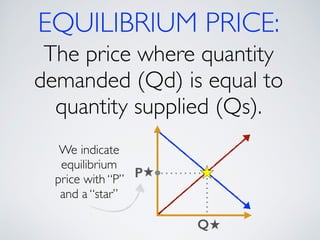
EQUILIBRIUM PRICE: 
The price where quantity 
demanded (Qd) is equal to 
quantity supplied (Qs). 
Q 
P 
We indicate 
equilibrium 
price with “P” 
and a “star”
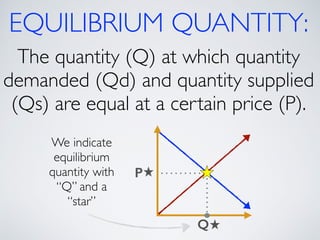
EQUILIBRIUM QUANTITY: 
The quantity (Q) at which quantity 
demanded (Qd) and quantity supplied 
(Qs) are equal at a certain price (P). 
Q 
P 
We indicate 
equilibrium 
quantity with 
“Q” and a 
“star”
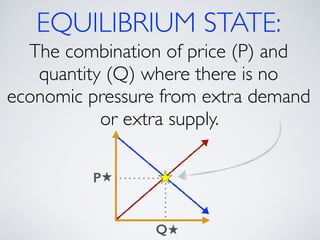
EQUILIBRIUM STATE: 
The combination of price (P) and 
quantity (Q) where there is no 
economic pressure from extra demand 
or extra supply. 
Q 
P
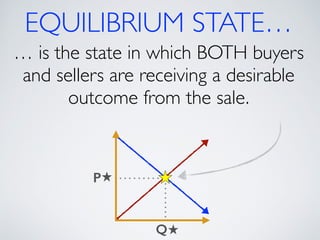
EQUILIBRIUM STATE… 
… is the state in which BOTH buyers 
and sellers are receiving a desirable 
outcome from the sale. 
Q 
P
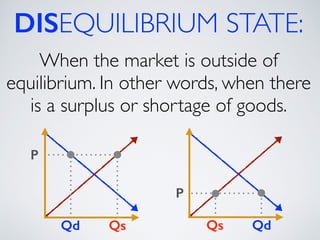
DISEQUILIBRIUM STATE: 
When the market is outside of 
equilibrium. In other words, when there 
is a surplus or shortage of goods. 
Qs 
P 
P 
Qd Qs 
Qd
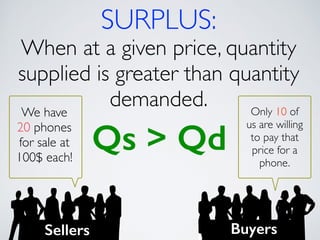
SURPLUS: 
When at a given price, quantity 
supplied is greater than quantity 
demanded. 
Qs > Qd 
We have 
20 phones 
for sale at 
100$ each! 
Only 10 of 
us are willing 
to pay that 
price for a 
phone. 
Sellers Buyers
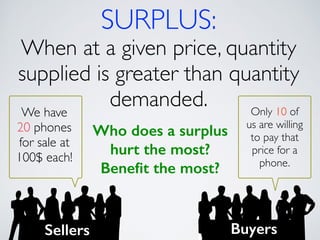
SURPLUS: 
When at a given price, quantity 
supplied is greater than quantity 
demanded. 
Who does a surplus 
hurt the most? 
Benefit the most? 
We have 
20 phones 
for sale at 
100$ each! 
Only 10 of 
us are willing 
to pay that 
price for a 
phone. 
Sellers Buyers
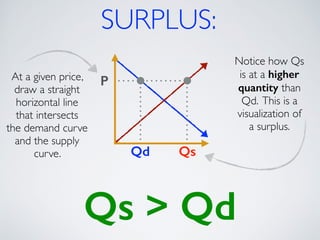
SURPLUS: 
Qs 
P 
Qd 
Notice how Qs 
is at a higher 
quantity than 
Qd. This is a 
visualization of 
a surplus. 
At a given price, 
draw a straight 
horizontal line 
that intersects 
the demand curve 
and the supply 
Qs > Qd 
curve.
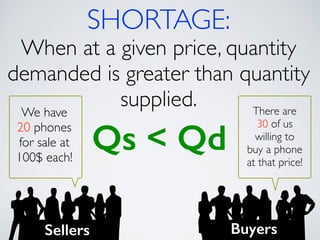
SHORTAGE: 
When at a given price, quantity 
demanded is greater than quantity 
supplied. 
Qs < Qd 
We have 
20 phones 
for sale at 
100$ each! 
There are 
30 of us 
willing to 
buy a phone 
at that price! 
Sellers Buyers
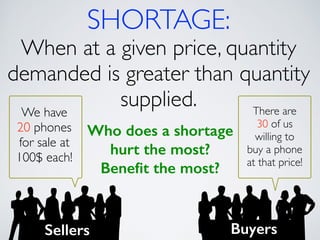
SHORTAGE: 
When at a given price, quantity 
demanded is greater than quantity 
supplied. We have 
20 phones 
for sale at 
100$ each! 
There are 
30 of us 
willing to 
buy a phone 
at that price! 
Who does a shortage 
hurt the most? 
Benefit the most? 
Sellers Buyers
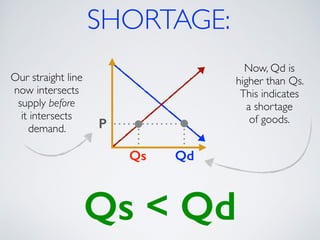
SHORTAGE: 
Now, Qd is 
higher than Qs. 
This indicates 
a shortage 
of goods. 
Qs < Qd 
Our straight line 
now intersects 
supply before 
it intersects 
demand. 
Qd 
P 
Qs
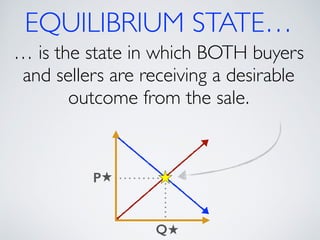
EQUILIBRIUM STATE… 
… is the state in which BOTH buyers 
and sellers are receiving a desirable 
outcome from the sale. 
Q 
P
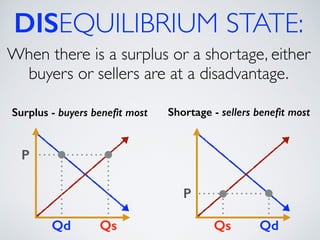
DISEQUILIBRIUM STATE: 
When there is a surplus or a shortage, either 
buyers or sellers are at a disadvantage. 
Surplus - buyers benefit most Shortage - sellers benefit most 
Qs 
P 
P 
Qd Qs 
Qd
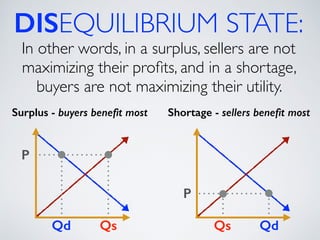
DISEQUILIBRIUM STATE: 
In other words, in a surplus, sellers are not 
maximizing their profits, and in a shortage, 
buyers are not maximizing their utility. 
Surplus - buyers benefit most Shortage - sellers benefit most 
Qs 
P 
P 
Qd Qs 
Qd

Equilibrium

  • 1.
  • 2.
    LET’S CREATE AMARKET IN OUR CLASSROOM You need a pencil and a piece of scrap paper.
  • 3.
    THE PRODUCT: “EconClass Snack Pack” Glass of Coca-Cola Mini Brownie Fruit Shish-Kabob
  • 4.
    STEP ONE: Howmuch money are you willing to pay for an “Econ Class Snack Pack”? ! Write the amount on a slip of paper.
  • 5.
    STEP TWO: Iwill create a demand schedule on the board based on the prices you have all just proposed. Price Quantity Demanded ? ? ? ? ? ?
  • 6.
    STEP THREE: Thinklike the supplier. What price do you think you should sell this product at? ! Your goal: sell at the highest price and the highest quantity you possibly can.
  • 7.
    HINTS: You cansell at a very high price and produce a large quantity…but how many people will be willing to buy the product? Will you have products that go unsold? You can sell at the lowest price and try to reach more customers, but remember that it cost you something to produce the product. You need to cover the costs of your own production.
  • 8.
    Qs In anideal world, sellers P want to sell large quantities at high prices so they make large profits. ! But, what if the demand is lower than the quantity they want to supply?
  • 9.
    Qs P Qd In an ideal world, sellers want to sell large quantities at high prices so they make large profits. ! But, what if the demand is lower than the quantity they want to supply?
  • 10.
    Qd P IfI am a seller, I want to sell at a price where: ! • People are demanding as much as I choose to produce. Not enough demand means I have products that go unsold. ! • There is not too much demand, either. Too much demand means I could be raising my prices. ! • The price is high enough to cover the cost of my production so I make a profit. Qs
  • 11.
    EQUILIBRIUM PRICE: Theprice where quantity demanded (Qd) is equal to quantity supplied (Qs). Q P We indicate equilibrium price with “P” and a “star”
  • 12.
    EQUILIBRIUM QUANTITY: Thequantity (Q) at which quantity demanded (Qd) and quantity supplied (Qs) are equal at a certain price (P). Q P We indicate equilibrium quantity with “Q” and a “star”
  • 13.
    EQUILIBRIUM STATE: Thecombination of price (P) and quantity (Q) where there is no economic pressure from extra demand or extra supply. Q P
  • 14.
    EQUILIBRIUM STATE… …is the state in which BOTH buyers and sellers are receiving a desirable outcome from the sale. Q P
  • 15.
    DISEQUILIBRIUM STATE: Whenthe market is outside of equilibrium. In other words, when there is a surplus or shortage of goods. Qs P P Qd Qs Qd
  • 16.
    SURPLUS: When ata given price, quantity supplied is greater than quantity demanded. Qs > Qd We have 20 phones for sale at 100$ each! Only 10 of us are willing to pay that price for a phone. Sellers Buyers
  • 17.
    SURPLUS: When ata given price, quantity supplied is greater than quantity demanded. Who does a surplus hurt the most? Benefit the most? We have 20 phones for sale at 100$ each! Only 10 of us are willing to pay that price for a phone. Sellers Buyers
  • 18.
    SURPLUS: Qs P Qd Notice how Qs is at a higher quantity than Qd. This is a visualization of a surplus. At a given price, draw a straight horizontal line that intersects the demand curve and the supply Qs > Qd curve.
  • 19.
    SHORTAGE: When ata given price, quantity demanded is greater than quantity supplied. Qs < Qd We have 20 phones for sale at 100$ each! There are 30 of us willing to buy a phone at that price! Sellers Buyers
  • 20.
    SHORTAGE: When ata given price, quantity demanded is greater than quantity supplied. We have 20 phones for sale at 100$ each! There are 30 of us willing to buy a phone at that price! Who does a shortage hurt the most? Benefit the most? Sellers Buyers
  • 21.
    SHORTAGE: Now, Qdis higher than Qs. This indicates a shortage of goods. Qs < Qd Our straight line now intersects supply before it intersects demand. Qd P Qs
  • 22.
    EQUILIBRIUM STATE… …is the state in which BOTH buyers and sellers are receiving a desirable outcome from the sale. Q P
  • 23.
    DISEQUILIBRIUM STATE: Whenthere is a surplus or a shortage, either buyers or sellers are at a disadvantage. Surplus - buyers benefit most Shortage - sellers benefit most Qs P P Qd Qs Qd
  • 24.
    DISEQUILIBRIUM STATE: Inother words, in a surplus, sellers are not maximizing their profits, and in a shortage, buyers are not maximizing their utility. Surplus - buyers benefit most Shortage - sellers benefit most Qs P P Qd Qs Qd