

Bellringer

Mankiw Ch 14

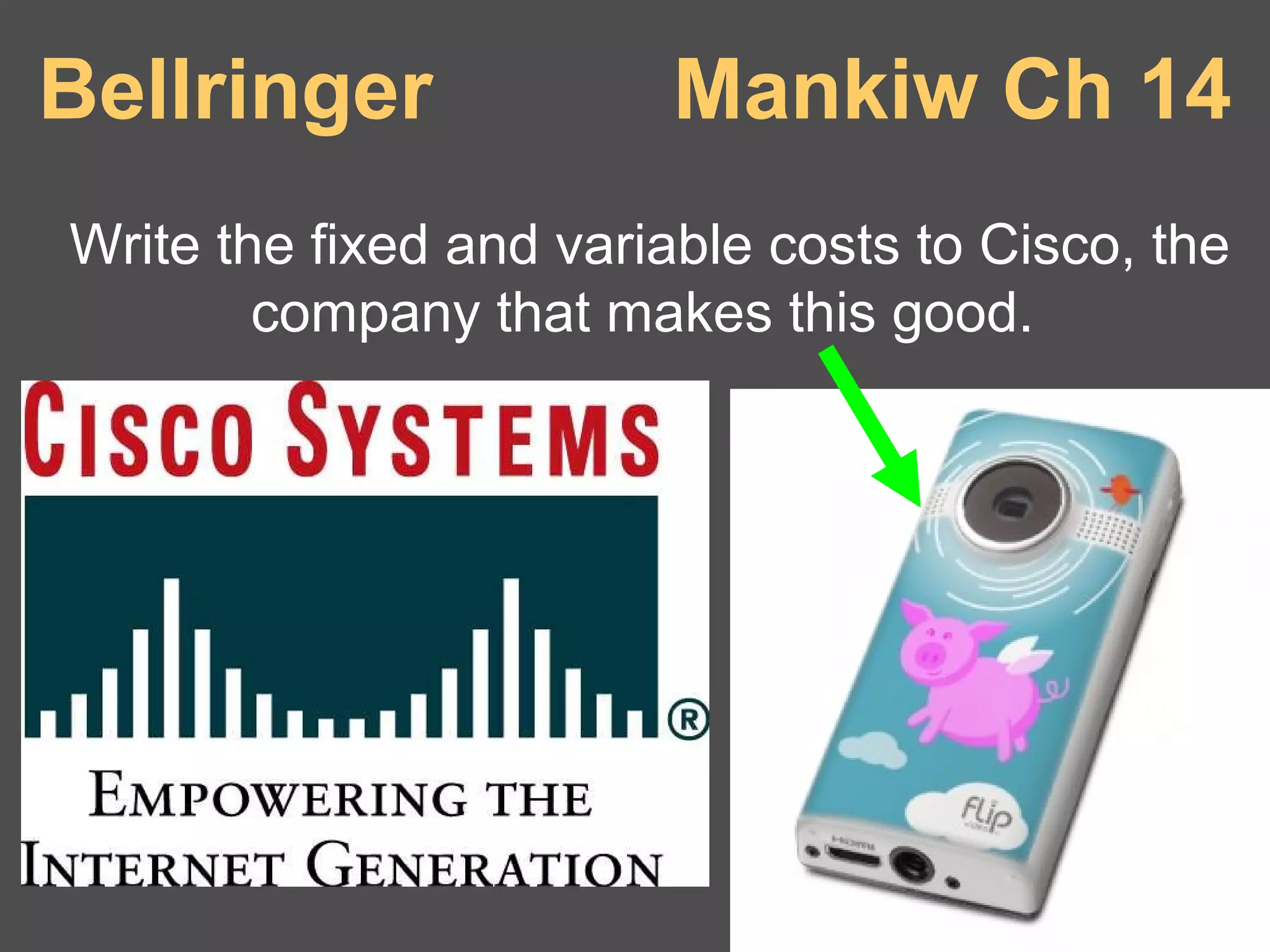
Write the fixed and variable costs to Cisco, the
company that makes this good.
Economic Competition
• 4 basic market types:
– Perfect Competition
– Monopolistic Competition
– Oligopoly
– Monopoly

• Measures price/nonprice competition, and
product differentiation
The Revenue of a Competitive
Firm
• Total revenue (TR)

TR = P x Q

• Average revenue
(AR)

TR
=P
AR =
Q

• Marginal revenue
(MR):
The change in TR from

∆TR
MR =
∆Q

FIRMS IN COMPETITIVE MARKETS

selling one more unit.

3
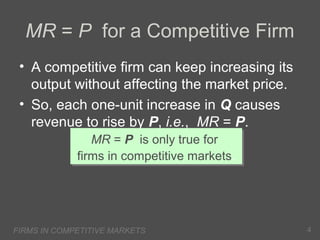
MR = P for a Competitive Firm
• A competitive firm can keep increasing its
output without affecting the market price.
• So, each one-unit increase in Q causes
revenue to rise by P, i.e., MR = P.
MR = P is only true for
firms in competitive markets.

FIRMS IN COMPETITIVE MARKETS

4
Have you ever seen this?
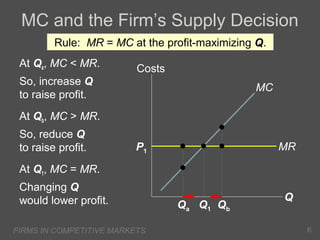
MC and the Firm’s Supply Decision
Rule: MR = MC at the profit-maximizing Q.
At Qa, MC < MR.

Costs

So, increase Q
to raise profit.

MC

At Qb, MC > MR.
So, reduce Q
to raise profit.

MR

P1

At Q1, MC = MR.
Changing Q
would lower profit.
FIRMS IN COMPETITIVE MARKETS

Qa Q1 Qb

Q
6
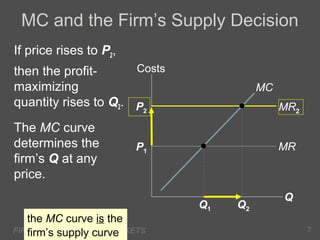
MC and the Firm’s Supply Decision
If price rises to P2,
Costs
then the profitmaximizing
quantity rises to Q2. P

MC
MR2

2

The MC curve
determines the
firm’s Q at any
price.

MR

P1

the MC curve is the
FIRMS IN COMPETITIVE MARKETS
firm’s supply curve.

Q1

Q2

Q
7
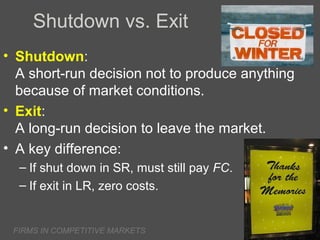
Shutdown vs. Exit
• Shutdown:
A short-run decision not to produce anything
because of market conditions.
• Exit:
A long-run decision to leave the market.
• A key difference:
– If shut down in SR, must still pay FC.
– If exit in LR, zero costs.

FIRMS IN COMPETITIVE MARKETS

8
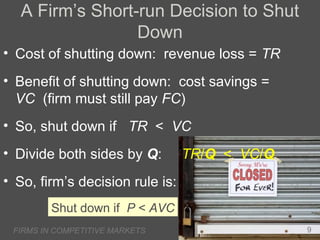
A Firm’s Short-run Decision to Shut
Down
• Cost of shutting down: revenue loss = TR
• Benefit of shutting down: cost savings =
VC (firm must still pay FC)
• So, shut down if TR < VC
• Divide both sides by Q:

TR/Q < VC/Q

• So, firm’s decision rule is:
Shut down if P < AVC
FIRMS IN COMPETITIVE MARKETS

9
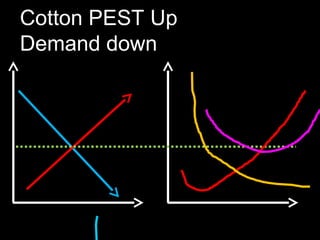
Cotton PEST Up
Demand down
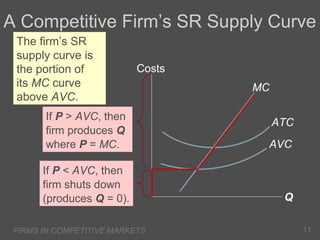
A Competitive Firm’s SR Supply Curve
The firm’s SR
supply curve is
the portion of
its MC curve
above AVC.

Costs

If P > AVC, then
firm produces Q
where P = MC.
If P < AVC, then
firm shuts down
(produces Q = 0).
FIRMS IN COMPETITIVE MARKETS

MC
ATC
AVC

Q
11
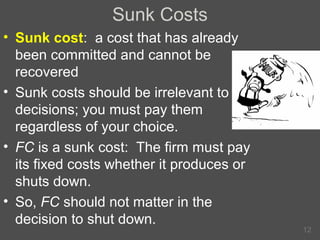
Sunk Costs
• Sunk cost: a cost that has already
been committed and cannot be
recovered
• Sunk costs should be irrelevant to
decisions; you must pay them
regardless of your choice.
• FC is a sunk cost: The firm must pay
its fixed costs whether it produces or
shuts down.
• So, FC should not matter in the
decision to shut down.

12
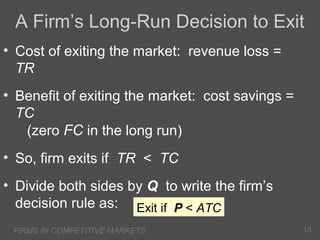
A Firm’s Long-Run Decision to Exit
• Cost of exiting the market: revenue loss =
TR
• Benefit of exiting the market: cost savings =
TC
(zero FC in the long run)
• So, firm exits if TR < TC
• Divide both sides by Q to write the firm’s
decision rule as: Exit if P < ATC
FIRMS IN COMPETITIVE MARKETS

13
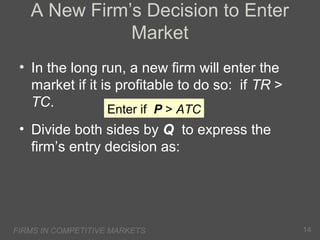
A New Firm’s Decision to Enter
Market
• In the long run, a new firm will enter the
market if it is profitable to do so: if TR >
TC.
Enter if P > ATC
• Divide both sides by Q to express the
firm’s entry decision as:

FIRMS IN COMPETITIVE MARKETS

14
Draw side by side
graphs on the board
Klein
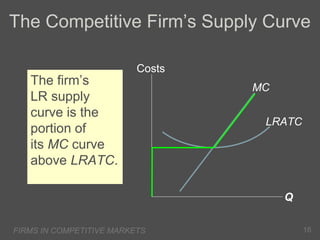
The Competitive Firm’s Supply Curve
The firm’s
LR supply
curve is the
portion of
its MC curve
above LRATC.

Costs
MC
LRATC

Q
FIRMS IN COMPETITIVE MARKETS

16
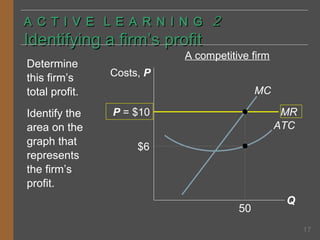
A C T I V E L E A R N I N G 2

Identifying a firm’s profit
Determine
this firm’s
total profit.
Identify the
area on the
graph that
represents
the firm’s
profit.

A competitive firm

Costs, P
MC
MR
ATC

P = $10
$6

50

Q
17
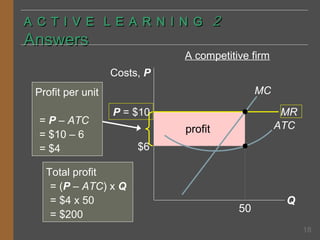
A C T I V E L E A R N I N G 2

Answers

A competitive firm
Costs, P
MC

Profit per unit
= P – ATC
= $10 – 6
= $4

MR
ATC

P = $10

Total profit
= (P – ATC) x Q
= $4 x 50
= $200

profit
$6

50

Q
18
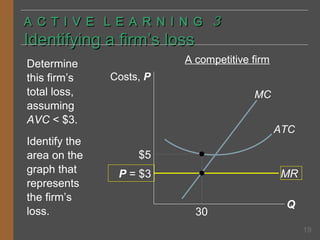
A C T I V E L E A R N I N G 3

Identifying a firm’s loss
Determine
this firm’s
total loss,
assuming
AVC < $3.
Identify the
area on the
graph that
represents
the firm’s
loss.

A competitive firm
Costs, P
MC
ATC

$5
MR

P = $3
30

Q
19
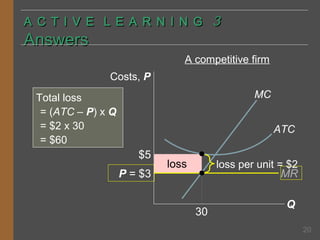
A C T I V E L E A R N I N G 3

Answers

A competitive firm
Costs, P
MC

Total loss
= (ATC – P) x Q
= $2 x 30
= $60

ATC

$5
P = $3

loss

loss per unit = $2
MR

30

Q
20
http://www.reffonomics.com/TRB/chapter9/perfectcompetitioninteractivegrapheverything
2.swf
Flip camera reading
Person 1: reads part 1 aloud
Person 2: Why didn’t Cisco think much of the Flip
camera?
Person 3: Why is the shut down surprising?
Person 1: Was the flip making a profit for Cisco?
Person 2: reads part 2 aloud
Person 3: Why was the Flip a successful product?
Person 1: Why do you think Cisco shut down rather than
sell the division?
Person 2: In the long run, why do you think Cisco
shutdown the Flip camera?
Person 3: reads part 3 aloud

Shut down point and profit

  • 1.
    Bellringer Mankiw Ch 14 Writethe fixed and variable costs to Cisco, the company that makes this good.
  • 2.
    Economic Competition • 4basic market types: – Perfect Competition – Monopolistic Competition – Oligopoly – Monopoly • Measures price/nonprice competition, and product differentiation
  • 3.
    The Revenue ofa Competitive Firm • Total revenue (TR) TR = P x Q • Average revenue (AR) TR =P AR = Q • Marginal revenue (MR): The change in TR from ∆TR MR = ∆Q FIRMS IN COMPETITIVE MARKETS selling one more unit. 3
  • 4.
    MR = Pfor a Competitive Firm • A competitive firm can keep increasing its output without affecting the market price. • So, each one-unit increase in Q causes revenue to rise by P, i.e., MR = P. MR = P is only true for MR = P is only true for firms in competitive markets. firms in competitive markets. FIRMS IN COMPETITIVE MARKETS 4
  • 5.
    Have you everseen this?
  • 6.
    MC and theFirm’s Supply Decision Rule: MR = MC at the profit-maximizing Q. At Qa, MC < MR. Costs So, increase Q to raise profit. MC At Qb, MC > MR. So, reduce Q to raise profit. MR P1 At Q1, MC = MR. Changing Q would lower profit. FIRMS IN COMPETITIVE MARKETS Qa Q1 Qb Q 6
  • 7.
    MC and theFirm’s Supply Decision If price rises to P2, Costs then the profitmaximizing quantity rises to Q2. P MC MR2 2 The MC curve determines the firm’s Q at any price. MR P1 the MC curve is the FIRMS IN COMPETITIVE MARKETS firm’s supply curve. Q1 Q2 Q 7
  • 8.
    Shutdown vs. Exit •Shutdown: A short-run decision not to produce anything because of market conditions. • Exit: A long-run decision to leave the market. • A key difference: – If shut down in SR, must still pay FC. – If exit in LR, zero costs. FIRMS IN COMPETITIVE MARKETS 8
  • 9.
    A Firm’s Short-runDecision to Shut Down • Cost of shutting down: revenue loss = TR • Benefit of shutting down: cost savings = VC (firm must still pay FC) • So, shut down if TR < VC • Divide both sides by Q: TR/Q < VC/Q • So, firm’s decision rule is: Shut down if P < AVC FIRMS IN COMPETITIVE MARKETS 9
  • 10.
  • 11.
    A Competitive Firm’sSR Supply Curve The firm’s SR supply curve is the portion of its MC curve above AVC. Costs If P > AVC, then firm produces Q where P = MC. If P < AVC, then firm shuts down (produces Q = 0). FIRMS IN COMPETITIVE MARKETS MC ATC AVC Q 11
  • 12.
    Sunk Costs • Sunkcost: a cost that has already been committed and cannot be recovered • Sunk costs should be irrelevant to decisions; you must pay them regardless of your choice. • FC is a sunk cost: The firm must pay its fixed costs whether it produces or shuts down. • So, FC should not matter in the decision to shut down. 12
  • 13.
    A Firm’s Long-RunDecision to Exit • Cost of exiting the market: revenue loss = TR • Benefit of exiting the market: cost savings = TC (zero FC in the long run) • So, firm exits if TR < TC • Divide both sides by Q to write the firm’s decision rule as: Exit if P < ATC FIRMS IN COMPETITIVE MARKETS 13
  • 14.
    A New Firm’sDecision to Enter Market • In the long run, a new firm will enter the market if it is profitable to do so: if TR > TC. Enter if P > ATC • Divide both sides by Q to express the firm’s entry decision as: FIRMS IN COMPETITIVE MARKETS 14
  • 15.
    Draw side byside graphs on the board Klein
  • 16.
    The Competitive Firm’sSupply Curve The firm’s LR supply curve is the portion of its MC curve above LRATC. Costs MC LRATC Q FIRMS IN COMPETITIVE MARKETS 16
  • 17.
    A C TI V E L E A R N I N G 2 Identifying a firm’s profit Determine this firm’s total profit. Identify the area on the graph that represents the firm’s profit. A competitive firm Costs, P MC MR ATC P = $10 $6 50 Q 17
  • 18.
    A C TI V E L E A R N I N G 2 Answers A competitive firm Costs, P MC Profit per unit = P – ATC = $10 – 6 = $4 MR ATC P = $10 Total profit = (P – ATC) x Q = $4 x 50 = $200 profit $6 50 Q 18
  • 19.
    A C TI V E L E A R N I N G 3 Identifying a firm’s loss Determine this firm’s total loss, assuming AVC < $3. Identify the area on the graph that represents the firm’s loss. A competitive firm Costs, P MC ATC $5 MR P = $3 30 Q 19
  • 20.
    A C TI V E L E A R N I N G 3 Answers A competitive firm Costs, P MC Total loss = (ATC – P) x Q = $2 x 30 = $60 ATC $5 P = $3 loss loss per unit = $2 MR 30 Q 20
  • 21.
  • 22.
    Flip camera reading Person1: reads part 1 aloud Person 2: Why didn’t Cisco think much of the Flip camera? Person 3: Why is the shut down surprising? Person 1: Was the flip making a profit for Cisco? Person 2: reads part 2 aloud Person 3: Why was the Flip a successful product? Person 1: Why do you think Cisco shut down rather than sell the division? Person 2: In the long run, why do you think Cisco shutdown the Flip camera? Person 3: reads part 3 aloud

Editor's Notes

  • #4 These revenue concepts are analogous to the cost concepts (TC, ATC, MC) in the previous chapter.
  • #7 This slide is similar to Figure 1 in the chapter. I’ve omitted the AVC and ATC curves (which appear in Figure 1 in the chapter) because they are not needed at this point.
  • #10 The shutdown rule, in plain English, says: If the cost of shutting down is less than the benefit, the firm should shut down.
  • #12 In edit mode, it looks like the text boxes are on top of each other. But in presentation mode, the text boxes display only one at a time.
  • #14 The decision rule for whether to exit says: If the cost of exiting is greater than the benefit, the firm should exit.
  • #15 Similarly, a prospective entrant compares the benefits of entering the market (TR) with the costs (TC), and enters if the benefits exceed the costs.
  • #18 Rather than tell students that profit equals (P – ATC) x Q, this exercise requires students to figure it out for themselves. If this exercise is too easy for your students, you can replace it with lecture slides that appear at the end of this file.
  • #19 The height of the rectangle is P – ATC, profit per unit. The width of the rectangle is Q, the number of units. The area of the rectangle = height x width = (profit per unit) x (number of units) = total profit.
  • #20 Students that didn’t figure out the answer to the previous exercise should be able to get this one. If this exercise is too easy for your students, you can replace it with lecture slides that appear at the end of this file. Note that the statement “assuming AVC &lt; $3” is needed to prevent shut-down, i.e. to insure that the firm produces Q=30 instead of Q=0.
  • #21 The height of the rectangle is ATC – P, loss per unit. The width of the rectangle is Q, the number of units. The area of the rectangle = height x width = (loss per unit) x (number of units) = total loss.