Tissues of Body
Types of Tissues
By
Ahmed Raza Shahid
Epithelial Tissue
• The four basic types of tissues are epithelial,
connective, muscular and nervous tissue.
These tissue exist and function in close
association with one another.
• The epithelial tissue or epithelium consist of
sheets of cells that cover the external faces of
the body, line the internal cavities, form
various organs and glands and line their ducts.
Epithelial Tissue
Epithelial Tissue
• Epithelial cells are in contact with each other.
• The structure of lining of epithelium differs
from organ to organ, depending on its location
and function.
• For example, epithelium that covers the outer
surfaces of the body, serves as a protective
layer differs from the epithelium that lines the
internal organs.
Surface Modifications on
Epithelial Cells
• Cilia are motile structures found on certain
cells in the uterine tubes, uterus and
conducting tubes of the respiratory system.
• Microvilli are small non-motile projections
that cover all absorptive cells in the small
intestine and proximal convulated tubules in
the kidney.
Cilia
Microvilli
Surface Modifications on
Epithelial Cells
• Stereocilia are long, non-motile, branched
microvilli that cover the cells in epididymis
and vas deferens. The function of microvilli
and stereocilia is to increase the surface area
to facilitate absorption.
• The function of cilia is to move water, relative
to the cell in a regular movement of the cilia.
This process results in cell movement through
the water.
Classification of Epithelium
• Epithelium is classified according to the
number of cell layers and the morphology or
structure of the surface cells.
• There is a thin basement membrane consist of
non-cellular region that separates the
epithelium from the underlying connective
tissue. This membrane is easily seen with a
light microscope.
Epithelium
Simple Epithelium
• An epithelium with a single layer of cells is
called simple epithelium. Simple squamous
epithelium covers the external surfaces of
digestive organs, lungs and heart is called
mesothelium.
• Simple squamous epithelium that covers the
lumina of the heart chambers, blood vessels
and lymphatic vessels is called endothelium.
Simple Epithelium
Simple Epithelium
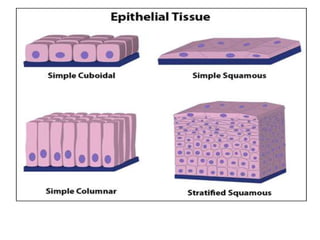
• Simple cuboidal epithelium lines small
excretory ducts in different organs. Like, in the
proximal convulated tubules of the kidney.
• Simple columnar epithelium covers the
digestive organs like stomach, small and large
intestine.
Stratified Epithelium
• Stratified squamous epithelium contains
multiple cell layers.
• There are two types of stratified squamous
epithelium; non-keratinized and keratinized.
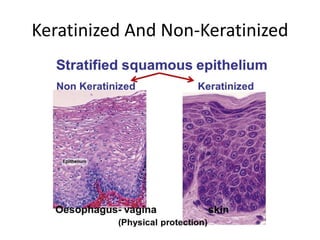
• Non-keratinized epithelium covers moist
cavities such as the mouth, pharynx,
esophagus, vagina and anal canal.
Stratified Epithelium
• Keratinized epithelium lines the external
surfaces of the body. The surface layers
contain non-living keratinized cells that are
filled with the protein keratin. The exposed
epithelium that covers the palms of and soles
exhibits especially thick layers of keratinized
cells.
Keratinized And Non-Keratinized
Stratified Epithelium
• Stratified cuboidal epithelium and stratified
columnar epithelium have a limited
distribution in the body line the larger
excretory ducts of pancreas, salivary and
sweat glands.
• Transitional epithelium lines the minor and
major calyxes, pelvis, ureter and bladder of
the urinary system.
Pseudostratified Columnar Epithelium
• Pseudostratified columnar epithelium lines
the respiratory pessages and lumina of the
epidydimis and vas deferens.
Functions of Epithelial Tissues

Epithelial Tissue 2.pptx

  • 1.
    Tissues of Body Typesof Tissues By Ahmed Raza Shahid
  • 2.
    Epithelial Tissue • Thefour basic types of tissues are epithelial, connective, muscular and nervous tissue. These tissue exist and function in close association with one another. • The epithelial tissue or epithelium consist of sheets of cells that cover the external faces of the body, line the internal cavities, form various organs and glands and line their ducts.
  • 3.
  • 4.
    Epithelial Tissue • Epithelialcells are in contact with each other. • The structure of lining of epithelium differs from organ to organ, depending on its location and function. • For example, epithelium that covers the outer surfaces of the body, serves as a protective layer differs from the epithelium that lines the internal organs.
  • 5.
    Surface Modifications on EpithelialCells • Cilia are motile structures found on certain cells in the uterine tubes, uterus and conducting tubes of the respiratory system. • Microvilli are small non-motile projections that cover all absorptive cells in the small intestine and proximal convulated tubules in the kidney.
  • 6.
  • 7.
  • 8.
    Surface Modifications on EpithelialCells • Stereocilia are long, non-motile, branched microvilli that cover the cells in epididymis and vas deferens. The function of microvilli and stereocilia is to increase the surface area to facilitate absorption. • The function of cilia is to move water, relative to the cell in a regular movement of the cilia. This process results in cell movement through the water.
  • 10.
    Classification of Epithelium •Epithelium is classified according to the number of cell layers and the morphology or structure of the surface cells. • There is a thin basement membrane consist of non-cellular region that separates the epithelium from the underlying connective tissue. This membrane is easily seen with a light microscope.
  • 11.
  • 12.
    Simple Epithelium • Anepithelium with a single layer of cells is called simple epithelium. Simple squamous epithelium covers the external surfaces of digestive organs, lungs and heart is called mesothelium. • Simple squamous epithelium that covers the lumina of the heart chambers, blood vessels and lymphatic vessels is called endothelium.
  • 13.
  • 14.
    Simple Epithelium • Simplecuboidal epithelium lines small excretory ducts in different organs. Like, in the proximal convulated tubules of the kidney. • Simple columnar epithelium covers the digestive organs like stomach, small and large intestine.
  • 16.
    Stratified Epithelium • Stratifiedsquamous epithelium contains multiple cell layers. • There are two types of stratified squamous epithelium; non-keratinized and keratinized. • Non-keratinized epithelium covers moist cavities such as the mouth, pharynx, esophagus, vagina and anal canal.
  • 17.
    Stratified Epithelium • Keratinizedepithelium lines the external surfaces of the body. The surface layers contain non-living keratinized cells that are filled with the protein keratin. The exposed epithelium that covers the palms of and soles exhibits especially thick layers of keratinized cells.
  • 18.
  • 19.
    Stratified Epithelium • Stratifiedcuboidal epithelium and stratified columnar epithelium have a limited distribution in the body line the larger excretory ducts of pancreas, salivary and sweat glands. • Transitional epithelium lines the minor and major calyxes, pelvis, ureter and bladder of the urinary system.
  • 20.
    Pseudostratified Columnar Epithelium •Pseudostratified columnar epithelium lines the respiratory pessages and lumina of the epidydimis and vas deferens.
  • 21.