MEOSAR beacons
Fundamental Elements InfoDay 2018
Prague, 14th March
Carmen Aguilera, Aviation and H2020 Coordinator
Manuel Lopez, Waterborne Sector
2
Galileo is providing Search & Rescue Initial Service
FLSRLS
Forward link Service (2016):
 Near real-time reception of distress messages
 To the Rescue Coordination Centre within 10
minutes (99%)
 Augmented coverage
 The more satellites and meoluts the more coverage
 Beacons with no GNSS receiver (non-LP): 3 Galileo satellites
are needed
 Beacons with GNSS receiver (LP): just 1 Galileo satellite is
needed
 Precise location of alerts
 Non-LP beacons: 5 km (95%) in 10 minutes
 LP beacons: Limitation to 123x123 m2
Return link Service (2018):
 Acknowledgement receipt message to the distress beacon
within 15 minutes (99%)
 It reduces stress in people affected
 It enables the remote activation of beacons
 It enables the possibility of detecting false alarms
3
SAR Beacon Types
• EPIRB (Maritime): A 406-MHz beacon designed for use aboard a marine
vessel is called an Emergency Position-Indicating Radio Beacon.
• ELT (Aviation): A beacon designed for use in an aircraft is known as an
Emergency Locator Transmitter.
• PLB (Personal): A beacon designed to be carried by an individual is known
as a Personal Locator Beacon.
Note: Sometimes PLBs are carried aboard aircraft or vessels, but you must check with
local authorities about the circumstances under which this is permitted.
Galileo RLS is included in all beacons specifications
First generation C/S 406MHZ distress beacons:
• C/S T.001 – SPECIFICATION FOR COSPAS-SARSAT 406 MHz DISTRESS BEACONS - Issue 4 Rev 2 –
February 2018.
• Defines minimum requirements to be used for the development and manufacture of 406 MHz
Emergency Locator Transmitters (ELTs), Emergency Position-Indicating Radio Beacons (EPIRBs),
and Personal Locator Beacons (PLBs). Includes Distress Tracking ELT (ELT-DT)
• It includes:
• Operational requirements for the Return Link Service (RLS).
• Return Link Service Location Protocol.
• C/S T.007- COSPAS-SARSAT 406 MHz DISTRESS BEACON TYPE APPROVAL STANDARD – Issue 5,
February 2018
• Defines the Cospas-Sarsat policy on type approval of 406 MHz distress beacons and describes:
• a. the procedure to apply for Cospas-Sarsat type approval of a 406 MHz distress beacon;
and
• b. the type approval test methods.
• It includes specific tests for RLS-enabled beacons
5
MEOSAR Beacon prototype Call objectives
Name Type Summary Max budget
MEOSAR
Beacon
prototyping
Grant
Objectives:
- Development of Galileo-based MEOSAR beacons and its
technology building blocks (C/S T.001);
- Testing and demonstrating the product capabilities
- Obtain type approval according to C/S T.007
Minimum capabilities:
• Return Link Service (RLS) function (required)
• Internal GNSS position source (required)
• RLS location protocol to encode the position data (required)
• RLS indicator (required)
• Automatic activation on indication of emergency (required in
ELTs and EPIRBs)
• Cancellation function (required in ELT DT, optional for other
beacons)
4 Mil EUR
Secure the availability of commercial products from European manufacturers of MEOSAR
Beacons compatible with the Return Link Service capabilities implemented by Galileo
6
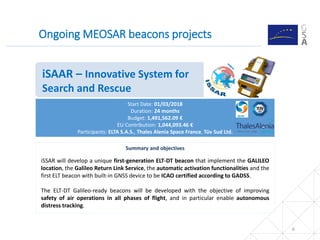
Ongoing MEOSAR beacons projects
Summary and objectives
iSAAR – Innovative System for
Search and Rescue
Start Date: 01/03/2018
Duration: 24 months
Budget: 1,491,562.09 €
EU Contribution: 1,044,093.46 €
Participants: ELTA S.A.S., Thales Alenia Space France, Tüv Sud Ltd.
iSSAR will develop a unique first-generation ELT-DT beacon that implement the GALILEO
location, the Galileo Return Link Service, the automatic activation functionalities and the
first ELT beacon with built-in GNSS device to be ICAO certified according to GADSS.
The ELT-DT Galileo-ready beacons will be developed with the objective of improving
safety of air operations in all phases of flight, and in particular enable autonomous
distress tracking.
7
Ongoing MEOSAR beacons projects
Summary and objectives
Development of PLB
Start Date: 01/03/2018
Duration: 14 months
Budget: 806,834 €
EU Contribution: 564,784 €
Participants: Syrlinks
The project objectives are the design, prototyping and certification of an ultra-compact SAR
RLS FGB tuned for large market penetration and large dissemination.
The radio module developed by Syrlinks will be adapted for this specific beacon integrating
RLS status, together with a new plastic enclosure to minimise false alarms rate.
8
Ongoing MEOSAR beacons projects
Summary and objectives
Phoenix
Start Date: 01/03/2018
Duration: 18 months
Budget: 464,378 €
EU Contribution: 325,050 €
Participants: Ocean Signal
Project Phoenix will encompass the design, development and manufacture of a 406MHz
MEOSAR PLB incorporating the ‘First Generation’ COSPAS-SARSAT 406MHz waveform.
Phoenix aims at accessing the benefits of the GALILEO Navigation Satellite Systems of
Galileo and more specifically the Return Link Service (RLS)/Return Link Message (RLM)
data encoded in the Galileo E1B navigation message.
9
Ongoing MEOSAR beacons projects
Summary and objectives
Cobalt
Start Date: 01/03/2018
Duration: 24 months
Budget: 622,296 €
EU Contribution: 435,607 €
Participants: Marine Rescue Technologies
Cobalt project will research, develop & market a COSPAS/SARSAT compliant 406MHz
personal locator beacon (PLB). The PLB will be a compact, lightweight and uniquely
designed unit for distressed users in both a maritime and land capacity.
The MRT Rescue unit will increase chances of location and survival by improving the relay
time of the distress alert, increasing the signal location accuracy, improving the signal
detection in difficult conditions and provide user reassurance through the return link
service (RLS).
Linking space to users needs
10

14. Meosar beacons

  • 1.
    MEOSAR beacons Fundamental ElementsInfoDay 2018 Prague, 14th March Carmen Aguilera, Aviation and H2020 Coordinator Manuel Lopez, Waterborne Sector
  • 2.
    2 Galileo is providingSearch & Rescue Initial Service FLSRLS Forward link Service (2016):  Near real-time reception of distress messages  To the Rescue Coordination Centre within 10 minutes (99%)  Augmented coverage  The more satellites and meoluts the more coverage  Beacons with no GNSS receiver (non-LP): 3 Galileo satellites are needed  Beacons with GNSS receiver (LP): just 1 Galileo satellite is needed  Precise location of alerts  Non-LP beacons: 5 km (95%) in 10 minutes  LP beacons: Limitation to 123x123 m2 Return link Service (2018):  Acknowledgement receipt message to the distress beacon within 15 minutes (99%)  It reduces stress in people affected  It enables the remote activation of beacons  It enables the possibility of detecting false alarms
  • 3.
    3 SAR Beacon Types •EPIRB (Maritime): A 406-MHz beacon designed for use aboard a marine vessel is called an Emergency Position-Indicating Radio Beacon. • ELT (Aviation): A beacon designed for use in an aircraft is known as an Emergency Locator Transmitter. • PLB (Personal): A beacon designed to be carried by an individual is known as a Personal Locator Beacon. Note: Sometimes PLBs are carried aboard aircraft or vessels, but you must check with local authorities about the circumstances under which this is permitted.
  • 4.
    Galileo RLS isincluded in all beacons specifications First generation C/S 406MHZ distress beacons: • C/S T.001 – SPECIFICATION FOR COSPAS-SARSAT 406 MHz DISTRESS BEACONS - Issue 4 Rev 2 – February 2018. • Defines minimum requirements to be used for the development and manufacture of 406 MHz Emergency Locator Transmitters (ELTs), Emergency Position-Indicating Radio Beacons (EPIRBs), and Personal Locator Beacons (PLBs). Includes Distress Tracking ELT (ELT-DT) • It includes: • Operational requirements for the Return Link Service (RLS). • Return Link Service Location Protocol. • C/S T.007- COSPAS-SARSAT 406 MHz DISTRESS BEACON TYPE APPROVAL STANDARD – Issue 5, February 2018 • Defines the Cospas-Sarsat policy on type approval of 406 MHz distress beacons and describes: • a. the procedure to apply for Cospas-Sarsat type approval of a 406 MHz distress beacon; and • b. the type approval test methods. • It includes specific tests for RLS-enabled beacons
  • 5.
    5 MEOSAR Beacon prototypeCall objectives Name Type Summary Max budget MEOSAR Beacon prototyping Grant Objectives: - Development of Galileo-based MEOSAR beacons and its technology building blocks (C/S T.001); - Testing and demonstrating the product capabilities - Obtain type approval according to C/S T.007 Minimum capabilities: • Return Link Service (RLS) function (required) • Internal GNSS position source (required) • RLS location protocol to encode the position data (required) • RLS indicator (required) • Automatic activation on indication of emergency (required in ELTs and EPIRBs) • Cancellation function (required in ELT DT, optional for other beacons) 4 Mil EUR Secure the availability of commercial products from European manufacturers of MEOSAR Beacons compatible with the Return Link Service capabilities implemented by Galileo
  • 6.
    6 Ongoing MEOSAR beaconsprojects Summary and objectives iSAAR – Innovative System for Search and Rescue Start Date: 01/03/2018 Duration: 24 months Budget: 1,491,562.09 € EU Contribution: 1,044,093.46 € Participants: ELTA S.A.S., Thales Alenia Space France, Tüv Sud Ltd. iSSAR will develop a unique first-generation ELT-DT beacon that implement the GALILEO location, the Galileo Return Link Service, the automatic activation functionalities and the first ELT beacon with built-in GNSS device to be ICAO certified according to GADSS. The ELT-DT Galileo-ready beacons will be developed with the objective of improving safety of air operations in all phases of flight, and in particular enable autonomous distress tracking.
  • 7.
    7 Ongoing MEOSAR beaconsprojects Summary and objectives Development of PLB Start Date: 01/03/2018 Duration: 14 months Budget: 806,834 € EU Contribution: 564,784 € Participants: Syrlinks The project objectives are the design, prototyping and certification of an ultra-compact SAR RLS FGB tuned for large market penetration and large dissemination. The radio module developed by Syrlinks will be adapted for this specific beacon integrating RLS status, together with a new plastic enclosure to minimise false alarms rate.
  • 8.
    8 Ongoing MEOSAR beaconsprojects Summary and objectives Phoenix Start Date: 01/03/2018 Duration: 18 months Budget: 464,378 € EU Contribution: 325,050 € Participants: Ocean Signal Project Phoenix will encompass the design, development and manufacture of a 406MHz MEOSAR PLB incorporating the ‘First Generation’ COSPAS-SARSAT 406MHz waveform. Phoenix aims at accessing the benefits of the GALILEO Navigation Satellite Systems of Galileo and more specifically the Return Link Service (RLS)/Return Link Message (RLM) data encoded in the Galileo E1B navigation message.
  • 9.
    9 Ongoing MEOSAR beaconsprojects Summary and objectives Cobalt Start Date: 01/03/2018 Duration: 24 months Budget: 622,296 € EU Contribution: 435,607 € Participants: Marine Rescue Technologies Cobalt project will research, develop & market a COSPAS/SARSAT compliant 406MHz personal locator beacon (PLB). The PLB will be a compact, lightweight and uniquely designed unit for distressed users in both a maritime and land capacity. The MRT Rescue unit will increase chances of location and survival by improving the relay time of the distress alert, increasing the signal location accuracy, improving the signal detection in difficult conditions and provide user reassurance through the return link service (RLS).
  • 10.
    Linking space tousers needs 10