Epidemiology-A Bird’s Eye View
Dr Shyam Ashtekar
June 2016
ashtekar.shyam@gmail.com
6/16/2016 1
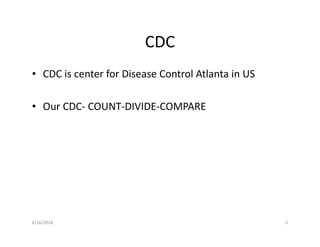
CDC
• CDC is center for Disease Control Atlanta in US
• Our CDC- COUNT-DIVIDE-COMPARE
6/16/2016 2
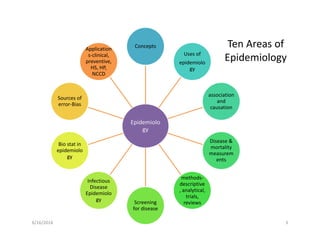
Ten Areas of
Epidemiology
Epidemiolo
gy
Concepts
Uses of
epidemiolo
gy
association
and
causation
Disease &
mortality
measurem
ents
methods-
descriptive
, analytical,
trials,
reviewsScreening
for disease
Infectious
Disease
Epidemiolo
gy
Bio stat in
epidemiolo
gy
Sources of
error-Bias
Application
s-clinical,
preventive,
HS, HP,
NCCD
6/16/2016 3
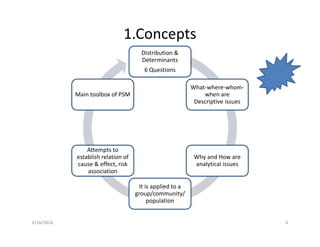
1.Concepts
Distribution &
Determinants
6 Questions
What-where-whom-
when are
Descriptive issues
Why and How are
analytical issues
It is applied to a
group/community/
population
Attempts to
establish relation of
cause & effect, risk
association
Main toolbox of PSM
6/16/2016 4
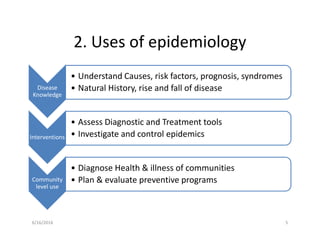
2. Uses of epidemiology
Disease
Knowledge
• Understand Causes, risk factors, prognosis, syndromes
• Natural History, rise and fall of disease
Interventions
• Assess Diagnostic and Treatment tools
• Investigate and control epidemics
Community
level use
• Diagnose Health & illness of communities
• Plan & evaluate preventive programs
6/16/2016 5
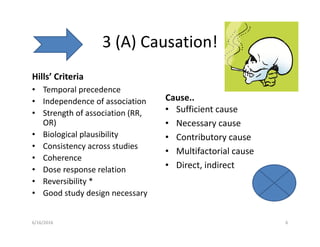
3 (A) Causation!
Hills’ Criteria
• Temporal precedence
• Independence of association
• Strength of association (RR,
OR)
• Biological plausibility
• Consistency across studies
• Coherence
• Dose response relation
• Reversibility *
• Good study design necessary
Cause..
• Sufficient cause
• Necessary cause
• Contributory cause
• Multifactorial cause
• Direct, indirect
6/16/2016 6
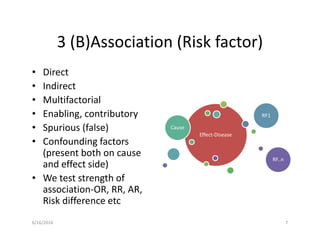
3 (B)Association (Risk factor)
• Direct
• Indirect
• Multifactorial
• Enabling, contributory
• Spurious (false)
• Confounding factors
(present both on cause
and effect side)
• We test strength of
association-OR, RR, AR,
Risk difference etc
Effect-Disease
Cause
RF1
RF..n
6/16/2016 7
4. Disease & Mortality Measurements
• Disease Incidence
• Disease Prevalence
• Mortality rates
• Life expectancy
• Proportional mortality rates
• Age-adjusted rates
• DALY index
• Rates
(number/time)
• Ratios (n/n)
• Proportions
(n/N)%
• Percentages
6/16/2016 8
6/16/2016 9
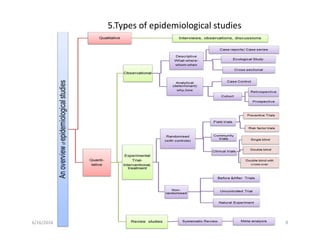
5.Types of epidemiological studies
6/16/2016 10
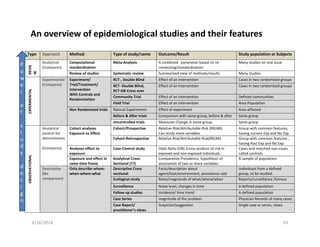
An overview of epidemiological studies and their features
Type Approach Method Type of study/name Outcome/Result Study population or Subjects
REVIE
W
Analytical
(Compares)
Computational
standardization
Meta-Analysis A combined parameter based on re-
computing/standardization
Many studies on one issue
Review of studies Systematic review Summarized view of methods/results Many studies
EXPERMENTAL
Experimental
(Compares)
Experiment/
Trial/Treatment/
Intervention
With Controls and
Randomization
RCT-, Double Blind Effect of an intervention Cases in two randomized groups
RCT- Double Blind,
RCT-DB-Cross over
Effect of an intervention Cases in two randomized groups
Community Trial Effect of an intervention Defined communities
Field Trial Effect of an intervention Area Population
Non Randomized trials Natural Experiments Effect of experiment Area affected
Before & After trials Comparison with same group, before & after Same group
Uncontrolled trials Measures Change in same group Same group
OBSERVATIONAL
Analytical
(search for
determinants
(Compares)
Cohort analyses
Exposure to Effect
Cohort/Prospective Relative Risk/Attributable Risk (RR/AR).
Can study more variables
Group with common features,
having current Exp and No Exp
Cohort-Retrospective Relative Risk/Attributable Risk(RR/AR) Group with common features ,
having Past Exp and No Exp
Analyses effect to
exposure
Case-Control study Odds Ratio (OR) /cross product of risk in
exposed and non-exposed individuals
Cases and matched non-cases
called controls
Exposure and effect in
same time frame
Analytical Cross-
Sectional (??)
Comparative Prevalence, hypothesis of
association of two or more variables
A sample of population
Descriptive
(No
comparison)
Only describe whom-
when-where-what
Descriptive Cross
sectional
Facts/description about
agent/host/environment, prevalence rate
Individuals from a defined
group, to be studied.
Ecological study Rates/magnitude of what/where/when Reports/surveillance /Census
Surveillance Noise level, changes in time A defined population
Follow up studies Incidence/ time trend A defined population
Case Series magnitude of the problem Physician Records of many cases
Case Report/
practitioner’s views
Suspicion/suggestion Single case or series, views
P
o
w
e
r
o
f
s
t
u
d
y
d
e
s
i
g
n
6. Screening pop at risk for disease
• Diagnostic test applied to
apparently healthy
population at risk
– Mass Screening test
– High risk Screening
– Multi-phasic screening
• Test should be Acceptable,
simple, repeatable, feasible,
low cost, valid (sensitive,
specific, accurate), high yield!
• Disease should be
common, important, treatable,
of good prognosis, sufficient
lead time/screening time
• Analysis done by 2*2
table with odds
ratio/cross product (Not
RR)
• Issues of borderline
values
6/16/2016 11
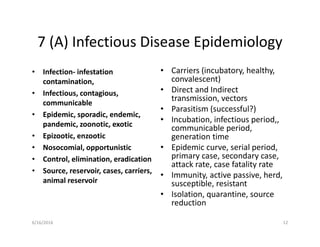
7 (A) Infectious Disease Epidemiology
• Infection- infestation
contamination,
• Infectious, contagious,
communicable
• Epidemic, sporadic, endemic,
pandemic, zoonotic, exotic
• Epizootic, enzootic
• Nosocomial, opportunistic
• Control, elimination, eradication
• Source, reservoir, cases, carriers,
animal reservoir
• Carriers (incubatory, healthy,
convalescent)
• Direct and Indirect
transmission, vectors
• Parasitism (successful?)
• Incubation, infectious period,,
communicable period,
generation time
• Epidemic curve, serial period,
primary case, secondary case,
attack rate, case fatality rate
• Immunity, active passive, herd,
susceptible, resistant
• Isolation, quarantine, source
reduction
6/16/2016 12
7 (B) Infectious Disease Epidemiology
Investigation of an epidemic-
• Verification of diagnosis,
• Confirmation of epidemic,
• Defining pop at risk,
• Case-finding, lab tests
• Relevant ecology info,
water/sanitation/pollution etc
• Data collection
• Data analysis,
• Build and test hypothesis,
• Investigate all people at risk of disease,
• Suggest control measures
• Report!
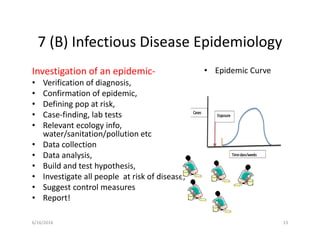
• Epidemic Curve
6/16/2016 13
8 (A) Bio stat in epidemiology
Objectives-Estimation, comparison,
Hypothesis, inference about
risk/effectiveness of intervention
Proper sampling, sampling size,
Types of variables-qualitative
(nominal, ordinal, categorical),
quantitative (discrete numbers or
continuous data)
Proper recording and data analysis
Normal distribution -Measures of
variation, dispersion, central
tendency, skewness, kurtosis..
Probability of events-independent,
dependent, combined
Tests for quantitative data (Z test,
Diff between Means, Anova, T
test for small samples, paired T
test)
Tests for qualitative data (Z test
Diff for between proportions, Chi
Square test, ranking-tests)
Correlation and regression for
relation/rate of change between
two variables
Tests for significance at p<0.05
Type 1 and type 2 errors
Graphic representation
6/16/2016 14
8 (B) Bio stat in epidemiology :2*2
tables
Important Concepts
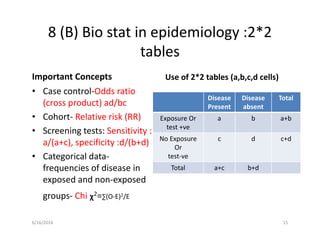
• Case control-Odds ratio
(cross product) ad/bc
• Cohort- Relative risk (RR)
• Screening tests: Sensitivity :
a/(a+c), specificity :d/(b+d)
• Categorical data-
frequencies of disease in
exposed and non-exposed
groups- Chi
ᵡ
2=∑(O-E)2/E
Use of 2*2 tables (a,b,c,d cells)
6/16/2016 15
Disease
Present
Disease
absent
Total
Exposure Or
test +ve
a b a+b
No Exposure
Or
test-ve
c d c+d
Total a+c b+d
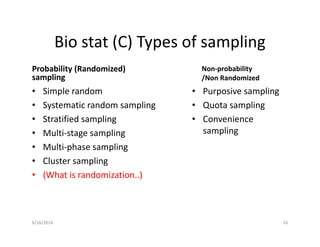
Bio stat (C) Types of sampling
Probability (Randomized)
sampling
• Simple random
• Systematic random sampling
• Stratified sampling
• Multi-stage sampling
• Multi-phase sampling
• Cluster sampling
• (What is randomization..)
Non-probability
/Non Randomized
• Purposive sampling
• Quota sampling
• Convenience
sampling
6/16/2016 16
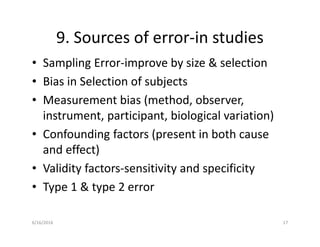
9. Sources of error-in studies
• Sampling Error-improve by size & selection
• Bias in Selection of subjects
• Measurement bias (method, observer,
instrument, participant, biological variation)
• Confounding factors (present in both cause
and effect)
• Validity factors-sensitivity and specificity
• Type 1 & type 2 error
6/16/2016 17
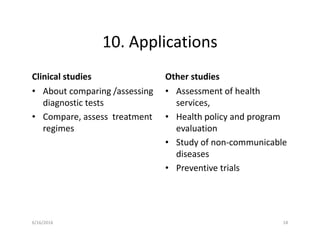
10. Applications
Clinical studies
• About comparing /assessing
diagnostic tests
• Compare, assess treatment
regimes
Other studies
• Assessment of health
services,
• Health policy and program
evaluation
• Study of non-communicable
diseases
• Preventive trials
6/16/2016 18
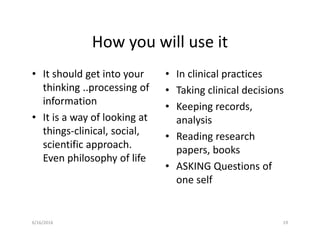
How you will use it
• It should get into your
thinking ..processing of
information
• It is a way of looking at
things-clinical, social,
scientific approach.
Even philosophy of life
• In clinical practices
• Taking clinical decisions
• Keeping records,
analysis
• Reading research
papers, books
• ASKING Questions of
one self
6/16/2016 19
Thanks
Dr Shyam Ashtekar
Assistant Professor, PSM dept,
SMBT medical college, Nandi Hills,
Dhamangaon Ta. Igatpuri Maharashtra
ashtekar.shyam@gmail.com
6/16/2016 20

Epidemiology: a bird’s eye view

  • 1.
    Epidemiology-A Bird’s EyeView Dr Shyam Ashtekar June 2016 ashtekar.shyam@gmail.com 6/16/2016 1
  • 2.
    CDC • CDC iscenter for Disease Control Atlanta in US • Our CDC- COUNT-DIVIDE-COMPARE 6/16/2016 2
  • 3.
    Ten Areas of Epidemiology Epidemiolo gy Concepts Usesof epidemiolo gy association and causation Disease & mortality measurem ents methods- descriptive , analytical, trials, reviewsScreening for disease Infectious Disease Epidemiolo gy Bio stat in epidemiolo gy Sources of error-Bias Application s-clinical, preventive, HS, HP, NCCD 6/16/2016 3
  • 4.
    1.Concepts Distribution & Determinants 6 Questions What-where-whom- whenare Descriptive issues Why and How are analytical issues It is applied to a group/community/ population Attempts to establish relation of cause & effect, risk association Main toolbox of PSM 6/16/2016 4
  • 5.
    2. Uses ofepidemiology Disease Knowledge • Understand Causes, risk factors, prognosis, syndromes • Natural History, rise and fall of disease Interventions • Assess Diagnostic and Treatment tools • Investigate and control epidemics Community level use • Diagnose Health & illness of communities • Plan & evaluate preventive programs 6/16/2016 5
  • 6.
    3 (A) Causation! Hills’Criteria • Temporal precedence • Independence of association • Strength of association (RR, OR) • Biological plausibility • Consistency across studies • Coherence • Dose response relation • Reversibility * • Good study design necessary Cause.. • Sufficient cause • Necessary cause • Contributory cause • Multifactorial cause • Direct, indirect 6/16/2016 6
  • 7.
    3 (B)Association (Riskfactor) • Direct • Indirect • Multifactorial • Enabling, contributory • Spurious (false) • Confounding factors (present both on cause and effect side) • We test strength of association-OR, RR, AR, Risk difference etc Effect-Disease Cause RF1 RF..n 6/16/2016 7
  • 8.
    4. Disease &Mortality Measurements • Disease Incidence • Disease Prevalence • Mortality rates • Life expectancy • Proportional mortality rates • Age-adjusted rates • DALY index • Rates (number/time) • Ratios (n/n) • Proportions (n/N)% • Percentages 6/16/2016 8
  • 9.
    6/16/2016 9 5.Types ofepidemiological studies
  • 10.
    6/16/2016 10 An overviewof epidemiological studies and their features Type Approach Method Type of study/name Outcome/Result Study population or Subjects REVIE W Analytical (Compares) Computational standardization Meta-Analysis A combined parameter based on re- computing/standardization Many studies on one issue Review of studies Systematic review Summarized view of methods/results Many studies EXPERMENTAL Experimental (Compares) Experiment/ Trial/Treatment/ Intervention With Controls and Randomization RCT-, Double Blind Effect of an intervention Cases in two randomized groups RCT- Double Blind, RCT-DB-Cross over Effect of an intervention Cases in two randomized groups Community Trial Effect of an intervention Defined communities Field Trial Effect of an intervention Area Population Non Randomized trials Natural Experiments Effect of experiment Area affected Before & After trials Comparison with same group, before & after Same group Uncontrolled trials Measures Change in same group Same group OBSERVATIONAL Analytical (search for determinants (Compares) Cohort analyses Exposure to Effect Cohort/Prospective Relative Risk/Attributable Risk (RR/AR). Can study more variables Group with common features, having current Exp and No Exp Cohort-Retrospective Relative Risk/Attributable Risk(RR/AR) Group with common features , having Past Exp and No Exp Analyses effect to exposure Case-Control study Odds Ratio (OR) /cross product of risk in exposed and non-exposed individuals Cases and matched non-cases called controls Exposure and effect in same time frame Analytical Cross- Sectional (??) Comparative Prevalence, hypothesis of association of two or more variables A sample of population Descriptive (No comparison) Only describe whom- when-where-what Descriptive Cross sectional Facts/description about agent/host/environment, prevalence rate Individuals from a defined group, to be studied. Ecological study Rates/magnitude of what/where/when Reports/surveillance /Census Surveillance Noise level, changes in time A defined population Follow up studies Incidence/ time trend A defined population Case Series magnitude of the problem Physician Records of many cases Case Report/ practitioner’s views Suspicion/suggestion Single case or series, views P o w e r o f s t u d y d e s i g n
  • 11.
    6. Screening popat risk for disease • Diagnostic test applied to apparently healthy population at risk – Mass Screening test – High risk Screening – Multi-phasic screening • Test should be Acceptable, simple, repeatable, feasible, low cost, valid (sensitive, specific, accurate), high yield! • Disease should be common, important, treatable, of good prognosis, sufficient lead time/screening time • Analysis done by 2*2 table with odds ratio/cross product (Not RR) • Issues of borderline values 6/16/2016 11
  • 12.
    7 (A) InfectiousDisease Epidemiology • Infection- infestation contamination, • Infectious, contagious, communicable • Epidemic, sporadic, endemic, pandemic, zoonotic, exotic • Epizootic, enzootic • Nosocomial, opportunistic • Control, elimination, eradication • Source, reservoir, cases, carriers, animal reservoir • Carriers (incubatory, healthy, convalescent) • Direct and Indirect transmission, vectors • Parasitism (successful?) • Incubation, infectious period,, communicable period, generation time • Epidemic curve, serial period, primary case, secondary case, attack rate, case fatality rate • Immunity, active passive, herd, susceptible, resistant • Isolation, quarantine, source reduction 6/16/2016 12
  • 13.
    7 (B) InfectiousDisease Epidemiology Investigation of an epidemic- • Verification of diagnosis, • Confirmation of epidemic, • Defining pop at risk, • Case-finding, lab tests • Relevant ecology info, water/sanitation/pollution etc • Data collection • Data analysis, • Build and test hypothesis, • Investigate all people at risk of disease, • Suggest control measures • Report! • Epidemic Curve 6/16/2016 13
  • 14.
    8 (A) Biostat in epidemiology Objectives-Estimation, comparison, Hypothesis, inference about risk/effectiveness of intervention Proper sampling, sampling size, Types of variables-qualitative (nominal, ordinal, categorical), quantitative (discrete numbers or continuous data) Proper recording and data analysis Normal distribution -Measures of variation, dispersion, central tendency, skewness, kurtosis.. Probability of events-independent, dependent, combined Tests for quantitative data (Z test, Diff between Means, Anova, T test for small samples, paired T test) Tests for qualitative data (Z test Diff for between proportions, Chi Square test, ranking-tests) Correlation and regression for relation/rate of change between two variables Tests for significance at p<0.05 Type 1 and type 2 errors Graphic representation 6/16/2016 14
  • 15.
    8 (B) Biostat in epidemiology :2*2 tables Important Concepts • Case control-Odds ratio (cross product) ad/bc • Cohort- Relative risk (RR) • Screening tests: Sensitivity : a/(a+c), specificity :d/(b+d) • Categorical data- frequencies of disease in exposed and non-exposed groups- Chi ᵡ 2=∑(O-E)2/E Use of 2*2 tables (a,b,c,d cells) 6/16/2016 15 Disease Present Disease absent Total Exposure Or test +ve a b a+b No Exposure Or test-ve c d c+d Total a+c b+d
  • 16.
    Bio stat (C)Types of sampling Probability (Randomized) sampling • Simple random • Systematic random sampling • Stratified sampling • Multi-stage sampling • Multi-phase sampling • Cluster sampling • (What is randomization..) Non-probability /Non Randomized • Purposive sampling • Quota sampling • Convenience sampling 6/16/2016 16
  • 17.
    9. Sources oferror-in studies • Sampling Error-improve by size & selection • Bias in Selection of subjects • Measurement bias (method, observer, instrument, participant, biological variation) • Confounding factors (present in both cause and effect) • Validity factors-sensitivity and specificity • Type 1 & type 2 error 6/16/2016 17
  • 18.
    10. Applications Clinical studies •About comparing /assessing diagnostic tests • Compare, assess treatment regimes Other studies • Assessment of health services, • Health policy and program evaluation • Study of non-communicable diseases • Preventive trials 6/16/2016 18
  • 19.
    How you willuse it • It should get into your thinking ..processing of information • It is a way of looking at things-clinical, social, scientific approach. Even philosophy of life • In clinical practices • Taking clinical decisions • Keeping records, analysis • Reading research papers, books • ASKING Questions of one self 6/16/2016 19
  • 20.
    Thanks Dr Shyam Ashtekar AssistantProfessor, PSM dept, SMBT medical college, Nandi Hills, Dhamangaon Ta. Igatpuri Maharashtra ashtekar.shyam@gmail.com 6/16/2016 20