Cost & Works Accounting
Material Accounting
(Methods/Techniques of Inventory control)
(Economic Ordering Quantity)
(E.O.Q)
Prof.Uday Teke
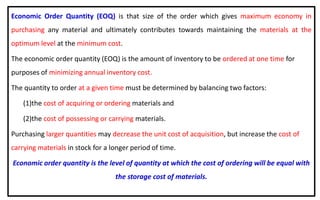
Economic Order Quantity (EOQ) is that size of the order which gives maximum economy in
purchasing any material and ultimately contributes towards maintaining the materials at the
optimum level at the minimum cost.
The economic order quantity (EOQ) is the amount of inventory to be ordered at one time for
purposes of minimizing annual inventory cost.
The quantity to order at a given time must be determined by balancing two factors:
(1)the cost of acquiring or ordering materials and
(2)the cost of possessing or carrying materials.
Purchasing larger quantities may decrease the unit cost of acquisition, but increase the cost of
carrying materials in stock for a longer period of time.
Economic order quantity is the level of quantity at which the cost of ordering will be equal with
the storage cost of materials.
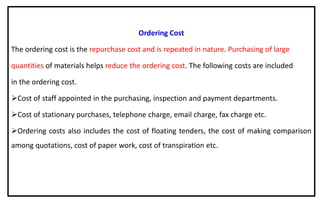
Ordering Cost
The ordering cost is the repurchase cost and is repeated in nature. Purchasing of large
quantities of materials helps reduce the ordering cost. The following costs are included
in the ordering cost.
Cost of staff appointed in the purchasing, inspection and payment departments.
Cost of stationary purchases, telephone charge, email charge, fax charge etc.
Ordering costs also includes the cost of floating tenders, the cost of making comparison
among quotations, cost of paper work, cost of transpiration etc.
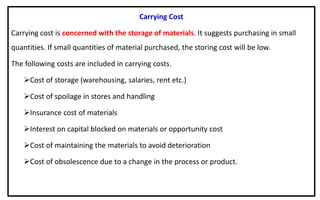
Carrying Cost
Carrying cost is concerned with the storage of materials. It suggests purchasing in small
quantities. If small quantities of material purchased, the storing cost will be low.
The following costs are included in carrying costs.
Cost of storage (warehousing, salaries, rent etc.)
Cost of spoilage in stores and handling
Insurance cost of materials
Interest on capital blocked on materials or opportunity cost
Cost of maintaining the materials to avoid deterioration
Cost of obsolescence due to a change in the process or product.
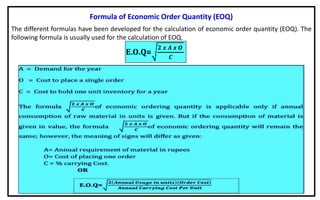
Formula of Economic Order Quantity (EOQ)
The different formulas have been developed for the calculation of economic order quantity (EOQ). The
following formula is usually used for the calculation of EOQ.
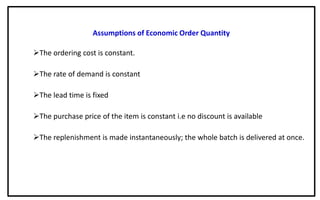
Assumptions of Economic Order Quantity
The ordering cost is constant.
The rate of demand is constant
The lead time is fixed
The purchase price of the item is constant i.e no discount is available
The replenishment is made instantaneously; the whole batch is delivered at once.

Economic Ordering Quantity ()EOQ

  • 1.
    Cost & WorksAccounting Material Accounting (Methods/Techniques of Inventory control) (Economic Ordering Quantity) (E.O.Q) Prof.Uday Teke
  • 2.
    Economic Order Quantity(EOQ) is that size of the order which gives maximum economy in purchasing any material and ultimately contributes towards maintaining the materials at the optimum level at the minimum cost. The economic order quantity (EOQ) is the amount of inventory to be ordered at one time for purposes of minimizing annual inventory cost. The quantity to order at a given time must be determined by balancing two factors: (1)the cost of acquiring or ordering materials and (2)the cost of possessing or carrying materials. Purchasing larger quantities may decrease the unit cost of acquisition, but increase the cost of carrying materials in stock for a longer period of time. Economic order quantity is the level of quantity at which the cost of ordering will be equal with the storage cost of materials.
  • 3.
    Ordering Cost The orderingcost is the repurchase cost and is repeated in nature. Purchasing of large quantities of materials helps reduce the ordering cost. The following costs are included in the ordering cost. Cost of staff appointed in the purchasing, inspection and payment departments. Cost of stationary purchases, telephone charge, email charge, fax charge etc. Ordering costs also includes the cost of floating tenders, the cost of making comparison among quotations, cost of paper work, cost of transpiration etc.
  • 4.
    Carrying Cost Carrying costis concerned with the storage of materials. It suggests purchasing in small quantities. If small quantities of material purchased, the storing cost will be low. The following costs are included in carrying costs. Cost of storage (warehousing, salaries, rent etc.) Cost of spoilage in stores and handling Insurance cost of materials Interest on capital blocked on materials or opportunity cost Cost of maintaining the materials to avoid deterioration Cost of obsolescence due to a change in the process or product.
  • 5.
    Formula of EconomicOrder Quantity (EOQ) The different formulas have been developed for the calculation of economic order quantity (EOQ). The following formula is usually used for the calculation of EOQ.
  • 6.
    Assumptions of EconomicOrder Quantity The ordering cost is constant. The rate of demand is constant The lead time is fixed The purchase price of the item is constant i.e no discount is available The replenishment is made instantaneously; the whole batch is delivered at once.