External Analysis – The identification
of Opportunities and Threats
External Analysis
• Analyzing the dynamics of the industry in
which an organization competes to help
identify opportunities and threats
“To assure victory, always carefully survey the
field before battle.” - Sun Tzu
Opportunities and Threats
• Opportunities arise when a company can take
advantage of conditions in its environment to
formulate and implement strategies that
enable it to become more profitable.
• Threats arise when conditions in the external
environment endanger the integrity and
profitability of the company’s business.
Defining industry
• Industry: “…a group of companies offering products or
services that are close substitutes for each other… that
satisfy the same basic customer need.”
– Identifying industry: Consumer-oriented view is better than
product-oriented view
– Broader view is better than narrow view
– Industry boundary may change
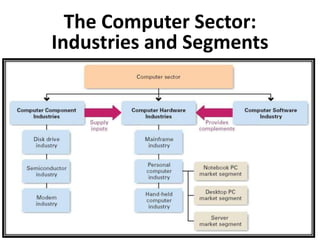
• Sector: “…a group of closely related industries.”
• Market Segments: “…distinct groups of customers
within a market that can be differentiated from each
other on the basis of their distinct attributes and
specific demands..”
The Computer Sector:
Industries and Segments
Forces Shape Competition
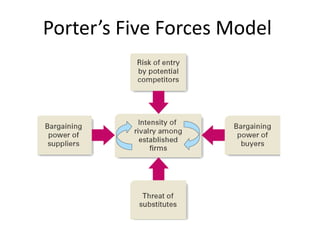
• Porter's five forces helps
• Stronger these forces, limited is the ability of
firms to raise prices and earn profit
Weak competitive forces = Opportunity
Strong competitive force = Threat (because they
depress profit)
• Strength of these forces changes
• And are the opportunities and threats –
design appropriate strategic responses
Porter’s Five Forces Model
Risk of Entry by Potential Competitors
Competitors: “…companies… not currently competing in
an industry but have the capability to do so...”
They may not enter if barriers are high
1. Economies of Scale – unit costs fall
 Cost reductions – mass production of standardized output
 Bulk purchase discounts
 Cost savings
2. Brand Loyalty = creating customer preferences
3. Absolute Cost Advantages v. New Entrants
 Superior production operation and process due to
accumulated experience, patents, and secret processes
 Control of production inputs
 Lower financial risks
4. Customer Switching Costs
5. Government Regulation
Rivalry Among Established Companies
Rivalry: “…competitive struggle between companies in
same industry to gain market share...”
Influenced by
1. Industry Competitive Structure- Number/size of
companies, consolidated vs. fragmented
2. Industry Demand Conditions
• Growing demand – reduces rivalry
• Declining demand – encourages rivalry
3. Cost Conditions
• High fixed costs – profitability leveraged by volume
• Slow demand/growth – intense rivalry/lower profits
4. Exit Barriers – lock up firms and reduce profit
• Write-off assets High fixed cost
• Economic dependence Emotional attachment
• Maintain assets Bankruptcy regulations
Bargaining Power of Buyers
Bargaining power here refers to the ability of buyers to
bargain down prices charged by companies in the industry or
to raise the costs of companies in the industry by demanding
better quality and service
High: Threat because they squeeze profit
Buyers are most powerful when:
1. Suppliers = many small companies, buyers large/few
2. Purchase in large quantities
3. Suppliers depend on buyers for large % of orders
4. Buyers switching costs are low
5. Buyer can purchase from several
6. Buyers supply own needs
Bargaining Power of Suppliers
Suppliers are most powerful when:
1. Few substitutes
2. Industry not important to suppliers
3. Buyers- purchase large % of orders
4. Buyers experience significant switching costs
5. Suppliers can threaten to enter industry
• Produce/supply own product
• Buyers cannot threaten to make own inputs
Substitute Products
They are “…products from different businesses or
industries…can satisfy similar customer needs.”
1. Existence of close substitutes a strong threat -
Substitutes limit price that companies can charge for
product
2. Substitutes a weak competitive force
• Few close substitutes
• Companies in industry can raise prices and earn
additional profits.
Sixth Force: Complementors
“…sell products that add value to the products.. In an
industry… when use together….”
1. Substitutes/complements influence demand
2. Important in demand & profitability in many hi-tech
industries
Strategic Groups Within Industries
They are“…follow a business model… similar to other companies
within… group, but are different from the business model of
other companies in other… groups.
Implications
1. Closest competitors in same strategic group viewed as
substitutes for each other
2. Different competitive forces and may face different set of
opportunities/threats
Mobility Barriers
1. Inhibit movement between strategic groups
2. Include barriers to enter another group or exit existing
Industry Life Cycle Analysis
• This approach
“…analyzes the effects of industry evolution on
competitive forces over time…characterized by five
distinct life cycle stages”
To remember:
Strength and nature of five forces change as industry
evolves
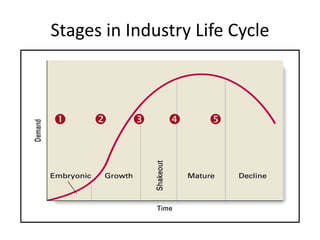
Stages in Industry Life Cycle
    
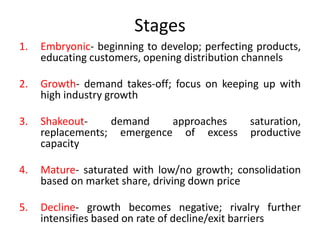
Stages
1. Embryonic- beginning to develop; perfecting products,
educating customers, opening distribution channels
2. Growth- demand takes-off; focus on keeping up with
high industry growth
3. Shakeout- demand approaches saturation,
replacements; emergence of excess productive
capacity
4. Mature- saturated with low/no growth; consolidation
based on market share, driving down price
5. Decline- growth becomes negative; rivalry further
intensifies based on rate of decline/exit barriers
Limitations of Models for Industry Analysis
1) Life Cycle Issues
a) Cycles not always follow generalization
b) Rapid growth situations may skip embryonic
c) Growth revitalized by innovation/social change
d) Time span of stages can vary
2) Innovation and Change
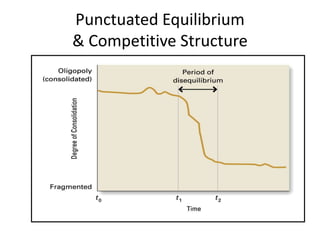
a) Punctuated Equilibrium- industry’s long term stable
structure punctuated with periods of rapid
change/innovation
b) Hypercompetitive industries- permanent, ongoing
innovation & competitive change
3) Company Differences
a) Significant variances in profit rates
b) Resources/capabilities determinants of profit
Punctuated Equilibrium
& Competitive Structure
The Macro-environment
• Macro-economic Forces: rates of interest, currency
exchange, inflation/deflation
• Global Forces: barriers to international trade and
investment
• Technological Forces: new technologies
• Demographic Forces: changes in characteristics of a
population
• Social Forces: social values and mores
• Political & Legal Forces: laws/regulations
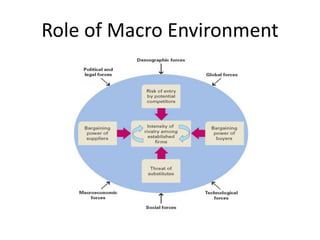
Role of Macro Environment
The Role of the Macro-environment
Changes in one or more forces in the
macro-environment can affect:
–Competitiveness of the industry (Porter’s
Five Forces)
–Attractiveness of the industry
–Relative strengths (or weaknesses) of a
given company
Michael Porter on strategy
“Strategy is a choice on how to compete.”

2.ext analysis

  • 1.
    External Analysis –The identification of Opportunities and Threats
  • 2.
    External Analysis • Analyzingthe dynamics of the industry in which an organization competes to help identify opportunities and threats “To assure victory, always carefully survey the field before battle.” - Sun Tzu
  • 3.
    Opportunities and Threats •Opportunities arise when a company can take advantage of conditions in its environment to formulate and implement strategies that enable it to become more profitable. • Threats arise when conditions in the external environment endanger the integrity and profitability of the company’s business.
  • 4.
    Defining industry • Industry:“…a group of companies offering products or services that are close substitutes for each other… that satisfy the same basic customer need.” – Identifying industry: Consumer-oriented view is better than product-oriented view – Broader view is better than narrow view – Industry boundary may change • Sector: “…a group of closely related industries.” • Market Segments: “…distinct groups of customers within a market that can be differentiated from each other on the basis of their distinct attributes and specific demands..”
  • 5.
  • 6.
    Forces Shape Competition •Porter's five forces helps • Stronger these forces, limited is the ability of firms to raise prices and earn profit Weak competitive forces = Opportunity Strong competitive force = Threat (because they depress profit) • Strength of these forces changes • And are the opportunities and threats – design appropriate strategic responses
  • 7.
  • 8.
    Risk of Entryby Potential Competitors Competitors: “…companies… not currently competing in an industry but have the capability to do so...” They may not enter if barriers are high 1. Economies of Scale – unit costs fall  Cost reductions – mass production of standardized output  Bulk purchase discounts  Cost savings 2. Brand Loyalty = creating customer preferences 3. Absolute Cost Advantages v. New Entrants  Superior production operation and process due to accumulated experience, patents, and secret processes  Control of production inputs  Lower financial risks 4. Customer Switching Costs 5. Government Regulation
  • 9.
    Rivalry Among EstablishedCompanies Rivalry: “…competitive struggle between companies in same industry to gain market share...” Influenced by 1. Industry Competitive Structure- Number/size of companies, consolidated vs. fragmented 2. Industry Demand Conditions • Growing demand – reduces rivalry • Declining demand – encourages rivalry 3. Cost Conditions • High fixed costs – profitability leveraged by volume • Slow demand/growth – intense rivalry/lower profits 4. Exit Barriers – lock up firms and reduce profit • Write-off assets High fixed cost • Economic dependence Emotional attachment • Maintain assets Bankruptcy regulations
  • 10.
    Bargaining Power ofBuyers Bargaining power here refers to the ability of buyers to bargain down prices charged by companies in the industry or to raise the costs of companies in the industry by demanding better quality and service High: Threat because they squeeze profit Buyers are most powerful when: 1. Suppliers = many small companies, buyers large/few 2. Purchase in large quantities 3. Suppliers depend on buyers for large % of orders 4. Buyers switching costs are low 5. Buyer can purchase from several 6. Buyers supply own needs
  • 11.
    Bargaining Power ofSuppliers Suppliers are most powerful when: 1. Few substitutes 2. Industry not important to suppliers 3. Buyers- purchase large % of orders 4. Buyers experience significant switching costs 5. Suppliers can threaten to enter industry • Produce/supply own product • Buyers cannot threaten to make own inputs
  • 12.
    Substitute Products They are“…products from different businesses or industries…can satisfy similar customer needs.” 1. Existence of close substitutes a strong threat - Substitutes limit price that companies can charge for product 2. Substitutes a weak competitive force • Few close substitutes • Companies in industry can raise prices and earn additional profits.
  • 13.
    Sixth Force: Complementors “…sellproducts that add value to the products.. In an industry… when use together….” 1. Substitutes/complements influence demand 2. Important in demand & profitability in many hi-tech industries
  • 14.
    Strategic Groups WithinIndustries They are“…follow a business model… similar to other companies within… group, but are different from the business model of other companies in other… groups. Implications 1. Closest competitors in same strategic group viewed as substitutes for each other 2. Different competitive forces and may face different set of opportunities/threats Mobility Barriers 1. Inhibit movement between strategic groups 2. Include barriers to enter another group or exit existing
  • 15.
    Industry Life CycleAnalysis • This approach “…analyzes the effects of industry evolution on competitive forces over time…characterized by five distinct life cycle stages” To remember: Strength and nature of five forces change as industry evolves
  • 16.
    Stages in IndustryLife Cycle     
  • 17.
    Stages 1. Embryonic- beginningto develop; perfecting products, educating customers, opening distribution channels 2. Growth- demand takes-off; focus on keeping up with high industry growth 3. Shakeout- demand approaches saturation, replacements; emergence of excess productive capacity 4. Mature- saturated with low/no growth; consolidation based on market share, driving down price 5. Decline- growth becomes negative; rivalry further intensifies based on rate of decline/exit barriers
  • 18.
    Limitations of Modelsfor Industry Analysis 1) Life Cycle Issues a) Cycles not always follow generalization b) Rapid growth situations may skip embryonic c) Growth revitalized by innovation/social change d) Time span of stages can vary 2) Innovation and Change a) Punctuated Equilibrium- industry’s long term stable structure punctuated with periods of rapid change/innovation b) Hypercompetitive industries- permanent, ongoing innovation & competitive change 3) Company Differences a) Significant variances in profit rates b) Resources/capabilities determinants of profit
  • 19.
  • 20.
    The Macro-environment • Macro-economicForces: rates of interest, currency exchange, inflation/deflation • Global Forces: barriers to international trade and investment • Technological Forces: new technologies • Demographic Forces: changes in characteristics of a population • Social Forces: social values and mores • Political & Legal Forces: laws/regulations
  • 21.
    Role of MacroEnvironment
  • 22.
    The Role ofthe Macro-environment Changes in one or more forces in the macro-environment can affect: –Competitiveness of the industry (Porter’s Five Forces) –Attractiveness of the industry –Relative strengths (or weaknesses) of a given company
  • 23.
    Michael Porter onstrategy “Strategy is a choice on how to compete.”