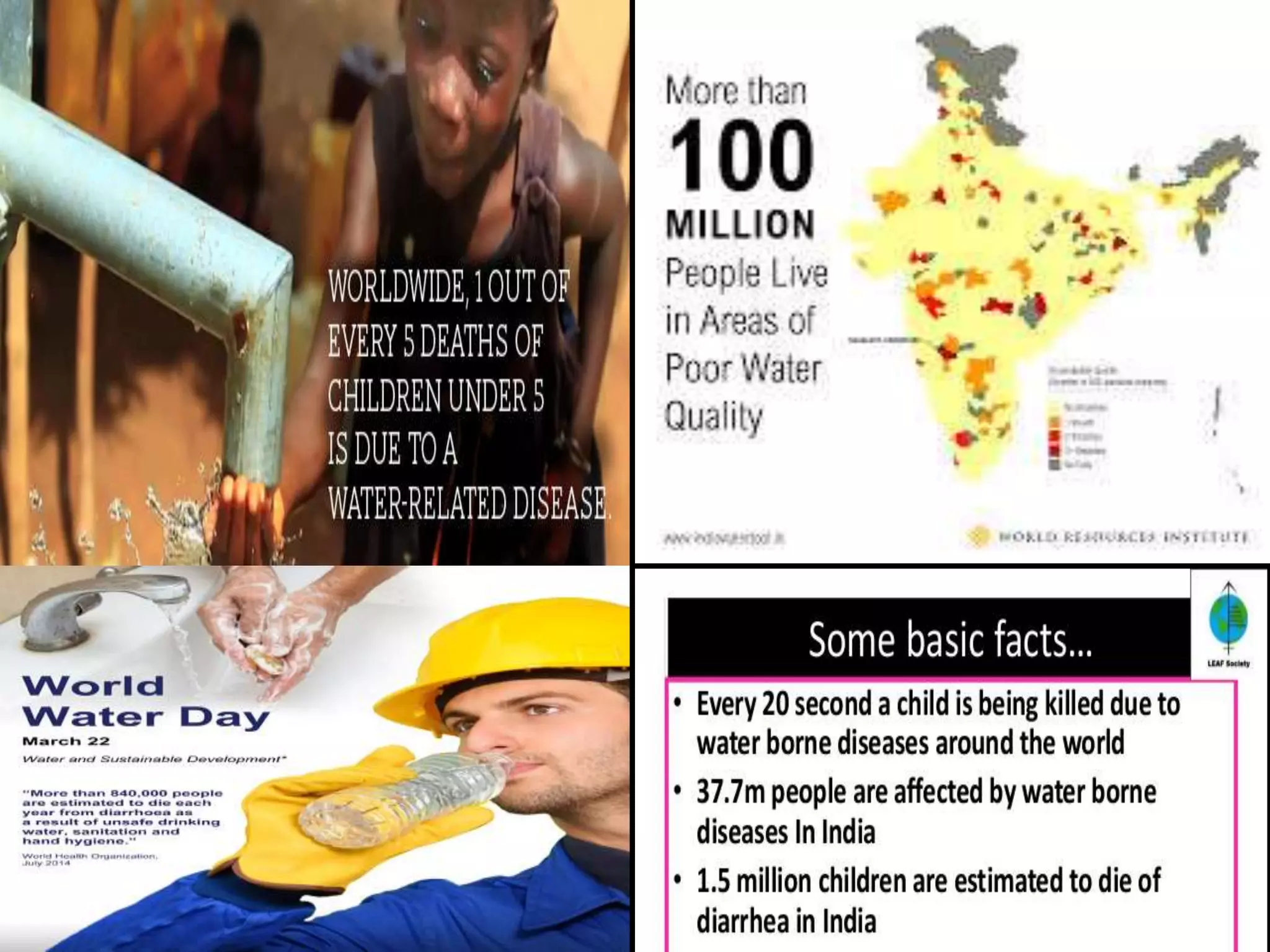
Environment in health and
disease (Water)
Presented by,
Dr. Shivashankar.K
P.G., Dept of Public Health Dentistry
CONTENTS
 INTRODUCTION
 ENVIRONMENTAL FACTORS
 WATER REQUIREMENT
 USES OF WATER
 SOURCES OF WATER SUPPLY
 WATER POLLUTION
 PURIFICATION OF WATER
 WATER QUALITY-CRITERIA AND STANDARDS
 SURVEILLANCE OF DRINKING WATER QUALITY
 HARDNESS OF WATER
 CONCLUSION
 REFERENCES
Introduction
• The study of disease is really the study of man and his
environment.
• All external factors--- living+ non-living+ non-material
• Social and economic conditions
Components of environment
Physical
Social
Biological
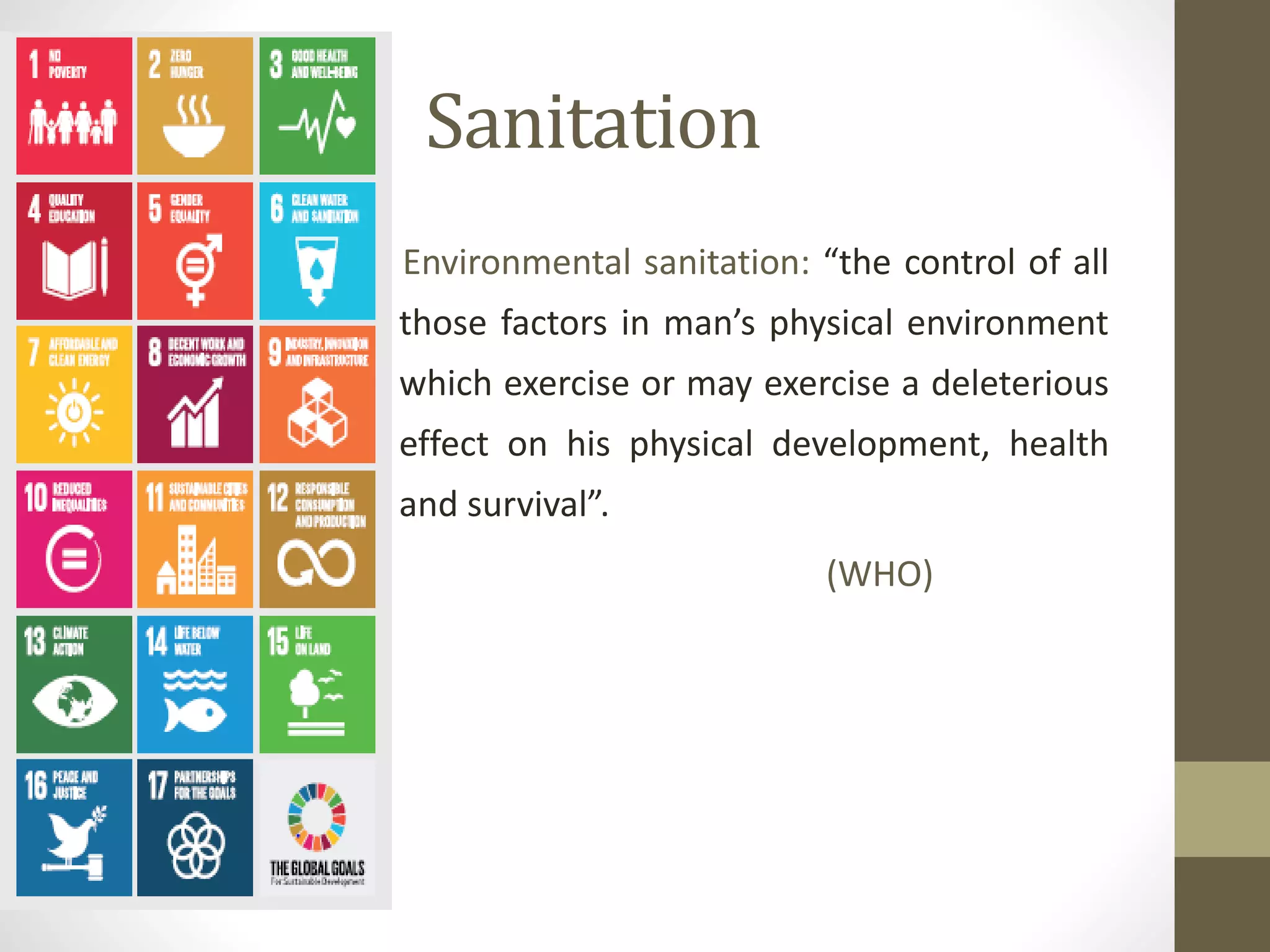
Sanitation
Environmental sanitation: “the control of all
those factors in man’s physical environment
which exercise or may exercise a deleterious
effect on his physical development, health
and survival”.
(WHO)
Environmentalfactorsinfluencingthespreadof
communicablediseases
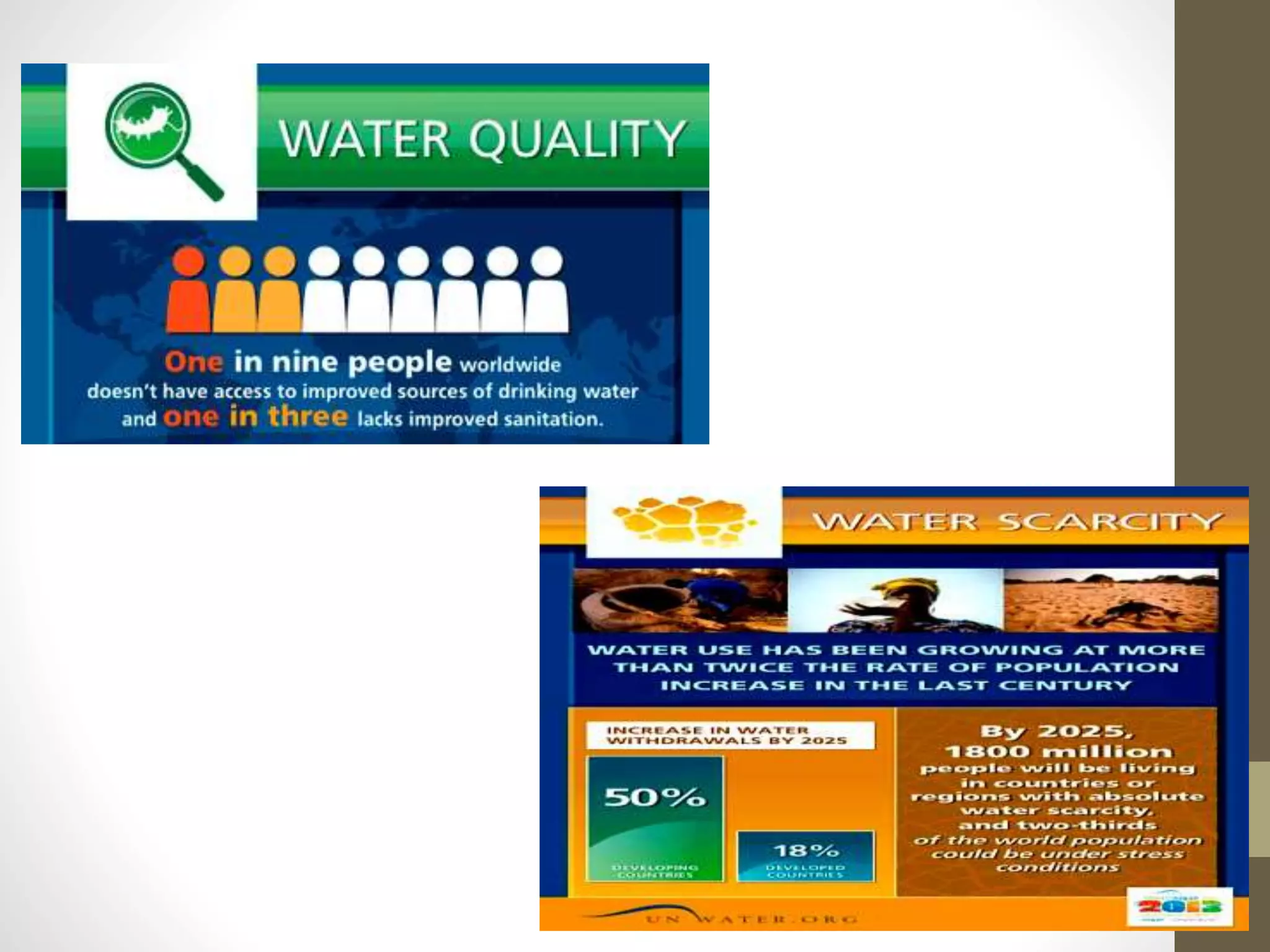
Water
Safe and wholesome water
Free of Pathogenic agents
Free of harmful Chemical substance
Pleasant to taste
Useable
Requirements
2 liters per head per day
The consumption of water – climatic conditions
A daily supply of 150-200l iters per capita
In rural India 40 liters per day is the target
USES OF WATER
a) Domestic
b) Public
c) Industrial
d) Agricultural
e) Power production
f) Carrying away
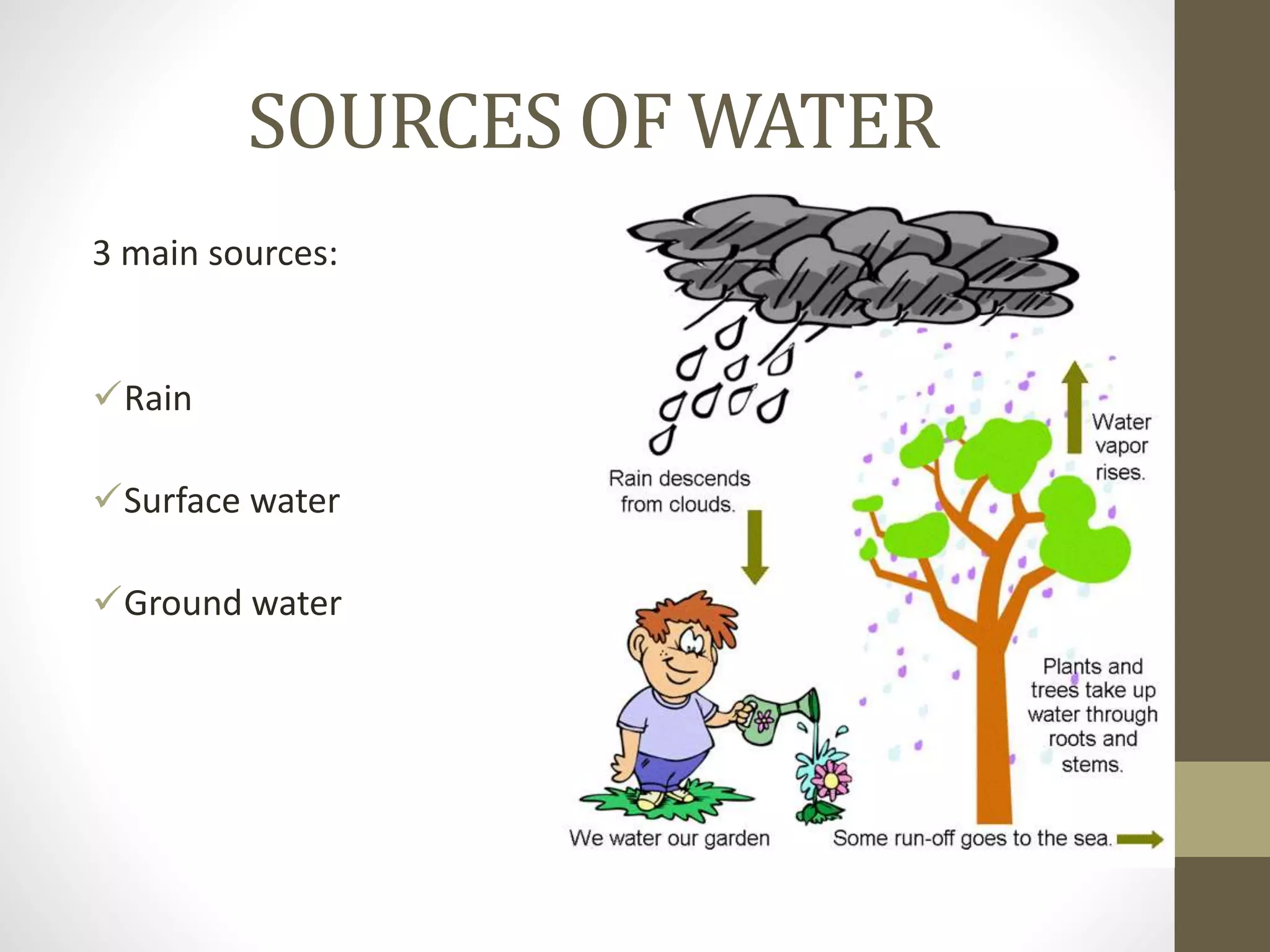
SOURCES OF WATER
3 main sources:
Rain
Surface water
Ground water
RAIN
 Physically- clear, bright and sparkling
 Chemically- soft
 Bacteriologically- free of pathogens
SURFACE WATER
IMPOUNDING RESERVOIRS
 Artificial lakes
 Dams built across rivers and mountain
streams.
RIVERS AND STREAMS
TANKS, LAKES AND PONDS
Large excavations in which surface water is
stored
• SEA WATER
GROUND WATER
• Rain water percolating into ground
• Cheapest & most practical way of
providing water to small communities
Advantages:
• Likely to be free from pathogenic agents
• Usually requires no treatment
• Supply likely to be certain even during
dry season
• Less subjected to contamination
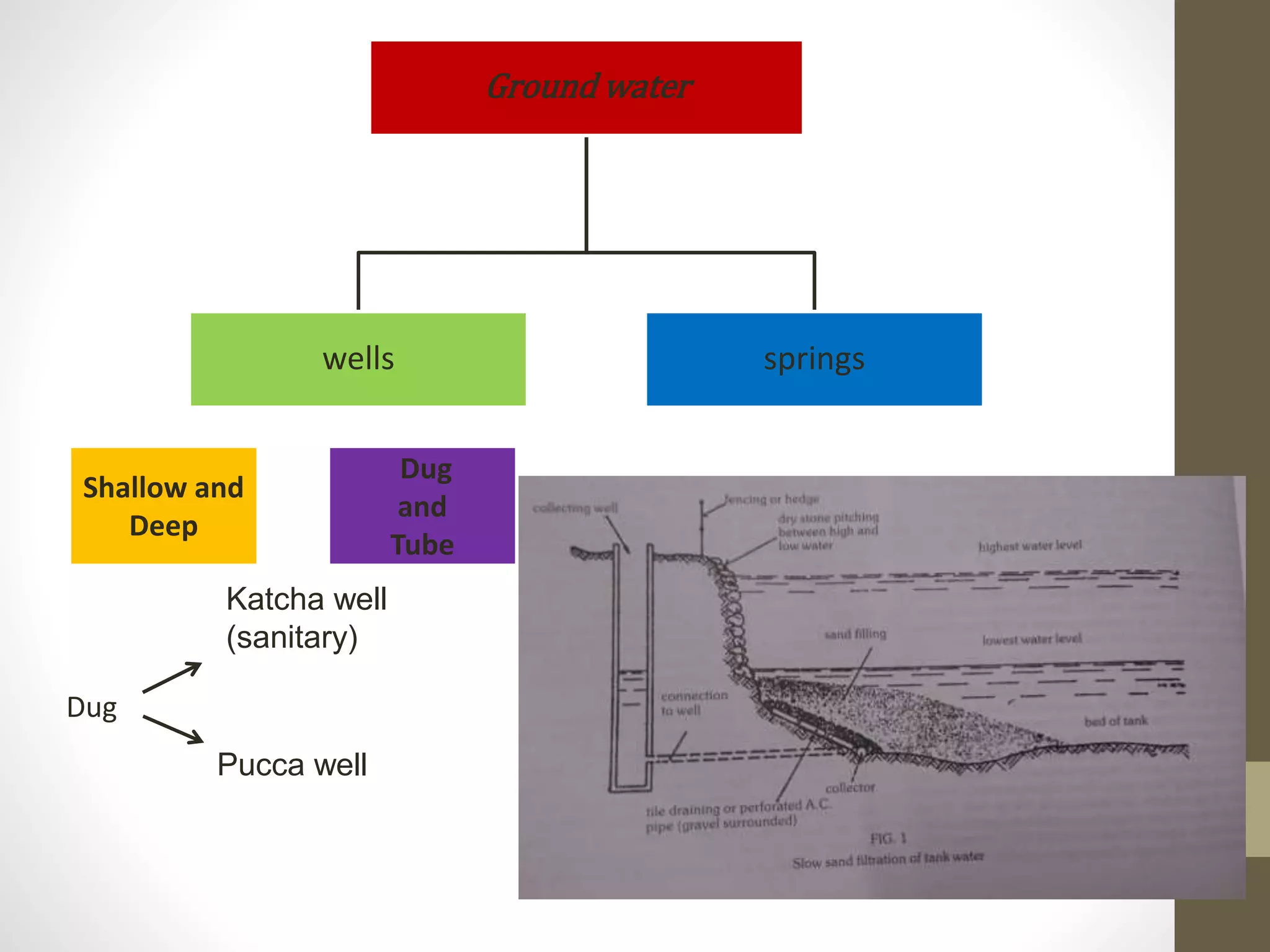
Ground water
wells springs
Shallow and
Deep
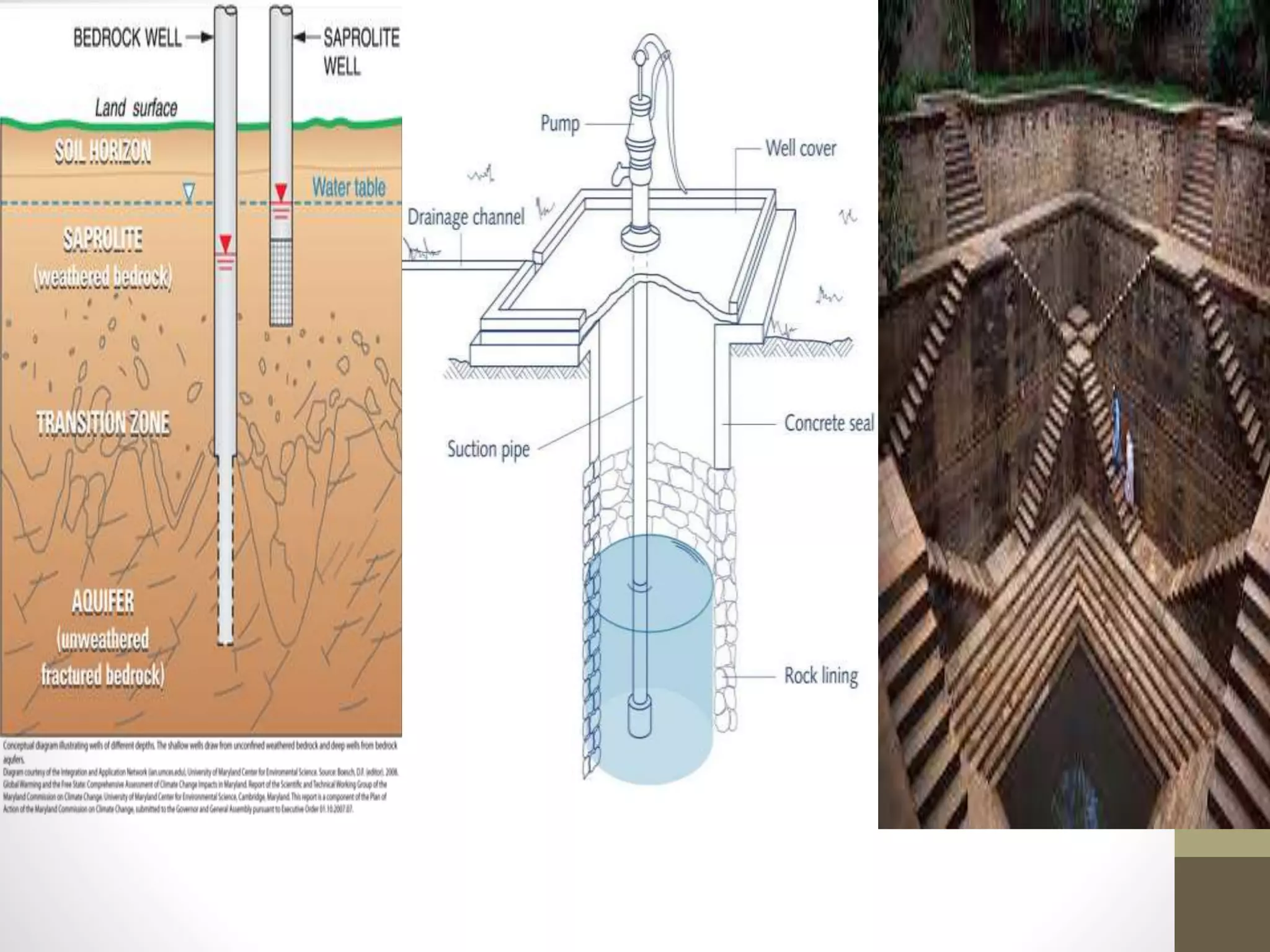
Dug
and
Tube
Dug
Katcha well
(sanitary)
Pucca well
Characteristics SHALLOW WELLS DEEP WELLS
Definition Taps the water from above the
first impervious layer
Taps the water from below the
first impervious layer
Chemical quality Moderately hard Much hard
Bacteriological quality
Often grossly contaminated
Taps purer water
Yield Usually goes dry in summer Provides a source of constant
supply
SANITARY WELL
A sanitary well is one which is
properly located, well-constructed
and protected against
contamination with a view to yield
a supply of safe water.
Points to be taken into
consideration:
1. Location- 15m
2. Lining-6m
3. Parapet-70cms
4. Platform-1m
5. Drain
6. Covering
7. Hand pump
8. Consumer responsibility
9. Quality
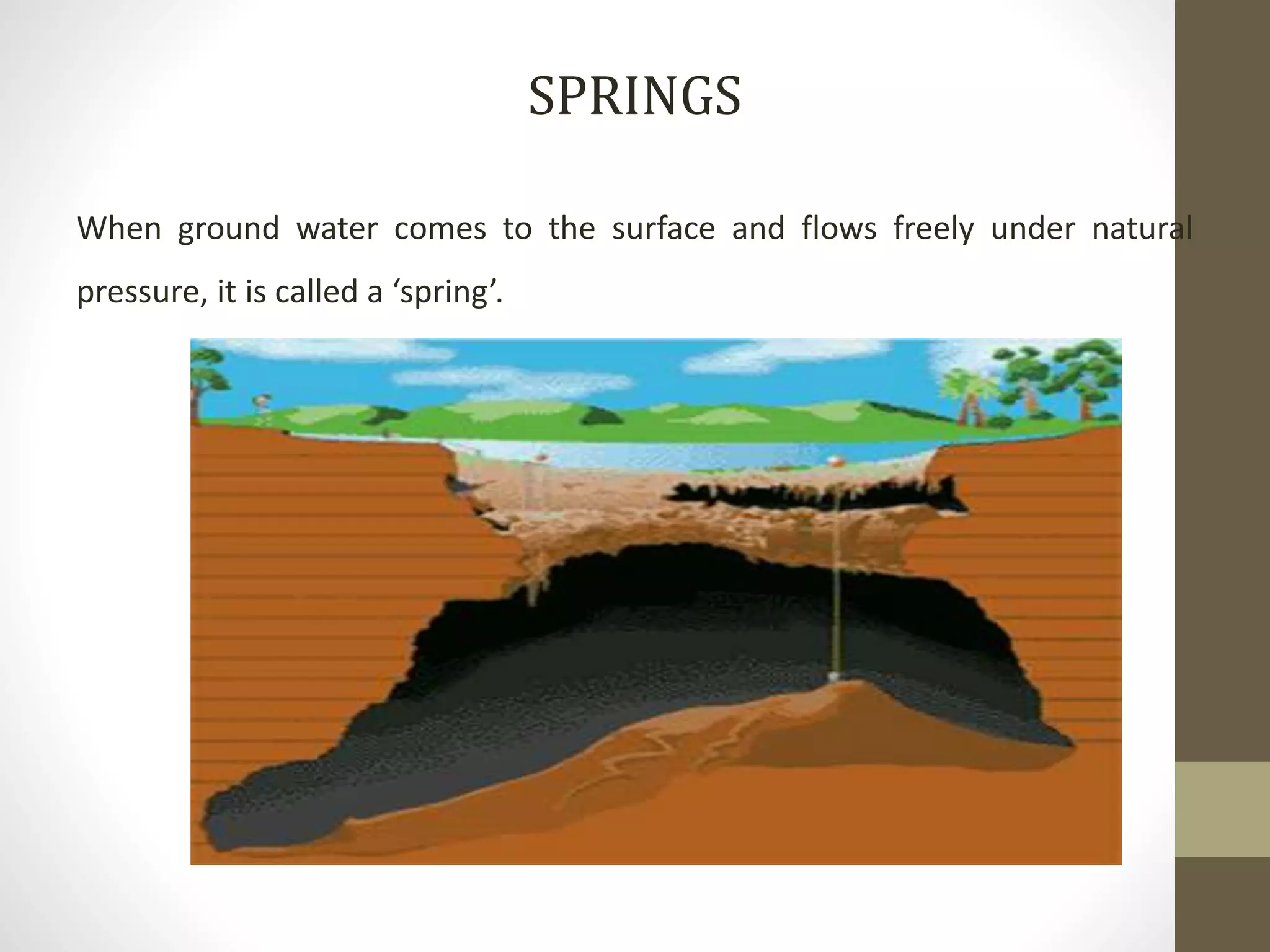
SPRINGS
When ground water comes to the surface and flows freely under natural
pressure, it is called a ‘spring’.
WATER POLLUTION
Natural impurities
Dissolved gases
Microscopic organisms
Suspended
impurities
Dissolved
minerals
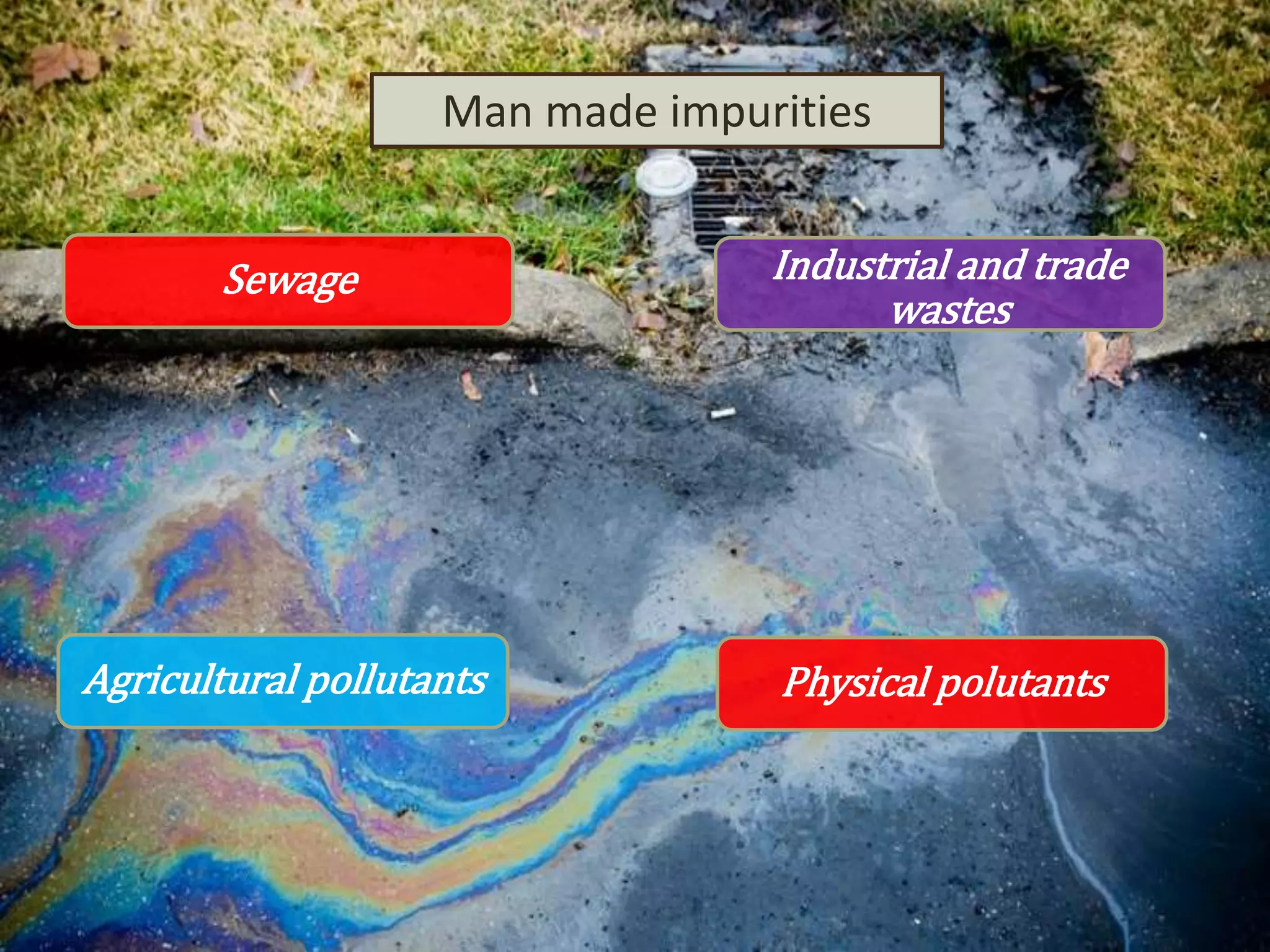
Man made impurities
Sewage Industrial and trade
wastes
Agricultural pollutants Physical polutants
Indicators of water pollution
• Amount of total suspended solids
• Biochemical oxygen demand (BOD) at 20 deg. C
• Concentration of chlorides
• Nitrogen and phosphorus
• Absence of dissolved oxygen.
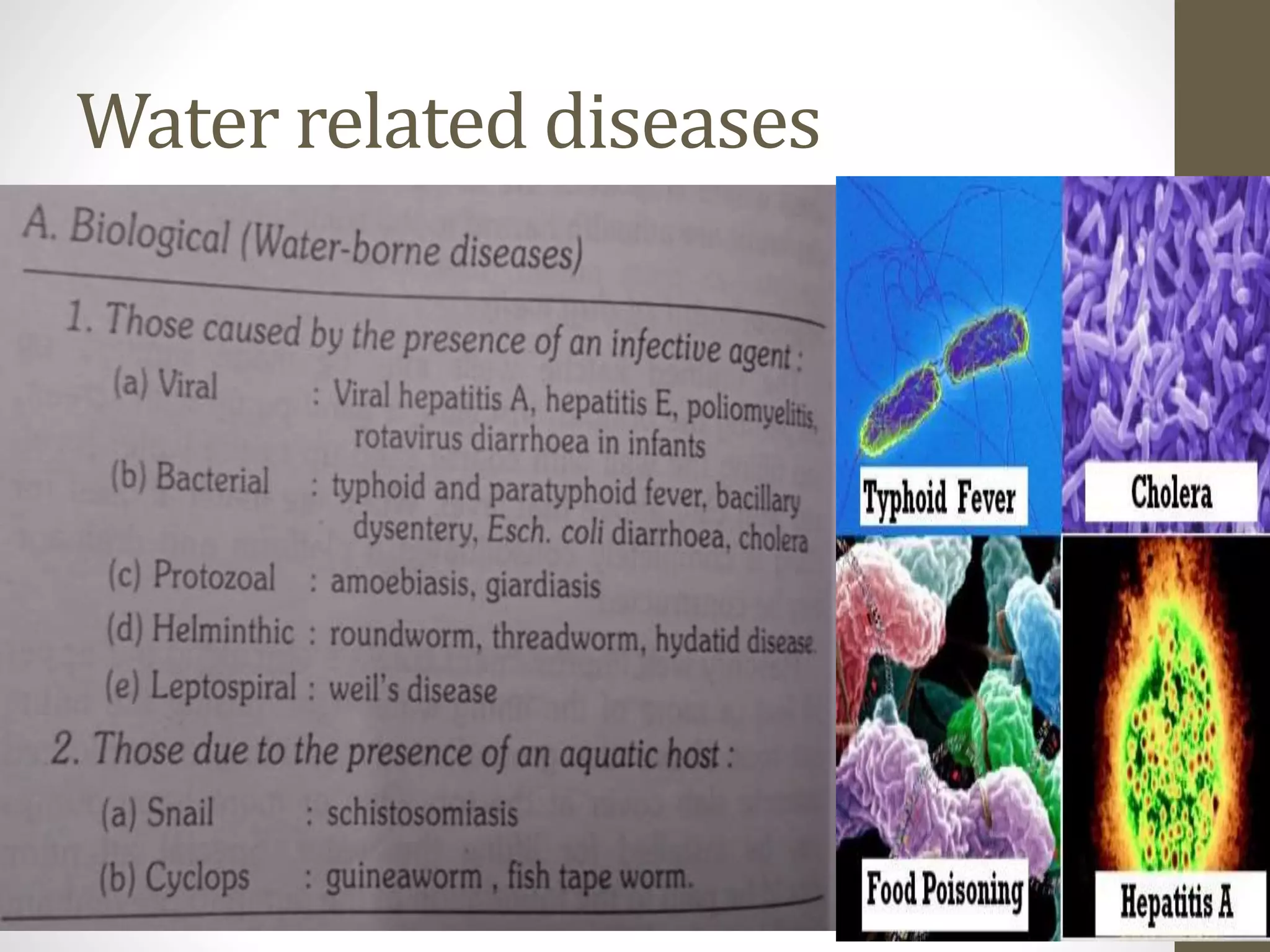
Water related diseases
b) CHEMICAL:
• Chemical pollutants of diverse nature
• may affect man’s health directly and indirectly
Other associated ...
Dental health
Cyanosis in infant
Cardiovascular diseases
inadequate use of water
Some diseases are related to the disease carrying insects
Water Pollution Law
• In India, water pollution is becoming a serious problem.
• Parliament in 1974-Water (Prevention and Control of
Pollution) Act.
• Seeks to provide legal deterrent against the spread of water
pollution.
• The Act is a comprehensive piece of legislation.
• It provides for the constitution of State and Central Water
Boards and Joint Water Boards endowed with wide powers for
controlling pollution.
Purification of water
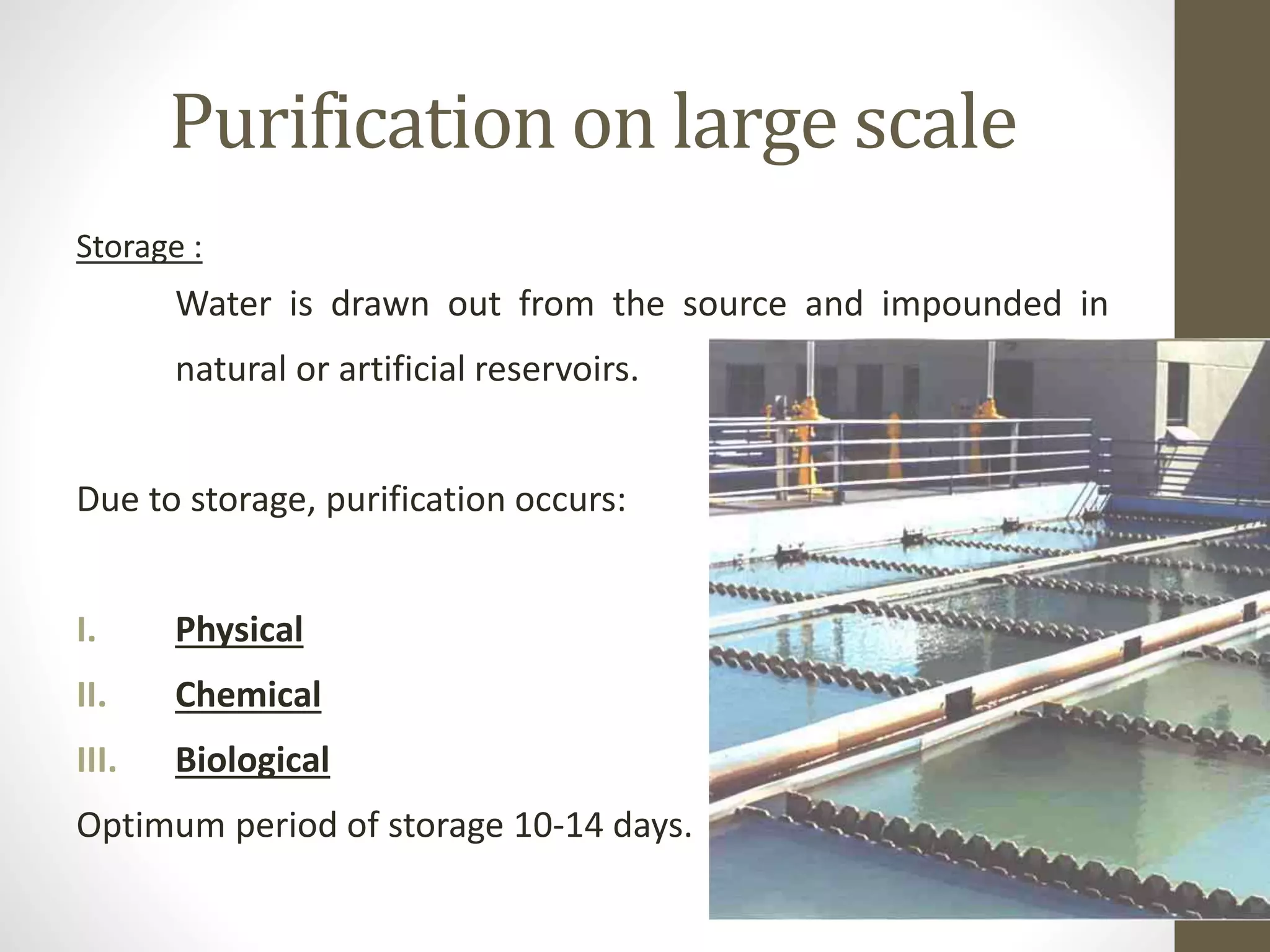
Purification on large scale
Storage :
Water is drawn out from the source and impounded in
natural or artificial reservoirs.
Due to storage, purification occurs:
I. Physical
II. Chemical
III. Biological
Optimum period of storage 10-14 days.
Purification on large scale
Filtration
Second stage in water purification
 98-99% of bacteria are removed by filtration
Types of filters
 Slow sand filter/ biological
 Rapid sand filter/ mechanical
Slow sand filters
a) Supernatant (raw) water: Above sand bed; depth varies
from 1 to 1.5M (always kept constant).
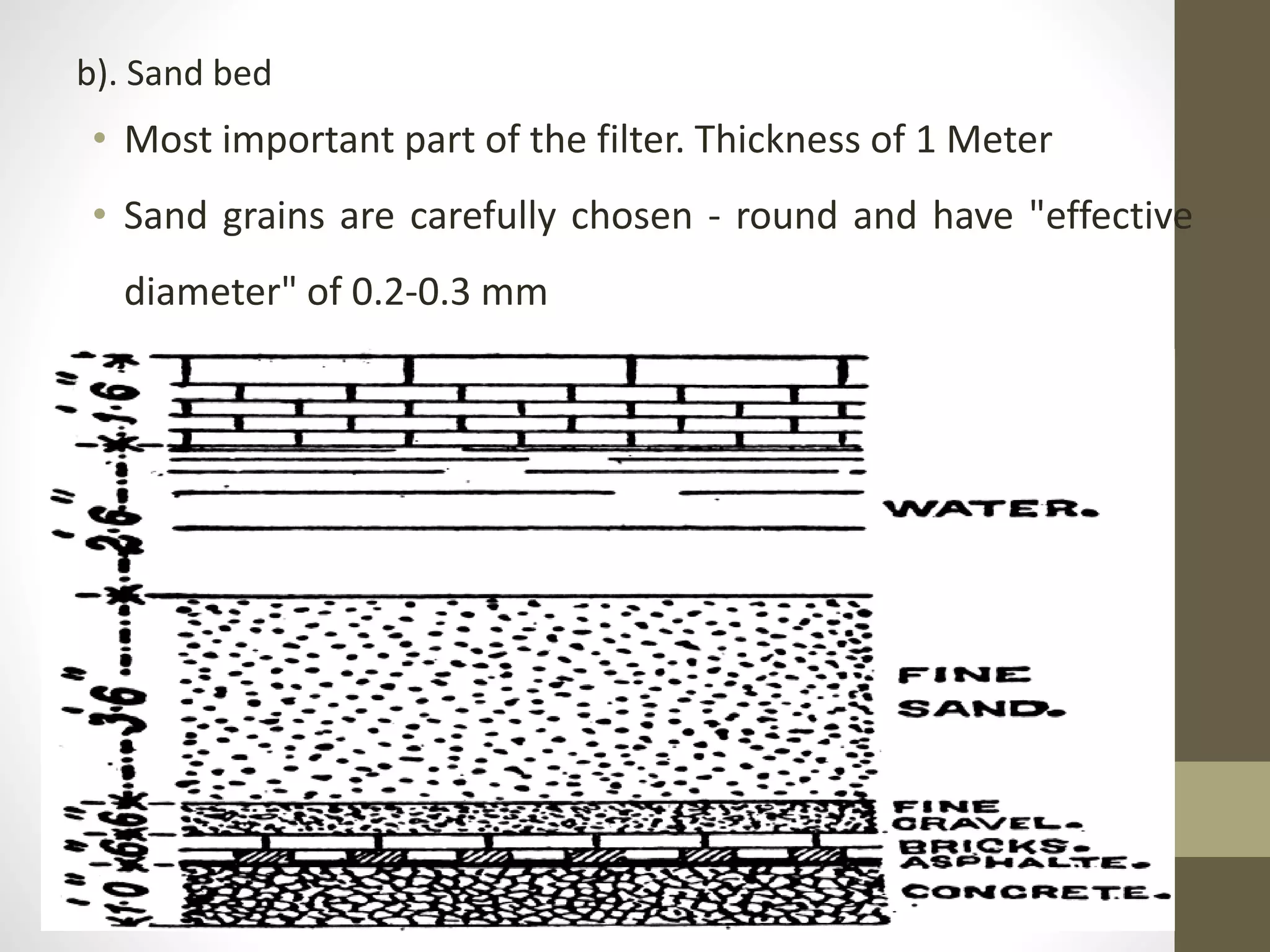
b). Sand bed
• Most important part of the filter. Thickness of 1 Meter
• Sand grains are carefully chosen - round and have "effective
diameter" of 0.2-0.3 mm
VITAL LAYER: ‘Schmutzdecke’ layer, Zoogleal layer, Biological layer
• Slimmy gelatinous layer - Algae, planktons, diatoms & bacteria.
• Formation of vital layer – ‘Ripening’ of the filter.
• When fully formed -extends for 2-3 cm into the top portion of the sand
bed.
• Heart of slow sand filter.
c) UNDER DRAINAGE SYSTEM
• FILTER BOX
• Supernatant water- 1 to 1.5m
• Sand bed-1.2m
• Gravel support-0.30m
• Filter bottom-0.16m
d) FILTER CONTROL
• Venturi meter- measures loss of head
• Loss of head 1.3meter- uneconomical
Cleaning:
Scraping of the top portion by 1 or 2 cms
Advantages:
• Simple to construct and operate.
• The cost of construction is cheaper
• quality of water is very high.
• reduce bacterial counts by 99.9 to 99.99 per cent and E. coli
by 99 to 99.9 per cent.
Rapid sand filters
Gravity type Pressure type (Candy 's filter)
• Coagulation
• Rapid mixing
• Flocculation
• Sedimentation
• Filtration
1.COAGULATION:
• Raw water+Alum (5-40mg/L) chemical coagulant
2.RAPID MIXING:
• Violent agitations in mixing chamber (few min)
3.FLOCCULATION:
• Slow & gentle stirring of treated water(30 min.)
• Mechanical type of flocculator
• Thick, copious, white floccules precipitate Of aluminum
hydroxide.
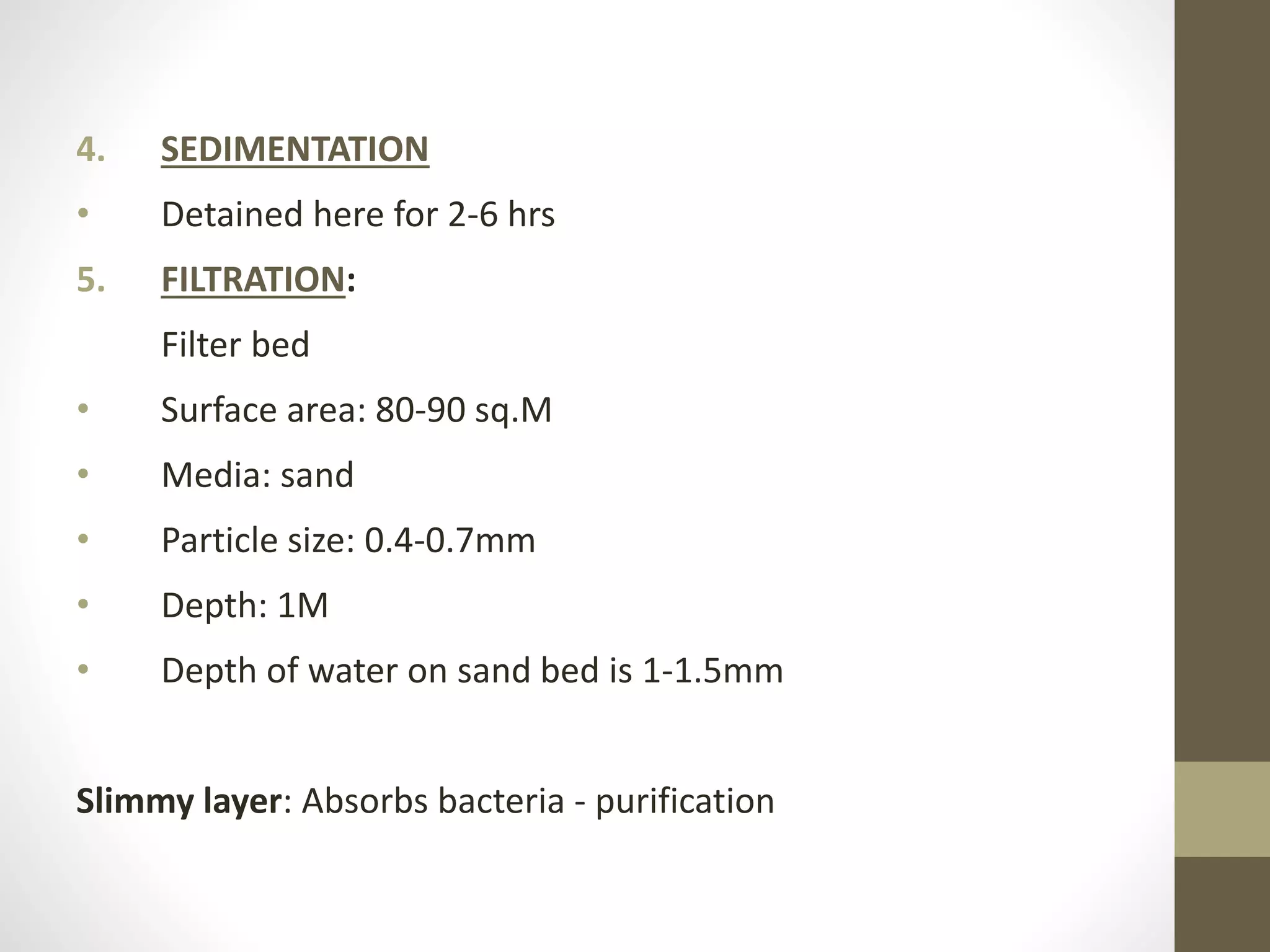
4. SEDIMENTATION
• Detained here for 2-6 hrs
5. FILTRATION:
Filter bed
• Surface area: 80-90 sq.M
• Media: sand
• Particle size: 0.4-0.7mm
• Depth: 1M
• Depth of water on sand bed is 1-1.5mm
Slimmy layer: Absorbs bacteria - purification
Cleaning:
Advantages:
1.No preliminary storage is needed.
2.The filter beds occupy less space.
3.Filtration is rapid
1.washing is easy.
2.Flexibility in operation.
Properties Rapid sand filter Slow sand filter
Area Small Large
Rate of filtration
(L/m2/hr)
4000-7500 100-400
Sand size (diameter) 0.4-0.7 mm 0.2-0.3 mm
pretreatment Coagulation and
sedimentation
Sedimentation
Filter cleaning Back washing Scraping
Operation More skilled Less skilled
Removal of bacteria 98-99% 99.9-99.99%
Prior water storage Storage needed No need
DISINFECTION
CHLORINATION:
Mechanism of action:
H2O + CL2 -- HCL + HOCL
HCL is neutralized by alkalinity of water
HOCL (Hypochlorus acid) Ionises into H + OCL (Hydrogen & Hypochlorite
ion)
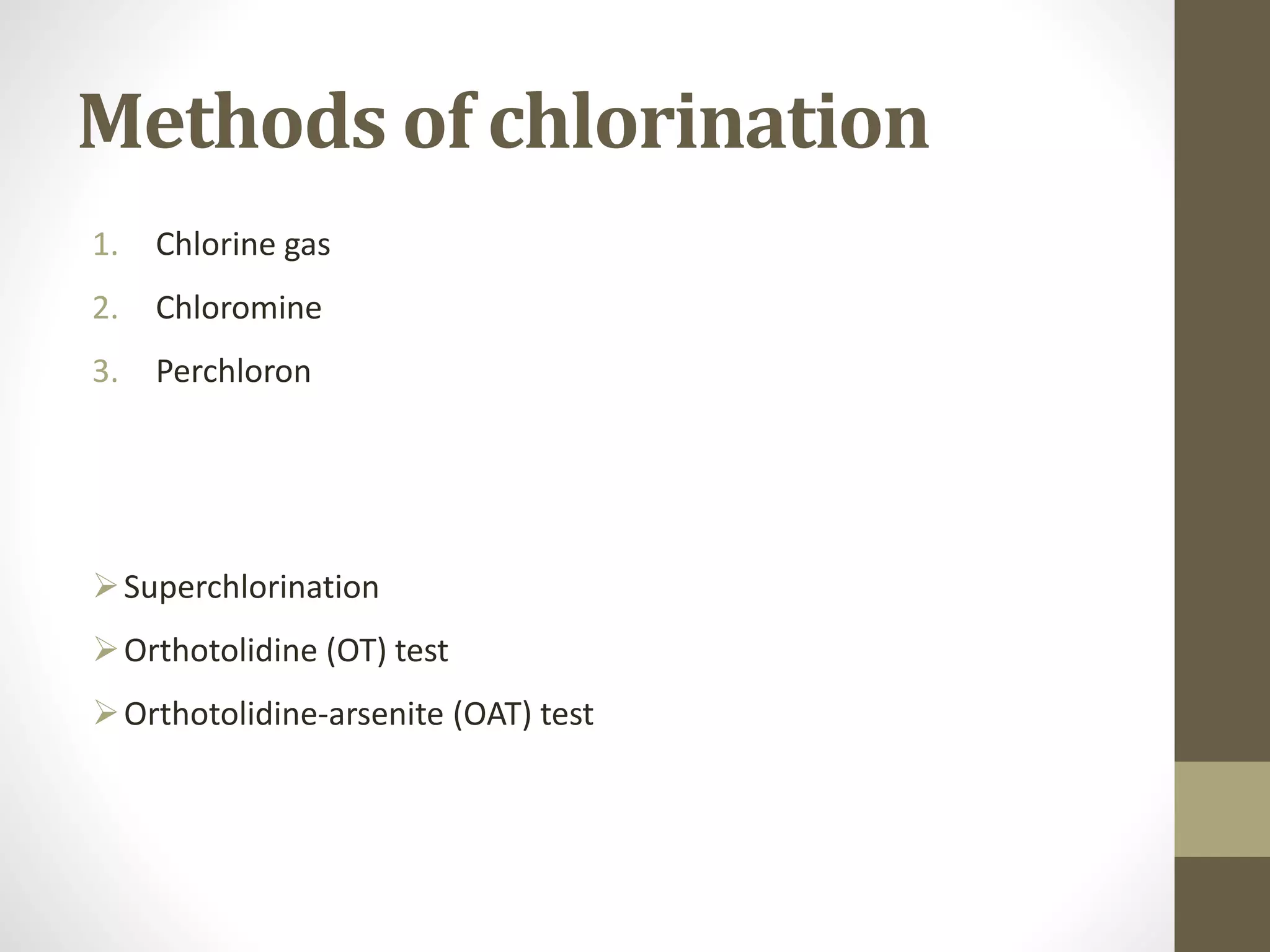
Methods of chlorination
1. Chlorine gas
2. Chloromine
3. Perchloron
Superchlorination
Orthotolidine (OT) test
Orthotolidine-arsenite (OAT) test
Other agents
a)Ozone oxidizing agent
b)U-V radiation
PURIFICATION OFWATER ONASMALL
SCALE
a. HOUSEHOLD PURIFICATION OF WATER:
• Boiling
• Chemical disinfection
• filtration
• Ultra violet irradiation
• Multistage reverse osmosis purification of water.
PURIFICATION OFWATER ONA
SMALLSCALE
b. Disinfection of wells
WATER QUALITY - CRITERIA &
STANDARDS
WHO guidelines for drinking water quality.
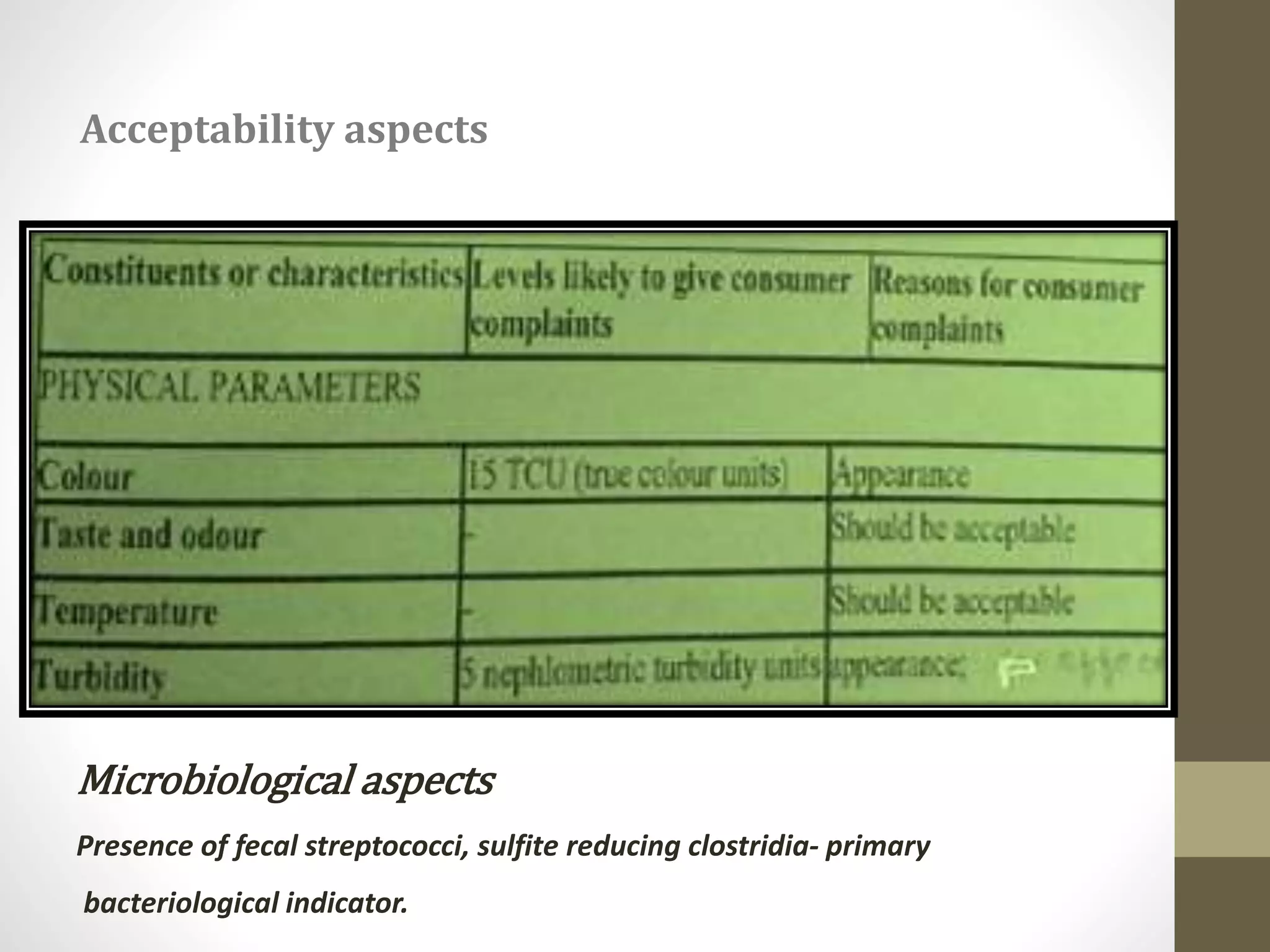
1. Acceptability aspects
2. Microbiological aspects
3. Chemical aspects
4. Radiological aspects
Microbiological aspects
Presence of fecal streptococci, sulfite reducing clostridia- primary
bacteriological indicator.
Acceptability aspects
Radiological aspects
Chemical aspects
NATIONALWATERSUPPLYAND SANITATION
PROGRAM
• The National Water Supply and Sanitation Program was launched
in 1954 by the Govt. of India …
• Provision has been made in the successive 5-year Plans to improve
the water supply.
• HEALTH EDUCATION…The provision of merely good water supply
does not in itself secure freedom from water-borne diseases.
…….important weapon in creating among people a desire for
higher standards of life.
CONCLUSION
REFERENCES
• Textbook of preventive and social medicine – K.Park 20TH Edition
• Environmental Health In Emergencies. WHO practical guide 2002
• The International Water and Sanitation Decade (1981-90) “Water for
All” by 1990
• WHO 1972.Health hazards of human environment, WHO, Geneva
• WHO 1995. The World health report 1995, Bridging the gaps, p-41
• WHO 2012, World health statistics 2012
• Water and sanitation interlinkages across the 2030 Agenda for
Sustainable Development. WHO

Environment and health shiva

  • 1.
    Environment in healthand disease (Water) Presented by, Dr. Shivashankar.K P.G., Dept of Public Health Dentistry
  • 2.
    CONTENTS  INTRODUCTION  ENVIRONMENTALFACTORS  WATER REQUIREMENT  USES OF WATER  SOURCES OF WATER SUPPLY  WATER POLLUTION  PURIFICATION OF WATER  WATER QUALITY-CRITERIA AND STANDARDS  SURVEILLANCE OF DRINKING WATER QUALITY  HARDNESS OF WATER  CONCLUSION  REFERENCES
  • 3.
    Introduction • The studyof disease is really the study of man and his environment. • All external factors--- living+ non-living+ non-material • Social and economic conditions
  • 4.
  • 5.
    Sanitation Environmental sanitation: “thecontrol of all those factors in man’s physical environment which exercise or may exercise a deleterious effect on his physical development, health and survival”. (WHO)
  • 6.
  • 8.
  • 9.
    Safe and wholesomewater Free of Pathogenic agents Free of harmful Chemical substance Pleasant to taste Useable
  • 10.
    Requirements 2 liters perhead per day The consumption of water – climatic conditions A daily supply of 150-200l iters per capita In rural India 40 liters per day is the target
  • 11.
    USES OF WATER a)Domestic b) Public c) Industrial d) Agricultural e) Power production f) Carrying away
  • 12.
    SOURCES OF WATER 3main sources: Rain Surface water Ground water
  • 13.
    RAIN  Physically- clear,bright and sparkling  Chemically- soft  Bacteriologically- free of pathogens
  • 14.
    SURFACE WATER IMPOUNDING RESERVOIRS Artificial lakes  Dams built across rivers and mountain streams. RIVERS AND STREAMS TANKS, LAKES AND PONDS Large excavations in which surface water is stored
  • 15.
  • 16.
    GROUND WATER • Rainwater percolating into ground • Cheapest & most practical way of providing water to small communities Advantages: • Likely to be free from pathogenic agents • Usually requires no treatment • Supply likely to be certain even during dry season • Less subjected to contamination
  • 17.
    Ground water wells springs Shallowand Deep Dug and Tube Dug Katcha well (sanitary) Pucca well
  • 18.
    Characteristics SHALLOW WELLSDEEP WELLS Definition Taps the water from above the first impervious layer Taps the water from below the first impervious layer Chemical quality Moderately hard Much hard Bacteriological quality Often grossly contaminated Taps purer water Yield Usually goes dry in summer Provides a source of constant supply
  • 20.
    SANITARY WELL A sanitarywell is one which is properly located, well-constructed and protected against contamination with a view to yield a supply of safe water. Points to be taken into consideration: 1. Location- 15m 2. Lining-6m 3. Parapet-70cms 4. Platform-1m 5. Drain 6. Covering 7. Hand pump 8. Consumer responsibility 9. Quality
  • 21.
    SPRINGS When ground watercomes to the surface and flows freely under natural pressure, it is called a ‘spring’.
  • 22.
    WATER POLLUTION Natural impurities Dissolvedgases Microscopic organisms Suspended impurities Dissolved minerals
  • 23.
    Man made impurities SewageIndustrial and trade wastes Agricultural pollutants Physical polutants
  • 24.
    Indicators of waterpollution • Amount of total suspended solids • Biochemical oxygen demand (BOD) at 20 deg. C • Concentration of chlorides • Nitrogen and phosphorus • Absence of dissolved oxygen.
  • 25.
  • 26.
    Water related diseases b)CHEMICAL: • Chemical pollutants of diverse nature • may affect man’s health directly and indirectly Other associated ... Dental health Cyanosis in infant Cardiovascular diseases inadequate use of water Some diseases are related to the disease carrying insects
  • 27.
    Water Pollution Law •In India, water pollution is becoming a serious problem. • Parliament in 1974-Water (Prevention and Control of Pollution) Act. • Seeks to provide legal deterrent against the spread of water pollution. • The Act is a comprehensive piece of legislation. • It provides for the constitution of State and Central Water Boards and Joint Water Boards endowed with wide powers for controlling pollution.
  • 29.
  • 30.
    Purification on largescale Storage : Water is drawn out from the source and impounded in natural or artificial reservoirs. Due to storage, purification occurs: I. Physical II. Chemical III. Biological Optimum period of storage 10-14 days.
  • 31.
    Purification on largescale Filtration Second stage in water purification  98-99% of bacteria are removed by filtration Types of filters  Slow sand filter/ biological  Rapid sand filter/ mechanical
  • 32.
    Slow sand filters a)Supernatant (raw) water: Above sand bed; depth varies from 1 to 1.5M (always kept constant).
  • 33.
    b). Sand bed •Most important part of the filter. Thickness of 1 Meter • Sand grains are carefully chosen - round and have "effective diameter" of 0.2-0.3 mm
  • 34.
    VITAL LAYER: ‘Schmutzdecke’layer, Zoogleal layer, Biological layer • Slimmy gelatinous layer - Algae, planktons, diatoms & bacteria. • Formation of vital layer – ‘Ripening’ of the filter. • When fully formed -extends for 2-3 cm into the top portion of the sand bed. • Heart of slow sand filter.
  • 35.
    c) UNDER DRAINAGESYSTEM • FILTER BOX • Supernatant water- 1 to 1.5m • Sand bed-1.2m • Gravel support-0.30m • Filter bottom-0.16m d) FILTER CONTROL • Venturi meter- measures loss of head • Loss of head 1.3meter- uneconomical
  • 37.
    Cleaning: Scraping of thetop portion by 1 or 2 cms Advantages: • Simple to construct and operate. • The cost of construction is cheaper • quality of water is very high. • reduce bacterial counts by 99.9 to 99.99 per cent and E. coli by 99 to 99.9 per cent.
  • 38.
    Rapid sand filters Gravitytype Pressure type (Candy 's filter) • Coagulation • Rapid mixing • Flocculation • Sedimentation • Filtration
  • 40.
    1.COAGULATION: • Raw water+Alum(5-40mg/L) chemical coagulant 2.RAPID MIXING: • Violent agitations in mixing chamber (few min) 3.FLOCCULATION: • Slow & gentle stirring of treated water(30 min.) • Mechanical type of flocculator • Thick, copious, white floccules precipitate Of aluminum hydroxide.
  • 41.
    4. SEDIMENTATION • Detainedhere for 2-6 hrs 5. FILTRATION: Filter bed • Surface area: 80-90 sq.M • Media: sand • Particle size: 0.4-0.7mm • Depth: 1M • Depth of water on sand bed is 1-1.5mm Slimmy layer: Absorbs bacteria - purification
  • 42.
    Cleaning: Advantages: 1.No preliminary storageis needed. 2.The filter beds occupy less space. 3.Filtration is rapid 1.washing is easy. 2.Flexibility in operation.
  • 43.
    Properties Rapid sandfilter Slow sand filter Area Small Large Rate of filtration (L/m2/hr) 4000-7500 100-400 Sand size (diameter) 0.4-0.7 mm 0.2-0.3 mm pretreatment Coagulation and sedimentation Sedimentation Filter cleaning Back washing Scraping Operation More skilled Less skilled Removal of bacteria 98-99% 99.9-99.99% Prior water storage Storage needed No need
  • 44.
    DISINFECTION CHLORINATION: Mechanism of action: H2O+ CL2 -- HCL + HOCL HCL is neutralized by alkalinity of water HOCL (Hypochlorus acid) Ionises into H + OCL (Hydrogen & Hypochlorite ion)
  • 45.
    Methods of chlorination 1.Chlorine gas 2. Chloromine 3. Perchloron Superchlorination Orthotolidine (OT) test Orthotolidine-arsenite (OAT) test
  • 46.
    Other agents a)Ozone oxidizingagent b)U-V radiation
  • 47.
    PURIFICATION OFWATER ONASMALL SCALE a.HOUSEHOLD PURIFICATION OF WATER: • Boiling • Chemical disinfection • filtration • Ultra violet irradiation • Multistage reverse osmosis purification of water.
  • 48.
  • 49.
    WATER QUALITY -CRITERIA & STANDARDS WHO guidelines for drinking water quality. 1. Acceptability aspects 2. Microbiological aspects 3. Chemical aspects 4. Radiological aspects
  • 50.
    Microbiological aspects Presence offecal streptococci, sulfite reducing clostridia- primary bacteriological indicator. Acceptability aspects
  • 51.
  • 52.
  • 53.
    NATIONALWATERSUPPLYAND SANITATION PROGRAM • TheNational Water Supply and Sanitation Program was launched in 1954 by the Govt. of India … • Provision has been made in the successive 5-year Plans to improve the water supply. • HEALTH EDUCATION…The provision of merely good water supply does not in itself secure freedom from water-borne diseases. …….important weapon in creating among people a desire for higher standards of life.
  • 57.
  • 58.
    REFERENCES • Textbook ofpreventive and social medicine – K.Park 20TH Edition • Environmental Health In Emergencies. WHO practical guide 2002 • The International Water and Sanitation Decade (1981-90) “Water for All” by 1990 • WHO 1972.Health hazards of human environment, WHO, Geneva • WHO 1995. The World health report 1995, Bridging the gaps, p-41 • WHO 2012, World health statistics 2012 • Water and sanitation interlinkages across the 2030 Agenda for Sustainable Development. WHO