At the end of this session the participants
should be able to conceptualize:
1. health in its physical, mental, social and
spiritual context;
2. environment to be an important factor in the
interaction of agent and host in the
epidemiological or ecological triad;
3. the physical, biological and psychosocial
environment and understand their impact on
health.
“Healthy people are those who
live in healthy homes on a
healthy diet; in an environment
equally fit for birth, growth,
work, healing, and dying...
Healthy people need no
bureaucratic interference to
mate, give birth, share the
human condition, and die.”
-Ivan Illich
It is a state of complete
physical, mental and
social well-being and
not merely the absence
of disease or infirmity.
It is a condition under
which the individual is
able to mobilize all his
resources, intellect,
emotional and physicalfor optimum living.
This concept recognizes the
strength of social, economic,
political and environmental
influences on health.
Heredity
Welfare services
Environment
Socio-economic conditions

Health and family
Life-style
Disease is a result from complex
interaction between man, an agent
and the environment.

From ecological point of view,
disease is defined as
“maladjustment of the human
organism to the environment”.
Environment

Vector

Agent

Host
Environment
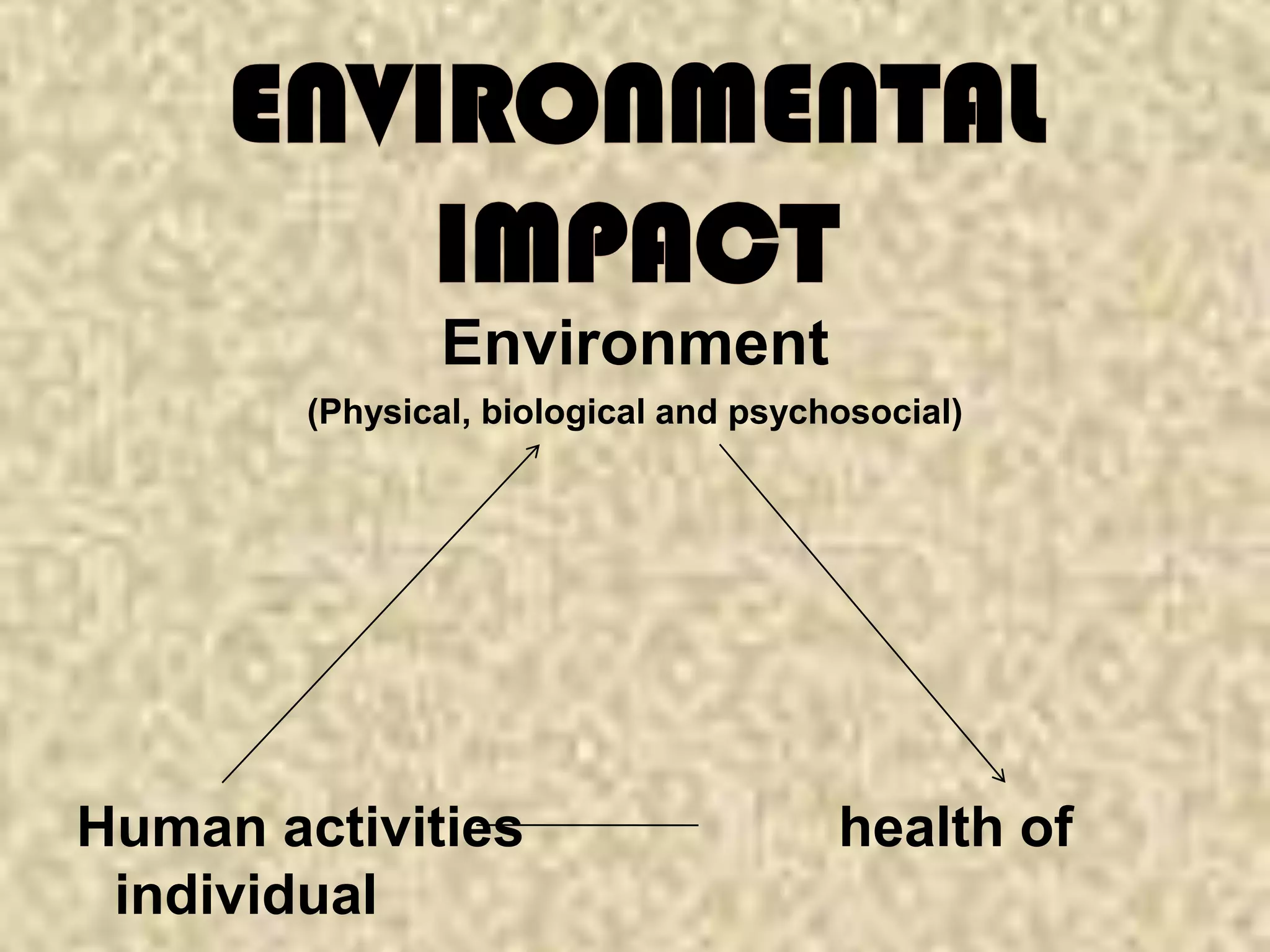
(Physical, biological and psychosocial)

Human activities
individual

health of
All of the external factors affecting an
organism. These factors may be other
living organisms (biotic factors) or
nonliving variables (abiotic factors),
such as temperature, rainfall, day
length, wind, and ocean currents.
The interactions of organisms with biotic
and abiotic factors form an ecosystem.
Macro-environment or the external
environment
-is said to be responsible for millions of
preventable diseases originating in it.

Micro-environment
-is the Domestic environment in which man lives.

Internal environment
-is some time used for the environment inside the
body
PHYSICAL:
air, water, soil, housing, climate, geography, heat, light,
noise, debris, radiation, etc.

BIOLOGICAL:
man, viruses, microbial agents, insects, rodents,
animals and plants, etc.

PSYCHOSOCIAL:
cultural values, customs, beliefs, habits, attitudes,
morals, religion, education, lifestyles, community
life, health services, social and political organization.
The environment is all external
conditions, circumstances, and
influences surrounding and
affecting the growth and
development of an organism or
community of organisms.

Environmental health is the
study and management of
environmental conditions that
affect the health and well-being of
These are living
organisms or their
products that are
harmful to
humans.
-are diseases that are transmitted in
drinking water
-these disease
organisms are shed into
the water in feces, and
can produce illness in
those who consume
untreated, contaminated
water.
-Our municipal water treatment
facilities are usually able to
purify water by removing these
agents or killing them by
disinfecting the water.
-are diseases transmitted in or on food
-to protect against food-borne diseases,
sanitarians from local health
departments routinely inspect food
service establishments (restaurants)
and retail food outlets (supermarkets)
to verify that food is being stored and
handled properly.
bacteria Salmonella
serotype enteritidis
Escherichia coli 0157:H7
-are those transmitted by insects or
other arthropods
-improper environmental management
can cause vector-borne disease
outbreaks.
St. Louis encephalitis
La Crosse encephalitis
They are transmitted by mosquitoes and
plague and urine typhus transmitted by
fleas.
It is a result from
mismanagement or
misuse of chemicals
resulting in an
unacceptable risk to
human health.
-that have been manufactured for the
purpose of reducing populations of
undesirable organisms (pests)

-most pesticides kill non-target
organisms as well as the target, or
pest species.

-the wise use of pesticides can
protect human health and
agricultural crops.
Herbicides
Insecticides
-is an environmental hazard
produced by millions that smoke
-diseases associated with ETS include
lung cancer and perhaps heart disease
-the EPA has classified ETS as a Class
A carcinogen
-Smoking has been increasingly
restricted from public buildings and
from many private work sites

-Regulation of smoking seems to be the
best approach to controlling this
pollutant
-is

a naturally occurring element that is
used in the manufacturing of many
industrial and domestic products
-Health problems associated with the
over exposure to lead are anemia, birth
defects, bone damage, neurological
damage, kidney damage, and others.
-Exposure is by ingestion and
inhalation.
-Children

are particularly at risk
from eating peeling lead paint.
-The prevalence of very high blood
lead levels among young children
declined significantly between 1984
and 1994 primarily because the
removal of lead from gasoline.
-Occupational exposure is a major
source of lead intake for adults.
It includes airborne
particles, humidity,
equipment design
and radiation.
are environmental
factors that produce
psychological changes
expressed as stress,
depression, hysteria.
are those that result from
living in a society where
one experiences noise,
lack of privacy and
overcrowding.
-Natural disasters are geographical and
meteorological events of such magnitude and
proximity to communities that they produce
significant damage and injuries.
-Examples are cyclones, earthquakes, floods,
hurricanes, tornadoes, typhoons, and
volcanic eruptions.
-The magnitude of devastation of these
events can sometimes be great.

-Biological, psychological and sociological
hazards may increase following a natural
disaster.
Valeroso, Daisy Mae
Salino, Sarah Gane Marie
Abarca, Mariel
Velez, Nadene
Abes, Liaddy
Deguma, Carl
Dagohoy, Sahara
Azote, Allyn
Ceniza, Ching Bee
Monding, Anjean

Health and environment

  • 2.
    At the endof this session the participants should be able to conceptualize: 1. health in its physical, mental, social and spiritual context; 2. environment to be an important factor in the interaction of agent and host in the epidemiological or ecological triad; 3. the physical, biological and psychosocial environment and understand their impact on health.
  • 3.
    “Healthy people arethose who live in healthy homes on a healthy diet; in an environment equally fit for birth, growth, work, healing, and dying... Healthy people need no bureaucratic interference to mate, give birth, share the human condition, and die.” -Ivan Illich
  • 4.
    It is astate of complete physical, mental and social well-being and not merely the absence of disease or infirmity.
  • 5.
    It is acondition under which the individual is able to mobilize all his resources, intellect, emotional and physicalfor optimum living.
  • 6.
    This concept recognizesthe strength of social, economic, political and environmental influences on health.
  • 7.
  • 8.
    Disease is aresult from complex interaction between man, an agent and the environment. From ecological point of view, disease is defined as “maladjustment of the human organism to the environment”.
  • 9.
  • 10.
    Environment (Physical, biological andpsychosocial) Human activities individual health of
  • 11.
    All of theexternal factors affecting an organism. These factors may be other living organisms (biotic factors) or nonliving variables (abiotic factors), such as temperature, rainfall, day length, wind, and ocean currents. The interactions of organisms with biotic and abiotic factors form an ecosystem.
  • 12.
    Macro-environment or theexternal environment -is said to be responsible for millions of preventable diseases originating in it. Micro-environment -is the Domestic environment in which man lives. Internal environment -is some time used for the environment inside the body
  • 13.
    PHYSICAL: air, water, soil,housing, climate, geography, heat, light, noise, debris, radiation, etc. BIOLOGICAL: man, viruses, microbial agents, insects, rodents, animals and plants, etc. PSYCHOSOCIAL: cultural values, customs, beliefs, habits, attitudes, morals, religion, education, lifestyles, community life, health services, social and political organization.
  • 14.
    The environment isall external conditions, circumstances, and influences surrounding and affecting the growth and development of an organism or community of organisms. Environmental health is the study and management of environmental conditions that affect the health and well-being of
  • 19.
    These are living organismsor their products that are harmful to humans.
  • 20.
    -are diseases thatare transmitted in drinking water -these disease organisms are shed into the water in feces, and can produce illness in those who consume untreated, contaminated water. -Our municipal water treatment facilities are usually able to purify water by removing these agents or killing them by disinfecting the water.
  • 25.
    -are diseases transmittedin or on food -to protect against food-borne diseases, sanitarians from local health departments routinely inspect food service establishments (restaurants) and retail food outlets (supermarkets) to verify that food is being stored and handled properly.
  • 26.
  • 27.
    -are those transmittedby insects or other arthropods -improper environmental management can cause vector-borne disease outbreaks.
  • 28.
    St. Louis encephalitis LaCrosse encephalitis They are transmitted by mosquitoes and plague and urine typhus transmitted by fleas.
  • 30.
    It is aresult from mismanagement or misuse of chemicals resulting in an unacceptable risk to human health.
  • 31.
    -that have beenmanufactured for the purpose of reducing populations of undesirable organisms (pests) -most pesticides kill non-target organisms as well as the target, or pest species. -the wise use of pesticides can protect human health and agricultural crops.
  • 32.
  • 33.
    -is an environmentalhazard produced by millions that smoke -diseases associated with ETS include lung cancer and perhaps heart disease -the EPA has classified ETS as a Class A carcinogen
  • 34.
    -Smoking has beenincreasingly restricted from public buildings and from many private work sites -Regulation of smoking seems to be the best approach to controlling this pollutant
  • 35.
    -is a naturally occurringelement that is used in the manufacturing of many industrial and domestic products -Health problems associated with the over exposure to lead are anemia, birth defects, bone damage, neurological damage, kidney damage, and others. -Exposure is by ingestion and inhalation.
  • 36.
    -Children are particularly atrisk from eating peeling lead paint. -The prevalence of very high blood lead levels among young children declined significantly between 1984 and 1994 primarily because the removal of lead from gasoline. -Occupational exposure is a major source of lead intake for adults.
  • 38.
    It includes airborne particles,humidity, equipment design and radiation.
  • 40.
    are environmental factors thatproduce psychological changes expressed as stress, depression, hysteria.
  • 42.
    are those thatresult from living in a society where one experiences noise, lack of privacy and overcrowding.
  • 44.
    -Natural disasters aregeographical and meteorological events of such magnitude and proximity to communities that they produce significant damage and injuries. -Examples are cyclones, earthquakes, floods, hurricanes, tornadoes, typhoons, and volcanic eruptions. -The magnitude of devastation of these events can sometimes be great. -Biological, psychological and sociological hazards may increase following a natural disaster.
  • 46.
    Valeroso, Daisy Mae Salino,Sarah Gane Marie Abarca, Mariel Velez, Nadene Abes, Liaddy Deguma, Carl Dagohoy, Sahara Azote, Allyn Ceniza, Ching Bee Monding, Anjean

Editor's Notes

  • #9 What is the relationship between the health and environment?  Inability to adjust to the demands of interpersonal relationships and the stresses of daily living.
  • #10 The branch of medicine that deals with the study of the causes, distribution, and control of disease in populations. Epidemiology… Pathology An organism, such as a mosquito or tick, that carries disease-causing microorganisms from one host to another.