PERSONALITY TYPE DESCRIPTION
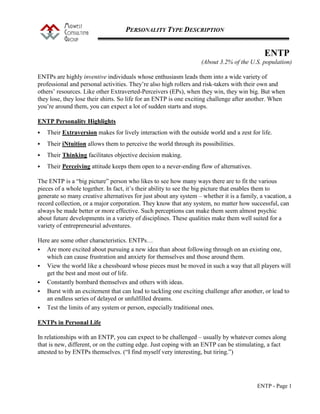
ENTP - Page 1
ENTP
(About 3.2% of the U.S. population)
ENTPs are highly inventive individuals whose enthusiasm leads them into a wide variety of
professional and personal activities. They’re also high rollers and risk-takers with their own and
others’ resources. Like other Extraverted-Perceivers (EPs), when they win, they win big. But when
they lose, they lose their shirts. So life for an ENTP is one exciting challenge after another. When
you’re around them, you can expect a lot of sudden starts and stops.
ENTP Personality Highlights
ď‚§ Their Extraversion makes for lively interaction with the outside world and a zest for life.
ď‚§ Their iNtuition allows them to perceive the world through its possibilities.
ď‚§ Their Thinking facilitates objective decision making.
ď‚§ Their Perceiving attitude keeps them open to a never-ending flow of alternatives.
The ENTP is a “big picture” person who likes to see how many ways there are to fit the various
pieces of a whole together. In fact, it’s their ability to see the big picture that enables them to
generate so many creative alternatives for just about any system – whether it is a family, a vacation, a
record collection, or a major corporation. They know that any system, no matter how successful, can
always be made better or more effective. Such perceptions can make them seem almost psychic
about future developments in a variety of disciplines. These qualities make them well suited for a
variety of entrepreneurial adventures.
Here are some other characteristics. ENTPs…
ď‚§ Are more excited about pursuing a new idea than about following through on an existing one,
which can cause frustration and anxiety for themselves and those around them.
ď‚§ View the world like a chessboard whose pieces must be moved in such a way that all players will
get the best and most out of life.
ď‚§ Constantly bombard themselves and others with ideas.
ď‚§ Burst with an excitement that can lead to tackling one exciting challenge after another, or lead to
an endless series of delayed or unfulfilled dreams.
ď‚§ Test the limits of any system or person, especially traditional ones.
ENTPs in Personal Life
In relationships with an ENTP, you can expect to be challenged – usually by whatever comes along
that is new, different, or on the cutting edge. Just coping with an ENTP can be stimulating, a fact
attested to by ENTPs themselves. (“I find myself very interesting, but tiring.”)
PERSONALITY TYPE DESCRIPTION
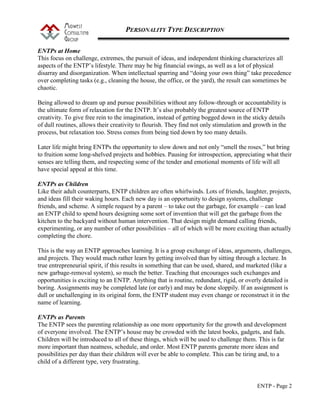
ENTP - Page 2
ENTPs at Home
This focus on challenge, extremes, the pursuit of ideas, and independent thinking characterizes all
aspects of the ENTP’s lifestyle. There may be big financial swings, as well as a lot of physical
disarray and disorganization. When intellectual sparring and “doing your own thing” take precedence
over completing tasks (e.g., cleaning the house, the office, or the yard), the result can sometimes be
chaotic.
Being allowed to dream up and pursue possibilities without any follow-through or accountability is
the ultimate form of relaxation for the ENTP. It’s also probably the greatest source of ENTP
creativity. To give free rein to the imagination, instead of getting bogged down in the sticky details
of dull routines, allows their creativity to flourish. They find not only stimulation and growth in the
process, but relaxation too. Stress comes from being tied down by too many details.
Later life might bring ENTPs the opportunity to slow down and not only “smell the roses,” but bring
to fruition some long-shelved projects and hobbies. Pausing for introspection, appreciating what their
senses are telling them, and respecting some of the tender and emotional moments of life will all
have special appeal at this time.
ENTPs as Children
Like their adult counterparts, ENTP children are often whirlwinds. Lots of friends, laughter, projects,
and ideas fill their waking hours. Each new day is an opportunity to design systems, challenge
friends, and scheme. A simple request by a parent – to take out the garbage, for example – can lead
an ENTP child to spend hours designing some sort of invention that will get the garbage from the
kitchen to the backyard without human intervention. That design might demand calling friends,
experimenting, or any number of other possibilities – all of which will be more exciting than actually
completing the chore.
This is the way an ENTP approaches learning. It is a group exchange of ideas, arguments, challenges,
and projects. They would much rather learn by getting involved than by sitting through a lecture. In
true entrepreneurial spirit, if this results in something that can be used, shared, and marketed (like a
new garbage-removal system), so much the better. Teaching that encourages such exchanges and
opportunities is exciting to an ENTP. Anything that is routine, redundant, rigid, or overly detailed is
boring. Assignments may be completed late (or early) and may be done sloppily. If an assignment is
dull or unchallenging in its original form, the ENTP student may even change or reconstruct it in the
name of learning.
ENTPs as Parents
The ENTP sees the parenting relationship as one more opportunity for the growth and development
of everyone involved. The ENTP’s house may be crowded with the latest books, gadgets, and fads.
Children will be introduced to all of these things, which will be used to challenge them. This is far
more important than neatness, schedule, and order. Most ENTP parents generate more ideas and
possibilities per day than their children will ever be able to complete. This can be tiring and, to a
child of a different type, very frustrating.
PERSONALITY TYPE DESCRIPTION
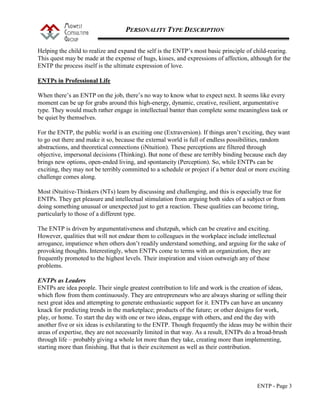
ENTP - Page 3
Helping the child to realize and expand the self is the ENTP’s most basic principle of child-rearing.
This quest may be made at the expense of hugs, kisses, and expressions of affection, although for the
ENTP the process itself is the ultimate expression of love.
ENTPs in Professional Life
When there’s an ENTP on the job, there’s no way to know what to expect next. It seems like every
moment can be up for grabs around this high-energy, dynamic, creative, resilient, argumentative
type. They would much rather engage in intellectual banter than complete some meaningless task or
be quiet by themselves.
For the ENTP, the public world is an exciting one (Extraversion). If things aren’t exciting, they want
to go out there and make it so, because the external world is full of endless possibilities, random
abstractions, and theoretical connections (iNtuition). These perceptions are filtered through
objective, impersonal decisions (Thinking). But none of these are terribly binding because each day
brings new options, open-ended living, and spontaneity (Perception). So, while ENTPs can be
exciting, they may not be terribly committed to a schedule or project if a better deal or more exciting
challenge comes along.
Most iNtuitive-Thinkers (NTs) learn by discussing and challenging, and this is especially true for
ENTPs. They get pleasure and intellectual stimulation from arguing both sides of a subject or from
doing something unusual or unexpected just to get a reaction. These qualities can become tiring,
particularly to those of a different type.
The ENTP is driven by argumentativeness and chutzpah, which can be creative and exciting.
However, qualities that will not endear them to colleagues in the workplace include intellectual
arrogance, impatience when others don’t readily understand something, and arguing for the sake of
provoking thoughts. Interestingly, when ENTPs come to terms with an organization, they are
frequently promoted to the highest levels. Their inspiration and vision outweigh any of these
problems.
ENTPs as Leaders
ENTPs are idea people. Their single greatest contribution to life and work is the creation of ideas,
which flow from them continuously. They are entrepreneurs who are always sharing or selling their
next great idea and attempting to generate enthusiastic support for it. ENTPs can have an uncanny
knack for predicting trends in the marketplace; products of the future; or other designs for work,
play, or home. To start the day with one or two ideas, engage with others, and end the day with
another five or six ideas is exhilarating to the ENTP. Though frequently the ideas may be within their
areas of expertise, they are not necessarily limited in that way. As a result, ENTPs do a broad-brush
through life – probably giving a whole lot more than they take, creating more than implementing,
starting more than finishing. But that is their excitement as well as their contribution.
PERSONALITY TYPE DESCRIPTION
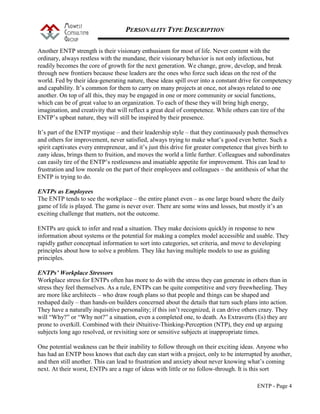
ENTP - Page 4
Another ENTP strength is their visionary enthusiasm for most of life. Never content with the
ordinary, always restless with the mundane, their visionary behavior is not only infectious, but
readily becomes the core of growth for the next generation. We change, grow, develop, and break
through new frontiers because these leaders are the ones who force such ideas on the rest of the
world. Fed by their idea-generating nature, these ideas spill over into a constant drive for competency
and capability. It’s common for them to carry on many projects at once, not always related to one
another. On top of all this, they may be engaged in one or more community or social functions,
which can be of great value to an organization. To each of these they will bring high energy,
imagination, and creativity that will reflect a great deal of competence. While others can tire of the
ENTP’s upbeat nature, they will still be inspired by their presence.
It’s part of the ENTP mystique – and their leadership style – that they continuously push themselves
and others for improvement, never satisfied, always trying to make what’s good even better. Such a
spirit captivates every entrepreneur, and it’s just this drive for greater competence that gives birth to
zany ideas, brings them to fruition, and moves the world a little further. Colleagues and subordinates
can easily tire of the ENTP’s restlessness and insatiable appetite for improvement. This can lead to
frustration and low morale on the part of their employees and colleagues – the antithesis of what the
ENTP is trying to do.
ENTPs as Employees
The ENTP tends to see the workplace – the entire planet even – as one large board where the daily
game of life is played. The game is never over. There are some wins and losses, but mostly it’s an
exciting challenge that matters, not the outcome.
ENTPs are quick to infer and read a situation. They make decisions quickly in response to new
information about systems or the potential for making a complex model accessible and usable. They
rapidly gather conceptual information to sort into categories, set criteria, and move to developing
principles about how to solve a problem. They like having multiple models to use as guiding
principles.
ENTPs’ Workplace Stressors
Workplace stress for ENTPs often has more to do with the stress they can generate in others than in
stress they feel themselves. As a rule, ENTPs can be quite competitive and very freewheeling. They
are more like architects – who draw rough plans so that people and things can be shaped and
reshaped daily – than hands-on builders concerned about the details that turn such plans into action.
They have a naturally inquisitive personality; if this isn’t recognized, it can drive others crazy. They
will “Why?” or “Why not?” a situation, even a completed one, to death. As Extraverts (Es) they are
prone to overkill. Combined with their iNtuitive-Thinking-Perception (NTP), they end up arguing
subjects long ago resolved, or revisiting sore or sensitive subjects at inappropriate times.
One potential weakness can be their inability to follow through on their exciting ideas. Anyone who
has had an ENTP boss knows that each day can start with a project, only to be interrupted by another,
and then still another. This can lead to frustration and anxiety about never knowing what’s coming
next. At their worst, ENTPs are a rage of ideas with little or no follow-through. It is this sort
PERSONALITY TYPE DESCRIPTION
ENTP - Page 5
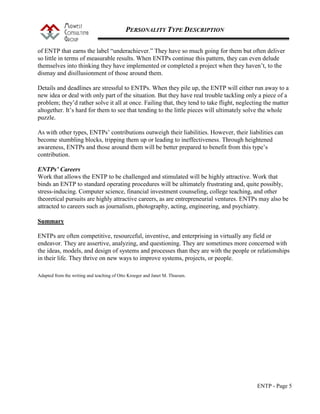
of ENTP that earns the label “underachiever.” They have so much going for them but often deliver
so little in terms of measurable results. When ENTPs continue this pattern, they can even delude
themselves into thinking they have implemented or completed a project when they haven’t, to the
dismay and disillusionment of those around them.
Details and deadlines are stressful to ENTPs. When they pile up, the ENTP will either run away to a
new idea or deal with only part of the situation. But they have real trouble tackling only a piece of a
problem; they’d rather solve it all at once. Failing that, they tend to take flight, neglecting the matter
altogether. It’s hard for them to see that tending to the little pieces will ultimately solve the whole
puzzle.
As with other types, ENTPs’ contributions outweigh their liabilities. However, their liabilities can
become stumbling blocks, tripping them up or leading to ineffectiveness. Through heightened
awareness, ENTPs and those around them will be better prepared to benefit from this type’s
contribution.
ENTPs’ Careers
Work that allows the ENTP to be challenged and stimulated will be highly attractive. Work that
binds an ENTP to standard operating procedures will be ultimately frustrating and, quite possibly,
stress-inducing. Computer science, financial investment counseling, college teaching, and other
theoretical pursuits are highly attractive careers, as are entrepreneurial ventures. ENTPs may also be
attracted to careers such as journalism, photography, acting, engineering, and psychiatry.
Summary
ENTPs are often competitive, resourceful, inventive, and enterprising in virtually any field or
endeavor. They are assertive, analyzing, and questioning. They are sometimes more concerned with
the ideas, models, and design of systems and processes than they are with the people or relationships
in their life. They thrive on new ways to improve systems, projects, or people.
Adapted from the writing and teaching of Otto Kroeger and Janet M. Thuesen.
PERSONALITY TYPE DESCRIPTION
ENTP - Page 6
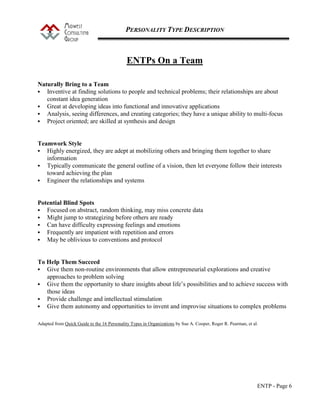
ENTPs On a Team
Naturally Bring to a Team
ď‚§ Inventive at finding solutions to people and technical problems; their relationships are about
constant idea generation
ď‚§ Great at developing ideas into functional and innovative applications
ď‚§ Analysis, seeing differences, and creating categories; they have a unique ability to multi-focus
ď‚§ Project oriented; are skilled at synthesis and design
Teamwork Style
ď‚§ Highly energized, they are adept at mobilizing others and bringing them together to share
information
ď‚§ Typically communicate the general outline of a vision, then let everyone follow their interests
toward achieving the plan
ď‚§ Engineer the relationships and systems
Potential Blind Spots
ď‚§ Focused on abstract, random thinking, may miss concrete data
ď‚§ Might jump to strategizing before others are ready
ď‚§ Can have difficulty expressing feelings and emotions
ď‚§ Frequently are impatient with repetition and errors
ď‚§ May be oblivious to conventions and protocol
To Help Them Succeed
ď‚§ Give them non-routine environments that allow entrepreneurial explorations and creative
approaches to problem solving
 Give them the opportunity to share insights about life’s possibilities and to achieve success with
those ideas
ď‚§ Provide challenge and intellectual stimulation
ď‚§ Give them autonomy and opportunities to invent and improvise situations to complex problems
Adapted from Quick Guide to the 16 Personality Types in Organizations by Sue A. Cooper, Roger R. Pearman, et al.
PERSONALITY TYPE DESCRIPTION
ENTP - Page 7
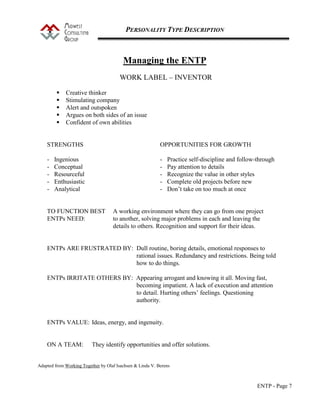
Managing the ENTP
WORK LABEL – INVENTOR
ď‚§ Creative thinker
ď‚§ Stimulating company
ď‚§ Alert and outspoken
ď‚§ Argues on both sides of an issue
ď‚§ Confident of own abilities
STRENGTHS OPPORTUNITIES FOR GROWTH
- Ingenious - Practice self-discipline and follow-through
- Conceptual - Pay attention to details
- Resourceful - Recognize the value in other styles
- Enthusiastic - Complete old projects before new
- Analytical - Don’t take on too much at once
TO FUNCTION BEST A working environment where they can go from one project
ENTPs NEED: to another, solving major problems in each and leaving the
details to others. Recognition and support for their ideas.
ENTPs ARE FRUSTRATED BY: Dull routine, boring details, emotional responses to
rational issues. Redundancy and restrictions. Being told
how to do things.
ENTPs IRRITATE OTHERS BY: Appearing arrogant and knowing it all. Moving fast,
becoming impatient. A lack of execution and attention
to detail. Hurting others’ feelings. Questioning
authority.
ENTPs VALUE: Ideas, energy, and ingenuity.
ON A TEAM: They identify opportunities and offer solutions.
Adapted from Working Together by Olaf Isachsen & Linda V. Berens

ENTP profile

  • 1.
    PERSONALITY TYPE DESCRIPTION ENTP- Page 1 ENTP (About 3.2% of the U.S. population) ENTPs are highly inventive individuals whose enthusiasm leads them into a wide variety of professional and personal activities. They’re also high rollers and risk-takers with their own and others’ resources. Like other Extraverted-Perceivers (EPs), when they win, they win big. But when they lose, they lose their shirts. So life for an ENTP is one exciting challenge after another. When you’re around them, you can expect a lot of sudden starts and stops. ENTP Personality Highlights  Their Extraversion makes for lively interaction with the outside world and a zest for life.  Their iNtuition allows them to perceive the world through its possibilities.  Their Thinking facilitates objective decision making.  Their Perceiving attitude keeps them open to a never-ending flow of alternatives. The ENTP is a “big picture” person who likes to see how many ways there are to fit the various pieces of a whole together. In fact, it’s their ability to see the big picture that enables them to generate so many creative alternatives for just about any system – whether it is a family, a vacation, a record collection, or a major corporation. They know that any system, no matter how successful, can always be made better or more effective. Such perceptions can make them seem almost psychic about future developments in a variety of disciplines. These qualities make them well suited for a variety of entrepreneurial adventures. Here are some other characteristics. ENTPs…  Are more excited about pursuing a new idea than about following through on an existing one, which can cause frustration and anxiety for themselves and those around them.  View the world like a chessboard whose pieces must be moved in such a way that all players will get the best and most out of life.  Constantly bombard themselves and others with ideas.  Burst with an excitement that can lead to tackling one exciting challenge after another, or lead to an endless series of delayed or unfulfilled dreams.  Test the limits of any system or person, especially traditional ones. ENTPs in Personal Life In relationships with an ENTP, you can expect to be challenged – usually by whatever comes along that is new, different, or on the cutting edge. Just coping with an ENTP can be stimulating, a fact attested to by ENTPs themselves. (“I find myself very interesting, but tiring.”)
  • 2.
    PERSONALITY TYPE DESCRIPTION ENTP- Page 2 ENTPs at Home This focus on challenge, extremes, the pursuit of ideas, and independent thinking characterizes all aspects of the ENTP’s lifestyle. There may be big financial swings, as well as a lot of physical disarray and disorganization. When intellectual sparring and “doing your own thing” take precedence over completing tasks (e.g., cleaning the house, the office, or the yard), the result can sometimes be chaotic. Being allowed to dream up and pursue possibilities without any follow-through or accountability is the ultimate form of relaxation for the ENTP. It’s also probably the greatest source of ENTP creativity. To give free rein to the imagination, instead of getting bogged down in the sticky details of dull routines, allows their creativity to flourish. They find not only stimulation and growth in the process, but relaxation too. Stress comes from being tied down by too many details. Later life might bring ENTPs the opportunity to slow down and not only “smell the roses,” but bring to fruition some long-shelved projects and hobbies. Pausing for introspection, appreciating what their senses are telling them, and respecting some of the tender and emotional moments of life will all have special appeal at this time. ENTPs as Children Like their adult counterparts, ENTP children are often whirlwinds. Lots of friends, laughter, projects, and ideas fill their waking hours. Each new day is an opportunity to design systems, challenge friends, and scheme. A simple request by a parent – to take out the garbage, for example – can lead an ENTP child to spend hours designing some sort of invention that will get the garbage from the kitchen to the backyard without human intervention. That design might demand calling friends, experimenting, or any number of other possibilities – all of which will be more exciting than actually completing the chore. This is the way an ENTP approaches learning. It is a group exchange of ideas, arguments, challenges, and projects. They would much rather learn by getting involved than by sitting through a lecture. In true entrepreneurial spirit, if this results in something that can be used, shared, and marketed (like a new garbage-removal system), so much the better. Teaching that encourages such exchanges and opportunities is exciting to an ENTP. Anything that is routine, redundant, rigid, or overly detailed is boring. Assignments may be completed late (or early) and may be done sloppily. If an assignment is dull or unchallenging in its original form, the ENTP student may even change or reconstruct it in the name of learning. ENTPs as Parents The ENTP sees the parenting relationship as one more opportunity for the growth and development of everyone involved. The ENTP’s house may be crowded with the latest books, gadgets, and fads. Children will be introduced to all of these things, which will be used to challenge them. This is far more important than neatness, schedule, and order. Most ENTP parents generate more ideas and possibilities per day than their children will ever be able to complete. This can be tiring and, to a child of a different type, very frustrating.
  • 3.
    PERSONALITY TYPE DESCRIPTION ENTP- Page 3 Helping the child to realize and expand the self is the ENTP’s most basic principle of child-rearing. This quest may be made at the expense of hugs, kisses, and expressions of affection, although for the ENTP the process itself is the ultimate expression of love. ENTPs in Professional Life When there’s an ENTP on the job, there’s no way to know what to expect next. It seems like every moment can be up for grabs around this high-energy, dynamic, creative, resilient, argumentative type. They would much rather engage in intellectual banter than complete some meaningless task or be quiet by themselves. For the ENTP, the public world is an exciting one (Extraversion). If things aren’t exciting, they want to go out there and make it so, because the external world is full of endless possibilities, random abstractions, and theoretical connections (iNtuition). These perceptions are filtered through objective, impersonal decisions (Thinking). But none of these are terribly binding because each day brings new options, open-ended living, and spontaneity (Perception). So, while ENTPs can be exciting, they may not be terribly committed to a schedule or project if a better deal or more exciting challenge comes along. Most iNtuitive-Thinkers (NTs) learn by discussing and challenging, and this is especially true for ENTPs. They get pleasure and intellectual stimulation from arguing both sides of a subject or from doing something unusual or unexpected just to get a reaction. These qualities can become tiring, particularly to those of a different type. The ENTP is driven by argumentativeness and chutzpah, which can be creative and exciting. However, qualities that will not endear them to colleagues in the workplace include intellectual arrogance, impatience when others don’t readily understand something, and arguing for the sake of provoking thoughts. Interestingly, when ENTPs come to terms with an organization, they are frequently promoted to the highest levels. Their inspiration and vision outweigh any of these problems. ENTPs as Leaders ENTPs are idea people. Their single greatest contribution to life and work is the creation of ideas, which flow from them continuously. They are entrepreneurs who are always sharing or selling their next great idea and attempting to generate enthusiastic support for it. ENTPs can have an uncanny knack for predicting trends in the marketplace; products of the future; or other designs for work, play, or home. To start the day with one or two ideas, engage with others, and end the day with another five or six ideas is exhilarating to the ENTP. Though frequently the ideas may be within their areas of expertise, they are not necessarily limited in that way. As a result, ENTPs do a broad-brush through life – probably giving a whole lot more than they take, creating more than implementing, starting more than finishing. But that is their excitement as well as their contribution.
  • 4.
    PERSONALITY TYPE DESCRIPTION ENTP- Page 4 Another ENTP strength is their visionary enthusiasm for most of life. Never content with the ordinary, always restless with the mundane, their visionary behavior is not only infectious, but readily becomes the core of growth for the next generation. We change, grow, develop, and break through new frontiers because these leaders are the ones who force such ideas on the rest of the world. Fed by their idea-generating nature, these ideas spill over into a constant drive for competency and capability. It’s common for them to carry on many projects at once, not always related to one another. On top of all this, they may be engaged in one or more community or social functions, which can be of great value to an organization. To each of these they will bring high energy, imagination, and creativity that will reflect a great deal of competence. While others can tire of the ENTP’s upbeat nature, they will still be inspired by their presence. It’s part of the ENTP mystique – and their leadership style – that they continuously push themselves and others for improvement, never satisfied, always trying to make what’s good even better. Such a spirit captivates every entrepreneur, and it’s just this drive for greater competence that gives birth to zany ideas, brings them to fruition, and moves the world a little further. Colleagues and subordinates can easily tire of the ENTP’s restlessness and insatiable appetite for improvement. This can lead to frustration and low morale on the part of their employees and colleagues – the antithesis of what the ENTP is trying to do. ENTPs as Employees The ENTP tends to see the workplace – the entire planet even – as one large board where the daily game of life is played. The game is never over. There are some wins and losses, but mostly it’s an exciting challenge that matters, not the outcome. ENTPs are quick to infer and read a situation. They make decisions quickly in response to new information about systems or the potential for making a complex model accessible and usable. They rapidly gather conceptual information to sort into categories, set criteria, and move to developing principles about how to solve a problem. They like having multiple models to use as guiding principles. ENTPs’ Workplace Stressors Workplace stress for ENTPs often has more to do with the stress they can generate in others than in stress they feel themselves. As a rule, ENTPs can be quite competitive and very freewheeling. They are more like architects – who draw rough plans so that people and things can be shaped and reshaped daily – than hands-on builders concerned about the details that turn such plans into action. They have a naturally inquisitive personality; if this isn’t recognized, it can drive others crazy. They will “Why?” or “Why not?” a situation, even a completed one, to death. As Extraverts (Es) they are prone to overkill. Combined with their iNtuitive-Thinking-Perception (NTP), they end up arguing subjects long ago resolved, or revisiting sore or sensitive subjects at inappropriate times. One potential weakness can be their inability to follow through on their exciting ideas. Anyone who has had an ENTP boss knows that each day can start with a project, only to be interrupted by another, and then still another. This can lead to frustration and anxiety about never knowing what’s coming next. At their worst, ENTPs are a rage of ideas with little or no follow-through. It is this sort
  • 5.
    PERSONALITY TYPE DESCRIPTION ENTP- Page 5 of ENTP that earns the label “underachiever.” They have so much going for them but often deliver so little in terms of measurable results. When ENTPs continue this pattern, they can even delude themselves into thinking they have implemented or completed a project when they haven’t, to the dismay and disillusionment of those around them. Details and deadlines are stressful to ENTPs. When they pile up, the ENTP will either run away to a new idea or deal with only part of the situation. But they have real trouble tackling only a piece of a problem; they’d rather solve it all at once. Failing that, they tend to take flight, neglecting the matter altogether. It’s hard for them to see that tending to the little pieces will ultimately solve the whole puzzle. As with other types, ENTPs’ contributions outweigh their liabilities. However, their liabilities can become stumbling blocks, tripping them up or leading to ineffectiveness. Through heightened awareness, ENTPs and those around them will be better prepared to benefit from this type’s contribution. ENTPs’ Careers Work that allows the ENTP to be challenged and stimulated will be highly attractive. Work that binds an ENTP to standard operating procedures will be ultimately frustrating and, quite possibly, stress-inducing. Computer science, financial investment counseling, college teaching, and other theoretical pursuits are highly attractive careers, as are entrepreneurial ventures. ENTPs may also be attracted to careers such as journalism, photography, acting, engineering, and psychiatry. Summary ENTPs are often competitive, resourceful, inventive, and enterprising in virtually any field or endeavor. They are assertive, analyzing, and questioning. They are sometimes more concerned with the ideas, models, and design of systems and processes than they are with the people or relationships in their life. They thrive on new ways to improve systems, projects, or people. Adapted from the writing and teaching of Otto Kroeger and Janet M. Thuesen.
  • 6.
    PERSONALITY TYPE DESCRIPTION ENTP- Page 6 ENTPs On a Team Naturally Bring to a Team  Inventive at finding solutions to people and technical problems; their relationships are about constant idea generation  Great at developing ideas into functional and innovative applications  Analysis, seeing differences, and creating categories; they have a unique ability to multi-focus  Project oriented; are skilled at synthesis and design Teamwork Style  Highly energized, they are adept at mobilizing others and bringing them together to share information  Typically communicate the general outline of a vision, then let everyone follow their interests toward achieving the plan  Engineer the relationships and systems Potential Blind Spots  Focused on abstract, random thinking, may miss concrete data  Might jump to strategizing before others are ready  Can have difficulty expressing feelings and emotions  Frequently are impatient with repetition and errors  May be oblivious to conventions and protocol To Help Them Succeed  Give them non-routine environments that allow entrepreneurial explorations and creative approaches to problem solving  Give them the opportunity to share insights about life’s possibilities and to achieve success with those ideas  Provide challenge and intellectual stimulation  Give them autonomy and opportunities to invent and improvise situations to complex problems Adapted from Quick Guide to the 16 Personality Types in Organizations by Sue A. Cooper, Roger R. Pearman, et al.
  • 7.
    PERSONALITY TYPE DESCRIPTION ENTP- Page 7 Managing the ENTP WORK LABEL – INVENTOR  Creative thinker  Stimulating company  Alert and outspoken  Argues on both sides of an issue  Confident of own abilities STRENGTHS OPPORTUNITIES FOR GROWTH - Ingenious - Practice self-discipline and follow-through - Conceptual - Pay attention to details - Resourceful - Recognize the value in other styles - Enthusiastic - Complete old projects before new - Analytical - Don’t take on too much at once TO FUNCTION BEST A working environment where they can go from one project ENTPs NEED: to another, solving major problems in each and leaving the details to others. Recognition and support for their ideas. ENTPs ARE FRUSTRATED BY: Dull routine, boring details, emotional responses to rational issues. Redundancy and restrictions. Being told how to do things. ENTPs IRRITATE OTHERS BY: Appearing arrogant and knowing it all. Moving fast, becoming impatient. A lack of execution and attention to detail. Hurting others’ feelings. Questioning authority. ENTPs VALUE: Ideas, energy, and ingenuity. ON A TEAM: They identify opportunities and offer solutions. Adapted from Working Together by Olaf Isachsen & Linda V. Berens