ORGANIZATIONAL
CITIZENSHIP
BEHAVIOUR
(OCB)

Presented By:
Sharath G ( MBA)
1
Contents


History of OCB



What is OCB? Definition.



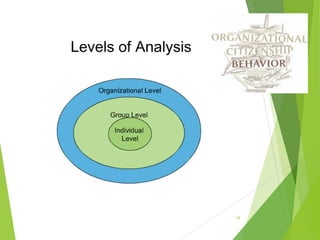
Levels of OCB



Independent variables



Conclusion
2



Video on OCB
History of OCB


Dennis Organ is generally considered the
father of OCB.



Dennis Organ expanded upon Katz's (1964)
original work on OCB.



Dennis Organ’s (1988) definition of OCB
has generated a great deal of criticism

3
What is OCB??


“Organizational citizenship behavior (OCB), is
defined… as behavior that



(a) goes beyond the basic requirements of the
job,



(b) is to a large extent discretionary, and



(c) is of benefit to the organization”
4
ORGANIZATIONAL CITIZENSHIP
BEHAVIOUR (OCB)


Work behaviour can be seen in terms of in-role and
extra-role behaviour.



Willingness to engage in extra-role behaviour is
indicative of high OCB



OCB is willingness to go the extra mile



OCB is product of high level of motivation and
commitment
5
(Cont..)


High OCB related to high performance level and
less need for hierarchical control.



Individuals become self driven



Also reflective of willingness to be resourceful
beyond immediate role requirement.

6
Organizational Citizenship


Discretionary behavior



Not part of an employee's formal job
requirements



Promotes the effective functioning of the
organization

7
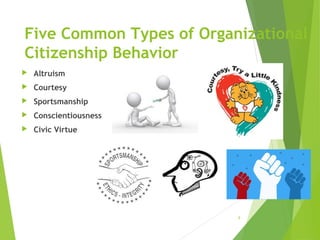
Five Common Types of Organizational
Citizenship Behavior


Altruism



Courtesy



Sportsmanship



Conscientiousness



Civic Virtue

8
Altruism


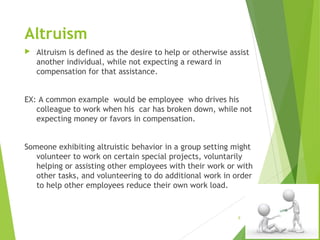
Altruism is defined as the desire to help or otherwise assist
another individual, while not expecting a reward in
compensation for that assistance.

EX: A common example would be employee who drives his
colleague to work when his car has broken down, while not
expecting money or favors in compensation.
Someone exhibiting altruistic behavior in a group setting might
volunteer to work on certain special projects, voluntarily
helping or assisting other employees with their work or with
other tasks, and volunteering to do additional work in order
to help other employees reduce their own work load. 

9
Courtesy


Courtesy is defined as behavior which is polite and
considerate towards other people.



In a business context, courtesy is usually exhibited through
behaviors such as inquiring about personal subjects that a
coworker has previously brought up, asking if a coworker is
having any trouble with a certain work related project, and
informing coworkers about prior commitments or any other
problems that might cause them to reduce their workload or
be absent from work. 

10
Sportsmanship


Sportsmanship is defined as exhibiting no negative behavior
when something does not go as planned--or when something
is being perceived as annoying, difficult, frustrating or
otherwise negative.

For example: Imagine an employee who submits their proposal
to their superior may be expecting it to be well-received
and accepted—it is rejected, instead, and the employee
displays good sportsmanship by not complaining about the
situation to other coworkers or individuals who may report
their behavior to others working for the business. 

11
Conscientiousness


Conscientiousness is defined as behavior that suggests a
reasonable level of self-control and discipline, which
extends beyond the minimum requirements expected in that
situation.



In the context of a business setting, conscientiousness is
observed when an employee not only meets their
employer’s requirements—such as coming into work on time
and completing assignments on time—but exceeds them.

12
Civic Virtue


Civic virtue is defined as behavior which exhibits how well a
person represents an organization with which they are
associated, and how well that person supports their
organization outside of an official capacity.



Example, how well someone represents their business and
how they may support that business are all examples of
someone's civic virtue.

Examples of civic virtue in a business setting include


speaking positively about the business to friends, family;



signing up for business events, such as charity walking
events.
13
14
Examples of Organizational
Citizenship


Helping others on one's work team



Volunteering for extra job activities



Avoiding unnecessary conflicts



Making constructive statements about one's
work group and the overall organization
15
Independent variables
Individual variables
Age,

gender, personality, emotion, values, attitude, ability

Perception,

individual decision making, learning, and

motivation
Group variables
Norm,

communication, leadership, power, politics

Organization system variables
Organizational

culture, HR practices
16
Conclusion


Organizational citizenship behavior has a critical
relation with organizational functioning. But little work
recovers the internal mechanism by which
organizational citizenship behavior facilitate
organizational performance and effectiveness.



We propose that organizational citizenship behavior,
especially, the social participation, advocacy
participation, functional participation and focus on
tasks contribute to internal learning, explorative
learning, emergent learning, and exploitation learning
between individual, and consequently enhance
organizational functioning and performance.
17
Thank you!

18

Organizational Citizenship Behavior

  • 1.
  • 2.
    Contents  History of OCB  Whatis OCB? Definition.  Levels of OCB  Independent variables  Conclusion 2  Video on OCB
  • 3.
    History of OCB  DennisOrgan is generally considered the father of OCB.  Dennis Organ expanded upon Katz's (1964) original work on OCB.  Dennis Organ’s (1988) definition of OCB has generated a great deal of criticism 3
  • 4.
    What is OCB??  “Organizationalcitizenship behavior (OCB), is defined… as behavior that  (a) goes beyond the basic requirements of the job,  (b) is to a large extent discretionary, and  (c) is of benefit to the organization” 4
  • 5.
    ORGANIZATIONAL CITIZENSHIP BEHAVIOUR (OCB)  Workbehaviour can be seen in terms of in-role and extra-role behaviour.  Willingness to engage in extra-role behaviour is indicative of high OCB  OCB is willingness to go the extra mile  OCB is product of high level of motivation and commitment 5
  • 6.
    (Cont..)  High OCB relatedto high performance level and less need for hierarchical control.  Individuals become self driven  Also reflective of willingness to be resourceful beyond immediate role requirement. 6
  • 7.
    Organizational Citizenship  Discretionary behavior  Notpart of an employee's formal job requirements  Promotes the effective functioning of the organization 7
  • 8.
    Five Common Typesof Organizational Citizenship Behavior  Altruism  Courtesy  Sportsmanship  Conscientiousness  Civic Virtue 8
  • 9.
    Altruism  Altruism is definedas the desire to help or otherwise assist another individual, while not expecting a reward in compensation for that assistance. EX: A common example would be employee who drives his colleague to work when his car has broken down, while not expecting money or favors in compensation. Someone exhibiting altruistic behavior in a group setting might volunteer to work on certain special projects, voluntarily helping or assisting other employees with their work or with other tasks, and volunteering to do additional work in order to help other employees reduce their own work load.  9
  • 10.
    Courtesy  Courtesy is definedas behavior which is polite and considerate towards other people.  In a business context, courtesy is usually exhibited through behaviors such as inquiring about personal subjects that a coworker has previously brought up, asking if a coworker is having any trouble with a certain work related project, and informing coworkers about prior commitments or any other problems that might cause them to reduce their workload or be absent from work.  10
  • 11.
    Sportsmanship  Sportsmanship is definedas exhibiting no negative behavior when something does not go as planned--or when something is being perceived as annoying, difficult, frustrating or otherwise negative. For example: Imagine an employee who submits their proposal to their superior may be expecting it to be well-received and accepted—it is rejected, instead, and the employee displays good sportsmanship by not complaining about the situation to other coworkers or individuals who may report their behavior to others working for the business.  11
  • 12.
    Conscientiousness  Conscientiousness is definedas behavior that suggests a reasonable level of self-control and discipline, which extends beyond the minimum requirements expected in that situation.  In the context of a business setting, conscientiousness is observed when an employee not only meets their employer’s requirements—such as coming into work on time and completing assignments on time—but exceeds them. 12
  • 13.
    Civic Virtue  Civic virtueis defined as behavior which exhibits how well a person represents an organization with which they are associated, and how well that person supports their organization outside of an official capacity.  Example, how well someone represents their business and how they may support that business are all examples of someone's civic virtue. Examples of civic virtue in a business setting include  speaking positively about the business to friends, family;  signing up for business events, such as charity walking events. 13
  • 14.
  • 15.
    Examples of Organizational Citizenship  Helpingothers on one's work team  Volunteering for extra job activities  Avoiding unnecessary conflicts  Making constructive statements about one's work group and the overall organization 15
  • 16.
    Independent variables Individual variables Age, gender,personality, emotion, values, attitude, ability Perception, individual decision making, learning, and motivation Group variables Norm, communication, leadership, power, politics Organization system variables Organizational culture, HR practices 16
  • 17.
    Conclusion  Organizational citizenship behaviorhas a critical relation with organizational functioning. But little work recovers the internal mechanism by which organizational citizenship behavior facilitate organizational performance and effectiveness.  We propose that organizational citizenship behavior, especially, the social participation, advocacy participation, functional participation and focus on tasks contribute to internal learning, explorative learning, emergent learning, and exploitation learning between individual, and consequently enhance organizational functioning and performance. 17
  • 18.