ENRON: THE
SCANDAL
Add Subtitle
Enron Corporation was an American energy commodity, and services company based
in Houston, Texas.
It was founded in 1985 by Kenneth Lay as the result of a merge between Houston
Natural Gas and InterNorth.
Enron Corporation was one of the leading suppliers of Natural Gas, Communications,
Pulp, and Paper.
Enron employed approximately 20,000 staff with claimed revenues of nearly $101 billion
during 2000.
Fortune named Enron “America’s Most Innovative Company” for six consecutive years.
ABOUT ENRON...
2
• In 2001, after a series of revelations involving irregular accounting procedures
bordering on fraud perpetrated throughout the 1990s involving Enron and its accounting
company Arthur Andersen, Enron suffered the largest bankruptcy in history.
• Some highlights of the scandal are:
 $30 million of self-dealings by the Chief Financial Officer
$700 million of Net earnings disappeared
$1.2 billion of Equity Shareholders disappeared
Over $4 billion hidden liabilities
• Many of Enron’s recorded assets and profits were inflated or totally fraudulent and non-
existent. Debts and losses were put into entities formed offshore that were not included
in the company’s financial statements.
WHAT MADE IT A SCANDAL?
3
KEY PLAYERS OF SCANDAL
4
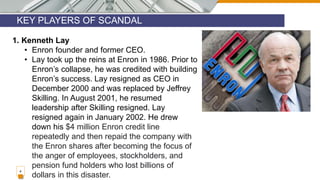
1. Kenneth Lay
• Enron founder and former CEO.
• Lay took up the reins at Enron in 1986. Prior to
Enron’s collapse, he was credited with building
Enron’s success. Lay resigned as CEO in
December 2000 and was replaced by Jeffrey
Skilling. In August 2001, he resumed
leadership after Skilling resigned. Lay
resigned again in January 2002. He drew
down his $4 million Enron credit line
repeatedly and then repaid the company with
the Enron shares after becoming the focus of
the anger of employees, stockholders, and
pension fund holders who lost billions of
dollars in this disaster.
KEY PLAYERS OF SCANDAL
5
2. Jeffrey Skilling
• Former Chief Executive, President, and Chief
Operating Officer.
• He joined Enron in 1990 from the consultancy
from McKinsey, where he had developed
financial instruments to trade gas contracts.
He was also seen as a key architect of the
company’s gas-trading strategy. He resigned
his post as Enron’s Chief Executive in August
2001 without a pay-off.
KEY PLAYERS OF SCANDAL
6
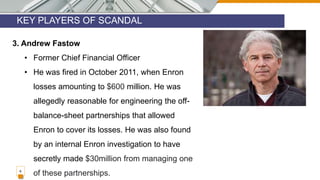
3. Andrew Fastow
• Former Chief Financial Officer
• He was fired in October 2011, when Enron
losses amounting to $600 million. He was
allegedly reasonable for engineering the off-
balance-sheet partnerships that allowed
Enron to cover its losses. He was also found
by an internal Enron investigation to have
secretly made $30million from managing one
of these partnerships.
KEY PLAYERS OF SCANDAL
7
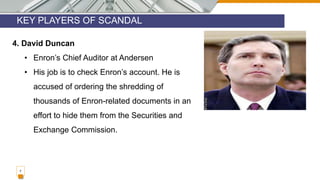
4. David Duncan
• Enron’s Chief Auditor at Andersen
• His job is to check Enron’s account. He is
accused of ordering the shredding of
thousands of Enron-related documents in an
effort to hide them from the Securities and
Exchange Commission.
KEY PLAYERS OF SCANDAL
8
5. Enron’s Accounting Firm- Arthur Andersen
• Arthur Andersen, was Enron’s auditing firm.
• His job was to check that the company’s
accounts were a fair reflection of what was
really going on. The company earned large
fees from its audit work for Enron and from
related work as consultants to the same
company. When the scandal broke, the US
government began to investigate the
company’s affairs, Andersen’s Chief Auditor
for Enron, David Duncan, ordered the
shredding of thousands of documents that
might prove compromising. That was after the
Securities and Exchange Commission (SEC)
WHISTLE BLOWER
9
Sherron Watkins was the Vice President of Corporate Development
at the Enron Corporation. In June 2001, she was given the task of
finding some assets to sell off but it was very difficult for her. She
prepared a memo regarding the various problems and placed it into
the box but this memo was not taken into consideration. On August
22, Watkins handed CEO Lay a seven-page letter and told him that
Enron would implode in a wave of accounting scandals.
• in August 2001, Watkins alerted then-Enron CEO Kenneth Lay of
accounting irregularities in financial reports. In February 2002, she
revealed the various facts regarding Enron partnerships and finally
resigned in November. But Watkins revealed all the facts only after
Enron filed for bankruptcy.
• However, Watkins has been criticized for not reporting the fraud to
government authorities and not speaking up publicly sooner about
her concerns, as her memo did not reach the public until five months
later.
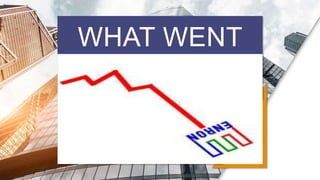
WHAT WENT
WRONG?
Add Subtitle
AUDITING AND ACCOUNTING ISSUES
11
As per federal securities law, the accounting statement of publicly traded
corporations is certified by an independent auditor.
Enron’s auditor, Arthur Andersen, turned a blind eye to improper accounting
practices as well as he was actively involved in devising complex financial
structures and transactions.
Enron’s auditor also violated GAAP (General Accepted Accounting Principles and
Permit Corporation) to play “number games”.
As an organization of the public accountant, Arthur Andersen violated the
regulations of the public Accountant practices because Andersen was not only as
the internal auditor but also the external auditor of Enron.
SPE (SPECIAL PURPOSE ENTITIES)
12
SPE’s reflect a common financing technique for companies.
Companies can cut their risk by moving assets into separate
partnerships that can be sold to outside investors.
In Enron’s case, assets that were losing money were sold to
partnerships. Enron listed the sales of these assets as
earnings. However, to be legitimate, accounting rules require
that an SPE be legally isolated from the company that created
it.
In Enron’s case this was not true. The SPE’s relied upon
Enron managers for leadership and Enron stock for capital.
When outside auditors told Enron to treat some of the 4,000
SPE’s it had created as part of Enron, the company had to
take the $1 billion charge against earnings.
PENSION ISSUES
13
Enron sponsored a pension plan for its employees that
contribute a portion of their pay on a deferred tax basis.
Almost 62% of assets held in the corporation’s 401(k)
retirement plan consist of Enron’s stock.
Shares traded in January 2001 for more than $80/share
become worth less than 70% in January 2002.
While the investments grow in the employees 401k account,
they do not pay any taxes on it.
Employees accounts were wiped out and losses suffered by
participants.
BANKING ISSUES
14
There was a questionable relationship between Enron and
bankers Citigroup and J.P Morgan Chase also contributed to
the downfall of Enron.
Enron was a lucrative investment banking business for the
banks. In exchange for potential profits, the bank had lent
money to Enron and promoted its derivative and securities.
ENERGY DERIVATIVE ISSUES
15
• Since the markets in which Enron traded are largely
unregulated, with no reporting requirements, little
information was available about the extent of
profitability of Enron’s derivative activities.
SO WHY DID ENRON SCANDAL HAPPEN?
16
• Due to the lack of corporate social responsibility, situation ethics, and
get-it-done business pragmatism.
• Due to the discrepancies of attempting to match profits and cash,
investors were typically given false or misleading reports as it was
difficult to estimate the cost and viability of contracts.
• Atmosphere of market euphoria and corporate arrogance.
• High-risk deals that went sour.
• Deceptive reporting practices-lack of transparency in reporting financial
affairs.
• Excessive interest in maintaining stock prices.
IMPACT OF
ACCOUNTIN
G FRAUD ON
DIFFERENT
PARTIES
IMPACT ON EMPLOYEES
18
Thousands of employees lost their jobs as well as their retirement savings
with the company.
The pension fund for the employees was obliterated.
After the bankruptcy, Enron fired 5000 workers, one-quarter of its 21000
employees. The company expects to fire more workers as it sells or shut
down business units.
Laid off workers received $4500 severance payment, no matter how many
years had worked for the company.
Lower-level employees were prevented from selling their stock due to 401k
restriction and many subsequently lost their life savings.
More than half employees invested about $1.2 billion in Enron stock. Those
who nearly worthless.
IMPACT ON SHAREHOLDERS
19
Enron shareholders received limited returns in
lawsuits despite losing billions in stock prices.
Eligible shareholders whose Enron holding
became worthless when the company crumbled
in the scandal will receive $7.2 billion in
settlements under a distribution plan approved in
federal court.
No one wants to do any more investment in
Enron.
Undermine the investor’s trust in the reliability of
mandated corporate filings.
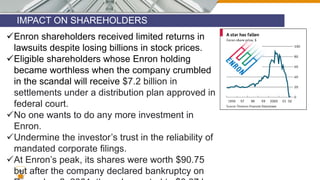
At Enron’s peak, its shares were worth $90.75
but after the company declared bankruptcy on
IMPACT ON COMPETITORS
20
On November 9, 2001, rival trader Dynegy Inc. decided to
purchase the company for $8 billion in stock.
By the end of the month, Dynegy had backed out of the deal,
citing Enron’s downgrade to “junk-bond” status and continuing
irregularities.
IMPACT ON COSTUMERS
21
Plans to develop natural gas deposits are being cut back dramatically. Lose their source , ultimately
it results in power shortages and higher cost in future years, the burden will fall on the customers.
Lose their source of supply.
Enron’s fraud prompted the US congress to pass Sarabanes-Oxley corporate accountability law,
which forces corporate executives to take personal responsibility for the accuracy of company
accounts. Suffered economic losses.
IMPACT ON GOVERNMENT
AMENDMENTS DONE AFTER THE SCANDAL
22
The Enron scandal was certainly enough to show the
American public and its representatives in congress that
new compliance standards for auditing and public
accounting were needed. Since the Enron collapse an
array of new laws and regulations has been adopted to
tighten corporate oversight.
SARBANES-OXLEY ACT
23
In July of 2002, President George W. Bush signed into law the
Sarbanes-Oxley Act.
The act was passed in response to a number of accounting
scandals between 2000-2002.
The act heightened the consequences for destroying, altering, or
fabricating financial records, or for trying to defraud shareholders.
It created the Public Company Accounting Oversight Board
(PCAOB), which is in charge of registering and inspecting public
accounting firms, and modifying audit standards.
This act aims at public accounting firms that participate in audits
of corporations.
FINANCIAL ACCOUNTING STANDARDS BOARD
24
It existed since 1973 as one of the most widely recognized
organizations responsible for establishing standards of financial
accounting and reporting.
The legacy of Enron/Arthur Andersen live on various changes to
the profession.
Prior to this case, the accounting field was supervised by Public
Oversight Board (POB)
But after this case came to light SEC (Securities Exchange
Commission) Chairman, Harley L. Pitt, 2002 made a series of
inquiries about the system of self-regulation in the accounting
profession without consulting the POB.
COMPANIES TO REPORT LEASES
25
After 25 years of the scandal, FASB has issued a final rule
that changes how companies account for most of their leases.
Regulators started to consider a change in lease accounting
after the collapse in 2001 of Enron, whose executives made
the company look stronger by keeping some of its financial
obligations “off-balance sheet”.
The new rule requires that the most common type of lease be
included on the company’s balance sheet, potentially giving
investors a more accurate picture of the company’s health.
LESSON
LEARNED
FROM
ENRON
SCANDAL
RELATED TO AUDITING
27
• Conflict of interest between the two roles played by Arthur
Andersen, as an auditor but also as a consultant.
• Stamp of approval by Andersen to Enron’s poor practices.
• GAAP (General Accepted Accounting Principles) were not
followed properly.
• Documents were destroyed.
• Mandatory rotation is suggested, every four years and so,
both audit partners, so that individual does not become too
committed to their clients like in this case, Andersen was
playing an active role of the auditor.
RELATED TO THE BOARD OF DIRECTORS
28
• Board of directors did not pay attention to their employees
considering themselves as representatives of shareholders.
• Closer attention to the behavior of management and the way
the company is making money.
• In this case when a stock is rising and the shareholders are
getting rich there is little incentive for the Board of Directors to
question executives closely. Therefore it must be acceptable
and mandatory to question management closely.
• The arrogance of corporate executives who claim they are the
best are the red flag for investor and public.
RELATED TO SPE (SPECIAL PURPOSE ENTITY)
29
• Company cannot use special purpose entity to hedge its
losses, as in this case, it can’t do it for a long time.
• The bubble burst very easily, and about 4000 SPE’s have
been created by Enron.
OTHER LESSONS
30
• This scandal demonstrates the need for significant reforms in
accounting and corporate governance in the United States, as well
as for a close look at the ethical quality of the culture of business
corporations.
• Complicated financial disclosure adds another page to the
scandal, and so companies should disclose their financial
statements closely and in a manner that is understandable to their
stakeholders.
THANK
YOU
31

ENRON.pptx

  • 1.
  • 2.
    Enron Corporation wasan American energy commodity, and services company based in Houston, Texas. It was founded in 1985 by Kenneth Lay as the result of a merge between Houston Natural Gas and InterNorth. Enron Corporation was one of the leading suppliers of Natural Gas, Communications, Pulp, and Paper. Enron employed approximately 20,000 staff with claimed revenues of nearly $101 billion during 2000. Fortune named Enron “America’s Most Innovative Company” for six consecutive years. ABOUT ENRON... 2
  • 3.
    • In 2001,after a series of revelations involving irregular accounting procedures bordering on fraud perpetrated throughout the 1990s involving Enron and its accounting company Arthur Andersen, Enron suffered the largest bankruptcy in history. • Some highlights of the scandal are:  $30 million of self-dealings by the Chief Financial Officer $700 million of Net earnings disappeared $1.2 billion of Equity Shareholders disappeared Over $4 billion hidden liabilities • Many of Enron’s recorded assets and profits were inflated or totally fraudulent and non- existent. Debts and losses were put into entities formed offshore that were not included in the company’s financial statements. WHAT MADE IT A SCANDAL? 3
  • 4.
    KEY PLAYERS OFSCANDAL 4 1. Kenneth Lay • Enron founder and former CEO. • Lay took up the reins at Enron in 1986. Prior to Enron’s collapse, he was credited with building Enron’s success. Lay resigned as CEO in December 2000 and was replaced by Jeffrey Skilling. In August 2001, he resumed leadership after Skilling resigned. Lay resigned again in January 2002. He drew down his $4 million Enron credit line repeatedly and then repaid the company with the Enron shares after becoming the focus of the anger of employees, stockholders, and pension fund holders who lost billions of dollars in this disaster.
  • 5.
    KEY PLAYERS OFSCANDAL 5 2. Jeffrey Skilling • Former Chief Executive, President, and Chief Operating Officer. • He joined Enron in 1990 from the consultancy from McKinsey, where he had developed financial instruments to trade gas contracts. He was also seen as a key architect of the company’s gas-trading strategy. He resigned his post as Enron’s Chief Executive in August 2001 without a pay-off.
  • 6.
    KEY PLAYERS OFSCANDAL 6 3. Andrew Fastow • Former Chief Financial Officer • He was fired in October 2011, when Enron losses amounting to $600 million. He was allegedly reasonable for engineering the off- balance-sheet partnerships that allowed Enron to cover its losses. He was also found by an internal Enron investigation to have secretly made $30million from managing one of these partnerships.
  • 7.
    KEY PLAYERS OFSCANDAL 7 4. David Duncan • Enron’s Chief Auditor at Andersen • His job is to check Enron’s account. He is accused of ordering the shredding of thousands of Enron-related documents in an effort to hide them from the Securities and Exchange Commission.
  • 8.
    KEY PLAYERS OFSCANDAL 8 5. Enron’s Accounting Firm- Arthur Andersen • Arthur Andersen, was Enron’s auditing firm. • His job was to check that the company’s accounts were a fair reflection of what was really going on. The company earned large fees from its audit work for Enron and from related work as consultants to the same company. When the scandal broke, the US government began to investigate the company’s affairs, Andersen’s Chief Auditor for Enron, David Duncan, ordered the shredding of thousands of documents that might prove compromising. That was after the Securities and Exchange Commission (SEC)
  • 9.
    WHISTLE BLOWER 9 Sherron Watkinswas the Vice President of Corporate Development at the Enron Corporation. In June 2001, she was given the task of finding some assets to sell off but it was very difficult for her. She prepared a memo regarding the various problems and placed it into the box but this memo was not taken into consideration. On August 22, Watkins handed CEO Lay a seven-page letter and told him that Enron would implode in a wave of accounting scandals. • in August 2001, Watkins alerted then-Enron CEO Kenneth Lay of accounting irregularities in financial reports. In February 2002, she revealed the various facts regarding Enron partnerships and finally resigned in November. But Watkins revealed all the facts only after Enron filed for bankruptcy. • However, Watkins has been criticized for not reporting the fraud to government authorities and not speaking up publicly sooner about her concerns, as her memo did not reach the public until five months later.
  • 10.
  • 11.
    AUDITING AND ACCOUNTINGISSUES 11 As per federal securities law, the accounting statement of publicly traded corporations is certified by an independent auditor. Enron’s auditor, Arthur Andersen, turned a blind eye to improper accounting practices as well as he was actively involved in devising complex financial structures and transactions. Enron’s auditor also violated GAAP (General Accepted Accounting Principles and Permit Corporation) to play “number games”. As an organization of the public accountant, Arthur Andersen violated the regulations of the public Accountant practices because Andersen was not only as the internal auditor but also the external auditor of Enron.
  • 12.
    SPE (SPECIAL PURPOSEENTITIES) 12 SPE’s reflect a common financing technique for companies. Companies can cut their risk by moving assets into separate partnerships that can be sold to outside investors. In Enron’s case, assets that were losing money were sold to partnerships. Enron listed the sales of these assets as earnings. However, to be legitimate, accounting rules require that an SPE be legally isolated from the company that created it. In Enron’s case this was not true. The SPE’s relied upon Enron managers for leadership and Enron stock for capital. When outside auditors told Enron to treat some of the 4,000 SPE’s it had created as part of Enron, the company had to take the $1 billion charge against earnings.
  • 13.
    PENSION ISSUES 13 Enron sponsoreda pension plan for its employees that contribute a portion of their pay on a deferred tax basis. Almost 62% of assets held in the corporation’s 401(k) retirement plan consist of Enron’s stock. Shares traded in January 2001 for more than $80/share become worth less than 70% in January 2002. While the investments grow in the employees 401k account, they do not pay any taxes on it. Employees accounts were wiped out and losses suffered by participants.
  • 14.
    BANKING ISSUES 14 There wasa questionable relationship between Enron and bankers Citigroup and J.P Morgan Chase also contributed to the downfall of Enron. Enron was a lucrative investment banking business for the banks. In exchange for potential profits, the bank had lent money to Enron and promoted its derivative and securities.
  • 15.
    ENERGY DERIVATIVE ISSUES 15 •Since the markets in which Enron traded are largely unregulated, with no reporting requirements, little information was available about the extent of profitability of Enron’s derivative activities.
  • 16.
    SO WHY DIDENRON SCANDAL HAPPEN? 16 • Due to the lack of corporate social responsibility, situation ethics, and get-it-done business pragmatism. • Due to the discrepancies of attempting to match profits and cash, investors were typically given false or misleading reports as it was difficult to estimate the cost and viability of contracts. • Atmosphere of market euphoria and corporate arrogance. • High-risk deals that went sour. • Deceptive reporting practices-lack of transparency in reporting financial affairs. • Excessive interest in maintaining stock prices.
  • 17.
    IMPACT OF ACCOUNTIN G FRAUDON DIFFERENT PARTIES
  • 18.
    IMPACT ON EMPLOYEES 18 Thousandsof employees lost their jobs as well as their retirement savings with the company. The pension fund for the employees was obliterated. After the bankruptcy, Enron fired 5000 workers, one-quarter of its 21000 employees. The company expects to fire more workers as it sells or shut down business units. Laid off workers received $4500 severance payment, no matter how many years had worked for the company. Lower-level employees were prevented from selling their stock due to 401k restriction and many subsequently lost their life savings. More than half employees invested about $1.2 billion in Enron stock. Those who nearly worthless.
  • 19.
    IMPACT ON SHAREHOLDERS 19 Enronshareholders received limited returns in lawsuits despite losing billions in stock prices. Eligible shareholders whose Enron holding became worthless when the company crumbled in the scandal will receive $7.2 billion in settlements under a distribution plan approved in federal court. No one wants to do any more investment in Enron. Undermine the investor’s trust in the reliability of mandated corporate filings. At Enron’s peak, its shares were worth $90.75 but after the company declared bankruptcy on
  • 20.
    IMPACT ON COMPETITORS 20 OnNovember 9, 2001, rival trader Dynegy Inc. decided to purchase the company for $8 billion in stock. By the end of the month, Dynegy had backed out of the deal, citing Enron’s downgrade to “junk-bond” status and continuing irregularities.
  • 21.
    IMPACT ON COSTUMERS 21 Plansto develop natural gas deposits are being cut back dramatically. Lose their source , ultimately it results in power shortages and higher cost in future years, the burden will fall on the customers. Lose their source of supply. Enron’s fraud prompted the US congress to pass Sarabanes-Oxley corporate accountability law, which forces corporate executives to take personal responsibility for the accuracy of company accounts. Suffered economic losses. IMPACT ON GOVERNMENT
  • 22.
    AMENDMENTS DONE AFTERTHE SCANDAL 22 The Enron scandal was certainly enough to show the American public and its representatives in congress that new compliance standards for auditing and public accounting were needed. Since the Enron collapse an array of new laws and regulations has been adopted to tighten corporate oversight.
  • 23.
    SARBANES-OXLEY ACT 23 In Julyof 2002, President George W. Bush signed into law the Sarbanes-Oxley Act. The act was passed in response to a number of accounting scandals between 2000-2002. The act heightened the consequences for destroying, altering, or fabricating financial records, or for trying to defraud shareholders. It created the Public Company Accounting Oversight Board (PCAOB), which is in charge of registering and inspecting public accounting firms, and modifying audit standards. This act aims at public accounting firms that participate in audits of corporations.
  • 24.
    FINANCIAL ACCOUNTING STANDARDSBOARD 24 It existed since 1973 as one of the most widely recognized organizations responsible for establishing standards of financial accounting and reporting. The legacy of Enron/Arthur Andersen live on various changes to the profession. Prior to this case, the accounting field was supervised by Public Oversight Board (POB) But after this case came to light SEC (Securities Exchange Commission) Chairman, Harley L. Pitt, 2002 made a series of inquiries about the system of self-regulation in the accounting profession without consulting the POB.
  • 25.
    COMPANIES TO REPORTLEASES 25 After 25 years of the scandal, FASB has issued a final rule that changes how companies account for most of their leases. Regulators started to consider a change in lease accounting after the collapse in 2001 of Enron, whose executives made the company look stronger by keeping some of its financial obligations “off-balance sheet”. The new rule requires that the most common type of lease be included on the company’s balance sheet, potentially giving investors a more accurate picture of the company’s health.
  • 26.
  • 27.
    RELATED TO AUDITING 27 •Conflict of interest between the two roles played by Arthur Andersen, as an auditor but also as a consultant. • Stamp of approval by Andersen to Enron’s poor practices. • GAAP (General Accepted Accounting Principles) were not followed properly. • Documents were destroyed. • Mandatory rotation is suggested, every four years and so, both audit partners, so that individual does not become too committed to their clients like in this case, Andersen was playing an active role of the auditor.
  • 28.
    RELATED TO THEBOARD OF DIRECTORS 28 • Board of directors did not pay attention to their employees considering themselves as representatives of shareholders. • Closer attention to the behavior of management and the way the company is making money. • In this case when a stock is rising and the shareholders are getting rich there is little incentive for the Board of Directors to question executives closely. Therefore it must be acceptable and mandatory to question management closely. • The arrogance of corporate executives who claim they are the best are the red flag for investor and public.
  • 29.
    RELATED TO SPE(SPECIAL PURPOSE ENTITY) 29 • Company cannot use special purpose entity to hedge its losses, as in this case, it can’t do it for a long time. • The bubble burst very easily, and about 4000 SPE’s have been created by Enron.
  • 30.
    OTHER LESSONS 30 • Thisscandal demonstrates the need for significant reforms in accounting and corporate governance in the United States, as well as for a close look at the ethical quality of the culture of business corporations. • Complicated financial disclosure adds another page to the scandal, and so companies should disclose their financial statements closely and in a manner that is understandable to their stakeholders.
  • 31.