INTRODUCTION/BACKGROUND OF
ENRON
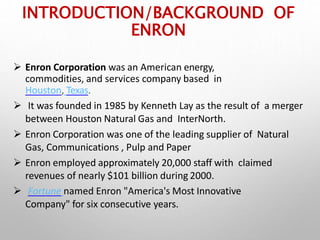
 Enron Corporation was an American energy,
commodities, and services company based in
Houston, Texas.
 It was founded in 1985 by Kenneth Lay as the result of a merger
between Houston Natural Gas and InterNorth.
 Enron Corporation was one of the leading supplier of Natural
Gas, Communications , Pulp and Paper
 Enron employed approximately 20,000 staff with claimed
revenues of nearly $101 billion during 2000.
 Fortune named Enron "America's Most Innovative
Company" for six consecutive years.
Enron traded in more than 30 different products.
Products traded on EnronOnline include
 Petrochemicals
Plastics
Power
Pulp and paper
Steel
Weather Risk Management
Oil and LNG transportation
Broadband
Derivative
Principal investments
Risk management for commodities
Shipping / freight
Streaming media
Water and wastewater
It was also an extensive futures trader including sugar,
coffee, grains, hogs, and other meat futures.
It created whole new markets for such oddball
"commodities" as broadcast time for advertisers,
Internet bandwidth.
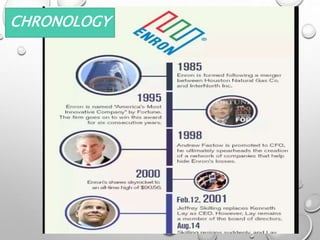
CHRONOLOGY
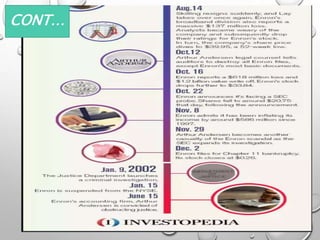
CONT…
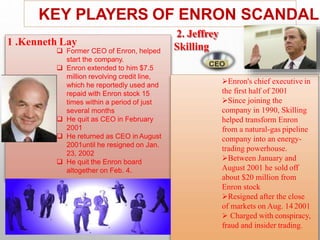
KEY PLAYERS OF ENRON SCANDAL
1 .Kenneth Lay
 Former CEO of Enron, helped
start the company.
 Enron extended to him $7.5
million revolving credit line,
which he reportedly used and
repaid with Enron stock 15
times within a period of just
several months
 He quit as CEO in February
2001
 He returned as CEO in August
2001until he resigned on Jan.
23, 2002
 He quit the Enron board
altogether on Feb. 4.
 Sherron Watkins said Lay was
"duped" by top executives.
Enron's chief executive in
the first half of 2001
Since joining the
company in 1990, Skilling
helped transform Enron
from a natural-gas pipeline
company into an energy-
trading powerhouse.
Between January and
August 2001 he sold off
about $20 million from
Enron stock
Resigned after the close
of markets on Aug. 14 2001
 Charged with conspiracy,
fraud and insider trading.
2. Jeffrey
Skilling
KEY PLAYERS OF ENRONSCANDAL
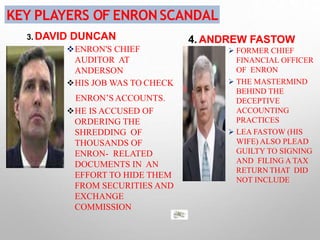
3. DAVID DUNCAN
ENRON'S CHIEF
AUDITOR AT
ANDERSON
HIS JOB WAS TO CHECK
ENRON’S ACCOUNTS.
HE IS ACCUSED OF
ORDERING THE
SHREDDING OF
THOUSANDS OF
ENRON- RELATED
DOCUMENTS IN AN
EFFORT TO HIDE THEM
FROM SECURITIES AND
EXCHANGE
COMMISSION
4. ANDREW FASTOW
 FORMER CHIEF
FINANCIAL OFFICER
OF ENRON
 THE MASTERMIND
BEHIND THE
DECEPTIVE
ACCOUNTING
PRACTICES
 LEA FASTOW (HIS
WIFE) ALSO PLEAD
GUILTY TO SIGNING
AND FILING A TAX
RETURN THAT DID
NOT INCLUDE
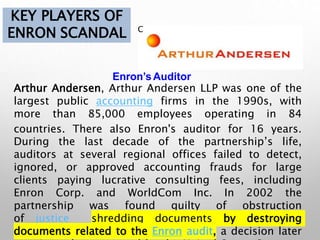
C
Enron’sAuditor
Arthur Andersen, Arthur Andersen LLP was one of the
largest public accounting firms in the 1990s, with
more than 85,000 employees operating in 84
countries. There also Enron's auditor for 16 years.
During the last decade of the partnership’s life,
auditors at several regional offices failed to detect,
ignored, or approved accounting frauds for large
clients paying lucrative consulting fees, including
Enron Corp. and WorldCom Inc. In 2002 the
partnership was found guilty of obstruction
of justice shredding documents by destroying
documents related to the Enron audit, a decision later
KEY PLAYERS OF
ENRON SCANDAL
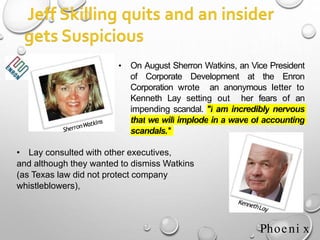
• On August Sherron Watkins, an Vice President
of Corporate Development at the Enron
Corporation wrote an anonymous letter to
Kenneth Lay setting out her fears of an
impending scandal. "I am incredibly nervous
that we will implode in a wave of accounting
scandals."
• Lay consulted with other executives,
and although they wanted to dismiss Watkins
(as Texas law did not protect company
whistleblowers),
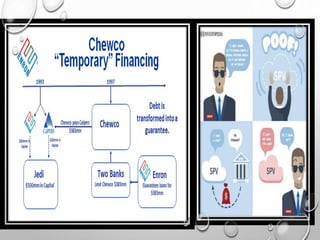
Phoeni x
SYMTOMS OF ENRON COMMIT
FRAUD
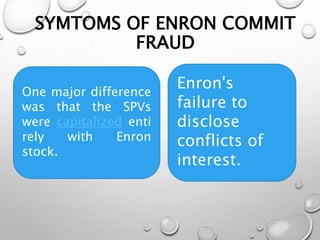
Enron's
failure to
disclose
conflicts of
interest.
One major difference
was that the SPVs
were capitalized enti
rely with Enron
stock.
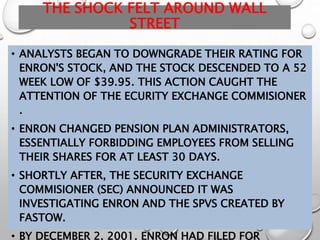
THE SHOCK FELT AROUND WALL
STREET
• ANALYSTS BEGAN TO DOWNGRADE THEIR RATING FOR
ENRON'S STOCK, AND THE STOCK DESCENDED TO A 52
WEEK LOW OF $39.95. THIS ACTION CAUGHT THE
ATTENTION OF THE ECURITY EXCHANGE COMMISIONER
.
• ENRON CHANGED PENSION PLAN ADMINISTRATORS,
ESSENTIALLY FORBIDDING EMPLOYEES FROM SELLING
THEIR SHARES FOR AT LEAST 30 DAYS.
• SHORTLY AFTER, THE SECURITY EXCHANGE
COMMISIONER (SEC) ANNOUNCED IT WAS
INVESTIGATING ENRON AND THE SPVS CREATED BY
FASTOW.
• BY DECEMBER 2, 2001, ENRON HAD FILED FOR
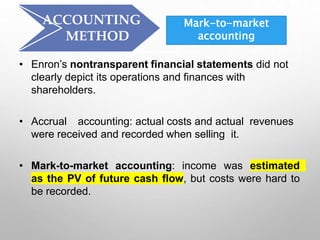
ACCOUNTING
METHOD
• Enron’s nontransparent financial statements did not
clearly depict its operations and finances with
shareholders.
• Accrual accounting: actual costs and actual revenues
were received and recorded when selling it.
• Mark-to-market accounting: income was estimated
as the PV of future cash flow, but costs were hard to
be recorded.
Mark-to-market
accounting
ACCOUNTING
METHOD
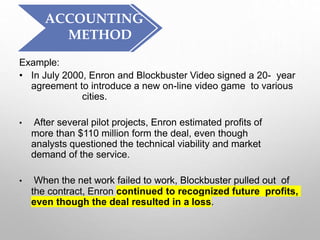
Example:
• In July 2000, Enron and Blockbuster Video signed a 20- year
agreement to introduce a new on-line video game to various
cities.
• After several pilot projects, Enron estimated profits of
more than $110 million form the deal, even though
analysts questioned the technical viability and market
demand of the service.
• When the net work failed to work, Blockbuster pulled out of
the contract, Enron continued to recognized future profits,
even though the deal resulted in a loss.
ACCOUNTING
METHOD
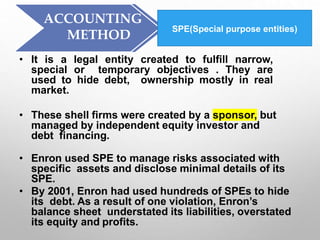
• It is a legal entity created to fulfill narrow,
special or temporary objectives . They are
used to hide debt, ownership mostly in real
market.
• These shell firms were created by a sponsor, but
managed by independent equity investor and
debt financing.
• Enron used SPE to manage risks associated with
specific assets and disclose minimal details of its
SPE.
• By 2001, Enron had used hundreds of SPEs to hide
its debt. As a result of one violation, Enron’s
balance sheet understated its liabilities, overstated
its equity and profits.
SPE(Special purpose entities)
MANAGEMENT
GROUP
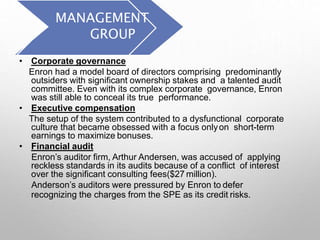
• Corporate governance
Enron had a model board of directors comprising predominantly
outsiders with significant ownership stakes and a talented audit
committee. Even with its complex corporate governance, Enron
was still able to conceal its true performance.
• Executive compensation
The setup of the system contributed to a dysfunctional corporate
culture that became obsessed with a focus onlyon short-term
earnings to maximize bonuses.
• Financial audit
Enron’s auditor firm, Arthur Andersen, was accused of applying
reckless standards in its audits because of a conflict of interest
over the significant consulting fees($27 million).
Anderson’s auditors were pressured by Enron to defer
recognizing the charges from the SPE as its credit risks.
ENRON’S BANKRUPTCY
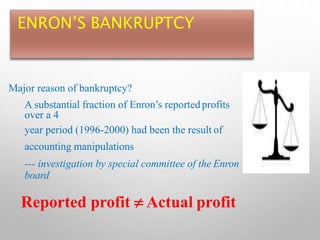
Major reason of bankruptcy?
A substantial fraction of Enron’s reportedprofits
over a 4
year period (1996-2000) had been the result of
accounting manipulations
--- investigation by special committee of the Enron
board
Reported profit  Actual profit
SARBANES-OXLEY ACT(SOX) OF
2002
Sarbanes-Oxley ACT(SOX) of 2002 is aUnited
States federal law as a reaction to a number of
major corporate and accounting scandals.
The act contains that companies must “enlist and
track performance of their material risk and
associated control procedures”.
CEOs are require to vouch for the financialof
their companies.
Board of Directors must have audit Committees
whose members are independent of company senior
management.
Companies can no longer make loans to a
company director.
In addition, penalties for fraudulent financial
activity made much more severe.
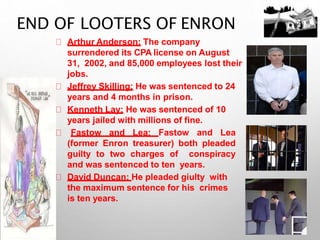
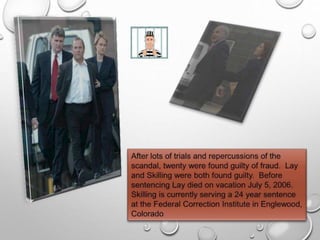
END OF LOOTERS OF ENRON
Arthur Anderson: The company
surrendered its CPA license on August
31, 2002, and 85,000 employees lost their
jobs.
Jeffrey Skilling: He was sentenced to 24
years and 4 months in prison.
Kenneth Lay: He was sentenced of 10
years jailed with millions of fine.
Fastow and Lea: Fastow and Lea
(former Enron treasurer) both pleaded
guilty to two charges of conspiracy
and was sentenced to ten years.
David Duncan: He pleaded giulty with
the maximum sentence for his crimes
is ten years.
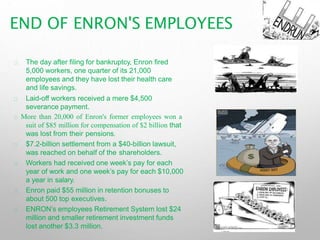
END OF ENRON'S EMPLOYEES
The day after filing for bankruptcy, Enron fired
5,000 workers, one quarter of its 21,000
employees and they have lost their health care
and life savings.
Laid-off workers received a mere $4,500
severance payment.
More than 20,000 of Enron's former employees won a
suit of $85 million for compensation of $2 billion that
was lost from their pensions.
$7.2-billion settlement from a $40-billion lawsuit,
was reached on behalf of the shareholders.
Workers had received one week’s pay for each
year of work and one week’s pay for each $10,000
a year in salary.
Enron paid $55 million in retention bonuses to
about 500 top executives.
ENRON’s employees Retirement System lost $24
million and smaller retirement investment funds
lost another $3.3 million.
CONCLUSION
Enron was a remarkable and innovative company in the
world, Its success cannot beneglected.
But there is ainterest question for Enron’s bankruptcy: Is
there a company can get success without ethics?
Tosee from the facts, the answer is“no.”
Whether Enron or Anderson, they finally pay for theirfault
on ethics.
We see ethic problem would bring afatal strike to a
company, no matter how it was successful.
There is something money cannot buy, integrity
is one of them.

Enron slide - Fraud

  • 3.
    INTRODUCTION/BACKGROUND OF ENRON  EnronCorporation was an American energy, commodities, and services company based in Houston, Texas.  It was founded in 1985 by Kenneth Lay as the result of a merger between Houston Natural Gas and InterNorth.  Enron Corporation was one of the leading supplier of Natural Gas, Communications , Pulp and Paper  Enron employed approximately 20,000 staff with claimed revenues of nearly $101 billion during 2000.  Fortune named Enron "America's Most Innovative Company" for six consecutive years.
  • 4.
    Enron traded inmore than 30 different products. Products traded on EnronOnline include  Petrochemicals Plastics Power Pulp and paper Steel Weather Risk Management Oil and LNG transportation Broadband Derivative Principal investments Risk management for commodities Shipping / freight Streaming media Water and wastewater It was also an extensive futures trader including sugar, coffee, grains, hogs, and other meat futures. It created whole new markets for such oddball "commodities" as broadcast time for advertisers, Internet bandwidth.
  • 5.
  • 6.
  • 7.
    KEY PLAYERS OFENRON SCANDAL 1 .Kenneth Lay  Former CEO of Enron, helped start the company.  Enron extended to him $7.5 million revolving credit line, which he reportedly used and repaid with Enron stock 15 times within a period of just several months  He quit as CEO in February 2001  He returned as CEO in August 2001until he resigned on Jan. 23, 2002  He quit the Enron board altogether on Feb. 4.  Sherron Watkins said Lay was "duped" by top executives. Enron's chief executive in the first half of 2001 Since joining the company in 1990, Skilling helped transform Enron from a natural-gas pipeline company into an energy- trading powerhouse. Between January and August 2001 he sold off about $20 million from Enron stock Resigned after the close of markets on Aug. 14 2001  Charged with conspiracy, fraud and insider trading. 2. Jeffrey Skilling
  • 8.
    KEY PLAYERS OFENRONSCANDAL 3. DAVID DUNCAN ENRON'S CHIEF AUDITOR AT ANDERSON HIS JOB WAS TO CHECK ENRON’S ACCOUNTS. HE IS ACCUSED OF ORDERING THE SHREDDING OF THOUSANDS OF ENRON- RELATED DOCUMENTS IN AN EFFORT TO HIDE THEM FROM SECURITIES AND EXCHANGE COMMISSION 4. ANDREW FASTOW  FORMER CHIEF FINANCIAL OFFICER OF ENRON  THE MASTERMIND BEHIND THE DECEPTIVE ACCOUNTING PRACTICES  LEA FASTOW (HIS WIFE) ALSO PLEAD GUILTY TO SIGNING AND FILING A TAX RETURN THAT DID NOT INCLUDE
  • 9.
    C Enron’sAuditor Arthur Andersen, ArthurAndersen LLP was one of the largest public accounting firms in the 1990s, with more than 85,000 employees operating in 84 countries. There also Enron's auditor for 16 years. During the last decade of the partnership’s life, auditors at several regional offices failed to detect, ignored, or approved accounting frauds for large clients paying lucrative consulting fees, including Enron Corp. and WorldCom Inc. In 2002 the partnership was found guilty of obstruction of justice shredding documents by destroying documents related to the Enron audit, a decision later KEY PLAYERS OF ENRON SCANDAL
  • 10.
    • On AugustSherron Watkins, an Vice President of Corporate Development at the Enron Corporation wrote an anonymous letter to Kenneth Lay setting out her fears of an impending scandal. "I am incredibly nervous that we will implode in a wave of accounting scandals." • Lay consulted with other executives, and although they wanted to dismiss Watkins (as Texas law did not protect company whistleblowers), Phoeni x
  • 11.
    SYMTOMS OF ENRONCOMMIT FRAUD Enron's failure to disclose conflicts of interest. One major difference was that the SPVs were capitalized enti rely with Enron stock.
  • 12.
    THE SHOCK FELTAROUND WALL STREET • ANALYSTS BEGAN TO DOWNGRADE THEIR RATING FOR ENRON'S STOCK, AND THE STOCK DESCENDED TO A 52 WEEK LOW OF $39.95. THIS ACTION CAUGHT THE ATTENTION OF THE ECURITY EXCHANGE COMMISIONER . • ENRON CHANGED PENSION PLAN ADMINISTRATORS, ESSENTIALLY FORBIDDING EMPLOYEES FROM SELLING THEIR SHARES FOR AT LEAST 30 DAYS. • SHORTLY AFTER, THE SECURITY EXCHANGE COMMISIONER (SEC) ANNOUNCED IT WAS INVESTIGATING ENRON AND THE SPVS CREATED BY FASTOW. • BY DECEMBER 2, 2001, ENRON HAD FILED FOR
  • 13.
    ACCOUNTING METHOD • Enron’s nontransparentfinancial statements did not clearly depict its operations and finances with shareholders. • Accrual accounting: actual costs and actual revenues were received and recorded when selling it. • Mark-to-market accounting: income was estimated as the PV of future cash flow, but costs were hard to be recorded. Mark-to-market accounting
  • 14.
    ACCOUNTING METHOD Example: • In July2000, Enron and Blockbuster Video signed a 20- year agreement to introduce a new on-line video game to various cities. • After several pilot projects, Enron estimated profits of more than $110 million form the deal, even though analysts questioned the technical viability and market demand of the service. • When the net work failed to work, Blockbuster pulled out of the contract, Enron continued to recognized future profits, even though the deal resulted in a loss.
  • 15.
    ACCOUNTING METHOD • It isa legal entity created to fulfill narrow, special or temporary objectives . They are used to hide debt, ownership mostly in real market. • These shell firms were created by a sponsor, but managed by independent equity investor and debt financing. • Enron used SPE to manage risks associated with specific assets and disclose minimal details of its SPE. • By 2001, Enron had used hundreds of SPEs to hide its debt. As a result of one violation, Enron’s balance sheet understated its liabilities, overstated its equity and profits. SPE(Special purpose entities)
  • 17.
    MANAGEMENT GROUP • Corporate governance Enronhad a model board of directors comprising predominantly outsiders with significant ownership stakes and a talented audit committee. Even with its complex corporate governance, Enron was still able to conceal its true performance. • Executive compensation The setup of the system contributed to a dysfunctional corporate culture that became obsessed with a focus onlyon short-term earnings to maximize bonuses. • Financial audit Enron’s auditor firm, Arthur Andersen, was accused of applying reckless standards in its audits because of a conflict of interest over the significant consulting fees($27 million). Anderson’s auditors were pressured by Enron to defer recognizing the charges from the SPE as its credit risks.
  • 18.
    ENRON’S BANKRUPTCY Major reasonof bankruptcy? A substantial fraction of Enron’s reportedprofits over a 4 year period (1996-2000) had been the result of accounting manipulations --- investigation by special committee of the Enron board Reported profit  Actual profit
  • 19.
    SARBANES-OXLEY ACT(SOX) OF 2002 Sarbanes-OxleyACT(SOX) of 2002 is aUnited States federal law as a reaction to a number of major corporate and accounting scandals. The act contains that companies must “enlist and track performance of their material risk and associated control procedures”. CEOs are require to vouch for the financialof their companies. Board of Directors must have audit Committees whose members are independent of company senior management. Companies can no longer make loans to a company director. In addition, penalties for fraudulent financial activity made much more severe.
  • 20.
    END OF LOOTERSOF ENRON Arthur Anderson: The company surrendered its CPA license on August 31, 2002, and 85,000 employees lost their jobs. Jeffrey Skilling: He was sentenced to 24 years and 4 months in prison. Kenneth Lay: He was sentenced of 10 years jailed with millions of fine. Fastow and Lea: Fastow and Lea (former Enron treasurer) both pleaded guilty to two charges of conspiracy and was sentenced to ten years. David Duncan: He pleaded giulty with the maximum sentence for his crimes is ten years.
  • 22.
    END OF ENRON'SEMPLOYEES The day after filing for bankruptcy, Enron fired 5,000 workers, one quarter of its 21,000 employees and they have lost their health care and life savings. Laid-off workers received a mere $4,500 severance payment. More than 20,000 of Enron's former employees won a suit of $85 million for compensation of $2 billion that was lost from their pensions. $7.2-billion settlement from a $40-billion lawsuit, was reached on behalf of the shareholders. Workers had received one week’s pay for each year of work and one week’s pay for each $10,000 a year in salary. Enron paid $55 million in retention bonuses to about 500 top executives. ENRON’s employees Retirement System lost $24 million and smaller retirement investment funds lost another $3.3 million.
  • 23.
    CONCLUSION Enron was aremarkable and innovative company in the world, Its success cannot beneglected. But there is ainterest question for Enron’s bankruptcy: Is there a company can get success without ethics? Tosee from the facts, the answer is“no.” Whether Enron or Anderson, they finally pay for theirfault on ethics. We see ethic problem would bring afatal strike to a company, no matter how it was successful. There is something money cannot buy, integrity is one of them.