Intro ToEnron
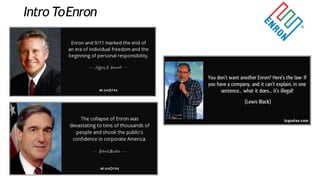
Intro ToEnron
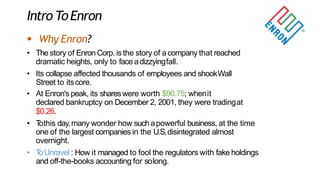
 Why Enron?
• The story of Enron Corp. is the story of acompany that reached
dramatic heights, only to face adizzyingfall.
• Its collapse affected thousands of employees and shookWall
Street to itscore.
• At Enron's peak, its shareswere worth $90.75; whenit
declared bankruptcy on December 2, 2001, they were tradingat
$0.26.
• Tothis day,many wonder how such apowerful business, at the time
one of the largest companies in the U.S,disintegrated almost
overnight.
• ToUnravel : How it managed to fool the regulators with fake holdings
and off-the-books accounting for solong.
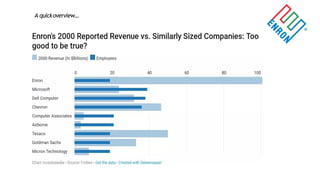
A quickoverview…
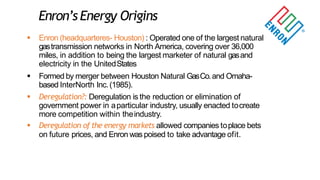
Enron’s Energy Origins
 Enron (headquarteres- Houston) : Operated one of the largest natural
gastransmission networks in North America, covering over 36,000
miles, in addition to being the largest marketer of natural gasand
electricity in the UnitedStates
 Formed by merger between Houston Natural GasCo.and Omaha-
based InterNorth Inc.(1985).
 Deregulation?: Deregulation is the reduction or elimination of
government power in aparticular industry, usually enacted tocreate
more competition within theindustry.
 Deregulation of the energy markets allowed companies toplace bets
on future prices, and Enron was poised to take advantage ofit.
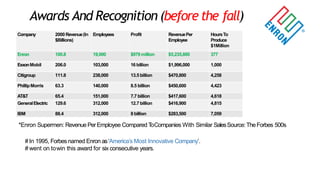
Awards And Recognition (before the fall)
Company 2000Revenue(In
$Billions)
Employees Profit RevenuePer
Employee
HoursTo
Produce
$1Million
Enron 100.8 19,000 $979 million $5,235,800 377
ExxonMobil 206.0 103,000 16 billion $1,996,000 1,000
Citigroup 111.8 238,000 13.5 billion $470,800 4,258
PhillipMorris 63.3 140,000 8.5 billion $450,600 4,423
AT&T 65.4 151,000 7.7 billion $417,600 4,618
GeneralElectric 129.6 312,000 12.7 billion $416,900 4,815
IBM 88.4 312,000 8 billion $283,500 7,059
*Enron Supermen: Revenue PerEmployee Compared ToCompanies With Similar SalesSource:TheForbes 500s
# In 1995, Forbesnamed Enron as„America‟s Most Innovative Company‟.
# went on towin this award for six consecutive years.
Smartest Guys in theroom
KennethLeeLay:
• Thefounder, CEOand Chairman of Enron and was
heavily involved in the Enronscandal.
• Laywas found guilty of 10 counts of securities fraudin
the trial of Kenneth Layand JeffreySkilling.
JeffreyKeithSkilling :
• TheCEOof Enron Corporation during the Enron scandal.
• Enron adopted Skilling‟s "mark-to-market" accounting.
• April,2001:In response to Richard Grubman saying "You know, you are the
only financial institution that can't produce a balance sheet or cash flow
statement with theirearnings", Skilling replied: "Thank you very much,we
appreciate that...Ass****." [23]
• Skilling unexpectedly resigned on August 14,2001.
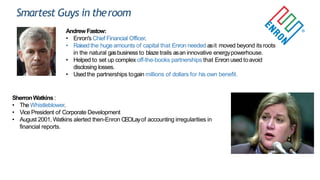
Andrew Fastow:
• Enron's Chief Financial Officer.
• Raisedthe huge amounts of capital that Enron needed asit moved beyond itsroots
in the natural gasbusiness to blaze trails asan innovative energypowerhouse.
• Helped to set up complex off-the-books partnerships that Enron used toavoid
disclosing losses.
• Usedthe partnerships togain millions of dollars for his own benefit.
SherronWatkins:
• TheWhistleblower.
• Vice President of Corporate Development
• August 2001, Watkins alerted then-Enron CEOLayof accounting irregularities in
financial reports.
Smartest Guys in theroom
TheDemonic Saga Of Enron-1
 In the processof the merger, Enron incurred massive debt and, asthe result of
deregulation, no longer had exclusive rights to itspipelines.
 Skilling proposed arevolutionary solution to Enron‟scredit, cashand profitwoes
in the gaspipeline business:create a“gasbank”.
 ThusEnron would buy gasfrom anetwork of suppliers and sell it to anetwork of
consumers, contractually guaranteeing both the supply and the price, charging
fees for the transactions and assumingthe associatedrisks.
 Result:Thecompany created both anew product and anew paradigm forthe
industry—the energyderivative.
 Under Skilling‟s leadership, Enron Finance Corp.soon dominated the market for
natural gascontracts, with more contacts, more accessto supplies and more
customers than any of itscompetitors
 With its market power, Enroncould predict future prices with great accuracy,
thereby guaranteeing superiorprofits.
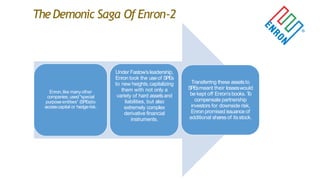
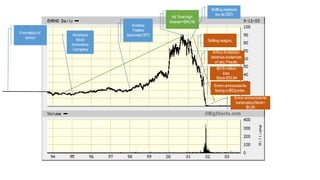
TheDemonic Saga Of Enron-2
Enron,like manyother
companies, used“special
purpose entities” (SPEs)to
accesscapital or hedgerisk.
Under Fastow‟sleadership,
Enron took the useof SPEs
to new heights,capitalizing
them with not only a
variety of hard assetsand
liabilities, but also
extremely complex
derivative financial
instruments.
Transferring these assetsto
SPEsmeant their losseswould
be kept off Enron‟sbooks. To
compensate partnership
investors for downside risk,
Enron promised issuance of
additional sharesof itsstock.
Formationof
enron
America‟s
Most
Innovative
Company
Andrew
Fastow
becomesCFO.
All Time high
shares==$90.56
Skilling replaces
lay asCEO.
Skilling resigns.
ArthurAnderson
destroysevidences
of acc.Frauds.
$618 million
loss.
Stock:$33.94
Enron announcesits
facing aSECprobe.
Enron announcesits
bankruptcy.Stock=
$0.26
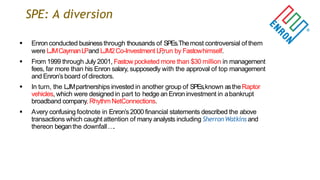
SPE: A diversion
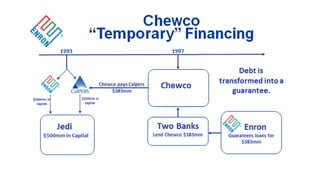
 Enron conducted businessthrough thousands of SPEs.Themost controversial of them
were LJMCaymanLPand LJM2Co-Investment LP,run by Fastowhimself.
 From 1999 through July 2001, Fastow pocketed more than $30 million in management
fees, far more than his Enron salary, supposedly with the approval of top management
and Enron‟s board of directors.
 In turn, the LJMpartnerships invested in another group of SPEs,known astheRaptor
vehicles, which were designed in part to hedge an Enron investment in abankrupt
broadband company, RhythmNetConnections.
 Avery confusing footnote in Enron‟s 2000 financial statements described the above
transactions which caught attention of many analysts including SherronWatkins and
thereon beganthe downfall….
Faulty accounting schemes:
Enron adopted complex and dubious accounting schemes:
 Toreduce taxpayments
 Toinflate income andprofits
 Toinflate stock prices and creditratings
 Tofraudulently misrepresent it‟s financial condition inpublic
reports.
 Tohide lossesin off-balance-sheet to funnel money to themselves,
friends and family
Mark ToMarketAccounting
Reflects the current value rather than bookvalue.
Logging estimated profits as actualones.
Led to schemes that were designed to hide the losses and made the
company appear to be more profitable than itreallywas.
Aims to provide a realistic appraisal of an institution’scurrent
financial situation.
Arthur Andersen: AuditingAccountability
Arthur Andersen wasone of the world‟s leading accountingfirm.
Despite Enron's poor accounting practices, it approved, signing offon
the corporate reports foryears.
Arthur Andersen destroyed all Enrondocuments.
ByApril 2001, many stock analysts started to question Enron's
earnings and their transparency.
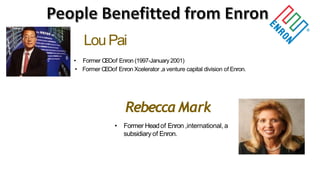
LouPai
• Former CEOof Enron (1997-January 2001)
• Former CEOof Enron Xcelerator ,a venture capital division of Enron.
RebeccaMark
• Former Headof Enron ,international, a
subsidiary of Enron.
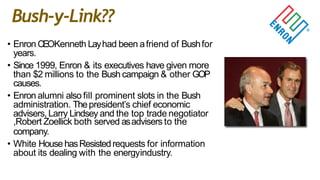
• Enron CEOKenneth Layhad been afriend of Bushfor
years.
• Since 1999, Enron & its executives have given more
than $2 millions to the Bush campaign & other GOP
causes.
• Enron alumni also fill prominent slots in the Bush
administration. Thepresident‟s chief economic
advisers,Larry Lindsey and the top trade negotiator
,Robert Zoellick both served asadvisers to the
company.
• White HousehasResistedrequests for information
about its dealing with the energyindustry.
Bush-y-Link??
Overview :Sarbanes-Oxley Act (2002)
● The U.S. Congress passed the Sarbanes-Oxley Act of 2002 on July 30.
● The Sarbanes-Oxley Act of 2002 came in response to financial scandals in the early 2000s
involving publicly traded companies such as Enron Corporation, Tyco International plc, and
WorldCom.
● The new law set out reforms and additions in four principal areas:
Corporate responsibility
Increased criminal punishment
Accounting regulation
New protections
Major Provisions of Sarbanes-Oxley Act (2002)
1
Section 302 of the SOX Act of 2002:
mandates that senior corporate officers
personally certify in writing that the
company's financial statements "comply
with SEC disclosure requirements and fairly
present in all material aspects the
operations and financial condition of the
issuer." Officers who sign off on financial
statements that they know to be inaccurate
are subject to criminal penalties, including
prison terms.
2
Section 404 of the SOX Act of 2002:
requires that management and auditors
establish internal controls and reporting methods
to ensure the adequacy of those controls.
3
Section 802 of the SOX Act of 2002: contains
3 rules that affect recordkeeping. The first deals
with destruction and falsification of records. The
second strictly defines the retention period for
storing records. The third rule outlines the
specific business records that companies need
to store, which includes electronic
communications.
Lay’s Death Consipiracy and Skilling’sPunishment
● Kenneth Lay was indicted by a grand jury and was found guilty of 10 counts of securities fraud.
Lay died in July 2006 while vacationing in his house near Aspen, Colorado, three months before
his scheduled sentencing. A preliminary autopsy reported Lay died of a myocardial infarction
(heart attack) caused by coronary artery disease; his death resulted in a vacated judgment.
● Ultimately,In 2006, former Enron CEO Jeffrey Skilling was convicted of conspiracy, fraud, and
insider trading. Skilling originally received a 24-year sentence, but in 2013 it was reduced by 10
years. As a part of the new deal, Skilling was required to give $42 million to the victims of the
Enron fraud and to cease challenging his conviction.
Learnings forFuture
.
1. | Not to have too much of the portfolio invested in a single stock.
2. | Company employees should be cautious about buying their employer's stock.
3. | One should know how a company's business works.
4. | Avoid companies that employ fancyderivatives.
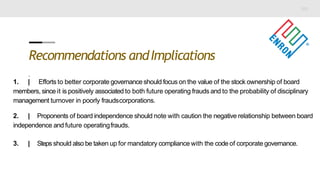
Recommendations andImplications
.
1. | Efforts to better corporate governance should focus on the value of the stock ownership of board
members, since it is positively associated to both future operating frauds and to the probability of disciplinary
management turnover in poorly fraudscorporations.
2. | Proponents of board independence should note with caution the negative relationship between board
independence and future operatingfrauds.
3. | Steps should also be taken up for mandatory compliance with the code of corporate governance.
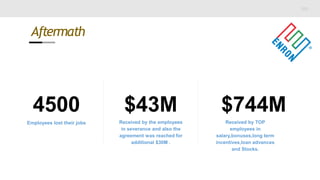
Aftermath
4500
Employees lost their jobs
$43M
Received by the employees
in severance and also the
agreement was reached for
additional $30M .
$744M
Received by TOP
employees in
salary,bonuses,long term
incentives,loan advances
and Stocks.

Enron: A Financial Mess

  • 1.
  • 2.
    Intro ToEnron  WhyEnron? • The story of Enron Corp. is the story of acompany that reached dramatic heights, only to face adizzyingfall. • Its collapse affected thousands of employees and shookWall Street to itscore. • At Enron's peak, its shareswere worth $90.75; whenit declared bankruptcy on December 2, 2001, they were tradingat $0.26. • Tothis day,many wonder how such apowerful business, at the time one of the largest companies in the U.S,disintegrated almost overnight. • ToUnravel : How it managed to fool the regulators with fake holdings and off-the-books accounting for solong.
  • 3.
  • 4.
    Enron’s Energy Origins Enron (headquarteres- Houston) : Operated one of the largest natural gastransmission networks in North America, covering over 36,000 miles, in addition to being the largest marketer of natural gasand electricity in the UnitedStates  Formed by merger between Houston Natural GasCo.and Omaha- based InterNorth Inc.(1985).  Deregulation?: Deregulation is the reduction or elimination of government power in aparticular industry, usually enacted tocreate more competition within theindustry.  Deregulation of the energy markets allowed companies toplace bets on future prices, and Enron was poised to take advantage ofit.
  • 5.
    Awards And Recognition(before the fall) Company 2000Revenue(In $Billions) Employees Profit RevenuePer Employee HoursTo Produce $1Million Enron 100.8 19,000 $979 million $5,235,800 377 ExxonMobil 206.0 103,000 16 billion $1,996,000 1,000 Citigroup 111.8 238,000 13.5 billion $470,800 4,258 PhillipMorris 63.3 140,000 8.5 billion $450,600 4,423 AT&T 65.4 151,000 7.7 billion $417,600 4,618 GeneralElectric 129.6 312,000 12.7 billion $416,900 4,815 IBM 88.4 312,000 8 billion $283,500 7,059 *Enron Supermen: Revenue PerEmployee Compared ToCompanies With Similar SalesSource:TheForbes 500s # In 1995, Forbesnamed Enron as„America‟s Most Innovative Company‟. # went on towin this award for six consecutive years.
  • 6.
    Smartest Guys intheroom KennethLeeLay: • Thefounder, CEOand Chairman of Enron and was heavily involved in the Enronscandal. • Laywas found guilty of 10 counts of securities fraudin the trial of Kenneth Layand JeffreySkilling. JeffreyKeithSkilling : • TheCEOof Enron Corporation during the Enron scandal. • Enron adopted Skilling‟s "mark-to-market" accounting. • April,2001:In response to Richard Grubman saying "You know, you are the only financial institution that can't produce a balance sheet or cash flow statement with theirearnings", Skilling replied: "Thank you very much,we appreciate that...Ass****." [23] • Skilling unexpectedly resigned on August 14,2001.
  • 7.
    Andrew Fastow: • Enron'sChief Financial Officer. • Raisedthe huge amounts of capital that Enron needed asit moved beyond itsroots in the natural gasbusiness to blaze trails asan innovative energypowerhouse. • Helped to set up complex off-the-books partnerships that Enron used toavoid disclosing losses. • Usedthe partnerships togain millions of dollars for his own benefit. SherronWatkins: • TheWhistleblower. • Vice President of Corporate Development • August 2001, Watkins alerted then-Enron CEOLayof accounting irregularities in financial reports. Smartest Guys in theroom
  • 8.
    TheDemonic Saga OfEnron-1  In the processof the merger, Enron incurred massive debt and, asthe result of deregulation, no longer had exclusive rights to itspipelines.  Skilling proposed arevolutionary solution to Enron‟scredit, cashand profitwoes in the gaspipeline business:create a“gasbank”.  ThusEnron would buy gasfrom anetwork of suppliers and sell it to anetwork of consumers, contractually guaranteeing both the supply and the price, charging fees for the transactions and assumingthe associatedrisks.  Result:Thecompany created both anew product and anew paradigm forthe industry—the energyderivative.  Under Skilling‟s leadership, Enron Finance Corp.soon dominated the market for natural gascontracts, with more contacts, more accessto supplies and more customers than any of itscompetitors  With its market power, Enroncould predict future prices with great accuracy, thereby guaranteeing superiorprofits.
  • 9.
    TheDemonic Saga OfEnron-2 Enron,like manyother companies, used“special purpose entities” (SPEs)to accesscapital or hedgerisk. Under Fastow‟sleadership, Enron took the useof SPEs to new heights,capitalizing them with not only a variety of hard assetsand liabilities, but also extremely complex derivative financial instruments. Transferring these assetsto SPEsmeant their losseswould be kept off Enron‟sbooks. To compensate partnership investors for downside risk, Enron promised issuance of additional sharesof itsstock.
  • 10.
    Formationof enron America‟s Most Innovative Company Andrew Fastow becomesCFO. All Time high shares==$90.56 Skillingreplaces lay asCEO. Skilling resigns. ArthurAnderson destroysevidences of acc.Frauds. $618 million loss. Stock:$33.94 Enron announcesits facing aSECprobe. Enron announcesits bankruptcy.Stock= $0.26
  • 11.
    SPE: A diversion Enron conducted businessthrough thousands of SPEs.Themost controversial of them were LJMCaymanLPand LJM2Co-Investment LP,run by Fastowhimself.  From 1999 through July 2001, Fastow pocketed more than $30 million in management fees, far more than his Enron salary, supposedly with the approval of top management and Enron‟s board of directors.  In turn, the LJMpartnerships invested in another group of SPEs,known astheRaptor vehicles, which were designed in part to hedge an Enron investment in abankrupt broadband company, RhythmNetConnections.  Avery confusing footnote in Enron‟s 2000 financial statements described the above transactions which caught attention of many analysts including SherronWatkins and thereon beganthe downfall….
  • 13.
    Faulty accounting schemes: Enronadopted complex and dubious accounting schemes:  Toreduce taxpayments  Toinflate income andprofits  Toinflate stock prices and creditratings  Tofraudulently misrepresent it‟s financial condition inpublic reports.  Tohide lossesin off-balance-sheet to funnel money to themselves, friends and family
  • 14.
    Mark ToMarketAccounting Reflects thecurrent value rather than bookvalue. Logging estimated profits as actualones. Led to schemes that were designed to hide the losses and made the company appear to be more profitable than itreallywas. Aims to provide a realistic appraisal of an institution’scurrent financial situation.
  • 15.
    Arthur Andersen: AuditingAccountability ArthurAndersen wasone of the world‟s leading accountingfirm. Despite Enron's poor accounting practices, it approved, signing offon the corporate reports foryears. Arthur Andersen destroyed all Enrondocuments. ByApril 2001, many stock analysts started to question Enron's earnings and their transparency.
  • 16.
    LouPai • Former CEOofEnron (1997-January 2001) • Former CEOof Enron Xcelerator ,a venture capital division of Enron. RebeccaMark • Former Headof Enron ,international, a subsidiary of Enron.
  • 17.
    • Enron CEOKennethLayhad been afriend of Bushfor years. • Since 1999, Enron & its executives have given more than $2 millions to the Bush campaign & other GOP causes. • Enron alumni also fill prominent slots in the Bush administration. Thepresident‟s chief economic advisers,Larry Lindsey and the top trade negotiator ,Robert Zoellick both served asadvisers to the company. • White HousehasResistedrequests for information about its dealing with the energyindustry. Bush-y-Link??
  • 18.
    Overview :Sarbanes-Oxley Act(2002) ● The U.S. Congress passed the Sarbanes-Oxley Act of 2002 on July 30. ● The Sarbanes-Oxley Act of 2002 came in response to financial scandals in the early 2000s involving publicly traded companies such as Enron Corporation, Tyco International plc, and WorldCom. ● The new law set out reforms and additions in four principal areas: Corporate responsibility Increased criminal punishment Accounting regulation New protections
  • 19.
    Major Provisions ofSarbanes-Oxley Act (2002) 1 Section 302 of the SOX Act of 2002: mandates that senior corporate officers personally certify in writing that the company's financial statements "comply with SEC disclosure requirements and fairly present in all material aspects the operations and financial condition of the issuer." Officers who sign off on financial statements that they know to be inaccurate are subject to criminal penalties, including prison terms. 2 Section 404 of the SOX Act of 2002: requires that management and auditors establish internal controls and reporting methods to ensure the adequacy of those controls. 3 Section 802 of the SOX Act of 2002: contains 3 rules that affect recordkeeping. The first deals with destruction and falsification of records. The second strictly defines the retention period for storing records. The third rule outlines the specific business records that companies need to store, which includes electronic communications.
  • 20.
    Lay’s Death Consipiracyand Skilling’sPunishment ● Kenneth Lay was indicted by a grand jury and was found guilty of 10 counts of securities fraud. Lay died in July 2006 while vacationing in his house near Aspen, Colorado, three months before his scheduled sentencing. A preliminary autopsy reported Lay died of a myocardial infarction (heart attack) caused by coronary artery disease; his death resulted in a vacated judgment. ● Ultimately,In 2006, former Enron CEO Jeffrey Skilling was convicted of conspiracy, fraud, and insider trading. Skilling originally received a 24-year sentence, but in 2013 it was reduced by 10 years. As a part of the new deal, Skilling was required to give $42 million to the victims of the Enron fraud and to cease challenging his conviction.
  • 21.
    Learnings forFuture . 1. |Not to have too much of the portfolio invested in a single stock. 2. | Company employees should be cautious about buying their employer's stock. 3. | One should know how a company's business works. 4. | Avoid companies that employ fancyderivatives.
  • 22.
    Recommendations andImplications . 1. |Efforts to better corporate governance should focus on the value of the stock ownership of board members, since it is positively associated to both future operating frauds and to the probability of disciplinary management turnover in poorly fraudscorporations. 2. | Proponents of board independence should note with caution the negative relationship between board independence and future operatingfrauds. 3. | Steps should also be taken up for mandatory compliance with the code of corporate governance.
  • 23.
    Aftermath 4500 Employees lost theirjobs $43M Received by the employees in severance and also the agreement was reached for additional $30M . $744M Received by TOP employees in salary,bonuses,long term incentives,loan advances and Stocks.