The best way to do great work is love
what you do.
Steve jobs
Case Study
Enron; The Good ,The Bad, The Really Ugly
By Denis Collins
Group Members
Sumaira Munir
Sana Ramzan
Abdul Rahman
Enron
 Enron was regarded as the most innovative company.
 It is the largest buyer/ seller of natural gas and electricity.
 It serves as a Gas Bank where producers sold their natural
Gas to the Enron and ten Enron sell this natural gas to the
customers
 Enron was heavily involved in the energy brokering ,
electronic energy trading and global commodity
Enron history
 Enron was formed in 1985 when InterNorth acquired Houston
Natural Gas.
 Enron was the merger of two gas pipeline
companies(Houston natural Gas (HNG) & Internorth Natural
Gas)
 Ken lay the CEO of HNG sold his company to Internorth for
$2.4million
 The company a heavy debt of 4.3 billion to manage Its
activities
 Ken lay was hired as a CEO of Enron.
Enron’s line of Businesses
Enron was originally involved in transmission of natural gas and electricity but
it also start trading in more than 30 products including:
 Petrochemicals
 Plastics
 Power
 Pulp and paper
 Steel
 Weather risk management
 Oil and LNG transportation
Conti….
 Broadband
 Shipping/Freight
 Streaming Media
 Water and waste paper
 Principle investment
 Risk management for commodities
Ken Lay’s life history
 At the age of 42 he became the CEO of Enron.
 He was the son of Baptist preacher
 He received a scholarship to attend the university of Missouri
 He had a master degree in economics
 He become a senior economist for a Houston Oil Company.
 In 1970 he got a doctoral degree in economics from the
university of Houston.
Conti……
 During the Vietnam war. He was assigned to conduct
economic analysis at the Pentagon work.
 He also serve as a president of government affairs at Florida
Gas.
Enron’s Success
 At the end of 1990 Enron had become the nation largest
natural gas company with $revenue of 13.2 billion.
 It won Fortune Magazine award for 5 consecutive years for
Nation’s most innovative company.
 In 1991 gas bank division had contract with more than 35
natural gas producers and 50 consumers.
 Enron also negotiated to supply 3 to 4% to the Great
Britain’s.
 Enron’s sock price stedily increase to $90.
Conti…….
 It acquires 41 other companies.
 In 1999 Enron succeeded General Electric as the winner
fortune magazine’s best managed company of America.
 In 2000 the Enron revenue was more than $100 billion
 It was ranked on the 7th on the fortune 500 list.
 Enron's stock increased from the start of the 1990s until year-
end 1998.
Mark to Market Method
 Enron uses Mark to Market Method
 With mark to market accounting, the price or value of a
security is recorded on a daily basis to calculate profits and
losses.
 Using this method allowed Enron to count projected earnings
from long-term energy contracts as current income. This was
money that might not be collected for many years.
Special Purpose Entities
 SPEs are the entity that protect company asset from risky
business projects.
 SPE is a separate entity rather than a subsidiary.
 If an SPE fails, the sponsoring company’s assets are legally
protected from the SPE creditors.
 SPEs are used to finance the purchase of assets.
Conti…..
According to Accounting standards the SPE status can be
declared if the business entity meets two criteria
 An independent owner maintains at least 3% equity
investment tat remains at risk at all times
 The independent owner exercises managerial control of the
SPE.
Conti......
 Andy Fastow was hired for cutting edge finance activities.
 He become an expert on Special Purpose Entity (SPEs).
 He generated large finance for both Enron and SPE.
 The SPE was vey attractive for outside investors because of
increasing economic value of SPE.
 SPEs was also used by Fastow to add revenue and decrease
liabilities from Enron which improves the financial statement
of Enron.
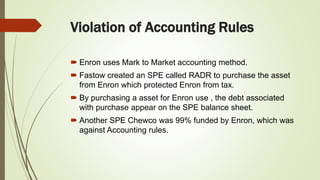
Violation of Accounting Rules
 Enron uses Mark to Market accounting method.
 Fastow created an SPE called RADR to purchase the asset
from Enron which protected Enron from tax.
 By purchasing a asset for Enron use , the debt associated
with purchase appear on the SPE balance sheet.
 Another SPE Chewco was 99% funded by Enron, which was
against Accounting rules.
Conti……
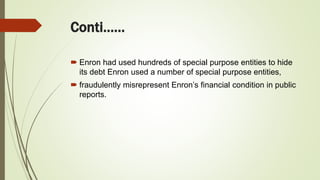
 Enron had used hundreds of special purpose entities to hide
its debt Enron used a number of special purpose entities,
 fraudulently misrepresent Enron’s financial condition in public
reports.
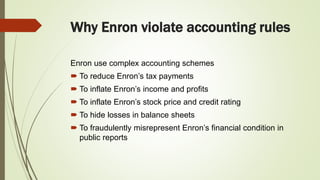
Why Enron violate accounting rules
Enron use complex accounting schemes
 To reduce Enron’s tax payments
 To inflate Enron’s income and profits
 To inflate Enron’s stock price and credit rating
 To hide losses in balance sheets
 To fraudulently misrepresent Enron’s financial condition in
public reports
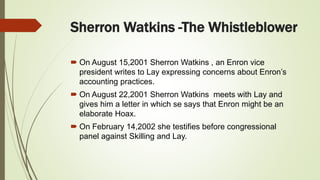
Sherron Watkins -The Whistleblower
 On August 15,2001 Sherron Watkins , an Enron vice
president writes to Lay expressing concerns about Enron’s
accounting practices.
 On August 22,2001 Sherron Watkins meets with Lay and
gives him a letter in which se says that Enron might be an
elaborate Hoax.
 On February 14,2002 she testifies before congressional
panel against Skilling and Lay.
Enron’s Fall
 The Enron scandal, revealed in October 2001, eventually led
to the bankruptcy of the Enron Corporation.
 On October 16, 2001 Lay announced losses of $618 billion.
 On November,2001 it admitted accounting errors, inflating
income by $586 million.
 It start losing 2 billion in a week.
 It stock price dropped to 61 cents.
 It had to payback $690 million in 2 weeks.
 It was delisted from New York Stock Exchange.
Key Elements involved in Enron’s
Scandal
 Ken Lay: Chief Executive Officer
 Jeffery Skilling: Chief Operating Officer
 Andy Fastow: Chief Financial Officer
 Michal Kopper: chewco’s managing director
 Richard Causey : Chief Accounting Officer
 Arthur Andersen: Auditor
Conti…..
 David Duncan: Enron's chief auditor at Andersen who
shredded key documents relating to the case.
 Sherron Watkins: Enron employee and "whistleblower" of
the scandal.
Conclusion
 The Enron was a massive failure which shook entire US
economy
 This action is still considered as an unethical behavior in
business, because the basic intention for conducting this
action is fraudulence.
 This made the authorities to realize the importance of ethics
and internal control in business

Enron case study

  • 1.
    The best wayto do great work is love what you do. Steve jobs
  • 2.
    Case Study Enron; TheGood ,The Bad, The Really Ugly By Denis Collins Group Members Sumaira Munir Sana Ramzan Abdul Rahman
  • 3.
    Enron  Enron wasregarded as the most innovative company.  It is the largest buyer/ seller of natural gas and electricity.  It serves as a Gas Bank where producers sold their natural Gas to the Enron and ten Enron sell this natural gas to the customers  Enron was heavily involved in the energy brokering , electronic energy trading and global commodity
  • 4.
    Enron history  Enronwas formed in 1985 when InterNorth acquired Houston Natural Gas.  Enron was the merger of two gas pipeline companies(Houston natural Gas (HNG) & Internorth Natural Gas)  Ken lay the CEO of HNG sold his company to Internorth for $2.4million  The company a heavy debt of 4.3 billion to manage Its activities  Ken lay was hired as a CEO of Enron.
  • 5.
    Enron’s line ofBusinesses Enron was originally involved in transmission of natural gas and electricity but it also start trading in more than 30 products including:  Petrochemicals  Plastics  Power  Pulp and paper  Steel  Weather risk management  Oil and LNG transportation
  • 6.
    Conti….  Broadband  Shipping/Freight Streaming Media  Water and waste paper  Principle investment  Risk management for commodities
  • 7.
    Ken Lay’s lifehistory  At the age of 42 he became the CEO of Enron.  He was the son of Baptist preacher  He received a scholarship to attend the university of Missouri  He had a master degree in economics  He become a senior economist for a Houston Oil Company.  In 1970 he got a doctoral degree in economics from the university of Houston.
  • 8.
    Conti……  During theVietnam war. He was assigned to conduct economic analysis at the Pentagon work.  He also serve as a president of government affairs at Florida Gas.
  • 9.
    Enron’s Success  Atthe end of 1990 Enron had become the nation largest natural gas company with $revenue of 13.2 billion.  It won Fortune Magazine award for 5 consecutive years for Nation’s most innovative company.  In 1991 gas bank division had contract with more than 35 natural gas producers and 50 consumers.  Enron also negotiated to supply 3 to 4% to the Great Britain’s.  Enron’s sock price stedily increase to $90.
  • 10.
    Conti…….  It acquires41 other companies.  In 1999 Enron succeeded General Electric as the winner fortune magazine’s best managed company of America.  In 2000 the Enron revenue was more than $100 billion  It was ranked on the 7th on the fortune 500 list.  Enron's stock increased from the start of the 1990s until year- end 1998.
  • 11.
    Mark to MarketMethod  Enron uses Mark to Market Method  With mark to market accounting, the price or value of a security is recorded on a daily basis to calculate profits and losses.  Using this method allowed Enron to count projected earnings from long-term energy contracts as current income. This was money that might not be collected for many years.
  • 12.
    Special Purpose Entities SPEs are the entity that protect company asset from risky business projects.  SPE is a separate entity rather than a subsidiary.  If an SPE fails, the sponsoring company’s assets are legally protected from the SPE creditors.  SPEs are used to finance the purchase of assets.
  • 13.
    Conti….. According to Accountingstandards the SPE status can be declared if the business entity meets two criteria  An independent owner maintains at least 3% equity investment tat remains at risk at all times  The independent owner exercises managerial control of the SPE.
  • 14.
    Conti......  Andy Fastowwas hired for cutting edge finance activities.  He become an expert on Special Purpose Entity (SPEs).  He generated large finance for both Enron and SPE.  The SPE was vey attractive for outside investors because of increasing economic value of SPE.  SPEs was also used by Fastow to add revenue and decrease liabilities from Enron which improves the financial statement of Enron.
  • 15.
    Violation of AccountingRules  Enron uses Mark to Market accounting method.  Fastow created an SPE called RADR to purchase the asset from Enron which protected Enron from tax.  By purchasing a asset for Enron use , the debt associated with purchase appear on the SPE balance sheet.  Another SPE Chewco was 99% funded by Enron, which was against Accounting rules.
  • 16.
    Conti……  Enron hadused hundreds of special purpose entities to hide its debt Enron used a number of special purpose entities,  fraudulently misrepresent Enron’s financial condition in public reports.
  • 17.
    Why Enron violateaccounting rules Enron use complex accounting schemes  To reduce Enron’s tax payments  To inflate Enron’s income and profits  To inflate Enron’s stock price and credit rating  To hide losses in balance sheets  To fraudulently misrepresent Enron’s financial condition in public reports
  • 18.
    Sherron Watkins -TheWhistleblower  On August 15,2001 Sherron Watkins , an Enron vice president writes to Lay expressing concerns about Enron’s accounting practices.  On August 22,2001 Sherron Watkins meets with Lay and gives him a letter in which se says that Enron might be an elaborate Hoax.  On February 14,2002 she testifies before congressional panel against Skilling and Lay.
  • 19.
    Enron’s Fall  TheEnron scandal, revealed in October 2001, eventually led to the bankruptcy of the Enron Corporation.  On October 16, 2001 Lay announced losses of $618 billion.  On November,2001 it admitted accounting errors, inflating income by $586 million.  It start losing 2 billion in a week.  It stock price dropped to 61 cents.  It had to payback $690 million in 2 weeks.  It was delisted from New York Stock Exchange.
  • 20.
    Key Elements involvedin Enron’s Scandal  Ken Lay: Chief Executive Officer  Jeffery Skilling: Chief Operating Officer  Andy Fastow: Chief Financial Officer  Michal Kopper: chewco’s managing director  Richard Causey : Chief Accounting Officer  Arthur Andersen: Auditor
  • 21.
    Conti…..  David Duncan:Enron's chief auditor at Andersen who shredded key documents relating to the case.  Sherron Watkins: Enron employee and "whistleblower" of the scandal.
  • 22.
    Conclusion  The Enronwas a massive failure which shook entire US economy  This action is still considered as an unethical behavior in business, because the basic intention for conducting this action is fraudulence.  This made the authorities to realize the importance of ethics and internal control in business