從 ESP 的學科本質
  看 ESP 的研究內容與方法


        Yu-Ying Chang
            張玉櫻
        元智大學應外系
      yymeichu@gmail.com
      北區英語教學資源中心
「職場英文的專業英文師資培訓─研究法 」專題
         2011.10.21
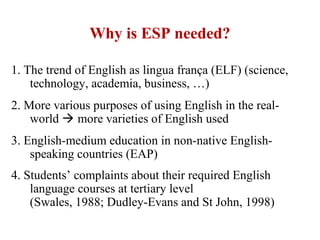
Why is ESP needed?

1. The trend of English as lingua frança (ELF) (science,
    technology, academia, business, …)
2. More various purposes of using English in the real-
    world  more varieties of English used
3. English-medium education in non-native English-
    speaking countries (EAP)
4. Students’ complaints about their required English
    language courses at tertiary level
    (Swales, 1988; Dudley-Evans and St John, 1998)
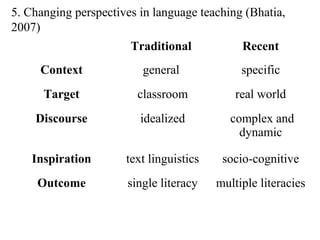
5. Changing perspectives in language teaching (Bhatia,
2007)
                       Traditional            Recent
     Context             general              specific
      Target            classroom            real world
    Discourse            idealized          complex and
                                              dynamic

    Inspiration       text linguistics    socio-cognitive
     Outcome          single literacy    multiple literacies
Major issues in language teaching
1. Teaching language for a purpose
2. Text vs. Context
   -realities of the world of work
   -language competence v. professional expertise
  *understanding of cultures
  *ethnic culture, professional culture, institutional culture
3. Teaching vs. Analysis
  “Discourse awareness always precedes discourse
   acquisition.” (John Swales)
  *training students as ethnographers and analyzers (Ann
    Johns)
Classification of ESP 1
Definitions of ESP
ESP Definition 1
Hutchinson and Waters (1987)
ESP must be seen as an approach rather than a
●


 product.
●   The foundation of ESP “needs”
    - “ Why does this learner need to learn a foreign
    language?”
    -important issues: learners, language required,
      the learning context
ESP Definition 1
Hutchinson and Waters (1987)
ESP is not only a matter of teaching “specialized
●

 varieties” of English.
 -characteristics of special English should not
 obscure the far larger area of common ground
 that underlies all English use.
ESP is not only a matter of special words and
●

 grammar.
 There is much more to communication than just
 the surface features.
ESP Definition 1

●   ESP is an approach to language teaching in
    which all decisions as to content and method are
    based on the learner’s reason for learning.

●   ESP is an approach to language learning which is
    based on learner need.
ESP Definition 2

Streven (1988)
● absolute characteristics of ESP
● variable characteristics of ESP
ESP Definition 2
●   Absolute characteristics of ESP
    -designed to meet specified needs of the learner
    -related in content (that is, in its themes and
    topics) to particular disciplines, occupations and
    activities
    -centered on language appropriate to those
    activities in syntax, lexis, discourse, semantics,
    and son on, and analysis of the discourse
    -in contrast with ‘General English”
ESP Definition 2
●   Variable characteristics of ESP
    -may be restricted as to the learning skills to be
     learned (for example, reading only)
    -may not be taught according to any pre-ordained
     methodology
ESP Definition 3
Robinson (1991)
● Criterial features


  -ESP is normally goal-directed.
  -ESP courses develop from a needs analysis,
  which ‘aims to specify as closely as possible what
  exactly it is that students have to do through the
  medium of English (Robinson 1991:3)’.
●   ESP courses are often taught to adults in
    homogeneous classes in terms of the work or
    specialist studies that the students are involved in.
ESP Definition 3
Robinson (1991)
● Variable features


   -ESP courses are generally constrained by limited
    time period (with clearly specified time period
    for the course)
  *This means objectives and their realization
   related to the time available should be closely
   specified.
  *Collaboration and negotiation among all those
   involved with the course are important
   (organizers, teachers, sponsors, and students)
ESP Definition 4
Dudley-Evans and St John (1998: 4-5)
●Absolute characteristics of ESP


 -ESP is designed to meet specific needs of the
  learner;
 -ESP makes use of the underlying methodology
  and activities of the disciplines it serves;
 -ESP is centered on the language (grammar, lexis,
  register), skills, discourse and genres appropriate
  to these activities.
ESP Definition 4
Dudley-Evans and St John (1998: 4-5)
● Variable characteristics of ESP


  -ESP may be related to or designed for specific
   disciplines;
  -ESP may use, in specific teaching situations, a
    different methodology from that of general
    English;
  -ESP is likely to be designed for adult learners,
   whether at a tertiary level institution or in a
   professional work situation. It could however be
   used for learners at secondary school level;
ESP Definition 4

-ESP is generally designed for intermediate or
 advanced students. Most ESP courses assume
 basic knowledge of the language system, but it
 can be used with beginners.
Continuum of ELT course types
Classification of ESP 2
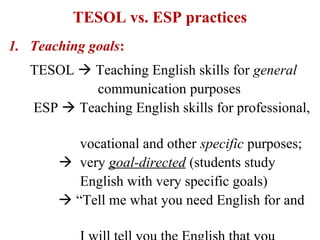
TESOL vs. ESP practices
1. Teaching goals:
   TESOL  Teaching English skills for general
            communication purposes
   ESP  Teaching English skills for professional,

          vocational and other specific purposes;
        very goal-directed (students study
          English with very specific goals)
        “Tell me what you need English for and
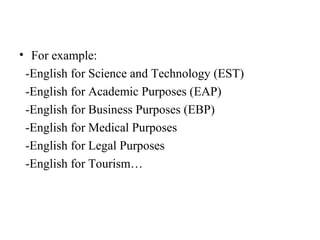
• For example:
 -English for Science and Technology (EST)
 -English for Academic Purposes (EAP)
 -English for Business Purposes (EBP)
 -English for Medical Purposes
 -English for Legal Purposes
 -English for Tourism…
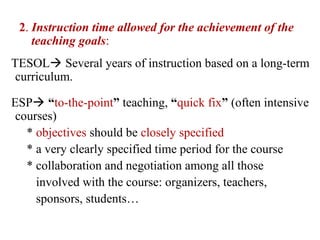
2. Instruction time allowed for the achievement of the
    teaching goals:
TESOL Several years of instruction based on a long-term
 curriculum.

ESP “to-the-point” teaching, “quick fix” (often intensive
 courses)
   * objectives should be closely specified
   * a very clearly specified time period for the course
   * collaboration and negotiation among all those
     involved with the course: organizers, teachers,
     sponsors, students…
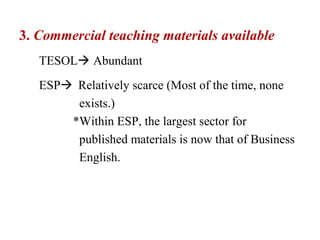
3. Commercial teaching materials available
   TESOL Abundant
   ESP Relatively scarce (Most of the time, none
        exists.)
       *Within ESP, the largest sector for
        published materials is now that of Business
        English.
4. ESP courses are based on need analyses
 -Needs analysis aims to specify as closely as possible
  what exactly it is that students have to do through the
  medium of English (Robinson, 1991: 3)
 -The important role of expert informants in both ESP
  practices and research

*ESP teaching is flexible and tailored to individual or
 group needs as they arise.
5. Different emphases in teacher training
 -Both require basic pedagogical training.
 -But, ESP emphasizes more on applied linguistic
  training, especially different analysis skills of
  language

6. Target students
  TESOL  from children to adults
  ESP adult learners, often in tertiary education

*Threshold debate – learner’s general English
  proficiency level before ESP courses
ESP research and practices

• 3 cores in ESP research and practices
 -Needs analysis
 -Analysis of ESP discourse at various levels
 -Pedagogical aspects
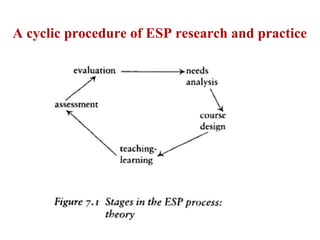
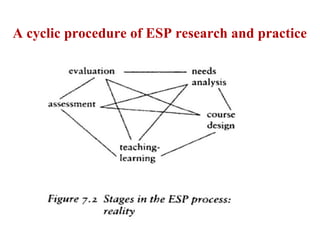
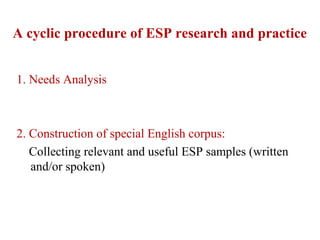
A cyclic procedure of ESP research and practice


1. Needs Analysis


2. Construction of special English corpus:
   Collecting relevant and useful ESP samples (written
   and/or spoken)
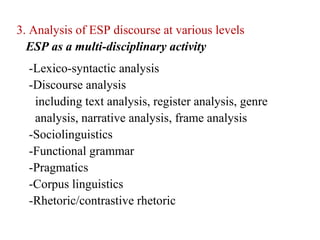
3. Analysis of ESP discourse at various levels
  ESP as a multi-disciplinary activity
  -Lexico-syntactic analysis
  -Discourse analysis
   including text analysis, register analysis, genre
   analysis, narrative analysis, frame analysis
  -Sociolinguistics
  -Functional grammar
  -Pragmatics
  -Corpus linguistics
  -Rhetoric/contrastive rhetoric
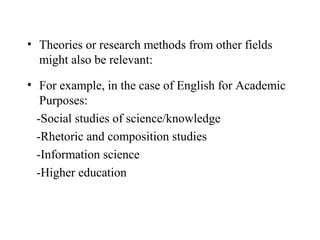
• Theories or research methods from other fields
  might also be relevant:

• For example, in the case of English for Academic
   Purposes:
  -Social studies of science/knowledge
  -Rhetoric and composition studies
  -Information science
  -Higher education
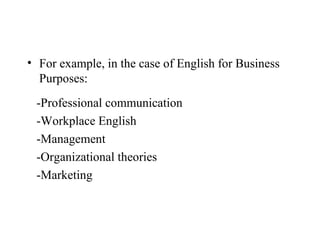
• For example, in the case of English for Business
  Purposes:
 -Professional communication
 -Workplace English
 -Management
 -Organizational theories
 -Marketing
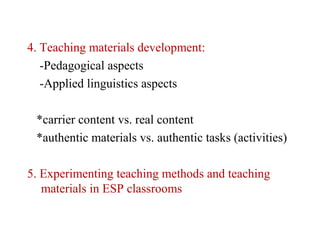
4. Teaching materials development:
   -Pedagogical aspects
   -Applied linguistics aspects

 *carrier content vs. real content
 *authentic materials vs. authentic tasks (activities)

5. Experimenting teaching methods and teaching
   materials in ESP classrooms
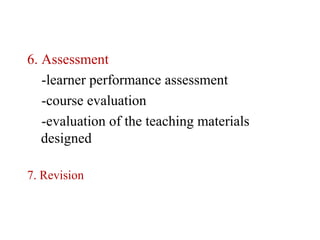
6. Assessment
   -learner performance assessment
   -course evaluation
   -evaluation of the teaching materials
   designed

7. Revision
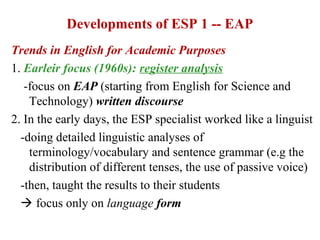
Developments of ESP 1 -- EAP
Trends in English for Academic Purposes
1. Earleir focus (1960s): register analysis
   -focus on EAP (starting from English for Science and
    Technology) written discourse
2. In the early days, the ESP specialist worked like a linguist
  -doing detailed linguistic analyses of
    terminology/vocabulary and sentence grammar (e.g the
    distribution of different tenses, the use of passive voice)
  -then, taught the results to their students
   focus only on language form
Developments of ESP Research 1 -- EAP
4. In the 1970s, rhetorical and discourse analysis
   -relating language form to language function (use)
   -not only what language is used, but also how and why
   -making “ use” the main criterion for the selection of ESP
    teaching materials
5. In the 1970s, analysis of study skills
   -In addition to language work, there is a need to address
    the thought processes that underpin language use.
6. In the 1970s, needs analysis
  -Questionnaires about students’ present or future needs
    were devised.
7. In the 1990s, genre approach to ESP language study
     and teaching
8. In the 2000s, three major developments:
(a) The socio-cultural, real-world contexts of ESP users
     have been taken on board:
    -different levels of analysis of ESP discourse (in-
     depth analysis, thick description)
    -multiple perspectives and triangulation in needs
     analysis (vs. earlier only questionnaires)
    collabaration with the client is crucial
    important role of expert informants
(b) Spoken language has entered ESP
  -ESP tradition built around written text:
   [Needs of first reading, then writing (especially in
   EAP) have taken priority.]
 -But in many fields, spoken interaction is central from
  the start: aviation, tourism, nursing etc.
 -Now in other fields (EAP, business,) speaking has
  also become very important.
 -Spoken language is not writing converted into
  speech.
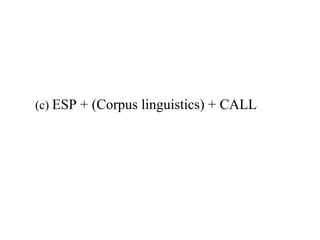
(c) ESP + (Corpus linguistics) + CALL
Developments of ESP 2 -- EOP
Trends in English for Occupational Purposes
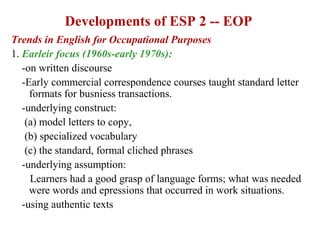
1. Earleir focus (1960s-early 1970s):
   -on written discourse
   -Early commercial correspondence courses taught standard letter
     formats for busniess transactions.
   -underlying construct:
    (a) model letters to copy,
    (b) specialized vocabulary
    (c) the standard, formal cliched phrases
   -underlying assumption:
     Learners had a good grasp of language forms; what was needed
     were words and epressions that occurred in work situations.
   -using authentic texts
Developments of ESP 2 -- EOP
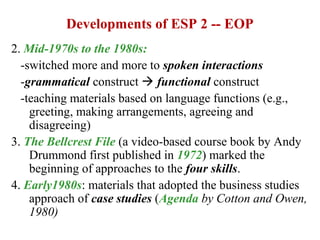
2. Mid-1970s to the 1980s:
  -switched more and more to spoken interactions
  -grammatical construct  functional construct
  -teaching materials based on language functions (e.g.,
    greeting, making arrangements, agreeing and
    disagreeing)
3. The Bellcrest File (a video-based course book by Andy
    Drummond first published in 1972) marked the
    beginning of approaches to the four skills.
4. Early1980s: materials that adopted the business studies
    approach of case studies (Agenda by Cotton and Owen,
    1980)
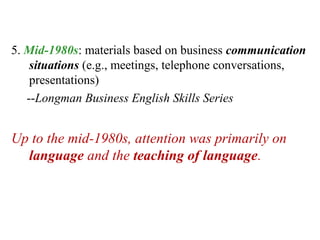
5. Mid-1980s: materials based on business communication
    situations (e.g., meetings, telephone conversations,
    presentations)
   --Longman Business English Skills Series


Up to the mid-1980s, attention was primarily on
  language and the teaching of language.
6. Starting from late 1980s, the focus began to shift to adopt
    tenets of business world
   -interface between language and behavioral skills
   -language teaching needs to take on board the
    business context within which communication
    takes place.
   -technology development
ESBP research in the last two decades
1.    Two trends have become increasingly important in the area of
      English for Specific Business Purposes (ESBP):
     (a) from the de-contextualized analysis of the language
         used in isolated written texts or speech events
          to contextualized analysis of communicative genres
      (b) a shift in focus from language skills as the driving force
          behind ESBP research to an increasing concern with
          identifying communication strategies that can be associated
          with effective communication in business, regardless of
          whether the speaker/writer is a native or non-native speaker
          ( English as a lingua franca, ELF)
ESBP research in the last two decades
2. Four major communicative genres investigated
   -negotiations
   -meetings
   -e-mails
   -business letters
3. Mismatch between research and materials development in
     business discourse
ESP teachers

●   What kind of person?
●   There is no single model for ESP teacher.
●   Conflicting viewpoints about the qualifications
     and capabilities needed by the ESP teacher
     and the tasks which the teacher is expected to
     perform:
     - How much should the ESP teacher know of
       the students’ specialism?
The roles of ESP teachers
1. The ESP practitioner as teacher
    a. Mediator
    b. classroom organizer
    c. Consultant
    d. facilitator – guiding observation
2. The ESP practitioner as course designer and
   materials provider
3. The ESP practitioner as researcher
4. The ESP practitioner as collaborator
   --cooperation, collaboration, team teaching
5. The ESP practitioner as evaluator
Major Teaching Methods for ESP
1. Skill-based approach
2. Task-based approach
3. Content-based approach
4. Project-based approach
5. Case studies
6. Genre approach

1. esp研究方法 張玉櫻

  • 1.
    從 ESP 的學科本質 看 ESP 的研究內容與方法 Yu-Ying Chang 張玉櫻 元智大學應外系 yymeichu@gmail.com 北區英語教學資源中心 「職場英文的專業英文師資培訓─研究法 」專題 2011.10.21
  • 2.
    Why is ESPneeded? 1. The trend of English as lingua frança (ELF) (science, technology, academia, business, …) 2. More various purposes of using English in the real- world  more varieties of English used 3. English-medium education in non-native English- speaking countries (EAP) 4. Students’ complaints about their required English language courses at tertiary level (Swales, 1988; Dudley-Evans and St John, 1998)
  • 3.
    5. Changing perspectivesin language teaching (Bhatia, 2007) Traditional Recent Context general specific Target classroom real world Discourse idealized complex and dynamic Inspiration text linguistics socio-cognitive Outcome single literacy multiple literacies
  • 4.
    Major issues inlanguage teaching 1. Teaching language for a purpose 2. Text vs. Context -realities of the world of work -language competence v. professional expertise *understanding of cultures *ethnic culture, professional culture, institutional culture 3. Teaching vs. Analysis “Discourse awareness always precedes discourse acquisition.” (John Swales) *training students as ethnographers and analyzers (Ann Johns)
  • 5.
  • 6.
  • 7.
    ESP Definition 1 Hutchinsonand Waters (1987) ESP must be seen as an approach rather than a ● product. ● The foundation of ESP “needs” - “ Why does this learner need to learn a foreign language?” -important issues: learners, language required, the learning context
  • 8.
    ESP Definition 1 Hutchinsonand Waters (1987) ESP is not only a matter of teaching “specialized ● varieties” of English. -characteristics of special English should not obscure the far larger area of common ground that underlies all English use. ESP is not only a matter of special words and ● grammar.  There is much more to communication than just the surface features.
  • 9.
    ESP Definition 1 ● ESP is an approach to language teaching in which all decisions as to content and method are based on the learner’s reason for learning. ● ESP is an approach to language learning which is based on learner need.
  • 10.
    ESP Definition 2 Streven(1988) ● absolute characteristics of ESP ● variable characteristics of ESP
  • 11.
    ESP Definition 2 ● Absolute characteristics of ESP -designed to meet specified needs of the learner -related in content (that is, in its themes and topics) to particular disciplines, occupations and activities -centered on language appropriate to those activities in syntax, lexis, discourse, semantics, and son on, and analysis of the discourse -in contrast with ‘General English”
  • 12.
    ESP Definition 2 ● Variable characteristics of ESP -may be restricted as to the learning skills to be learned (for example, reading only) -may not be taught according to any pre-ordained methodology
  • 13.
    ESP Definition 3 Robinson(1991) ● Criterial features -ESP is normally goal-directed. -ESP courses develop from a needs analysis, which ‘aims to specify as closely as possible what exactly it is that students have to do through the medium of English (Robinson 1991:3)’. ● ESP courses are often taught to adults in homogeneous classes in terms of the work or specialist studies that the students are involved in.
  • 14.
    ESP Definition 3 Robinson(1991) ● Variable features -ESP courses are generally constrained by limited time period (with clearly specified time period for the course) *This means objectives and their realization related to the time available should be closely specified. *Collaboration and negotiation among all those involved with the course are important (organizers, teachers, sponsors, and students)
  • 15.
    ESP Definition 4 Dudley-Evansand St John (1998: 4-5) ●Absolute characteristics of ESP -ESP is designed to meet specific needs of the learner; -ESP makes use of the underlying methodology and activities of the disciplines it serves; -ESP is centered on the language (grammar, lexis, register), skills, discourse and genres appropriate to these activities.
  • 16.
    ESP Definition 4 Dudley-Evansand St John (1998: 4-5) ● Variable characteristics of ESP -ESP may be related to or designed for specific disciplines; -ESP may use, in specific teaching situations, a different methodology from that of general English; -ESP is likely to be designed for adult learners, whether at a tertiary level institution or in a professional work situation. It could however be used for learners at secondary school level;
  • 17.
    ESP Definition 4 -ESPis generally designed for intermediate or advanced students. Most ESP courses assume basic knowledge of the language system, but it can be used with beginners.
  • 18.
    Continuum of ELTcourse types
  • 19.
  • 20.
    TESOL vs. ESPpractices 1. Teaching goals: TESOL  Teaching English skills for general communication purposes ESP  Teaching English skills for professional, vocational and other specific purposes;  very goal-directed (students study English with very specific goals)  “Tell me what you need English for and
  • 21.
    • For example: -English for Science and Technology (EST) -English for Academic Purposes (EAP) -English for Business Purposes (EBP) -English for Medical Purposes -English for Legal Purposes -English for Tourism…
  • 22.
    2. Instruction timeallowed for the achievement of the teaching goals: TESOL Several years of instruction based on a long-term curriculum. ESP “to-the-point” teaching, “quick fix” (often intensive courses) * objectives should be closely specified * a very clearly specified time period for the course * collaboration and negotiation among all those involved with the course: organizers, teachers, sponsors, students…
  • 23.
    3. Commercial teachingmaterials available TESOL Abundant ESP Relatively scarce (Most of the time, none exists.) *Within ESP, the largest sector for published materials is now that of Business English.
  • 24.
    4. ESP coursesare based on need analyses -Needs analysis aims to specify as closely as possible what exactly it is that students have to do through the medium of English (Robinson, 1991: 3) -The important role of expert informants in both ESP practices and research *ESP teaching is flexible and tailored to individual or group needs as they arise.
  • 25.
    5. Different emphasesin teacher training -Both require basic pedagogical training. -But, ESP emphasizes more on applied linguistic training, especially different analysis skills of language 6. Target students TESOL  from children to adults ESP adult learners, often in tertiary education *Threshold debate – learner’s general English proficiency level before ESP courses
  • 26.
    ESP research andpractices • 3 cores in ESP research and practices -Needs analysis -Analysis of ESP discourse at various levels -Pedagogical aspects
  • 27.
    A cyclic procedureof ESP research and practice
  • 28.
    A cyclic procedureof ESP research and practice
  • 29.
    A cyclic procedureof ESP research and practice 1. Needs Analysis 2. Construction of special English corpus: Collecting relevant and useful ESP samples (written and/or spoken)
  • 30.
    3. Analysis ofESP discourse at various levels ESP as a multi-disciplinary activity -Lexico-syntactic analysis -Discourse analysis including text analysis, register analysis, genre analysis, narrative analysis, frame analysis -Sociolinguistics -Functional grammar -Pragmatics -Corpus linguistics -Rhetoric/contrastive rhetoric
  • 31.
    • Theories orresearch methods from other fields might also be relevant: • For example, in the case of English for Academic Purposes: -Social studies of science/knowledge -Rhetoric and composition studies -Information science -Higher education
  • 32.
    • For example,in the case of English for Business Purposes: -Professional communication -Workplace English -Management -Organizational theories -Marketing
  • 33.
    4. Teaching materialsdevelopment: -Pedagogical aspects -Applied linguistics aspects *carrier content vs. real content *authentic materials vs. authentic tasks (activities) 5. Experimenting teaching methods and teaching materials in ESP classrooms
  • 34.
    6. Assessment -learner performance assessment -course evaluation -evaluation of the teaching materials designed 7. Revision
  • 35.
    Developments of ESP1 -- EAP Trends in English for Academic Purposes 1. Earleir focus (1960s): register analysis -focus on EAP (starting from English for Science and Technology) written discourse 2. In the early days, the ESP specialist worked like a linguist -doing detailed linguistic analyses of terminology/vocabulary and sentence grammar (e.g the distribution of different tenses, the use of passive voice) -then, taught the results to their students  focus only on language form
  • 36.
    Developments of ESPResearch 1 -- EAP 4. In the 1970s, rhetorical and discourse analysis -relating language form to language function (use) -not only what language is used, but also how and why -making “ use” the main criterion for the selection of ESP teaching materials 5. In the 1970s, analysis of study skills -In addition to language work, there is a need to address the thought processes that underpin language use. 6. In the 1970s, needs analysis -Questionnaires about students’ present or future needs were devised.
  • 37.
    7. In the1990s, genre approach to ESP language study and teaching 8. In the 2000s, three major developments: (a) The socio-cultural, real-world contexts of ESP users have been taken on board: -different levels of analysis of ESP discourse (in- depth analysis, thick description) -multiple perspectives and triangulation in needs analysis (vs. earlier only questionnaires)  collabaration with the client is crucial  important role of expert informants
  • 38.
    (b) Spoken languagehas entered ESP -ESP tradition built around written text: [Needs of first reading, then writing (especially in EAP) have taken priority.] -But in many fields, spoken interaction is central from the start: aviation, tourism, nursing etc. -Now in other fields (EAP, business,) speaking has also become very important. -Spoken language is not writing converted into speech.
  • 39.
    (c) ESP +(Corpus linguistics) + CALL
  • 40.
    Developments of ESP2 -- EOP Trends in English for Occupational Purposes 1. Earleir focus (1960s-early 1970s): -on written discourse -Early commercial correspondence courses taught standard letter formats for busniess transactions. -underlying construct: (a) model letters to copy, (b) specialized vocabulary (c) the standard, formal cliched phrases -underlying assumption: Learners had a good grasp of language forms; what was needed were words and epressions that occurred in work situations. -using authentic texts
  • 41.
    Developments of ESP2 -- EOP 2. Mid-1970s to the 1980s: -switched more and more to spoken interactions -grammatical construct  functional construct -teaching materials based on language functions (e.g., greeting, making arrangements, agreeing and disagreeing) 3. The Bellcrest File (a video-based course book by Andy Drummond first published in 1972) marked the beginning of approaches to the four skills. 4. Early1980s: materials that adopted the business studies approach of case studies (Agenda by Cotton and Owen, 1980)
  • 42.
    5. Mid-1980s: materialsbased on business communication situations (e.g., meetings, telephone conversations, presentations) --Longman Business English Skills Series Up to the mid-1980s, attention was primarily on language and the teaching of language.
  • 43.
    6. Starting fromlate 1980s, the focus began to shift to adopt tenets of business world -interface between language and behavioral skills -language teaching needs to take on board the business context within which communication takes place. -technology development
  • 44.
    ESBP research inthe last two decades 1. Two trends have become increasingly important in the area of English for Specific Business Purposes (ESBP): (a) from the de-contextualized analysis of the language used in isolated written texts or speech events  to contextualized analysis of communicative genres (b) a shift in focus from language skills as the driving force behind ESBP research to an increasing concern with identifying communication strategies that can be associated with effective communication in business, regardless of whether the speaker/writer is a native or non-native speaker ( English as a lingua franca, ELF)
  • 45.
    ESBP research inthe last two decades 2. Four major communicative genres investigated -negotiations -meetings -e-mails -business letters 3. Mismatch between research and materials development in business discourse
  • 46.
    ESP teachers ● What kind of person? ● There is no single model for ESP teacher. ● Conflicting viewpoints about the qualifications and capabilities needed by the ESP teacher and the tasks which the teacher is expected to perform: - How much should the ESP teacher know of the students’ specialism?
  • 47.
    The roles ofESP teachers 1. The ESP practitioner as teacher a. Mediator b. classroom organizer c. Consultant d. facilitator – guiding observation 2. The ESP practitioner as course designer and materials provider 3. The ESP practitioner as researcher 4. The ESP practitioner as collaborator --cooperation, collaboration, team teaching 5. The ESP practitioner as evaluator
  • 48.
    Major Teaching Methodsfor ESP 1. Skill-based approach 2. Task-based approach 3. Content-based approach 4. Project-based approach 5. Case studies 6. Genre approach