Final revision Present Perfect The Future Have to / Don’t have to / Must First Conditional Second Conditional Giving advice
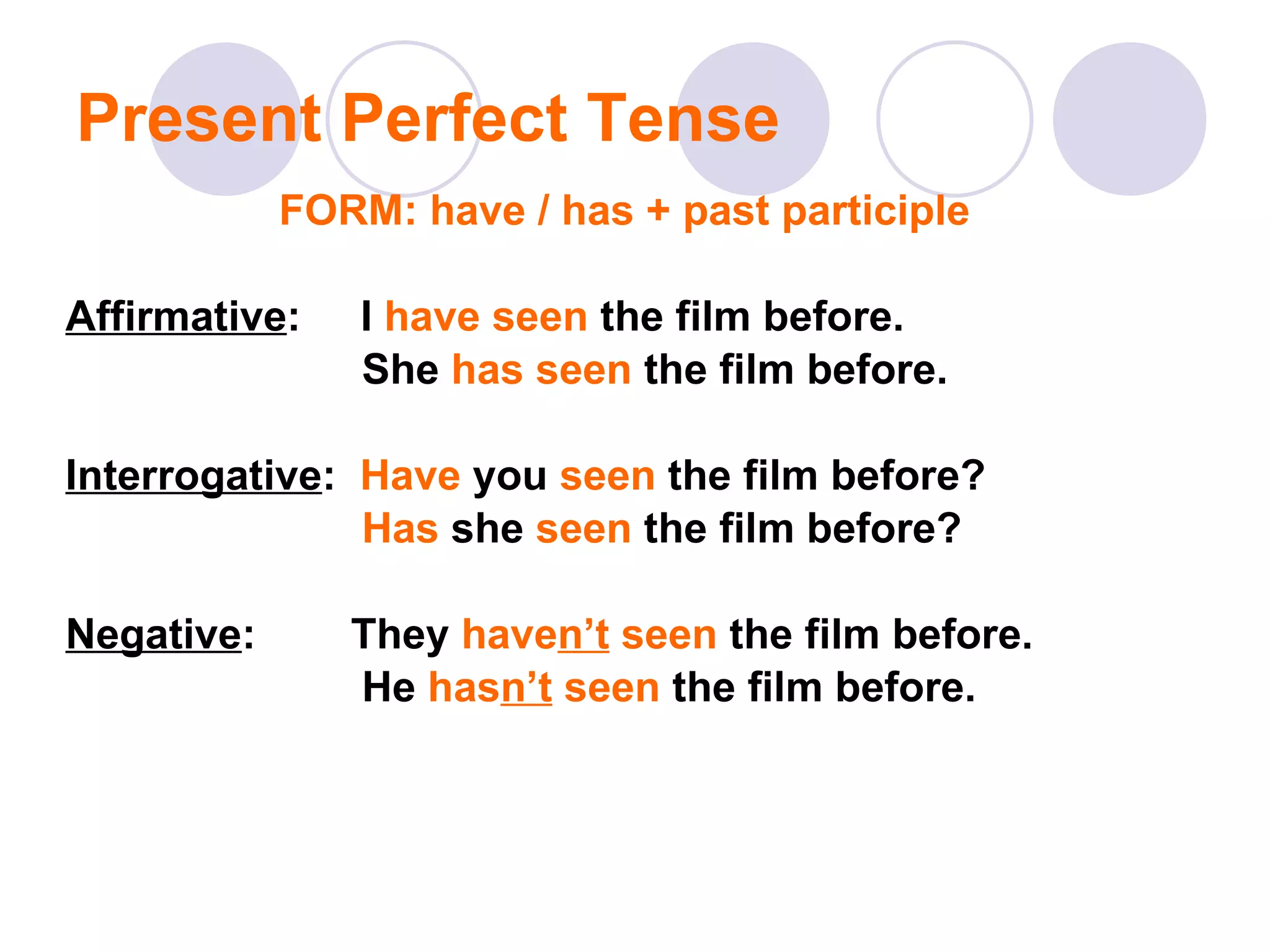
Present Perfect Tense FORM: have / has + past participle Affirmative :   I  have seen  the film before. She  has seen  the film before. Interrogative :   Have  you  seen  the film before? Has  she  seen  the film before? Negative :  They  have n’t  seen  the film before. He  has n’t  seen  the film before.
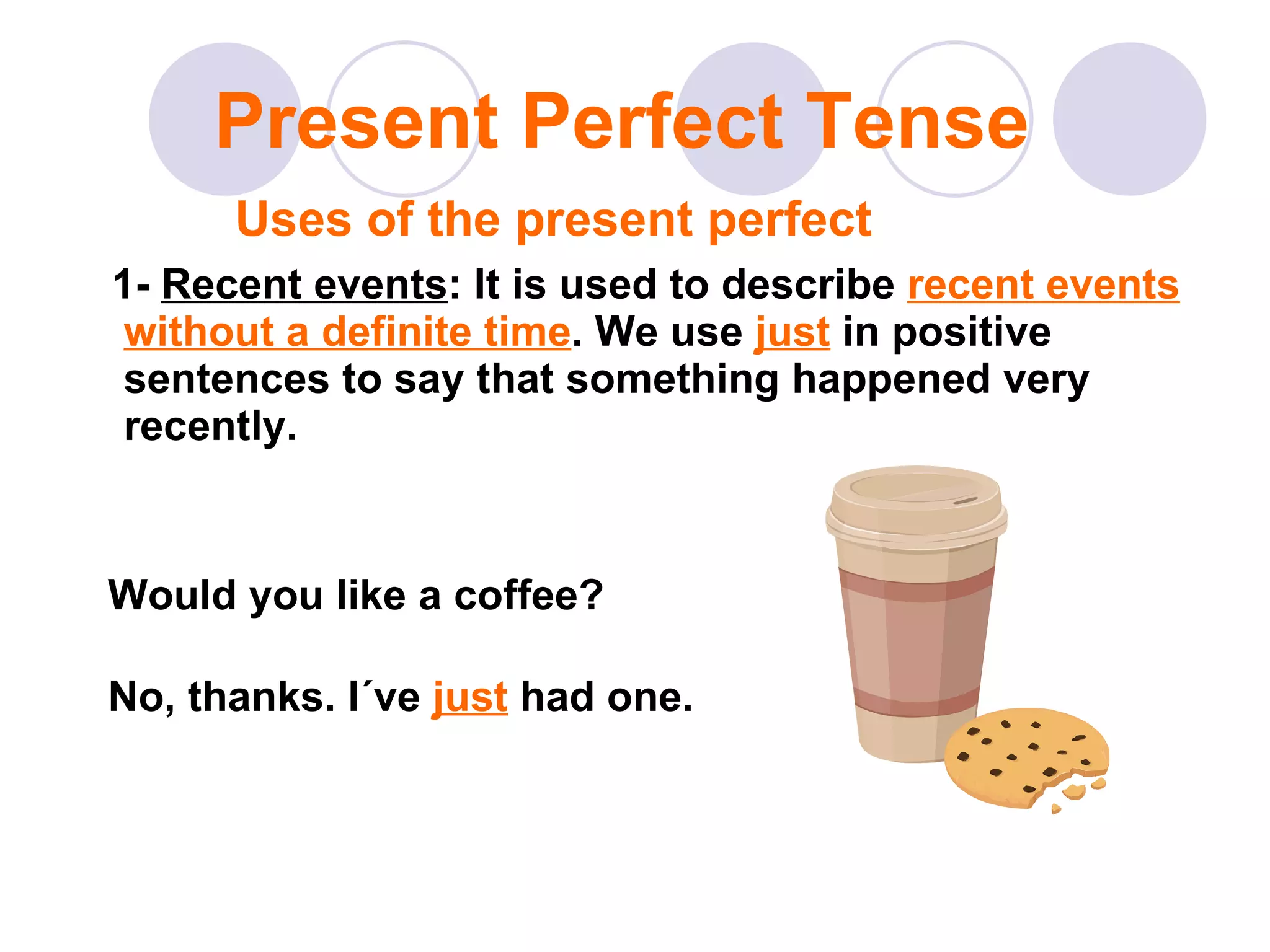
1-  Recent events : It is used to describe  recent events without a definite time . We use  just  in positive sentences to say that something happened very recently. Present Perfect Tense Uses of the present perfect Would you like a coffee? No, thanks. I´ve  just  had one.
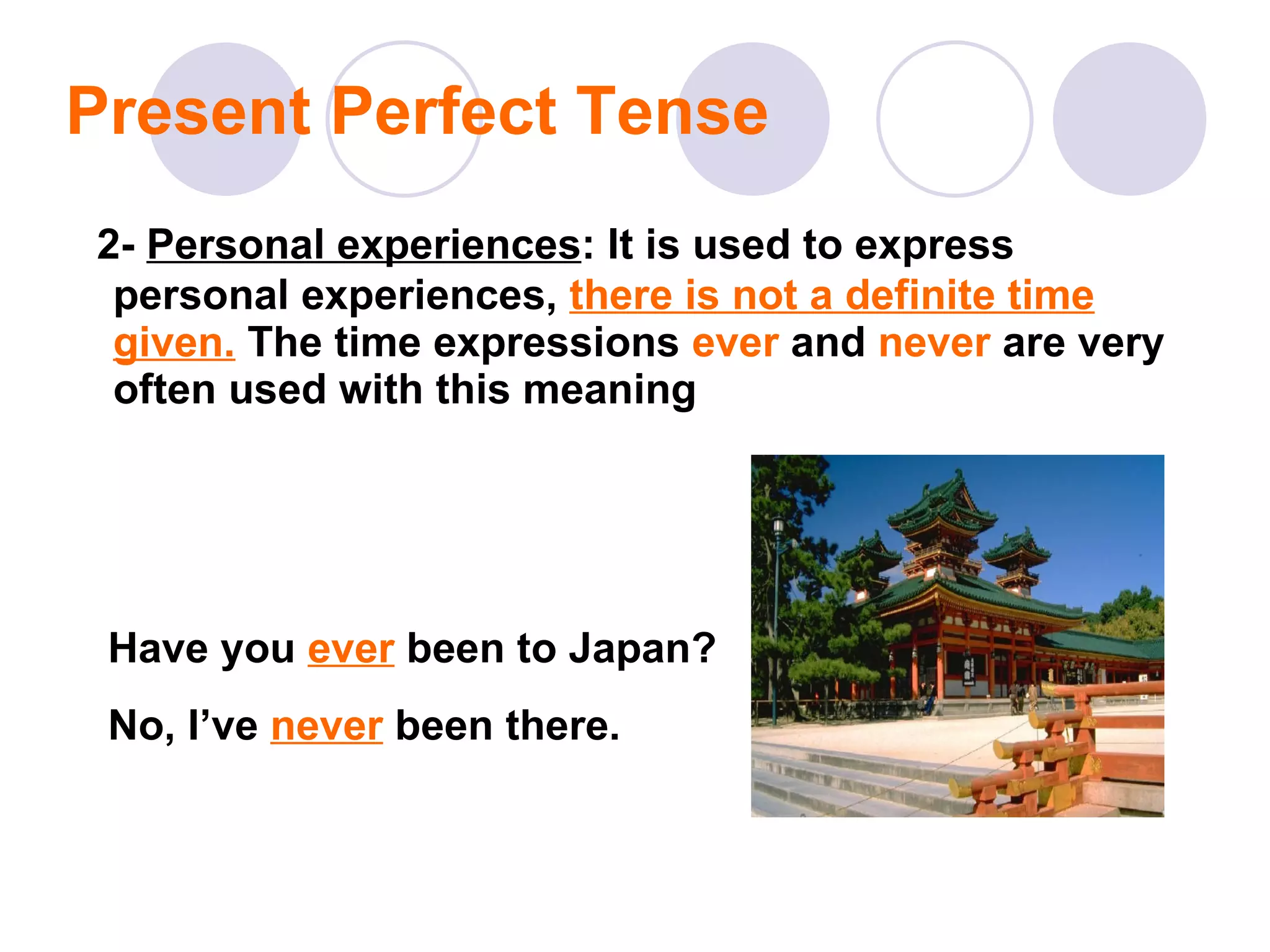
Present Perfect Tense 2-   Personal experiences : It is used to express personal experiences,  there is not a definite time given.   The time expressions  ever  and  never  are very often used with this meaning Have you  ever  been to Japan?  No, I’ve  never  been there.
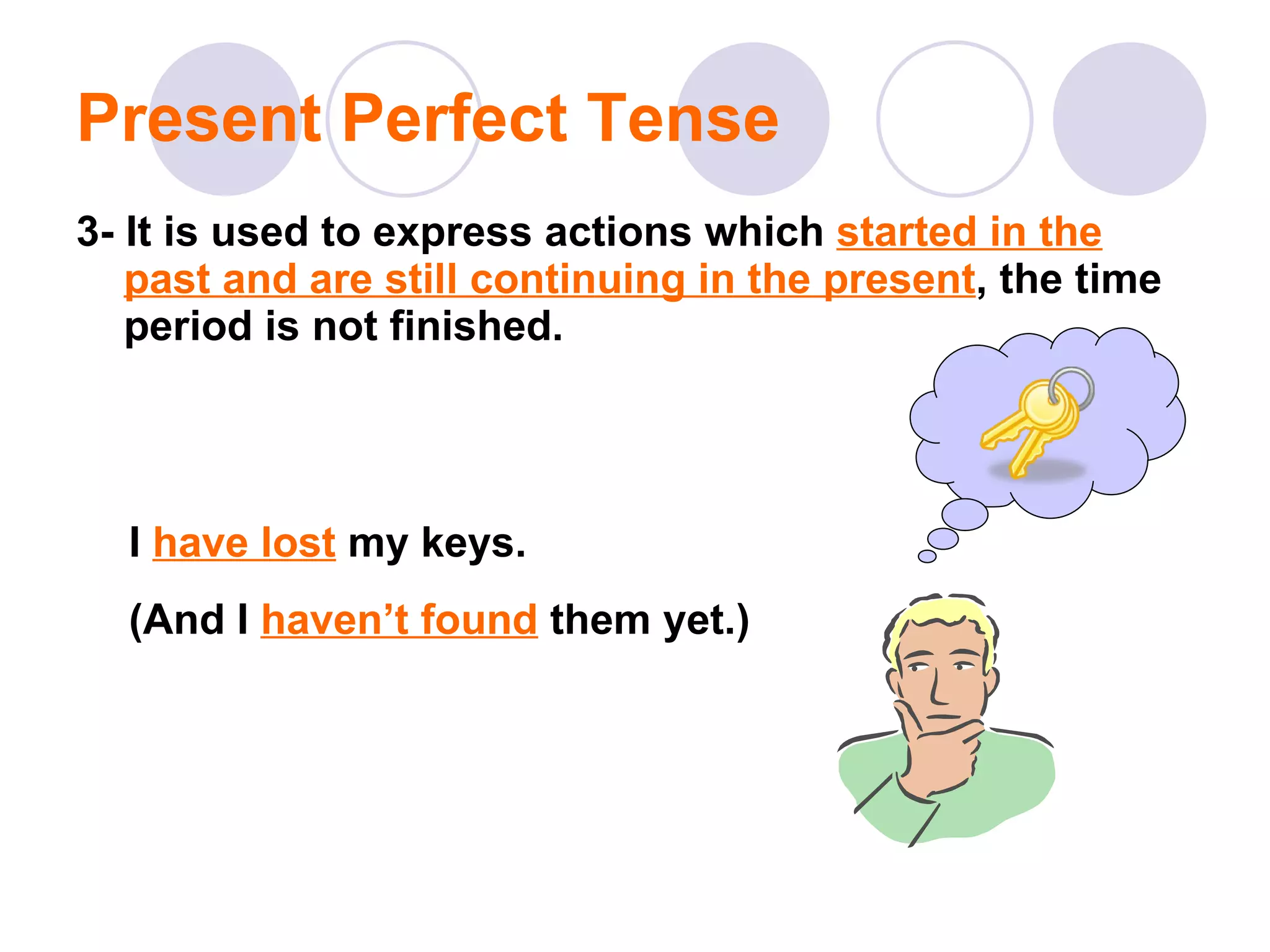
Present Perfect Tense 3- It is used to express actions which  started in the past and are still continuing in the present , the time period is not finished.  I  have lost  my keys. (And I  haven’t found  them yet.)
Present Perfect + already and yet We often use the present perfect tense with  already  and  yet . Already : Something happened before now or earlier than expected You can use already in  positive sentences . Put already  before the main verb. Yet : Until now. You can use yet in  negative sentences  and  questions . Yet is usually  at the end . Example : A) Have you done your homework yet? B) No, I haven’t done it yet. / Yes, I’ve already done it.
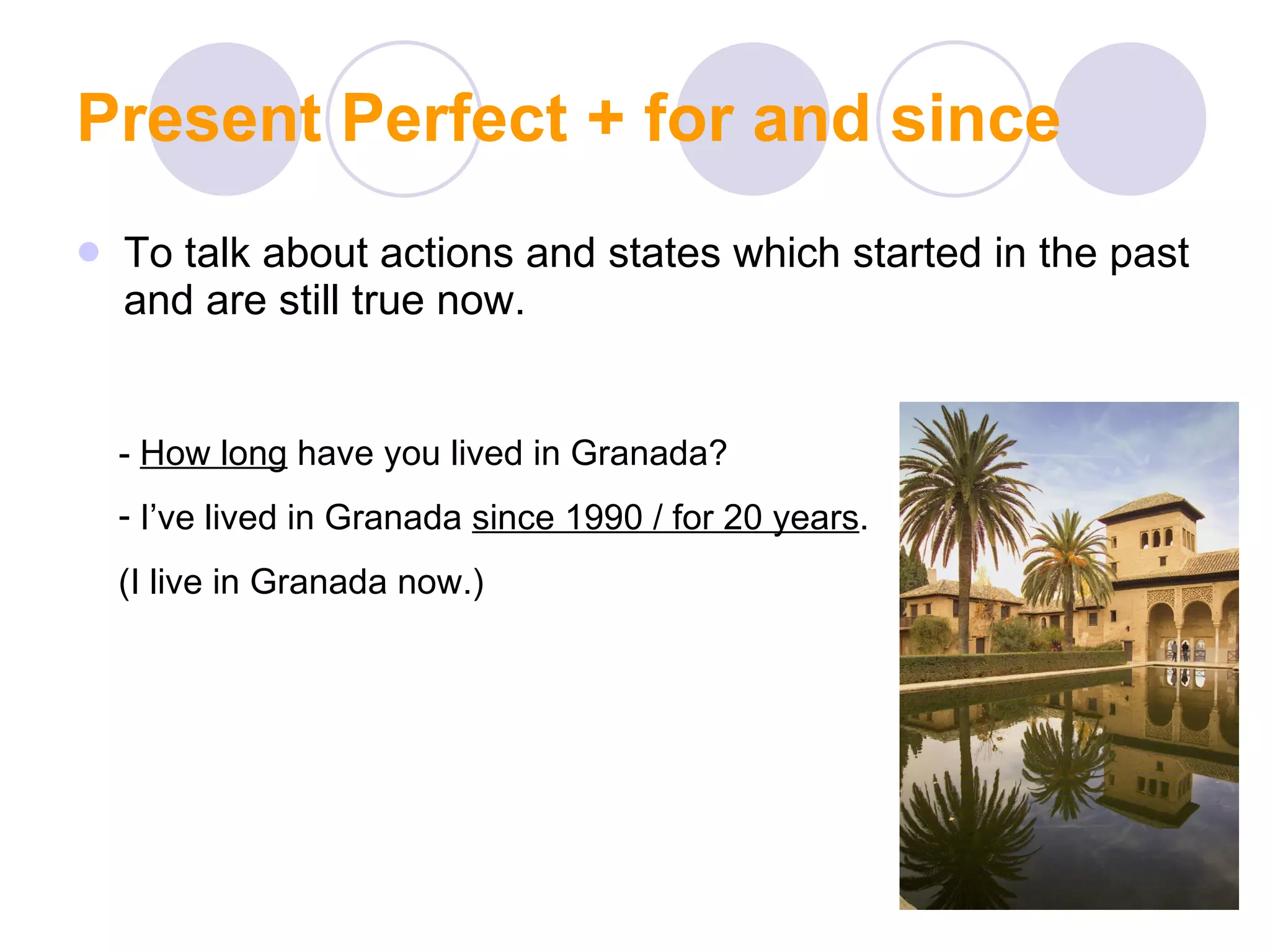
Present Perfect + for and since To talk about actions and states which started in the past and are still true now. -  How long  have you lived in Granada? I’ve lived in Granada  since 1990 / for 20 years . (I live in Granada now.)
Present Perfect or  Past Simple We use definite expressions with the Past simple tense:  yesterday, last week, … ago, etc,  while we don’t use definite time expressions with the Present perfect tense. I  have been  to France three times. When  did   you  go   there?  I  went   there  last summer.
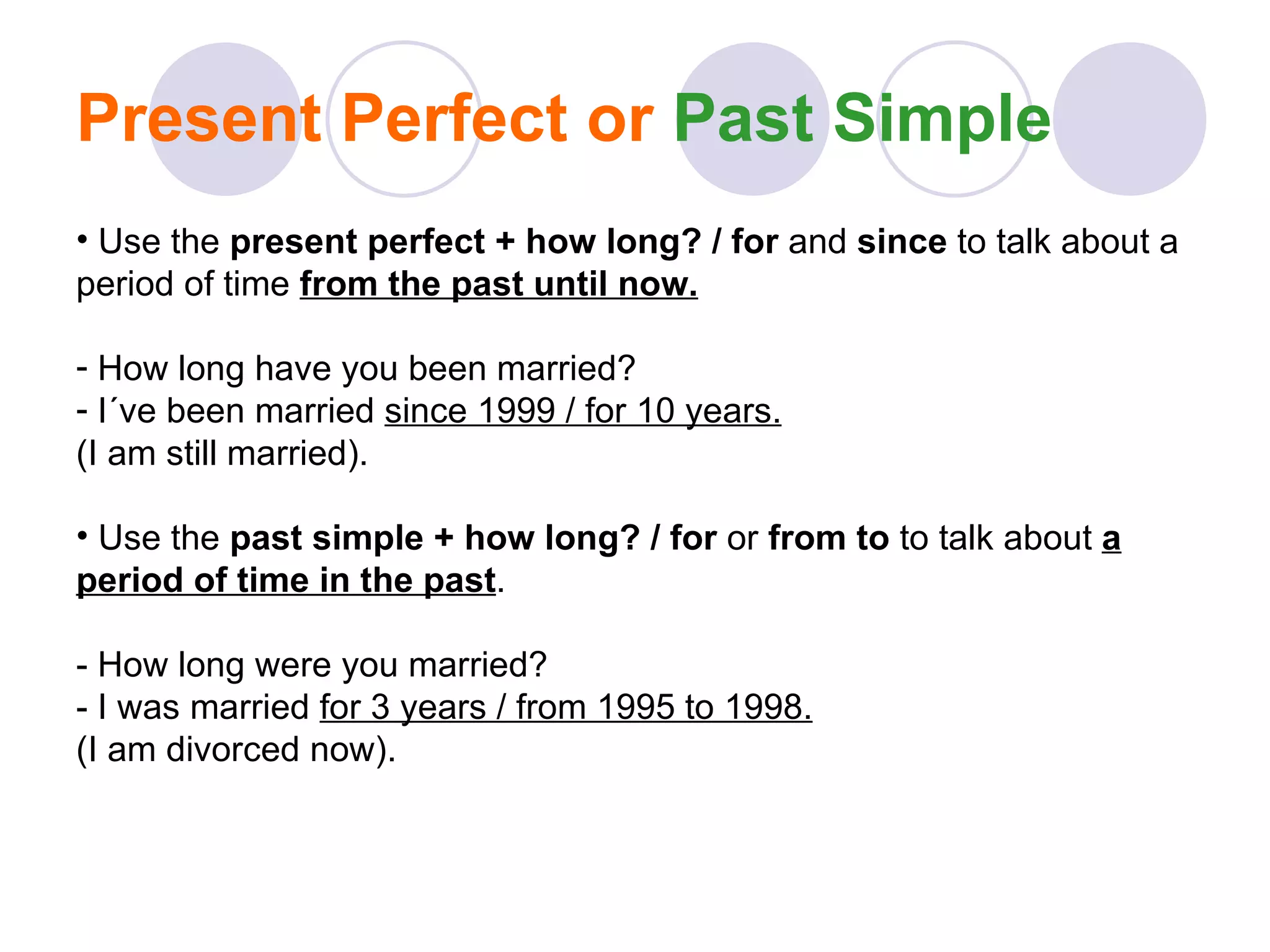
Present Perfect or  Past Simple Use the  present perfect + how long? / for  and  since  to talk about a period of time  from the past until now. How long have you been married? I´ve been married  since 1999 / for 10 years. (I am still married). Use the  past simple + how long? / for  or  from to  to talk about  a period of time in the past . - How long were you married? - I was married  for 3 years / from 1995 to 1998. (I am divorced now).
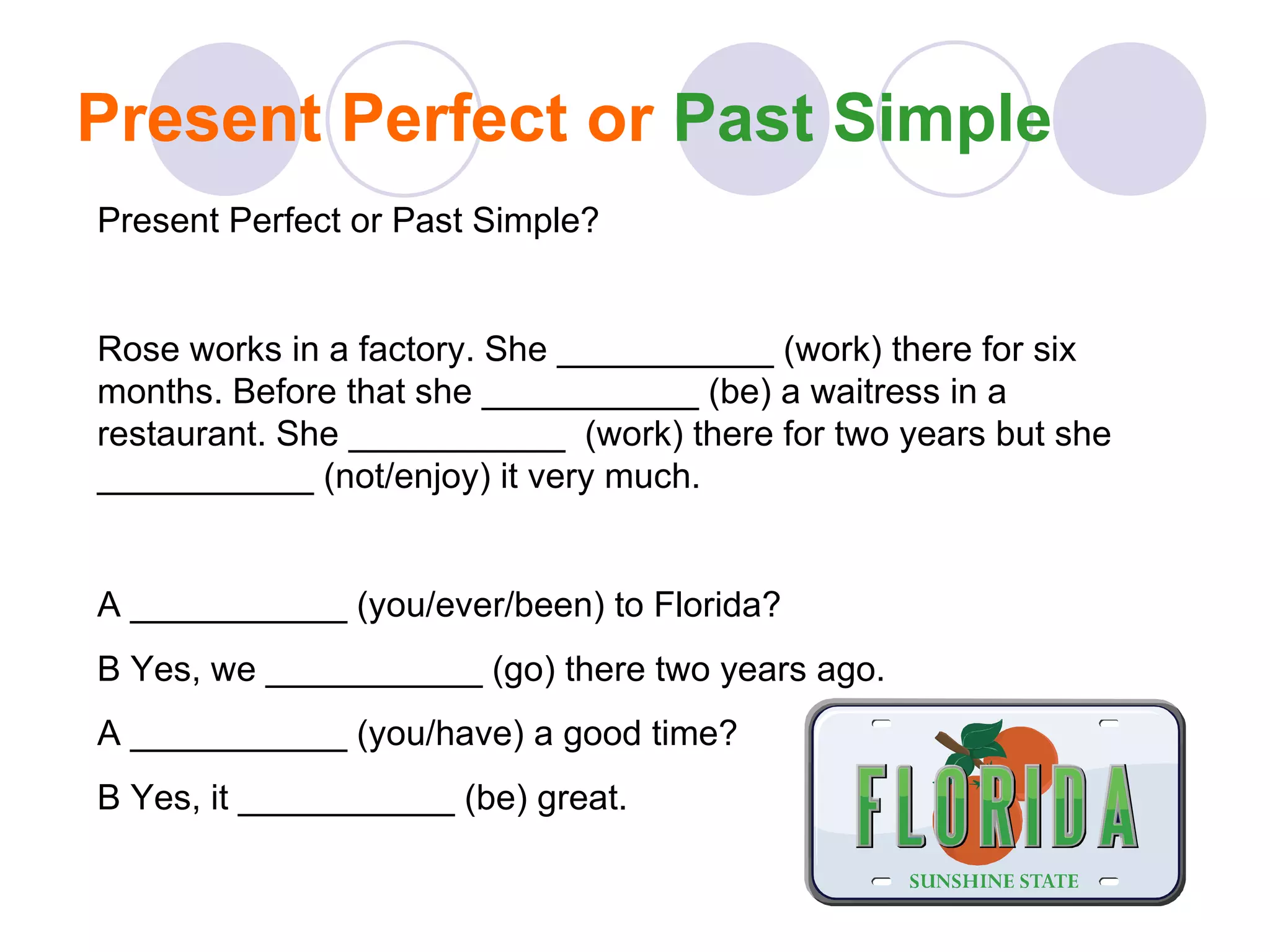
Present Perfect or  Past Simple Present Perfect or Past Simple? Rose works in a factory. She ___________ (work) there for six months. Before that she ___________ (be) a waitress in a restaurant. She ___________  (work) there for two years but she ___________ (not/enjoy) it very much. A ___________ (you/ever/been) to Florida? B Yes, we ___________ (go) there two years ago. A ___________ (you/have) a good time? B Yes, it ___________ (be) great.
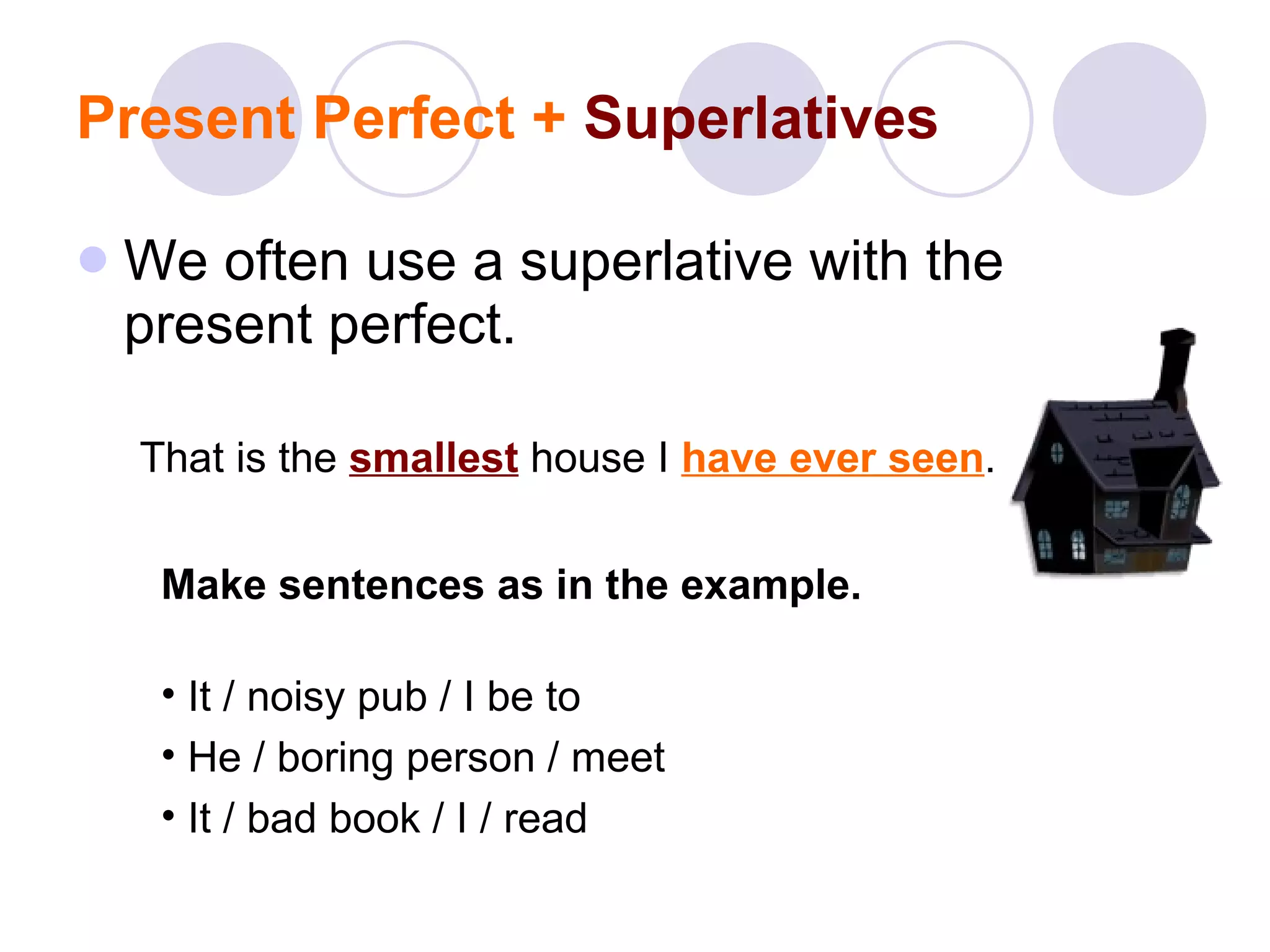
Present Perfect +  Superlatives We often use a superlative with the present perfect. That is the  smallest  house I  have ever seen . Make sentences as in the example. It / noisy pub / I be to He / boring person / meet It / bad book / I / read
WILL / WON’T (BE) GOING TO PRESENT CONTINUOUS THE FUTURE
Predictions Promises Offers Instant decisions
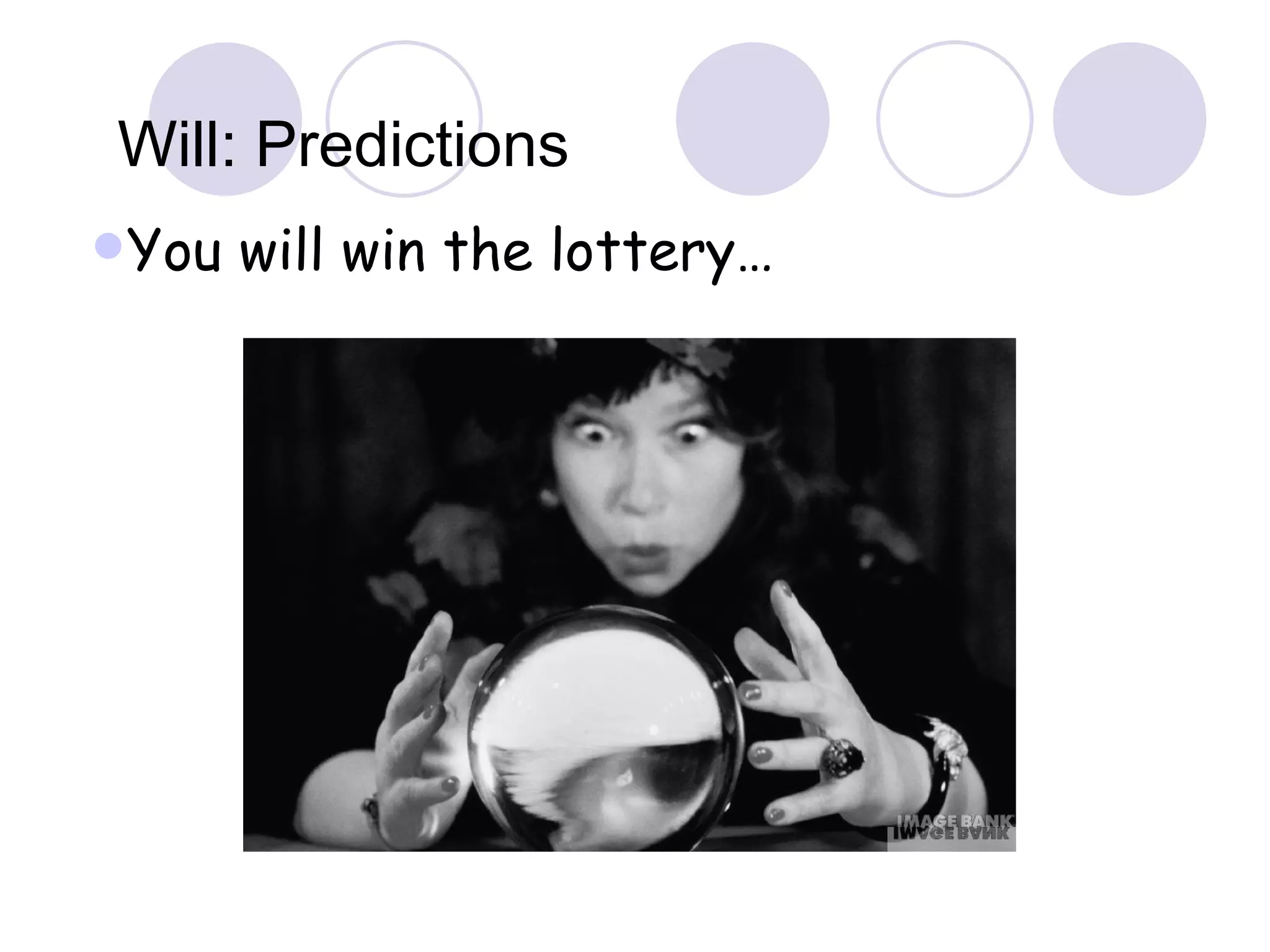
You will win the lottery… Will: Predictions
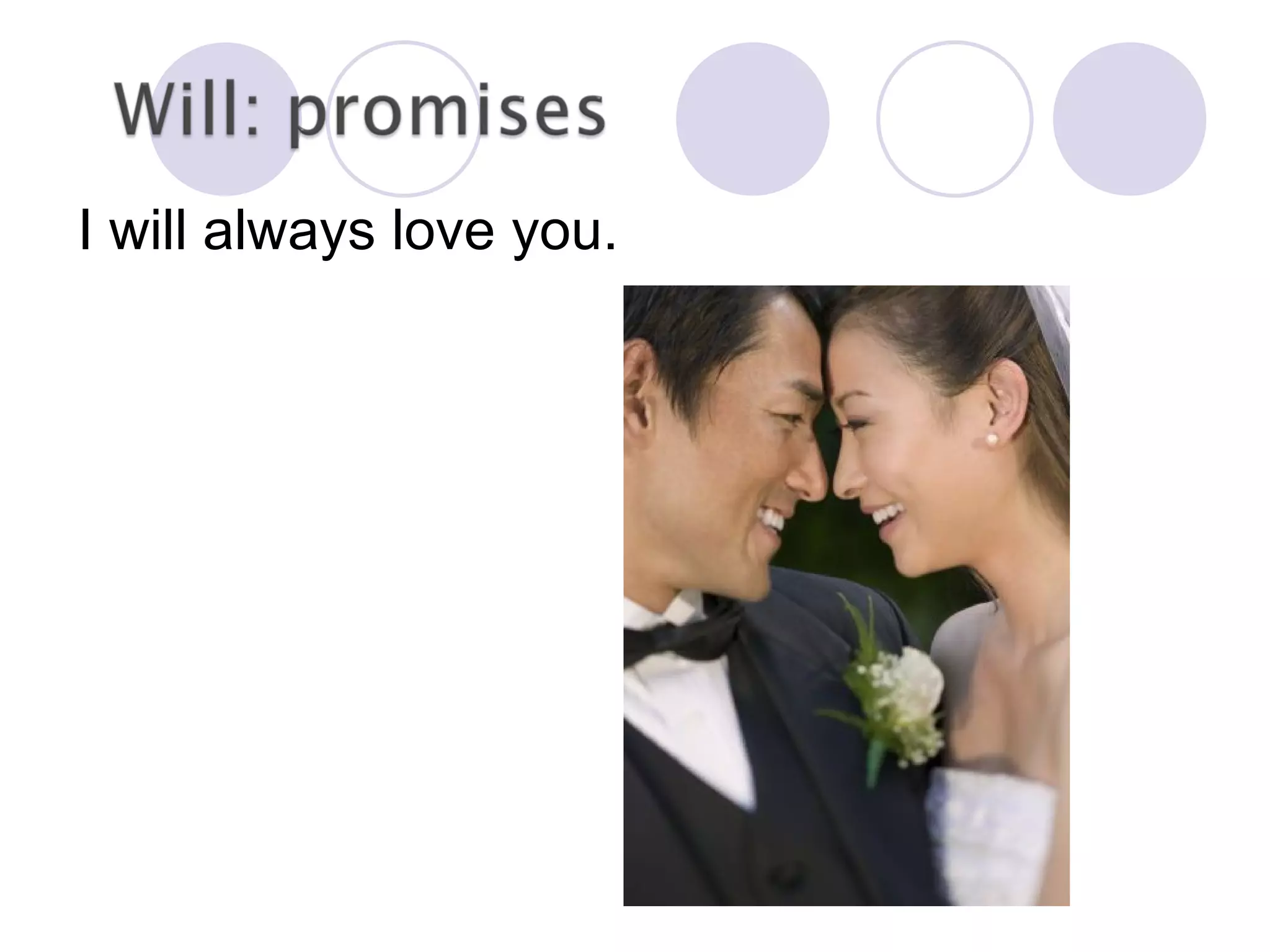
I will always love you.
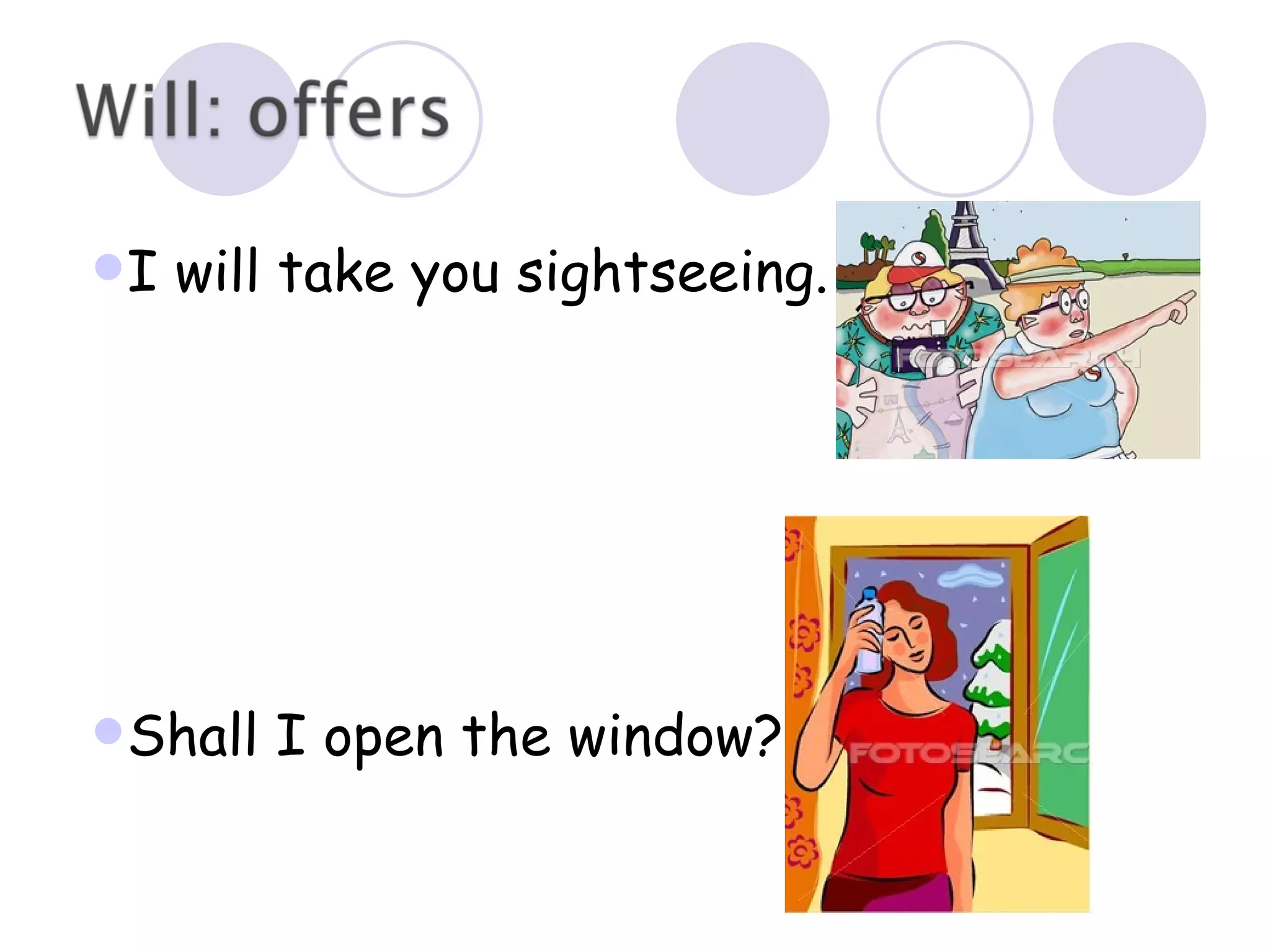
I will take you sightseeing. Shall I open the window?
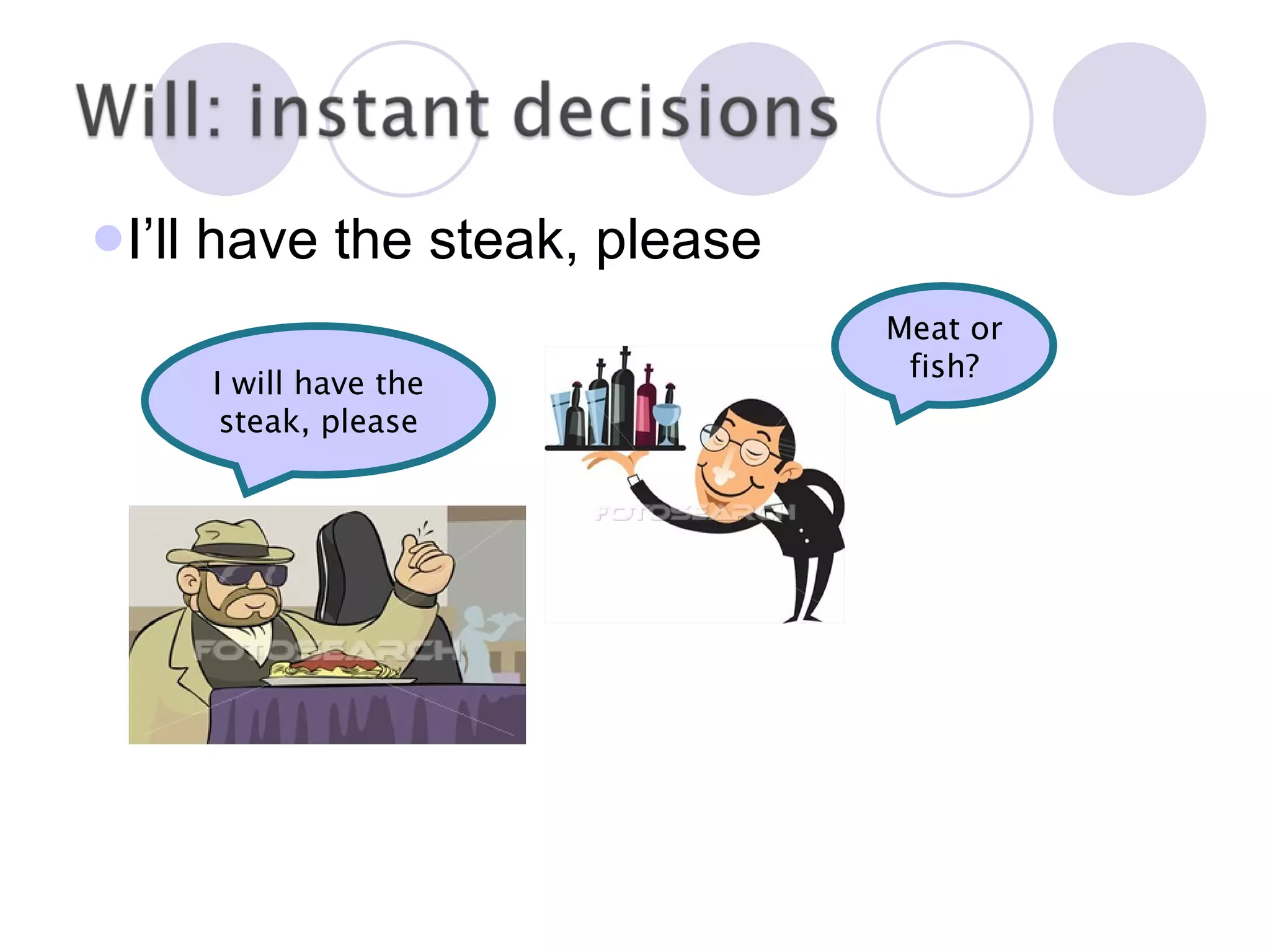
I’ll have the steak, please Meat or fish? I will have the steak, please Meat or fish?
Predictions Decisions that you have planned before: future plans and intentions
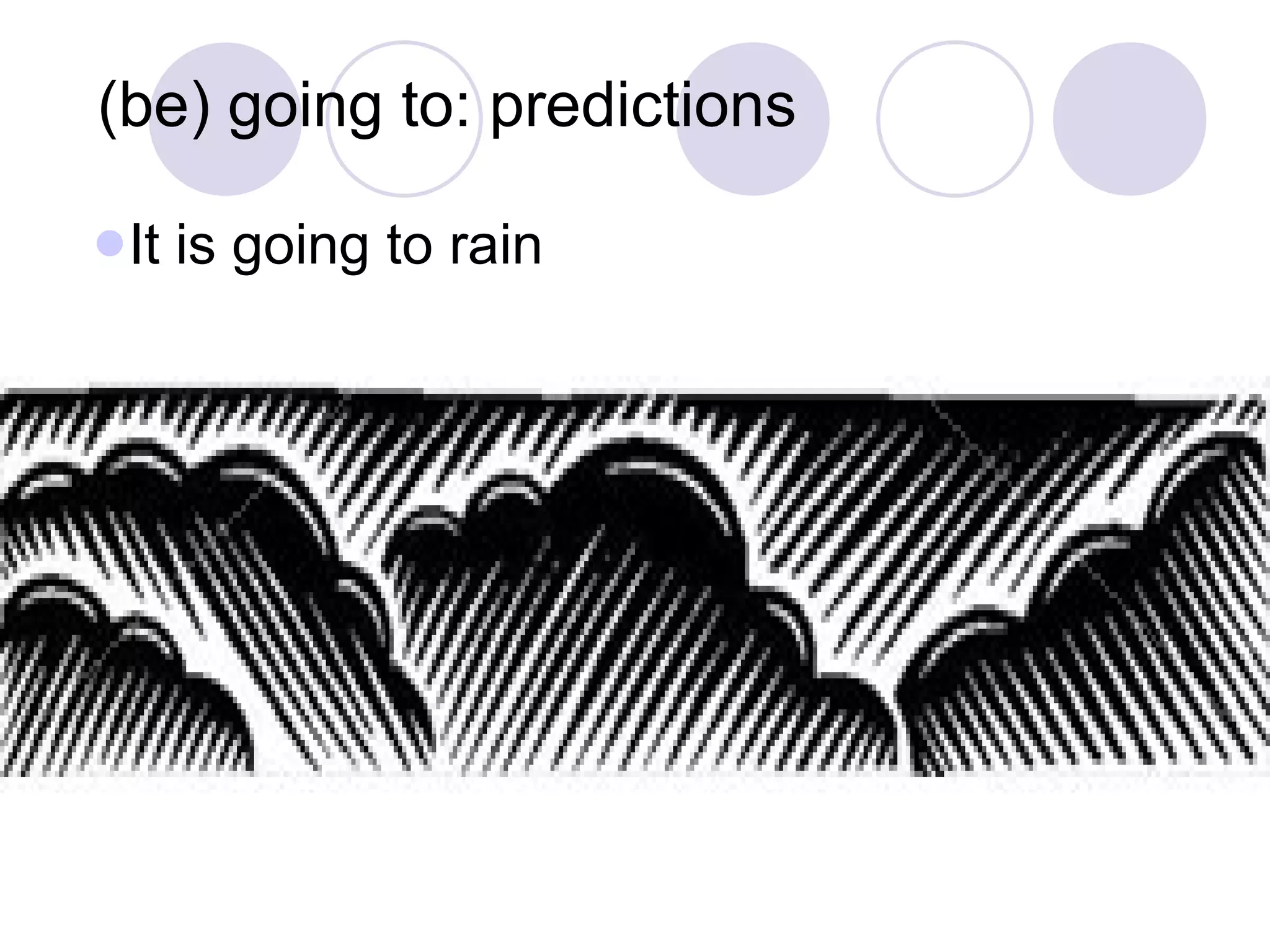
It is going to rain (be) going to: predictions
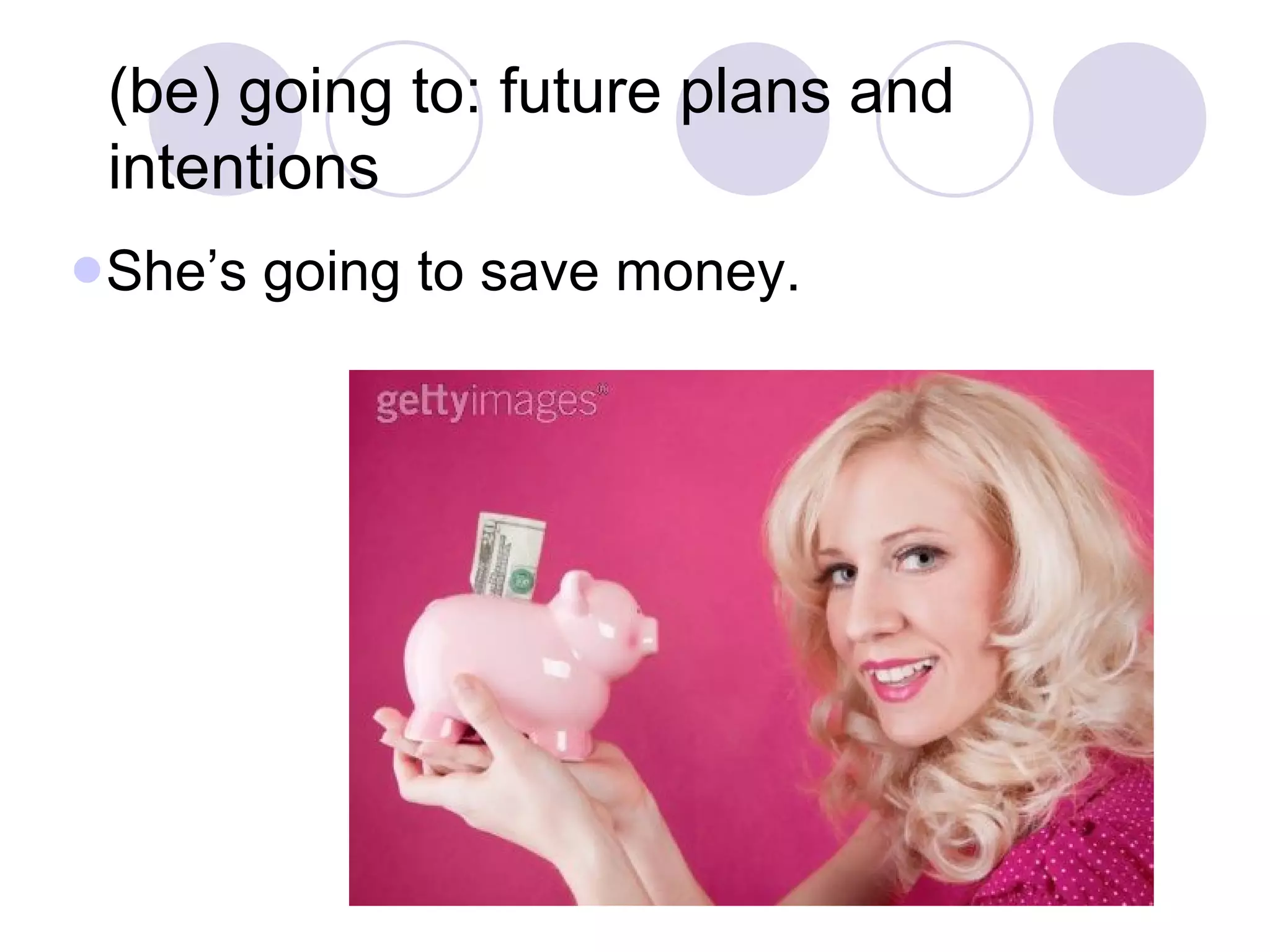
She’s going to save money. (be) going to: future plans and intentions
Future arrangements The sentence usually contains an adverb which refers to the future
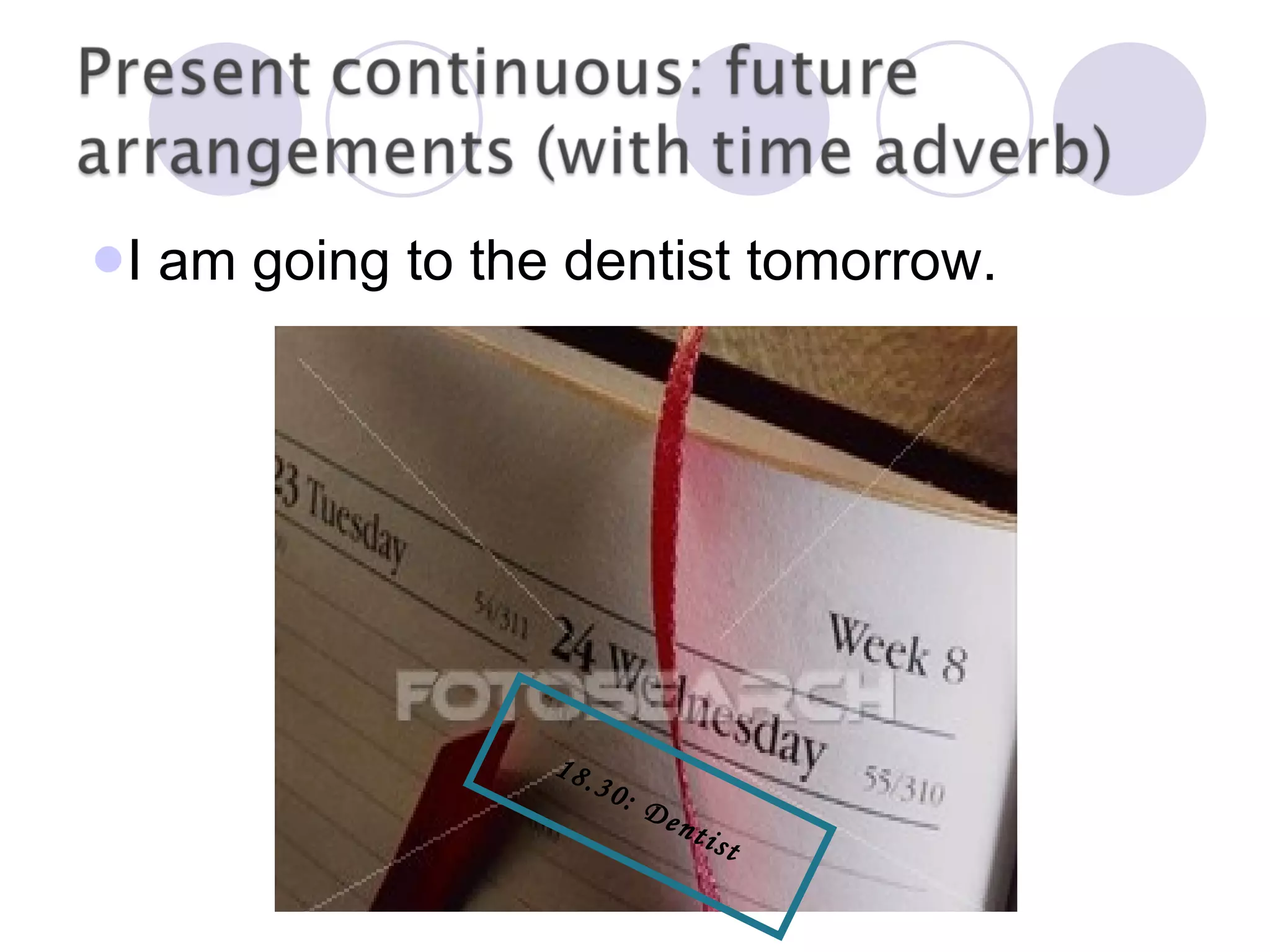
I am going to the dentist tomorrow. 18.30: Dentist
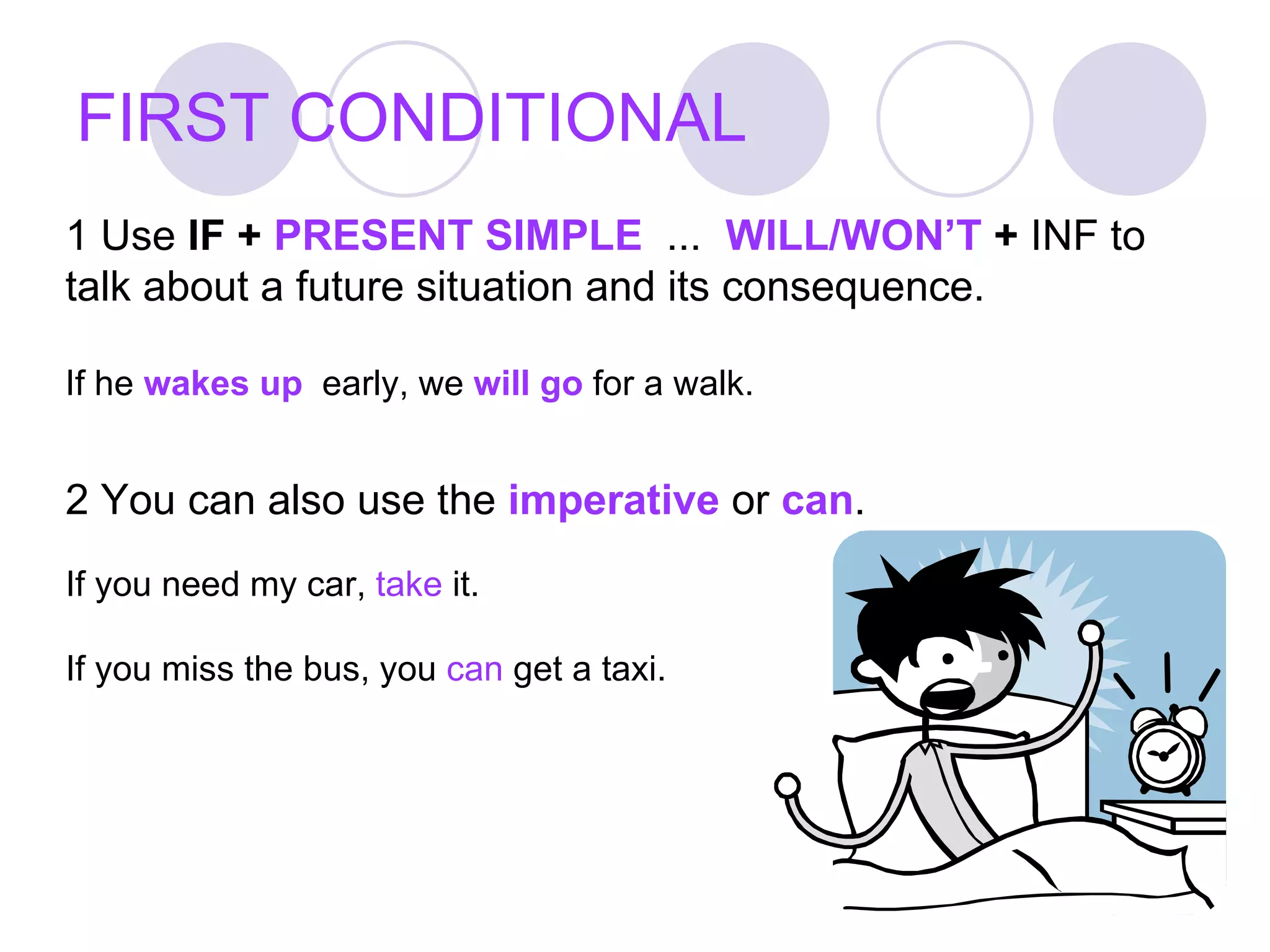
FIRST CONDITIONAL 2 You can also use the  imperative  or  can .   If you need my car,  take  it. If you miss the bus, you  can  get a taxi. 1 Use  IF +  PRESENT SIMPLE   ...  WILL/WON’T  +  INF to talk about a future situation and its consequence. If he  wakes up   early, we  will go  for a walk.
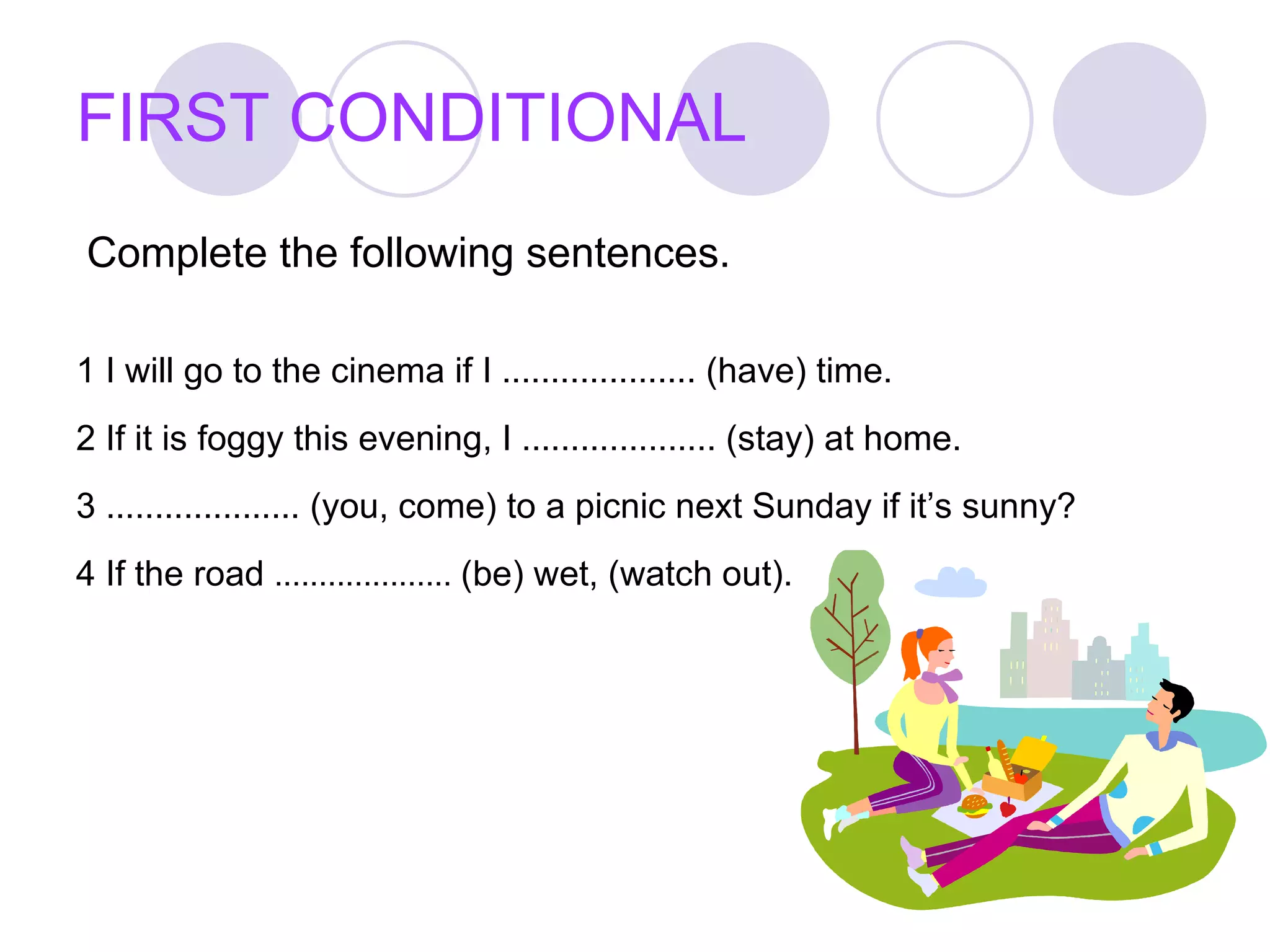
FIRST CONDITIONAL Complete the following sentences. 1 I will go to the cinema if I .................... (have) time. 2 If it is foggy this evening, I .................... (stay) at home. 3 .................... (you, come) to a picnic next Sunday if it’s sunny? 4 If the road  ....................  (be) wet, (watch out).
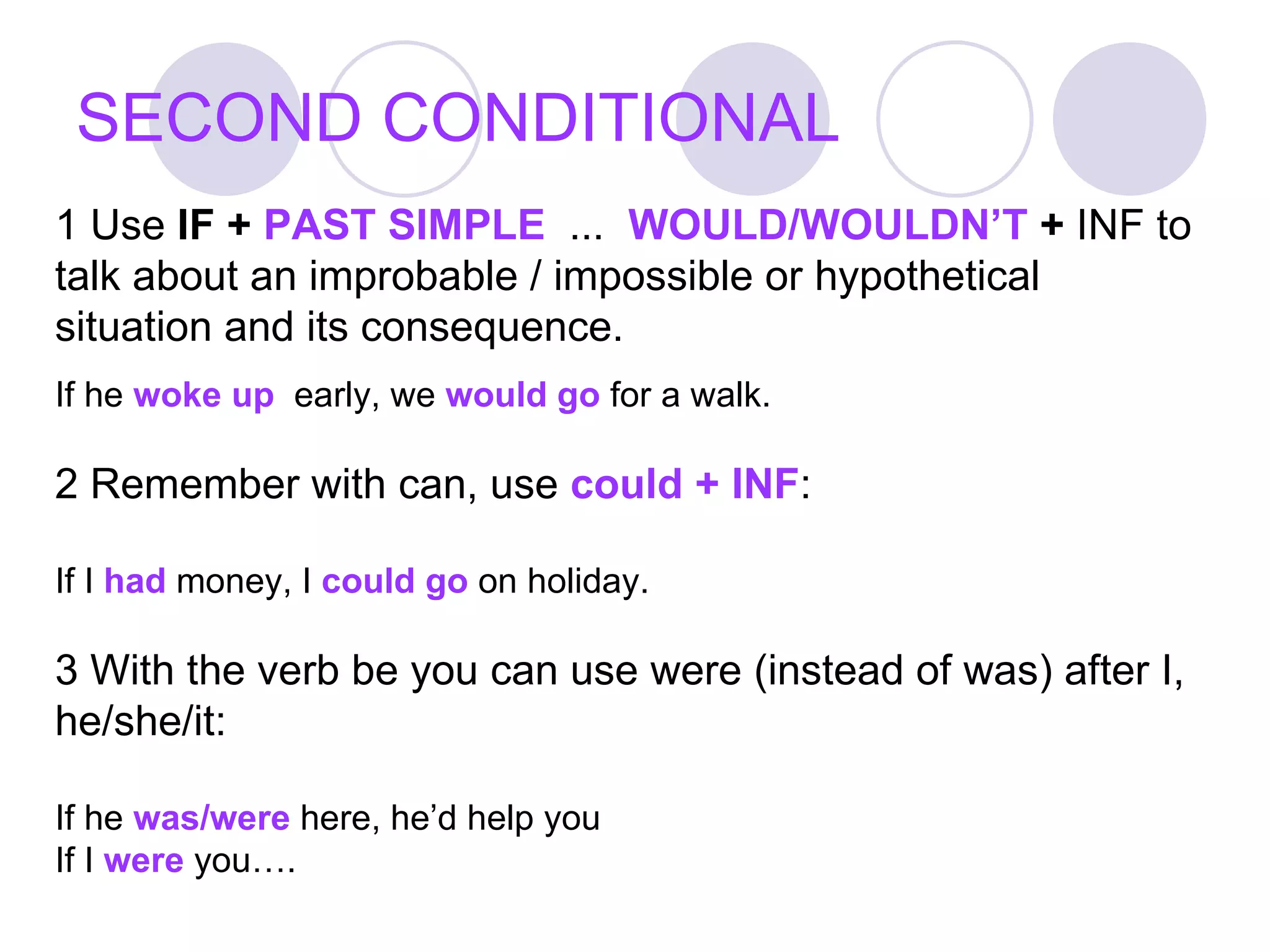
SECOND CONDITIONAL 1 Use  IF +  PAST SIMPLE   ...  WOULD/WOULDN’T  +  INF to talk about an improbable / impossible or hypothetical situation and its consequence. If he  woke up   early, we  would go  for a walk. 2 Remember with can, use  could + INF :  If I  had  money, I  could go  on holiday. 3 With the verb be you can use were (instead of was) after I, he/she/it: If he  was/were  here, he’d help you If I  were  you….
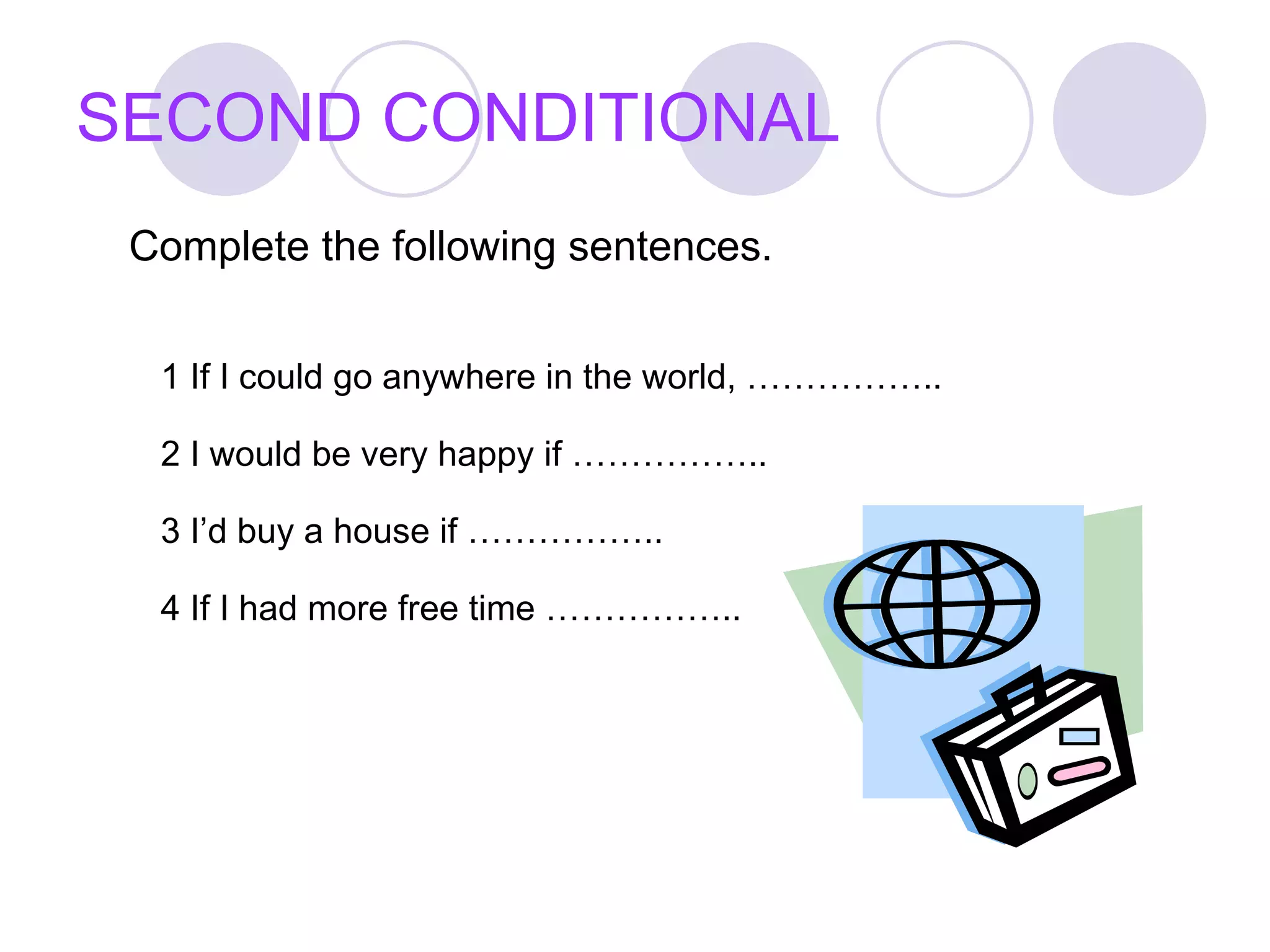
SECOND CONDITIONAL Complete the following sentences. 1 If I could go anywhere in the world, …………….. 2 I would be very happy if …………….. 3 I’d buy a house if …………….. 4 If I had more free time ……………..
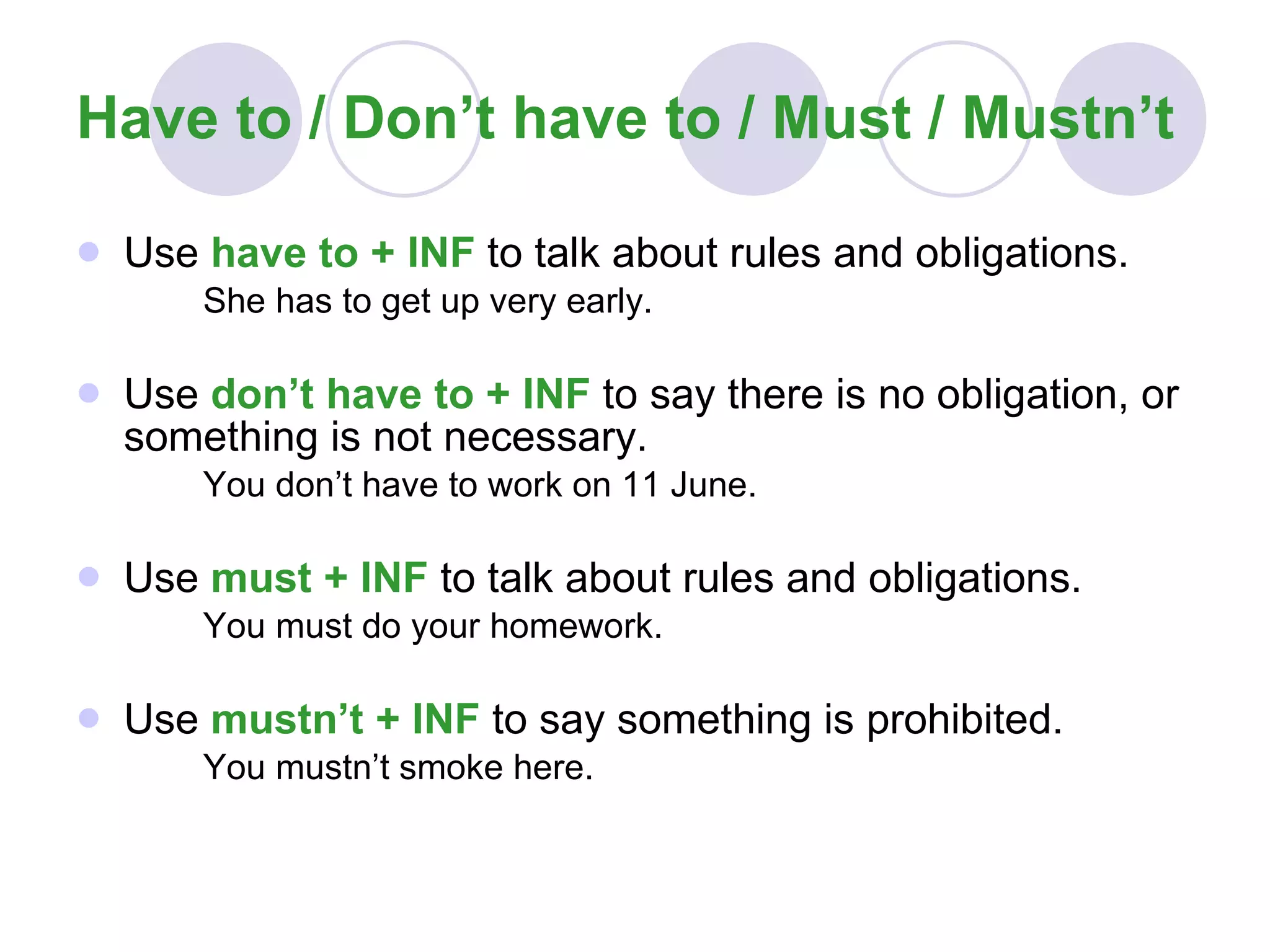
Have to / Don’t have to / Must / Mustn’t Use  have to + INF  to talk about rules and obligations. She has to get up very early. Use  don’t have to + INF  to say there is no obligation, or something is not necessary. You don’t have to work on 11 June. Use  must + INF  to talk about rules and obligations. You must do your homework. Use  mustn’t + INF  to say something is prohibited. You mustn’t smoke here.
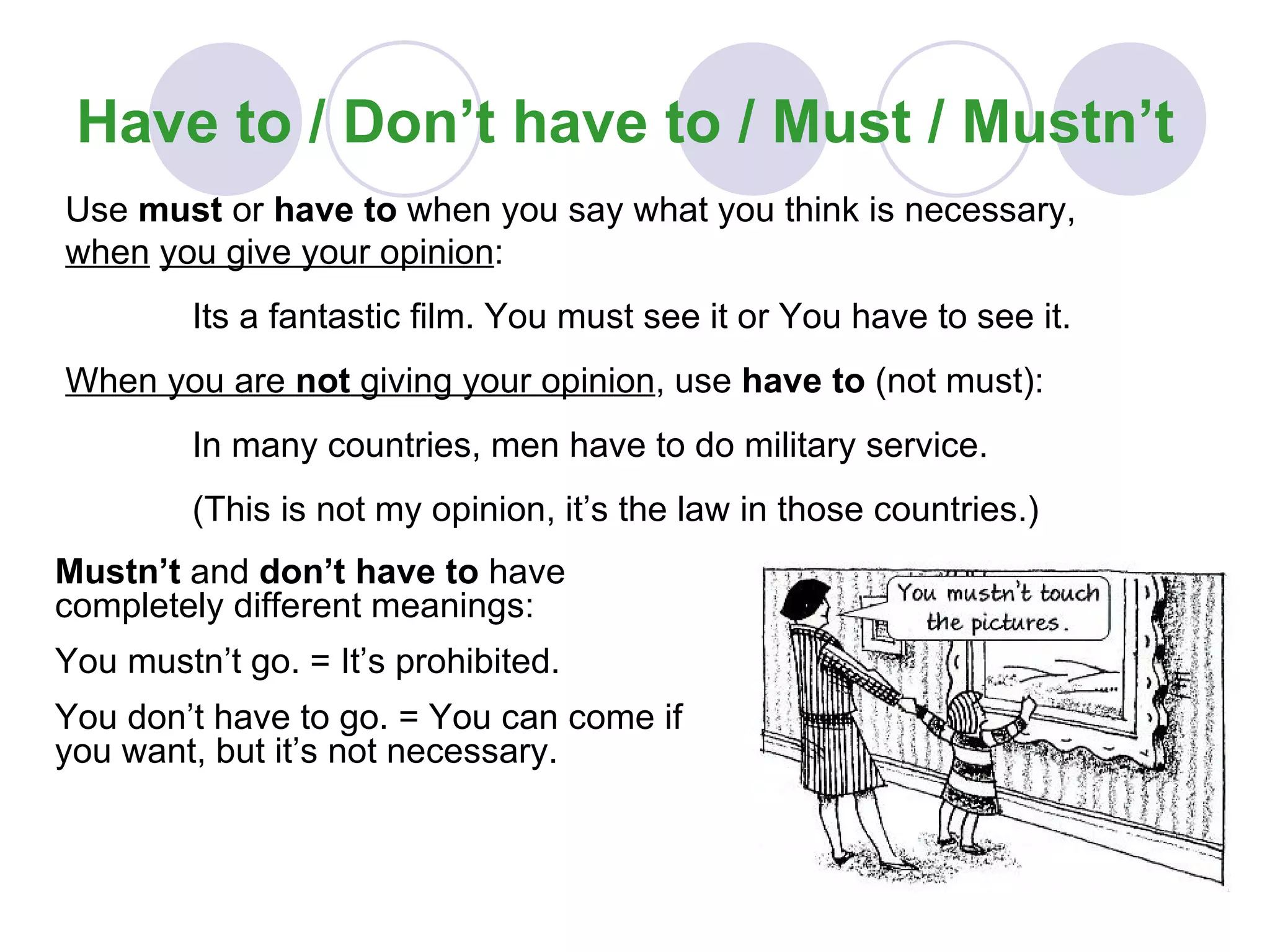
Have to / Don’t have to / Must / Mustn’t Mustn’t  and  don’t have to  have completely different meanings: You mustn’t go. = It’s prohibited. You don’t have to go. = You can come if you want, but it’s not necessary. Use  must  or  have to  when you say what you think is necessary,  when   you give your opinion : Its a fantastic film. You must see it or You have to see it. When you are  not  giving your opinion , use  have to  (not must): In many countries, men have to do military service.  (This is not my opinion, it’s the law in those countries.)
Have to / Don’t have to / Must / Mustn’t Complete the following sentences with mustn’t or dont have to. 1 Gary gave me a letter to post. I __________ forget to post it. 2 There’s plenty of time. You __________ to decide now. 3 This is a valuable book. You __________ lose it. 4 A What sort of house do you want to buy? Something big? B Well, it __________ be big - that’s not so important, but it must have a nice garden.
GIVING ADVICE Use  should / shouldn’t + INF  to give somebody advice. You can also use  ought to / ought not to + INF  or  If I were you, I would + INF. A I’ve got a cold. What should I do?  B You should go to the doctor. / If I were you I’d go to the doctor.
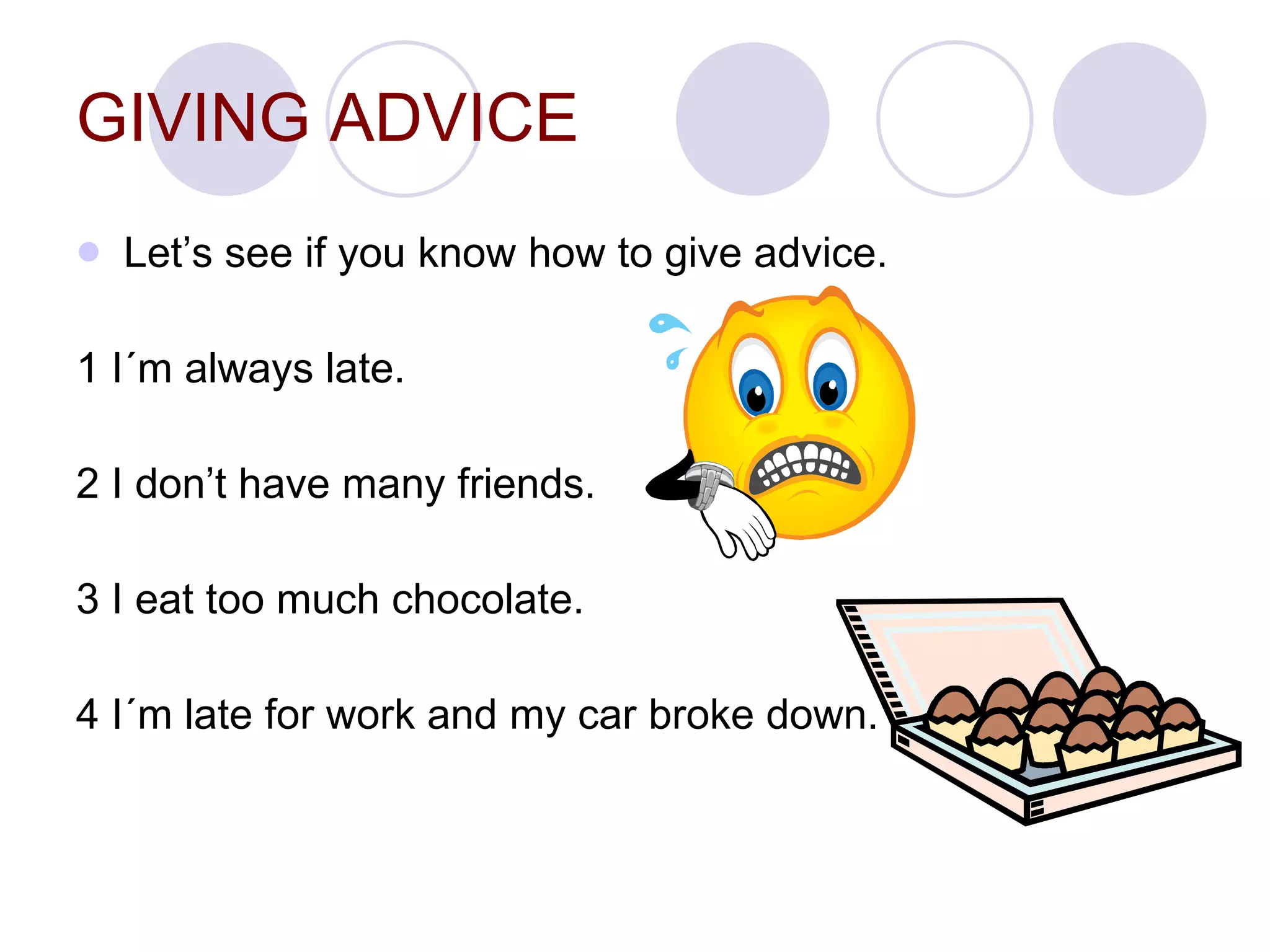
GIVING ADVICE Let’s see if you know how to give advice. 1 I´m always late. 2 I don’t have many friends. 3 I eat too much chocolate. 4 I´m late for work and my car broke down.

Final Revision Segundo

  • 1.
    Final revision PresentPerfect The Future Have to / Don’t have to / Must First Conditional Second Conditional Giving advice
  • 2.
    Present Perfect TenseFORM: have / has + past participle Affirmative : I have seen the film before. She has seen the film before. Interrogative : Have you seen the film before? Has she seen the film before? Negative : They have n’t seen the film before. He has n’t seen the film before.
  • 3.
    1- Recentevents : It is used to describe recent events without a definite time . We use just in positive sentences to say that something happened very recently. Present Perfect Tense Uses of the present perfect Would you like a coffee? No, thanks. I´ve just had one.
  • 4.
    Present Perfect Tense2- Personal experiences : It is used to express personal experiences, there is not a definite time given. The time expressions ever and never are very often used with this meaning Have you ever been to Japan? No, I’ve never been there.
  • 5.
    Present Perfect Tense3- It is used to express actions which started in the past and are still continuing in the present , the time period is not finished. I have lost my keys. (And I haven’t found them yet.)
  • 6.
    Present Perfect +already and yet We often use the present perfect tense with already and yet . Already : Something happened before now or earlier than expected You can use already in positive sentences . Put already before the main verb. Yet : Until now. You can use yet in negative sentences and questions . Yet is usually at the end . Example : A) Have you done your homework yet? B) No, I haven’t done it yet. / Yes, I’ve already done it.
  • 7.
    Present Perfect +for and since To talk about actions and states which started in the past and are still true now. - How long have you lived in Granada? I’ve lived in Granada since 1990 / for 20 years . (I live in Granada now.)
  • 8.
    Present Perfect or Past Simple We use definite expressions with the Past simple tense: yesterday, last week, … ago, etc, while we don’t use definite time expressions with the Present perfect tense. I have been to France three times. When did you go there? I went there last summer.
  • 9.
    Present Perfect or Past Simple Use the present perfect + how long? / for and since to talk about a period of time from the past until now. How long have you been married? I´ve been married since 1999 / for 10 years. (I am still married). Use the past simple + how long? / for or from to to talk about a period of time in the past . - How long were you married? - I was married for 3 years / from 1995 to 1998. (I am divorced now).
  • 10.
    Present Perfect or Past Simple Present Perfect or Past Simple? Rose works in a factory. She ___________ (work) there for six months. Before that she ___________ (be) a waitress in a restaurant. She ___________ (work) there for two years but she ___________ (not/enjoy) it very much. A ___________ (you/ever/been) to Florida? B Yes, we ___________ (go) there two years ago. A ___________ (you/have) a good time? B Yes, it ___________ (be) great.
  • 11.
    Present Perfect + Superlatives We often use a superlative with the present perfect. That is the smallest house I have ever seen . Make sentences as in the example. It / noisy pub / I be to He / boring person / meet It / bad book / I / read
  • 12.
    WILL / WON’T(BE) GOING TO PRESENT CONTINUOUS THE FUTURE
  • 13.
    Predictions Promises OffersInstant decisions
  • 14.
    You will winthe lottery… Will: Predictions
  • 15.
    I will alwayslove you.
  • 16.
    I will takeyou sightseeing. Shall I open the window?
  • 17.
    I’ll have thesteak, please Meat or fish? I will have the steak, please Meat or fish?
  • 18.
    Predictions Decisions thatyou have planned before: future plans and intentions
  • 19.
    It is goingto rain (be) going to: predictions
  • 20.
    She’s going tosave money. (be) going to: future plans and intentions
  • 21.
    Future arrangements Thesentence usually contains an adverb which refers to the future
  • 22.
    I am goingto the dentist tomorrow. 18.30: Dentist
  • 23.
    FIRST CONDITIONAL 2You can also use the imperative or can . If you need my car, take it. If you miss the bus, you can get a taxi. 1 Use IF + PRESENT SIMPLE ... WILL/WON’T + INF to talk about a future situation and its consequence. If he wakes up early, we will go for a walk.
  • 24.
    FIRST CONDITIONAL Completethe following sentences. 1 I will go to the cinema if I .................... (have) time. 2 If it is foggy this evening, I .................... (stay) at home. 3 .................... (you, come) to a picnic next Sunday if it’s sunny? 4 If the road .................... (be) wet, (watch out).
  • 25.
    SECOND CONDITIONAL 1Use IF + PAST SIMPLE ... WOULD/WOULDN’T + INF to talk about an improbable / impossible or hypothetical situation and its consequence. If he woke up early, we would go for a walk. 2 Remember with can, use could + INF : If I had money, I could go on holiday. 3 With the verb be you can use were (instead of was) after I, he/she/it: If he was/were here, he’d help you If I were you….
  • 26.
    SECOND CONDITIONAL Completethe following sentences. 1 If I could go anywhere in the world, …………….. 2 I would be very happy if …………….. 3 I’d buy a house if …………….. 4 If I had more free time ……………..
  • 27.
    Have to /Don’t have to / Must / Mustn’t Use have to + INF to talk about rules and obligations. She has to get up very early. Use don’t have to + INF to say there is no obligation, or something is not necessary. You don’t have to work on 11 June. Use must + INF to talk about rules and obligations. You must do your homework. Use mustn’t + INF to say something is prohibited. You mustn’t smoke here.
  • 28.
    Have to /Don’t have to / Must / Mustn’t Mustn’t and don’t have to have completely different meanings: You mustn’t go. = It’s prohibited. You don’t have to go. = You can come if you want, but it’s not necessary. Use must or have to when you say what you think is necessary, when you give your opinion : Its a fantastic film. You must see it or You have to see it. When you are not giving your opinion , use have to (not must): In many countries, men have to do military service. (This is not my opinion, it’s the law in those countries.)
  • 29.
    Have to /Don’t have to / Must / Mustn’t Complete the following sentences with mustn’t or dont have to. 1 Gary gave me a letter to post. I __________ forget to post it. 2 There’s plenty of time. You __________ to decide now. 3 This is a valuable book. You __________ lose it. 4 A What sort of house do you want to buy? Something big? B Well, it __________ be big - that’s not so important, but it must have a nice garden.
  • 30.
    GIVING ADVICE Use should / shouldn’t + INF to give somebody advice. You can also use ought to / ought not to + INF or If I were you, I would + INF. A I’ve got a cold. What should I do? B You should go to the doctor. / If I were you I’d go to the doctor.
  • 31.
    GIVING ADVICE Let’ssee if you know how to give advice. 1 I´m always late. 2 I don’t have many friends. 3 I eat too much chocolate. 4 I´m late for work and my car broke down.