Present Perfect Tense
Thepresent perfect is
often used for an action
which started at some
time in the past , and is
still continuing now .
3
4.
Note
To form thePRESENT PERFECT
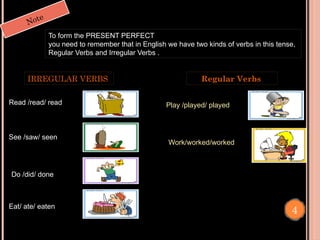
you need to remember that in English we have two kinds of verbs in this tense,
Regular Verbs and Irregular Verbs .
Read /read/ read Play /played/ played
Work/worked/worked
See /saw/ seen
Do /did/ done
IRREGULAR VERBS Regular Verbs
Eat/ ate/ eaten
4
5.
1- Recent events:It is used to describe recent
events without a definite time. The idea of time
or place in the speaker’s mind makes the event
recent. A Time Expression may emphasize
recentness: just, recently, lately.
Present Perfect Tense
Uses of the present perfect
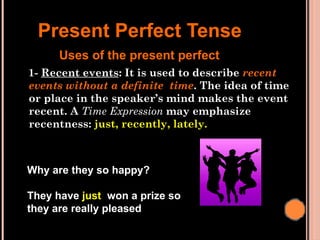
Why are they so happy?
They have just won a prize so
they are really pleased
6.
PRESENT PERFECT TENSE
2-Personal experiences: It is used to express
personal experiences, there is not a definite time
given. The time expressions ever and never are
very often used with this meaning
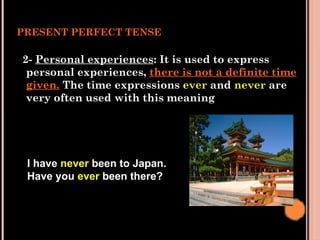
I have never been to Japan.
Have you ever been there?
7.
PRESENT PERFECT TENSE
3-Up to now: It is used to express actions that
started in the past and continue to the present,
the time period is not finished. We use for and
since with this meaning. We use for with
“periods of time” and since with “points of time”.
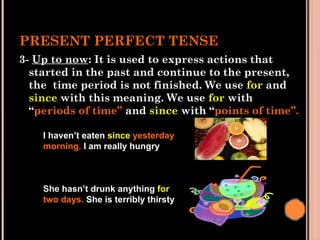
I haven’t eaten since yesterday
morning. I am really hungry
She hasn’t drunk anything for
two days. She is terribly thirsty
8.
FORM: have /has + past participle
I have read that book before.
Or
I’ve read that book before
1- Affirmative: S + HAVE / HAS + PARTICIPLE +
COMPLEMENT (C)
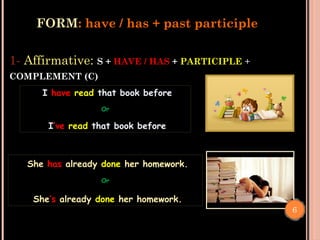
She has already done her homework.
Or
She’s already done her homework.
6
9.
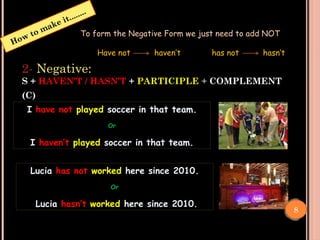
Negative:
How to makeit........
To form the Negative Form we just need to add NOT
Have not haven’t has not hasn’t
8
2- Negative:
S + HAVEN’T / HASN’T + PARTICIPLE + COMPLEMENT
(C)
I have not played soccer in that team.
Or
I haven’t played soccer in that team.
Lucia has not worked here since 2010.
Or
Lucia hasn’t worked here since 2010.
10.
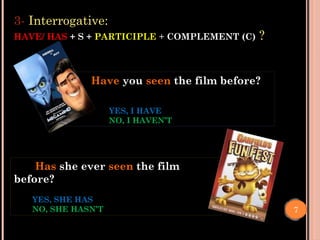
Has she everseen the film
before?
YES, SHE HAS
NO, SHE HASN’T
Have you seen the film before?
YES, I HAVE
NO, I HAVEN’T
7
3- Interrogative:
HAVE/ HAS + S + PARTICIPLE + COMPLEMENT (C) ?
11.
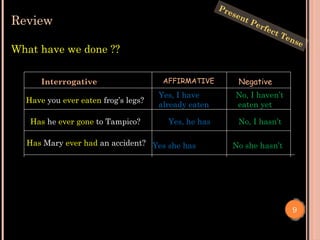
Interrogative AFFIRMATIVE Negative
Haveyou ever eaten frog’s legs?
Yes, I have
already eaten
No, I haven’t
eaten yet
Has he ever gone to Tampico? Yes, he has No, I hasn’t
Has Mary ever had an accident? Yes she has No she hasn’t
Review
What have we done ??
Present Perfect Tense
9
12.
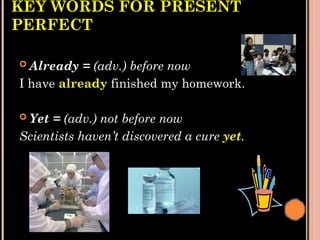
KEY WORDS FORPRESENT
PERFECT
Already = (adv.) before now
I have already finished my homework.
Yet = (adv.) not before now
Scientists haven’t discovered a cure yet.
13.
KEY WORDS FORPRESENT
PERFECT
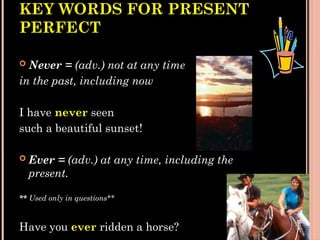
Never = (adv.) not at any time
in the past, including now
I have never seen
such a beautiful sunset!
Ever = (adv.) at any time, including the
present.
** Used only in questions**
Have you ever ridden a horse?
14.
KEY WORDS FORPRESENT
PERFECT
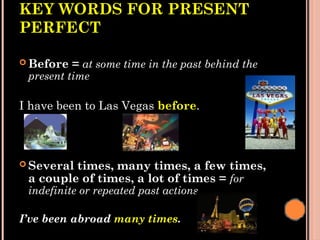
Before = at some time in the past behind the
present time
I have been to Las Vegas before.
Several times, many times, a few times,
a couple of times, a lot of times = for
indefinite or repeated past actions.
I’ve been abroad many times.
15.
KEY WORDS FORPRESENT
PERFECT
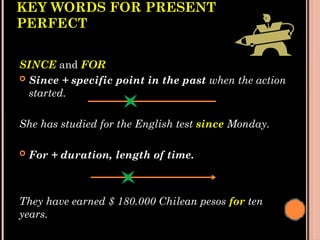
SINCE and FOR
Since + specific point in the past when the action
started.
She has studied for the English test since Monday.
For + duration, length of time.
They have earned $ 180.000 Chilean pesos for ten
years.
16.
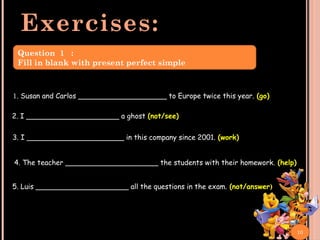
Exercises:
1. Susan andCarlos ____________________ to Europe twice this year. (go)
2. I _____________________ a ghost (not/see)
4. The teacher _____________________ the students with their homework. (help)
5. Luis _____________________ all the questions in the exam. (not/answer)
3. I ______________________ in this company since 2001. (work)
10
Question 1 :
Fill in blank with present perfect simple
17.
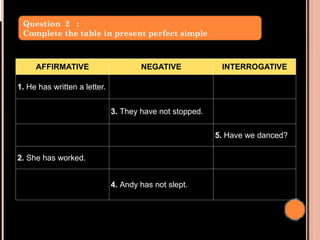
AFFIRMATIVE NEGATIVE INTERROGATIVE
1.He has written a letter.
3. They have not stopped.
5. Have we danced?
2. She has worked.
4. Andy has not slept.
Question 2 :
Complete the table in present perfect simple
18.
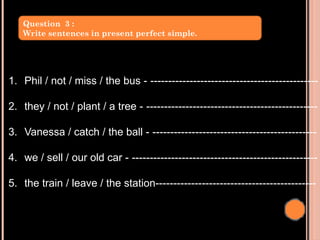
1. Phil /not / miss / the bus - -----------------------------------------------
2. they / not / plant / a tree - ------------------------------------------------
3. Vanessa / catch / the ball - ----------------------------------------------
4. we / sell / our old car - ----------------------------------------------------
5. the train / leave / the station---------------------------------------------
Question 3 :
Write sentences in present perfect simple.
19.
.
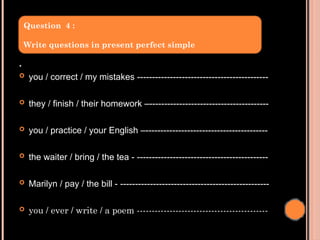
you /correct / my mistakes --------------------------------------------
they / finish / their homework –----------------------------------------
you / practice / your English –-----------------------------------------
the waiter / bring / the tea - --------------------------------------------
Marilyn / pay / the bill - --------------------------------------------------
you / ever / write / a poem --------------------------------------------
Question 4 :
Write questions in present perfect simple
20.
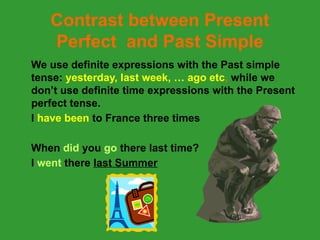
Contrast between Present
Perfectand Past Simple
We use definite expressions with the Past simple
tense: yesterday, last week, … ago etc, while we
don’t use definite time expressions with the Present
perfect tense.
I have been to France three times
When did you go there last time?
I went there last Summer
21.
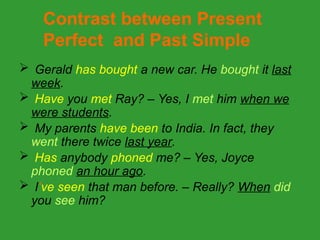
Gerald hasbought a new car. He bought it last
week.
Have you met Ray? – Yes, I met him when we
were students.
My parents have been to India. In fact, they
went there twice last year.
Has anybody phoned me? – Yes, Joyce
phoned an hour ago.
I’ve seen that man before. – Really? When did
you see him?
Contrast between Present
Perfect and Past Simple
Present Perfect Tense
Haveyou walked along a
riverside similar to the one on
the photograph?
When did you do it?
24.
Note the difference
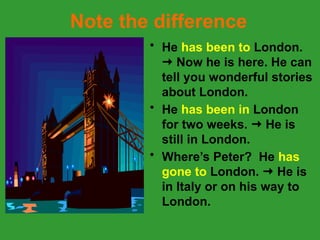
•He has been to London.
Now he is here. He can
tell you wonderful stories
about London.
• He has been in London
for two weeks. He is
still in London.
• Where’s Peter? He has
gone to London. He is
in Italy or on his way to
London.
Write threemore examples for EACH
USE or context of Present Perfect.
Use the KEY WORDS for each USE of
Present Perfect.
Nine minutes to do it.
Exercises
HAVE / HAS + PARTICIPLE