Present Indefinite Tense back menu next
Действие происходит ежедневно, обычно, часто, редко и т.д . I go to school every day. You go to school every day We go to school every day You go to school every day They go to school every day. ( often, seldom, very seldom, usually, always ) back menu next
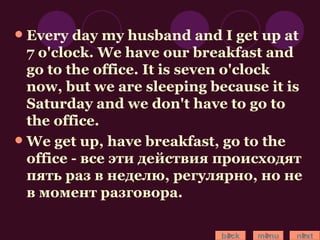
Study the following: Every day my husband and I get up at 7 o'clock. We have our breakfast and go to the office. It is seven o'clock now, but we are sleeping because it is Saturday and we don't have to go to the office. We get up, have breakfast, go to the office - все эти действия происходят пять раз в неделю, регулярно, но не в момент разговора. back menu next
Мы используем Present Simple, для того, чтобы сказать о действиях, которые происходят постоянно. Мы не связываем действие с определенным моментом, а считаем, что действие происходит постоянно или повторяется время от времени. Неважно, когда произошло действие по отношению ко времени разговора: -  I always put down the new words into my  notebook. - Does she study French three times a week? - They do not watch TV every evening. - Who does the shopping in your family? - My mother does. She goes shopping twice a week. back menu next
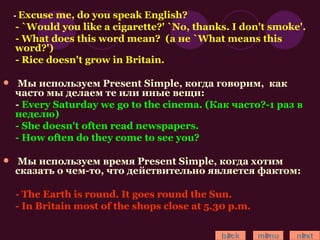
-  Excuse me, do you speak English? - `Would you like a cigarette?' `No, thanks. I don't smoke'. - What does this word mean?  (а не `What means this word?') - Rice doesn't grow in Britain. Мы используем  Present Simple , когда говорим,  как часто мы делаем те или иные вещи: -  Every Saturday we go to the cinema. (Как часто?-1 раз в неделю) - She doesn't often read newspapers. - How often do they come to see you? Мы используем время  P resent  Simple , когда хотим сказать о чем-то, что действительно является фактом: - The Earth is round. It goes round the Sun. - In Britain most of the shops close at 5.30 p.m. back menu next
Every day my husband and I get up at 7 o'clock. We have our breakfast and go to the office. It is seven o'clock now, but we are sleeping because it is Saturday and we don't have to go to the office. We get up, have breakfast, go to the office - все эти действия происходят пять раз в неделю, регулярно, но не в момент разговора. back menu next
3  лицо единственное число. 3  person singular. Глагол +  s (es)  [z]  [s] Send-sends  [z]  Take-takes [s] Play – plays [z]  Sit – sits  [s] See – sees  [z]   [iz]  Go – goes  [z]   Wash-washes [iz] Do- does  [z]   Catch – catches [is] back menu next
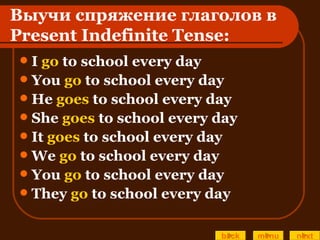
Выучи спряжение глаголов в  Present Indefinite Tense: I  go  to school   every day You  go  to school every day He  goes  to school every day She  goes  to school every day It  goes  to school every day We  go  to school every day You  go  to school every day They  go  to school every day back menu next
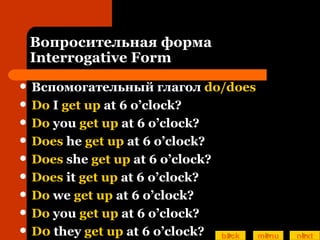
Вопросительная форма Interrogative Form Вспомогательный глагол  do/does Do  I  get up  at 6 o’clock?  Do  you  get up  at 6 o’clock? Does  he  get up  at 6 o’clock? Does  she  get up  at 6 o’clock? Does  it  get up  at 6 o’clock? Do  we  get up  at 6 o’clock? Do  you  get up  at 6 o’clock? D0  they  get up  at 6 o’clock? back menu next
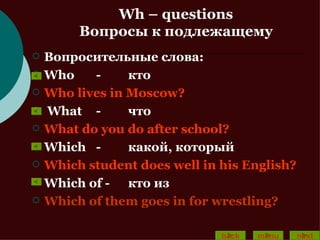
Wh – questions Вопросы к подлежащему Вопросительные слова: Who - кто Who lives in Moscow? What - что   What do you do after school? Which - какой, который Which student does well in his English? Which of  -  кто из Which of them goes in for wrestling? back menu next
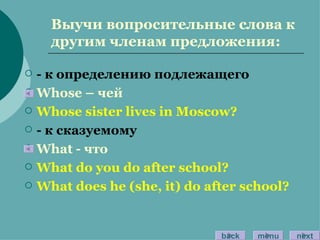
Выучи вопросительные слова к другим членам предложения: - к определению подлежащего Whose –  чей Whose sister lives in Moscow? -  к сказуемому What -  что What do you do after school? What does he (she, it) do after school? back menu next
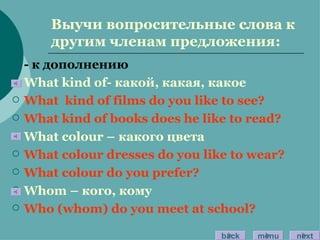
Выучи вопросительные слова к другим членам предложения: - к дополнению What kind of - какой, какая, какое What  kind of films do you like to see? What kind of books does he like to read? What colour –  какого цвета What colour dresses do you like to wear? What colour do you prefer? Whom –  кого ,  кому Who (whom) do you meet at school? back menu next
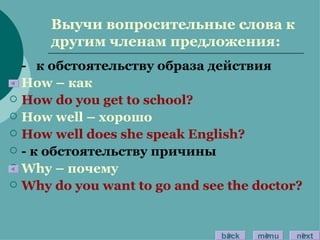
Выучи вопросительные слова к другим членам предложения: -  к обстоятельству образа действия How –  как How do you get to school? How well –  хорошо How well does she speak English? -  к обстоятельству причины Why –  почему Why do you want to go and see the doctor? back menu next
Выучи вопросительные слова к другим членам предложения: -  к обстоятельству места: Where –  где, куда Where do you live? Where does he go after school? -  к обстоятельству времени: When –  когда When do you usually get up? When does she usually play the piano? back menu next
Отрицательная форма Negative Form Do not, does not / don’t, doesn’t I  don’t   go  to school You  don’t   go  to school He  doesn’t   go  to school She  doesn’t   go  to school It  doesn’t   go  to school We  don’t   go  to school You  don’t   go  to school They  don’t   go  to school back menu next
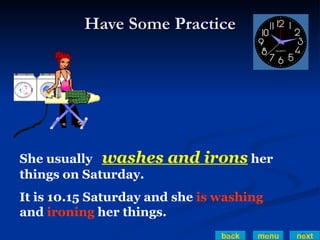
Have Some Practice She usually  washes and irons  her things on Saturday. It is 10.15 Saturday and she  is washing  and  ironing  her things. back menu next
The girls usually  dance  during the breaks in different games. It is a break in the game and they  are dancing  now. back menu next
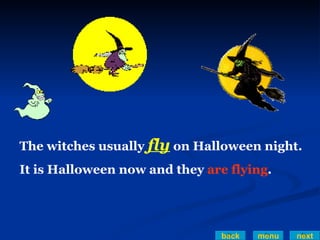
back menu next The witches usually  fly  on Halloween night. It is Halloween now and they  are flying .
back menu next He always  rides   his race-horse on Sundays.  He  likes   to take part in the horse races. It is Sunday now and he  is riding  his race-horse. He  is taking  part in the steeplechase.
They always  play  when they meet. They  are playing  now. back menu next
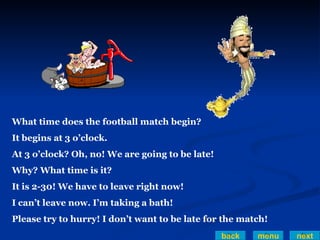
What time does the football match begin? It begins at 3 o’clock. At 3 o’clock? Oh, no! We are going to be late! Why? What time is it? It is 2-30! We have to leave right now! I can’t leave now. I’m taking a bath! Please try to hurry! I don’t want to be late for the match! back menu next
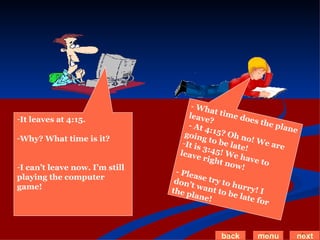
It leaves at 4:15. Why? What time is it? I can’t leave now. I’m still playing the computer game! -  What time does the plane leave? - At 4:15? Oh no! We are going to be late! It is 3:45! We have to leave right now! - Please try to hurry! I don’t want to be late for the plane! back menu next
How do you feel today? I feel terrible. What’s the matter? I have a terrible toothache. I’m sorry to hear that. back menu next

Present Indefinite Tense

  • 1.
  • 2.
    Действие происходит ежедневно,обычно, часто, редко и т.д . I go to school every day. You go to school every day We go to school every day You go to school every day They go to school every day. ( often, seldom, very seldom, usually, always ) back menu next
  • 3.
    Study the following:Every day my husband and I get up at 7 o'clock. We have our breakfast and go to the office. It is seven o'clock now, but we are sleeping because it is Saturday and we don't have to go to the office. We get up, have breakfast, go to the office - все эти действия происходят пять раз в неделю, регулярно, но не в момент разговора. back menu next
  • 4.
    Мы используем PresentSimple, для того, чтобы сказать о действиях, которые происходят постоянно. Мы не связываем действие с определенным моментом, а считаем, что действие происходит постоянно или повторяется время от времени. Неважно, когда произошло действие по отношению ко времени разговора: - I always put down the new words into my notebook. - Does she study French three times a week? - They do not watch TV every evening. - Who does the shopping in your family? - My mother does. She goes shopping twice a week. back menu next
  • 5.
    - Excuseme, do you speak English? - `Would you like a cigarette?' `No, thanks. I don't smoke'. - What does this word mean? (а не `What means this word?') - Rice doesn't grow in Britain. Мы используем Present Simple , когда говорим, как часто мы делаем те или иные вещи: - Every Saturday we go to the cinema. (Как часто?-1 раз в неделю) - She doesn't often read newspapers. - How often do they come to see you? Мы используем время P resent Simple , когда хотим сказать о чем-то, что действительно является фактом: - The Earth is round. It goes round the Sun. - In Britain most of the shops close at 5.30 p.m. back menu next
  • 6.
    Every day myhusband and I get up at 7 o'clock. We have our breakfast and go to the office. It is seven o'clock now, but we are sleeping because it is Saturday and we don't have to go to the office. We get up, have breakfast, go to the office - все эти действия происходят пять раз в неделю, регулярно, но не в момент разговора. back menu next
  • 7.
    3 лицоединственное число. 3 person singular. Глагол + s (es) [z] [s] Send-sends [z] Take-takes [s] Play – plays [z] Sit – sits [s] See – sees [z] [iz] Go – goes [z] Wash-washes [iz] Do- does [z] Catch – catches [is] back menu next
  • 8.
    Выучи спряжение глаголовв Present Indefinite Tense: I go to school every day You go to school every day He goes to school every day She goes to school every day It goes to school every day We go to school every day You go to school every day They go to school every day back menu next
  • 9.
    Вопросительная форма InterrogativeForm Вспомогательный глагол do/does Do I get up at 6 o’clock? Do you get up at 6 o’clock? Does he get up at 6 o’clock? Does she get up at 6 o’clock? Does it get up at 6 o’clock? Do we get up at 6 o’clock? Do you get up at 6 o’clock? D0 they get up at 6 o’clock? back menu next
  • 10.
    Wh – questionsВопросы к подлежащему Вопросительные слова: Who - кто Who lives in Moscow? What - что What do you do after school? Which - какой, который Which student does well in his English? Which of - кто из Which of them goes in for wrestling? back menu next
  • 11.
    Выучи вопросительные словак другим членам предложения: - к определению подлежащего Whose – чей Whose sister lives in Moscow? - к сказуемому What - что What do you do after school? What does he (she, it) do after school? back menu next
  • 12.
    Выучи вопросительные словак другим членам предложения: - к дополнению What kind of - какой, какая, какое What kind of films do you like to see? What kind of books does he like to read? What colour – какого цвета What colour dresses do you like to wear? What colour do you prefer? Whom – кого , кому Who (whom) do you meet at school? back menu next
  • 13.
    Выучи вопросительные словак другим членам предложения: - к обстоятельству образа действия How – как How do you get to school? How well – хорошо How well does she speak English? - к обстоятельству причины Why – почему Why do you want to go and see the doctor? back menu next
  • 14.
    Выучи вопросительные словак другим членам предложения: - к обстоятельству места: Where – где, куда Where do you live? Where does he go after school? - к обстоятельству времени: When – когда When do you usually get up? When does she usually play the piano? back menu next
  • 15.
    Отрицательная форма NegativeForm Do not, does not / don’t, doesn’t I don’t go to school You don’t go to school He doesn’t go to school She doesn’t go to school It doesn’t go to school We don’t go to school You don’t go to school They don’t go to school back menu next
  • 16.
    Have Some PracticeShe usually washes and irons her things on Saturday. It is 10.15 Saturday and she is washing and ironing her things. back menu next
  • 17.
    The girls usually dance during the breaks in different games. It is a break in the game and they are dancing now. back menu next
  • 18.
    back menu nextThe witches usually fly on Halloween night. It is Halloween now and they are flying .
  • 19.
    back menu nextHe always rides his race-horse on Sundays. He likes to take part in the horse races. It is Sunday now and he is riding his race-horse. He is taking part in the steeplechase.
  • 20.
    They always play when they meet. They are playing now. back menu next
  • 21.
    What time doesthe football match begin? It begins at 3 o’clock. At 3 o’clock? Oh, no! We are going to be late! Why? What time is it? It is 2-30! We have to leave right now! I can’t leave now. I’m taking a bath! Please try to hurry! I don’t want to be late for the match! back menu next
  • 22.
    It leaves at4:15. Why? What time is it? I can’t leave now. I’m still playing the computer game! - What time does the plane leave? - At 4:15? Oh no! We are going to be late! It is 3:45! We have to leave right now! - Please try to hurry! I don’t want to be late for the plane! back menu next
  • 23.
    How do youfeel today? I feel terrible. What’s the matter? I have a terrible toothache. I’m sorry to hear that. back menu next