OBJECTIVES:
• To knowthe definition, the key concepts in engineering
economics, principles of engineering economy, role of
engineers in economic decision, and design process in an
Engineering Economy
3.
BASIC CONCEPTS
1. INTEREST
2.INTEREST RATE
3. SIMPLE INTEREST
4. COMPOUND INTEREST
5. TIME VALUE OF MONEY
6. INFLATION
7. TAXES
8. CASHFLOWS
4.
BASIC CONCEPTS
1. INTEREST
ITIS A FEE THAT IS CHARGED FOR THE USE OF
SOMEONE ELSE'S MONEY. THE SIZE OF THE FEE WILL
DEPEND UPON THE TOTAL AMOUNT OF MONEY
BORROWED AND THE LENGTH OF TIME OVER WHICH
IT IS BORROWED.
BASIC CONCEPTS
2. INTERESTRATE
IT IS THE GIVEN AMOUNT OF MONEY IS
BORROWED FOR A SPECIFIED PERIOD OF TIME
(TYPICALLY, ONE YEAR), A CERTAIN PERCENTAGE
OF THE MONEY IS CHARGED AS INTEREST. THIS
PERCENTAGE IS CALLED THE INTEREST RATE.
BASIC CONCEPTS
3. SIMPLEINTEREST
IT IS DEFINED AS A FIXED PERCENTAGE OF THE
PRINCIPAL (THE AMOUNT OF MONEY
BORROWED), MULTIPLIED BY THE LIFE OF THE
LOAN. THUS,
I = nip
9.
WHERE:
I = totalamount of simple interest
n = life of the loan
I = interest rate (expressed as a decimal)
P = principal
It is understood that n and i refer to the same unit of time (e.g., the
year).
Normally, when a simple interest loan is made, nothing is repaid
until the end of the loan period; then, both the principal and the
accumulated interest are repaid. The total amount due can be
expressed as
BASIC CONCEPTS
4. COMPOUNDINTEREST
WHEN INTEREST IS COMPOUNDED, THE TOTAL TIME PERIOD IS
SUBDIVIDED INTO SEVERAL INTEREST PERIODS (E.G., ONE YEAR, THREE
MONTHS, ONE MONTH). INTEREST IS CREDITED AT THE END OF EACH
INTEREST PERIOD, AND IS ALLOWED TO ACCUMULATE FROM ONE
INTEREST PERIOD TO THE NEXT.
NOTICE THAT F, THE TOTAL AMOUNT OF MONEY ACCUMULATED, INCREASES EXPONENTIALLY WITH
N, THE TIME MEASURED IN INTEREST PERIODS.
12.
BASIC CONCEPTS
COMPOUND INTEREST:EXAMPLE
F = $2,012.20
Compound Interest Simple Interest
F = P(1+ni)
F = $1000[1+12(0.06)]
F = $1,720.00
Thus, the student's original investment
will have more than doubled over the 12-
13.
BASIC CONCEPTS
5. TIMEVALUE OF MONEY
SINCE MONEY HAS THE ABILITY TO EARN INTEREST, ITS VALUE INCREASES WITH
TIME. FOR INSTANCE, $100 TODAY IS EQUIVALENT TO
FIVE YEARS FROM NOW IF THE INTEREST RATE IS 7% PER YEAR, COMPOUNDED
ANNUALLY. WE SAY THAT THE FUTURE WORTH OF $100 IS $140.26 IF I = 7% (PER
YEAR) AND N = 5 (YEARS).
SINCE MONEY INCREASES IN VALUE AS WE MOVE FROM THE PRESENT TO THE
FUTURE, IT MUST DECREASE IN VALUE AS WE MOVE FROM THE FUTURE TO THE
PRESENT. THUS, THE PRESENT WORTH OF $140.26 IS $100 IF I = 7% (PER YEAR)
AND N = 5 (YEARS)
14.
BASIC CONCEPTS
TIME VALUEOF MONEY: EXAMPLE
P = $4,258.07
Compound Interest
The present worth of $5,000 is $4,258.07
if I = 5.5%, compounded annually, and
15.
BASIC CONCEPTS
6. INFLATION
NATIONALECONOMIES FREQUENTLY EXPERIENCE INFLATION, IN WHICH
THE COST OF GOODS AND SERVICES INCREASES FROM ONE YEAR TO THE
NEXT. NORMALLY, INFLATIONARY INCREASES ARE EXPRESSED IN TERMS
OF PERCENTAGES WHICH ARE COMPOUNDED ANNUALLY. THUS, IF THE
PRESENT COST OF A COMMODITY IS PC, ITS FUTURE COST, FC, WILL BE
BASIC CONCEPTS
INFLATION: EXAMPLE
WhereF is the future worth, measured in today’s dollars, of a present amount
P
OR
In a inflationary economy, the value (buying power) of money decreases as
costs increase. Thus,
18.
BASIC CONCEPTS
INFLATION: EXAMPLE
F= $74.76
Thus, $100 in five years will be worth only
$74.73 in terms of today's dollars. Stated
differently, in five years $100 will be
required to purchase the same
commodity that can now be purchased
for $74.73.
19.
IF INTEREST ISBEING COMPOUNDED AT THE SAME TIME THAT
INFLATION IS OCCURRING, THEN THE FUTURE WORTH CAN BE
DETERMINED BY COMBINING (1.3) AND (1.5):
(1.3) (1.5)
Or, defining the composite interest rate,
BASIC CONCEPTS
INFLATION: EXAMPLE
F= $74.76
A composite interest rate can be determined from this
equation;
Substituting this value, we obtain
22.
BASIC CONCEPTS
7. TAXES
INMOST SITUATIONS, THE INTEREST THAT IS RECEIVED FROM
AN INVESTMENT WILL BE SUBJECT TO TAXATION. SUPPOSE
THAT THE INTEREST IS TAXED AT A RATE T, AND THAT THE
PERIOD OF TAXATION IS THE SAME AS THE INTEREST PERIOD
(E.G., ONE YEAR). THEN THE TAX FOR EACH PERIOD WILL BE
, SO THAT THE NET RETURN TO THE
INVESTOR (AFTER TAXES) WILL BE
I’ = I – T = (1 – t)iP
T = tiP
23.
IF THE EFFECTSOF TAXATION AND INFLATION ARE BOTH
INCLUDED IN A COMPOUND INTEREST CALCULATION, MAY
STILL BE USED TO RELATE PRESENT AND FUTURE VALUES,
PROVIDED THE COMPOSITE INTEREST RATE IS REDEFINED AS
24.
BASIC CONCEPTS
TAXES: EXAMPLE
F= $9,236.61
Let us assume that the engineer is able to invest the entire $10,000 in a savings
certificate and that the tax bracket includes all federal, state, and local taxes.
By;
Substituting this value, we obtain
25.
Because of thecombined effects of inflation and taxation, I3 is negative, and
the engineer ends up with less real purchasing power after 15 years than he
has today. (To make matters worse, the engineer will most likely have to pay
taxes on the original $10 000, substantially reducing the amount of money
available for investment.)
26.
BASIC CONCEPTS
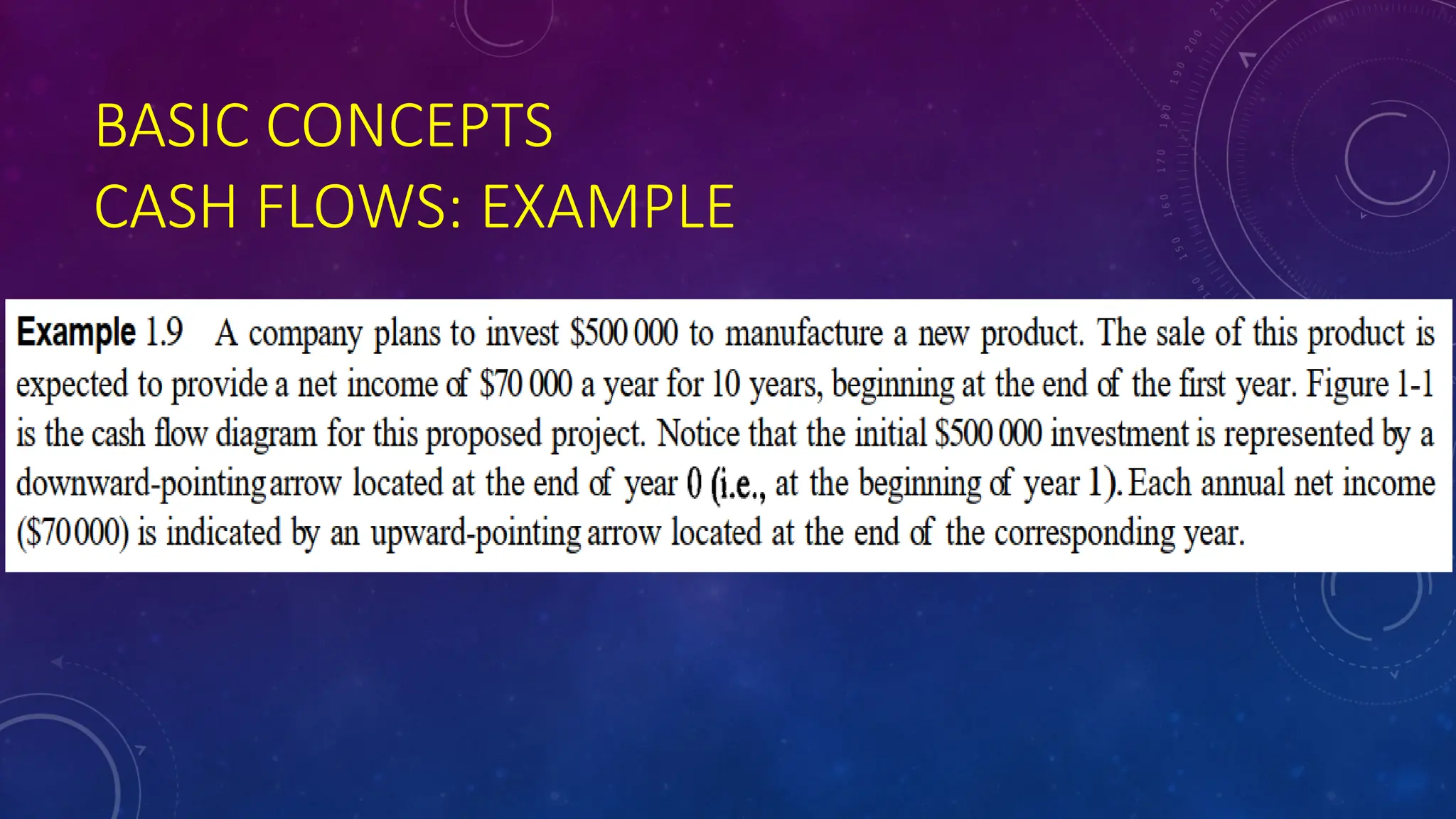
7. CASHFLOWS
A CASH FLOW IS THE DIFFERENCE BETWEEN TOTAL CASH RECEIPTS (INFLOWS) AND
TOTAL CASH DISBURSEMENTS (OUTFLOWS) FOR A GIVEN PERIOD OF TIME (TYPICALLY,
ONE YEAR). CASH FLOWS ARE VERY IMPORTANT IN ENGINEERING ECONOMICS BECAUSE
THEY FORM THE BASIS FOR EVALUATING PROJECTS, EQUIPMENT, AND INVESTMENT
ALTERNATIVES.
THE EASIEST WAY TO VISUALIZE A CASH FLOW IS THROUGH A CASH FLOW DIAGRAM, IN
WHICH THE INDIVIDUAL CASH FLOWS ARE REPRESENTED AS VERTICAL ARROWS ALONG
A HORIZONTAL TIME SCALE. POSITIVE CASH FLOWS (NET INFLOWS) ARE REPRESENTED
BY UPWARD-POINTING ARROWS, AND NEGATIVE CASH FLOWS (NET OUTFLOWS) BY
DOWNWARD-POINTING ARROWS; THE LENGTH OF AN ARROW IS PROPORTIONAL TO
THE MAGNITUDE OF THE CORRESPONDING CASH FLOW. EACH CASH FLOW IS ASSUMED
TO OCCUR AT THE END OF THE RESPECTIVE TIME PERIOD.
In a lender-
borrower
situation,an
inflow for the
one is an
outflow for the
other. Hence, the
cash flow
diagram for the
lender will be
the mirror image
in the time line
of the cash flow
diagram for the
29.
PREPARED BY: ENGR.OWEN FRANCIS A. MAONGAT
ES 123 INSTRUCTOR
ANNUAL
COMPOUNDING
3. UNIFORM-SERIES, COMPOUND-AMOUNTFACTOR
Let equal amounts of money, A, be deposited in a
savings account (or placed in some other interest-
bearing investment) at the end of each year, as
indicated in Fig. 2-1. If the money earns interest at a
rate i, compounded annually, how much money will
have accumulated after n years?
5. UNIFORM-SERIES, CAPITAL-RECOVERYFACTOR
Let us now consider a somewhat different situation
involving uniform annual payments. Suppose that a
given sum of money, P, is deposited in a savings
account where it earns interest at a rate i per year,
compounded annually. At the end of each year a fixed
amount, A, is withdrawn (Fig. 2-2). How large should A
be so that the bank account will just be depleted at the
end of n years?
7. GRADIENT SERIESFACTOR
IT IS A SERIES OF ANNUAL PAYMENTS IN WHICH EACH
PAYMENT IS GREATER THAN THE PREVIOUS ONE BY A
CONSTANT AMOUNT, G.
50.
ANNUAL COMPOUNDING
GRADIENT-SERIES FACTOR
Wewish to solve for P, given Ao, G, i, and n. We first obtain a series withdrawals
A’ equivalent to the series of gradients
A = $5,926
ANNUAL COMPOUNDING
GRADIENT-SERIES FACTOR
Amore concise, and the preferable way, to solve this problem is to write
P = $106,116.59
P = Ao x (P/A, i%, n) + G x (A/G, i%, n) x (P/A, i%, n)


![BASIC CONCEPTS
SIMPLE INTEREST: EXAMPLE
F = P(1+ni)
F = $3,000[1+2(0.055)]
F = $3,330](https://image.slidesharecdn.com/3-4basicconceptsannualcompounding-250307104725-3e0ab2ec/75/3-4-Basic-Concepts-Annual-Compounding-pptx-10-2048.jpg)

![BASIC CONCEPTS
COMPOUND INTEREST: EXAMPLE
F = $2,012.20
Compound Interest Simple Interest
F = P(1+ni)
F = $1000[1+12(0.06)]
F = $1,720.00
Thus, the student's original investment
will have more than doubled over the 12-](https://image.slidesharecdn.com/3-4basicconceptsannualcompounding-250307104725-3e0ab2ec/75/3-4-Basic-Concepts-Annual-Compounding-pptx-12-2048.jpg)