kishorepvpsit@gmail.com 7382219990 PVPSIT@MECH PPC U1
MANAGERIAL ECONOMICS
AND FINANCIAL ANALYSIS
MEFA U3
kishorepvpsit@gmail.com 7382219990 PVPSIT@MECH PPC U1
COURSE OUTCOMES:
1. Understand of various aspects of managerial economics,
demand analysis.
2. Understand the use of demand elasticity and various
methods of demand forecasting techniques in
Managerial decisions.
3. Apply production theory, cost theory in relevant
Managerial decision making.
4. Understand the differenced between price output
determination under different market conditions along
with pricing policies.
5. apply capital budgeting, financial analysis techniques in
evaluating various investment opportunities.
MEFA U4
kishorepvpsit@gmail.com 7382219990 PVPSIT@MECH PPC U1
Price output determination under different
Markets & Pricing Policies:
Market Structures: Types of competition, Features
of Perfect Competition, Monopoly and Monopoly
Competition, Price-Output Determination under
Perfect Competition, Monopoly, Monopolistic
Competition and Oligopoly Managerial theories of
the firm – Marris and Williamson‟s models.
Pricing Policies: Methods of pricing.
MEFA U4
kishorepvpsit@gmail.com 7382219990 PVPSIT@MECH PPC U1
UNIT 4
Price output determination under different
Markets & Pricing Policies
What is mArket?
Market is a place where buyer and seller meet, goods
and services are offered for the sale and transfer of
ownership occurs.
MEFA U4
kishorepvpsit@gmail.com 7382219990 PVPSIT@MECH PPC U1
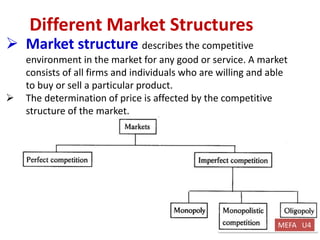
Different Market Structures
 Market structure describes the competitive
environment in the market for any good or service. A market
consists of all firms and individuals who are willing and able
to buy or sell a particular product.
 The determination of price is affected by the competitive
structure of the market.
MEFA U4
kishorepvpsit@gmail.com 7382219990 PVPSIT@MECH PPC U1
Perfect Competition
In a perfectly competitive market, a single market price
prevails for the commodity, which is determined by the
forces of total demand and total supply in the market.
MEFA U4
Characteristics
 A large number of buyers and sellers
 Homogeneous product
 Free entry and exit
 Perfect knowledge
 Indifference: No buyer has a preference to buy from a particular
seller and no seller to sell to a particular buyer.
kishorepvpsit@gmail.com 7382219990 PVPSIT@MECH PPC U1
Pricing under perfect competition
The price or value of a commodity under perfect
competition is determined by the demand for and the
supply of that commodity.
Each firm supplies only very small portion of the market
demand. No single buyer or seller is powerful enough to
influence the price.
the main problem of a firm in a perfectly competitive
market is not to determine the price of its product but to
adjust its output to the given price, So that the profit is
maximum.
MEFA U4
kishorepvpsit@gmail.com 7382219990 PVPSIT@MECH PPC U1
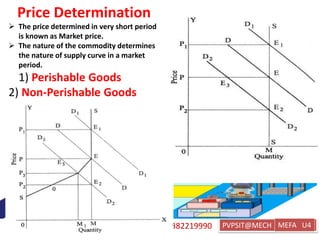
Price Determination
 The price determined in very short period
is known as Market price.
 The nature of the commodity determines
the nature of supply curve in a market
period.
1) Perishable Goods
2) Non-Perishable Goods
MEFA U4
kishorepvpsit@gmail.com 7382219990 PVPSIT@MECH PPC U1
Monopoly
Monopoly is a form of market organization in which there
is only one seller of the commodity.
There are no close substitutes for the commodity sold by
the seller.
Characteristics
 Single person or a firm
 No close substitute
 Large number of Buyers
 Mono - Price Maker
 Downward Sloping Demand Curve
MEFA U4
kishorepvpsit@gmail.com 7382219990 PVPSIT@MECH PPC U1
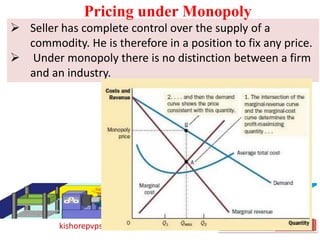
 Seller has complete control over the supply of a
commodity. He is therefore in a position to fix any price.
 Under monopoly there is no distinction between a firm
and an industry.
MEFA U4
Pricing under Monopoly
kishorepvpsit@gmail.com 7382219990 PVPSIT@MECH PPC U1
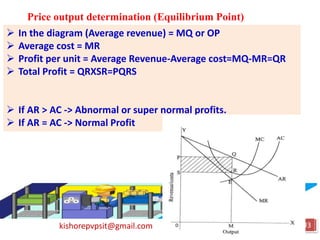
Price output determination (Equilibrium Point)
 In the diagram (Average revenue) = MQ or OP
 Average cost = MR
 Profit per unit = Average Revenue-Average cost=MQ-MR=QR
 Total Profit = QRXSR=PQRS
 If AR > AC -> Abnormal or super normal profits.
 If AR = AC -> Normal Profit
MEFA U3
kishorepvpsit@gmail.com 7382219990 PVPSIT@MECH PPC U1
Monopolistic competition
 Every market seems to exhibit characteristics of both
perfect competition and monopoly.
 Monopolistic competition state of imperfect competition
lying between these two extreme limits that work.
Characteristics:
 Existence of Many firms
 Product Differentiation
 Large Number of Buyers
 Free Entry and Exist of Firms
 Imperfect Knowledge: Imperfect knowledge about the product. If the
buyers are fully aware of the quality of the product they cannot be influenced
much by advertisement or other sales promotion techniques.
MEFA U4
kishorepvpsit@gmail.com 7382219990 PVPSIT@MECH PPC U1
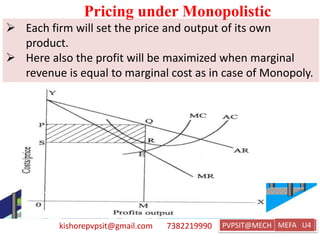
 Each firm will set the price and output of its own
product.
 Here also the profit will be maximized when marginal
revenue is equal to marginal cost as in case of Monopoly.
MEFA U4
Pricing under Monopolistic
kishorepvpsit@gmail.com 7382219990 PVPSIT@MECH PPC U1
Oligopoly competition
 Oligopoly is the form of imperfect competition where
there are a few firms in the market, producing either a
homogeneous product or producing products, which are
close but not perfect substitute of each other.
Characteristics:
 Existence of Few firms
 Indeterminate Demand Curve
 Advertising and selling costs: greater role in the oligopoly market
compared to other market systems
MEFA U4
kishorepvpsit@gmail.com 7382219990 PVPSIT@MECH PPC U1
OTHER MARKET STRUCTURES
1. Duopoly
Duopoly refers to a market situation in which there
are only two sellers. Eg. Coca-Cola and Pepsi
2. Monopsony
Market, which there is a single buyer.
It may be created when all consumers of a commodity are organized together
and/or when only one consumer requires that commodity which no one else
requires.
3.Bilateral Monopoly
A bilateral monopoly is a market situation in which a single seller (Monopoly) faces a single
buyer (Monopsony).
MEFA U4
kishorepvpsit@gmail.com 7382219990 PVPSIT@MECH PPC U1
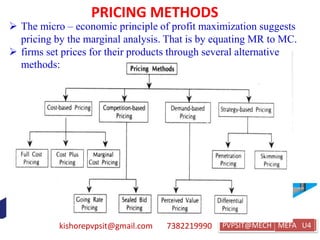
PRICING METHODS
MEFA U4
 The micro – economic principle of profit maximization suggests
pricing by the marginal analysis. That is by equating MR to MC.
 firms set prices for their products through several alternative
methods:
kishorepvpsit@gmail.com 7382219990 PVPSIT@MECH PPC U1
PRICING METHODS …
1. Cost Based Pricing:
Full – cost or break even pricing:
price = average (total) cost.
Cost plus pricing
price = average (total) cost + (…)
Marginal cost pricing.
price = marginal cost
MEFA U4
kishorepvpsit@gmail.com 7382219990 PVPSIT@MECH PPC U1
PRICING METHODS …
2. Competition based pricing: priced according to the
competition in their markets …
going rate method:
prices its new product according to the prevailing
prices of comparable products in the market. …. when
television was first manufactures in India, its import cost must
have been a guiding force in its price determination..
sealed bid pricing
in the case of construction activities and in
the disposition of used produces. In this method
the prospective seller (buyers) are asked to quote
their prices through a sealed cover.
MEFA U4
kishorepvpsit@gmail.com 7382219990 PVPSIT@MECH PPC U1
PRICING METHODS …
1. Demand Based Pricing:
Perceived value pricing
..pricing considers the buyer’s perception of the value of
the product.
Differential pricing
…different prices in different market
segments.
MEFA U4
kishorepvpsit@gmail.com 7382219990 PVPSIT@MECH PPC U1
PRICING METHODS …
1. Strategy based pricing (new product pricing):
skimming pricing:
new product is priced high in the beginning, and its price
is reduced gradually as it faces a dearth of buyers..
….strategy may be beneficial for products, which are fancy, but
of poor quality and / or of insignificant use over a period of
time.
Cost plus pricing
firms sell their new product at a low price
in the beginning in order to catch the attention of
consumers, once the product penetrates.. seller
slowly starts hiking prices.
MEFA U4

MEFA U04 APR2022222.pptx

  • 1.
    kishorepvpsit@gmail.com 7382219990 PVPSIT@MECHPPC U1 MANAGERIAL ECONOMICS AND FINANCIAL ANALYSIS MEFA U3
  • 2.
    kishorepvpsit@gmail.com 7382219990 PVPSIT@MECHPPC U1 COURSE OUTCOMES: 1. Understand of various aspects of managerial economics, demand analysis. 2. Understand the use of demand elasticity and various methods of demand forecasting techniques in Managerial decisions. 3. Apply production theory, cost theory in relevant Managerial decision making. 4. Understand the differenced between price output determination under different market conditions along with pricing policies. 5. apply capital budgeting, financial analysis techniques in evaluating various investment opportunities. MEFA U4
  • 3.
    kishorepvpsit@gmail.com 7382219990 PVPSIT@MECHPPC U1 Price output determination under different Markets & Pricing Policies: Market Structures: Types of competition, Features of Perfect Competition, Monopoly and Monopoly Competition, Price-Output Determination under Perfect Competition, Monopoly, Monopolistic Competition and Oligopoly Managerial theories of the firm – Marris and Williamson‟s models. Pricing Policies: Methods of pricing. MEFA U4
  • 4.
    kishorepvpsit@gmail.com 7382219990 PVPSIT@MECHPPC U1 UNIT 4 Price output determination under different Markets & Pricing Policies What is mArket? Market is a place where buyer and seller meet, goods and services are offered for the sale and transfer of ownership occurs. MEFA U4
  • 5.
    kishorepvpsit@gmail.com 7382219990 PVPSIT@MECHPPC U1 Different Market Structures  Market structure describes the competitive environment in the market for any good or service. A market consists of all firms and individuals who are willing and able to buy or sell a particular product.  The determination of price is affected by the competitive structure of the market. MEFA U4
  • 6.
    kishorepvpsit@gmail.com 7382219990 PVPSIT@MECHPPC U1 Perfect Competition In a perfectly competitive market, a single market price prevails for the commodity, which is determined by the forces of total demand and total supply in the market. MEFA U4 Characteristics  A large number of buyers and sellers  Homogeneous product  Free entry and exit  Perfect knowledge  Indifference: No buyer has a preference to buy from a particular seller and no seller to sell to a particular buyer.
  • 7.
    kishorepvpsit@gmail.com 7382219990 PVPSIT@MECHPPC U1 Pricing under perfect competition The price or value of a commodity under perfect competition is determined by the demand for and the supply of that commodity. Each firm supplies only very small portion of the market demand. No single buyer or seller is powerful enough to influence the price. the main problem of a firm in a perfectly competitive market is not to determine the price of its product but to adjust its output to the given price, So that the profit is maximum. MEFA U4
  • 8.
    kishorepvpsit@gmail.com 7382219990 PVPSIT@MECHPPC U1 Price Determination  The price determined in very short period is known as Market price.  The nature of the commodity determines the nature of supply curve in a market period. 1) Perishable Goods 2) Non-Perishable Goods MEFA U4
  • 9.
    kishorepvpsit@gmail.com 7382219990 PVPSIT@MECHPPC U1 Monopoly Monopoly is a form of market organization in which there is only one seller of the commodity. There are no close substitutes for the commodity sold by the seller. Characteristics  Single person or a firm  No close substitute  Large number of Buyers  Mono - Price Maker  Downward Sloping Demand Curve MEFA U4
  • 10.
    kishorepvpsit@gmail.com 7382219990 PVPSIT@MECHPPC U1  Seller has complete control over the supply of a commodity. He is therefore in a position to fix any price.  Under monopoly there is no distinction between a firm and an industry. MEFA U4 Pricing under Monopoly
  • 11.
    kishorepvpsit@gmail.com 7382219990 PVPSIT@MECHPPC U1 Price output determination (Equilibrium Point)  In the diagram (Average revenue) = MQ or OP  Average cost = MR  Profit per unit = Average Revenue-Average cost=MQ-MR=QR  Total Profit = QRXSR=PQRS  If AR > AC -> Abnormal or super normal profits.  If AR = AC -> Normal Profit MEFA U3
  • 12.
    kishorepvpsit@gmail.com 7382219990 PVPSIT@MECHPPC U1 Monopolistic competition  Every market seems to exhibit characteristics of both perfect competition and monopoly.  Monopolistic competition state of imperfect competition lying between these two extreme limits that work. Characteristics:  Existence of Many firms  Product Differentiation  Large Number of Buyers  Free Entry and Exist of Firms  Imperfect Knowledge: Imperfect knowledge about the product. If the buyers are fully aware of the quality of the product they cannot be influenced much by advertisement or other sales promotion techniques. MEFA U4
  • 13.
    kishorepvpsit@gmail.com 7382219990 PVPSIT@MECHPPC U1  Each firm will set the price and output of its own product.  Here also the profit will be maximized when marginal revenue is equal to marginal cost as in case of Monopoly. MEFA U4 Pricing under Monopolistic
  • 14.
    kishorepvpsit@gmail.com 7382219990 PVPSIT@MECHPPC U1 Oligopoly competition  Oligopoly is the form of imperfect competition where there are a few firms in the market, producing either a homogeneous product or producing products, which are close but not perfect substitute of each other. Characteristics:  Existence of Few firms  Indeterminate Demand Curve  Advertising and selling costs: greater role in the oligopoly market compared to other market systems MEFA U4
  • 15.
    kishorepvpsit@gmail.com 7382219990 PVPSIT@MECHPPC U1 OTHER MARKET STRUCTURES 1. Duopoly Duopoly refers to a market situation in which there are only two sellers. Eg. Coca-Cola and Pepsi 2. Monopsony Market, which there is a single buyer. It may be created when all consumers of a commodity are organized together and/or when only one consumer requires that commodity which no one else requires. 3.Bilateral Monopoly A bilateral monopoly is a market situation in which a single seller (Monopoly) faces a single buyer (Monopsony). MEFA U4
  • 16.
    kishorepvpsit@gmail.com 7382219990 PVPSIT@MECHPPC U1 PRICING METHODS MEFA U4  The micro – economic principle of profit maximization suggests pricing by the marginal analysis. That is by equating MR to MC.  firms set prices for their products through several alternative methods:
  • 17.
    kishorepvpsit@gmail.com 7382219990 PVPSIT@MECHPPC U1 PRICING METHODS … 1. Cost Based Pricing: Full – cost or break even pricing: price = average (total) cost. Cost plus pricing price = average (total) cost + (…) Marginal cost pricing. price = marginal cost MEFA U4
  • 18.
    kishorepvpsit@gmail.com 7382219990 PVPSIT@MECHPPC U1 PRICING METHODS … 2. Competition based pricing: priced according to the competition in their markets … going rate method: prices its new product according to the prevailing prices of comparable products in the market. …. when television was first manufactures in India, its import cost must have been a guiding force in its price determination.. sealed bid pricing in the case of construction activities and in the disposition of used produces. In this method the prospective seller (buyers) are asked to quote their prices through a sealed cover. MEFA U4
  • 19.
    kishorepvpsit@gmail.com 7382219990 PVPSIT@MECHPPC U1 PRICING METHODS … 1. Demand Based Pricing: Perceived value pricing ..pricing considers the buyer’s perception of the value of the product. Differential pricing …different prices in different market segments. MEFA U4
  • 20.
    kishorepvpsit@gmail.com 7382219990 PVPSIT@MECHPPC U1 PRICING METHODS … 1. Strategy based pricing (new product pricing): skimming pricing: new product is priced high in the beginning, and its price is reduced gradually as it faces a dearth of buyers.. ….strategy may be beneficial for products, which are fancy, but of poor quality and / or of insignificant use over a period of time. Cost plus pricing firms sell their new product at a low price in the beginning in order to catch the attention of consumers, once the product penetrates.. seller slowly starts hiking prices. MEFA U4