The Engaged Campus:
  STRATEGIES TO CONNECT
STUDENT & ACADEMIC AFFAIRS
  Roundtable, & webinar, plus tour of May 4th Museum
                             
               Thursday March 21, 2013
                    1:30 – 5 p.m.
                 Kent State University
                Moulton Hall Ballroom
Our Vision


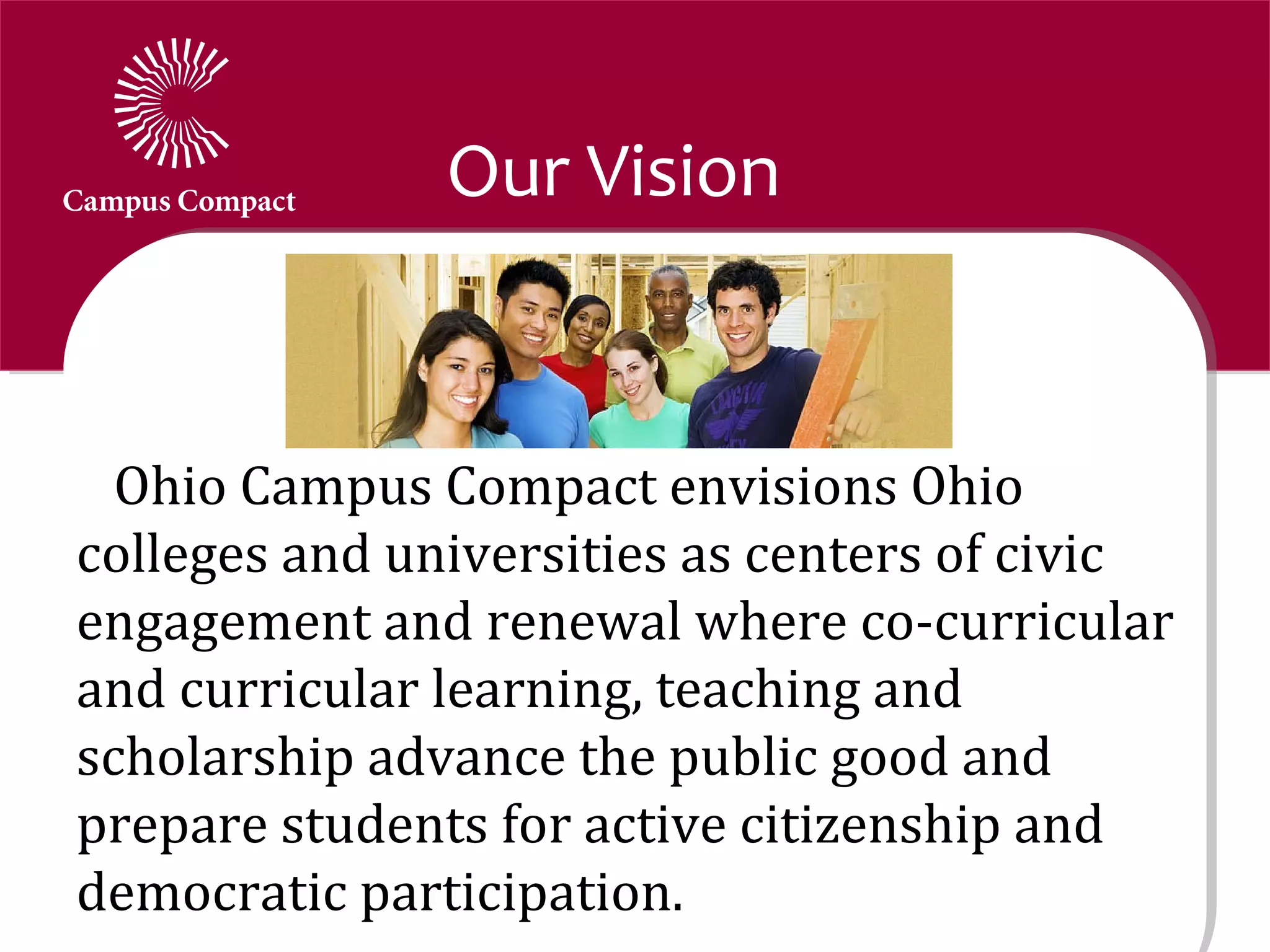
  Ohio Campus Compact envisions Ohio
colleges and universities as centers of civic
engagement and renewal where co-curricular
and curricular learning, teaching and
scholarship advance the public good and
prepare students for active citizenship and
democratic participation.
So, why is this work important?
“We believe that a democratic-centered
 civic engagement effort based on
 collaboratively addressing pressing real-
 world problems holds the promise of
 transforming not only the educational
 practice and the institutional identity of
 colleges and universities, but the larger
 public culture of democracy as well.”
A charge to colleges and universities to:
• Develop cohesive, intentional strategies for fostering
   democratic engagement and civic learning across an
   institution's culture, structures, and learning
   environments.
• Create integrated civic learning programs
• Prepare students, regardless of discipline, to be civic
   problem solvers by embedding goals of civic literacy, civic
   inquiry, and civic knowledge into their college experience.
“As the State of Ohio works to transform our
  economy, higher education has a responsibility
  to produce more quality graduates with the
  skills needed to meet the new and changing
  needs of businesses located in Ohio.
  Simultaneously, higher education, must continue
  to foster its historic mission to generate the
  knowledge and innovation required to sustain
  vibrant civic culture and an engaged citizenry.
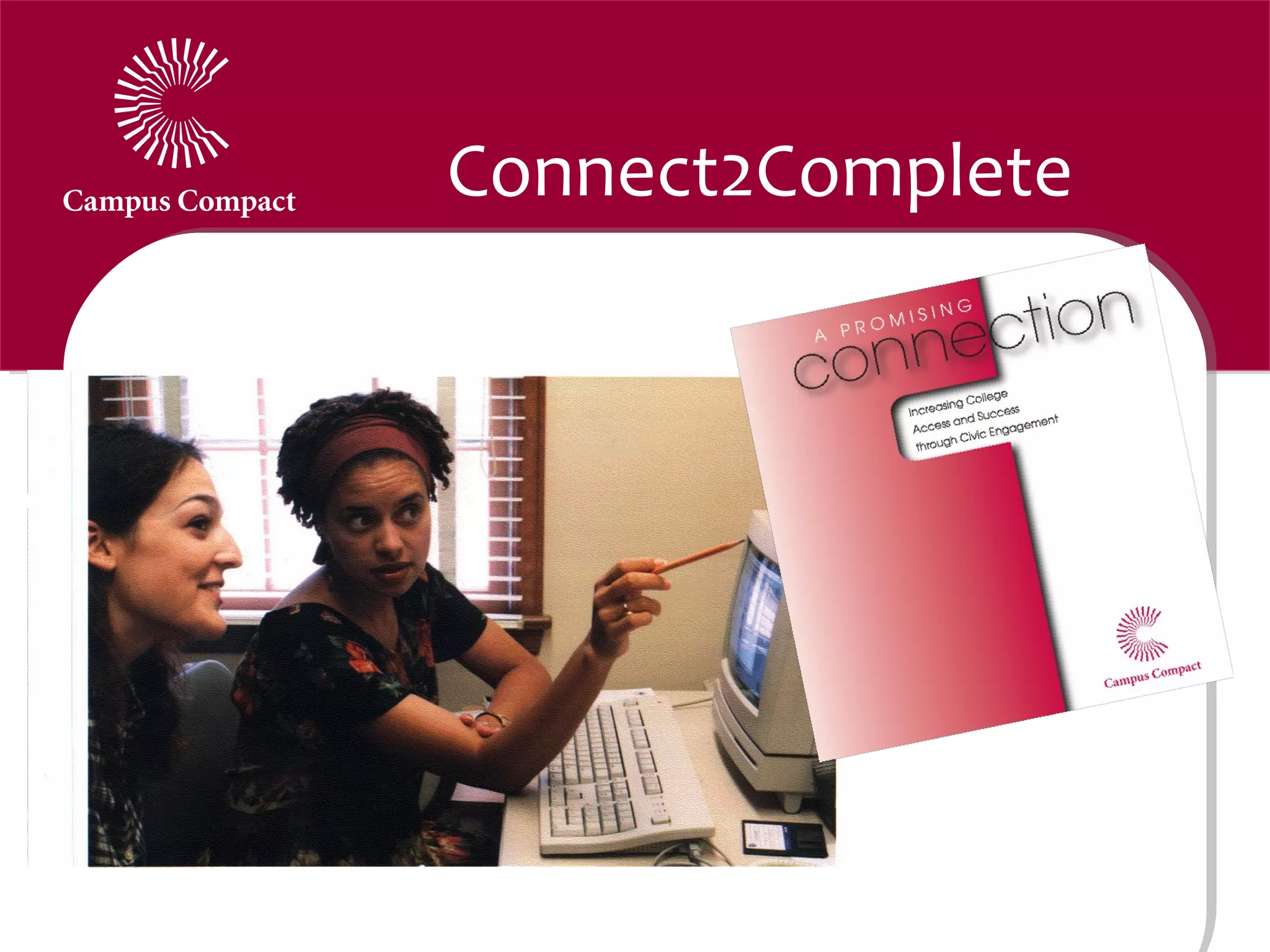
Connect2Complete
Other Updates &
    Resources


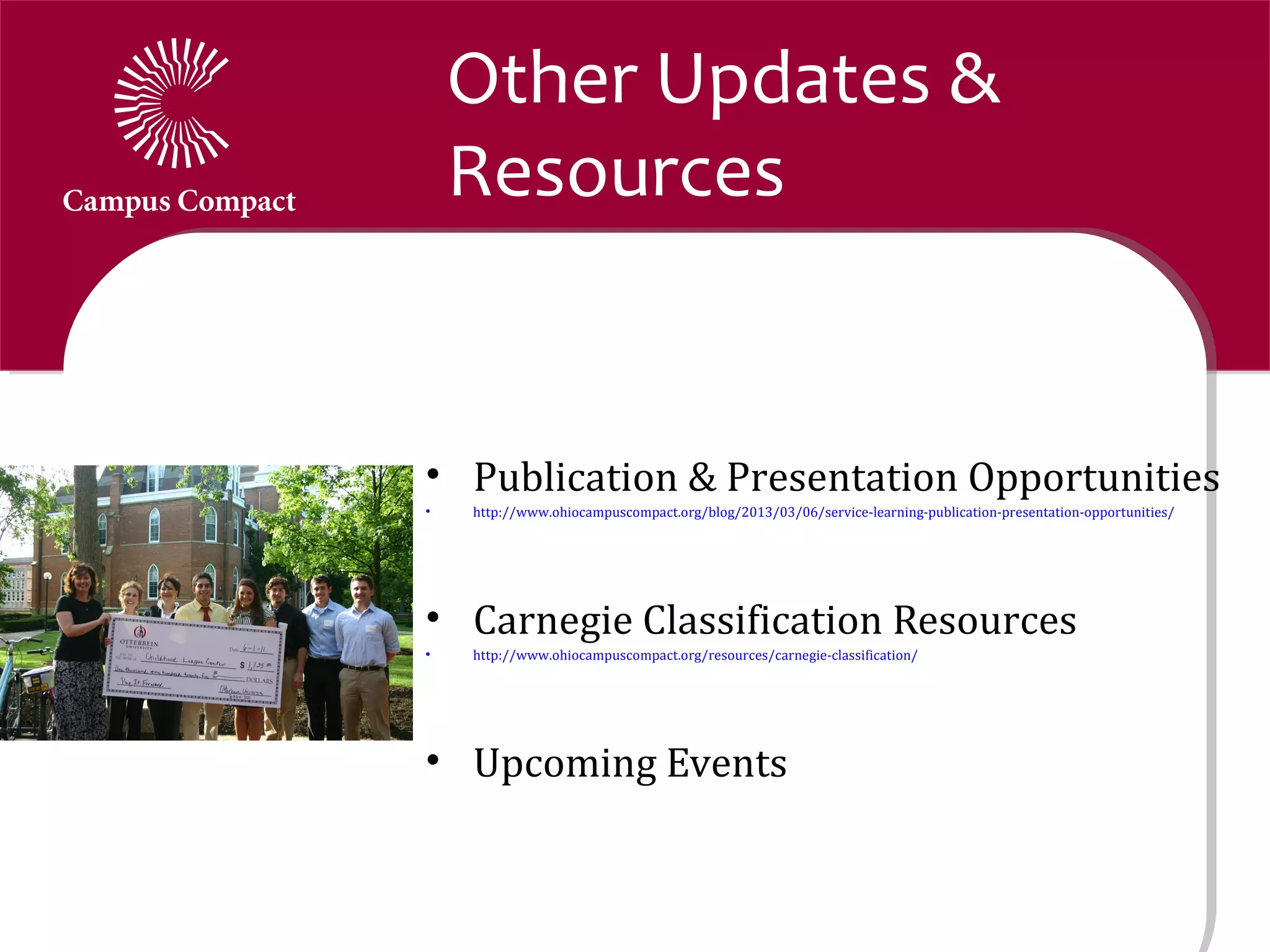
• Publication & Presentation Opportunities
•   http://www.ohiocampuscompact.org/blog/2013/03/06/service-learning-publication-presentation-opportunities/


• Carnegie Classification Resources
•   http://www.ohiocampuscompact.org/resources/carnegie-classification/


• Upcoming Events
The Engaged Campus Series

                        PAST WEBINARS
•   Preparing for the 2015 Carnegie Community Engagement
    Classification
•   Approaches to Measuring Community Impact
•   Engaged Learning Economies: Linking Civic Engagement
    and Economic Development
•   Linking Civic Engagement and Social Entrepreneurism

     Recordings of all of these webinars are available on our
                National website: compact.org
Discussion Questions
 What are other examples of
engaged partnerships between
student and academic affairs?
     What made them successful?
 Were they examples of structural or
collaborative integration of academic
        and student affairs?
Discussion Questions


What are barriers to engaged
partnerships between
student and academic
affairs? (What gets in the
way?)
Discussion Questions
Carnegie Question:

  “Does the institution maintain
  systematic campus-wide
  tracking or documentation
  mechanisms to record and/or
  track engagement with the
  community?”
Discussion Question

Carnegie Question:

  Does the institution have a
  campus-wide coordinating
  infrastructure (center, office,
  etc.) to support and advance
  community engagement?

Engaged Campus: Strategies to Connect Student & Academic Affairs Intro

  • 1.
    The Engaged Campus: STRATEGIES TO CONNECT STUDENT & ACADEMIC AFFAIRS Roundtable, & webinar, plus tour of May 4th Museum   Thursday March 21, 2013 1:30 – 5 p.m. Kent State University Moulton Hall Ballroom
  • 2.
    Our Vision Ohio Campus Compact envisions Ohio colleges and universities as centers of civic engagement and renewal where co-curricular and curricular learning, teaching and scholarship advance the public good and prepare students for active citizenship and democratic participation.
  • 4.
    So, why isthis work important?
  • 5.
    “We believe thata democratic-centered civic engagement effort based on collaboratively addressing pressing real- world problems holds the promise of transforming not only the educational practice and the institutional identity of colleges and universities, but the larger public culture of democracy as well.”
  • 6.
    A charge tocolleges and universities to: • Develop cohesive, intentional strategies for fostering democratic engagement and civic learning across an institution's culture, structures, and learning environments. • Create integrated civic learning programs • Prepare students, regardless of discipline, to be civic problem solvers by embedding goals of civic literacy, civic inquiry, and civic knowledge into their college experience.
  • 8.
    “As the Stateof Ohio works to transform our economy, higher education has a responsibility to produce more quality graduates with the skills needed to meet the new and changing needs of businesses located in Ohio. Simultaneously, higher education, must continue to foster its historic mission to generate the knowledge and innovation required to sustain vibrant civic culture and an engaged citizenry.
  • 9.
  • 10.
    Other Updates & Resources • Publication & Presentation Opportunities • http://www.ohiocampuscompact.org/blog/2013/03/06/service-learning-publication-presentation-opportunities/ • Carnegie Classification Resources • http://www.ohiocampuscompact.org/resources/carnegie-classification/ • Upcoming Events
  • 11.
    The Engaged CampusSeries PAST WEBINARS • Preparing for the 2015 Carnegie Community Engagement Classification • Approaches to Measuring Community Impact • Engaged Learning Economies: Linking Civic Engagement and Economic Development • Linking Civic Engagement and Social Entrepreneurism Recordings of all of these webinars are available on our National website: compact.org
  • 12.
    Discussion Questions Whatare other examples of engaged partnerships between student and academic affairs? What made them successful? Were they examples of structural or collaborative integration of academic and student affairs?
  • 13.
    Discussion Questions What arebarriers to engaged partnerships between student and academic affairs? (What gets in the way?)
  • 14.
    Discussion Questions Carnegie Question: “Does the institution maintain systematic campus-wide tracking or documentation mechanisms to record and/or track engagement with the community?”
  • 15.
    Discussion Question Carnegie Question: Does the institution have a campus-wide coordinating infrastructure (center, office, etc.) to support and advance community engagement?

Editor's Notes

  • #2 Agenda for the day Before I begin discussing the Engaged Campus series, I’d like to tell you a bit about Campus Compact.
  • #3 Ohio Campus Compact is one of 34 state compact offices.   Campus Compact was originally founded in 1985 by the presidents of Brown, Georgetown and Stanford Universities and the president of the Education Commission of the States. In the mid-1980s, the media portrayed college students as materialistic and self-absorbed, more interested in making money than in helping their neighbors.   The founding presidents believed this public image was false; they noted many students on their campuses who were involved in community service and believed many others would follow suit with the proper encouragement and supportive structures. Campus Compact was created to help colleges and universities create such support structures.   These include offices and staff to coordinate community engagement efforts, training to help faculty members integrate community work into their teaching and research, scholarships and other student incentives, and the institutional will to make civic and community engagement a priority. Ohio Campus Compact is a statewide non-profit coalition of 46 college and university presidents and their campuses working to promote the civic purposes of higher education.   More than 45 two-year, four-year, public and private institutions in Ohio are members of Ohio Campus Compact. Our members share a common commitment to address the needs of surrounding communities and to integrate public service as a central part of undergraduate education. Together, we work to:   integrate the ethic of service across the institution by facilitating, supporting and rewarding participation encourage faculty efforts to connect service and academic study ; and foster an environment that stimulates students to move beyond service and engage in long-term problem resolution through applying skills learned in the classroom.
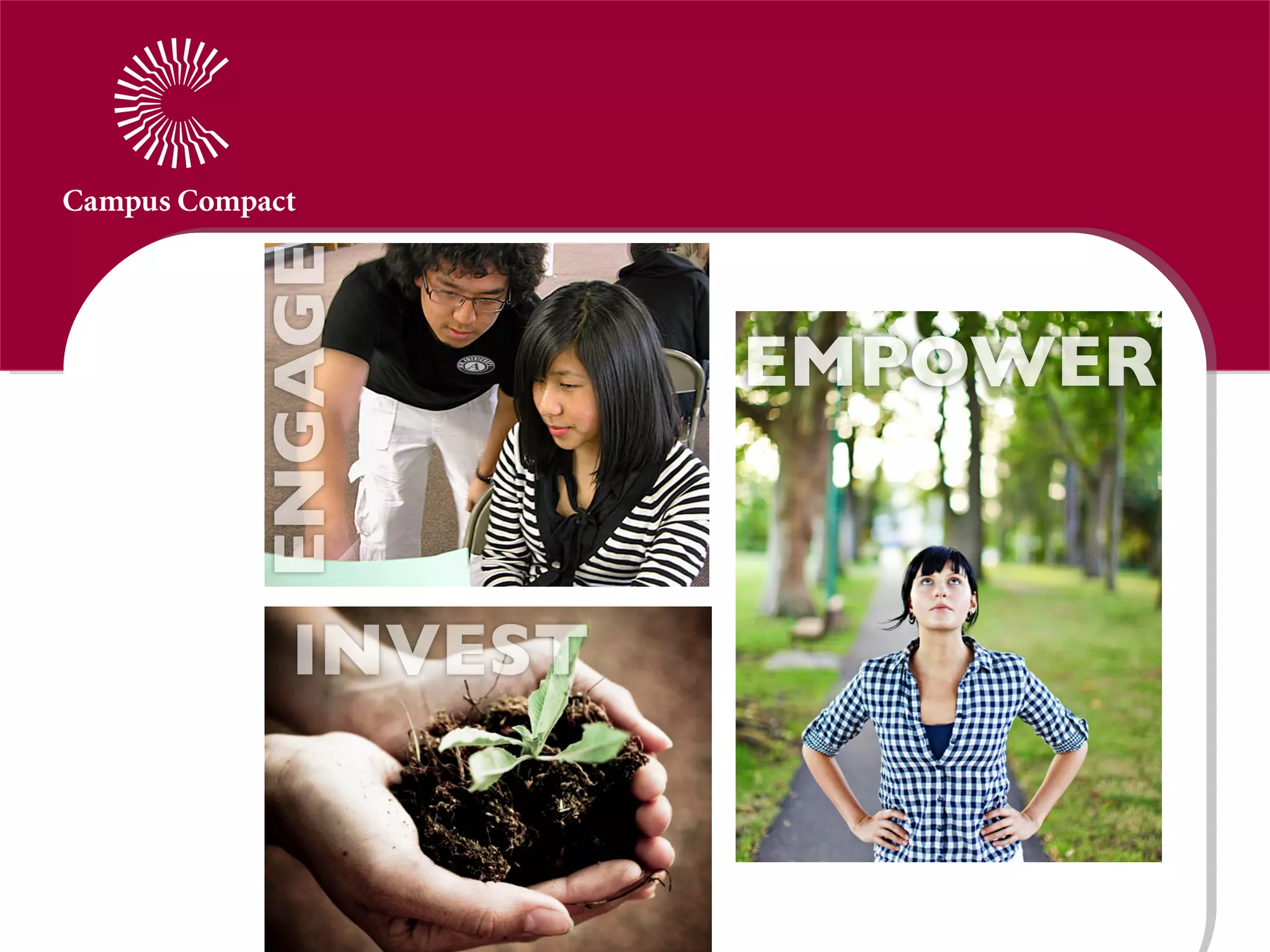
  • #4 We invest in good ideas. FUNDING We invest in civic engagement on our member campuses through mini grants We engage campuses in community service, service-learning & civic engagement. SERVICE PROGRAMS Our Students in Service and AmeriCorps VISTA programs strategically connect college resources with communities in need, with a particular focus on poverty alleviation. Ohio Campus Compact has had a partnership with Kent State dating back to the first cohort in 1998 12 VISTAs We empower campus leaders to help local communities. TRAINING We bring together scholars and the state’s brightest youth leaders. And we put that brainpower to work to tackle issues like poverty, hunger and joblessness. Our symposiums, trainings & resources bring out the best in faculty, administrators and campus leaders. And with our help, they make an even greater impact on students and in local communities.
  • #5 Why connect student & academic affairs through community and civic engagement?
  • #6 A lot of hand wringing and genuine concern about the troubling state of civic knowledge within higher education.  although there is any number of new books and reports out lately that speaks to the urgency of reinvesting in democratic engagement and civic learning within higher education. Meanwhile, there is a lot of fear that the cost of higher ed is going to hit a bubble, students are going to abandon the traditional bricks and mortar institutions and seek out MOOCs WHO KNOWS THE ACRONYM??? Massive Open Online Course How can colleges and universities help re-define their worth as a value proposition…? One way is to reclaim and REINVEST in the civic missions and public purposes of higher ed. Educated and active citizens of our democracy and our world. type of Democratic engagement It is these rich, transformative experiences ---that we know service opportunities offer--- that YOU all can offer at your institutions that no MOOC can ever hope to replicate.
  • #7 AAC&U & Task force on Civic Learning & Democratic Engagement & released at the White House to great fanfare report calls for a reinvigoration of civic learning in higher education, particularly as it connects to democratic engagement and collaborative problem-solving. The crucible moment calls on higher ed to embrace civic learning and democratic engagement as an “undisputed educational priority” Civic learning and community engagement Crucible Moment charges our nation’s colleges and universities to: Develop cohesive, intentional strategies As Campus Compact summarizes in A Praxis Brief: “OFFERING ONE CIVIC EXPERIENCE IS NOT THE SAME A DEVELOPING A PERVASIVE STRATEGY OF CIVIC LEARNING” AND report Service Learning is just ONE PART of civic learning program. Thus, it can’t just be academic affairs operating in its silo. There MUST be collaboration and cooperation across divisions, across campus,
  • #8 This issue has Presidential interest---at the college & University President level: Hundreds and hundreds and hundreds of university presidents signed the declaration. “As presidents of colleges and universities, both private and public, large and small, two-year and four-year, we challenge higher education to re-examine its public purposes and its commitments to the democratic ideal. We also challenge higher education to become engaged, through actions and teaching, with its communities. We have a fundamental task to renew our role as agents of our democracy…” As well as THE President…as in POTUS. Re: Honor Roll: want to extend our congratulations again to to the PRESIDENTS HONOR ROLL members   The award honors colleges and universities that   -have shown exemplary community service and   -achieve meaningful, measurable outcomes in their communities.   -committed to bettering their communities through service and service-learning.   KENT STATE OWENS HIRAM CASE WESTERN---WITH DISTINCTION
  • #9 Finally, at the state level, this is a priority as well. Although some may perceive this focus on civic learning may be viewed as creating a conflict or at least a tension with other priorities of higher ed…but Crucible Moment and even the state of Ohio view these as complementary! FOSTERING INFORMED, ENGAGED, RESPONSIBLE CITIZENS There are civic dimensions of every career field In OHIO: FOCUS is largely oN ECONOMIC DEVELOPMENT AND State funding shift from enrollment-based to completion-based formulas, Students that are civically involved are more likely to remain involved and complete their degree (transition to A promising connection/c2C)
  • #10 How can you demonstrate the link between CE and college persistence/completion for policy makers, funders and campus leaders? A recent report, “ A Promising Connection: Increasing College Access & Success through Civic Engagement” makes these connections clearer. Students who participate in civic engagement learning activities not only earn higher GPAs, but also have higher retention rates and are more likely to complete their college degrees. Explain C2C program
  • #11 The C2C models fall into 2 broad categories – course-based and co-curricular. On the left you see the two key strategies. If you look across, you’ll see how these strategies play out in course based and co-curricular models. C2C started with two models and continues to believe that the ideally campuses would have curricular and course based approaches; however, we’ve found in our pilot programs that the course based approach achieves the outcomes we’re working towards. T: I’m going to shift gears to look at what makes PAs interested.
  • #12 ENGAGED CAMPUS SERIES A series of webinars, events and resources designed to help Campus Compact members deepen their engagement work and encourage dialogue about impact, assessment and the connection between civic engagement and emergent trends.    --Preparing for the Carnegie Classification   The Engaged Campus: Linking Civic Engagement and Social Entrepreneurism   The Engaged Campus: Approaches to Measuring Community Impact with Barbara Holland     THE RECORDINGS OF ALL OF THESE WEBINARS ARE AVAILABLE ON OUR NATIONAL WEBSITE: COMPACT.ORG BREAK TO WEBINAR
  • #13 Structural integration entails administrative consolidation of academic and student affairs functions Whereas collaborative integration focuses on efforts between departments or individuals to coordinate academic and student services resources (pairing students in basic skills course with peer mentors, for example) Collaborative integration often occurs with a limited number of faculty and staff and reach a smaller number of students.
  • #14 Is this another case where there simply are entrenched attitudes and perceptions where faculty and academic affairs folks consider the student services professionals are “the party people” who hold pizza events for students And the student services professionals view the academic affairs folks and faculty as focused exclusively on their own research and don’t acknowledge the fact that a lot of learning can occur outside their classrooms. Is that true on your campus? It’s ok, we’re a friendly group here! Perhaps it is different languages, or at least vocabularies
  • #15 At most institutions, this would require some sort of collaboration or integration between student affairs and academic affairs. Carnegie looks at tracking and recording mechanisms are indicators of sustainability in that their existence and use is an indication of institutional value for and attention to community engagement. Keeping systemaatic records ind
  • #16 That’s an easy one, right? Most campuses, the answer is yes. Ok great, are they part of Student Affairs or Academic Affairs BUT, as Carnegie explains in its documentation framework: the purpose of the question is to determine the presence of “dedicated infrastructure for community engagement. The presence of such infrastructure indicates commitment as well as an increased potential for effectiveness and sustainability. We expect a description of specific center(s) or office(s) that exist primarily for the purposes of leading/managing/supporting/coordinating community If your student affairs team is sending fraternities out to do service projects at Community Partner X site….at the same time that Academic Affairs is coordinating a service hours for a service-learning psychology faculty at that same Community Partner X site. --- might there be a problem? Has anyone had this problem before? OPTIONAL QUESTION: (pg 10, Question 2 of Praxis Brief) Refer to Table 2 of Praxis Brief: which knowledge, skills, values & collective experience are articulated within your program’s design? If your institution coordinates diverse activieis (S-L, alt breaks, etc.) does each of these activities articulate similar objectives? How can you encourage cohesiveness between your program’s objectives and activities?