Relationships matters
working with service users and carers
Welcome
Introduction
• SUAC involvement in SW education has been mandatory since
2003
• No two unis teach SW in exactly the same way – allowing them to
respond to local need & culture
• This diversity is reflected in how SUACs are involved, but
examples include:
i. Sharing lived experiences –with social work or interprofessional H&SC
students
ii. Role-play and/or professional skill development with students
iii. Working with external organisations - like Who Cares Scotland? to bring in
wider range of SUAC voices
iv. Working with community activists
v. Critical reading to shape the SW curriculum
vi. Student recruitment and induction
vii. Conference planning & delivery
Scottish Inter-Uni Service User & Carer
Network
• Begun in 2005 & formally launched at first SIUSUACN
conference in 2013 at Uni of Stirling (Real Lives: Real
Difference)
• Includes SUACs and academics from the 8 unis offering
SW in Scotland
• Meets 3 xs a year
• Despite repeated efforts the group remains unfunded……
• Its function is to influence policy & share and widen good
practice.
Widening our influence…
• SUAC members have fed into revised Standards in SW
Education & are part of Social Work Education
Partnership
• Creative partnerships
• Produced 7 stories with Iriss, celebrating SUAC involvement in SW education -
what it looks like and how to make it work
• www.iriss.org.uk/collection/user-involvement-social-work-education
• Provides workshops & has delivered 2 national conferences (2013 and
2017) &
• an international knowledge exchange event with Iriss in 2018-
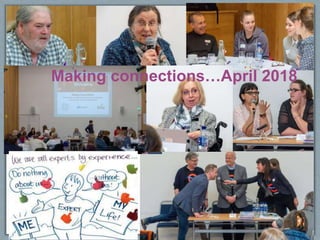
‘Making Connections’– involving PowerUs partners
from Sweden and Belgium
Making connections…April 2018
What is Gap Mending?
 Gap-mending is an analytical tool which helps service
users, educators, practitioners and researchers reflect
together on what in their practice increases, maintains or
widens the gap between policies, services, professionals
and students.
 PowerUs is synonomous with inclusion which results in
more equal practice and promotes social justice and
ensures non discriminatory and inclusive practice as a
result.
Mend the Gap
 Began at Lund University, Sweden, in 2005 this method of teaching
aims to provide a platform where:
 People in traditionally different positions of power can develop a
mutual form of learning, on as similar terms as possible.
 In 2009 a similar course began in Lillehammer University College,
Norway.
 In 2011, Shaping Our Lives took the lead in England and the
PowerUs international partnership began
 First gap mending programme in North East England in 2015.
Background
The gap mending approach was developed by ‘Power Us, the Social
Work Learning Partnership’ to promote new ways of learning that can
come from sharing experiences, knowledge and skills within professional
education. People with experiences of professional involvement in their
lives can give unique perspectives for students and practitioners to learn
from.
Professionals and students may also have their own experiences of
receiving support from services. By creating a positive environment
people can learn together to influence professional education and
develop respectful relationships to improve practice and outcomes.
PowerUs – A growing network:
Belgium, Canada, Catalonia, Croatia, Denmark, England, France,
Germany, The Netherlands, Norway, Poland, Scotland, South Africa,
Sweden, Switzerland.
Gaps identified in social work
between:
Needs and resources
Service users and providers
Expert and experiental knowledge
Social work education and practice
Researchers and research subjects
Questions
• Why did you want to become involved in Social
Work?
• Describe a situation where you received a service
e.g. banking, medical, travel-related – one that went
well, and one that didn’t. Say how you felt.
Thinking about how can services be best delivered
between SWs & SUACs…..
• What widens, maintains or mends the gap?
Thank you for listening!
For more information & to contact:
SIUSUAC website
https://bettersocialwork.wordpress.com/
Resources created with Iriss:
www.iriss.org.uk/news/post-event-reports/2018/05/14/making-
connections
www.iriss.org.uk/collection/user-involvement-social-work-
education
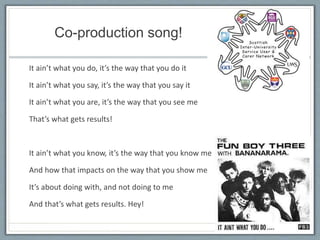
Co-production song!
It ain’t what you do, it’s the way that you do it
It ain’t what you say, it’s the way that you say it
It ain’t what you are, it’s the way that you see me
That’s what gets results!
It ain’t what you know, it’s the way that you know me
And how that impacts on the way that you show me
It’s about doing with, and not doing to me
And that’s what gets results. Hey!

SIUSUACN: mend the gap slides

  • 1.
    Relationships matters working withservice users and carers Welcome
  • 2.
    Introduction • SUAC involvementin SW education has been mandatory since 2003 • No two unis teach SW in exactly the same way – allowing them to respond to local need & culture • This diversity is reflected in how SUACs are involved, but examples include: i. Sharing lived experiences –with social work or interprofessional H&SC students ii. Role-play and/or professional skill development with students iii. Working with external organisations - like Who Cares Scotland? to bring in wider range of SUAC voices iv. Working with community activists v. Critical reading to shape the SW curriculum vi. Student recruitment and induction vii. Conference planning & delivery
  • 3.
    Scottish Inter-Uni ServiceUser & Carer Network • Begun in 2005 & formally launched at first SIUSUACN conference in 2013 at Uni of Stirling (Real Lives: Real Difference) • Includes SUACs and academics from the 8 unis offering SW in Scotland • Meets 3 xs a year • Despite repeated efforts the group remains unfunded…… • Its function is to influence policy & share and widen good practice.
  • 4.
    Widening our influence… •SUAC members have fed into revised Standards in SW Education & are part of Social Work Education Partnership • Creative partnerships • Produced 7 stories with Iriss, celebrating SUAC involvement in SW education - what it looks like and how to make it work • www.iriss.org.uk/collection/user-involvement-social-work-education • Provides workshops & has delivered 2 national conferences (2013 and 2017) & • an international knowledge exchange event with Iriss in 2018- ‘Making Connections’– involving PowerUs partners from Sweden and Belgium
  • 5.
  • 6.
    What is GapMending?  Gap-mending is an analytical tool which helps service users, educators, practitioners and researchers reflect together on what in their practice increases, maintains or widens the gap between policies, services, professionals and students.  PowerUs is synonomous with inclusion which results in more equal practice and promotes social justice and ensures non discriminatory and inclusive practice as a result.
  • 7.
    Mend the Gap Began at Lund University, Sweden, in 2005 this method of teaching aims to provide a platform where:  People in traditionally different positions of power can develop a mutual form of learning, on as similar terms as possible.  In 2009 a similar course began in Lillehammer University College, Norway.  In 2011, Shaping Our Lives took the lead in England and the PowerUs international partnership began  First gap mending programme in North East England in 2015.
  • 8.
    Background The gap mendingapproach was developed by ‘Power Us, the Social Work Learning Partnership’ to promote new ways of learning that can come from sharing experiences, knowledge and skills within professional education. People with experiences of professional involvement in their lives can give unique perspectives for students and practitioners to learn from. Professionals and students may also have their own experiences of receiving support from services. By creating a positive environment people can learn together to influence professional education and develop respectful relationships to improve practice and outcomes.
  • 9.
    PowerUs – Agrowing network: Belgium, Canada, Catalonia, Croatia, Denmark, England, France, Germany, The Netherlands, Norway, Poland, Scotland, South Africa, Sweden, Switzerland.
  • 10.
    Gaps identified insocial work between: Needs and resources Service users and providers Expert and experiental knowledge Social work education and practice Researchers and research subjects
  • 11.
    Questions • Why didyou want to become involved in Social Work? • Describe a situation where you received a service e.g. banking, medical, travel-related – one that went well, and one that didn’t. Say how you felt. Thinking about how can services be best delivered between SWs & SUACs….. • What widens, maintains or mends the gap?
  • 12.
    Thank you forlistening! For more information & to contact: SIUSUAC website https://bettersocialwork.wordpress.com/ Resources created with Iriss: www.iriss.org.uk/news/post-event-reports/2018/05/14/making- connections www.iriss.org.uk/collection/user-involvement-social-work- education
  • 13.
    Co-production song! It ain’twhat you do, it’s the way that you do it It ain’t what you say, it’s the way that you say it It ain’t what you are, it’s the way that you see me That’s what gets results! It ain’t what you know, it’s the way that you know me And how that impacts on the way that you show me It’s about doing with, and not doing to me And that’s what gets results. Hey!