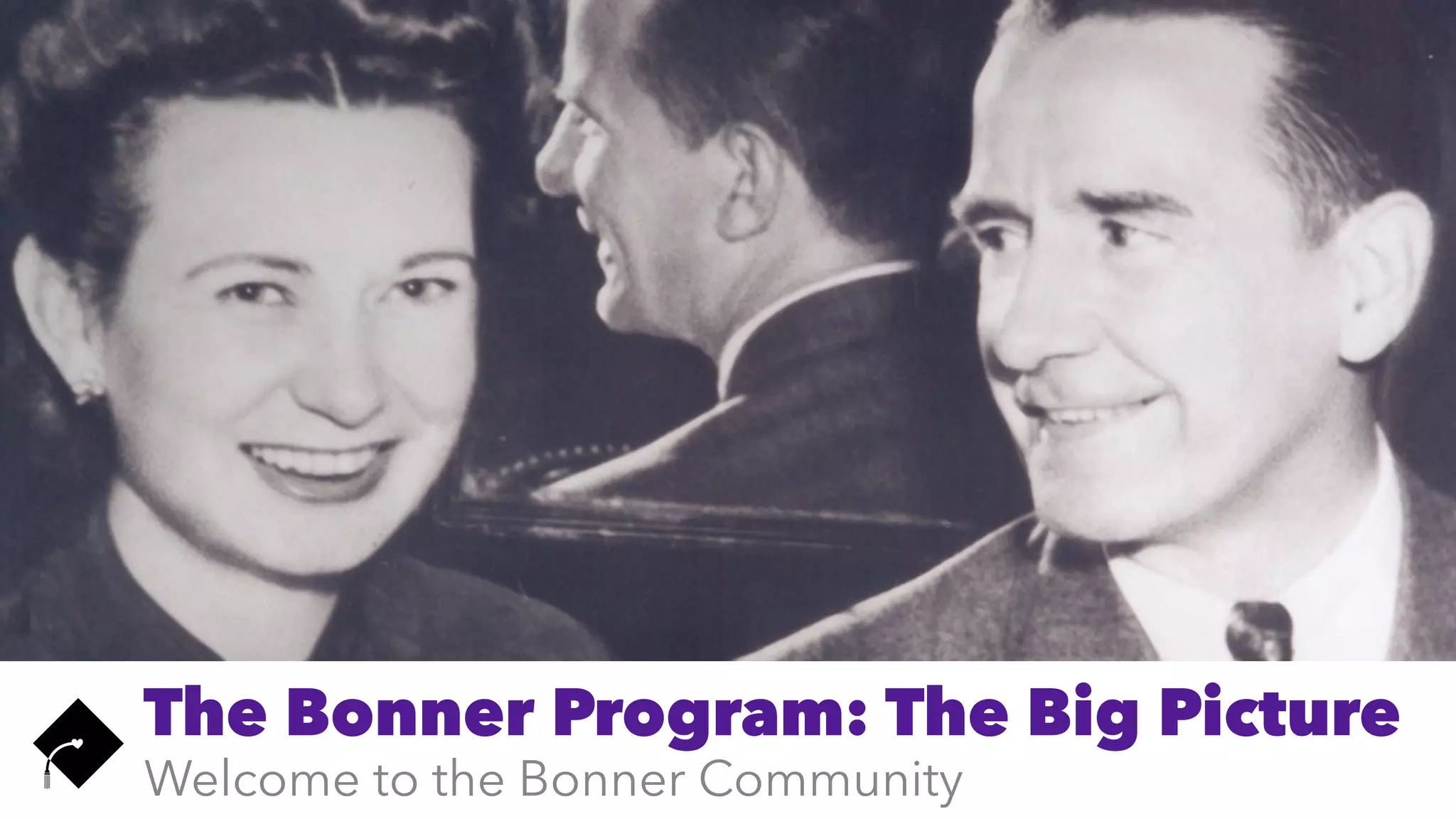
The Bonner Program: The Big Picture
Welcome to the Bonner Community
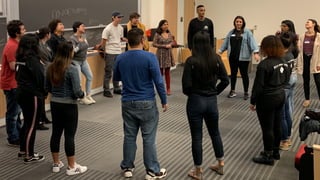
Introductions
What brought you into
the higher education
community-engagement field?
Breakout Question
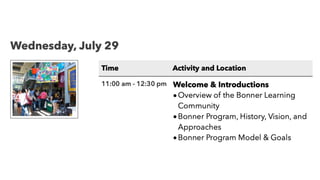
Bonner Program
History &
Commitments
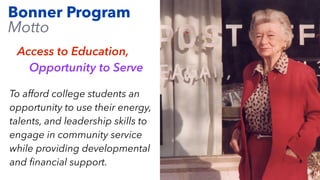
Bonner Program
Motto
To afford college students an
opportunity to use their energy,
talents, and leadership skills to
engage in community service
while providing developmental
and financial support.
Access to Education,
Opportunity to Serve
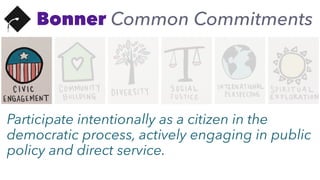
Bonner Common Commitments
Participate intentionally as a citizen in the
democratic process, actively engaging in public
policy and direct service.
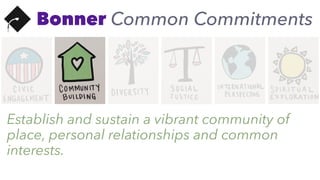
Bonner Common Commitments
Establish and sustain a vibrant community of
place, personal relationships and common
interests.
Bonner Common Commitments
Respect the many different dimensions of
diversity in our public lives.
Bonner Common Commitments
Advocate for fairness, impartiality and equality
while addressing systemic social and
environmental issues.
Bonner Common Commitments
Develop international understanding that
enables Bonners to participate successfully in a
global society.
Bonner Common Commitments
Explore personal beliefs while respecting the
spiritual practices of others.
Bonner Program
Model
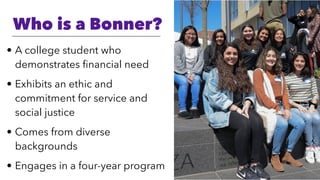
Who is a Bonner?
• A college student who
demonstrates financial need
• Exhibits an ethic and
commitment for service and
social justice
• Comes from diverse
backgrounds
• Engages in a four-year program
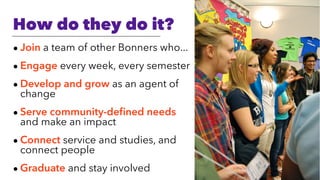
How do they do it?
• Join a team of other Bonners who...
• Engage every week, every semester
• Develop and grow as an agent of
change
• Serve community-defined needs
and make an impact
• Connect service and studies, and
connect people
• Graduate and stay involved
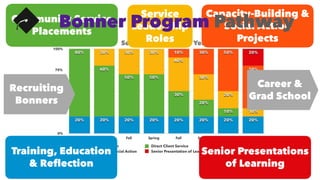
Community Service
Placements
Training, Education
& Reflection
Capacity-Building &
Social Action
Projects
Senior Presentations
of Learning
Recruiting
Bonners
Career &
Grad School
Service
Leadership
Roles
Bonner Program Pathway
Bonner Program:
Why does it work?
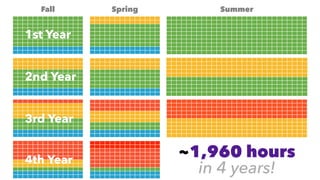
Fall Spring Summer
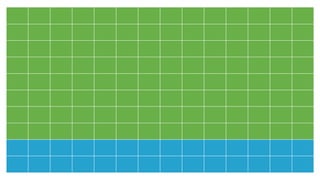
~1,960 hours
in 4 years!
1st Year
2nd Year
3rd Year
4th Year
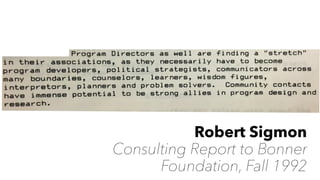
Robert Sigmon
Consulting Report to Bonner
Foundation, Fall 1992
Why else does it work?
What part of the Bonner
Program model do you find
most compelling?
Breakout Question
Bonner Program
Impact
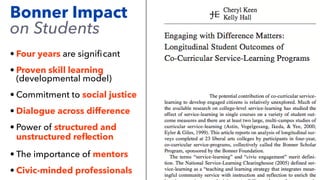
• Four years are significant
• Proven skill learning
(developmental model)
• Commitment to social justice
• Dialogue across difference
• Power of structured and
unstructured reflection
• The importance of mentors
• Civic-minded professionals
Bonner Impact
on Students
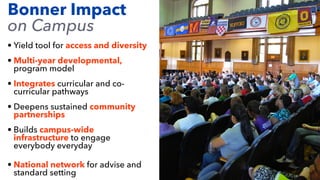
• Yield tool for access and diversity
• Multi-year developmental,
program model
• Integrates curricular and co-
curricular pathways
• Deepens sustained community
partnerships
• Builds campus-wide
infrastructure to engage
everybody everyday
• National network for advise and
standard setting
Bonner Impact
on Campus
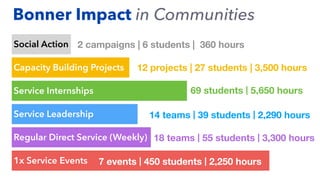
Social Action 2 campaigns | 6 students | 360 hours
Capacity Building Projects 12 projects | 27 students | 3,500 hours
Service Internships 69 students | 5,650 hours
Service Leadership 14 teams | 39 students | 2,290 hours
Regular Direct Service (Weekly) 18 teams | 55 students | 3,300 hours
1x Service Events 7 events | 450 students | 2,250 hours
Bonner Impact in Communities
Campus- and
Community-Wide
Goals & Strategies
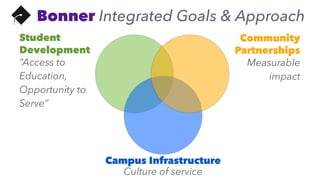
Student
Development
“Access to
Education,
Opportunity to
Serve”
Campus Infrastructure
Culture of service
Community
Partnerships
Measurable
impact
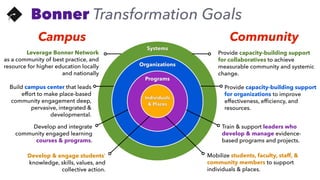
Bonner Integrated Goals & Approach
CommunityCampus
Leverage Bonner Network
as a community of best practice, and
resource for higher education locally
and nationally
Systems
Provide capacity-building support
for collaboratives to achieve
measurable community and systemic
change.
Build campus center that leads
effort to make place-based
community engagement deep,
pervasive, integrated &
developmental.
Organizations
Provide capacity-building support
for organizations to improve
effectiveness, efficiency, and
resources.
Develop and integrate
community engaged learning
courses & programs.
Programs
Train & support leaders who
develop & manage evidence-
based programs and projects.
Develop & engage students’
knowledge, skills, values, and
collective action.
Individuals
& Places
Mobilize students, faculty, staff, &
community members to support
individuals & places.
Bonner Transformation Goals
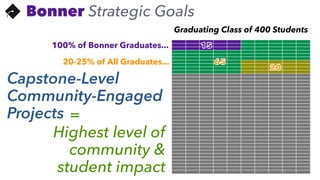
Capstone-Level
Community-Engaged
Projects
Graduating Class of 400 Students
100% of Bonner Graduates... 15
20-25% of All Graduates... 65
15
20
Bonner Strategic Goals
=
Highest level of
community &
student impact
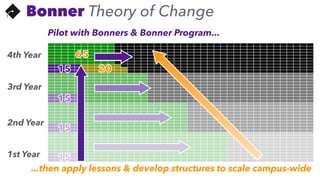
Bonner Theory of Change
4th Year
3rd Year
2nd Year
1st Year
Pilot with Bonners & Bonner Program...
65
2015
15
15
15
...then apply lessons & develop structures to scale campus-wide
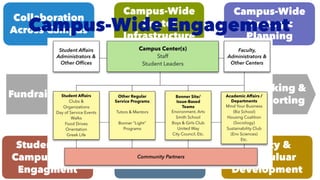
Campus-Wide
Center
Infrastructure
Publicity
Collaboration
Across Campus
Student-Led
Campus-Wide
Engagment
Campus-Wide
Strategic
Planning
Faculty &
Curriculuar
Development
Fundraising
Tracking &
Reporting
Campus-Wide Engagement
What are your primary goals for
your Bonner Program this year
(or for starting one next year)?
BLC Question
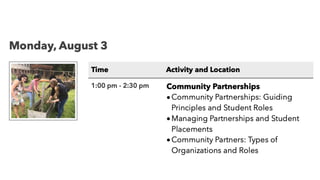
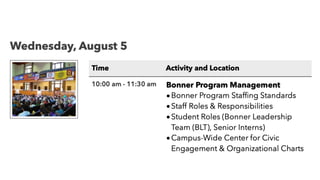
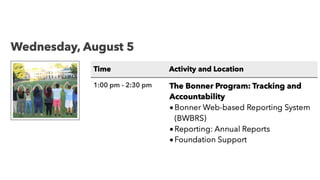
Agenda
Zoom Sessions
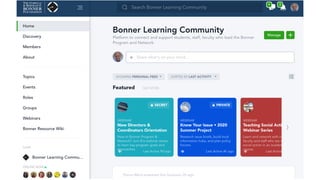
Bonner Learning
Community
Quick Tour
2020 New Bonner Directors & Coordinators Orientation - Opening Session

2020 New Bonner Directors & Coordinators Orientation - Opening Session