Strategic Plan
2011–2016
DIVISION OF DIVERSITY AND COMMUNITY ENGAGEMENT
2015-2016 PROGRESS REPORT
2 DDCE STRATEGIC PLAN • 2015-2016 PROGRESS REPORT
Strategic Plan 2011–2016: 2015-2016 Progress Report
DIVISION OF DIVERSITY AND COMMUNITY ENGAGEMENT • THE UNIVERSITY OF TEXAS AT AUSTIN
Vision
The Division of Diversity and Community Engagement,
as a national model, will strengthen the university’s
academic and engagement mission by fostering a culture
of excellence and social justice for the success of students,
faculty, staff, alumni, and the community.
Mission
The Division of Diversity and Community Engagement
advances socially just learning and working environments that
foster a culture of excellence through diverse people, ideas,
and perspectives. We engage in dynamic community-university
partnerships designed to transform our lives.
Value Statements
Diversity: Demonstrating respect for all
individuals and valuing each perspective
and experience.
Community Engagement: Learning and
working collaboratively with community
members and organizations to achieve
positive change.
Inclusion: Breaking down barriers to
meaningful participation and fostering
a sense of belonging.
Integrity: Setting high standards of
professional ethics and being consistent
in principles, expectations, and actions.
Leadership: Guiding and inspiring people
and organizations toward excellence.
Partnerships: Cultivating mutually
beneficial internal and external relationships
built upon trust, cooperation, and shared
responsibility.
Social Justice: Challenging injustice and
working toward an equitable society in which
all enjoy equal rights and opportunities.
“2016 marks the end of our ambitious five-year strategic plan. In looking back on our
many accomplishments over the past five years, I am amazed at all we have done.
Together we continue to foster a culture of excellence through diverse people, ideas, and
perspectives. As we close this chapter, we now look to the future to build on the national
standard we have set for what academic diversity and community engagement looks
like in higher education.”
Dr. Gregory J. Vincent
Vice President for Diversity and Community Engagement
Year 4 Highlights: BY THE NUMBERS
• Record number admissions applications from African American and Hispanic
students—an 18% and 20% increase, respectively, from previous year
• 75% of Longhorns volunteered 1 million hours—an average of
approximately $22 million in economic impact for the communities we serve
• 118 teaching assistants and assistant instructors from 45 academic departments
participated in Inclusive Classrooms Leadership Certificate Seminars
• 20+ DDCE representatives presented original research at American Education
Research Association and the Association for the Study of Higher Education
meetings
• 14,000+ pre-college students served within the Longhorn Center for
School Partnerships
• 300 community partners, including non-profit organizations, school districts,
and pipeline initiatives
• 118 bias incident reports managed by the Campus Climate Response Team
• 100+ people attended Peers for Pride performance where Gender and Sexuality
Center Peers for Pride Research Project findings were presented
• 1,821 UTAustin students served in the Longhorn Center for Academic Excellence,
including over 300 in Intellectual Entrepreneurship Program
• 83 external and internal events, including 20 signature and special community
events coordinated by Community and External Relations
• 53 different social justice educational opportunities coordinated by units
represented on the Campus Culture Council
• 19 bias response teams at institutions across the nation participated in the Bias
Response Team Study
2015-2016 PROGRESS REPORT • DDCE STRATEGIC PLAN 3
Campus Culture
2014–15 Highlighted Accomplishments
• Administered pilot of the social justice educational
opportunities inventory with departments represented
on the Campus Culture Council, which yielded docu-
mentation of 53 educational opportunities.
• Piloted the Student Social Justice Education Initiative,
based out of the Multicultural Engagement Center, as
an active and intentional cross-community building
initiative for students.
• Facilitated 5 Inclusive Classrooms Leadership Certificate
Seminars for teaching assistants and assistant instruc-
tors after piloting initial seminar in partnership with the
Graduate School.
• Advised College of Fine Arts Diversity Committee in im-
plementing year-one priorities within its diversity plan’s
curriculum and creative programming, recruitment and
retention, and culture and climate goals.
• Partnered with College of Natural Sciences associate
dean for faculty affairs to implement inclusive recruit-
ment best practices within college resulting in an
increase of women and faculty of color interviewed
and hired.
• Collaborated with senior vice provost for faculty affairs
to create campus-wide Council for Racial and Ethnic Eq-
uity and Diversity focused on recruiting, retaining, and
advancing a racially and ethnically diverse faculty.
2015–16 Highlighted Priorities
• Leverage staff expertise and UT Austin partnerships within
DDCE’s new Office for Inclusion and Equity to develop a
national model for creating and sustaining a more inclusive
campus culture.*
• Develop new and updated content for at least two existing
workforce training sessions offered by the Office for Inclusion
and Equity to foster a culture of inclusion and accessibility.*
• Provide campus faculty and staff training and education
related to diversity, equity, and social justice via the Diversity
Education Initiatives Committee.
• Facilitate faculty focus group to generate input and support
for development of Inclusive Classrooms Faculty Leadership
Seminar.
• Broaden the Office for Inclusion and Equity’s faculty recruit-
ment and retention initiatives through its work with the Coun-
cil for Racial and Ethnic Equity and Diversity and partnerships
with individual colleges and schools.
• Initiate the development of a Title VI/Nondiscrimination Plan,
which considers education, outreach, compliance, data collec-
tion and analysis, and language access.*
*Denotes multi-year priority activity
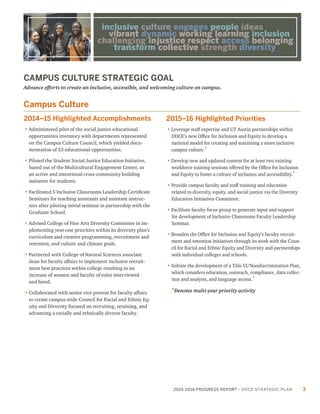
CAMPUS CULTURE STRATEGIC GOAL
Advance efforts to create an inclusive, accessible, and welcoming culture on campus.
inclusive culture engages people ideas
vibrant dynamic working learning inclusion
challenging injustice respect access belonging
transform collective strength diversity
Community Engagement
2014–15 Highlighted Accomplishments
• Received ten-year Carnegie Foundation for the Advancement
of Teaching Community Engagement Classification docu-
menting UT Austin’s activities around community engage-
ment and public service.
• Participated in new UT Austin website launch while continu-
ing to develop community engagement web portal design
and its supporting mechanisms through collaboration with
University Communications staff.
• Continued to establish guidelines for partnership and spon-
sorship stewardship system that best measures effectiveness
of agreements and roles of individual units.
• Implemented DDCE Austin Community Advisory Council
evaluation of partnership stewardship which informed the
Community Engagement Plan, designed to improve commu-
nity access to university resources.
• Convened Community Engagement Taskforce for President’s
Higher Education Community Service Honor Roll, recogniz-
ing UT Austin’s role in solving community problems and
participating in civic engagement via meaningful and mea-
surable outcomes.
• Continued reaffirmation of commitment to repair fragmented
relationships with historically and currently underserved
communities via community events and division-wide initia-
tives, programs, and platforms.
2015–16 Highlighted Priorities
• Convene Community Engagement Portal Workgroup to
discuss Digital Experience Project Plan online overhaul
including reviewing and further developing the community
engagement core site structure.*
• Work with University Communications to develop a portal
communications plan for execution via campus-wide commu-
nications representatives once site framework and structure
are confirmed.*
• Receive all four President’s Higher Education Community
Service Honor Roll category recognitions, which highlight
UT Austin’s role in solving community problems and par-
ticipating in civic engagement via meaningful, measurable
community outcomes.*
• Utilize Community Engagement Taskforce to update partner-
ship and sponsorship inventory, stewardship definitions, and
division-wide MOU agreements to include in Community
Engagement Plan.*
• Continue to develop communication platforms including
Mission Moments, Community Compass, and publications
as part of community relations initiatives to be included in
Community Engagement Plan.
• Assess feedback from DDCE Austin Community Advisory
Council survey to determine direction for community rela-
tions programs to be included in Community Engagement
Plan.
*Denotes multi-year priority activity
4 DDCE STRATEGIC PLAN • 2015-2016 PROGRESS REPORT
COMMUNITY ENGAGEMENT STRATEGIC GOAL
Cultivate mutually beneficial community-university partnerships that further the mission of the university to
serve Texas and beyond with an emphasis on historically and currently underserved communities.
partnership cultivate enrich resources ideas
unite create connect history learning plan
potential community synergy success change
opportunity build future service social
2015-2016 PROGRESS REPORT • DDCE STRATEGIC PLAN 5
Education Pipeline
2014–15 Highlighted Accomplishments
• Received multi-year grant from Law School Admission
Council to create DiscoverLaw.org PLUS, a partnership
between Huston-Tillotson, UT Law, and DDCE. (Inaugural
session held during summer 2015)
• Conducted strategic meetings with deans and associate
deans of all colleges across UT Austin’s campus to coordinate
services that impact students, including the sharing of
student performance data.
• Launched collaboration between pre-college units and
Admissions to promote Texas Advance, a scholarship initiative
supporting “hard-working, economically disadvantaged”
high school students in Texas.
• Updated recruitment/retention plan during retreats and
emphasized expanding Academic Diversity Initiatives (ADI)
partnerships to enhance collective impact of pipeline.
• Started process of simplifying data collection methods and
standardizing reported content across ADI units to provide
fuller portrait of implementation of pipeline priorities.
2015–16 Highlighted Priorities
• Expand the Pipeline Council to include representatives from
across Academic Diversity Initiatives (ADI) units and increase
attendance at council meetings.
• Develop time and cost effective methods for collecting feed-
back from partners for use in decision-making.
• Determine and build opportunities for student-focused inter-
nal ADI collaborations.*
• Identify and create opportunities for student-focused internal
UT Austin collaborations, including a pre-college to college
STEM pipeline.*
• Investigate opportunities for creating student-focused pro-
gramming centered on health sciences and identify potential
collaborations within UT Austin and across relevant commu-
nities.*
• Increase longitudinal tracking of students in education
pipeline by continuing pilot of data management system in
pre-college units and investigate scaling system across DDCE,
including funding.*
*Denotes multi-year priority activity
EDUCATION PIPELINE STRATEGIC GOAL
Create a successful pathway for first-generation and underrepresented students as they progress from
pre-K through graduate and professional school.
pathways culture engages people ideas
educate college learning working programs
progress student diversity success belonging
transform strength community align
6 DDCE STRATEGIC PLAN • 2015-2016 PROGRESS REPORT
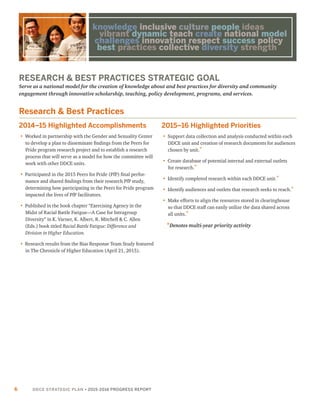
RESEARCH & BEST PRACTICES STRATEGIC GOAL
Serve as a national model for the creation of knowledge about and best practices for diversity and community
engagement through innovative scholarship, teaching, policy development, programs, and services.
Research & Best Practices
2014–15 Highlighted Accomplishments
• Worked in partnership with the Gender and Sexuality Center
to develop a plan to disseminate findings from the Peers for
Pride program research project and to establish a research
process that will serve as a model for how the committee will
work with other DDCE units.
• Participated in the 2015 Peers for Pride (PfP) final perfor-
mance and shared findings from their research PfP study,
determining how participating in the Peers for Pride program
impacted the lives of PfP facilitators.
• Published in the book chapter “Exercising Agency in the
Midst of Racial Battle Fatigue—A Case for Intragroup
Diversity” in K. Varner, K. Albert, R. Mitchell & C. Allen
(Eds.) book titled Racial Battle Fatigue: Difference and
Division in Higher Education.
• Research results from the Bias Response Team Study featured
in The Chronicle of Higher Education (April 21, 2015).
2015–16 Highlighted Priorities
• Support data collection and analysis conducted within each
DDCE unit and creation of research documents for audiences
chosen by unit.*
• Create database of potential internal and external outlets
for research.*
• Identify completed research within each DDCE unit.*
• Identify audiences and outlets that research seeks to reach.*
• Make efforts to align the resources stored in clearinghouse
so that DDCE staff can easily utilize the data shared across
all units.*
*Denotes multi-year priority activity
knowledge inclusive culture people ideas
vibrant dynamic teach create national model
challenges innovation respect success policy
best practices collective diversity strength
2015-2016 PROGRESS REPORT • DDCE STRATEGIC PLAN 7
2014–15 Implementation Committee
co-chairs
Dr. Sherri L. Sanders
Associate Vice President for Strategic Initiatives
Dr. Gregory J. Vincent
Vice President for Diversity and Community Engagement
members
Ms. Katherine Antwi Green
Institutional Equity
Ms. Leslie Blair
Community and External Relations
Dr. Aileen Bumphus
Academic Diversity Initiatives and Student Engagement
Ms. Kim Carmichael
University Interscholastic League
Dr. Robiaun Charles
Development
Dr. Eric Dieter
Academic Diversity Initiatives and Student Engagement
Dr. Suchitra Gururaj
Academic Diversity Initiatives and Student Engagement
Mr. Simon Hughes
Information Technology Services
Dr. Jennifer Maedgen
Equity and Access and Chief of Staff
Dr. Octavio Martinez
Hogg Foundation for Mental Health
Dr. Ryan A. Miller
Academic Diversity Initiatives and Student Engagement
Mr. Jason Molin
Community and External Relations
Dr. Leonard Moore
Academic Diversity Initiatives and Student Engagement
Mr. Patrick Patterson
Academic Diversity Initiatives and Student Engagement
Ms. Ixchel Rosal
Student Diversity Initiatives
Ms. Erica Sáenz
Community and External Relations
Dr. Stella Smith
Academic Diversity Initiatives and Student Engagement
Dr. Betty Jeanne Taylor
Strategic Initiatives
2015–16 Implementation Committee
co-chairs
Erica Sáenz
Associate Vice President for Community and External Relations
Dr. Suchitra Gururaj
Assistant Vice President and Executive Director, Longhorn Center for
Community Engagement and Community Engagement Center
Dr. Ryan A. Miller
Director, Office for Inclusion and Equity
Dr. Gregory J. Vincent
Vice President for Diversity and Community Engagement
members
Ms. Leslie Blair
Community and External Relations
Dr. Aileen Bumphus
Academic Diversity Initiatives and Student Engagement
Ms. Tatiana Calliham
DDCE Finance
Ms. Kim Carmichael
University Interscholastic League
Dr. Eric Dieter
Academic Diversity Initiatives and Student Engagement
Mr. Simon Hughes
Information Technology Services
Dr. Darren Kelly
Academic Diversity Initiatives and Student Engagement
Dr. Jennifer Maedgen
Equity and Access and Chief of Staff
Dr. Octavio Martinez
Hogg Foundation for Mental Health
Mr. Jason Molin
Community and External Relations
Dr. Leonard Moore
Academic Diversity Initiatives and Student Engagement
Mr. Patrick Patterson
Academic Diversity Initiatives and Student Engagement
Mr. Gregory Perrin
Development
Ms. Ixchel Rosal
Student Diversity Initiatives
Dr. Stella Smith
Academic Diversity Initiatives and Student Engagement
Ms. Helen Wormington
Office of the Vice President
Implementation Committee
The Division of Diversity and Community Engagement strategic planning process involved a variety of staff who served
on design, steering, planning, and strategy teams. To facilitate the next phase of the strategic plan, Dr. Gregory J. Vincent
appointed an Implementation Committee to set priorities, track progress toward achieving the division’s four strategic
goals, and oversee the implementation of the goals aligned with their specific portfolios and units.
For More Information
contact:
Erica Sáenz
Associate Vice President for Community
and External Relations
ericasaenz@austin.utexas.edu
Dr. Suchitra Gururaj
Assistant Vice President and Executive
Director, Longhorn Center for
Community Engagement and
Community Engagement Center
suchi.gururaj@austin.utexas.edu
Dr. Ryan A. Miller
Director, Office for Inclusion and Equity
rmiller@austin.utexas.edu
Division of Diversity and Community Engagement
The University of Texas at Austin
110 Inner Campus Drive, Stop G1050
Austin, Texas 78712 • (512) 471-3212
online: Access all DDCE Strategic Plan documents at http://ddce.utexas.edu/2016
CAMPUS
CULTURE
Advance efforts to create
an inclusive, accessible,
and welcoming culture
on campus.
COMMUNITY
ENGAGEMENT
Cultivate mutually beneficial
community-university
partnerships that further
the mission of the university
to serve Texas and beyond
with an emphasis on
historically and currently
underserved communities.
EDUCATION
PIPELINE
Create a successful pathway
for first-generation and
underrepresented students
as they progress from
pre-K through graduate
and professional school.
RESEARCH &
BEST PRACTICES
Serve as a national
model for the creation
of knowledge about
and best practices
for diversity and
community engagement
through innovative
scholarship, teaching,
policy development,
programs, and services.
STRATEGIC GOALS from the DDCE Strategic Plan 2011–2016
MARCH 2016

2015.2016 DDCE Strategic Plan Progress Report

  • 1.
    Strategic Plan 2011–2016 DIVISION OFDIVERSITY AND COMMUNITY ENGAGEMENT 2015-2016 PROGRESS REPORT
  • 2.
    2 DDCE STRATEGICPLAN • 2015-2016 PROGRESS REPORT Strategic Plan 2011–2016: 2015-2016 Progress Report DIVISION OF DIVERSITY AND COMMUNITY ENGAGEMENT • THE UNIVERSITY OF TEXAS AT AUSTIN Vision The Division of Diversity and Community Engagement, as a national model, will strengthen the university’s academic and engagement mission by fostering a culture of excellence and social justice for the success of students, faculty, staff, alumni, and the community. Mission The Division of Diversity and Community Engagement advances socially just learning and working environments that foster a culture of excellence through diverse people, ideas, and perspectives. We engage in dynamic community-university partnerships designed to transform our lives. Value Statements Diversity: Demonstrating respect for all individuals and valuing each perspective and experience. Community Engagement: Learning and working collaboratively with community members and organizations to achieve positive change. Inclusion: Breaking down barriers to meaningful participation and fostering a sense of belonging. Integrity: Setting high standards of professional ethics and being consistent in principles, expectations, and actions. Leadership: Guiding and inspiring people and organizations toward excellence. Partnerships: Cultivating mutually beneficial internal and external relationships built upon trust, cooperation, and shared responsibility. Social Justice: Challenging injustice and working toward an equitable society in which all enjoy equal rights and opportunities. “2016 marks the end of our ambitious five-year strategic plan. In looking back on our many accomplishments over the past five years, I am amazed at all we have done. Together we continue to foster a culture of excellence through diverse people, ideas, and perspectives. As we close this chapter, we now look to the future to build on the national standard we have set for what academic diversity and community engagement looks like in higher education.” Dr. Gregory J. Vincent Vice President for Diversity and Community Engagement Year 4 Highlights: BY THE NUMBERS • Record number admissions applications from African American and Hispanic students—an 18% and 20% increase, respectively, from previous year • 75% of Longhorns volunteered 1 million hours—an average of approximately $22 million in economic impact for the communities we serve • 118 teaching assistants and assistant instructors from 45 academic departments participated in Inclusive Classrooms Leadership Certificate Seminars • 20+ DDCE representatives presented original research at American Education Research Association and the Association for the Study of Higher Education meetings • 14,000+ pre-college students served within the Longhorn Center for School Partnerships • 300 community partners, including non-profit organizations, school districts, and pipeline initiatives • 118 bias incident reports managed by the Campus Climate Response Team • 100+ people attended Peers for Pride performance where Gender and Sexuality Center Peers for Pride Research Project findings were presented • 1,821 UTAustin students served in the Longhorn Center for Academic Excellence, including over 300 in Intellectual Entrepreneurship Program • 83 external and internal events, including 20 signature and special community events coordinated by Community and External Relations • 53 different social justice educational opportunities coordinated by units represented on the Campus Culture Council • 19 bias response teams at institutions across the nation participated in the Bias Response Team Study
  • 3.
    2015-2016 PROGRESS REPORT• DDCE STRATEGIC PLAN 3 Campus Culture 2014–15 Highlighted Accomplishments • Administered pilot of the social justice educational opportunities inventory with departments represented on the Campus Culture Council, which yielded docu- mentation of 53 educational opportunities. • Piloted the Student Social Justice Education Initiative, based out of the Multicultural Engagement Center, as an active and intentional cross-community building initiative for students. • Facilitated 5 Inclusive Classrooms Leadership Certificate Seminars for teaching assistants and assistant instruc- tors after piloting initial seminar in partnership with the Graduate School. • Advised College of Fine Arts Diversity Committee in im- plementing year-one priorities within its diversity plan’s curriculum and creative programming, recruitment and retention, and culture and climate goals. • Partnered with College of Natural Sciences associate dean for faculty affairs to implement inclusive recruit- ment best practices within college resulting in an increase of women and faculty of color interviewed and hired. • Collaborated with senior vice provost for faculty affairs to create campus-wide Council for Racial and Ethnic Eq- uity and Diversity focused on recruiting, retaining, and advancing a racially and ethnically diverse faculty. 2015–16 Highlighted Priorities • Leverage staff expertise and UT Austin partnerships within DDCE’s new Office for Inclusion and Equity to develop a national model for creating and sustaining a more inclusive campus culture.* • Develop new and updated content for at least two existing workforce training sessions offered by the Office for Inclusion and Equity to foster a culture of inclusion and accessibility.* • Provide campus faculty and staff training and education related to diversity, equity, and social justice via the Diversity Education Initiatives Committee. • Facilitate faculty focus group to generate input and support for development of Inclusive Classrooms Faculty Leadership Seminar. • Broaden the Office for Inclusion and Equity’s faculty recruit- ment and retention initiatives through its work with the Coun- cil for Racial and Ethnic Equity and Diversity and partnerships with individual colleges and schools. • Initiate the development of a Title VI/Nondiscrimination Plan, which considers education, outreach, compliance, data collec- tion and analysis, and language access.* *Denotes multi-year priority activity CAMPUS CULTURE STRATEGIC GOAL Advance efforts to create an inclusive, accessible, and welcoming culture on campus. inclusive culture engages people ideas vibrant dynamic working learning inclusion challenging injustice respect access belonging transform collective strength diversity
  • 4.
    Community Engagement 2014–15 HighlightedAccomplishments • Received ten-year Carnegie Foundation for the Advancement of Teaching Community Engagement Classification docu- menting UT Austin’s activities around community engage- ment and public service. • Participated in new UT Austin website launch while continu- ing to develop community engagement web portal design and its supporting mechanisms through collaboration with University Communications staff. • Continued to establish guidelines for partnership and spon- sorship stewardship system that best measures effectiveness of agreements and roles of individual units. • Implemented DDCE Austin Community Advisory Council evaluation of partnership stewardship which informed the Community Engagement Plan, designed to improve commu- nity access to university resources. • Convened Community Engagement Taskforce for President’s Higher Education Community Service Honor Roll, recogniz- ing UT Austin’s role in solving community problems and participating in civic engagement via meaningful and mea- surable outcomes. • Continued reaffirmation of commitment to repair fragmented relationships with historically and currently underserved communities via community events and division-wide initia- tives, programs, and platforms. 2015–16 Highlighted Priorities • Convene Community Engagement Portal Workgroup to discuss Digital Experience Project Plan online overhaul including reviewing and further developing the community engagement core site structure.* • Work with University Communications to develop a portal communications plan for execution via campus-wide commu- nications representatives once site framework and structure are confirmed.* • Receive all four President’s Higher Education Community Service Honor Roll category recognitions, which highlight UT Austin’s role in solving community problems and par- ticipating in civic engagement via meaningful, measurable community outcomes.* • Utilize Community Engagement Taskforce to update partner- ship and sponsorship inventory, stewardship definitions, and division-wide MOU agreements to include in Community Engagement Plan.* • Continue to develop communication platforms including Mission Moments, Community Compass, and publications as part of community relations initiatives to be included in Community Engagement Plan. • Assess feedback from DDCE Austin Community Advisory Council survey to determine direction for community rela- tions programs to be included in Community Engagement Plan. *Denotes multi-year priority activity 4 DDCE STRATEGIC PLAN • 2015-2016 PROGRESS REPORT COMMUNITY ENGAGEMENT STRATEGIC GOAL Cultivate mutually beneficial community-university partnerships that further the mission of the university to serve Texas and beyond with an emphasis on historically and currently underserved communities. partnership cultivate enrich resources ideas unite create connect history learning plan potential community synergy success change opportunity build future service social
  • 5.
    2015-2016 PROGRESS REPORT• DDCE STRATEGIC PLAN 5 Education Pipeline 2014–15 Highlighted Accomplishments • Received multi-year grant from Law School Admission Council to create DiscoverLaw.org PLUS, a partnership between Huston-Tillotson, UT Law, and DDCE. (Inaugural session held during summer 2015) • Conducted strategic meetings with deans and associate deans of all colleges across UT Austin’s campus to coordinate services that impact students, including the sharing of student performance data. • Launched collaboration between pre-college units and Admissions to promote Texas Advance, a scholarship initiative supporting “hard-working, economically disadvantaged” high school students in Texas. • Updated recruitment/retention plan during retreats and emphasized expanding Academic Diversity Initiatives (ADI) partnerships to enhance collective impact of pipeline. • Started process of simplifying data collection methods and standardizing reported content across ADI units to provide fuller portrait of implementation of pipeline priorities. 2015–16 Highlighted Priorities • Expand the Pipeline Council to include representatives from across Academic Diversity Initiatives (ADI) units and increase attendance at council meetings. • Develop time and cost effective methods for collecting feed- back from partners for use in decision-making. • Determine and build opportunities for student-focused inter- nal ADI collaborations.* • Identify and create opportunities for student-focused internal UT Austin collaborations, including a pre-college to college STEM pipeline.* • Investigate opportunities for creating student-focused pro- gramming centered on health sciences and identify potential collaborations within UT Austin and across relevant commu- nities.* • Increase longitudinal tracking of students in education pipeline by continuing pilot of data management system in pre-college units and investigate scaling system across DDCE, including funding.* *Denotes multi-year priority activity EDUCATION PIPELINE STRATEGIC GOAL Create a successful pathway for first-generation and underrepresented students as they progress from pre-K through graduate and professional school. pathways culture engages people ideas educate college learning working programs progress student diversity success belonging transform strength community align
  • 6.
    6 DDCE STRATEGICPLAN • 2015-2016 PROGRESS REPORT RESEARCH & BEST PRACTICES STRATEGIC GOAL Serve as a national model for the creation of knowledge about and best practices for diversity and community engagement through innovative scholarship, teaching, policy development, programs, and services. Research & Best Practices 2014–15 Highlighted Accomplishments • Worked in partnership with the Gender and Sexuality Center to develop a plan to disseminate findings from the Peers for Pride program research project and to establish a research process that will serve as a model for how the committee will work with other DDCE units. • Participated in the 2015 Peers for Pride (PfP) final perfor- mance and shared findings from their research PfP study, determining how participating in the Peers for Pride program impacted the lives of PfP facilitators. • Published in the book chapter “Exercising Agency in the Midst of Racial Battle Fatigue—A Case for Intragroup Diversity” in K. Varner, K. Albert, R. Mitchell & C. Allen (Eds.) book titled Racial Battle Fatigue: Difference and Division in Higher Education. • Research results from the Bias Response Team Study featured in The Chronicle of Higher Education (April 21, 2015). 2015–16 Highlighted Priorities • Support data collection and analysis conducted within each DDCE unit and creation of research documents for audiences chosen by unit.* • Create database of potential internal and external outlets for research.* • Identify completed research within each DDCE unit.* • Identify audiences and outlets that research seeks to reach.* • Make efforts to align the resources stored in clearinghouse so that DDCE staff can easily utilize the data shared across all units.* *Denotes multi-year priority activity knowledge inclusive culture people ideas vibrant dynamic teach create national model challenges innovation respect success policy best practices collective diversity strength
  • 7.
    2015-2016 PROGRESS REPORT• DDCE STRATEGIC PLAN 7 2014–15 Implementation Committee co-chairs Dr. Sherri L. Sanders Associate Vice President for Strategic Initiatives Dr. Gregory J. Vincent Vice President for Diversity and Community Engagement members Ms. Katherine Antwi Green Institutional Equity Ms. Leslie Blair Community and External Relations Dr. Aileen Bumphus Academic Diversity Initiatives and Student Engagement Ms. Kim Carmichael University Interscholastic League Dr. Robiaun Charles Development Dr. Eric Dieter Academic Diversity Initiatives and Student Engagement Dr. Suchitra Gururaj Academic Diversity Initiatives and Student Engagement Mr. Simon Hughes Information Technology Services Dr. Jennifer Maedgen Equity and Access and Chief of Staff Dr. Octavio Martinez Hogg Foundation for Mental Health Dr. Ryan A. Miller Academic Diversity Initiatives and Student Engagement Mr. Jason Molin Community and External Relations Dr. Leonard Moore Academic Diversity Initiatives and Student Engagement Mr. Patrick Patterson Academic Diversity Initiatives and Student Engagement Ms. Ixchel Rosal Student Diversity Initiatives Ms. Erica Sáenz Community and External Relations Dr. Stella Smith Academic Diversity Initiatives and Student Engagement Dr. Betty Jeanne Taylor Strategic Initiatives 2015–16 Implementation Committee co-chairs Erica Sáenz Associate Vice President for Community and External Relations Dr. Suchitra Gururaj Assistant Vice President and Executive Director, Longhorn Center for Community Engagement and Community Engagement Center Dr. Ryan A. Miller Director, Office for Inclusion and Equity Dr. Gregory J. Vincent Vice President for Diversity and Community Engagement members Ms. Leslie Blair Community and External Relations Dr. Aileen Bumphus Academic Diversity Initiatives and Student Engagement Ms. Tatiana Calliham DDCE Finance Ms. Kim Carmichael University Interscholastic League Dr. Eric Dieter Academic Diversity Initiatives and Student Engagement Mr. Simon Hughes Information Technology Services Dr. Darren Kelly Academic Diversity Initiatives and Student Engagement Dr. Jennifer Maedgen Equity and Access and Chief of Staff Dr. Octavio Martinez Hogg Foundation for Mental Health Mr. Jason Molin Community and External Relations Dr. Leonard Moore Academic Diversity Initiatives and Student Engagement Mr. Patrick Patterson Academic Diversity Initiatives and Student Engagement Mr. Gregory Perrin Development Ms. Ixchel Rosal Student Diversity Initiatives Dr. Stella Smith Academic Diversity Initiatives and Student Engagement Ms. Helen Wormington Office of the Vice President Implementation Committee The Division of Diversity and Community Engagement strategic planning process involved a variety of staff who served on design, steering, planning, and strategy teams. To facilitate the next phase of the strategic plan, Dr. Gregory J. Vincent appointed an Implementation Committee to set priorities, track progress toward achieving the division’s four strategic goals, and oversee the implementation of the goals aligned with their specific portfolios and units.
  • 8.
    For More Information contact: EricaSáenz Associate Vice President for Community and External Relations ericasaenz@austin.utexas.edu Dr. Suchitra Gururaj Assistant Vice President and Executive Director, Longhorn Center for Community Engagement and Community Engagement Center suchi.gururaj@austin.utexas.edu Dr. Ryan A. Miller Director, Office for Inclusion and Equity rmiller@austin.utexas.edu Division of Diversity and Community Engagement The University of Texas at Austin 110 Inner Campus Drive, Stop G1050 Austin, Texas 78712 • (512) 471-3212 online: Access all DDCE Strategic Plan documents at http://ddce.utexas.edu/2016 CAMPUS CULTURE Advance efforts to create an inclusive, accessible, and welcoming culture on campus. COMMUNITY ENGAGEMENT Cultivate mutually beneficial community-university partnerships that further the mission of the university to serve Texas and beyond with an emphasis on historically and currently underserved communities. EDUCATION PIPELINE Create a successful pathway for first-generation and underrepresented students as they progress from pre-K through graduate and professional school. RESEARCH & BEST PRACTICES Serve as a national model for the creation of knowledge about and best practices for diversity and community engagement through innovative scholarship, teaching, policy development, programs, and services. STRATEGIC GOALS from the DDCE Strategic Plan 2011–2016 MARCH 2016