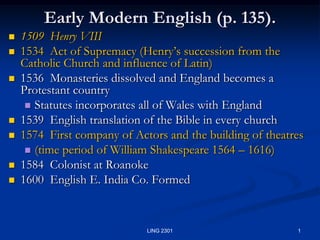
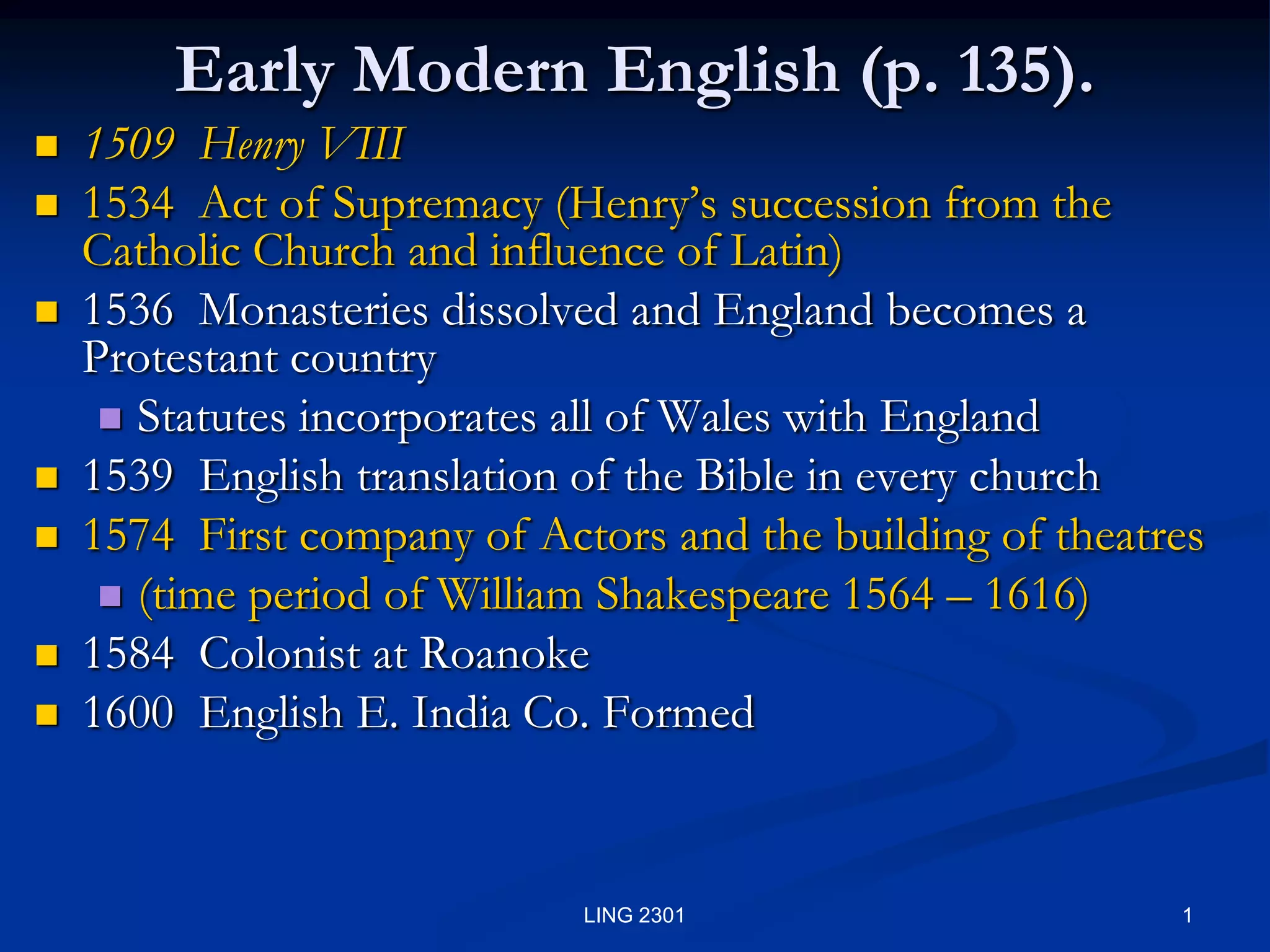
1LING 2301Early Modern English (p. 135). 1509  Henry VIII1534  Act of Supremacy (Henry’s succession from the Catholic Church and influence of Latin)1536  Monasteries dissolved and England becomes a Protestant countryStatutes incorporates all of Wales with England1539  English translation of the Bible in every church1574  First company of Actors and the building of theatres (time period of William Shakespeare 1564 – 1616)1584  Colonist at Roanoke1600  English E. India Co. Formed
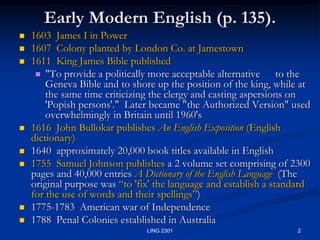
2LING 2301Early Modern English (p. 135). 1603  James I in Power1607  Colony planted by London Co. at Jamestown1611  King James Bible published "To provide a politically more acceptable alternative 	to the Geneva Bible and to shore up the position of the king, while at the same time criticizing the clergy and casting aspersions on 'Popish persons'."  Later became "the Authorized Version" used overwhelmingly in Britain until 1960's1616  John Bullokar publishes An English Exposition (English dictionary)1640  approximately 20,000 book titles available in English1755  Samuel Johnson publishes a 2 volume set comprising of 2300 pages and 40,000 entries A Dictionary of the English Language (The original purpose was “to 'fix' the language and establish a standard for the use of words and their spellings”)1775-1783  American war of Independence 1788  Penal Colonies established in Australia
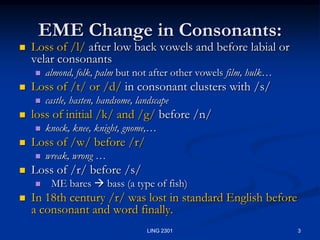
3LING 2301EME Change in Consonants:Loss of /l/ after low back vowels and before labial or velar consonantsalmond, folk, palm but not after other vowels film, hulk…Loss of /t/ or /d/ in consonant clusters with /s/castle, hasten, handsome, landscapeloss of initial /k/ and /g/ before /n/knock,knee, knight, gnome,…Loss of /w/ before /r/wreak, wrong …Loss of /r/ before /s/	ME bares  bass (a type of fish)In 18th century /r/ was lost in standard English before a consonant and word finally.
4LING 2301EME Changes in Vowels: Unstressed vowels were reduced to [ɪ] or [ə] in ME and continued in EMEThe Great Vowel Shifthttp://facweb.furman.edu/~mmenzer/gvs/seehear.htmhttp://facweb.furman.edu/~mmenzer/gvs/what.htmhttp://courses.fas.harvard.edu/%7Echaucer/vowels.html(see other ppt and handout on language changeClark Language… p 250, 337
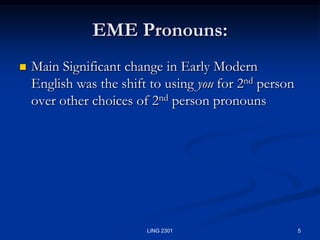
5LING 2301EME Pronouns:Main Significant change in Early Modern English was the shift to using you for 2nd person over other choices of 2nd person pronouns
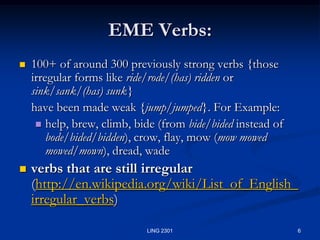
6LING 2301EME Verbs:100+ of around 300 previously strong verbs {those irregular forms like ride/rode/(has) ridden or sink/sank/(has) sunk} 	have been made weak {jump/jumped}. For Example:help, brew, climb, bide (from bide/bided instead of bode/bided/bidden), crow, flay, mow (mow mowed mowed/mown), dread, wadeverbs that are still irregular (http://en.wikipedia.org/wiki/List_of_English_irregular_verbs)
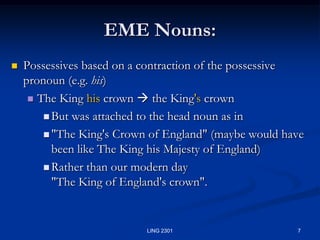
7LING 2301EME Nouns:Possessives based on a contraction of the possessive pronoun (e.g. his)The King his crown  the King's crown But was attached to the head noun as in "The King's Crown of England" (maybe would have been like The King his Majesty of England)Rather than our modern day "The King of England's crown".
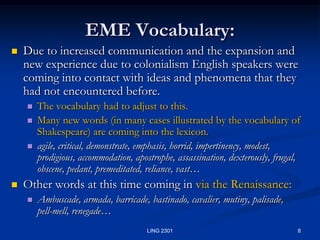
8LING 2301EME Vocabulary:Due to increased communication and the expansion and new experience due to colonialism English speakers were coming into contact with ideas and phenomena that they had not encountered before.  The vocabulary had to adjust to this.  Many new words (in many cases illustrated by the vocabulary of Shakespeare) are coming into the lexicon. agile, critical, demonstrate, emphasis, horrid, impertinency, modest, prodigious, accommodation, apostrophe, assassination, dexterously, frugal, obscene, pedant, premeditated, reliance, vast…Other words at this time coming in via the Renaissance:Ambuscade, armada, barricade, bastinado, cavalier, mutiny, palisade, pell-mell, renegade…
9LING 2301Latin and Greek (the Renaissance) Again Latin and Greek were seen as scholarly languages – as the crusaders started to learn about the science of the Arabs who had translated many of the works from Latin and Greek.  Many modern languages were being advocated as a medium of learning.  While English eventually became accepted by the academe many of the Science and Literary authors such as Sir Francis Bacon, John Milton, and Sir Isaac Newton wrote their major works in Latin.  Eventually the use of Latin declined, but the vocabulary was brought into English to "fill the gaps" Some words were borrowed from Greek via Latin or French: anachronism, climax, pathetic, system, & antithesis

Early modern english

  • 1.
    1LING 2301Early ModernEnglish (p. 135). 1509 Henry VIII1534 Act of Supremacy (Henry’s succession from the Catholic Church and influence of Latin)1536 Monasteries dissolved and England becomes a Protestant countryStatutes incorporates all of Wales with England1539 English translation of the Bible in every church1574 First company of Actors and the building of theatres (time period of William Shakespeare 1564 – 1616)1584 Colonist at Roanoke1600 English E. India Co. Formed
  • 2.
    2LING 2301Early ModernEnglish (p. 135). 1603 James I in Power1607 Colony planted by London Co. at Jamestown1611 King James Bible published "To provide a politically more acceptable alternative to the Geneva Bible and to shore up the position of the king, while at the same time criticizing the clergy and casting aspersions on 'Popish persons'." Later became "the Authorized Version" used overwhelmingly in Britain until 1960's1616 John Bullokar publishes An English Exposition (English dictionary)1640 approximately 20,000 book titles available in English1755 Samuel Johnson publishes a 2 volume set comprising of 2300 pages and 40,000 entries A Dictionary of the English Language (The original purpose was “to 'fix' the language and establish a standard for the use of words and their spellings”)1775-1783 American war of Independence 1788 Penal Colonies established in Australia
  • 3.
    3LING 2301EME Changein Consonants:Loss of /l/ after low back vowels and before labial or velar consonantsalmond, folk, palm but not after other vowels film, hulk…Loss of /t/ or /d/ in consonant clusters with /s/castle, hasten, handsome, landscapeloss of initial /k/ and /g/ before /n/knock,knee, knight, gnome,…Loss of /w/ before /r/wreak, wrong …Loss of /r/ before /s/ ME bares  bass (a type of fish)In 18th century /r/ was lost in standard English before a consonant and word finally.
  • 4.
    4LING 2301EME Changesin Vowels: Unstressed vowels were reduced to [ɪ] or [ə] in ME and continued in EMEThe Great Vowel Shifthttp://facweb.furman.edu/~mmenzer/gvs/seehear.htmhttp://facweb.furman.edu/~mmenzer/gvs/what.htmhttp://courses.fas.harvard.edu/%7Echaucer/vowels.html(see other ppt and handout on language changeClark Language… p 250, 337
  • 5.
    5LING 2301EME Pronouns:MainSignificant change in Early Modern English was the shift to using you for 2nd person over other choices of 2nd person pronouns
  • 6.
    6LING 2301EME Verbs:100+of around 300 previously strong verbs {those irregular forms like ride/rode/(has) ridden or sink/sank/(has) sunk} have been made weak {jump/jumped}. For Example:help, brew, climb, bide (from bide/bided instead of bode/bided/bidden), crow, flay, mow (mow mowed mowed/mown), dread, wadeverbs that are still irregular (http://en.wikipedia.org/wiki/List_of_English_irregular_verbs)
  • 7.
    7LING 2301EME Nouns:Possessivesbased on a contraction of the possessive pronoun (e.g. his)The King his crown  the King's crown But was attached to the head noun as in "The King's Crown of England" (maybe would have been like The King his Majesty of England)Rather than our modern day "The King of England's crown".
  • 8.
    8LING 2301EME Vocabulary:Dueto increased communication and the expansion and new experience due to colonialism English speakers were coming into contact with ideas and phenomena that they had not encountered before. The vocabulary had to adjust to this. Many new words (in many cases illustrated by the vocabulary of Shakespeare) are coming into the lexicon. agile, critical, demonstrate, emphasis, horrid, impertinency, modest, prodigious, accommodation, apostrophe, assassination, dexterously, frugal, obscene, pedant, premeditated, reliance, vast…Other words at this time coming in via the Renaissance:Ambuscade, armada, barricade, bastinado, cavalier, mutiny, palisade, pell-mell, renegade…
  • 9.
    9LING 2301Latin andGreek (the Renaissance) Again Latin and Greek were seen as scholarly languages – as the crusaders started to learn about the science of the Arabs who had translated many of the works from Latin and Greek. Many modern languages were being advocated as a medium of learning. While English eventually became accepted by the academe many of the Science and Literary authors such as Sir Francis Bacon, John Milton, and Sir Isaac Newton wrote their major works in Latin. Eventually the use of Latin declined, but the vocabulary was brought into English to "fill the gaps" Some words were borrowed from Greek via Latin or French: anachronism, climax, pathetic, system, & antithesis