Job Scheduling in Grid Environment using
machine learning Algorithms
GUIDE: T R SWAPNA

JAYAKRISHNAN B
CB.EN.P2CSE12007
1
Motivation
• The resource scheduling in grid is a NP complete problem
• The choice of the best pairs of jobs and resources cannot be
determined accurately.
• Only way it can do this is by past experience.
• This gives high scope for machine learning algorithms which
makes system learn from previous experiences

2
Objective
• Minimize makespan of Grid System
• Makespan is used to measure the throughput of the grid
system.
• Makespan is the total completion time of a particular task on
a machine

3
Alternative solutions
• Grid scheduling algorithms such as
Opportunistic load balancing (OLB)
Maximum Standard deviation heuristic
• ANT COLONY OPTIMIZATION(ACO)
[1]
• ACO is a population based search optimization technique
developed in the year 1997
• This algorithm simulates a colony of artificial ants that behave
as cooperative agents where they are allowed to search and
reinforce pathways (solutions) in order to find the optimal
ones.
• This approach which is population based has been successfully
applied to many NP-hard optimization problems.

4
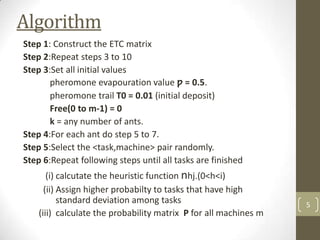
Algorithm
Step 1: Construct the ETC matrix
Step 2:Repeat steps 3 to 10
Step 3:Set all initial values
pheromone evapouration value ƿ = 0.5.
pheromone trail T0 = 0.01 (initial deposit)
Free(0 to m-1) = 0
k = any number of ants.
Step 4:For each ant do step 5 to 7.
Step 5:Select the <task,machine> pair randomly.
Step 6:Repeat following steps until all tasks are finished
(i) calcutate the heuristic function nhj.(0<h<i)
(ii) Assign higher probabilty to tasks that have high
standard deviation among tasks
(iii) calculate the probability matrix P for all machines m

5
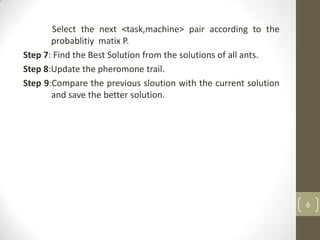
Select the next <task,machine> pair according to the
probablitiy matix P.
Step 7: Find the Best Solution from the solutions of all ants.
Step 8:Update the pheromone trail.
Step 9:Compare the previous sloution with the current solution
and save the better solution.

6
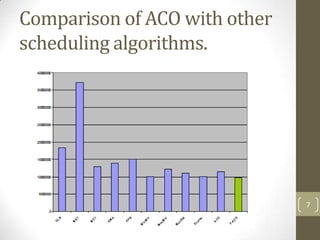
Comparison of ACO with other
scheduling algorithms.

7
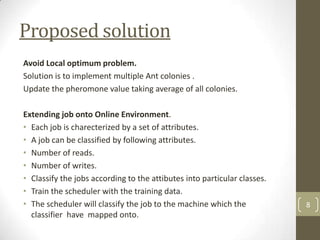
Proposed solution
Avoid Local optimum problem.
Solution is to implement multiple Ant colonies .
Update the pheromone value taking average of all colonies.
Extending job onto Online Environment.
• Each job is charecterized by a set of attributes.
• A job can be classified by following attributes.
• Number of reads.
• Number of writes.
• Classify the jobs according to the attibutes into particular classes.
• Train the scheduler with the training data.
• The scheduler will classify the job to the machine which the
classifier have mapped onto.

8
Feasibility study
• The jobs are classified onto appropriate machine using
read and write operations per job,using machine learning tool
WEKA.
• Using the excel based tool SOLVER ,training data set is given
as input .
•
Constraint is given as ∑min(makespan).
•
New testing data classfied automatically.
• Neural networks can also be used for classification.

9
Conclusion
• Grid scheduling can be implemented within Polynomial time
by adopting machine learning algorithms.
• ACO algorithm performs better than traditional scheduling
algorithms.
• The scheduling can be extended onto an online environment
by applying suitable classification algorithms.

10
References
• [1].Ant Colony System: A Cooperative Learning Approach to the
Salesman Problem , Marco Dorigo,IEEE 1997

Traveling

• [2].An Improved Ant Algorithm for Grid Scheduling Problem,
Bagherzadeh, Mojtaba MadadyarAdeh,IEEE 2009

Jamshid

• [3].Task Scheduling with Load Balancing using Multiple Ant Colonies Optimization
in Grid Computing, Liang Bai, Yan-Li Hu, Song-Yang Lao, Wei-Ming Zhang,2010
IEEE

• [4].A Task scheduling for grid scheduling using Ant colony Optimization,Jun
Mao,IEEE 2011
• [5].Evaluating Scheduling Algorithms on Distributed
Ryan J. Wisnesky

Computational Grids,

• [6] Improved job grouping based PSO algorithm for task scheduling in grid
computing,Sudha sadhasivam,IJEST 2010
• [7] Wikipedia-Particle Swarm optimization.

11

JOB SCHEDULING USING ANT COLONY OPTIMIZATION ALGORITHM

  • 1.
    Job Scheduling inGrid Environment using machine learning Algorithms GUIDE: T R SWAPNA JAYAKRISHNAN B CB.EN.P2CSE12007 1
  • 2.
    Motivation • The resourcescheduling in grid is a NP complete problem • The choice of the best pairs of jobs and resources cannot be determined accurately. • Only way it can do this is by past experience. • This gives high scope for machine learning algorithms which makes system learn from previous experiences 2
  • 3.
    Objective • Minimize makespanof Grid System • Makespan is used to measure the throughput of the grid system. • Makespan is the total completion time of a particular task on a machine 3
  • 4.
    Alternative solutions • Gridscheduling algorithms such as Opportunistic load balancing (OLB) Maximum Standard deviation heuristic • ANT COLONY OPTIMIZATION(ACO) [1] • ACO is a population based search optimization technique developed in the year 1997 • This algorithm simulates a colony of artificial ants that behave as cooperative agents where they are allowed to search and reinforce pathways (solutions) in order to find the optimal ones. • This approach which is population based has been successfully applied to many NP-hard optimization problems. 4
  • 5.
    Algorithm Step 1: Constructthe ETC matrix Step 2:Repeat steps 3 to 10 Step 3:Set all initial values pheromone evapouration value ƿ = 0.5. pheromone trail T0 = 0.01 (initial deposit) Free(0 to m-1) = 0 k = any number of ants. Step 4:For each ant do step 5 to 7. Step 5:Select the <task,machine> pair randomly. Step 6:Repeat following steps until all tasks are finished (i) calcutate the heuristic function nhj.(0<h<i) (ii) Assign higher probabilty to tasks that have high standard deviation among tasks (iii) calculate the probability matrix P for all machines m 5
  • 6.
    Select the next<task,machine> pair according to the probablitiy matix P. Step 7: Find the Best Solution from the solutions of all ants. Step 8:Update the pheromone trail. Step 9:Compare the previous sloution with the current solution and save the better solution. 6
  • 7.
    Comparison of ACOwith other scheduling algorithms. 7
  • 8.
    Proposed solution Avoid Localoptimum problem. Solution is to implement multiple Ant colonies . Update the pheromone value taking average of all colonies. Extending job onto Online Environment. • Each job is charecterized by a set of attributes. • A job can be classified by following attributes. • Number of reads. • Number of writes. • Classify the jobs according to the attibutes into particular classes. • Train the scheduler with the training data. • The scheduler will classify the job to the machine which the classifier have mapped onto. 8
  • 9.
    Feasibility study • Thejobs are classified onto appropriate machine using read and write operations per job,using machine learning tool WEKA. • Using the excel based tool SOLVER ,training data set is given as input . • Constraint is given as ∑min(makespan). • New testing data classfied automatically. • Neural networks can also be used for classification. 9
  • 10.
    Conclusion • Grid schedulingcan be implemented within Polynomial time by adopting machine learning algorithms. • ACO algorithm performs better than traditional scheduling algorithms. • The scheduling can be extended onto an online environment by applying suitable classification algorithms. 10
  • 11.
    References • [1].Ant ColonySystem: A Cooperative Learning Approach to the Salesman Problem , Marco Dorigo,IEEE 1997 Traveling • [2].An Improved Ant Algorithm for Grid Scheduling Problem, Bagherzadeh, Mojtaba MadadyarAdeh,IEEE 2009 Jamshid • [3].Task Scheduling with Load Balancing using Multiple Ant Colonies Optimization in Grid Computing, Liang Bai, Yan-Li Hu, Song-Yang Lao, Wei-Ming Zhang,2010 IEEE • [4].A Task scheduling for grid scheduling using Ant colony Optimization,Jun Mao,IEEE 2011 • [5].Evaluating Scheduling Algorithms on Distributed Ryan J. Wisnesky Computational Grids, • [6] Improved job grouping based PSO algorithm for task scheduling in grid computing,Sudha sadhasivam,IJEST 2010 • [7] Wikipedia-Particle Swarm optimization. 11