Opportunities for Energy Efficiency
Programs and Collaboratives in the
Commonwealth
Mary Shoemaker, Senior Research Analyst
American Council for an Energy-Efficient Economy
Dominion Energy Efficiency Stakeholder Meeting
February 1, 2019
aceee.org @ACEEEdc
The American Council for an Energy-Efficient Economy is a nonprofit
501(c)(3) founded in 1980. We act as a catalyst to advance energy efficiency
policies, programs, technologies, investments, & behaviors.
Our research explores economic impacts, financing options, behavior
changes, program design, and utility planning, as well as US national, state,
& local policy.
Our work is made possible by foundation funding, contracts, government
grants, and conference revenue.
I. Energy Efficiency Program Opportunities
• Best practices for delivery
• Program case studies
II. Energy Efficiency Collaboratives
• Recommendations for success
• Collaborative case studies
Today’s Presentation
What types of energy efficiency
programs do utilities offer?
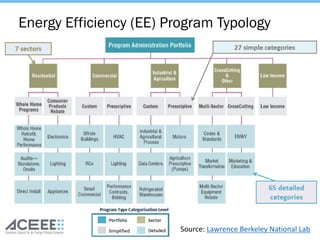
Energy Efficiency (EE) Program Typology
Source: Lawrence Berkeley National Lab
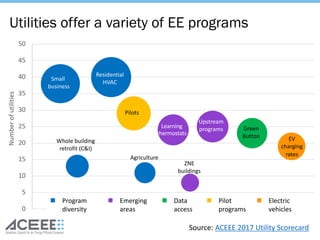
Utilities offer a variety of EE programs
Small
business
Whole building
retrofit (C&I)
Residential
HVAC
Agriculture
Learning
thermostats
ZNE
buildings
Upstream
programs Green
Button
Pilots
EV
charging
rates
0
5
10
15
20
25
30
35
40
45
50
Numberofutilities
n Program
diversity
n Emerging
areas
n Data
access
n Pilot
programs
n Electric
vehicles
Source: ACEEE 2017 Utility Scorecard
Energy Efficiency Program
Opportunities for Dominion
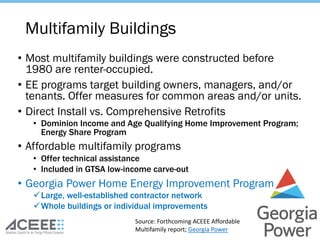
• Most multifamily buildings were constructed before
1980 are renter-occupied.
• EE programs target building owners, managers, and/or
tenants. Offer measures for common areas and/or units.
• Direct Install vs. Comprehensive Retrofits
• Dominion Income and Age Qualifying Home Improvement Program;
Energy Share Program
• Affordable multifamily programs
• Offer technical assistance
• Included in GTSA low-income carve-out
• Georgia Power Home Energy Improvement Program
üLarge, well-established contractor network
üWhole buildings or individual improvements
Multifamily Buildings
Source: Forthcoming ACEEE Affordable
Multifamily report; Georgia Power
Residential New Construction
• Ensure new homes are built or manufactured to
above-code energy performance standards (e.g.
ENERGY STAR or net zero homes)
• Target an array of residential new construction
stakeholders (e.g. building owners, builders,
realtors, sales professionals, code officials, etc.)
• Offer tiered incentive levels based on energy
savings above code.
• AEP Ohio EfficiencyCrafted HomesSM
üUses HERS- and ENERGY STAR-based tiers
üBase and pay-for-performance incentives ($/kWh)
Source: AEP Ohio
Leveraging Data for Monitoring-based
Commissioning (MBCx)
• Optimizes energy performance of existing
commercial, public, and industrial facilities.
• Uses data analytics tools, sensors, and software to
provide continuous, actionable information.
• Drives deeper, more persistent savings than
standard retrocommissioning (RCx) programs
• ComEd MBCx
• Savings are 15-25% higher than standard RCx.
• Project payback across all RCx and
MBCx projects is under 1.5 years
Source: ComEd
Combined Heat and Power (CHP)
• An important resilience technology for critical
facilities.
• Individual projects can deliver deep energy
savings.
• Regulators can set specific targets for CHP.
• GTSA requirement to consider CHP in IRP
• Baltimore Gas & Electric Smart Energy Savers
Program
• Open to all nonresidential customers
• Incentive delivered over course of project
Other Program Opportunities
• Utility Partnerships: Collaborative program models with local
governments and nonprofits.
• Xcel Energy Partners in Energy
• Strategic Energy Management: Energy savings through
operations and maintenance improvements in institutional,
commercial, and industrial markets.
• AEP Ohio Continuous Energy Improvement Program
• Upstream and Midstream: Leverage rebates in product
distribution channels for greater market impact.
• Efficiency Vermont Heat Pump Water Program
• Data to drive program design and delivery: Use more
granular customer data to segment customers and target
program offerings.
• Pacific Gas & Electric
Energy Efficiency Collaboratives:
Best Practices and Examples
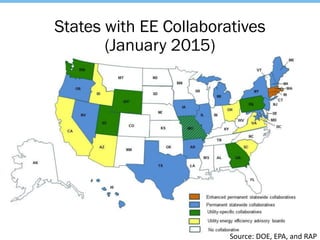
Source: DOE, EPA, and RAP
States with EE Collaboratives
(January 2015)
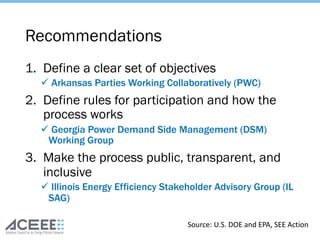
Recommendations
1. Define a clear set of objectives
ü Arkansas Parties Working Collaboratively (PWC)
2. Define rules for participation and how the
process works
ü Georgia Power Demand Side Management (DSM)
Working Group
3. Make the process public, transparent, and
inclusive
ü Illinois Energy Efficiency Stakeholder Advisory Group (IL
SAG)
Source: U.S. DOE and EPA, SEE Action
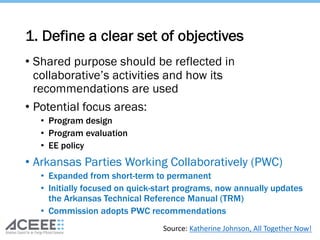
1. Define a clear set of objectives
• Shared purpose should be reflected in
collaborative’s activities and how its
recommendations are used
• Potential focus areas:
• Program design
• Program evaluation
• EE policy
• Arkansas Parties Working Collaboratively (PWC)
• Expanded from short-term to permanent
• Initially focused on quick-start programs, now annually updates
the Arkansas Technical Reference Manual (TRM)
• Commission adopts PWC recommendations
Source: Katherine Johnson, All Together Now!
2. Define rules for participation and how
the process works
• Rules should define:
• Group procedures
• Decision-making processes
• Participants and means of participation
• Roles and expectations for group members
• Independent facilitator supports:
• Design and execution of procedures
• Group efforts to meet objectives.
• Georgia Power Demand Side Management (DSM)
Working Group
• Robust and iterative program planning in year before the IRP
• Defined timeline: program refinement, proposal to PSC, and
issuance of RFPs.
3. Make the process public, transparent,
and inclusive
• Post materials online in a timely fashion
• Define clear rules, procedures, and means of
participation
• Facilitator or subcommittee provides regular updates
to the Commission, Governor, and General Assembly.
• Establish how collaborative findings will be used by
utilities and Commission in decision-making.
• Illinois Energy Efficiency Stakeholder Advisory
Group (IL SAG)
• Monthly in-person meetings with remote subcommittee
meetings as-needed
• Public SAG website with relevant documents
• Commission usually adopts SAG recommendations
Source: IL SAG
Takeaways
• Dominion can look to new program models to
benefit all customer classes.
• EE Collaboratives have a long and successful
history and have been used – in some form – in
more than half of states.
• Dominion, APCo, and EE stakeholders in Virginia
have an exciting opportunity to deepen energy
savings across the Commonwealth.
“A collaborative is most useful if it can
provide an engaging forum for
stakeholders to discuss energy efficiency
program matters, as well as contribute
directly to regulatory efficiency.
A virtuous cycle can be created if a
collaborative does quality work and the
commission gives weight to the findings
and conclusions of the collaborative."
– DOE, EPA & RAP
Resources
• ACEEE, Exemplary Energy Efficiency Programs
• SEE Action, Energy Efficiency Collaboratives
• Midwest Energy Efficiency Alliance, Midwestern
Energy Efficiency Collaboratives
• Katherine Johnson, Arkansas Parties Working
Collaboratively (PWC)
Mary Shoemaker
mshoemaker@aceee.org
202-507-4003
Dominion Energy Efficiency Collaborative Presentation

Dominion Energy Efficiency Collaborative Presentation

  • 1.
    Opportunities for EnergyEfficiency Programs and Collaboratives in the Commonwealth Mary Shoemaker, Senior Research Analyst American Council for an Energy-Efficient Economy Dominion Energy Efficiency Stakeholder Meeting February 1, 2019
  • 2.
    aceee.org @ACEEEdc The AmericanCouncil for an Energy-Efficient Economy is a nonprofit 501(c)(3) founded in 1980. We act as a catalyst to advance energy efficiency policies, programs, technologies, investments, & behaviors. Our research explores economic impacts, financing options, behavior changes, program design, and utility planning, as well as US national, state, & local policy. Our work is made possible by foundation funding, contracts, government grants, and conference revenue.
  • 3.
    I. Energy EfficiencyProgram Opportunities • Best practices for delivery • Program case studies II. Energy Efficiency Collaboratives • Recommendations for success • Collaborative case studies Today’s Presentation
  • 4.
    What types ofenergy efficiency programs do utilities offer?
  • 5.
    Energy Efficiency (EE)Program Typology Source: Lawrence Berkeley National Lab
  • 6.
    Utilities offer avariety of EE programs Small business Whole building retrofit (C&I) Residential HVAC Agriculture Learning thermostats ZNE buildings Upstream programs Green Button Pilots EV charging rates 0 5 10 15 20 25 30 35 40 45 50 Numberofutilities n Program diversity n Emerging areas n Data access n Pilot programs n Electric vehicles Source: ACEEE 2017 Utility Scorecard
  • 7.
  • 8.
    • Most multifamilybuildings were constructed before 1980 are renter-occupied. • EE programs target building owners, managers, and/or tenants. Offer measures for common areas and/or units. • Direct Install vs. Comprehensive Retrofits • Dominion Income and Age Qualifying Home Improvement Program; Energy Share Program • Affordable multifamily programs • Offer technical assistance • Included in GTSA low-income carve-out • Georgia Power Home Energy Improvement Program üLarge, well-established contractor network üWhole buildings or individual improvements Multifamily Buildings Source: Forthcoming ACEEE Affordable Multifamily report; Georgia Power
  • 9.
    Residential New Construction •Ensure new homes are built or manufactured to above-code energy performance standards (e.g. ENERGY STAR or net zero homes) • Target an array of residential new construction stakeholders (e.g. building owners, builders, realtors, sales professionals, code officials, etc.) • Offer tiered incentive levels based on energy savings above code. • AEP Ohio EfficiencyCrafted HomesSM üUses HERS- and ENERGY STAR-based tiers üBase and pay-for-performance incentives ($/kWh) Source: AEP Ohio
  • 10.
    Leveraging Data forMonitoring-based Commissioning (MBCx) • Optimizes energy performance of existing commercial, public, and industrial facilities. • Uses data analytics tools, sensors, and software to provide continuous, actionable information. • Drives deeper, more persistent savings than standard retrocommissioning (RCx) programs • ComEd MBCx • Savings are 15-25% higher than standard RCx. • Project payback across all RCx and MBCx projects is under 1.5 years Source: ComEd
  • 11.
    Combined Heat andPower (CHP) • An important resilience technology for critical facilities. • Individual projects can deliver deep energy savings. • Regulators can set specific targets for CHP. • GTSA requirement to consider CHP in IRP • Baltimore Gas & Electric Smart Energy Savers Program • Open to all nonresidential customers • Incentive delivered over course of project
  • 12.
    Other Program Opportunities •Utility Partnerships: Collaborative program models with local governments and nonprofits. • Xcel Energy Partners in Energy • Strategic Energy Management: Energy savings through operations and maintenance improvements in institutional, commercial, and industrial markets. • AEP Ohio Continuous Energy Improvement Program • Upstream and Midstream: Leverage rebates in product distribution channels for greater market impact. • Efficiency Vermont Heat Pump Water Program • Data to drive program design and delivery: Use more granular customer data to segment customers and target program offerings. • Pacific Gas & Electric
  • 13.
  • 14.
    Source: DOE, EPA,and RAP States with EE Collaboratives (January 2015)
  • 15.
    Recommendations 1. Define aclear set of objectives ü Arkansas Parties Working Collaboratively (PWC) 2. Define rules for participation and how the process works ü Georgia Power Demand Side Management (DSM) Working Group 3. Make the process public, transparent, and inclusive ü Illinois Energy Efficiency Stakeholder Advisory Group (IL SAG) Source: U.S. DOE and EPA, SEE Action
  • 16.
    1. Define aclear set of objectives • Shared purpose should be reflected in collaborative’s activities and how its recommendations are used • Potential focus areas: • Program design • Program evaluation • EE policy • Arkansas Parties Working Collaboratively (PWC) • Expanded from short-term to permanent • Initially focused on quick-start programs, now annually updates the Arkansas Technical Reference Manual (TRM) • Commission adopts PWC recommendations Source: Katherine Johnson, All Together Now!
  • 17.
    2. Define rulesfor participation and how the process works • Rules should define: • Group procedures • Decision-making processes • Participants and means of participation • Roles and expectations for group members • Independent facilitator supports: • Design and execution of procedures • Group efforts to meet objectives. • Georgia Power Demand Side Management (DSM) Working Group • Robust and iterative program planning in year before the IRP • Defined timeline: program refinement, proposal to PSC, and issuance of RFPs.
  • 18.
    3. Make theprocess public, transparent, and inclusive • Post materials online in a timely fashion • Define clear rules, procedures, and means of participation • Facilitator or subcommittee provides regular updates to the Commission, Governor, and General Assembly. • Establish how collaborative findings will be used by utilities and Commission in decision-making. • Illinois Energy Efficiency Stakeholder Advisory Group (IL SAG) • Monthly in-person meetings with remote subcommittee meetings as-needed • Public SAG website with relevant documents • Commission usually adopts SAG recommendations Source: IL SAG
  • 19.
    Takeaways • Dominion canlook to new program models to benefit all customer classes. • EE Collaboratives have a long and successful history and have been used – in some form – in more than half of states. • Dominion, APCo, and EE stakeholders in Virginia have an exciting opportunity to deepen energy savings across the Commonwealth.
  • 20.
    “A collaborative ismost useful if it can provide an engaging forum for stakeholders to discuss energy efficiency program matters, as well as contribute directly to regulatory efficiency. A virtuous cycle can be created if a collaborative does quality work and the commission gives weight to the findings and conclusions of the collaborative." – DOE, EPA & RAP
  • 21.
    Resources • ACEEE, ExemplaryEnergy Efficiency Programs • SEE Action, Energy Efficiency Collaboratives • Midwest Energy Efficiency Alliance, Midwestern Energy Efficiency Collaboratives • Katherine Johnson, Arkansas Parties Working Collaboratively (PWC) Mary Shoemaker mshoemaker@aceee.org 202-507-4003