Warm up
1. What are some characteristics that flatworms
              and cnidarians share?

   2. What are some characteristics that are
                  different?
Platyhelminthes

  The flatworms
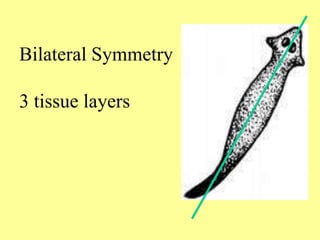
Bilateral Symmetry

3 tissue layers
No body cavity

Mouth but no anus

Branched intestines

Feed on small animals;
scavengers

Parasites; tapeworms
No skeleton; Body cavity is fluid filled to move and keep shape

Sexual reproduction, but hermaphroditic

Live in all environments

Primitive muscles!

Many parasitic for humans

Definite nerve organs including eyespots for sensing light

Most primitive of the bilateral animals!!! 
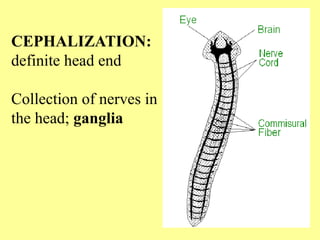
CEPHALIZATION:
definite head end

Collection of nerves in
the head; ganglia
Hymenolepis dimunata
This is how tapeworm attach to a host.
They are found in uncooked meat and fecal material.
The host can become VERY SICK!!!
Bilharzia burrows through you skin and
moves to your gut.
The host becomes very sick.
It comes from fouled water.
 ~250,000,000 people are infected
Sparganosis is from infected water.

             Humans can get it from
             reptiles, birds, & other mammals that
             have it.

             They can grow up to 14 inches.

             This flatworm can infect the brain or
             eyes.

Most
common
in eastern
Asia!
Nematoda

The roundworms
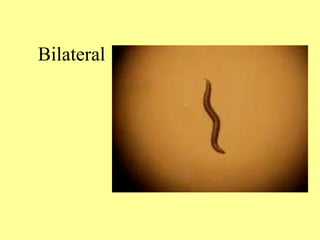
Bilateral
Digestive cavity

Mouth and anus

Feed on just about
anything

Many harmful parasites
to humans!
No skeleton
Sexual reproduction
Found everywhere
Name means thread-like
No circulatory
system

Look like
worms, but are
NOT!

Coelom (body cavity
type body plan)

Two nerve cords that
transmit impulses
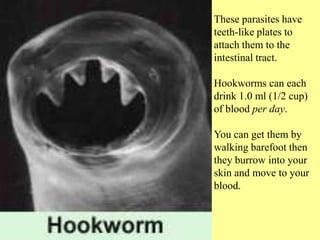
These parasites have
teeth-like plates to
attach them to the
intestinal tract.

Hookworms can each
drink 1.0 ml (1/2 cup)
of blood per day.

You can get them by
walking barefoot then
they burrow into your
skin and move to your
blood.
Trichinella roundworms
                       in human muscle


Whipworm found in
50% of puppies;
Transmitted to human
owners
                        Most common
                        childhood intestinal
                        parasite

Flatworms roundworms notes