CopyRight@JFOgugo.CitadelSchools.com
Subject: Physics Class: SS3
ENERGY QUANTIZATION
CONTENTS
 INTRODUCTION
 QUANTIZATION
 ATOMIC ENERGY LEVELS
 ATOMIC SPECTRA
 PHOTO-ELECTRIC EFFECT
CopyRight@JFOgugo.CitadelSchools.com
Subject: Physics Class: SS3
ENERGY QUANTIZATION
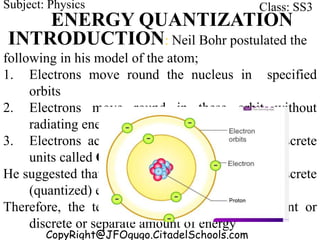
INTRODUCTION: Neil Bohr postulated the
following in his model of the atom;
1. Electrons move round the nucleus in specified
orbits
2. Electrons move round in these orbit without
radiating energy.
3. Electrons acquire or lose energy only in discrete
units called QUANTA
He suggested that electrons in the atoms exist in discrete
(quantized) energy states.
Therefore, the term quantum means fixed amount or
discrete or separate amount of energy
CopyRight@JFOgugo.CitadelSchools.com
Subject: Physics Class: SS3
ENERGY QUANTIZATION
PLANCK’S THEORY OF RADIATION
In 1902 Max Planck was able to show that radiation
emitted by a substance could be explained and that the
energy emitted from such body are in separate or
discrete packets of energy known as energy Quanta of
value hf where h is a constant known as Planck’s
Constant & f is the frequency of the radiation.
Thus the energy E of the quantum of radiation or
photon is given as; E = hf . Energy is not a continuous
quantity rather quantized .
This is the concept of of energy quantization
CopyRight@JFOgugo.CitadelSchools.com
Subject: Physics Class: SS3
ATOMIC ENERGY LEVELS
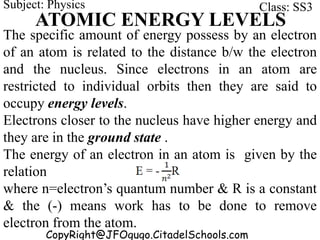
The specific amount of energy possess by an electron
of an atom is related to the distance b/w the electron
and the nucleus. Since electrons in an atom are
restricted to individual orbits then they are said to
occupy energy levels.
Electrons closer to the nucleus have higher energy and
they are in the ground state .
The energy of an electron in an atom is given by the
relation
where n=electron’s quantum number & R is a constant
& the (-) means work has to be done to remove
electron from the atom.
CopyRight@JFOgugo.CitadelSchools.com
Subject: Physics Class: SS3
ATOMIC ENERGY LEVELS
CopyRight@JFOgugo.CitadelSchools.com
Subject: Physics Class: SS3
Transition blw energy levels
 When Electron is at the lowest energy level, the
atom is said to be in its ground level.
 If the atom absorbs some energy, the electron may
be excited to one of the higher energy levels
through a process known as EXCITATION.
 the atom became unstable.
 De–excitation occurs as the electron return to the
ground level & the absorbed energy is released or
emitted in the form of electromagnetic (EM)
radiation.
 The released EM radiation is in the form of a
PHOTON for each De-excitation.
CopyRight@JFOgugo.CitadelSchools.com
Subject: Physics Class: SS3
WHAT IS A PHOTON?
 A photon is a packet of energy in the form of EM
radiation.
 In 1905, Albert Einstein postulated that EM
radiation is emitted, transmitted & absorbed in
discrete packets or quanta of energy.
 These packets of energy are called PHOTON.
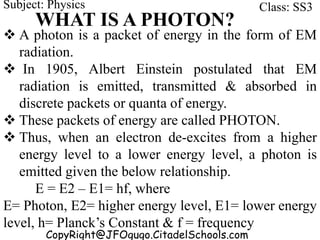
 Thus, when an electron de-excites from a higher
energy level to a lower energy level, a photon is
emitted given the below relationship.
E = E2 – E1= hf, where
E= Photon, E2= higher energy level, E1= lower energy
level, h= Planck’s Constant & f = frequency
CopyRight@JFOgugo.CitadelSchools.com
Subject: Physics Class: SS3
ATOMIC ENERGY LEVELS
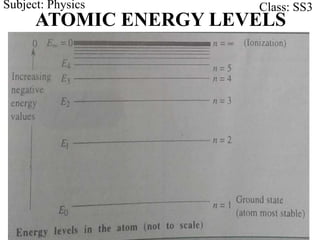
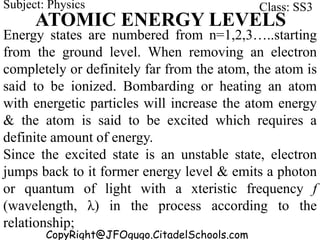
Energy states are numbered from n=1,2,3…..starting
from the ground level. When removing an electron
completely or definitely far from the atom, the atom is
said to be ionized. Bombarding or heating an atom
with energetic particles will increase the atom energy
& the atom is said to be excited which requires a
definite amount of energy.
Since the excited state is an unstable state, electron
jumps back to it former energy level & emits a photon
or quantum of light with a xteristic frequency f
(wavelength, λ) in the process according to the
relationship;
CopyRight@JFOgugo.CitadelSchools.com
Subject: Physics Class: SS3
ATOMIC ENERGY LEVELS
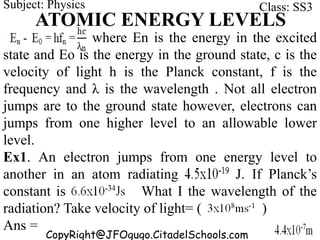
where En is the energy in the excited
state and Eo is the energy in the ground state, c is the
velocity of light h is the Planck constant, f is the
frequency and λ is the wavelength . Not all electron
jumps are to the ground state however, electrons can
jumps from one higher level to an allowable lower
level.
Ex1. An electron jumps from one energy level to
another in an atom radiating J. If Planck’s
constant is . What I the wavelength of the
radiation? Take velocity of light= ( )
Ans =
CopyRight@JFOgugo.CitadelSchools.com
Subject: Physics Class: SS3
ATOMIC ENERGY LEVELS
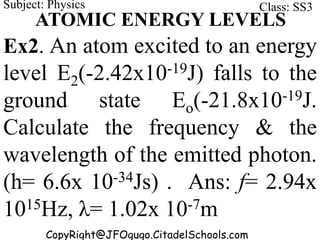
Ex2. An atom excited to an energy
level E2(-2.42x10⁻¹⁹J) falls to the
ground state Eo(-21.8x10⁻¹⁹J.
Calculate the frequency & the
wavelength of the emitted photon.
(h= 6.6x 10⁻³⁴Js) . Ans: f= 2.94x
1015Hz, λ= 1.02x 10⁻⁷m
CopyRight@JFOgugo.CitadelSchools.com
Subject: Physics Class: SS3
ATOMIC SPECTRA; COLOUR & LIGHT FREQUENCY
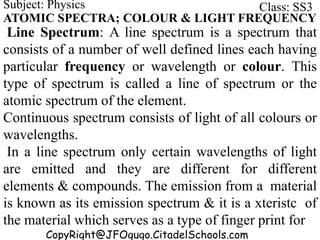
Line Spectrum: A line spectrum is a spectrum that
consists of a number of well defined lines each having
particular frequency or wavelength or colour. This
type of spectrum is called a line of spectrum or the
atomic spectrum of the element.
Continuous spectrum consists of light of all colours or
wavelengths.
In a line spectrum only certain wavelengths of light
are emitted and they are different for different
elements & compounds. The emission from a material
is known as its emission spectrum & it is a xteristc of
the material which serves as a type of finger print for
CopyRight@JFOgugo.CitadelSchools.com
Subject: Physics Class: SS3
ATOMIC SPECTRA; COLOUR & LIGHT FREQUENCY
identification of the gas. When a continuous spectrum
is passed through a gas, dark lines are observed in the
spectrum & they are corresponded to lines normally
emitted by the gas. It is called Absorption Spectrum.
The frequencies at which gases absorbed or emitted
light are the same.
The frequencies of light given off by an excited atom
of an element are unique or peculiar to that element.
Only certain xteristic energy changes take place
within the atom which is emitted by an excited atom.
The electrons in an atom can only have energies
corresponding to the set of electrons energy levels in
CopyRight@JFOgugo.CitadelSchools.com
Subject: Physics Class: SS3
ATOMIC SPECTRA; COLOUR & LIGHT FREQUENCY
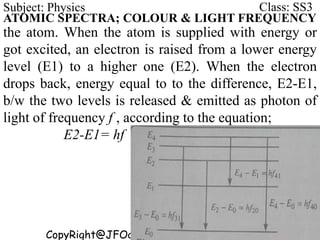
the atom. When the atom is supplied with energy or
got excited, an electron is raised from a lower energy
level (E1) to a higher one (E2). When the electron
drops back, energy equal to to the difference, E2-E1,
b/w the two levels is released & emitted as photon of
light of frequency f , according to the equation;
E2-E1= hf
CopyRight@JFOgugo.CitadelSchools.com
Subject: Physics Class: SS3
THE PHOTO-ELECTRIC EFFECT
Electrons are emitted when light falls on the metal
surface the atom. The process is known as Photo-
Electric Effect & the emitted electrons are known as
photo-electrons.
The maximum kinetic energy of the emitted electrons
is directly proportional to the frequency (or
wavelength) but independent of the intensity of the
incident light.
By increasing the intensity of incident light also
increases the number of photo-electrons though not
their energy or velocity. For light with frequency
lower than threshold frequency complete absorption of
Subject: Physics Class: SS3
THE PHOTO-ELECTRIC EFFECT
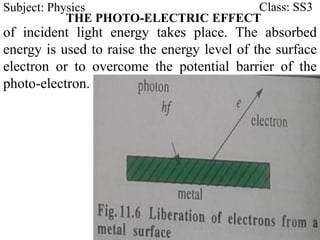
of incident light energy takes place. The absorbed
energy is used to raise the energy level of the surface
electron or to overcome the potential barrier of the
photo-electron.
CopyRight@JFOgugo.CitadelSchools.com
Subject: Physics Class: SS3
THE PHOTO-ELECTRIC EFFECT
Uses of photocells
 Burglar alarm
 Television Camera
 Automatic doors
Automatic street lightening
Automatic digital counters
 sound production from film
tracks
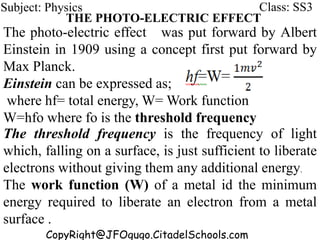
The photo-electric effect was put forward by Albert
Einstein in 1909 using a concept first put forward by
Max Planck.
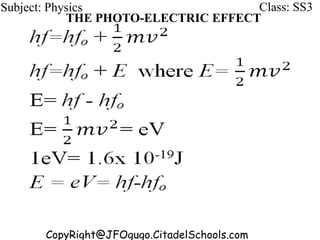
Einstein can be expressed as;
where hf= total energy, W= Work function
W=hfo where fo is the threshold frequency
CopyRight@JFOgugo.CitadelSchools.com
Subject: Physics Class: SS3
THE PHOTO-ELECTRIC EFFECT
The threshold frequency is the frequency of light
which, falling on a surface, is just sufficient to liberate
electrons without giving them any additional energy.
The work function (W) of a metal id the minimum
energy required to liberate an electron from a metal
surface .
CopyRight@JFOgugo.CitadelSchools.com
Subject: Physics Class: SS3
THE PHOTO-ELECTRIC EFFECT
CopyRight@JFOgugo.CitadelSchools.com
Subject: Physics Class: SS3
THE PHOTO-ELECTRIC EFFECT
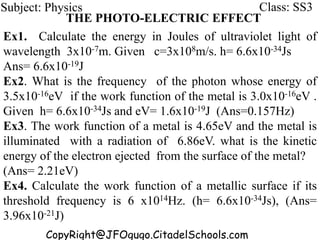
Ex1. Calculate the energy in Joules of ultraviolet light of
wavelength 3x10⁻⁷m. Given c=3x10⁸m/s. h= 6.6x10⁻³⁴Js
Ans= 6.6x10⁻¹⁹J
Ex2. What is the frequency of the photon whose energy of
3.5x10⁻¹⁶eV if the work function of the metal is 3.0x10⁻¹⁶eV .
Given h= 6.6x10⁻³⁴Js and eV= 1.6x10⁻¹⁹J (Ans=0.157Hz)
Ex3. The work function of a metal is 4.65eV and the metal is
illuminated with a radiation of 6.86eV. what is the kinetic
energy of the electron ejected from the surface of the metal?
(Ans= 2.21eV)
Ex4. Calculate the work function of a metallic surface if its
threshold frequency is 6 x10¹⁴Hz. (h= 6.6x10⁻³⁴Js), (Ans=
3.96x10⁻²¹J)
CopyRight@JFOgugo.CitadelSchools.com
Subject: Physics Class: SS3
THE PHOTO-ELECTRIC EFFECT
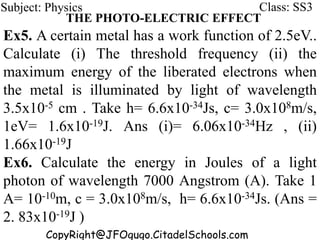
Ex5. A certain metal has a work function of 2.5eV..
Calculate (i) The threshold frequency (ii) the
maximum energy of the liberated electrons when
the metal is illuminated by light of wavelength
3.5x10⁻⁵ cm . Take h= 6.6x10⁻³⁴Js, c= 3.0x10⁸m/s,
1eV= 1.6x10⁻¹⁹J. Ans (i)= 6.06x10⁻³⁴Hz , (ii)
1.66x10⁻¹⁹J
Ex6. Calculate the energy in Joules of a light
photon of wavelength 7000 Angstrom (A). Take 1
A= 10-10m, c = 3.0x10⁸m/s, h= 6.6x10⁻³⁴Js. (Ans =
2. 83x10-19J )
CopyRight@JFOgugo.CitadelSchools.com
X-RAYS & ITS PRODUCTION
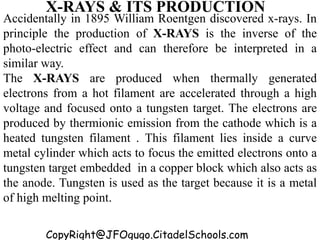
Accidentally in 1895 William Roentgen discovered x-rays. In
principle the production of X-RAYS is the inverse of the
photo-electric effect and can therefore be interpreted in a
similar way.
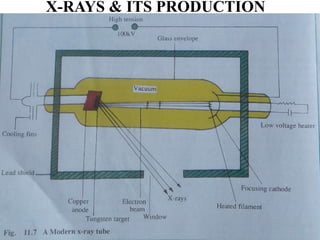
The X-RAYS are produced when thermally generated
electrons from a hot filament are accelerated through a high
voltage and focused onto a tungsten target. The electrons are
produced by thermionic emission from the cathode which is a
heated tungsten filament . This filament lies inside a curve
metal cylinder which acts to focus the emitted electrons onto a
tungsten target embedded in a copper block which also acts as
the anode. Tungsten is used as the target because it is a metal
of high melting point.
CopyRight@JFOgugo.CitadelSchools.com
X-RAYS & ITS PRODUCTION
CopyRight@JFOgugo.CitadelSchools.com
Subject: Physics Class: SS3
ATOMIC SPECTRA; COLOUR & LIGHT FREQUENCY
CopyRight@JFOgugo.CitadelSchools.com
Subject: Physics Class: SS3
ATOMIC SPECTRA; COLOUR & LIGHT FREQUENCY

ENERGY QUANTIZATION.ppt

  • 2.
    CopyRight@JFOgugo.CitadelSchools.com Subject: Physics Class:SS3 ENERGY QUANTIZATION CONTENTS  INTRODUCTION  QUANTIZATION  ATOMIC ENERGY LEVELS  ATOMIC SPECTRA  PHOTO-ELECTRIC EFFECT
  • 3.
    CopyRight@JFOgugo.CitadelSchools.com Subject: Physics Class:SS3 ENERGY QUANTIZATION INTRODUCTION: Neil Bohr postulated the following in his model of the atom; 1. Electrons move round the nucleus in specified orbits 2. Electrons move round in these orbit without radiating energy. 3. Electrons acquire or lose energy only in discrete units called QUANTA He suggested that electrons in the atoms exist in discrete (quantized) energy states. Therefore, the term quantum means fixed amount or discrete or separate amount of energy
  • 4.
    CopyRight@JFOgugo.CitadelSchools.com Subject: Physics Class:SS3 ENERGY QUANTIZATION PLANCK’S THEORY OF RADIATION In 1902 Max Planck was able to show that radiation emitted by a substance could be explained and that the energy emitted from such body are in separate or discrete packets of energy known as energy Quanta of value hf where h is a constant known as Planck’s Constant & f is the frequency of the radiation. Thus the energy E of the quantum of radiation or photon is given as; E = hf . Energy is not a continuous quantity rather quantized . This is the concept of of energy quantization
  • 5.
    CopyRight@JFOgugo.CitadelSchools.com Subject: Physics Class:SS3 ATOMIC ENERGY LEVELS The specific amount of energy possess by an electron of an atom is related to the distance b/w the electron and the nucleus. Since electrons in an atom are restricted to individual orbits then they are said to occupy energy levels. Electrons closer to the nucleus have higher energy and they are in the ground state . The energy of an electron in an atom is given by the relation where n=electron’s quantum number & R is a constant & the (-) means work has to be done to remove electron from the atom.
  • 6.
  • 7.
    CopyRight@JFOgugo.CitadelSchools.com Subject: Physics Class:SS3 Transition blw energy levels  When Electron is at the lowest energy level, the atom is said to be in its ground level.  If the atom absorbs some energy, the electron may be excited to one of the higher energy levels through a process known as EXCITATION.  the atom became unstable.  De–excitation occurs as the electron return to the ground level & the absorbed energy is released or emitted in the form of electromagnetic (EM) radiation.  The released EM radiation is in the form of a PHOTON for each De-excitation.
  • 8.
    CopyRight@JFOgugo.CitadelSchools.com Subject: Physics Class:SS3 WHAT IS A PHOTON?  A photon is a packet of energy in the form of EM radiation.  In 1905, Albert Einstein postulated that EM radiation is emitted, transmitted & absorbed in discrete packets or quanta of energy.  These packets of energy are called PHOTON.  Thus, when an electron de-excites from a higher energy level to a lower energy level, a photon is emitted given the below relationship. E = E2 – E1= hf, where E= Photon, E2= higher energy level, E1= lower energy level, h= Planck’s Constant & f = frequency
  • 9.
    CopyRight@JFOgugo.CitadelSchools.com Subject: Physics Class:SS3 ATOMIC ENERGY LEVELS Energy states are numbered from n=1,2,3…..starting from the ground level. When removing an electron completely or definitely far from the atom, the atom is said to be ionized. Bombarding or heating an atom with energetic particles will increase the atom energy & the atom is said to be excited which requires a definite amount of energy. Since the excited state is an unstable state, electron jumps back to it former energy level & emits a photon or quantum of light with a xteristic frequency f (wavelength, λ) in the process according to the relationship;
  • 10.
    CopyRight@JFOgugo.CitadelSchools.com Subject: Physics Class:SS3 ATOMIC ENERGY LEVELS where En is the energy in the excited state and Eo is the energy in the ground state, c is the velocity of light h is the Planck constant, f is the frequency and λ is the wavelength . Not all electron jumps are to the ground state however, electrons can jumps from one higher level to an allowable lower level. Ex1. An electron jumps from one energy level to another in an atom radiating J. If Planck’s constant is . What I the wavelength of the radiation? Take velocity of light= ( ) Ans =
  • 11.
    CopyRight@JFOgugo.CitadelSchools.com Subject: Physics Class:SS3 ATOMIC ENERGY LEVELS Ex2. An atom excited to an energy level E2(-2.42x10⁻¹⁹J) falls to the ground state Eo(-21.8x10⁻¹⁹J. Calculate the frequency & the wavelength of the emitted photon. (h= 6.6x 10⁻³⁴Js) . Ans: f= 2.94x 10¹⁵Hz, λ= 1.02x 10⁻⁷m
  • 12.
    CopyRight@JFOgugo.CitadelSchools.com Subject: Physics Class:SS3 ATOMIC SPECTRA; COLOUR & LIGHT FREQUENCY Line Spectrum: A line spectrum is a spectrum that consists of a number of well defined lines each having particular frequency or wavelength or colour. This type of spectrum is called a line of spectrum or the atomic spectrum of the element. Continuous spectrum consists of light of all colours or wavelengths. In a line spectrum only certain wavelengths of light are emitted and they are different for different elements & compounds. The emission from a material is known as its emission spectrum & it is a xteristc of the material which serves as a type of finger print for
  • 13.
    CopyRight@JFOgugo.CitadelSchools.com Subject: Physics Class:SS3 ATOMIC SPECTRA; COLOUR & LIGHT FREQUENCY identification of the gas. When a continuous spectrum is passed through a gas, dark lines are observed in the spectrum & they are corresponded to lines normally emitted by the gas. It is called Absorption Spectrum. The frequencies at which gases absorbed or emitted light are the same. The frequencies of light given off by an excited atom of an element are unique or peculiar to that element. Only certain xteristic energy changes take place within the atom which is emitted by an excited atom. The electrons in an atom can only have energies corresponding to the set of electrons energy levels in
  • 14.
    CopyRight@JFOgugo.CitadelSchools.com Subject: Physics Class:SS3 ATOMIC SPECTRA; COLOUR & LIGHT FREQUENCY the atom. When the atom is supplied with energy or got excited, an electron is raised from a lower energy level (E1) to a higher one (E2). When the electron drops back, energy equal to to the difference, E2-E1, b/w the two levels is released & emitted as photon of light of frequency f , according to the equation; E2-E1= hf
  • 15.
    CopyRight@JFOgugo.CitadelSchools.com Subject: Physics Class:SS3 THE PHOTO-ELECTRIC EFFECT Electrons are emitted when light falls on the metal surface the atom. The process is known as Photo- Electric Effect & the emitted electrons are known as photo-electrons. The maximum kinetic energy of the emitted electrons is directly proportional to the frequency (or wavelength) but independent of the intensity of the incident light. By increasing the intensity of incident light also increases the number of photo-electrons though not their energy or velocity. For light with frequency lower than threshold frequency complete absorption of
  • 16.
    Subject: Physics Class:SS3 THE PHOTO-ELECTRIC EFFECT of incident light energy takes place. The absorbed energy is used to raise the energy level of the surface electron or to overcome the potential barrier of the photo-electron.
  • 17.
    CopyRight@JFOgugo.CitadelSchools.com Subject: Physics Class:SS3 THE PHOTO-ELECTRIC EFFECT Uses of photocells  Burglar alarm  Television Camera  Automatic doors Automatic street lightening Automatic digital counters  sound production from film tracks
  • 18.
    The photo-electric effectwas put forward by Albert Einstein in 1909 using a concept first put forward by Max Planck. Einstein can be expressed as; where hf= total energy, W= Work function W=hfo where fo is the threshold frequency CopyRight@JFOgugo.CitadelSchools.com Subject: Physics Class: SS3 THE PHOTO-ELECTRIC EFFECT The threshold frequency is the frequency of light which, falling on a surface, is just sufficient to liberate electrons without giving them any additional energy. The work function (W) of a metal id the minimum energy required to liberate an electron from a metal surface .
  • 19.
  • 20.
    CopyRight@JFOgugo.CitadelSchools.com Subject: Physics Class:SS3 THE PHOTO-ELECTRIC EFFECT Ex1. Calculate the energy in Joules of ultraviolet light of wavelength 3x10⁻⁷m. Given c=3x10⁸m/s. h= 6.6x10⁻³⁴Js Ans= 6.6x10⁻¹⁹J Ex2. What is the frequency of the photon whose energy of 3.5x10⁻¹⁶eV if the work function of the metal is 3.0x10⁻¹⁶eV . Given h= 6.6x10⁻³⁴Js and eV= 1.6x10⁻¹⁹J (Ans=0.157Hz) Ex3. The work function of a metal is 4.65eV and the metal is illuminated with a radiation of 6.86eV. what is the kinetic energy of the electron ejected from the surface of the metal? (Ans= 2.21eV) Ex4. Calculate the work function of a metallic surface if its threshold frequency is 6 x10¹⁴Hz. (h= 6.6x10⁻³⁴Js), (Ans= 3.96x10⁻²¹J)
  • 21.
    CopyRight@JFOgugo.CitadelSchools.com Subject: Physics Class:SS3 THE PHOTO-ELECTRIC EFFECT Ex5. A certain metal has a work function of 2.5eV.. Calculate (i) The threshold frequency (ii) the maximum energy of the liberated electrons when the metal is illuminated by light of wavelength 3.5x10⁻⁵ cm . Take h= 6.6x10⁻³⁴Js, c= 3.0x10⁸m/s, 1eV= 1.6x10⁻¹⁹J. Ans (i)= 6.06x10⁻³⁴Hz , (ii) 1.66x10⁻¹⁹J Ex6. Calculate the energy in Joules of a light photon of wavelength 7000 Angstrom (A). Take 1 A= 10-10m, c = 3.0x10⁸m/s, h= 6.6x10⁻³⁴Js. (Ans = 2. 83x10-19J )
  • 22.
    CopyRight@JFOgugo.CitadelSchools.com X-RAYS & ITSPRODUCTION Accidentally in 1895 William Roentgen discovered x-rays. In principle the production of X-RAYS is the inverse of the photo-electric effect and can therefore be interpreted in a similar way. The X-RAYS are produced when thermally generated electrons from a hot filament are accelerated through a high voltage and focused onto a tungsten target. The electrons are produced by thermionic emission from the cathode which is a heated tungsten filament . This filament lies inside a curve metal cylinder which acts to focus the emitted electrons onto a tungsten target embedded in a copper block which also acts as the anode. Tungsten is used as the target because it is a metal of high melting point.
  • 23.
  • 24.
    CopyRight@JFOgugo.CitadelSchools.com Subject: Physics Class:SS3 ATOMIC SPECTRA; COLOUR & LIGHT FREQUENCY
  • 25.
    CopyRight@JFOgugo.CitadelSchools.com Subject: Physics Class:SS3 ATOMIC SPECTRA; COLOUR & LIGHT FREQUENCY

Editor's Notes

  • #21 solution. E=hf=hc/λ = 6.6x10-34x3x108= 6.6xa0-19J E=hf-W, 3.5x10⁻¹⁶- 3.0x10-16=6.5x10⁻¹⁶eV 6.5x10-16X1.6x10-19/6,6x10-34= 0.157Hz (3)
  • #22 solution. E=hf=hc/λ = 6.6x10-34x3x108= 6.6xa0-19J E=hf-W, 3.5x10⁻¹⁶- 3.0x10-16=6.5x10⁻¹⁶eV 6.5x10-16X1.6x10-19/6,6x10-34= 0.157Hz (3)
  • #23 solution. E=hf=hc/λ = 6.6x10-34x3x108= 6.6xa0-19J E=hf-W, 3.5x10⁻¹⁶- 3.0x10-16=6.5x10⁻¹⁶eV 6.5x10-16X1.6x10-19/6,6x10-34= 0.157Hz (3)
  • #24 solution. E=hf=hc/λ = 6.6x10-34x3x108= 6.6xa0-19J E=hf-W, 3.5x10⁻¹⁶- 3.0x10-16=6.5x10⁻¹⁶eV 6.5x10-16X1.6x10-19/6,6x10-34= 0.157Hz (3)