MEASURING INSTR
MEASURING INSTRUMENTS & UNITS
SS1PHY
LESSON CONTENTS
 MEASURING OF TIME
 MEASURING OF LENGTH
 MEASURING OF VOLUME
 MEASURING OF MASS &
WEIGHT
SS1PHY
In the beginning was the
word & the word was
with God & the word
was God.
Time & word exist right
from time.
WORD OF WISD
MEASUREMENT OF PHYSCICAL QUANTITIES
SS1PHY
Physical quantities can be
measured using various kinds of
instruments. The quantities to be
consider here are;
 Time
 Length
 Volume
MEASUREMENT OF TIME
SS1PHY
TIME: Time is defined as the period in which a
process, action or an event takes place. It is also the
point or period when something occurs. Time is an
integral part of Physics & every single quantity in the
physical world relies on it. Time has made the
universe function in a simple and routine way. There
would have been many irregularities I the schedule
and timing of people if not for time. Physical
quantities like velocity, acceleration, electromagnetive
wave all depend on time. Time is a repetitive event.
Meaning 24hr = 1day, another 24hrs makes another
day. The most natural time unit is the solar system
which is manifested by the passing of day & night
SS1PHYS
An instrument used for measuring of time is a
watch or clock & the S.I. unit of time is Second(s)
Types of Clock/Watch
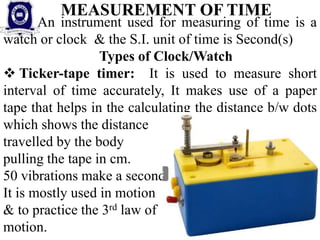
 Ticker-tape timer: It is used to measure short
interval of time accurately, It makes use of a paper
tape that helps in the calculating the distance b/w dots
which shows the distance
travelled by the body
pulling the tape in cm.
50 vibrations make a second.
It is mostly used in motion
& to practice the 3rd law of
motion.
MEASUREMENT OF TIME
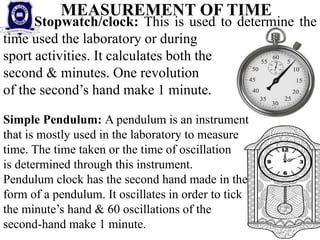
Stopwatch/clock: This is used to determine the
time used the laboratory or during
sport activities. It calculates both the
second & minutes. One revolution
of the second’s hand make 1 minute.
Simple Pendulum: A pendulum is an instrument
that is mostly used in the laboratory to measure
time. The time taken or the time of oscillation
is determined through this instrument.
Pendulum clock has the second hand made in the
form of a pendulum. It oscillates in order to tick
the minute’s hand & 60 oscillations of the
second-hand make 1 minute.
MEASUREMENT OF TIME
Heart-beat: It is a natural way of counting time
in medical field. The heart beat gives the pressure &
the rate of pumping blood in the body. An increase in
heart-beat is an increase in blood pressure & vice
versa. (diagram here)
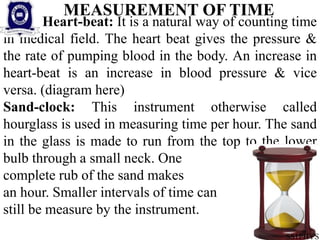
Sand-clock: This instrument otherwise called
hourglass is used in measuring time per hour. The sand
in the glass is made to run from the top to the lower
bulb through a small neck. One
complete rub of the sand makes
an hour. Smaller intervals of time can
still be measure by the instrument.
SS1PHYS
MEASUREMENT OF TIME
SS1PHYS
MEASUREMENT OF LENGTH
Length is a fundamental quantity. The
following instruments used for its measurement;
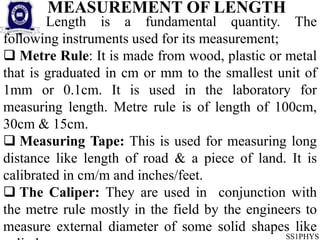
 Metre Rule: It is made from wood, plastic or metal
that is graduated in cm or mm to the smallest unit of
1mm or 0.1cm. It is used in the laboratory for
measuring length. Metre rule is of length of 100cm,
30cm & 15cm.
 Measuring Tape: This is used for measuring long
distance like length of road & a piece of land. It is
calibrated in cm/m and inches/feet.
 The Caliper: They are used in conjunction with
the metre rule mostly in the field by the engineers to
measure external diameter of some solid shapes like
SS1PHYS
The vernier Caliper: The vernier caliper is
suitable for measuring smaller length like the
thickness of a metre rule, internal & external diameter
of rod etc. Mostly its measurement is more accurate
than the metre rule. It has two scales; the main scale
and the vernier scale which slides on the main scale.
The main scale is graduated in
cm or mm & the vernier scale
is constructed by 9mm into
10 equal divisions. It measur
ement is of 0.1mm accuracy.
Vernier caliper measurement is
= Main scale + Vernier scale.
MEASUREMENT OF LENGTH
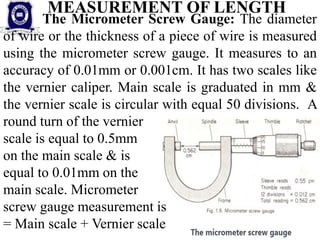
The Micrometer Screw Gauge: The diameter
of wire or the thickness of a piece of wire is measured
using the micrometer screw gauge. It measures to an
accuracy of 0.01mm or 0.001cm. It has two scales like
the vernier caliper. Main scale is graduated in mm &
the vernier scale is circular with equal 50 divisions. A
round turn of the vernier
scale is equal to 0.5mm
on the main scale & is
equal to 0.01mm on the
main scale. Micrometer
screw gauge measurement is
= Main scale + Vernier scale
MEASUREMENT OF LENGTH
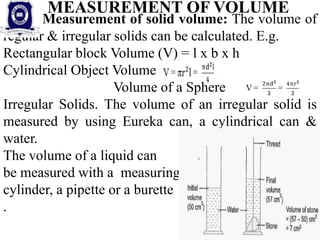
Measurement of solid volume: The volume of
regular & irregular solids can be calculated. E.g.
Rectangular block Volume (V) = l x b x h
Cylindrical Object Volume
Volume of a Sphere
Irregular Solids. The volume of an irregular solid is
measured by using Eureka can, a cylindrical can &
water.
The volume of a liquid can
be measured with a measuring
cylinder, a pipette or a burette
.
SS1PHYS
MEASUREMENT OF VOLUME
Mass: This is the quantity of matter in a body
& it is constant everywhere in the universe. It is a
fundamental quantity & it S.I. unit is kilogram (kg)
Chemical balance, beam balance are the some of the
balances used for measuring mass
Weight: This is the force or pull with which the earth
attracts a body towards the centre of the earth. It varies
from place to place on or around the earth surface.
Spring balance is used to measure weight & its S.I unit
is Newton (N). It is a vector quantity & also a derived
quantity.
SS1PHYS
MEASUREMENT OF MASS & WEIGHT
SS1PHYS
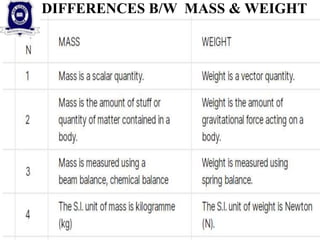
DIFFERENCES B/W MASS & WEIGHT
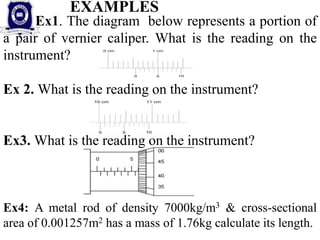
Ex1. The diagram below represents a portion of
a pair of vernier caliper. What is the reading on the
instrument?
Ex 2. What is the reading on the instrument?
Ex3. What is the reading on the instrument?
Ex4: A metal rod of density 7000kg/m3 & cross-sectional
area of 0.001257m2 has a mass of 1.76kg calculate its length.
EXAMPLES
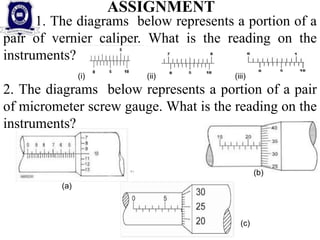
1. The diagrams below represents a portion of a
pair of vernier caliper. What is the reading on the
instruments?
2. The diagrams below represents a portion of a pair
of micrometer screw gauge. What is the reading on the
instruments?
ASSIGNMENT
(i) (ii) (iii)
(a)
(b)
(c)
THANK
YOU

MEASURING INSTRUMENTS.ppt

  • 1.
  • 2.
    MEASURING INSTRUMENTS &UNITS SS1PHY LESSON CONTENTS  MEASURING OF TIME  MEASURING OF LENGTH  MEASURING OF VOLUME  MEASURING OF MASS & WEIGHT
  • 3.
    SS1PHY In the beginningwas the word & the word was with God & the word was God. Time & word exist right from time. WORD OF WISD
  • 4.
    MEASUREMENT OF PHYSCICALQUANTITIES SS1PHY Physical quantities can be measured using various kinds of instruments. The quantities to be consider here are;  Time  Length  Volume
  • 5.
    MEASUREMENT OF TIME SS1PHY TIME:Time is defined as the period in which a process, action or an event takes place. It is also the point or period when something occurs. Time is an integral part of Physics & every single quantity in the physical world relies on it. Time has made the universe function in a simple and routine way. There would have been many irregularities I the schedule and timing of people if not for time. Physical quantities like velocity, acceleration, electromagnetive wave all depend on time. Time is a repetitive event. Meaning 24hr = 1day, another 24hrs makes another day. The most natural time unit is the solar system which is manifested by the passing of day & night
  • 6.
    SS1PHYS An instrument usedfor measuring of time is a watch or clock & the S.I. unit of time is Second(s) Types of Clock/Watch  Ticker-tape timer: It is used to measure short interval of time accurately, It makes use of a paper tape that helps in the calculating the distance b/w dots which shows the distance travelled by the body pulling the tape in cm. 50 vibrations make a second. It is mostly used in motion & to practice the 3rd law of motion. MEASUREMENT OF TIME
  • 7.
    Stopwatch/clock: This isused to determine the time used the laboratory or during sport activities. It calculates both the second & minutes. One revolution of the second’s hand make 1 minute. Simple Pendulum: A pendulum is an instrument that is mostly used in the laboratory to measure time. The time taken or the time of oscillation is determined through this instrument. Pendulum clock has the second hand made in the form of a pendulum. It oscillates in order to tick the minute’s hand & 60 oscillations of the second-hand make 1 minute. MEASUREMENT OF TIME
  • 8.
    Heart-beat: It isa natural way of counting time in medical field. The heart beat gives the pressure & the rate of pumping blood in the body. An increase in heart-beat is an increase in blood pressure & vice versa. (diagram here) Sand-clock: This instrument otherwise called hourglass is used in measuring time per hour. The sand in the glass is made to run from the top to the lower bulb through a small neck. One complete rub of the sand makes an hour. Smaller intervals of time can still be measure by the instrument. SS1PHYS MEASUREMENT OF TIME
  • 9.
    SS1PHYS MEASUREMENT OF LENGTH Lengthis a fundamental quantity. The following instruments used for its measurement;  Metre Rule: It is made from wood, plastic or metal that is graduated in cm or mm to the smallest unit of 1mm or 0.1cm. It is used in the laboratory for measuring length. Metre rule is of length of 100cm, 30cm & 15cm.  Measuring Tape: This is used for measuring long distance like length of road & a piece of land. It is calibrated in cm/m and inches/feet.  The Caliper: They are used in conjunction with the metre rule mostly in the field by the engineers to measure external diameter of some solid shapes like
  • 10.
    SS1PHYS The vernier Caliper:The vernier caliper is suitable for measuring smaller length like the thickness of a metre rule, internal & external diameter of rod etc. Mostly its measurement is more accurate than the metre rule. It has two scales; the main scale and the vernier scale which slides on the main scale. The main scale is graduated in cm or mm & the vernier scale is constructed by 9mm into 10 equal divisions. It measur ement is of 0.1mm accuracy. Vernier caliper measurement is = Main scale + Vernier scale. MEASUREMENT OF LENGTH
  • 11.
    The Micrometer ScrewGauge: The diameter of wire or the thickness of a piece of wire is measured using the micrometer screw gauge. It measures to an accuracy of 0.01mm or 0.001cm. It has two scales like the vernier caliper. Main scale is graduated in mm & the vernier scale is circular with equal 50 divisions. A round turn of the vernier scale is equal to 0.5mm on the main scale & is equal to 0.01mm on the main scale. Micrometer screw gauge measurement is = Main scale + Vernier scale MEASUREMENT OF LENGTH
  • 12.
    Measurement of solidvolume: The volume of regular & irregular solids can be calculated. E.g. Rectangular block Volume (V) = l x b x h Cylindrical Object Volume Volume of a Sphere Irregular Solids. The volume of an irregular solid is measured by using Eureka can, a cylindrical can & water. The volume of a liquid can be measured with a measuring cylinder, a pipette or a burette . SS1PHYS MEASUREMENT OF VOLUME
  • 13.
    Mass: This isthe quantity of matter in a body & it is constant everywhere in the universe. It is a fundamental quantity & it S.I. unit is kilogram (kg) Chemical balance, beam balance are the some of the balances used for measuring mass Weight: This is the force or pull with which the earth attracts a body towards the centre of the earth. It varies from place to place on or around the earth surface. Spring balance is used to measure weight & its S.I unit is Newton (N). It is a vector quantity & also a derived quantity. SS1PHYS MEASUREMENT OF MASS & WEIGHT
  • 14.
  • 15.
    Ex1. The diagrambelow represents a portion of a pair of vernier caliper. What is the reading on the instrument? Ex 2. What is the reading on the instrument? Ex3. What is the reading on the instrument? Ex4: A metal rod of density 7000kg/m3 & cross-sectional area of 0.001257m2 has a mass of 1.76kg calculate its length. EXAMPLES
  • 16.
    1. The diagramsbelow represents a portion of a pair of vernier caliper. What is the reading on the instruments? 2. The diagrams below represents a portion of a pair of micrometer screw gauge. What is the reading on the instruments? ASSIGNMENT (i) (ii) (iii) (a) (b) (c)
  • 17.

Editor's Notes