Festivals of India
Done by
D.Sai Tarun kumar
• Festivals are of 3 types:
• Religious festivals
• National festivals
• Cultural festivals
Religious festivals
• India is a land of many religious.
• So, we have many religious
festivals that are celebrated with joy
across the country.
Sankranti
Sankranti is one of the most auspicious
occasions for the Hindus, and is
celebrated in almost all parts of India and
Nepal in a myriad of cultural forms, with
great devotion, fervour, and gaiety. It is a
harvest festival.
Dussehra
• Dussehra (Vijaya Dashami, Dasara, or Dashain) is a Hindu festival
that celebrates the victory of good over evil. It is a gazetted holiday
in India, which is marked on the 10th day of the bright half (Shukla
Paksha) of the month of Ashvin (Ashwayuja), according to
the Hindu calendar. Dussehra (Vijaya Dashami, Dasara, or
Dashain) is a Hindu festival that celebrates the victory of good over
evil. It is a gazetted holiday in India, which is marked on the 10th
day of the bright half (Shukla Paksha) of the month of Ashvin
(Ashwayuja), according to the Hindu calendar.
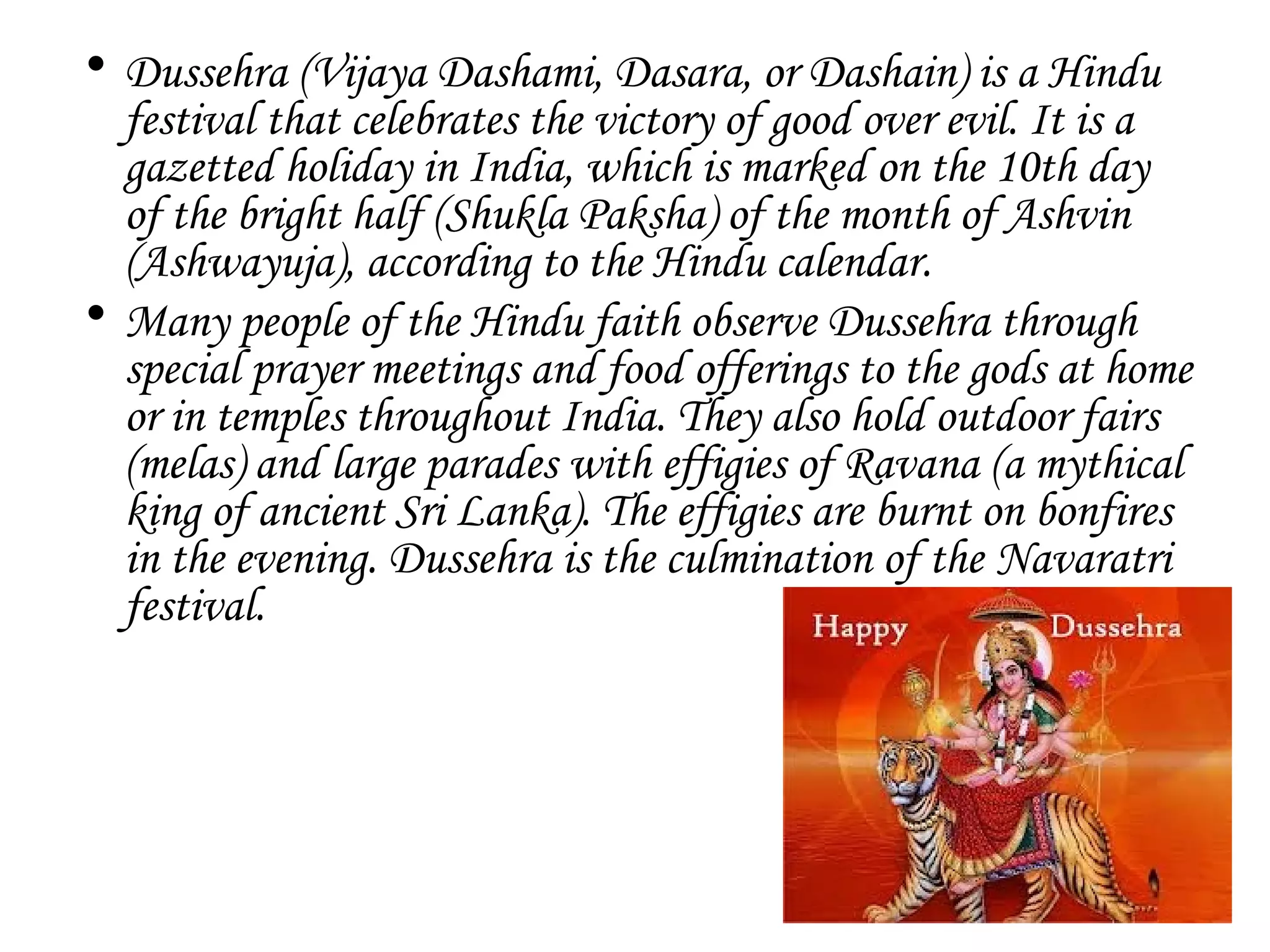
• Dussehra (Vijaya Dashami, Dasara, or Dashain) is a Hindu
festival that celebrates the victory of good over evil. It is a
gazetted holiday in India, which is marked on the 10th day
of the bright half (Shukla Paksha) of the month of Ashvin
(Ashwayuja), according to the Hindu calendar.
• Many people of the Hindu faith observe Dussehra through
special prayer meetings and food offerings to the gods at home
or in temples throughout India. They also hold outdoor fairs
(melas) and large parades with effigies of Ravana (a mythical
king of ancient Sri Lanka). The effigies are burnt on bonfires
in the evening. Dussehra is the culmination of the Navaratri
festival.
National festivals
• Festivals which are
celebrated by the
entire nation are
national festivals.
Come lets see some national festivals.
Republic Day (India)
• In India, Republic Day honours the date on which the 
Constitution of India came into force–on 26 January
1950–replacing the Government of India Act (1935) as
the governing document of India.[1]
• The Constitution was passed in the 
Constituent Assembly of India on 26 November 1949
and was adopted on 26 January 1950 with a democratic
government system, completing the country's transition
toward becoming an independent republic.
• 26 January was the date selected for this purpose because it
was this day in 1930 when the Declaration of Indian
Independence (Purna Swaraj) was proclaimed by the Indian
National Congress. Independence Day in India is the
celebration of victory over British Rule that succeeded a long
fought war through violent and non-violent means, Republic
Day celebrates the coming into force of its constitution. The
main Republic Day celebration is held in the national capital,
New Delhi, at the Rajpath before the President of India . On
this day, ceremonious parades take place at the Rajpath,
which are performed as a tribute to India .
Independence Day
• Independence Day, observed annually on
15 August, is a national holiday in India
commemorating the nation's
independence from British rule on 15
August 1947
Pongal
• Thai Pongal () or Pongal () is a harvest
festival celebrated by Tamil people at the end of the
harvest season.[1]Pongal is a four day festival which
usually takes place from January 13 to 16 in
the Gregorian calendar i.e., the last day of the Tamil
monthMaargazhi to the third day of Tamil
month Thai.
Onam
Onam The festival of Onam portrays
the rich cultural heritage of Kerala, its
golden past, rich traditions and
prosperous present. The festival is
celebrated for a period of ten
days, starting from the first day
Atham and continuing till tenth
Festivals
Festivals

Festivals

  • 1.
    Festivals of India Doneby D.Sai Tarun kumar
  • 2.
    • Festivals areof 3 types: • Religious festivals • National festivals • Cultural festivals
  • 3.
    Religious festivals • Indiais a land of many religious. • So, we have many religious festivals that are celebrated with joy across the country.
  • 5.
    Sankranti Sankranti is oneof the most auspicious occasions for the Hindus, and is celebrated in almost all parts of India and Nepal in a myriad of cultural forms, with great devotion, fervour, and gaiety. It is a harvest festival.
  • 9.
    Dussehra • Dussehra (VijayaDashami, Dasara, or Dashain) is a Hindu festival that celebrates the victory of good over evil. It is a gazetted holiday in India, which is marked on the 10th day of the bright half (Shukla Paksha) of the month of Ashvin (Ashwayuja), according to the Hindu calendar. Dussehra (Vijaya Dashami, Dasara, or Dashain) is a Hindu festival that celebrates the victory of good over evil. It is a gazetted holiday in India, which is marked on the 10th day of the bright half (Shukla Paksha) of the month of Ashvin (Ashwayuja), according to the Hindu calendar.
  • 10.
    • Dussehra (VijayaDashami, Dasara, or Dashain) is a Hindu festival that celebrates the victory of good over evil. It is a gazetted holiday in India, which is marked on the 10th day of the bright half (Shukla Paksha) of the month of Ashvin (Ashwayuja), according to the Hindu calendar. • Many people of the Hindu faith observe Dussehra through special prayer meetings and food offerings to the gods at home or in temples throughout India. They also hold outdoor fairs (melas) and large parades with effigies of Ravana (a mythical king of ancient Sri Lanka). The effigies are burnt on bonfires in the evening. Dussehra is the culmination of the Navaratri festival.
  • 12.
    National festivals • Festivalswhich are celebrated by the entire nation are national festivals. Come lets see some national festivals.
  • 14.
    Republic Day (India) •In India, Republic Day honours the date on which the  Constitution of India came into force–on 26 January 1950–replacing the Government of India Act (1935) as the governing document of India.[1] • The Constitution was passed in the  Constituent Assembly of India on 26 November 1949 and was adopted on 26 January 1950 with a democratic government system, completing the country's transition toward becoming an independent republic.
  • 15.
    • 26 Januarywas the date selected for this purpose because it was this day in 1930 when the Declaration of Indian Independence (Purna Swaraj) was proclaimed by the Indian National Congress. Independence Day in India is the celebration of victory over British Rule that succeeded a long fought war through violent and non-violent means, Republic Day celebrates the coming into force of its constitution. The main Republic Day celebration is held in the national capital, New Delhi, at the Rajpath before the President of India . On this day, ceremonious parades take place at the Rajpath, which are performed as a tribute to India .
  • 18.
    Independence Day • IndependenceDay, observed annually on 15 August, is a national holiday in India commemorating the nation's independence from British rule on 15 August 1947
  • 21.
    Pongal • Thai Pongal () or Pongal () isa harvest festival celebrated by Tamil people at the end of the harvest season.[1]Pongal is a four day festival which usually takes place from January 13 to 16 in the Gregorian calendar i.e., the last day of the Tamil monthMaargazhi to the third day of Tamil month Thai.
  • 23.
    Onam Onam The festivalof Onam portrays the rich cultural heritage of Kerala, its golden past, rich traditions and prosperous present. The festival is celebrated for a period of ten days, starting from the first day Atham and continuing till tenth