Unit No:01
Thermodynamics
Prof. Yash B. Parikh
M.Tech (Computer Integrated Manufacturing)
B.E.(Mechanical Engineering)
Assistant Professor
Department of Mechanical Engineering
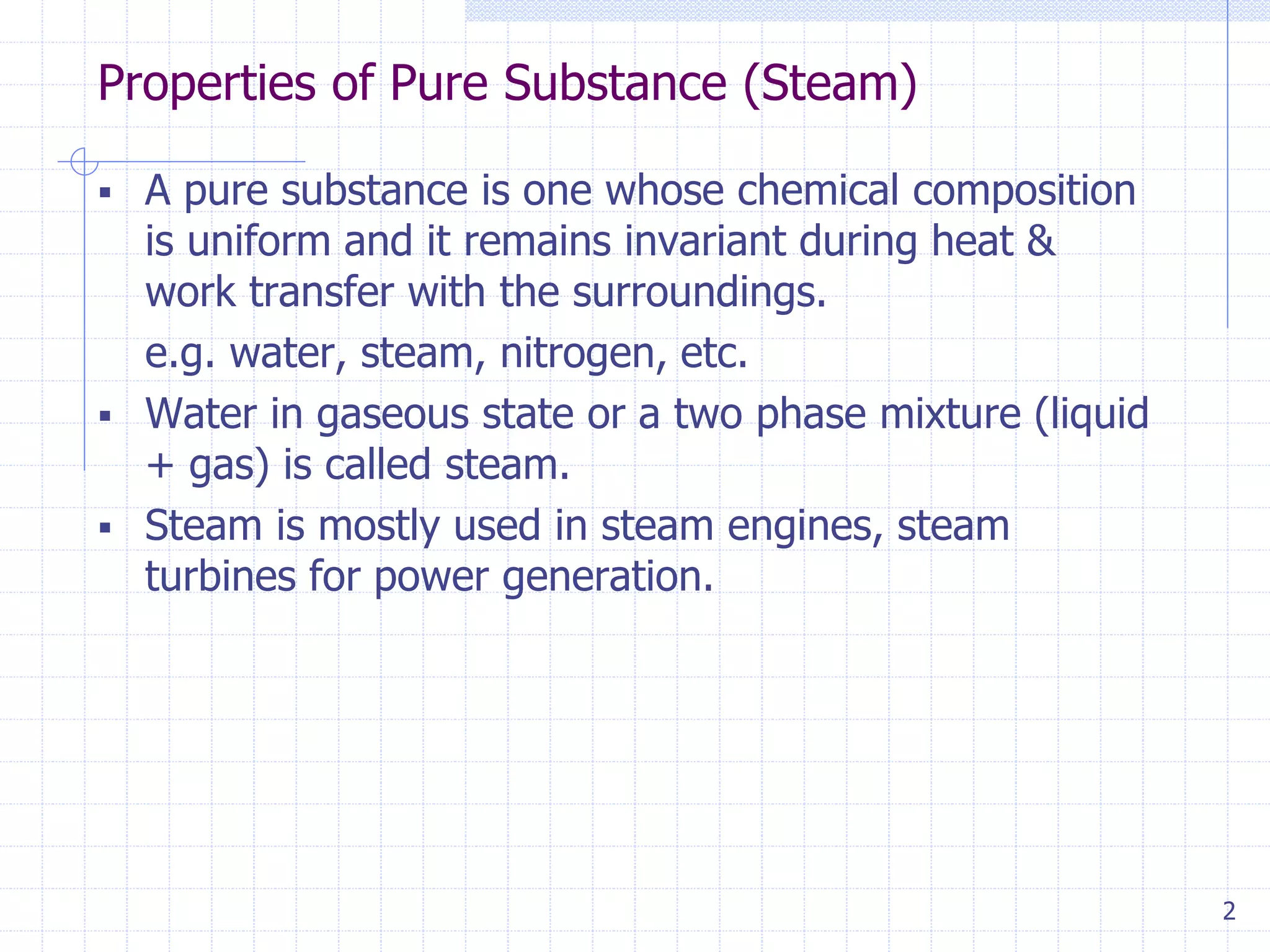
Properties of Pure Substance (Steam)
2
 A pure substance is one whose chemical composition
is uniform and it remains invariant during heat &
work transfer with the surroundings.
e.g. water, steam, nitrogen, etc.
 Water in gaseous state or a two phase mixture (liquid
+ gas) is called steam.
 Steam is mostly used in steam engines, steam
turbines for power generation.
Difference between Gas & Vapour
3
 Gas :
it is the state of substance in which the
evaporation from the liquid state is complete.
 Vapour :
it is the homogeneous mixture of minute
liquid particles in suspension with true gas of the
same substance.
 With changes in t & p, gas remains in its gaseous
state (except under extreme conditions)
 With changes in t & p, a vapour can undergo
condensation or evaporation.
 Gas obey the gas laws whereas vapour doesn’t.
Properties of Steam
4
Specific Sensible Heat or Specific Enthalpy of Water :
 It is assumed that enthalpy of water at 00C is zero.
 It is the amount of heat energy to be supplied to
convert 1 kg of water at 00C to its saturation
temperature at given steam pressure.
 It is denoted by hf and unit is kJ/kg.
 The value of enthalpy of water at different pressures
can be read from steam tables.
Properties of Steam
5
Latent Heat of Vaporization:
 It represents the amount of heat energy needed for
complete evaporation of saturated liquid into dry-
saturated steam at a given pressure.
 It is denoted by hfg and unit is kJ/kg.
 It’s value can be read from steam tables.
Properties of Steam
6
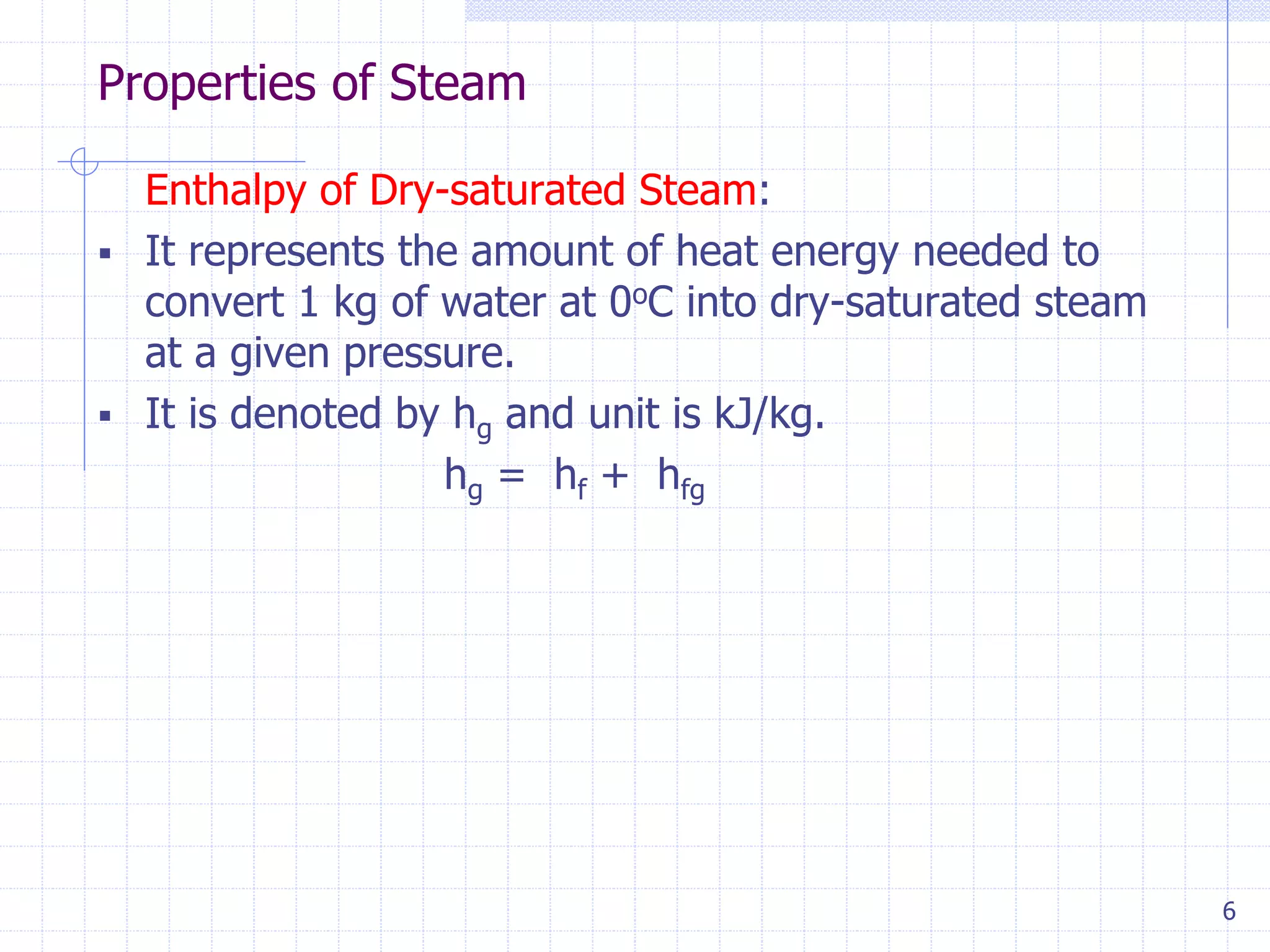
Enthalpy of Dry-saturated Steam:
 It represents the amount of heat energy needed to
convert 1 kg of water at 0oC into dry-saturated steam
at a given pressure.
 It is denoted by hg and unit is kJ/kg.
hg = hf + hfg
Properties of Steam
7
Enthalpy of Superheated Steam:
 Any further heating of dry-saturated steam will
increase the temperature of steam at a given
pressure.
 This steam is called superheated steam and its
temperature is denoted by tsup in 0C.
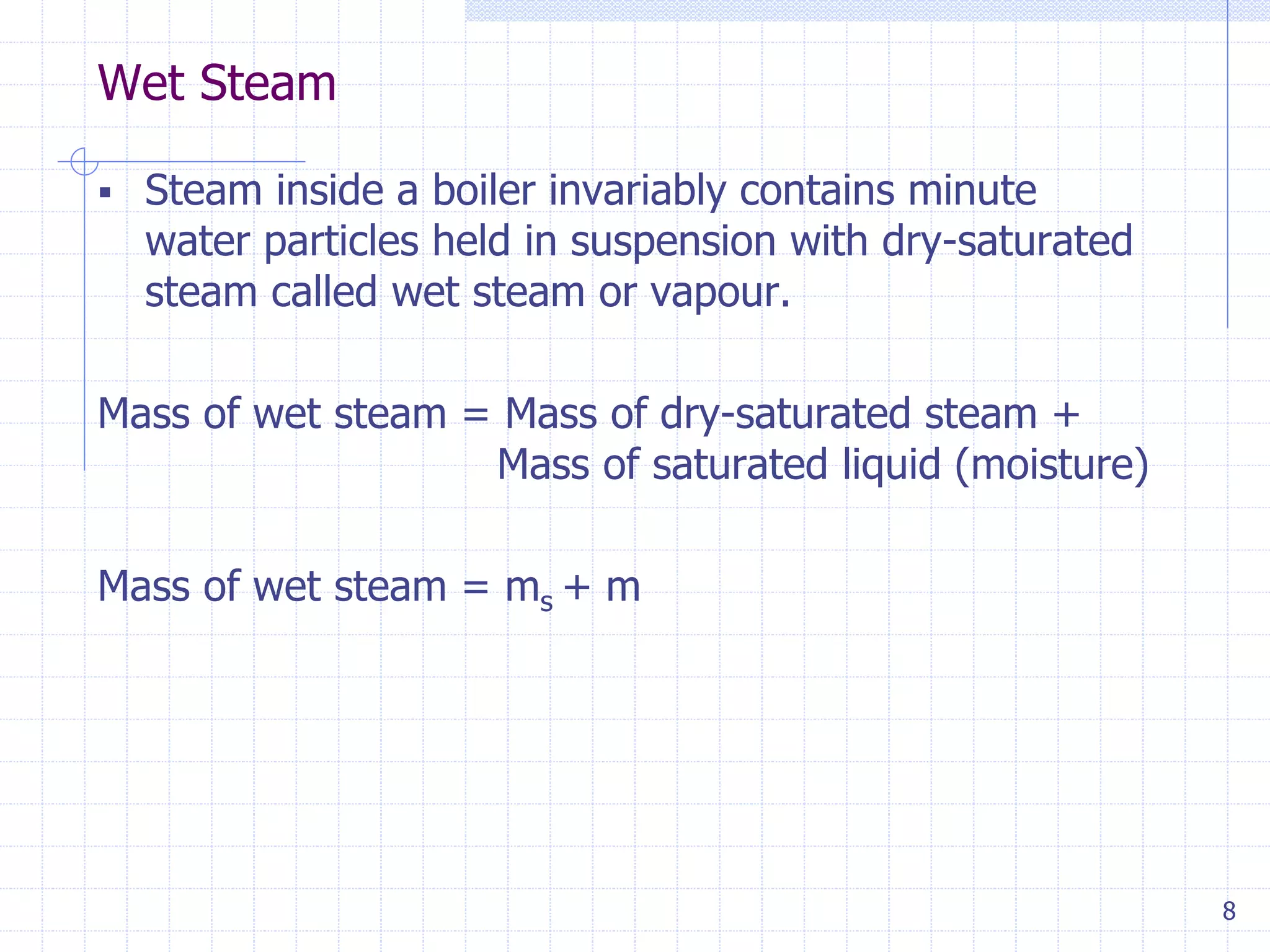
Wet Steam
8
 Steam inside a boiler invariably contains minute
water particles held in suspension with dry-saturated
steam called wet steam or vapour.
Mass of wet steam = Mass of dry-saturated steam +
Mass of saturated liquid (moisture)
Mass of wet steam = ms + m
Dryness Fraction
9
 The ratio of mass of dry-saturated steam in a given
mass of wet steam is defined as dryness fraction and
its denoted by x.
Dryness fraction, x = ms / ms+ m
 If mass of wet steam is 1 kg.
i.e. ms+ m = 1
Then, x = ms
 Dryness fraction represents the mass of dry-
saturated steam in 1 kg of wet steam.
 Value of x lies between 0 to 1.
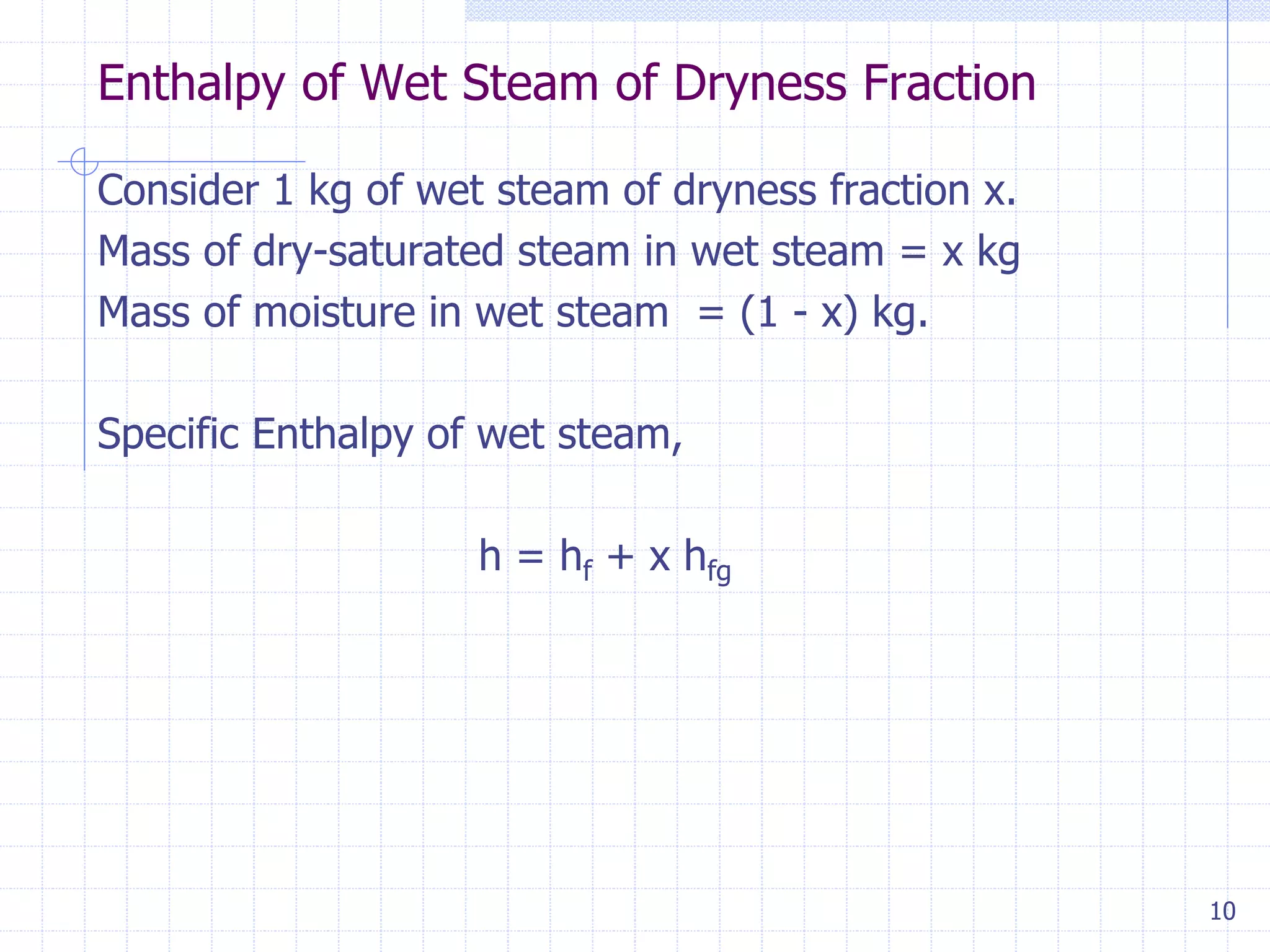
Enthalpy of Wet Steam of Dryness Fraction
10
Consider 1 kg of wet steam of dryness fraction x.
Mass of dry-saturated steam in wet steam = x kg
Mass of moisture in wet steam = (1 - x) kg.
Specific Enthalpy of wet steam,
h = hf + x hfg

Thermal 09

  • 1.
    Unit No:01 Thermodynamics Prof. YashB. Parikh M.Tech (Computer Integrated Manufacturing) B.E.(Mechanical Engineering) Assistant Professor Department of Mechanical Engineering
  • 2.
    Properties of PureSubstance (Steam) 2  A pure substance is one whose chemical composition is uniform and it remains invariant during heat & work transfer with the surroundings. e.g. water, steam, nitrogen, etc.  Water in gaseous state or a two phase mixture (liquid + gas) is called steam.  Steam is mostly used in steam engines, steam turbines for power generation.
  • 3.
    Difference between Gas& Vapour 3  Gas : it is the state of substance in which the evaporation from the liquid state is complete.  Vapour : it is the homogeneous mixture of minute liquid particles in suspension with true gas of the same substance.  With changes in t & p, gas remains in its gaseous state (except under extreme conditions)  With changes in t & p, a vapour can undergo condensation or evaporation.  Gas obey the gas laws whereas vapour doesn’t.
  • 4.
    Properties of Steam 4 SpecificSensible Heat or Specific Enthalpy of Water :  It is assumed that enthalpy of water at 00C is zero.  It is the amount of heat energy to be supplied to convert 1 kg of water at 00C to its saturation temperature at given steam pressure.  It is denoted by hf and unit is kJ/kg.  The value of enthalpy of water at different pressures can be read from steam tables.
  • 5.
    Properties of Steam 5 LatentHeat of Vaporization:  It represents the amount of heat energy needed for complete evaporation of saturated liquid into dry- saturated steam at a given pressure.  It is denoted by hfg and unit is kJ/kg.  It’s value can be read from steam tables.
  • 6.
    Properties of Steam 6 Enthalpyof Dry-saturated Steam:  It represents the amount of heat energy needed to convert 1 kg of water at 0oC into dry-saturated steam at a given pressure.  It is denoted by hg and unit is kJ/kg. hg = hf + hfg
  • 7.
    Properties of Steam 7 Enthalpyof Superheated Steam:  Any further heating of dry-saturated steam will increase the temperature of steam at a given pressure.  This steam is called superheated steam and its temperature is denoted by tsup in 0C.
  • 8.
    Wet Steam 8  Steaminside a boiler invariably contains minute water particles held in suspension with dry-saturated steam called wet steam or vapour. Mass of wet steam = Mass of dry-saturated steam + Mass of saturated liquid (moisture) Mass of wet steam = ms + m
  • 9.
    Dryness Fraction 9  Theratio of mass of dry-saturated steam in a given mass of wet steam is defined as dryness fraction and its denoted by x. Dryness fraction, x = ms / ms+ m  If mass of wet steam is 1 kg. i.e. ms+ m = 1 Then, x = ms  Dryness fraction represents the mass of dry- saturated steam in 1 kg of wet steam.  Value of x lies between 0 to 1.
  • 10.
    Enthalpy of WetSteam of Dryness Fraction 10 Consider 1 kg of wet steam of dryness fraction x. Mass of dry-saturated steam in wet steam = x kg Mass of moisture in wet steam = (1 - x) kg. Specific Enthalpy of wet steam, h = hf + x hfg