Seminar on
Submitted by
Dinesh Kumar
7th Semester B.Tech
Roll.No.-EE-63
Seminar Guide
Mr. A Behera
Department of Electrical Engg. 1
Outline of Presentation
Introduction
Conservation Of Energy At Various Levels
Major Renewable sources
Energy Efficient Devices
Concept Of Energy Auditing
Energy Conservation Act_2001
Conclusion
Reference
Department of Electrical Engg.
INTRODUCTION
 Energy conservation refers to efforts
made to reduce energy consumption.
Energy conservation can be achieved
through increased efficient energy
use, in conjunction with
decreased energy consumption and/or
reduced consumption from
conventional energy sources.
 Individuals and organizations that
are direct consumers of energy choose
to conserve energy to reduce energy
costs and promote economic security.
 Industrial and commercial users can
increase energy use efficiency to
maximize profit.
Department of Electrical Engg.
Conservation Of Energy At
Various Levels:-
Energy conservation at household level
Energy conservation at community
level
Energy conservation in industry and
other places
Energy conservation in transportation
sector
Energy Conservation At Household
Levels:-
• Energy conservation in major appliances for
domestic use:-
*Energy Conservation in Refrigerator
*Energy Conservation in Oven/Microwave Oven
*Energy Conservation in Ironing
*Energy Conservation in Cooking
*Energy Conservation in Washing machine
• Energy Conservation During Lighting
• Energy Conservation During Cooling
Energy Conservation At
Community Level:-
 All unnecessary lights should be turned off especially
when conference rooms etc. are not in use.
 Computers, monitors, photocopiers and other
business equipments should be set to their
energy saving mode.
 Skylights should be used for warehouses.
 We Should ensure that offices having air conditions
have proper windows and all doors are closed when
the air conditioner is in use.
Energy Conservation At
Community Level:-
Use Of Renewable Energy
Resources:-
 Alternative resources i.e. renewable energy sources
should be used in place of nonrenewable energy
sources e.g. solar energy, biogas, wind energy etc.
 solar energy for cooking and heating should
promoted.
 Projects involving wind-generated energy for
community and municipal needs should be
demonstrated to the whole community.
 Demonstration of biogas programmes is also
required to tell people for the efficient used of it.
.
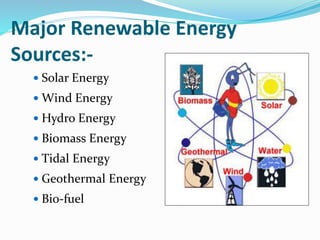
Major Renewable Energy
Sources:-
 Solar Energy
 Wind Energy
 Hydro Energy
 Biomass Energy
 Tidal Energy
 Geothermal Energy
 Bio-fuel
Total Renewable Energy Installed Capacity (May 2014)
Renewables : Total installed capacity 31,833.01 MW
Energy Conservation At
Community Level:-
Energy Conservation At Community
Level For Housing Complexes:-
 Installation of photoelectric controls or timers should
be used
 Water pumps should be switched off during non-peak
utility hours
 Only single Elevator/Lift should be operated during
“non-peak” hours
 Training programme about energy efficient repairs
should be organized
 Locally manufactured, improved cook stoves should be
introduced to reduce charcoal/fuel consumption
Energy conservation in industry
and other places:-
Auditing
Process modification
Improved measuring instruments
Energy loss reduction
Light load reduction
Energy conservation in
transportation sector:-
 Reduction of fuel consumption:-
 Car speed should be maintained as far as possible 50 to 60
km/hr.
 We should avoid free frequent starts and stops to reduce
fuel consumption.
 We should apply brakes gradually as far as possible
 Fuel economy- maximizing behaviour:-
 Moderate driving
 Driving at lower speeds
 Turning off a vehicles engine at stops rather than idling &
using cruise control
Energy Efficient Devices:-
 CFL
 Pressurized steam
cooker & Solar cooker
 Natural water cooler is a
safe drinking water
device which works on
the principle of “cooling
by evaporation”. No
external source of energy
such as electricity or ice
is required.
CONCEPT OF ENERGY AUDITING:-
 Energy auditing is a systematic approach to monitor
industrial energy consumption and to find out the
sources of energy wastage.
 The first and most important role of energy auditing is
to identify the areas of energy consumption and to
find the overuse for accessing the opportunity of
saving energy.
 Analysis of energy use is done for identifying the areas
of energy consumption.
Development & Design of Power plants:-
 Development, design and engineering of
co-generation & captive power plants.
Our engineering consultation services
encompass Design and Engineering of
Co-generation & Captive Power Plants.
These services are executed with in the
shortest frame of time and meet the
consultation requirements for:
 Co-generation power plants for sugar
mills, rice mills, maize processing plants,
industrial sector, etc.
 Waste heat recovery from hot gases and
liquids for generation of steam for
process use and power generation.
Department of Electrical Engg.
ENERGY CONSERVATION IN ELECTRICAL
MOTORS
 Motor Efficiency =O/P Power/Input
PowerX100
Watt Losses-
Stator & rotor losses
Iron Losses
Friction & Windage losses
Stray Load losses
 Energy Waste- Causes
@Use of less efficient motors
@Improper supply voltage
@Voltage fluctuations
@Poor power factor
@Less efficient driven equipment
@Idle running
 By supplying proper voltage
and running the motor on
proper load the efficiency of
the motor can be increased.
Total saving in mcl from 95-96 till 2000-2001:-
 Maximize returns from the existing assets
 Reduce losses in transportation and in end use
 Initiate action to reduce energy intensity of different
consuming sectors and promote conservation through
organizational and fiscal measures
 Initiate steps to meet the basic energy need of rural and
urban households so as to reduce the existing inequities.
 Maximize satisfaction of demand for energy from
indigenous resources
Energy Policy of India – Short term
 Progressive steps to substitute petroleum products by coal,
natural gas and electricity
 Action for accelerated development of all renewable energy
resources especially hydro potential
 Promote programmes to achieve self-reliance in energy
sector
 Create appropriate organizational changes in consistent
with the over all energy strategy
Energy Policy of India –
Medium term
 Promote an energy supply system, largely based on
renewable sources of energy
 Promote technologies of production, transportation
and use of energy that are environmentally benign and
cost effective
Energy Policy of India – Long term
Advantages:-
 Energy conservation can result in increased financial
capital, environmental quality, national
security, personal security, and human comfort.
 Energy efficiency saves money.
 It is environmental friendly.
 It improves indoor air quality.
 Longer life span to appliances.
 Energy is in short supply in India, and is expensive, especially for industry.
 Management of Energy Resources is a important part of power system.So
as to save natural resources the conservation of energy has to done done at
different levels i.e. at social and commercial level.
 With use of more energy efficient technologies, many businesses could cut
their energy consumption by up to 20 %
 More renewable resources can be used at consumer level for energy
conservation.
 It is more important to provide education regarding energy conservation to
the general mass.
 Thus we can say that Energy Conservation can improve the possibility of
Energy fulfillment.
Conclusions
REFERENCES:
 Environmental and Renewable Energy Innovation
Potential among the States: State Rankings. Applied
Research Project. Texas State University.
http://ecommons.txstate.edu/arp/291/
 Hermann Scheer “Energy Autonomy: The Economic,
Social & Technological Case for Renewable Energy”
 Mark Diesendorf “Greenhouse Solutions with
Sustainable Energy”.
 Energy: What do we want to achieve ? - European
commission". Ec.europa.eu. Retrieved 2010-07-29.
24

Energy conservation.pdf

  • 1.
    Seminar on Submitted by DineshKumar 7th Semester B.Tech Roll.No.-EE-63 Seminar Guide Mr. A Behera Department of Electrical Engg. 1
  • 2.
    Outline of Presentation Introduction ConservationOf Energy At Various Levels Major Renewable sources Energy Efficient Devices Concept Of Energy Auditing Energy Conservation Act_2001 Conclusion Reference Department of Electrical Engg.
  • 3.
    INTRODUCTION  Energy conservationrefers to efforts made to reduce energy consumption. Energy conservation can be achieved through increased efficient energy use, in conjunction with decreased energy consumption and/or reduced consumption from conventional energy sources.  Individuals and organizations that are direct consumers of energy choose to conserve energy to reduce energy costs and promote economic security.  Industrial and commercial users can increase energy use efficiency to maximize profit. Department of Electrical Engg.
  • 4.
    Conservation Of EnergyAt Various Levels:- Energy conservation at household level Energy conservation at community level Energy conservation in industry and other places Energy conservation in transportation sector
  • 5.
    Energy Conservation AtHousehold Levels:- • Energy conservation in major appliances for domestic use:- *Energy Conservation in Refrigerator *Energy Conservation in Oven/Microwave Oven *Energy Conservation in Ironing *Energy Conservation in Cooking *Energy Conservation in Washing machine • Energy Conservation During Lighting • Energy Conservation During Cooling
  • 6.
    Energy Conservation At CommunityLevel:-  All unnecessary lights should be turned off especially when conference rooms etc. are not in use.  Computers, monitors, photocopiers and other business equipments should be set to their energy saving mode.  Skylights should be used for warehouses.  We Should ensure that offices having air conditions have proper windows and all doors are closed when the air conditioner is in use.
  • 7.
    Energy Conservation At CommunityLevel:- Use Of Renewable Energy Resources:-  Alternative resources i.e. renewable energy sources should be used in place of nonrenewable energy sources e.g. solar energy, biogas, wind energy etc.  solar energy for cooking and heating should promoted.  Projects involving wind-generated energy for community and municipal needs should be demonstrated to the whole community.  Demonstration of biogas programmes is also required to tell people for the efficient used of it. .
  • 8.
    Major Renewable Energy Sources:- Solar Energy  Wind Energy  Hydro Energy  Biomass Energy  Tidal Energy  Geothermal Energy  Bio-fuel
  • 9.
    Total Renewable EnergyInstalled Capacity (May 2014) Renewables : Total installed capacity 31,833.01 MW
  • 10.
    Energy Conservation At CommunityLevel:- Energy Conservation At Community Level For Housing Complexes:-  Installation of photoelectric controls or timers should be used  Water pumps should be switched off during non-peak utility hours  Only single Elevator/Lift should be operated during “non-peak” hours  Training programme about energy efficient repairs should be organized  Locally manufactured, improved cook stoves should be introduced to reduce charcoal/fuel consumption
  • 11.
    Energy conservation inindustry and other places:- Auditing Process modification Improved measuring instruments Energy loss reduction Light load reduction
  • 12.
    Energy conservation in transportationsector:-  Reduction of fuel consumption:-  Car speed should be maintained as far as possible 50 to 60 km/hr.  We should avoid free frequent starts and stops to reduce fuel consumption.  We should apply brakes gradually as far as possible  Fuel economy- maximizing behaviour:-  Moderate driving  Driving at lower speeds  Turning off a vehicles engine at stops rather than idling & using cruise control
  • 13.
    Energy Efficient Devices:- CFL  Pressurized steam cooker & Solar cooker  Natural water cooler is a safe drinking water device which works on the principle of “cooling by evaporation”. No external source of energy such as electricity or ice is required.
  • 14.
    CONCEPT OF ENERGYAUDITING:-  Energy auditing is a systematic approach to monitor industrial energy consumption and to find out the sources of energy wastage.  The first and most important role of energy auditing is to identify the areas of energy consumption and to find the overuse for accessing the opportunity of saving energy.  Analysis of energy use is done for identifying the areas of energy consumption.
  • 15.
    Development & Designof Power plants:-  Development, design and engineering of co-generation & captive power plants. Our engineering consultation services encompass Design and Engineering of Co-generation & Captive Power Plants. These services are executed with in the shortest frame of time and meet the consultation requirements for:  Co-generation power plants for sugar mills, rice mills, maize processing plants, industrial sector, etc.  Waste heat recovery from hot gases and liquids for generation of steam for process use and power generation. Department of Electrical Engg.
  • 16.
    ENERGY CONSERVATION INELECTRICAL MOTORS  Motor Efficiency =O/P Power/Input PowerX100 Watt Losses- Stator & rotor losses Iron Losses Friction & Windage losses Stray Load losses  Energy Waste- Causes @Use of less efficient motors @Improper supply voltage @Voltage fluctuations @Poor power factor @Less efficient driven equipment @Idle running  By supplying proper voltage and running the motor on proper load the efficiency of the motor can be increased.
  • 17.
    Total saving inmcl from 95-96 till 2000-2001:-
  • 18.
     Maximize returnsfrom the existing assets  Reduce losses in transportation and in end use  Initiate action to reduce energy intensity of different consuming sectors and promote conservation through organizational and fiscal measures  Initiate steps to meet the basic energy need of rural and urban households so as to reduce the existing inequities.  Maximize satisfaction of demand for energy from indigenous resources Energy Policy of India – Short term
  • 19.
     Progressive stepsto substitute petroleum products by coal, natural gas and electricity  Action for accelerated development of all renewable energy resources especially hydro potential  Promote programmes to achieve self-reliance in energy sector  Create appropriate organizational changes in consistent with the over all energy strategy Energy Policy of India – Medium term
  • 20.
     Promote anenergy supply system, largely based on renewable sources of energy  Promote technologies of production, transportation and use of energy that are environmentally benign and cost effective Energy Policy of India – Long term
  • 21.
    Advantages:-  Energy conservationcan result in increased financial capital, environmental quality, national security, personal security, and human comfort.  Energy efficiency saves money.  It is environmental friendly.  It improves indoor air quality.  Longer life span to appliances.
  • 22.
     Energy isin short supply in India, and is expensive, especially for industry.  Management of Energy Resources is a important part of power system.So as to save natural resources the conservation of energy has to done done at different levels i.e. at social and commercial level.  With use of more energy efficient technologies, many businesses could cut their energy consumption by up to 20 %  More renewable resources can be used at consumer level for energy conservation.  It is more important to provide education regarding energy conservation to the general mass.  Thus we can say that Energy Conservation can improve the possibility of Energy fulfillment. Conclusions
  • 23.
    REFERENCES:  Environmental andRenewable Energy Innovation Potential among the States: State Rankings. Applied Research Project. Texas State University. http://ecommons.txstate.edu/arp/291/  Hermann Scheer “Energy Autonomy: The Economic, Social & Technological Case for Renewable Energy”  Mark Diesendorf “Greenhouse Solutions with Sustainable Energy”.  Energy: What do we want to achieve ? - European commission". Ec.europa.eu. Retrieved 2010-07-29.
  • 24.